신경재활치료과학 제7 권 제 2 호
Therapeutic Science for Neurorehabilitation Vol. 7. No. 2. 2018.
https://doi.org/10.22683/tsnr.2018.7.2.029
Normative Data of Upper Extremity Performance Test for Elderly (TEMPA) for Korean Adult Population and Characteristics of Hand Function and Strength
Lee, Chang Dae*, M.S., O.T., Jung, Min-Ye**, Ph.D., O.T., Park, Ji-Hyuk**, Ph.D., O.T., Kim, Jongbae**, Ph.D.
*Dept. of Occupational Therapy, Steinhardt School of Culture,
Education and Human Development, New York University, New York, NY, USA
**Dept. of Occupational Therapy, College of Health Science, Yonsei University, Wonju, South Korea
Abstract
Objective : The purpose of this study was establishing clinical norms of TEMPA Korean version for Korean adult population in addition to identifying characteristics of hand function by age and gender based on the collected data.
Methods : A total of 138 healthy adults between ages 20 and 59 were recruited by continuous sampling. All subjects had been employed TEMPA Korean version and Jarmar dynamometer and pinch gauge to evaluate hand function and strength.
Results : The results showed that there were no statistically significant difference in overall hand function among the age groups and between genders. Also, while there were no sig- nificant differences in overall speed and qualitative movement, age groups of 40s and 50s showed a declining tendency in speed in some of the tasks. Also, hand strength increases up to 40s and start declining from the 50s, but most results did not show significant differences among the age groups.
Conclusion : Normative data of TEMPA Korean version for Korean adult population was estab- lished, therefore, it can be used in clinical setting and research as evidence based.
Furthermore, occupational therapists need to consider about the signs of decline in hand function and strength in middle-aged adults and to provide education programs to maintain their hand function.
Key Words : Hand function, Hand strength, Normative data, TEMPA
교신저자 : 정민예([email protected]) || 접수일: 2018.04.22. || 심사일: 2018.05.02.
|| 게재승인일: 2018.05.16.
I. Introduction
Hand function is one of the most crucial fac- tor for humans. Impaired hand function affects everyday activities (Regardt, 2014). It increases a person’s dependency while performing tasks, consequently the impairment leads to decreased quality of life (Incel, Sezgin, As, Cimen, & Sahin, 2009; Regardt, 2014). As hand function affects humans’ overall lives, a measurement tool that can assess precise hand function and the norma- tive data of the tool are necessary. It is essential for occupational therapy practitioners to eval- uate patient’s hand function with such tool and its normative data. With them, occupational therapy practitioners can understand ascertain level of the impairment of the patient and the level of recovery after a treatment by comparing with the average hand function level of a healthy population who have the same demographic characteristics with the patient.
Upper Extremity Performance Test for Elderly (Test Évaluant les Membres supérieurs des Personnes Âgées; TEMPA) is a measure- ment tool that can accurately assess hand func- tion impairments of patients. It was originally developed to measure the older adults’ hand function, however, it is significant for its capa- bility to also assess impaired hand functions raised from various disorders such as amputa- tion, paresis, arthritis, and etc. TEMPA consists of 9 tasks, selected through a task analysis among daily living activities, that measures a person’s hand function quantitatively (speed of execution) and qualitatively (functional rating and task analysis)(Desrosiers, Hébert, Dutil, &
Bravo, 1993). In view of the described strengths (daily activities based tasks, measures quantita- tively and qualitatively), TEMPA is a compre- hensive measurement tool that can measure hand functions simultaneously (Jebsen, Taylor, Trieschmann, Trotter, & Howard, 1969;
Lemmens, Timmermans, Janssen-Potten, Smeets, & Seelen, 2012).
TEMPA Korean version was recently in- troduced in Korea, but normative data of TEMPA for Korean population by age groups and gender has not been established. Thus, if this valid and reliable measurement has more normative data for various population, it would be a considerable value to occupational therapy practitioners. Therefore, the purposes of this study were establishing the normative data of TEMPA Korean version for adult population, as well as identifying the characteristics of the hand function and strength in adult population through TEMPA Korean version and hand pinch strength tests.
II. Method
1. Participants
A total of 138 adults, from 20 years old to 59 years old participated in the study. The partic- ipants who meet inclusion criteria of the study were recruited by continuous sampling (Table 1).
Inclusion criteria were (1) not have any neuro- logical, musculoskeletal diseases which can af- fect the hand function, (2) not have a visual prob- lem, (3) not show cognitive impairment
(MMSE>24), (4) able to follow instructions, and (5) able to understand the purpose of the study and agree to participate. This study was ap- proved by institutional review boards at Yonsei University and written informed consent was obtained from all participants. Also, the purpose and process of the assessment were explained to all participants.
2. Measurements
1) Upper extremity performance test for elderly (Test Évaluant les Membres supérieurs des Personnes Âgées; TEMPA).
TEMPA was developed by Desrosiers and her colleagues (1993) to assess hand functions of old- er adults. The tool consists of 9 tasks (4 unilat- eral, 5 bilateral tasks) which were selected
among daily living activities through a task analysis. Three sub-scores are used to evaluate each of the tasks: speed of execution, functional rating, and task analysis. Speed of execution measures the length of time to complete the tasks. A maximum of 120 seconds is provided to complete each task. Functional rating measures the independence during the performance of tasks. Task analysis measures the difficulty that the subject feels during the performance of the tasks. The task analysis consists of five sub- categories, which are: range of movement, strength, control of gross movement, pre- hensions patterns, and fine movement. Both functional rating and task analysis use a four-point scale (0 to -3 point). Korean version TEMPA’s test-retest reliability was .71-1.0, and intraclass correlation coefficients (ICC) was .79~1.0 (Lee, 2015).
2) Jamar dynamometer and pinch gauge.
To measure palmar grasp strength, the adjust- able-handle Jamar dynamometer, which is well known as the most accurate instrument to meas- ure grip strength, was employed (Bellace, Healy, Besser, Byron, & Hohman, 2000). For stand- ardization, it was set at the second handle posi- tion for all participants. Pinch gauge, which measures finger strength, was employed for lat- eral pinch, tripod pinch and tip pinch. For the lateral pinch the gauge was held between the thumb pad and middle phalanx of the index finger. The position of the tripod pinch was making the index and middle fingers in opposi- tion to the thumb. Also the tip pinch position was making the index finger and thumb in con- tact with one another. Participants were as-
Variables N (%)
Gender Male 64(46.4)
Female 74(53.6)
Aged
20 to 29 37(26.8)
30 to 39 33(23.9)
40 to 49 32(23.2)
50 to 59 36(26.1)
Dominant hand Right 131(94.9)
Education
No formal edu-
cation 0(0)
Elementary
school 0(0)
Middle school 1(0.7)
High school 34(24.6)
College degree 103(74.6) Table 1. General information of participants (N=138)
sessed in a seated position, shoulder adducted and neutrally rotated, elbow flexed at 90°, fore- arm positioned neutrally resting on a support, wrist extension at 0–30°, and ulnar deviation at 0 –15°.
3. Procedures
All participants were administered TEMPA Korean version tasks, followed by the hand and finger strength tests. All measurements were performed with the same examiner. During hand and finger strength measurements, partic- ipants were measured three times for each measurement (palmar grasp, lateral pinch, tri- pod pinch, and tip pinch), and a 60-second pause was provided as recovery between the three measurements. The outcome was presented with the mean of the measurements.
Participants were allocated in four groups (20s, 30s, 40s, and 50s) to compare the outcomes by age and also by gender. Normative data for the speed of execution for each age groups and for each gender was established.
4. Analysis
To analyze participants’ general information, descriptive statistical analysis was used.
Comparisons of speed of execution between and among age group and gender were analyzed by the independent t test and one-way ANOVA, and Scheffe test was used for post-hoc. The re- sult of the functional rating and task analysis were compared by the chi-square test. To ana- lyze the outcomes, SPSS (win 21.0) was used.
III. Result
1. Normative date of speed of execution The speed of execution normative data of Korean TEMPA for the adult population is pre- sented in appendix A.
2. Characteristic of hand function among the adult groups
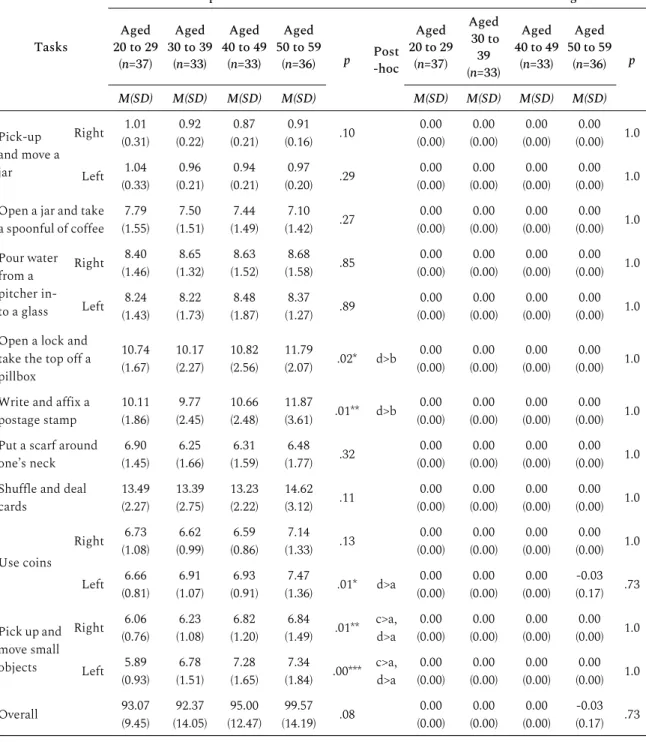
The result of the overall speed of execution did not show a statistically significant difference among groups. However, four tasks showed a significant difference among the groups. 50s group’s speed of execution was slower than that of the 30s group in ‘open a lock and take the top off a pillbox’ and ‘write and affix a postage stamp’ tasks (p<.05). They were also slower than the 20s group’s speed of execution in ‘use coins - left’ task (p<.05). Moreover, the 40s and 50s groups’ speed of execution were slower than the 20s group in ‘pick up and move small objects’
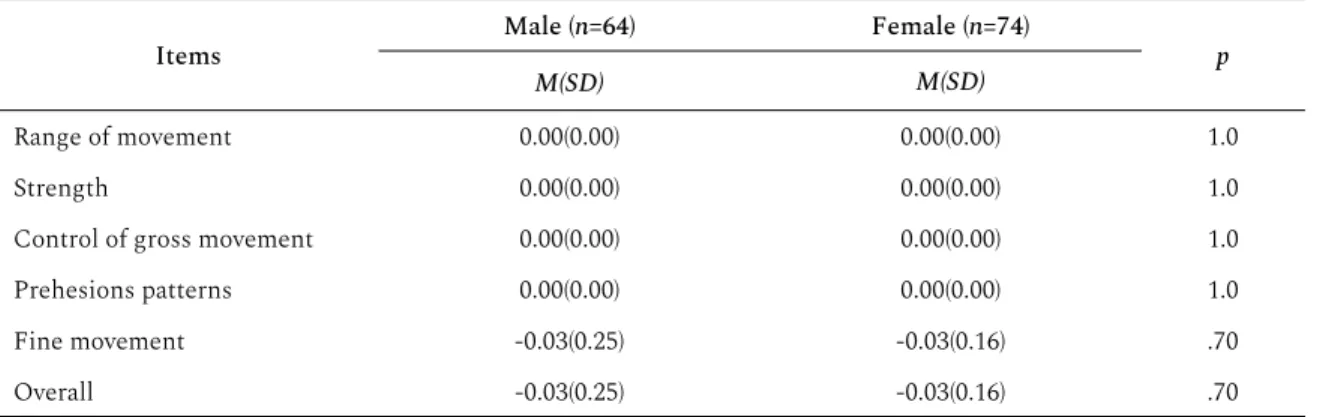
task (p<.001). On the other hand, there were no statistically significant difference among the groups in functional rating and task analysis (Table 2).
3. Characteristic of hand function between genders
There was no difference in overall speed of ex- ecution between genders, however the result of each tasks showed that the speed of execution of females was faster than males. Females were faster in three tasks which were: ‘pour water
from a pitcher into a glass – left’ (p<.05), ‘use coins – left’ (p<.05), and ‘pick up and move small objects’ (p<.01 in right, p<.05 in left). However,
there was no statistically significant difference between genders in both functional rating and task analysis (Table 3).
Tasks
Speed of execution Functional rating
Aged 20 to 29
(n=37)
Aged 30 to 39
(n=33)
Aged 40 to 49
(n=33)
Aged 50 to 59
(n=36) p Post -hoc
Aged 20 to 29
(n=37)
Aged 30 to (n=33)39
Aged 40 to 49
(n=33)
Aged 50 to 59
(n=36) p
M(SD) M(SD) M(SD) M(SD) M(SD) M(SD) M(SD) M(SD)
Pick-up and move a jar
Right 1.01
(0.31) 0.92
(0.22) 0.87
(0.21) 0.91
(0.16) .10 0.00
(0.00) 0.00
(0.00) 0.00
(0.00) 0.00 (0.00) 1.0 Left 1.04
(0.33) 0.96
(0.21) 0.94
(0.21) 0.97
(0.20) .29 0.00
(0.00) 0.00
(0.00) 0.00
(0.00) 0.00 (0.00) 1.0 Open a jar and take
a spoonful of coffee 7.79
(1.55) 7.50
(1.51) 7.44
(1.49) 7.10
(1.42) .27 0.00
(0.00) 0.00
(0.00) 0.00
(0.00) 0.00 (0.00) 1.0 Pour water
from a pitcher in- to a glass
Right 8.40
(1.46) 8.65
(1.32) 8.63
(1.52) 8.68
(1.58) .85 0.00
(0.00) 0.00
(0.00) 0.00
(0.00) 0.00 (0.00) 1.0 Left 8.24
(1.43) 8.22
(1.73) 8.48
(1.87) 8.37
(1.27) .89 0.00
(0.00) 0.00
(0.00) 0.00
(0.00) 0.00 (0.00) 1.0 Open a lock and
take the top off a pillbox
10.74
(1.67) 10.17
(2.27) 10.82
(2.56) 11.79
(2.07) .02* d>b 0.00
(0.00) 0.00
(0.00) 0.00
(0.00) 0.00 (0.00) 1.0 Write and affix a
postage stamp 10.11
(1.86) 9.77
(2.45) 10.66
(2.48) 11.87
(3.61) .01** d>b 0.00
(0.00) 0.00
(0.00) 0.00
(0.00) 0.00 (0.00) 1.0 Put a scarf around
one’s neck 6.90
(1.45) 6.25
(1.66) 6.31
(1.59) 6.48
(1.77) .32 0.00
(0.00) 0.00
(0.00) 0.00
(0.00) 0.00 (0.00) 1.0 Shuffle and deal
cards 13.49
(2.27) 13.39
(2.75) 13.23
(2.22) 14.62
(3.12) .11 0.00
(0.00) 0.00
(0.00) 0.00
(0.00) 0.00 (0.00) 1.0 Use coins
Right 6.73
(1.08) 6.62
(0.99) 6.59
(0.86) 7.14
(1.33) .13 0.00
(0.00) 0.00
(0.00) 0.00
(0.00) 0.00 (0.00) 1.0 Left 6.66
(0.81) 6.91
(1.07) 6.93
(0.91) 7.47
(1.36) .01* d>a 0.00
(0.00) 0.00
(0.00) 0.00
(0.00) -0.03 (0.17) .73 Pick up and
move small objects
Right 6.06
(0.76) 6.23
(1.08) 6.82
(1.20) 6.84
(1.49) .01** c>a, d>a 0.00
(0.00) 0.00
(0.00) 0.00
(0.00) 0.00 (0.00) 1.0 Left 5.89
(0.93) 6.78
(1.51) 7.28
(1.65) 7.34
(1.84) .00*** c>a, d>a 0.00
(0.00) 0.00
(0.00) 0.00
(0.00) 0.00 (0.00) 1.0
Overall 93.07
(9.45) 92.37
(14.05) 95.00
(12.47) 99.57
(14.19) .08 0.00
(0.00) 0.00
(0.00) 0.00
(0.00) -0.03 (0.17) .73
Table 2. Comparison of TEMPA results among age groups (N=138)
Tasks
Speed of execution Functional rating
Male (n=64) Female (n=74)
p Male (n=64) Female (n=74)
M(SD) M(SD) M(SD) M(SD) p
Pick-up and move a jar
Right 0.90(0.25) 0.96(0.22) .18 0.00(0.00) 0.00(0.00) 1.0
Left 0.94(0.24) 1.01(0.25) .08 0.00(0.00) 0.00(0.00) 1.0
Open a jar and take a spoonful
of coffee 7.67(1.39) 7.27(1.57) .12 0.00(0.00) 0.00(0.00) 1.0
Pour water from a pitcher into a glass
Right 8.78(1.58) 8.41(1.34) .14 0.00(0.00) 0.00(0.00) 1.0
Left 8.67(1.66) 8.03(1.42) .02* 0.00(0.00) 0.00(0.00) 1.0
Open a lock and take the top off
a pillbox 10.87(2.10) 10.92(2.31) .88 0.00(0.00) 0.00(0.00) 1.0
Write and affix a postage stamp 11.00(3.16) 10.28(2.36) .13 0.00(0.00) 0.00(0.00) 1.0 Put a scarf around one’s neck 6.68(1.76) 6.34(1.49) .22 0.00(0.00) 0.00(0.00) 1.0
Shuffle and deal cards 6.68(2.70) 6.34(2.56) .06 0.00(0.00) 0.00(0.00) 1.0
Use coins Right 6.96(1.11) 6.62(1.07) .07 0.00(0.00) 0.00(0.00) 1.0
Left 7.20(1.20) 6.82(0.97) .04* 0.00(0.00) -0.01(0.12) 1.0
Pick up and move small objects
Right 6.84(1.26) 6.17(1.05) .00** 0.00(0.00) 0.00(0.00) 1.0
Left 7.18(1.65) 6.47(1.51) .01* 0.00(0.00) 0.00(0.00) 1.0
Overall 96.93(13.84) 93.42(11.72) .11 0.00(0.00) -0.01(0.12) 1.0
Table 3. Comparison of TEMPA results between genders (N=138)
Task analysis Items
Aged 20 to 29
(n=37) Aged 30 to 39
(n=33) Aged 40 to 49
(n=33) Aged 50 to 59
(n=36) p
M(SD) M(SD) M(SD) M(SD)
Range of movement 0.00(0.00) 0.00(0.00) 0.00(0.00) 0.00(0.00) 1.0
Strength 0.00(0.00) 0.00(0.00) 0.00(0.00) 0.00(0.00) 1.0
Control of gross movement 0.00(0.00) 0.00(0.00) 0.00(0.00) 0.00(0.00) 1.0
Prehensions patterns 0.00(0.00) 0.00(0.00) 0.00(0.00) 0.00(0.00) 1.0
Fine movement -0.03(0.16) 0.00(0.00) 0.00(0.00) -0.03(0.37) .96
Overall -0.03(0.16) 0.00(0.00) 0.00(0.00) -0.03(0.37) .96
*p<.05, **p<.01, ***p<.001, a: aged 20 to 29, b: aged 30 to 39, c: aged 40 to 49, d: aged 50 to 59
4. Hand and pinch strength
Both male and female groups did not show
differences in hand and pinch strength among age groups except for lateral pinch-right item between 20s and 40s female groups (Table 4).
Task analysis
Items Male (n=64) Female (n=74)
M(SD) M(SD) p
Range of movement 0.00(0.00) 0.00(0.00) 1.0
Strength 0.00(0.00) 0.00(0.00) 1.0
Control of gross movement 0.00(0.00) 0.00(0.00) 1.0
Prehesions patterns 0.00(0.00) 0.00(0.00) 1.0
Fine movement -0.03(0.25) -0.03(0.16) .70
Overall -0.03(0.25) -0.03(0.16) .70
*p<.05, **p<.01
Tasks
Male Female
Aged 20 to 29
(n=15)
Aged 30 to 39
(n=17)
Aged 40 to 49
(n=16)
Aged 50 to59
(n=16) p
Aged 20 to 29
(n=22)
Aged 30 to 39
(n=16)
Aged 40 to 49
(n=16)
Aged 50 to 59
(n=20) p Post- KG hoc
(SD) KG
(SD) KG
(SD) KG
(SD) KG
(SD) KG
(SD) KG
(SD) KG
(SD)
Palmar grasp
Right 42.44
(9.20) 43.84
(8.81) 46.15
(7.07) 44.65
(10.21) .59 22.90
(5.29) 26.21
(7.04) 27.58
(5.87) 24.2 (4.93) .11
Left 40.78
(10.05) 42.14
(8.34) 44.15
(5.40) 42.50
(9.51) .72 22.73
(5.30) 24.75
(6.33) 26.25
(6.83) 22.73 (4.89) .38 Lateral
pinch
Right 22.73
(3.17) 22.61
(3.54) 23.42
(3.31) 21.83
(2.31) .43 14.44
(2.26) 15.27
(2.67) 16.33
(2.31) 14.67
(2.37) .03* c>a
Left 21.47
(3.76) 22.51
(2.92) 23.15
(3.45) 21.85
(2.32) .57 14.08
(1.95) 14.23
(2.72) 14.50
(2.25) 13.33 (2.45) .27 Tripod
pinch
Right 17.96
(4.12) 18.61
(4.48) 20.79
(4.41) 16.82
(3.30) .20 12.58
(2.90) 14.00
(3.87) 14.46
(2.73) 12.97 (2.54) .18
Left 16.96
(4.24) 18.55
(4.17) 19.94
(3.57) 19.06
(3.25) .36 12.55
(2.72) 13.42
(3.50) 13.46
(2.51) 12.57 (3.01) .65 Tippinch
Right 12.58
(3.45) 13.73
(3.05) 14.71
(3.27) 12.34
(4.27) .15 9.41
(2.26) 10.38
(3.86) 10.67
(2.26) 10.32 (2.59) .43
Left 13.11
(3.80) 13.76
(2.26) 15.52
(3.07) 14.96
(3.22) .10 9.33
(2.39) 10.19
(3.49) 10.48
(2.49) 10.20 (2.56) .43
*p<.05, a: aged 20 to 29, b: aged 30 to 39, c: aged 40 to 49, d: aged 50 to 59
Table 4. Comparison of hand strength among age groups and between genders (N=138)
IV. Discussion
The purpose of this study was establishing normative data of Korean TEMPA as well as identifying the characteristics of hand function and strength by age and gender based on the col- lected data from the adult population. The result that there was no difference in overall speed and qualitative movement among adult groups co- heres with the former studies (Chae & Lee, 1997).
However, during a few specific tasks, the 40s and 50s groups showed a declined speed of ex- ecution than the 20s and 30s groups. This closely observed result may indicate that the decline in hand function starts from the 40s or 50s al- though the overall speed of execution seems to maintain throughout the 40s and 50s group.
As the sign of decline in hand function seems apparent from the 40s group, occupational ther- apy practitioners can provide education such as joint protection techniques to middle-aged adult population. Through the joint protection techniques the adults will learn to use bigger joints and muscles instead of small joint and muscles. This type of education program will de- crease the risk of or delay development of degen- erative disorders or conditions (e.g. osteo- arthritis or rheumatoid arthritis), which affect hand function, and keep maintaining their max- imum hand function as long as possible (Stamm et al., 2002).
Between genders, there was no significant dif- ference in the overall speed of execution, func- tional rating, and task analysis scores, although some of the tasks’ results presented that females’
speed of execution was faster than males’. This
result was similar with the previous study, which reported that there was statistically a significant difference between genders, but the result can- not draw a general conclusion. (Jebsen et al., 1969).
Nonetheless, contrary to the speed and qual- itative movement results, hand and pinch strength, except right lateral pinch strength in the 40s, is well maintained until the 50s. While the results of change in hand and pinch strength by age were not statistically significant, the hand and pinch strength tended to increase until the 40s and slightly decrease after the 50s. The result has discrepancy with the previous studies which reported that, generally, hand strength peaks in 30s and started decreasing after 40s (Kim, Jeon, Kim, Jeong, & Koo, 2018; Massy-Westropp, Gill, Taylor, Bohannon, & Hill, 2011). However, there is also another study, which fairly coheres with our findings, reporting that hand strength peaks at age 35 to 45 (Werle et al, 2009). In addition, when we compared the results with the norma- tive data of hand strength for Korean pop- ulation, the magnitude of difference (0.2% to 8.6%) were acceptable in size (Kim et al., 2018).
Therefore, the results of this study is still accept- able and meaningful.
The limitation of this study was that we used continuous sampling for recruiting participants.
Due to the non-probability sampling we could not control factors such as the education level, the occupation, or body mass index (BMI) of the test subjects, which can affect a person’s hand functions(LaCroix, Guralnik, Berkman, Wallace,
& Satterfield, 1993; Russo et al., 2006; Werle et al., 2009).
V. Conclusion
This study has significance in establishing norms of TEMPA Korean version for the adult population. With this data we hope more Korean researchers and occupational therapy practi- tioners use TEMPA in research and during intervention. Furthermore, through the research we found the characteristics of hand function and strength among adults. According to these findings, occupational therapy practitioners need to consider and provide education pro- grams to middle-aged adults with slight signs of declined hand function to prevent degenerative disorders and conditions which can affect their hand functions.
References
Bellace, J. V., Healy, D., Besser, M. P., Byron, T., &
Hohman, L. (2000). Validity of the Dexter Evaluation System's Jamar dynamometer attachment for assess- ment of hand grip strength in a normal population.
Journal of Hand Therapy, 13(1), 46-51. Doi:
10.1016/S0894-1130(00)80052-6
Chae, K., & Lee, H. S. (1997). Assessment of Upper Extremity Function in Normal Korean Adults by Manual Function Test. Journal of Korean Society of Occupational Therapy, 5(1), 52-57.
Desrosiers, J., Hébert, R., Dutil, E., & Bravo, G. (1993).
Development and reliability of an upper extremity function test for the elderly: The TEMPA. Canadian Journal of Occupational Therapy, 60(1), 9-16.
Incel, N. A., Sezgin, M., As, I., Cimen, O. B., & Sahin, G.
(2009). The geriatric hand: correlation of hand-muscle function and activity restriction in elderly.
International Journal of Rehabilitation Research, 32(3), 213-218.doi: 10.1097/MRR.0b013e3283298226 Jebsen, R. H., Taylor, N., Trieschmann, R., Trotter, M., &
Howard, L. (1969). An objective and standardized test of hand function. Archives of Physical Medicine and Rehabilitation, 50(6), 311.
Kim, C. R., Jeon, Y. J., Kim, M. C., Jeong, T., & Koo, W. R.
(2018). Reference values for hand grip strength in the South Korean population. PloS one, 13(4), e0195485.
Doi: 10.1371/journal.pone.0195485
LaCroix, A. Z., Guralnik, J. M., Berkman, L. F., Wallace, R. B., & Satterfield, S. (1993). Maintaining mobility in late life. II. Smoking, alcohol consumption, physical activity, and body mass index. American Journal of Epidemiology, 137(8), 858-869. Doi:
10.1093/oxfordjournals.aje.a116747
Lee, C. D. (2015). A Study on Validity and Reliability of Upper extremity performance test for elderly (TEMPA).
(Master thesis), Yonsei University, Seoul. Retrieved from http://www.riss.kr/link?id=T13873411
Lemmens, R. J., Timmermans, A. A., Janssen-Potten, Y.
J., Smeets, R. J., & Seelen, H. A. (2012). Valid and reli- able instruments for arm-hand assessment at ICF ac- tivity level in persons with hemiplegia: A systematic review. BioMed Central Neurology, 12(1), 21. Doi:
10.1186/1471-2377-12-21
Massy-Westropp, N. M., Gill, T. K., Taylor, A. W., Bohannon, R. W., & Hill, C. L. (2011). Hand grip strength: Age and gender stratified normative data in a population-based study. BMC research notes, 4(1), 127. Doi: 10.1186/1756-0500-4-127
Regardt, M. (2014). Hand function, activity limitation and health-related quality of life in patients with poly- myositis and dermatomyositis. Inst för neurobiologi, vårdvetenskap och samhälle/Dept of Neurobiology, Care Sciences and Society.
Russo, A., Onder, G., Cesari, M., Zamboni, V., Barillaro, C., Capoluongo, E., ... & Landi, F. (2006). Lifetime oc- cupation and physical function: A prospective cohort study on persons aged 80 years and older living in a community. Occupational and Environmental Medicine, 63(7), 438-442. Doi:
10.1136/oem.2006.027623
Stamm, T. A., Machold, K. P., Smolen, J. S., Fischer, S., Redlich, K., Graninger, W., ... & Erlacher, L. (2002).
Joint protection and home hand exercises improve hand function in patients with hand osteoarthritis: A randomized controlled trial. Arthritis Care &
Research, 47(1), 44-49. Doi: 10.1002/art1.10246
Werle, S., Goldhahn, J., Drerup, S., Simmen, B. R., Sprott, H., & Herren, D. B. (2009). Age-and gender-specific normative data of grip and pinch strength in a healthy
adult Swiss population. Journal of Hand Surgery (European Volume), 34(1), 76-84. Doi:
10.1177/1753193408096763
국문초록
한국 성인의 TEMPA 표준치, 손기능과 근력에 관한 연구
이창대*, 정민예**, 박지혁**, 김종배**
*New York University
**연세대학교 보건과학대학 작업치료학과
목적 : 본 연구의 목적은 한국 성인의Upper extremity performance test for elderly (TEMPA) 표준치
를 제시하고, 수집된 자료를 바탕으로 성인의 손 기능의 특성과 근력의 차이를 연령별, 성별로 알아
보는 것이다.
연구방법 : 연구에 참여한 대상자는 20세에서 59세 사이의 손 기능에 장애가 없는 성인 138명이었다.
손 기능의 특성과 근력을 평가하기 위하여 모든 대상자에게 TEMPA, Jarmar dynamometer, pinch gauge를 시행하였다.
결과 : 성인의 손 기능에는 연령별, 성별 차이가 통계적으로 유의미한 차이를 보이지는 않았지만, 40대 와 50대에서 수행 속도가 감소하는 경향을 보였다. 성인의 근력은 40대에서 가장 높은 수준의 근력
을 보였으며 50대에서 감소하는 경향을 보였지만 대부분의 결과에서 유의미한 차이는 없었다.
결론 : 작업치료사는 중년 성인의 손기능과 근력에서 나타나는 감소의 전조 증상에 대한 관심과 그 기
능 수준을 유지하기 위한 교육 프로그램을 제공하는 것이 필요할 것이다. 본 연구를 통해 한국 성인
의 TEMPA 표준치가 확립되었다. 이 표준치가 임상적 평가 및 근거 기반연구에 있어 유용한 자료가 되기를 기대한다.
주제어 : 성인, 손 근력, 손 기능, 표준치, TEMPA
Tasks
Male Female
Aged 20 to 29
(n=15)
Aged 30 to 39
(n=17)
Aged 40 to 49
(n=16)
Aged 50 to 59
(n=16)
Aged 20 to 29
(n=22)
Aged 30 to 39
(n=16)
Aged 40 to 49
(n=16)
50 to 59Aged (n=20)
M(SD) M(SD) M(SD) M(SD) M(SD) M(SD) M(SD) M(SD)
Pick-up and move a jar
Right 1.01
(0.37) 0.87
(0.17) 0.83
(0.25) 0.90
(0.13) 1.01
(0.27) 0.97
(0.26) 0.92
(0.16) 0.92
(0.19) Left 1.01
(0.31) 0.93
(0.19) 0.90
(0.27) 0.92
(0.17) 1.07
(0.34) 0.99
(0.22) 0.98
(0.12) 1.00
(0.22) Open a jar and take
a spoonful of coffee 8.13
(1.43) 7.56
(1.35) 7.54
(1.61) 7.48
(1.19) 7.56
(1.62) 7.43
(1.71) 7.33
(1.41) 6.79
(1.55) Pour water
from a pitcher in- to a glass
Right 8.50
(1.80) 8.90
(1.47) 8.75
(1.74) 8.96
(1.40) 8.33
(1.21) 8.39
(1.12) 8.50
(1.31) 8.45
(1.70)
Left 8.17
(1.39) 8.49
(1.73) 8.91
(2.07) 9.09
(1.33) 8.28
(1.49) 7.94
(1.73) 8.06
(1.59) 7.80
(0.88) Open a lock and
take the top off a pillbox
10.81
(1.43) 9.87
(1.95) 10.67
(2.29) 12.17
(2.10) 10.69
(1.85) 10.48
(2.60) 10.96
(2.88) 11.49 (2.05) Write and affix a
postage stamp 10.04
(1.74) 10.16
(2.11) 11.29
(2.97) 12.50
(4.63) 10.17
(1.98) 9.36
(2.77) 10.03
(1.74) 11.37 (2.55) Put a scarf around
one’s neck 7.04
(1.48) 6.58
(1.81) 6.59
(1.67) 6.54
(2.12) 6.81
(1.45) 5.90
(1.45) 6.03
(1.51) 6.43
(1.49) Shuffle and deal
cards 13.30
(1.98) 13.04
(1.76) 12.76
(2.61) 13.88
(4.03) 13.62
(2.49) 13.77
(3.54) 13.70
(1.70) 15.22 (2.08) Use coins
Right 7.15
(0.93) 6.84
(1.06) 6.63
(0.91) 7.25
(1.44) 6.45
(1.10) 6.39
(0.88) 6.54
(0.83) 7.05
(1.27)
Left 6.97
(0.80) 7.11
(1.15) 7.00
(1.00) 7.70
(1.62) 6.44
(0.76) 6.70
(0.97) 6.87
(0.84) 7.28
(1.12) Pick up
and move small ob- jects
Right 6.17
(0.89) 6.63
(1.10) 7.05
(1.24) 7.49
(1.46) 5.99
(0.66) 5.80
(0.90) 6.60
(1.15) 6.31
(1.32)
Left 6.30
(0.94) 7.21
(1.66) 7.16
(1.56) 8.01
(1.93) 5.60
(0.83) 6.32
(1.21) 7.41
(1.78) 6.80
(1.62)
Overall 94.60
(9.10) 94.19
(12.80) 96.08
(14.20) 102.88
(17.28) 92.02
(9.75) 90.45
(15.45) 93.92
(10.82) 96.92 (10.89)
Appendix A
Normative Data of Speed of execution for Korean adult population