Vascular Neurology 2010;2:37-41
ISSN 2092-6855
서 론
외상성 뇌손상(traumatic brain injury, TBI)으로 인한 비정상적인 근긴장도, 움직임의 비대칭성, 자세조절 장애는 보 행 및 일상생활의 동작 수행에도 영향을 미친다. 특히 보행은 독립적인 일상생활을 유지하기 위해 필수적인 요소이며, 이를 위해 여러 가지 재활치료가 시행되고 있다.
리듬청각자극(rhythmic auditory stimulation, RAS)은 음악의 여러 가지 요소 중, 리듬이 신체의 움직임에 영향을 줄 수 있다는 특성을 이용하여 보행훈련에 사용하는 신경학적 음악치료의 방법 중 하나이다.1 규칙적으로 제공되는 청각 자극인 리듬은 대상자의 보행패턴과, 속도에 따라 개별화 해 적용하여, 환자의 보행패턴과 속도 등을 일정하고 규칙 적으로 유도해 환자가 가진 능력을 최대한 효율적으로 이용
할 수 있도록 한다.1 Thaut 등1,2은 외부적인 청각자극이 내 부의 청각 신경계를 자극하여, 근육운동을 조절하는 추체외 로계에 영향을 주어 청각자극과 근육의 움직임이 동조화 (entrainment)되어 신체의 움직임을 보다 효율적으로 조절 하고 움직일 수 있게 해 준다고 제안하였다. 이러한 이론은 신경학적 손상으로 인하여 내부의 리듬신호가 정상적으로 이루어지지 않을 때 외부적인 리듬신호를 제공하여 신체의 움직임이 원활해 질 수 있도록 할 것이라는 이론적 근거를 제시하였고, 실험연구를 통해 뇌졸중,3,4 파킨슨병,4,5 뇌성 마비6,7 등의 중추신경계 질환에서 효과적인 것으로 보고되 었다.
외상성 뇌손상 환자의 경우에도 Hurt 등8의 연구에서 분 속수(cadence), 활보장(stride length), 보행대칭성이 증가 됨을 나타내었다. 그러나 기존 연구에서는 시공간적 지표 변
Therapeutic Effects of Gait Training with Rhythmic Auditory Stimulation in Traumatic Brain Injury
Soo-Ji Kim,1 Eunmi Emily Kwak,1 Soo-Jin Oh,1 Sung-Rae Cho2
1
Department of Music Therapy, Myongii University, Seoul, Korea
2
Department and Research Institute of Rehabilitation Medicine, Yonsei University College of Medicine, Seoul, Korea
외상성 뇌손상 환자에서 리듬청각자극을 통한 보행훈련 효과
명지대학교 음악치료학과,
1연세대학교 의과대학 재활의학교실 및 재활의학연구소
2김수지1·곽은미1·오수진1·조성래2
Received August 14, 2010 Revised August 28, 2010 Accepted September 2, 2010 Correspondence Sung-Rae Cho, MD, PhD Department and Research Institute of Rehabilitation Medicine, Yonsei University College of Medicine, 250 Seongsan-ro, Seodaemun-gu, Seoul 120-752, Korea
Tel +82-2-2228-3715 Fax +82-2-363-2795 E-mail [email protected]
Objectiveaa This study is to evaluate therapeutic effects of gait training with rhythmic auditory stimulation (RAS) on kinematic gait patterns as well as temporospatial data in traumatic brain in- jury (TBI).
Methodsaa The participant walked 10 m at comfortable walking speed. Temporospatial data and kinematic parameters of gait were analyzed before and after gait training with RAS. During 4 weeks, 3 times a week, RAS was provided using a combination of a metronome beat set to the in- dividual’s cadence and rhythmic cueing from a live keyboard, played by music therapists.
Resultsaa Gait analysis revealed that gait training with RAS improved cadence, walking speed, step length, and stride length. In addition, excessive pelvic anterior tilt and pelvic obliquity during a gait cycle was ameliorated after gait training with RAS.
Conclusionsaa Gait training with RAS resulted in an improvement in the temporospatial data as
well as kinematic pattern of pelvic movement in TBI. Vascular Neurology 2010;2:37-41
Key Wordsaa Rhythmic auditory stimulation, Gait training, Traumatic brain injury, Kinematics.
화를 중점으로 다루었으며, 보행패턴을 나타내는 운동형상 학적 지표를 보이지 않았다. 따라서 본 연구에서는 리듬청각 자극을 통한 보행훈련 후 객관적으로 운동형상학적 지표상 의 변화가 나타나는지 살펴보고자 하였다.
대상 및 방법
대 상
대상자는 외상성 뇌손상으로 진단되고, 실내에서 최소 10 m 거리의 독립보행이 가능한 실내보행자(household ambulator)이었다. 제공된 음악의 빠르기는 1회기부터 3회 기까지 분속수 55로, 4회기부터 8회기까지는 분속수 60으로, 그리고 9·10회기에는 분속수 65로 하여 총 10회기의 리듬청 각자극을 통한 보행훈련을 실시하였다.
방 법
대상자의 시공간적 지표와 운동형상학적 지표의 변화는 VICON 370 Motion Analysis System(Oxford Metrics Inc., Oxford U.K.)으로 측정하였다. VICON 370 Motion Analysis System은 6개의 적외선 카메라로 구성되어 있는 동작분석 시스템이다. 측정을 위해 대상자의 천골, 양측 골반, 양측 대퇴, 양측 슬관절, 양측 경골, 양측 족관절, 그리고 양 측 전족부와 후족부에 총 15개의 수동 표식자를 부착한 상태 에서 7 m의 구간을 보행하여 측정하였다. 사전평가와 사후평 가는 동일하게 실시하였고, 한 회기의 리듬청각자극 보행훈 련 시간은 30분으로, 총 4주간 주 3회 리듬청각자극 보행훈 련이 진행되었다. 리듬청각자극 보행훈련은 7 m의 직선구 간과 20 m의 타원형 구간이 확보된 독립적인 공간에서 진 행되었다. 한 회기시 리듬청각자극 보행훈련 시간은 총 30분 으로, 훈련 전 1~2분간 리듬청각자극 보행훈련에 사용되는 음악을 들으며 보행훈련을 준비할 수 있도록 하였고, 리듬 청각자극 보행훈련 후 1~2분은 호흡하며 대상자의 상태를 점검하는 것으로 마무리하였다. 리듬청각자극 보행훈련시 사용된 음악은 대상자의 분속수에 따라 다르게 적용하였다.
분속수가 정상 범주에서 현저히 느리거나, 빠를 경우 4/4박 자로 구성된 8마디의 음악을 반복적으로 사용하였다. 또한 대상자가 선호하는 노래 중 4/4 박자로 구성되고, 분속수 가 유사한 곡을 선택하여 후렴구를 반복하여 사용하였다.
곡의 빠르기에 따라 대상자의 분속수에 관계없이 보행 속도 가 곡의 빠르기를 따라가려는 성향이 있기 때문에, 선호곡 사용시 곡의 빠르기와 대상자의 분속수 간의 차이를 5% 내 외로 유지하였다. 또한 보행훈련기 동안 정상범주 분속수에 근접하기 위해 제공하는 음악의 빠르기를 지속적으로 5%
내외로 증가시켜 제공하였다.
VICON 370 Motion Analysis System에서 측정된 시공 간 지표와 운동형상학적 지표에서 골반, 고관절, 슬관절 및 족관절의 움직임을 분석하였다. 시공간 지표의 각 항목은 전 후의 변화를 백분율로 나타내었고, 운동형상학적 지표의 각 관절의 움직임은 그래프로 나타내었다. 이 그래프에는 회 색으로 이루어진 정상보행의 범주와 대상자 각 관절의 움직 임 표식이 함께 나타나는데, 이것을 기준으로 리듬청각자극 보행훈련 후 대상자의 보행패턴에 어떠한 변화를 나타내었 는지 분석하였다.
결 과
시공간적 지표
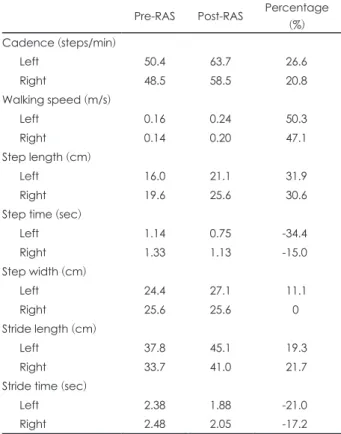
분속수는 좌측이 50.4 steps/min에서 63.7 steps/min로 증가하였으며, 우측이 48.5 steps/min에서 58.5 steps/min 로 향상되었다. 보행속도(walking speed)는 좌측이 0.16 m/s에서 0.24 m/s로 증가하였으며, 우측이 0.14 m/s에서 0.20 m/s로 향상되었다. 또한 보장(step length)은 좌측이 16.0 cm에서 21.1 cm로, 우측이 19.6 cm에서 25.6 cm로 증 가하였다. 보장시간(step time)은 좌측이 1.14 sec에서 0.75
Table 1. Temporospatial data after gait training with RAS in TBI Pre-RAS Post-RAS Percentage
(%) Cadence (steps/min)
Left 50.4 63.7 26.6
Right 48.5 58.5 20.8
Walking speed (m/s)
Left 0.16 0.24 50.3
Right 0.14 0.20 47.1
Step length (cm)
Left 16.0 21.1 31.9
Right 19.6 25.6 30.6
Step time (sec)
Left 1.14 0.75 -34.4
Right 1.33 1.13 -15.0
Step width (cm)
Left 24.4 27.1 11.1
Right 25.6 25.6 0
Stride length (cm)
Left 37.8 45.1 19.3
Right 33.7 41.0 21.7
Stride time (sec)
Left 2.38 1.88 -21.0
Right 2.48 2.05 -17.2
RAS: rhythmic auditory stimulation, TBI: traumatic brain injury.
sec로, 우측이 1.33 sec에서 1.13 sec로 감소하였다. 활보 장은 좌측이 37.8 cm에서 45.1 cm로, 우측은 33.7 cm에서 41.0 cm로 증가하였고, 활보장시간(stride time)은 좌측이 2.38 sec에서 1.88 sec로, 우측이 2.48 sec에서 2.05 sec로 감소하였다(Table 1).
운동형상학적 지표
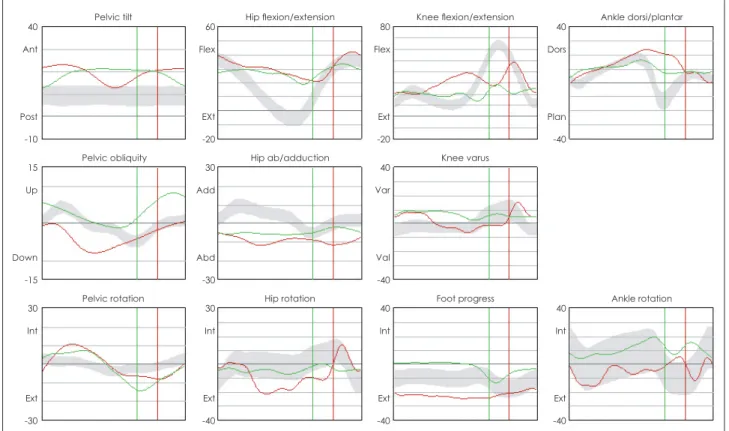
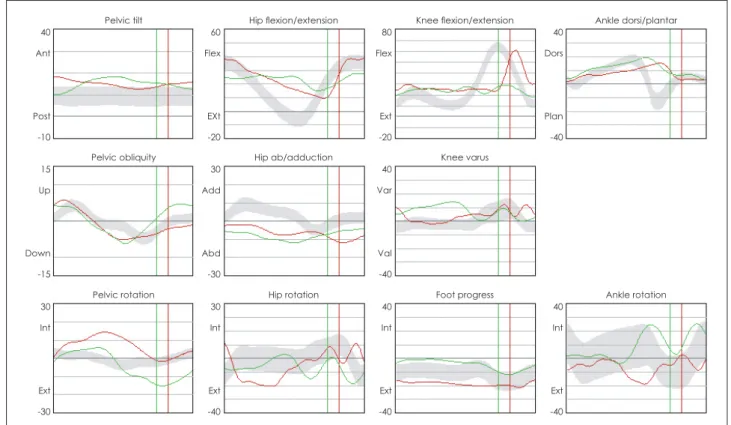
골반부 시상면(sagittal plane)에서 골반 전방경사(anterior tilt)는 치료 전(Fig. 1) 정상범주보다 과도하게 증가되어 있었으 나, 치료 후(Fig. 2) 전방경사가 감소하여 완만한 곡선을 이루고 있는 소견을 보였다. 또한 골반부 관상면(coronal plane)에서는 치료 전(Fig. 1) 우측이 upward obliquity, 좌측이 downward obliquity된 비대칭 소견이 치료 후(Fig. 2) 정상범주와 유사한 형태로 비대칭성이 감소된 소견을 보였다. 고관절 시상면에서 고관절 굴곡 각도는 치료 전(Fig. 1) 좌우측 모두 입각기에서 정상범주에서 벗어나 굴곡되어 있지만, 치료 후(Fig. 2) 좌측 고관절의 움직임은 사전평가보다 굴곡이 감소되는 경향을 나타내었다. 한편 슬관절 시상면에서 유각기 슬관절 굴곡은 치료 전(Fig. 1) 좌우측 모두 정상적인 굴곡을 보이지 못했으 나, 치료 후(Fig. 2) 좌측의 경우 유각기시 정상범주와 유사한 가동범위를 보였다. 그러나 족관절 시상면에서 치료 전후 모두 전입각기에서 정상적인 족관절 족저굴곡(plantar flexion) 소
견을 보이지 않았다.
고 찰
리듬청각자극 보행훈련 후 대상자는 시공간 지표 중 분속 수, 보행속도, 보장, 활보장에서 공통적으로 증가된 것으로 나타났고, 보장시간과 활보장 시간은 감소하는 것으로 나타 났다. 이는 Hurt 등8의 선행연구와 동일하게 분속수, 보행 속도, 보장, 활보장의 증가가 나타나 리듬청각자극 보행훈련 이 외상성 뇌손상 환자의 재활에 긍정적인 영향을 미치는 것으로 분석된다.
운동형상학적 지표에서는 시상면의 골반 전방경사, 고관절 각도, 슬관절 각도, 족관절 각도의 움직임의 변화 정도를 나 타내었다. 대상자는 보행훈련 후 모든 관절의 움직임이 정상 범주의 형상과 유사한 형태를 나타내지는 않았으나, 치료 전 과도하게 전방으로 향해 있던 골반 전방 경사도의 경우 치료 후 정상범주에 근접하려는 경향성을 보였다. 리듬청각자극 훈 련 후 관절의 움직임이 정상범주의 형상으로 근접해가는 양 상의 경우 보행 패턴 및 효율성에서 긍정적인 영향을 미치는 것으로 생각된다.
즉, 최초 몇 번의 청각자극 반복은 자극의 정보를 처리하기 위해 피질을 통과해 청각 정보가 전달되지만, 같은 반복이 연
Pelvic tilt
Pelvic obliquity
Pelvic rotation
Knee flexion/extension
Knee varus
Foot progress
Ankle dorsi/plantar
Ankle rotation Hip flexion/extension
Hip ab/adduction
Hip rotation 40
Ant
Post -10
15 Up
Down -15
30 Int
Ext -30
80 Flex
Ext -20
40 Var
Val -40
40 Int
Ext -40
40 Dors
Plan -40
40 Int
Ext -40 60
Flex
EXt -20
30 Add
Abd -30
30 Int
Ext -40
Figure 1. Kinematic data before gait training with RAS in TBI. RAS: rhythmic auditory stimulation, TBI: traumatic brain injury.
속적이고 규칙적인 청각자극은 피질을 통과하지 않고, 피질 하 영역에서 정보가 처리되며, 뇌간 내에 망상구조(reticulo- spinal tract)로 전달되어 대뇌피질을 거치지 않고 척수 운동 계의 신경세포를 통해 신체의 움직임을 유도하는 것으로 추 정된다.9
본 연구는 외상성 뇌손상 대상자에게 4주간 리듬청각자극 보행훈련을 실시하여 시공간적 지표와 운동형상학적 지표에 어떠한 변화를 나타냈는지를 확인하여 다음과 같은 결론을 도출하였다. 첫째, 리듬청각자극 보행훈련 후 대상자는 시공 간적 지표 항목 중 분속수, 보행속도, 보행시간, 보장, 활보 장의 증가를 나타내었다. 둘째, 운동형상적 지표에서 특히 골반부의 움직임이 정상범주의 형상과 근접해가는 경향성 을 나타내었다. 이러한 리듬청각자극 보행훈련의 효과는 보행장애가 있는 여러 신경계 질환 대상군에게 적용하여 기 본적인 재활치료와 더불어 또 다른 치료영역으로 방향을 제시할 수 있다.3-10
결 론
외상성 뇌손상 환자에게 리듬청각자극을 통한 보행훈련을 실시하여 시공간적 지표 뿐만 아니라 운동형상학적 지표에서 향상된 소견을 보였다. 따라서 리듬청각자극을 이용한 보행
훈련은 향후 외상성 뇌손상 환자에서 보행 패턴 및 효율성을 향상시키기 위한 치료법이 될 수 있을 것으로 사료된다.
Acknowledgments
Supported by grants from the National Research Foundation (2010- 332-B00407), Stem Cell Research Center of the 21st Century Frontier Re- search Program (SC-4160), and Development projects leading stem cell researchers (7-2010-0487), funded by the Ministry of Science and Tech- nology, Republic of Korea.
REFERENCES
1. Thaut MH, Abiru M. Rhythmic auditory stimulation in rehabilitation of movement disorders: a review of current research. Music Percep- tion 2010;27:263-269.
2. Thaut MH, Miller RA, Schauer LM. Multiple synchronization strate- gies in rhythmic sensorimotor tasks: phase vs period correction. Biol Cybern 1998;79:241-250.
3. Thaut MH, Leins AK, Rice RR, Argstatter H, Kenyon GP, McIntosh GC, et al. Rhythmic auditory stimulation improves gait more than NDT/Bobath training in near-ambulatory patients early poststroke: a single-blind, randomized trial. Neurorehabil Neural Repair 2007;
21:455-459.
4. McIntosh GC, Thaut MH, Rice RR. Rhythmic auditory stimulation as entrainment and therapy technique in gait of stroke and Parkinson’s disease patients. Music Medicine 1996;2:145-152.
5. Hausdorff JM, Lowenthal J, Herman T, Gruendlinger L, Peretz C, Gi- ladi N. Rhythmic auditory stimulation modulates gait variability in Parkinson’s disease. Eur J Neurosci 2007;26:2369-2375.
6. Kwak EE. Effect of rhythmic auditory stimulation on gait perfor- mance in children with spastic cerebral palsy. J Music Ther 2007;44:
198-216.
Pelvic tilt Hip flexion/extension Knee flexion/extension Ankle dorsi/plantar
Pelvic obliquity Hip ab/adduction Knee varus
Pelvic rotation Hip rotation Foot progress Ankle rotation
40 Ant
Post -10
60 Flex
EXt -20
80 Flex
Ext -20
40 Dors
Plan -40
15 Up
Down -15
30 Add
Abd -30
40 Var
Val -40
30 Int
Ext -30
30 Int
Ext -40
40 Int
Ext -40
40 Int
Ext -40