Infection &
Chemotherapy
근육주사 후 발생한 Mycobacterium abscessus 피부연조직 감염:
증례보고
김민규
1· 성열보
1· 김백남
2인제대학교 의과대학 정형외과학교실1 , 내과학교실2
Case Report
Submitted: June 15, 2011 Revised: October 13, 2011 Accepted: October 18, 2011 Correspondence to Yerl-Bo Sung, M.D.
Department of Orthopedic Surgery, Inje University Sanggye Paik Hospital, Sanggye 7-dong, Nowon-gu, Seoul 139-707, Korea
Tel: +82-2-950-1032, Fax: +82-2-934-6342 E-mail: [email protected]
http://dx.doi.org/10.3947/ic.2012.44.2.67 Infect Chemother 2012;44(2):67-70 pISSN 2093-2340 eISSN 2092-6448
www.icjournal.org
Skin and Soft Tissue Infection Caused by Mycobacterium abscessus Developed after Intramuscular Injection: A
Case Report
Mycobacterium abscessus is a rapidly-growing bacterium which spreads everywhere in the natural world. Lung infection is the most common infection that it causes, but skin and soft tissue infections can occur after injections, operations, or other trauma. We report a case of subcutaneous infection caused by M. abscessus followed by an intra- muscular injection.
Key Words:
Mycobacterium abscessus, Skin and soft tissue infection, Intramuscular injection, ClarithromycinMinkyu Kim1, Yerl-Bo Sung1, and Baek-Nam Kim2
Departments of 1Orthopedic Surgery and 2Internal Medi- cine, Inje University College of Medicine, Busan, Korea
서론
Mycobacterium abscessus는 Runyon group 제 IV형에 속하는 신속발육균(rapid grower)으로 습지대, 강, 토양 등의 자연계 어디에서나 발견된다[1]. 1953년 Moore와 Freriches에 의해 인체감염이 처음으로 보고되었다. M. abscessus 감염은 일반적으 로 후천성면역결핍증, 당뇨병자, 신장이식, 혈액투석, 낭성섬유증 등이 있는 면역저하 환자에서 발생하기 쉬우며, 폐에 가장 흔히 발생하나 최근 피부연조직 감염 보고가 증 가하고 있다[2]. M. abscessus에 의한 피부연조직감염은 건강한 사람에서 접종이나 수술, 외상 후 피부나 연부조직을 침범하여 국소적인 병변을 나타내나 면역저하환자에 서는 파종성 피부감염을 일으키거나 내부장기를 침범하여 치명적인 결과를 초래할 수 도 있다[3]. M. abscessus에 의한 피부연조직감염은 팔과 다리 등과 같이 노출된 부위 에 흔히 발생한다[4]. M. abscessus에 의한 피부연조직감염은 국내에서 Lee 등에 의 해 경피내시경하 위루술 후 발생한 창상감염이 1997년 처음[5] 보고된 이래, 2000년대 부터 보고가 늘고 있으며 최근에는 근육주사나 침을 맞은 후 집단발생도 보고되었다 [6-8]. 저자들은 근육주사 후 발생한 M. abscessus 연조직감염 1례를 국내문헌 고찰 과 함께 보고한다.
This is an Open Access article distributed under the terms of the Creative Commons Attribution Non-Commercial License (http://creativecommons.
org/licenses/by-nc/3.0) which permits unrestricted non-commercial use, distribution, and reproduction in any medium, provided the original work is properly cited.
Copyright © 2012 by The Korean Society of Infectious Diseases | Korean Society for Chemotherapy
68
MK Kim, et al. • Mycobacterium Abscessus Skin and Soft Tissue Infectionwww.icjournal.org
증례
54세 여성이 10일 전 왼쪽 엉덩이에 생긴 국소 열감을 동반한 종창이 점점 커져 입원하였다. 4년 전 제3, 4, 5요추의 척추전방전위증을 동반 한 척추관협착으로 후방감압술과 후방고정술을 받았는데, 수술 후 인 접한 척추분절의 퇴행성 변화로 4개월 전부터 왼쪽 엉덩이에 통증을 느 끼기 시작하여 통증이 심해진 6주 전부터 2주 동안 한의원에서 매일 엉 덩이와 허리에 침을 맞았다. 호전이 없어 4주 전 개인의원에서 1주 간격 으로 2회 왼쪽 엉덩이에 소염진통제 근육주사를 맞았다. 10일 전부터 는 근육주사를 맞은 부위를 중심으로 종창이 생기더니 점점 커졌다. 체 온은 36.7℃이었으며 왼쪽 엉덩이 상외측에 발적을 동반한 종창이 관찰 되었고 압통이 있었다. 골반 자기공명영상에서 왼쪽 대둔근 상외측과 인접한 피하조직에 9×6×9.5 cm 크기의 불규칙한 소엽의 다발성 격막 이 있는 피하농양이 관찰되었다(Fig. 1). 말초혈액 백혈구 치는 11,240/
mm3, ESR 34 mm/h, CRP 1.6 mg/dL이었다.
경피적 흡인술로 치즈 색 고름을 확인한 후 절개배농술을 시행하였 다. 비정형미코박테륨 감염을 의심하여 수술 직후부터 clarithromycin (500 mg 하루 2회 복용)과 amikacin (500 mg 하루 2회 매주 3회 주사) 으로 경험적 항생제치료를 시작하였다. 일반세균배양과 혐기균배양검 사 결과는 음성이었으나 항산성간균 염색에서 항산균이 관찰되었다.
수술 후 7일째 비정형미코박테륨 중합효소연쇄반응 검사(서울대학교 의과대학 미생물학교실에 의뢰) 결과 M. abscessus로 확인되었다. 수술 후 17일째 clarithromycin만 유지하기로 하고 퇴원하였다.
수술 후 1개월 째 봉합부에 농양이 남아 있어 다시 절개배농술을 시 행하였으며 당시 입원한 10일 동안 clarithromycin과 amikacin을 같이 투여하였다. 수술 후 2개월 째 수술부위 주위 발적과 장액성 분비물이 관찰되어 clarithromycin에 doxycycline (100 mg 하루 2회 복용)을 추 가하였다. 수술 후 4개월 째 자기공명영상에서 왼쪽 엉덩이 피하조직에 선상의 주변부 증강은 감소하였으며 초기 병변이 없어졌음을 확인하였 다. Clarithromycin은 총 7개월 doxycycline은 총 5개월 복용하고 항생 제치료를 끝냈다. 항생제치료 종료 후 1년 동안 이상소견은 발견되지 않
았다.
고찰
M. abscessus 피부연조직감염은 오염된 강, 호수, 바다, 토양 등에 접 촉하는 동안 외상이나 개방성 상처 및 치료기구를 통해 비정형미코박 테륨이 침입하여 4-6주의 잠복기 후 발병한다[1]. 감염부위는 침입하 는 경로에 따라 다양하며, 침을 맞은 후 발생한 집단감염에서는 하지에 서 가장 흔하였고 그 다음으로 상지와 몸통의 순이었다[4]. M. abscessus 에 의한 피부연조직감염은 홍반성 결절, 농양, 궤양 등의 다양한 병변으 로 나타난다[9]. M. abscessus 피부연조직감염은 병리조직학적으로 숙주의 면역상태에 따라 급성 화농성 병변에서 결핵양형 육아종성 병 변에 이르기까지 다양하며 같은 조직 내에서도 두 가지 이상의 병리소 견이 나타날 수 있다[10].
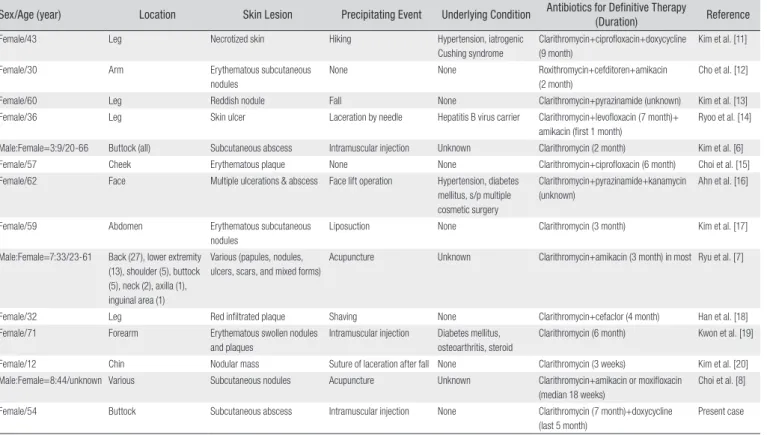
의학문헌데이터베이스 Koreamed와 PubMed를 이용하여 국내문헌 을 검색한 결과 M. abscessus 피부연조직감염은 이 증례 포함하여 국내 에서 115례가 보고되었다(Table 1). 국내 M. abscessus 피부연조직감 염의 85%에서는 여성에서 발생하였다. 유발요인이 없는 2례와 외상 후 발생한 3례를 제외하고, 이 증례와 마찬가지로, 모두 처치나 시술과 연 관이 있었다. 소수 환자에게서 당뇨병(2례), 의인쿠싱증후군(1례) 등의 기저질환이 있었다. 피부병변은 감염 경로에 따라 다양하였으나 홍반성 소결절이나 농양이 비교적 흔하였다. 모든 환자가 macrolide계 항생제 (roxithromycin 2례, clarithromycin 113례)를 바탕으로 한 약제로 치 료받았다. 최근에는 국내에서 집단발생한 경우도 3례 보고되었는데[6- 8], 모두 1차 의료기관에서 근육주사나 침을 맞고 발생하였다. 이 증례 에서는 소염진통제를 근육주사하는 과정에서 원인미생물이 주입되었 을 것으로 추정된다.
M. abscessus는 표준적인 1차항결핵제에 내성을 나타낸다. 외국의 보고에 따르면 M. abscessus에 amikacin, cefoxitin, clarithromycin 은 높은 감수성을 나타내나 ciprofloxacin과 doxycycline은 내성을 보 인다[21]. 국내에서 분리된 M. abscessus에 대한 약제감수성은 거의
A B
Figure. 1. Magnetic resonance image of the lesion. (A) T1 weighted axial view with Gadolinium enhance
ment and (B) T2 weighted sagittal view. An irregular, lobulated and multiseptated enhancing lesion with surrounding soft tissue signal change in the subcutaneous layer is seen in the left buttock and adjacent gluteus muscles.
http://dx.doi.org/10.3947/ic.2011.44.2.67 • Infect Chemother 2011;44(2):67-70
69
www.icjournal.org
알려지지 않았다. 호흡기검체에서 분리된 M. abscessus 74균주에 대 하여 amikacin (99%)과 cefoxitin (99%)은 거의 모두 감수성을 보였 으며 경구용 약제 중에서는 clarithromycin이 가장 높은 감수성(91%) 을 나타냈으나 ciprofloxacin과 moxifloxacin은 중등도 감수성(각 각 57%, 73%)을 보였으며 doxycyline은 감수성이 거의 없었다(7%) [22]. 집단발생 환자 12명의 피부연조직에서 수집된 균주는 amikacin 과 clarithromycin, 그리고 linezolid에 모두 감수성을 보였고 92%
는 ciprofloxacin에 중등도 이상의 내성을 보였으나 doxycycline과 sulfamethoxazole에는 모두 내성이었다[8]. 이 환자의 분리 균주를 대 상으로 대한결핵협회 결핵연구원에서 약제감수성검사를 시행하였으 나 당시 비정형미코박테륨도 통상적인 결핵균의 약제감수성을 검사 하였고 비정형미코박테륨에 대한 약제감수성검사(CLSI지침에 따른) 는 결핵연구원이 2009년 12월 시작하였기 때문에 실제로는 이 환자의 M. abscessus에 대한 정확한 약제감수성을 확인하지는 못하였다. 국 내보고를 바탕으로 추정하자면 수술 후 2개월째 발적과 분비물이 있 어 경험적으로 추가한 doxycycline은 내성일 가능성이 있어 실제로는 clarithromycin으로 단독치료한 것과 다름 없다고 본다.
경증 M. abscessus 피부연조직감염의 치료는 clarithromycin과 같 은 macrolide계 항생제를 근간으로 한다[21]. 중증 감염의 경우에는 초 기 2주 이상 정주용 항생제를 병합하며 이보다 더 심한 감염에는 clari- thromycin과 함께 초기 2-6주 동안 amikacin+cefoxitin이나 imipenem 과 같은 정주용 항생제를 같이 투여한다[21]. M. abscessus 피부연조직 감염에서 약제 투여기간은 아직 확립되지 않았으나 중증도에 따라 3-6 개월이 권장되고 있다[23]. 국내에서 침을 맞고 집단발생한 52례를 대상
으로 한 관찰연구에서 Choi 등은 clarithromycin과 amikacin 병합요 법에 비해 clarithromycin과 moxifloxacin 병합요법으로 피부병변이 더 빨리 없어졌다고(중앙값 20주 vs. 17주, P=0.017) 보고하였다[8]. 치 료제가 10-36주(중앙값 18주) 투여된 것을 바탕으로 저자들은 3개월 투여기간은 충분하지 않다고 하였다.
결론적으로 우리나라에서 발생한 M. abscessus 피부연조직감염 사 례는 모두 의료기관에서 시행되는 침습적 처치나 시술과 연관 있었다.
이러한 비정형미코박테륨의 침범을 예방하기 위해서는 감염예방원칙 을 준수하려는 의료진의 세심한 주의가 필요하다.
References
1. Sastry V, Brennan PJ. Cutaneous infections with rapidly growing mycobacteria. Clin Dermatol 1995;13:266-71.
2. Medjahed H, Gaillard JL, Reyrat JM. Mycobacterium abscessus: a new player in the mycobacterial field. Trends Microbiol 2010;18:117-23.
3. Wagner D, Young LS. Nontuberculous mycobacterial infec- tions: a clinical review. Infection 2004;32:257-70.
4. Tang P, Walsh S, Murray C, Alterman C, Varia M, Broukhanski G, Chedore P, DeKoven J, Assaad D, Gold WL, Ghazarian D, Finkelstein M, Pritchard M, Yaffe B, Jamieson F, Henry B, Phillips E. Outbreak of acupuncture-associated cutaneous Mycobacterium abscessus infections. J Cutan Med Surg 2006;
Table 1. Summary of Cases of Skin and Soft Tissue Infection Caused by
M. abscessus Reported in KoreaSex/Age (year) Location Skin Lesion Precipitating Event Underlying Condition Antibiotics for Definitive Therapy
(Duration) Reference
Female/43 Leg Necrotized skin Hiking Hypertension, iatrogenic
Cushing syndrome
Clarithromycin+ciprofloxacin+doxycycline (9 month)
Kim et al. [11]
Female/30 Arm Erythematous subcutaneous
nodules
None None Roxithromycin+cefditoren+amikacin
(2 month)
Cho et al. [12]
Female/60 Leg Reddish nodule Fall None Clarithromycin+pyrazinamide (unknown) Kim et al. [13]
Female/36 Leg Skin ulcer Laceration by needle Hepatitis B virus carrier Clarithromycin+levofloxacin (7 month)+
amikacin (first 1 month)
Ryoo et al. [14]
Male:Female=3:9/2066 Buttock (all) Subcutaneous abscess Intramuscular injection Unknown Clarithromycin (2 month) Kim et al. [6]
Female/57 Cheek Erythematous plaque None None Clarithromycin+ciprofloxacin (6 month) Choi et al. [15]
Female/62 Face Multiple ulcerations & abscess Face lift operation Hypertension, diabetes mellitus, s/p multiple cosmetic surgery
Clarithromycin+pyrazinamide+kanamycin (unknown)
Ahn et al. [16]
Female/59 Abdomen Erythematous subcutaneous
nodules
Liposuction None Clarithromycin (3 month) Kim et al. [17]
Male:Female=7:33/2361 Back (27), lower extremity (13), shoulder (5), buttock (5), neck (2), axilla (1), inguinal area (1)
Various (papules, nodules, ulcers, scars, and mixed forms)
Acupuncture Unknown Clarithromycin+amikacin (3 month) in most Ryu et al. [7]
Female/32 Leg Red infiltrated plaque Shaving None Clarithromycin+cefaclor (4 month) Han et al. [18]
Female/71 Forearm Erythematous swollen nodules
and plaques
Intramuscular injection Diabetes mellitus, osteoarthritis, steroid
Clarithromycin (6 month) Kwon et al. [19]
Female/12 Chin Nodular mass Suture of laceration after fall None Clarithromycin (3 weeks) Kim et al. [20]
Male:Female=8:44/unknown Various Subcutaneous nodules Acupuncture Unknown Clarithromycin+amikacin or moxifloxacin
(median 18 weeks)
Choi et al. [8]
Female/54 Buttock Subcutaneous abscess Intramuscular injection None Clarithromycin (7 month)+doxycycline
(last 5 month)
Present case
70
MK Kim, et al. • Mycobacterium Abscessus Skin and Soft Tissue Infectionwww.icjournal.org
10:166-9.
5. Lee SH, Kim KY, Hong SP, Kim MJ, Yang MH, Seou JT. A Mycobacterium chelonae subsp. abscessus wound infection after percutaneous endoscopic gastrostomy. Korean J Med 1997;53:842-6.
6. Kim HS, Park HJ, Lee JY, Cho BK. Twelve cases of cutaneous infection by Mycobacterium abscessus: review on its treatment modality. Korean J Dermatol 2005;43:1603-9.
7. Ryu HJ, Kim WJ, Oh CH, Song HJ. Iatrogenic Mycobacterium abscessus infection associated with acupuncture: clinical manifestations and its treatment. Int J Dermatol 2005;44:846- 50.
8. Choi WS, Kim MJ, Park DW, Son SW, Yoon YK, Song T, Bae SM, Sohn JW, Cheong HJ, Kim MJ. Clarithromycin and amikacin vs. clarithromycin and moxifloxacin for the treatment of post- acupuncture cutaneous infections due to Mycobacterium abscessus: a prospective observational study. Clin Microbiol Infect 2011;17:1084-90.
9. Escalonilla P, Esteban J, Soriano ML, Fariña MC, Piqu E, Grilli R, Ramírez JR, Barat A, Martín L, Requena L. Cutaneous manifestations of infection by nontuberculous mycobacteria.
Clin Exp Dermatol 1998;23:214-21.
10. Rodríguez G, Ortegón M, Camargo D, Orozco LC. Iatrogenic Mycobacterium abscessus infection: histopathology of 71 patients. Br J Dermatol 1997;137:214-8.
11. Kim YS, Hong IC, Kim CK, Kim SW, Kim S, Peck KR, Kim BJ, Kook YH, Song JH. A case of skin and soft tissue infection caused by Mycobacterium abscessus. Korean J Infect Dis 2000;32:64-8.
12. Cho JH, Kim MY, Park YM, Kim HO. A case of cutaneous infection due to Mycobacterium abscessus. Korean J Der- matol 2004;42:512-5.
13. Kim JH, Choe WH, Kang JO, Choi TY. Five cases of Myco- bacterium abscessus. Korean J Clin Microbiol 2004;7:84-9.
14. Ryoo NH, Lee WM, Ha JS, Jeon DS, Kim JR, Sohn DG, Kim SW.
A case of skin and soft tissue infection by Mycobacterium abscessus. Korean J Clin Microbiol 2005;8:198-201.
15. Choi YL, Lee KJ, Lee DY, Lee ES. A case of skin infection caused by Mycobacterium abscessus. Korean J Dermatol 2005;43:852-5.
16. Ahn HC, Baik EH, Oh JK, Sung KY. Facial skin tuberculosis by Mycobacterium abscessus. J Korean Soc Plast Reconstr Surg 2006;33:127-30.
17. Kim JE, Park HJ, Lee JY, Cho BK. Atypical Mycobacterial soft tissue infection after autologous fat transplantation at liposuction site. Korean J Dermatol 2006;44:871-3.
18. Han YJ, Choi HY, Myung KB, Choi YW. A case of cutaneous Mycobacterium abscessus infection. Korean J Dermatol 2008;46:1657-60.
19. Kwon YH, Lee GY, Kim WS, Kim KJ. A case of skin and soft tissue infection caused by Mycobacterium abscessus. Ann Dermatol (Seoul) 2009;21:84-7.
20. Kim HR, Kim DW. Soft tissue infection with Mycobacterium abscessus on the chin of a healthy child: A case report. J Korean Soc Plast Reconstr Surg 2010;37:289-92.
21. Brown-Elliott B, Wallace RJ. Clinical and taxonomic status of pathogenic nonpigmented or late-pigmenting rapidly grow- ing mycobacteria. Clin Microbiol Rev 2002;15:716-46.
22. Park S, Kim S, Park E, Kim H, Kwon O, Chang C, Lew W, Park Y, Koh W. In vitro antimicrobial susceptibility of Mycobac- terium abscessus in Korea. J Korean Med Sci 2008;23:49-52.
23. De Groote M, Huitt G. Infections due to rapidly growing mycobacteria. Clin Infect Dis 2006;42:1756-63.