Orofacial pain is a common complaint in the medical and dental setting.1 This includes complaints of headaches, jaw pain, ear fullness, and clicking sounds in and around the temporomandibular joint(TMJ). A majority of these unclear pain symptoms are commonly associated with a diagnosis of temporomandibular disorder(TMD).1 More concerning is that treatment options may be provided without conclusively identifying the primary underlying cause. Typically, recalcitrant orofacial pain cases are even
tually referred to an oral medicine specialist for further evaluation, diagnosis, and management. Eventually it may take several months from the time of the initial complaint for the definitive diagnosis to be established.
Pain in the orofacial region can be potentially caused by infections, trauma, TMJ arthralgia, TMJ articular disc disorder, myofascial pain, psychiatric disorders, atypical facial pain, otalgic pain, and cancer, including hemato
logic and solid tumors.2 The ease of attributing orofacial
pain to the TMJ may be why tumors can initially be con
sidered unlikely in the differential diagnosis until the pain becomes intractable.3 Additionally, the initial use without success of conservative therapeutic management approa
ches such as physical therapy, analgesics, and muscle re
laxants then alerts the clinician to consider the possibility of tumorassociated pain. This is even more the case in the absence of swelling, ulceration, or peripheral lymph
adenopathy.
Several case reports have shown that head and neck cancers and metastatic cancer to the head and neck region can present with pain that closely mimics TMD.1,4 Some of these findings were later diagnosed as nasopharyngeal carcinoma, oral cancer, adenocystic carcinoma, or oro
pharyngeal carcinoma.2,4,5 Due to the anatomical location of the oropharynx and adjacent structures, it is not an area easily visualized by the patient. Furthermore, tumors in this area are painless at an early stage. Therefore, it is not unusual for an oropharyngeal tumor to eventually be detected either incidentally during diagnostic imaging or when surrounding structures are invaded, causing dyspha
gia, dysphonia, otalgia, or facial pain.
Magnetic resonance imaging(MRI) is an essential tool
Incidental finding of an extensive oropharyngeal mass in magnetic resonance imaging of a patient with temporomandibular disorder: A case report
Temitope T. Omolehinwa1, Mel Mupparapu1, Sunday O. Akintoye1,*
1Department of Oral Medicine, School of Dental Medicine, University of Pennsylvania, Philadelphia, PA, USA
AbstrAct
In this report, we describe the incidental finding of an oropharyngeal mass in a patient who presented with a chief complaint of temporomandibular pain. The patient was initially evaluated by an otorhinolaryngologist for complaints of headaches, earache, and sinus congestion. Due to worsening headaches and trismus, he was further referred for the management of temporomandibular disorder. The clinical evaluation was uneventful except for limited mouth opening(trismus). An advanced radiological evaluation using magnetic resonance imaging revealed a mass in the nasopharyngeal/oropharyngeal region. The mass occupied the masticatory space and extended superioinferiorly from the skull base to the mandible. A diagnostic biopsy of the lesion revealed a longstanding human papilloma virus(HPV16)positive squamous cell carcinoma of the oropharynx. This case illustrates the need for the timely radiological evaluation of seemingly innocuous orofacial pain.(Imaging Sci Dent 2016; 46: 285-90) Key words: Magnetic Resonance Imaging; Oropharyngeal Neoplasms; Human Papillomavirus 16; Facial Pain
Copyright ⓒ 2016 by Korean Academy of Oral and Maxillofacial Radiology
This is an Open Access article distributed under the terms of the Creative Commons Attribution NonCommercial License(http://creativecommons.org/licenses/bync/3.0) which permits unrestricted noncommercial use, distribution, and reproduction in any medium, provided the original work is properly cited.
Imaging Science in Dentistry·pISSN 22337822 eISSN 22337830 Received April 23, 2016; Revised July 27, 2016; Accepted August 11, 2016
*Correspondence to : Dr. Sunday O. Akintoye
Department of Oral Medicine, School of Dental Medicine, University of Pennsylva
nia, The Robert Schattner Center Room 211, 240 South 40th Street, Philadelphia, PA 19104, USA
Tel) 12158989932, Fax) 12155737853, Email) [email protected]
in diagnosing softtissue masses. MRI is more accurate than computed tomography(CT) in delineating between tumor masses and other soft tissues such as muscle, prob
ably because it has fewer artifacts.6
This report presents the case of an incidentally found oropharyngeal mass diagnosed with the aid of MRI in a patient referred for the management of TMD. It also un
derscores the importance of advanced imaging in the di
agnosis of unclear orofacial symptoms.
case report
A 67yearold Caucasian male presented to the Oral Medicine Clinic of the School of Dental Medicine, Uni
versity of Pennsylvania, with a history of pain in the left preauricular and facial regions and headaches for 1 year.
He also reported progressive trismus that had lasted for 4 months. He denied any form of trauma associated with the onset of facial pain. His pain was described as persis
tent dull aching pain aggravated with jaw function, espe
cially talking and mastication. He obtained minimal relief by taking 600mg Ibuprofen tablets.
The patient did not report any parafunctional habits or previous episodes of jaw lock, despite occasional nonten
der bilateral clicking of the TMJs. He had not experienced any previous facial numbness or tingling sensations, but had noticed increasing difficulty putting food in his mouth due to the limited opening of the mouth. This resulted in severe weight loss of 6 pounds within a 4week period.
He had recently changed to a liquid protein supplement diet at the time of presentation. Additionally, the patient also reported sinus problems and recurring ear infections of 3 months’ duration, with occasional bloodstained mu
cous discharge from the nose.
Interestingly, the patient had presented to his general dentist at the onset of his facial pain. It was attributed at that time to inflammation around the left maxillary third molar. After the tooth was extracted, he experienced pain relief for only 2 weeks. He was then referred to an oto
rhinolaryngologist due to the persistent ear pain. Based on a positive bacterial culture, he was treated with anti
biotics, but the pain relief only lasted for 3 weeks. The patient’s past medical history was positive for paranoid schizophrenia and bipolar disorder, managed by his pri
mary care physician with risperidone. He had smoked at least a pack of cigarettes daily for 40 years. His review of systems was positive for occasional epistaxis and weight loss, but his vital signs were within the normal limits.
The clinical examination revealed an anxious, cachexic
patient. Extraorally, no facial swellings or asymmetry was present, the head and neck lymph nodes were not palpa
ble, and an examination of cranial nerves IIXII showed results within the normal limits.
Intraorally, the Mallampati airway score was 4 and the maximum interincisal mouth opening with firm stop was 20mm. The modified Mallampati airway score includes class 0(ability to see any part of the epiglottis upon mouth opening), class 1(soft palate, fauces, uvula, and pillars visible), class 2(soft palate, fauces, and uvula visible), class 3(soft palate and base of the uvula visible), and class 4(soft palate not visible at all).7 Mild left TMJ pain was present, and a soft reciprocal click was observed on palpation. The mandible deviated to the right on opening.
The masticatory muscles were mild to moderately tender, but worse on the left side. Other intraoral examinations could not be completed due to the limited mouth opening.
At this point, internal derangement of the left TMJ, head
ache, and myofascial pain were considered in the differ
ential diagnosis, pending imaging studies.
An MRI scan of the bilateral temporomandibular joints (open and close) with T1 and T2weighted sagittal and coronal images was ordered to ascertain the cause of the trismus. His pain medication was changed to 15mg of meloxicam(Mobic®) daily pending the result of the MRI.
At a followup visit, the maximum interincisal opening had decreased to 15mm and the patient displayed more difficulty speaking clearly. He had also lost 6 additional pounds within a 4week period.
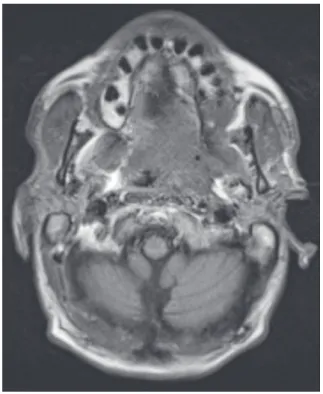
The MRI findings were consistent with the presence of a bulky mass with similar signal intensity to the adjacent structures in the left nasopharynx(Fig. 1), oropharynx, left soft palate, vomer, and inferior turbinate(Fig. 2). The mass had also expanded to the masticatory muscles(Figs.
35), and showed involvement of the masticator space ex
tending to the extramucosal spaces of the skull base(Fig.
6). In addition to soft tissue involvement, erosion of the left mandibular condyle and ramus was also noted(Figs.
7 and 8).
The differential diagnosis was expanded to include na
sopharyngeal carcinoma, squamous cell carcinoma, ex
tranodal Hodgkin lymphoma, nonHodgkin lymphoma, and adenocystic carcinoma. Also considered was naso
pharyngeal lymphoid hyperplasia, but this was less likely since the patient did not have a history of human immu
nodeficiency virus infection.
The patient was immediately referred to an ear, nose, and throat surgeon for evaluation and management of the bulky mass. Following tracheostomy, biopsies were ob
Fig. 1. T1weighted axial magnetic resonance imaging shows a mass in the left posterior wall of the nasopharynx, with deviation of the nasal septum to the right.
Fig. 3. T1weighted axial magnetic resonance imaging shows the extension of abnormal soft tissue to the left parapharyngeal space, with no separation from the left masticator space and muscles, specifically the pterygoid and masseter muscles. In addition, ex
tension of the mass to the skull base is present.
Fig. 2. T1weighted axial magnetic resonance imaging shows a mass in the left nasopharyngeal wall, left soft palate, vomer, and choana, and inseparable from the inferior turbinate.
Fig. 4. T1weighted axial magnetic resonance imaging shows evi
dence of erosion of the lingual cortex of the left mandibular ramus and presence of abnormal soft tissue in the left retromolar trigone.
tained by direct laryngoscopy. Additionally, esophagosco
py and open gastrotomy tube placement were carried out to rule out the spread of the mass to the esophagus and to
aid with feeding and nutrition, respectively. Histopathol
ogy of the left oropharynx revealed an in situ and inva
sive poorly differentiated squamous cell carcinoma, with
Fig. 5. Enhanced T1weighted axial magnetic resonance imaging
shows the presence of abnormal soft tissue in the left retromolar area. Fig. 7. T1weighted axial magnetic resonance imaging shows ero
sive changes on the superficial surface of the left condylar head.
Fig. 6. Nonenhanced T1weighted coronal magnetic resonance imaging shows the involvement of the pharyngeal area on the left side, with extension to the base of the brain.
Fig. 8. T1weighted coronal magnetic resonance imaging shows a discontinuity in the lingual cortex of the left mandibular ramus, signifying involvement.
lymphatic invasion. Immunostaining studies confirmed a p16positive human papilloma virus(HPV)infected car
cinoma. Positron emission tomographycomputed tomog
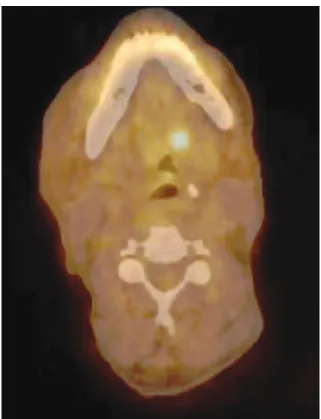
raphy(Fig. 9) revealed a hypermetabolic mass measuring 5.0×5.0×7.3cm, centered in the left nasooropharynx.
It also showed cortical destruction of the medial and lat
eral pterygoid plates and invasion of the left mandibular ramus and angle(maximum standardized uptake value, 19.4). No distant metastasis was observed, and the tumor was staged as IVb(T4bN2bM0). The patient was treated with a radiation dose of 6996cGy over 33 fractions(212 cGy/fraction) with concurrent cetuximab. The treatment was well tolerated, with no significant complications oth
er than xerostomia that persisted over 7 months of follow
up.
discussion
This report describes the incidental finding of an exten
sive oropharyngeal mass that extended from the orophar
ynx to the nasopharynx, mandible, masseter, and base of the skull. Diagnostic studies with MRI for the further evaluation of seemingly innocuous trismus and otalgia were highly instrumental in identifying the cause of the
patient’s protracted symptoms.
Oropharyngeal squamous cell carcinoma(OPSCC) is a cancer of epithelial origin with increasing incidence in recent years.8 It is known to be associated with HPV in 70% of cases.8 HPV is a DNA virus known to encode nu
merous oncogenes. The most commonly implicated HPV subtype is HPV16, which accounts for 90% of all HPV
positive OPSCCs. This subtype is associated with the overexpression of p16, a protein and byproduct of the in
hibitory expression of retinoblastoma(Rb) by E7(an early oncoprotein).9
OPSCC is common in middleaged Caucasian males in the fourth and fifth decades of life, as exemplified by this patient. It is more prevalent in nonsmokers, although smoking can increase the risk of OPSCC, as well as cer
tain sexual behaviors and the use of marijuana.3 The com
mon intraoral sites of presentation are either the base of the tongue or areas hidden within the tonsils. Interesting
ly, the base of the tongue was spared in this patient. Un
fortunately, OPSCC is often asymptomatic at early stages, and only becomes symptomatic as the tumor enlarges and invade adjacent structures. In some cases, otalgia may be the only presenting symptom.10
Histologic examination of biopsied HPV16 OPSCC tissue usually reveals poorly differentiated nonkeratinous epithelium at the basal layer with infiltration of lympho
cytes into the connective tissue. This is unlike HPVneg
ative OPSCC, which is well differentiated and kerati
nized.11,12
The treatment options for HPV16 OPSCC include sur
gery, radiation, and chemotherapy. The use of less toxic treatment options is often recommended in the manage
ment of HPV p16positive OPSCC because the patients are younger and display a better 5year survival rate than patients with HPVnegative OPSCC.13,14
As demonstrated in this patient, it is not uncommon for OPSCC to masquerade as TMD due to the unclear symp
toms of dull TMJ pain, trismus, deviation on jaw opening, headaches, earaches, and tender or nontender TMJ clicks and pain during mastication.1,5,15,16 Other possible symp
toms include sinusitis, ear infections, blocked hearing or absolute hearing loss, abnormal cranial nerve examination findings, and epistaxis or nasal obstruction, which further complicate the diagnosis without definitive diagnostic aids such as imaging.17,18
A review by Reiter et al. of patients with nasopharyn
geal carcinoma with TMDlike symptoms2 revealed that the most common presenting symptoms were trismus, ear involvement, and deviation of the mandible to the contral
Fig. 9. A positron emission tomographycomputed tomography image shows a hypermetabolic mass centered on the left nasooro
pharynx with involvement of the left ramus.
ateral side during mouth opening, as displayed by our pa
tient. The authors also attributed speech difficulty to tumor infiltration of the soft palate. The diagnosis of neoplasms presenting as TMD is still often missed in the early stages of the tumor. Therefore, it cannot be overemphasized that if a patient presents with symptoms incommensurate with the clinical findings,1,2 it is imperative to request addition
al advanced radiographic imaging to rule out a neoplasm.
The possibility that the pain was caused by a lesion was initially missed by other healthcare providers previously contacted by the patient. This is a clear example of the ju
dicious use of advanced diagnostic imaging, specifically MRI, to make the definitive diagnosis of the cause of am
biguous protracted orofacial pain symptoms.
references
1. Grosskopf CC, Kuperstein AS, O’Malley BW Jr, Sollecito TP.
Parapharyngeal space tumors: another consideration for otal
gia and temporomandibular disorders. Head Neck 2013; 35:
E1536.
2. Reiter S, Gavish A, EmodiPerlman A, Eli I. Nasopharyngeal carcinoma mimicking a temporomandibular disorder: a case report. J Orofac Pain 2006; 20: 7481.
3. Lewis A, Kang R, Levine A, Maghami E. The new face of head and neck cancer: the HPV epidemic. Oncology(Williston Park) 2015; 29: 61626.
4. Omolehinwa TT, Musbah T, Desai B, O’Malley BW Jr, Stoopler ET. Neuralgia associated with transcutaneous elec
trical nerve stimulation therapy in a patient initially diagnosed with temporomandibular disorder. Oral Surg Oral Med Oral Pathol Oral Radiol 2015; 119: e1014.
5. SariRieger A, Hassfeld S, Junker K, Rustemeyer J. Adenoid cystic carcinoma of the skull base mimicking temporoman
dibular disorder. Oral Maxillofac Surg 2014; 18: 1158.
6. Schneider A, Forstner R. The value of MRI in imaging malig
nant head and neck tumours. Imaging Decis MRI 2007; 11:
310.
7. Lee A, Fan LT, Gin T, Karmakar MK, Ngan Kee WD. A sys
tematic review(metaanalysis) of the accuracy of the Malla
mpati tests to predict the difficult airway. Anesth Analg 2006;
102: 186778.
8. Chaturvedi AK, Engels EA, Pfeiffer RM, Hernandez BY, Xiao W, Kim E, et al. Human papillomavirus and rising oropharyn
geal cancer incidence in the United States. J Clin Oncol 2011;
29: 4294301.
9. Lewis JS Jr, Thorstad WL, Chernock RD, Haughey BH, Yip JH, Zhang Q, et al. p16 positive oropharyngeal squamous cell carcinoma: an entity with a favorable prognosis regardless of tumor HPV status. Am J Surg Pathol 2010; 34: 108896.
10. Chen RC, Khorsandi AS, Shatzkes DR, Holliday RA. The ra
diology of referred otalgia. AJNR Am J Neuroradiol 2009; 30:
181723.
11. Pitiyage G, Lei M, Guererro Urbano T, Odell E, Thavaraj S.
Biphenotypic human papillomavirusassociated head and neck squamous cell carcinoma: a report of two cases. Diagn Pathol 2015; 10: 97.
12. Hennessey PT, Westra WH, Califano JA. Human papilloma
virus and head and neck squamous cell carcinoma: recent evi
dence and clinical implications. J Dent Res 2009; 88: 3006.
13. Deschler DG, Richmon JD, Khariwala SS, Ferris RL, Wang MB. The “new” head and neck cancer patientyoung, non
smoker, nondrinker, and HPV positive: evaluation. Otolaryn
gol Head Neck Surg 2014; 151: 37580.
14. Lorincz BB, Jowett N, Knecht R. Decision management in transoral robotic surgery: indications, individual patient selec
tion, and role in the multidisciplinary treatment for head and neck cancer from a European perspective. Head Neck 2016;
38 Suppl 1: E21906.
15. Agulnik M, Epstein JB. Nasopharyngeal carcinoma: current management, future directions and dental implications. Oral Oncol 2008; 44: 61727.
16. Fischer DJ, Klasser GD, Epstein JB. Cancer and orofacial pain. Oral Maxillofac Surg Clin North Am 2008; 20: 287301.
17. Kamran SC, Riaz N, Lee N. Nasopharyngeal carcinoma. Surg Oncol Clin N Am 2015; 24: 54761.
18. Khan J, Quek SY, Markman S. Nasopharyngeal carcinoma masquerading as TMJ orofacial pain. Quintessence Int 2010;
41: 3879.