S Kumar, et al
352 Ann Dermatol
Received February 14, 2011, Revised September 1, 2011, Accepted for publication September 5, 2011
Corresponding author: Sumir Kumar, Department Of Dermatology, G.G.S Medical College, Faridkot 151203, India. Tel: 91-98887-07940, E-mail:
This is an Open Access article distributed under the terms of the Creative Commons Attribution Non-Commercial License (http://
creativecommons.org/licenses/by-nc/3.0) which permits unrestricted non-commercial use, distribution, and reproduction in any medium, provided the original work is properly cited.
Ann Dermatol Vol. 25, No. 3, 2013 http://dx.doi.org/10.5021/ad.2013.25.3.352
CASE REPORT
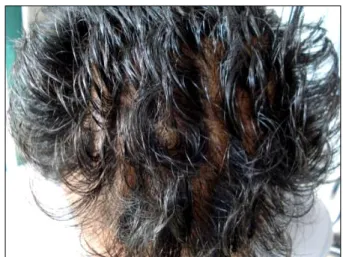
Fig. 1. Cutis verticis gyrata.
Touraine−Soulente-Golé Syndrome: A Rare Case Report and Review of the Literature
Sumir Kumar, Sandeep Sidhu, Bharat Bhushan Mahajan
Department of Dermatology, G.G.S Medical College and Hospital, Faridkot, India
Touraine–Soulente-Golé Syndrome (TSG) or pachydermo- periostosis is a rare disorder characterized by pachydermia, periostosis & digital clubbing. Herein, we report a case of a 27 year old male, with the looks of a 47 year old. He presented with excessive wrinkling on his face since past 8 years. TSG syndrome was suspected and examined by histo- pathological, endocrinological and radiological studies for the confirmation of clinical diagnosis. (Ann Dermatol 25(3) 352∼355, 2013)
-Keywords-
Hypertrophic osteoarthropathy, Pachydermoperiostosis, Tou- raine–soulente-golé syndrome
INTRODUCTION
Touraine−Soulente-Golé (TSG) Syndrome or primary hy- pertrophic osteoarthropathy (PHO) is a genodermatosis characterized by digital clubbing of hands and feet, en- largement of extremities, secondary to bones and peri- articular tissue proliferation. There is bilateral ptosis, leonine facies, and skin thickening along with joint pains.
It is PHO of a presumable autosomal dominant inheri- tance with mainly variable expression and incomplete penetrance. Although recessive autosomal inheritance and
x-linked mutations may also be present, these may differ in severity and prevalence of clinical features1. Secondary form of diseases can occur in association with other di- seases like Pulmonary: Bronchogenic carcinoma, naso- pharyngeal carcinoma, bronchiectasis, abscess, emphy- sema, metastasis, mesothelioma, cystic fibrosis; Cardiac:
Congenital heart disease, aortic or axillary artery graft rejection and gastrointestinal tract: Crohn’s disease, ulce- rative colitis, polyps, biliary atresia, biliary cirrhosis, biliary neoplasm and esophageal carcinoma2.
CASE REPORT
A 27-year-old male came with complaints of repetitive wrinkling and thickening of skin on face and scalp along with broadening of hands since 8 years ago. He also complained of increased oiliness on the face. This healthy Indian male with normal physique and intelligence level was the 1st son of non-consanguineous parents, his elder brother was 31. He has a 3 years old son and a 5 years old
Touraine−Soulente-Golé Syndrome
Vol. 25, No. 3, 2013 353 Fig. 3. Broadening of hands and fingers.
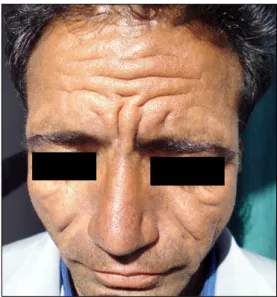
Fig. 2. Leonine faces.
Fig. 5. Histopathological examination showing hyperplasia epi- dermal and dermal changes (H&E, ×10).
Fig. 4. Periosteal reaction along the shaft.
daughter. Family history was unremarkable. History of joint pains, oral and genital ulceration, hoarseness of voice, epistaxis and sensory loss was denied. No similar history was found in the family. Physical examinations revealed scalp skin was folded, giving appearance of peculiarity cutis verticis gyrata (Fig. 1), whereas the hair growth appeared normal. Eyebrows appeared dense. Skin over face was thickened, non-pinchable, greasy to touch and folded, giving appearance of leonine faces (Fig. 2).
Follicular openings were prominent and so were the video-dermoscopy. In addition, clubbing of fingers and toes was presented along with broadening of hands and fingers (Fig. 3). Cutaneous examination over the rest of his
body including mucosae was normal. Laboratory inves- tigations included growth hormone assay, thyroid profile, and Venereal Diseases Research Laboratory Assay and were found to be within normal limits. Erythrocyte sedi- mentation rate was elevated (45 mm in 1st hour). Serum calcium, alkaline phosphatase and other biochemical tests were also within normal limits. Smears for lepra bacilli were negative. Radiological investigations included radio- graphs’ of skull, which were normal including sella tur- cica. Long bones of legs showed minimal periosteal reaction along the shaft (Fig. 4) and his feet showed evidence of cortical erosions and tufting ends of terminal phalanges. Histopathological examination from skin be-
S Kumar, et al
354 Ann Dermatol
hind ear lobule showed a hyperplastic epidermis and dermis (Fig. 5). On the basis of history, clinical features, radiological and lab findings, the diagnosis of TSG syn- drome was formulated.
DISCUSSION
TSG syndrome, which is a rare disease, precise incidence of which is not known, with approximately estimated prevalence 0.16%3. TSG syndrome accounts for 3∼5% of all cases of hypertrophic osteoarthropathy and occurs predominantly in men (80%), in which severe phenotype is observed4. Pathogenesis is not fully clear. Biopsy of skin and bone marrow may show an exacerbated proliferation of fibroblasts, which are associated with diffused epider- mal hyperplasia and lymphohistiocytic infiltration with collagen redistribution. Studies have shown a circulating connective tissue growth modulator, increase in plasmatic substances including osteocalcin, endothelin-1, β-trom- boglobulin, PDGF, v W factor, VEGF and dermal acid mucopolysaccharide of ground substance5,6. Increased ste- roid receptors concentration in these patients suggest an increase in tissue sensitivity to circulating sex hormones7. One study showed TSG syndrome mapped to band 4q33-q34 and mutation in HPGD, encoding 15-hydroxy- prostaglandin dehydrogenase, the main enzyme of pros- taglandin degradation8. The clinical condition typically begins in adolescence and manifest variably depending on the presentations. Touraine et al.9 described 3 forms of syndrome: Complete (pachydermia and periostitis), In- complete (with periostitis and no pachydermia), and For- me fruste (pachydermia with minimal or absent perios- titis). Characteristic cutaneous changes are pachydermia i.e. thickening of facial skins resulting in leonine faces, over scalp, cutis verticis gyrata, and over the eyes ble- phroptosis10. These changes give a characteristic known as
‘bull dog appearance’. Other influences are acne, eczema, seborrhea, palmoplanter hyperhydrosis, burning sensation of hands and feet, clubbing of fingers with or without paronychial thickening. Skeletal and radiological changes are symmetrical and irregular subperiosteal deposits in metaphysis and epiphysis of long bones especially in the forearm and leg, and small bones, widening ends of long bones especially wrist and knee, enlargement of distal part of digits with resorption of phalanges and acro-osteolysis, calcification of ligaments and interosseous membranes, cortical thickening with or without narrowing of me- dullary cavity, enlargement of paranasal sinuses4,11-13. There is joint effusion, inflammation and reduction of joint spaces, contractures in late stages and rarely periarticular erosion14. In axial skeleton, changes are spondylolithiasis,
with narrowing of intervertebral disc spaces and foramina, ligamentous ossification and laxity4. Differential diagnoses are secondary hypertrophic osteoarthropathy, thyroid acropachy, acromegaly, van Buchem’s disease, diaphyseal dysplasia and syphilitic periostitis. There is no specific treatment for the condition. Surgical management includes plastic surgery and correction of associated bony de- formities15-17. Medical treatment includes non-steroidal anti-inflammatory drugs (NSAIDs), corticosteroids, tri- cyclic antidepressants, resedronate, and pamidronate and tamoxifen citrate to control arthritis. Due to heterogeneity in transmission of TSG and difficulty of genetic tests, guidance to these patients is often complicated13. Such disease runs insidiously and chronically for about a decade with phases of exacerbations and asymptomatic periods stabilizing spontaneously13. Disabilities may be left-sided kyphosis, restricted motions and neurological complications which may occur later. However, it usually doesn’t interfere with patient’s life expectancy18.
Current clinical and radiological findings favor the 3rd type diagnosis, the forme fruste of TSG syndrome in our case. Other family members were also advised for clinico-radiological examinations. Patient was referred to plastic surgery department for the improvement of cosmetic appearance. As the condition is amenable to treatment, prognosis depends mostly upon the extent of joint involvements and periarticular periosteal thickening.
Detailed investigation and early diagnosis may help in prevention of disabilities later in life.
REFERENCES
1. Castori M, Sinibaldi L, Mingarelli R, Lachman RS, Rimoin DL, Dallapiccola B. Pachydermoperiostosis: an update. Clin Genet 2005;68:477-486.
2. Lowenthal MN, Tombak A, Lowenthal A. Secondary hyper- trophic osteoarthropathy (HOA) mimicking primary HOA (pachydermoperiostitis or Touraine-Solente-Golé) syndrome.
Isr Med Assoc J 2004;6:64.
3. Jajic I, Jajic Z. Prevalence of primary hypertrophic osteoar- thropathy in selected population. Clin Ex Rheum 1992;10:73.
4. Resnick D. Enostosis, hyperostosis, and periostitis: In:
Resnick D, Kransdorf MJ, editors. Bone and joint imaging.
3rd ed. Philadelphia, PA: Elsevier Saunders, 2005:1433- 1435.
5. Oikarinen A, Palatsi R, Kylmäniemi M, Keski-Oja J, Risteli J, Kallioinen M. Pachydermoperiostosis: analysis of the con- nective tissue abnormality in one family. J Am Acad Derma- tol 1994;31:947-953.
6. Silveira LH, Martínez-Lavín M, Pineda C, Fonseca MC, Navarro C, Nava A. Vascular endothelial growth factor and hypertrophic osteoarthropathy. Clin Exp Rheumatol 2000;
18:57-62.
Touraine−Soulente-Golé Syndrome
Vol. 25, No. 3, 2013 355 7. Bianchi L, Lubrano C, Carrozzo AM, Iraci S, Tomassoli M,
Spera G, et al. Pachydermoperiostosis: study of epidermal growth factor and steroid receptors. Br J Dermatol 1995;132:
128-133.
8. Uppal S, Diggle CP, Carr IM, Fishwick CW, Ahmed M, Ibrahim GH, et al. Mutations in 15-hydroxyprostaglandin dehydrogenase cause primary hypertrophic osteoarthropathy.
Nat Genet 2008;40:789-793.
9. Touraine A, Solente G, Gole L. Un syndrome osteodermo- pathique: la pachydermie plicaturee avec pachyperiostose ds extremites. Presse Med 1935;43:1820-1824.
10. Alves AP, Holanda Filha JG, Jerônimo FT. Eyelid ptosis associated with pachydermoperiostosis: case report. Arq Bras Oftalmol 2005;68:401-404.
11. Cooper RG, Freemont AJ, Riley M, Holt PJ, Anderson DC, Jayson MI. Bone abnormalities and severe arthritis in pachy- dermoperiostosis. Ann Rheum Dis 1992;51:416-419.
12. Hedayati H, Barmada R, Skosey JL. Acrolysis in pachy- dermoperiostosis. Primary or idiopathic hypertrophic oste- oarthropathy. Arch Intern Med 1980;140:1087-1088.
13. Jajic Z, Jajic I, Nemcic T. Primary hypertrophic osteoar- thropathy: clinical, radiologic, and scintigraphic characteris- tics. Arch Med Res 2001;32:136-142.
14. Schumacher HR Jr. Hypertrophic osteoarthropathy: rheuma- to logic manifestations. Clin Exp Rheumatol 1992;10 Suppl 7:35-40.
15. Seyhan T, Ozerdem OR, Aliagaoglu C. Severe complete pachydermoperiostosis (Touraine-Solente-Golé syndrome).
Dermatol Surg 2005;31:1465-1467.
16. George L, Sachithanandam K, Gupta A, Pulimood S. Frontal rhytidectomy as surgical treatment for pachydermoperiosto- sis: a case report. J Dermatolog Treat 2008;19:61-63.
17. Brüner S, Frerichs O, Raute-Kreinsen U, Fansa H. Correction of finger clubbing in primary hypertrophic osteoarthropathy (Touraine-Solente-Gole syndrome). Handchir Mikrochir Plast Chir 2007;39:135-138.
18. Goyal S, Schwartz AR, Richards GM, Goyal R. Pachyder- moperiostosis [Internet]. New York (NY): Medscape; [updated on 2008 Apr 30]. Available from: http://www. emedicine.com.