ISSN 2234-3806 • eISSN 2234-3814
http://dx.doi.org/10.3343/alm.2015.35.2.269 www.annlabmed.org 269
Ann Lab Med 2015;35:269-271
http://dx.doi.org/10.3343/alm.2015.35.2.269
Letter to the Editor
Diagnostic Genetics
Two Cases of Shwachman-Diamond Syndrome in Adolescents Confirmed by Genetic Analysis
Won Kyoung Cho, M.D.1, In Ah Jung, M.D.1, Jiyeon Kim, M.D.2, Hyojin Chae, M.D.2, Myungshin Kim, M.D.2, Nack-Gyun Chung, M.D.1, and Byung-Kyu Suh, M.D.1
Departments of Pediatrics1 and Laboratory Medicine2, The Catholic University of Korea, Seoul St. Mary’s Hospital, Seoul, Korea
Dear Editor,
Shwachman–Diamond syndrome (SDS) is an autosomal reces- sive disorder (OMIM 260400) characterized by exocrine pancre- atic insufficiency, skeletal abnormalities, and hematologic dys- function, with up to 30% risk of developing MDS. The SBDS gene (OMIM 607744) maps to chromosome 7q11.21, and 90% of SDS patients possess mutations of this gene [1].
To date, three SDS cases have been reported in Korea, and only one has been confirmed on the basis of SBDS genetic anal- ysis [2-4] (Table 1). We describe two cases of unrelated Korean adolescent SDS patients. We received approval from the Institu- tional Review Board of Seoul St. Mary’s Hospital.
A boy of 13 yr and 9 months underwent a corticotomy of the right femur and external fixation with the Ilizarov method to cor- rect a genu valgum orthopedic deformity. While hospitalized, congenital lipomatosis of the pancreas was unexpectedly ob- served in an abdominal computed tomography (CT) scan for hisdyspepsia.
There were no abnormal findings in his birth, family, and sib- ling histories. He was the younger of the two children. A brain magnetic resonance imaging (MRI) for failure to thrive (FTT) at 6 months old, growth hormone stimulation test, chromosomal
analysis, and chromosomal breakage test conducted for short stature at 11 yr old and newly observed neutropenia at 13 yr old were normal.
At diagnosis, the weight and height of the patient were each below the 3rd percentile (35 kg and 139 cm). The results of a peripheral blood (PB) examination were as follows: leukocyte count, 3.31×10⁹/L (neutrophils 5%, lymphocytes 88%, mono- cytes 5%, and eosinophils 0%); hemoglobin, 12.3 g/dL (mean cell volume [MCV] 90.7 fL); platelet count, 109 ×109/L; Hb F, 1.2%. Low digestive enzyme levels with respect to amylase were found (52 U/L, normal range: 48-176 U/L), lipase was 4.0 U/L (7.0-50.0 U/L) and trypsin was less than 50 ng/mL (110-460 ng/
mL).
A boy of 15 yr and 6 months was accidently diagnosed as having congenital lipomatosis of the pancreas by CT scan in the course of a differential diagnosis of appendicitis. There were no abnormal findings in the birth, family, and sibling histories, and he was the youngest child of three boys. He had been followed up for mild cytopenia without transfusion in another hospital since 12 months of age, and valgus osteotomy was done for congenital coxa vara at 7 yr of age.
At diagnosis, the patient was below the 3rd percentile for
Received: April 21, 2014 Revision received: April 21, 2014 Accepted: December 18, 2014 Corresponding author: Myungshin Kim
Department of Laboratory Medicine, The Catholic University of Korea, Seoul St. Mary’s Hospital, 222 Banpo-daero, Seocho-gu, Seoul 137-701, Korea Tel: +82-2-2258-1645, Fax: +82-2-2258-1719
E-mail: [email protected] Co-corresponding author: Byung-Kyu Suh
Department of Pediatrics, The Catholic University of Korea, Seoul St. Mary’s Hospital, 222 Banpo-daero, Seocho-gu, Seoul 137-701, Korea
Tel: +82-2-2258-6185, Fax: +82-2-532-6185, E-mail: [email protected]
© The Korean Society for Laboratory Medicine.
This is an Open Access article distributed under the terms of the Creative Commons Attribution Non-Commercial License (http://creativecommons.org/licenses/by-nc/3.0) which permits unrestricted non-commercial use, distribution, and reproduction in any medium, provided the original work is properly cited.
Cho WK, et al.
Two cases of Shwachman–Diamond syndrome
270 www.annlabmed.org http://dx.doi.org/10.3343/alm.2015.35.2.269 height and 10th percentile for weight (48 kg and 154.8 cm). The
results of a PB examination were as follows: leukocytes, 3.68
×109/L (neutrophils 33%, lymphocytes 56%, monocytes 10%, and eosinophils 1%); hemoglobin, 13.6 g/dL (MCV 95 fL); plate- let count, 103×109/L ; and Hb F, 1.8%. A low level of amylase (30 U/L, normal range: 48-176 U/L) was observed, and lipase (23.8 U/L, 7.0-50.0 U/L) and trypsin (200 ng/mL, 110-460 ng/
mL) were within the normal ranges.
Genomic DNA was isolated from PB leukocytes by using the QIAamp DNA Mini Kit (Qiagen, Hamburg, Germany). PCR was carried out by using gene-specific primers for exon2 of SBDS [5]. Since an unprocessed pseudogene, SBDSP, resides in a lo- cally duplicated genomic segment of 305 kb [6], the specifici- ties of the primers were checked by using Primer-BLAST (http://
www.ncbi.nlm.nih.gov.proxy.cuk.ac.kr:8080/tools/primer-blast) and also in 10 normal controls.
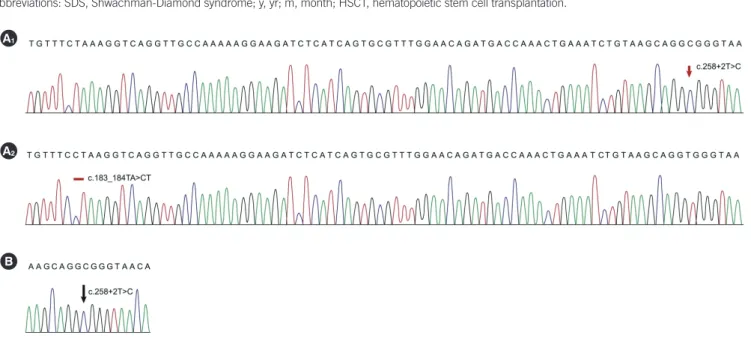
Fig. 1. The chromatograms of SBDS mutations in the present SDS cases. (A) Case 1: Sequencing chromatograms of subcloned PCR prod- ucts demonstrate the compound heterozygosity of c.258+2T>C (A1) and c.183_184TA>CT (A2) mutations. (B) Case 2: Direct sequenc- ing shows a homozygous mutation, c.258+2T>C, in intron 2.
Table 1. Clinical features of SDS patients reported in Korea Patient
no. Age at
diagnosis/sex Exocrinepancreatic
dysfunction Hematological Skeletal Others Outcome SBDS gene analysis Reference
1 21 y/F Congenital
lipomatosis of pancreas
AML Metaphysical
dysostosis
HSCT Not done Park et al. [2]
(2002)
2 10 y/M Congenital
lipomatosis of pancreas
MDS Short stature,
Pigeon chest
Death Not done Kwak et al. [3]
(2004)
3 42 m/F Congenital
lipomatosis of pancreas
Neutropenia Short stature Recurrent infections
Unknown homozygous mutation, c. [258+2T>C] and heterozygous mutation, c.[183_184TA>CT]
Lee et al.[4]
(2008)
4 13 y 9 m/M Congenital lipomatosis of pancreas
Neutropenia,
Thrombocytopenia Short stature, Legg- Calve-Perthes syndrome, Congenital coxa vara
Alive Two heterozygous mutations, c.[183_184TA>CT] and [258+2T>C].
Present case 1
5 15 y 6 m/M Congenital lipomatosis of pancreas
Neutropenia, Thrombocytopenia
Short stature, Congenital coxa vara
Alive homozygous mutation, c. [258+2T>C]
Present case 2
Abbreviations: SDS, Shwachman-Diamond syndrome; y, yr; m, month; HSCT, hematopoietic stem cell transplantation.
A1
A2
B
Cho WK, et al.
Two cases of Shwachman–Diamond syndrome
http://dx.doi.org/10.3343/alm.2015.35.2.269 www.annlabmed.org 271
All mutations were described according to the Human Ge- nome Variation Society nomenclature [7]. RefSeq ID: NM_
016038.2 was used for the alignment. Direct sequencing of the PCR products revealed two heterozygous mutations, c.183_
184TA >CT and c.258+2T >C, for Case 1 and a homozygous mutation c.[258+2T>C];[258+2T>C] for Case 2 (Fig. 1).
We subcloned the PCR products with a TOPO TA Cloning Kit (Invitrogen, Carlsbad, CA, USA) and sequenced the products to confirm the zygosity of the mutations in Case 1. Direct sequencing of the cloned PCR products demonstrated that the two heterozy- gous mutations were compound heterozygous, c.[183_ 184TA>
CT];[258+2T>C].
SDS is the second most common cause of inherited exocrine pancreatic dysfunction in children. A short stature seemed to be caused by intrinsic factors of SDS and risk factors such as mal- absorption, delayed puberty, and infections [8].
The most frequently reported mutation type, c.[183_ 184TA
>CT], forms in-frame stop codons, while c.[258+2T>C] forms truncated proteins by the destruction of donor splice sites [6].
Based on the guidelines proposed by Dror et al. [9], there was no single test to confirm the diagnosis. Genotyping may be used for diagnostic confirmation, but a negative test for SBDS muta- tions does not exclude the diagnosis, given that 10% of SDS in- dividuals showed no SBDS mutations [10]. An early diagnosis of SDS is necessary to monitor the risk of hematologic malignancy and supplementary therapy for clinical symptoms.
Authors’ Disclosures of Potential Conflicts of Interest
No potential conflicts of interest relevant to this article were re- ported.
Acknowledgments
This study was supported by a grant from the Korea Health Technology R&D Project, Ministry of Health & Welfare, Republic of Korea (A120175).
REFERENCES
1. Minelli A, Maserati E, Nicolis E, Zecca M, Sainati L, Longoni D, et al.
The isochromosome i(7)(q10) carrying c.258+2t>c mutation of the SBDS gene does not promote development of myeloid malignancies in patients with Shwachman syndrome. Leukemia 2009;23:708-11.
2. Park SY, Chae MB, Kwack YG, Lee MH, Kim I, Kim YS, et al. Allogeneic bone marrow transplantation in Shwachman-Diamond syndrome with malignant myeloid transformation. A case report. Korean J Intern Med 2002;17:204-6.
3. Kwak JW, Kim S, Lim YT. A case of Shwachman-Diamond syndrome. Ko- rean J Pediatr 2004;47:900-3.
4. Lee JH, Bae SH, Yu JJ, Lee R, Yun YM, Song EY. A case of Shwachman- Diamond syndrome confirmed with genetic analysis in a Korean child. J Korean Med Sci 2008;23:142-5.
5. Nicolis E, Bonizzato A, Assael BM, Cipolli M. Identification of novel mu- tations in patients with Shwachman-Diamond syndrome. Hum Mutat 2005;25:410.
6. Boocock GR, Morrison JA, Popovic M, Richards N, Ellis L, Durie PR, et al. Mutations in SBDS are associated with Shwachman-Diamond syn- drome. Nat Genet 2003;33:97-101.
7. den Dunnen JT and Antonarakis SE. Mutation nomenclature extensions and suggestions to describe complex mutations: a discussion. Hum Mu- tat 2000;15:7-12.
8. Toiviainen-Salo S, Mäyränpää MK, Durie PR, Richards N, Grynpas M, Ellis L, et al. Shwachman-Diamond syndrome is associated with low- turnover osteoporosis. Bone 2007;41:965-72.
9. Dror Y, Donadieu J, Koglmeier J, Dodge J, Toiviainen-Salo S, Makitie O, et al. Draft consensus guidelines for diagnosis and treatment of Shwach- man-Diamond syndrome. Ann N Y Acad Sci 2011;1242:40-55.
10. Hashmi SK, Allen C, Klaassen R, Fernandez CV, Yanofsky R, Shereck E, et al. Comparative analysis of Shwachman-Diamond syndrome to other inherited bone marrow failure syndromes and genotype-phenotype cor- relation. Clin Genet 2011;79:448-58.