서 론
청소년기는 신체적 성장뿐 아니라 정서적, 사회적 발달 및 정체성 이 형성되는 시기로서 청소년기에 결식과 같은 잘못된 식습관의 형 성은 영양 불균형 및 비정상적 식사 태도를 초래한다고 알려져 있 다.1) 또한 청소년기는 신체 이미지를 형성하는 시기로 자아 형성 및 자기 평가와 밀접한 관련을 갖고 있으며 특히 여자 청소년에서 외모
에 대한 관심이 많기 때문에 이러한 경향이 더 강하게 나타난다.2,3) 이러한 청소년기의 체중 감량 시도는 지식 및 경제력 부족으로 인해 잘못된 방법으로 시행될 가능성이 높은데 그 방법으로는 단식, 식 사 후 구토 등이 있었다.4)
여자 청소년 중 식이 장애 고위험군에서 장기적으로 우울증상 및 자살 사고로 진행될 수 있다고 알려져 있는데, 최근 젊은 여성을 대 상으로 시행한 연구결과 결식군에서 자살 생각과 스트레스 인지율
Brief
Communication
대한민국 여자 청소년의 하루 중 결식 횟수와 신체 지수 및 정신건강상태와의 관련성: 제5기 국민건강영양조사 2010-2012
권송희, 김민정*, 김석중, 홍선진, 이제한, 심은성
국립중앙의료원 가정의학과
Relevance of the Meal-Skipping Numbers per Day and Physical Index and Mental Health for Female Adolescents of Republic of Korea: The 5th Korea National Health and Nutrition Examination
Survey, 2010–2012
Song-Hui Kwon, Min-Jeong Kim*, Seok-Joong Kim, Sun-Jin Hong, Je-Han Lee, Eun-Sung Sim
Department of Family Medicine, National Medical Center, Seoul, KoreaBackground: The purpose of this study was to examine the association between physical and mental status and the number of meals skipped among 13–18-year-old female adolescents.
Methods: This study evaluated the association between number of skipped meals and body mass index (BMI), economic status, eating behavior, and mental health status in female adolescents. Data were obtained from the Korea National Health and Nutrition Examination Survey (2010–2012). Six hundred sixty-nine subjects were divided into three groups, based on the average number of meals skipped per day over the last 2 days.
Results: Compared to the non-meal skipping group, subjects missing 2 meals per day were taller, with an increased body weight and a higher BMI. The number of skipped meals correlated with economic status. Subjects skipping meals perceived themselves as obese and had fewer family meals per week. Conversely, in all groups showed that no association with mental health status.
Conclusion: Missing meals occurred more frequently in female adolescents who were taller, with an increased body weight, higher BMI, and lower economic status, and with a self-perception as obese. Numbers of skipped meals were associated with less frequent family meals. There was no association between mental health and the number of meals skipped. Long-term research is necessary to identify factors affecting the number of skipped meals in female adolescents.
Keywords: Adolescents; Female; Skipping Meals; Physical Index; Mental Health
https://doi.org/10.21215/kjfp.2017.7.1.144 eISSN 2233-9116Korean J Fam Pract. 2017;7(1):144-148
KJFP
Korean Journal of Family PracticeReceived March 31, 2016 Revised June 28, 2016 Accepted July 22, 2016 Corresponding author Min-Jeong Kim
Tel: +82-2-2260-4717, Fax: +82-2-2262-4739 E-mail: [email protected]
Copyright © 2017 The Korean Academy of Family Medicine
This is an open-access article distributed under the terms of the Creative Commons At- tribution Non-Commercial License (http://creativecommons.org/licenses/by-nc/4.0) which permits unrestricted noncommercial use, distribution, and reproduction in any medium, provided the original work is properly cited.
권송희 외. 한국 여자 청소년의 하루 중 결식 횟수와 신체 및 정신건강상태와의 관련성 Korean Journal of Family Practice
KJFP
Brief
Communication
Korean Journal of Family Practice 이 높은 것으로 나타났다.5,6) 청소년기는 특히 정신적, 신체적으로 급
격한 변화를 겪는 불안정한 시기로서 향후 식이 장애로 진행될 수 있는 결식과 관련된 연구가 필요하다고 생각된다.7)
따라서 본 연구에서는 만 13–18세 여자 청소년을 대상으로 결식 횟수에 따른 신체 지수 및 정신건강상태와의 관련성을 비교하고자 하였다.
방 법
1. 연구대상
본 연구는 대한민국 질병관리본부와 보건복지부에서 시행한 2010–2012년 국민건강영양조사 제5기 원시자료를 이용하였다. 국민 건강영양조사는 층화집락표본 추출방식으로 조사 가구를 선정하 였으며 참가자의 동의를 얻어 조사를 시행하였다. 건강 설문조사를 작성한 25,534명에서 중·고등학교 재학중인 만 13–18세 여자 청소년 844명 중 결측치가 있는 175명을 제외하였으며 1일 평균 2식 결식군 44명, 1일 평균 1식 결식군 285명, 3식 모두 섭취한 식사군 340명을 포 함한 총 669명을 최종 연구대상으로 하였다.
2. 조사방법
본 연구는 국민건강영양조사에서 건강검진과 건강의식행태조사 설문지를 이용하였으며 연구에서 이용한 변수들은 다음과 같다.
최근 2일간 식사 횟수를 조사하여 하루 평균 0–1.5회인 경우 2회 결식군, 평균 2–2.5회는 1회 결식군, 3회 모두 식사한 경우 식사군으 로 정의하였다.
검진 조사에서 신체 계측치 중 키, 체중, 허리둘레, 체질량지수 (body mass index, BMI)를 사용하였으며, BMI <18.5 kg/m2은 저체중, 18.5≤BMI<23.0 kg/m2은 정상, 23.0≤BMI<25 kg/m2을 과체중, BMI ≥25 kg/m2을 비만으로 정의하였다.
인구사회학 특성으로 경제상태는 소득 4분위를 기준으로 하였 다. 건강행태영역 항목 중 주관적 체형 인식, 체중 조절 노력, 체중 조 절 방법, 외식 빈도, 가족 식사 빈도, 지난 2주간 우울증상의 경험, 1 년간 자살 생각, 정신 문제 상담, 스트레스 인지 및 수면 시간에 대한 문항을 포함하였다. 외식 횟수 항목은 4주 단위로 환산하여 하루 2 회 이상(56회), 하루 1회(28회), 주 5–6회(22회), 주 3–4회(14회), 주 1–2 회(6회), 월 1–3회(2회)로 분석하였다. 가족 식사는 최근 1년간 아침, 점심, 저녁 식사 중 동반 대상이 가족인 경우에 대해 하루 중 식사 횟 수로 계산하여 분석하였다.
3. 통계분석
자료의 통계처리 및 분석을 위해 SAS Institute 프로그램(ver 9.2;
SAS Institute, Cary, NC, USA)을 사용하였다. 종속변수인 결식 유형 에 따른 독립변수가 나이, 키, 몸무게, 허리둘레, BMI, 외식 횟수, 가 족동반 식사 횟수, 수면 시간 등의 연속형 변수인 경우 평균값±표준 오차로 나타냈으며 general linear model analysis를 통해 종속변수의 세 집단 간의 차이가 존재하는지 분석하였다. 독립변수가 소득 4분 위, 체형 인식, 체중 감소 노력, 체중감량 방법, 지난 2주간 우울감, 지 난 1년간 자살사고, 지난 1년간 정신 상담, 스트레스 인지 정도 등의 범주형 변수인 경우 비율(추정값±표준오차)로 나타냈으며, 분할표 를 생성하여 Pearson chi-squared test를 시행하였다. 모든 통계 분석에 서 유의 수준은 P<0.05로 하였다.
결 과
1. 하루 중 결식 횟수에 따른 신체계측, 가계소득, 체중변화 및 건강습관 비교(Table 1)
세 군 중 2회 결식군에서 키가 크고(P=0.0195) 몸무게가 높았으며 (P=0.0075), BMI가 높게 나타났다(P=0.0165). 소득 4분위 기준으로 1 분위에 해당하는 경우가 세 군 중 2회 결식군에서 가장 높았으며 (28.05%±8.88%), 자신의 체형을 비만으로 인식하는 경우가 2회 결식 군에서 높게 나타났으나(53.02%±9.24%), 체중 감소 노력 및 체중 조절 방법과 결식 횟수 간에 상관관계는 없었다. 외식 횟수와 결식 횟수 간에 관계는 없었으나 가족 동반 식사 횟수가 적을수록 결식 횟수가 증가하는 양상을 보였다(P<0.0001).
2. 하루 중 결식 횟수와 정신건강과의 관계(Table 2)
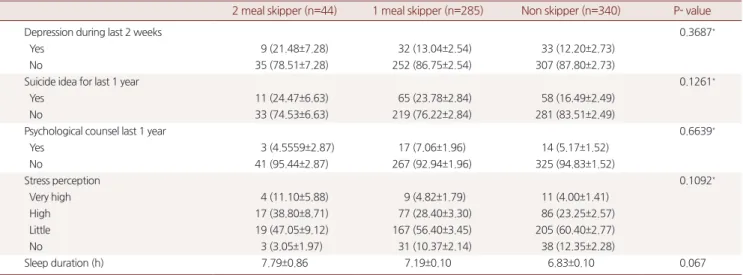
세 군 모두에서 최근 2주 이내 우울감, 최근 1년 이내 자살사고 여 부, 정신과 상담 여부, 스트레스 인지 정도 및 수면 시간에 대해 결식 횟수와 연관을 보이지 않았다.
고 찰
본 연구에서는 만 13–18세 여자 청소년을 대상으로 하루 중 결식 횟수에 따른 신체 지수 및 정신건강상태와의 관련성을 비교하기 위 해 제5기 국민건강영양조사(2010–2012년) 자료를 이용하여 단면 연 구를 시행하였다.
연구결과 2회 결식군에서 나이와 관계없이 키와 몸무게 및 BMI가 유의하게 높았으며 세 군 모두 BMI는 정상 범위에 해당되었으나 2회 결식군에서 자신의 체형을 비만으로 인식하는 비율이 높았다. 2014
Song-Hui Kwon, et al. Relevance of the Meal-Skipping Numbers and Physical, Mental Health for Female Adolescents
Korean Journal of Family Practice
KJFP
년 청소년건강행태 보고서에서 신체 이미지 왜곡 인지율에 대해 BMI 85백분위수 미만인 학생 중 자신을 비만으로 인지한 여학생은 35.5%에 달했으며 체중 감량 시도 시 지식 및 경제력 부족으로 인해
단식을 시행한다는 결과와 유사한 결과로 보인다.4) 이러한 여자 청소 년의 부적절한 신체 이미지 형성의 원인으로는 날씬한 여성을 유능 하고 매력적으로 여기는 사회문화적 압박이 연관되어 있는 것으로
Table 1. Relationship between physical index, economic status, weight change, related behavior and meal skipping patterns of 13–18 years old fe- male adolescents
2 meal skipper (n=44) 1 meal skipper (n=285) Non skipper (n=340) P-value
Age (y) 16.14±0.23 15.52±0.12 15.44±0.12 0.1077
Height (cm) 162.15±1.00 160.62±0.44 160.07±0.36 0.0195
Weight (kg) 58.35±1.98 54.54±0.72 53.27±0.66 0.0075
Waist circumference (cm) 70.32±1.73 69.12±0.61 68.20±0.60 0.1264
Body mass index (kg/m2) 22.12±0.65 21.09±0.23 20.78±0.25 0.0165
House hold income 0.0079*
1st quartile (lowest) 10 (28.05±8.88) 39 (14.93±2.91) 37 (14.66±2.70)
2nd quartile 7 (8.16±3.58) 75 (22.40±3.03) 118 (27.87±3.20)
3rd quartile 16 (39.61±8.72) 81 (33.71±3.58) 80 (29.07±3.59)
4th quartile (highest) 11 (24.18±8.88) 88 (28.96±3.05) 105 (28.41±3.36)
Body shape perception 0.0207*
Thin 2 (2.19±1.64) 47 (14.39±2.42) 61 (15.58±2.32)
Normal 21 (44.78±8.96) 124 (45.33±3.56) 178 (53.14±3.62)
Obese 21 (53.02±9.24) 113 (40.28±3.85) 101 (31.28±3.36)
Weight loss efforts for last year 0.6178*
Effort for loss 26 (69.52±6.92) 154 (56.71±3.51) 177 (53.19±3.41)
Effort to maintain 9 (17.20±5.32) 48 (18.02±2.67) 58 (18.10±2.74)
Effort for gain 0 (0.00±0.00) 13 (3.30±1.11) 12 (3.10±1.05)
No effort+don't know 9 (13.27±5.44) 70 (21.96±2.76) 97 (25.61±3.05)
Weight control methods 0.2344*
Exercise 20 (55.53±8.95) 132 (68.99±3.88) 167 (70.76±3.61)
Diet 15 (44.47±8.95) 70 (31.01±3.88) 69 (29.24±3.61)
Eating out (number/mo) 32.65±2.92 33.39±1.14 31.33±1.13 0.3229
Eating with family (number/d) 0.62±0.11 0.86±0.05 1.20±0.05 <0.0001
Values are presented as estimated mean±standard error or unweighted number (estimated mean±standard error%).
P-values are obtained by general linear model analysis in complex sample design.
*P-values are obtained by cross tabulation analysis (Pearson's chi-squared test) in complex sample design.
Table 2. Relationship between mental health status and meal skipping patterns of 13–18 years old female adolescents
2 meal skipper (n=44) 1 meal skipper (n=285) Non skipper (n=340) P- value
Depression during last 2 weeks 0.3687*
Yes 9 (21.48±7.28) 32 (13.04±2.54) 33 (12.20±2.73)
No 35 (78.51±7.28) 252 (86.75±2.54) 307 (87.80±2.73)
Suicide idea for last 1 year 0.1261*
Yes 11 (24.47±6.63) 65 (23.78±2.84) 58 (16.49±2.49)
No 33 (74.53±6.63) 219 (76.22±2.84) 281 (83.51±2.49)
Psychological counsel last 1 year 0.6639*
Yes 3 (4.5559±2.87) 17 (7.06±1.96) 14 (5.17±1.52)
No 41 (95.44±2.87) 267 (92.94±1.96) 325 (94.83±1.52)
Stress perception 0.1092*
Very high 4 (11.10±5.88) 9 (4.82±1.79) 11 (4.00±1.41)
High 17 (38.80±8.71) 77 (28.40±3.30) 86 (23.25±2.57)
Little 19 (47.05±9.12) 167 (56.40±3.45) 205 (60.40±2.77)
No 3 (3.05±1.97) 31 (10.37±2.14) 38 (12.35±2.28)
Sleep duration (h) 7.79±0.86 7.19±0.10 6.83±0.10 0.067
Values are presented as unweighted number (estimated mean±standard error%) or estimated mean±standard error.
P-values are obtained by general linear model analysis in complex sample design.
*P-values are obtained by cross tabulation analysis (Pearson's chi-squared test) in complex sample design.
권송희 외. 한국 여자 청소년의 하루 중 결식 횟수와 신체 및 정신건강상태와의 관련성 Korean Journal of Family Practice
KJFP
생각해 볼 수 있다.5,8,9)
가계 소득과 관련하여 소득 4분위 중 1분위에 해당하는 경우가 2 회 결식군에서 높게 나타났으며 4분위는 2회 결식군에서 낮게 나타 났는데 이는 성인과 달리 청소년의 결식 여부가 가계 소득의 차이에 영향을 받는다는 결과를 보여주었다.6) 또한 가족 동반 식사 횟수가 높을수록 결식 횟수가 감소했는데 청소년에서 가족 동반 식사 횟수 가 높을수록 비정상적인 식이 행동 및 잘못된 체중 조절 시도가 줄 어들었다는 선행연구와 비슷한 결과로 가족 동반 식사가 청소년기 의 발달 및 식사 태도 형성과 중요한 연관성을 가지는 것으로 생각 해 볼 수 있다.10-12)
여자 청소년의 결식 횟수와 정신건강상태 사이에 연관성을 보이 지 않았는데, 선행 연구에 따르면 여자 청소년에서 식사 태도와 우 울증의 관련성에 대해 연구 초기에는 우울증이 발견되지 않았으나 식이 장애를 보인 여자 청소년의 경우 장기적으로 우울증으로 진행 될 가능성이 높았다.6,13) 그러므로 결식 횟수가 높은 여자 청소년에서 식이 장애로 이환될 가능성을 고려하여 결식군을 미리 발견하고 예 방 및 관리를 통해 향후 우울증으로 진행되는 것을 막을 수 있을 것 으로 기대해 볼 수 있다.14)
이번 연구는 대한민국 여자 청소년 전체의 하루 중 결식 횟수와 관련 요인과의 관계를 잘 나타낼 것으로 생각되나 한계점 또한 명확 하다.
첫째, 본 연구는 단면 연구로서 결식 횟수와 변수 간의 인과관계 가 아닌 상관관계만 나타낸다. 둘째, 결식 횟수 분석에 대해 최근 2일 간의 결과만 반영하였기 때문에 응답자의 평소 결식 횟수 반영에 한 계가 있다. 셋째, 정신건강상태에 대해 자기 기입식 설문 결과로만 분 석하였기 때문에 정확도에 부족한 점이 있다. 넷째, 연구대상이 여자 청소년으로 한정되어 있으므로 이 결과를 전체 청소년으로 일반화 하는 데 한계점이 있다.
결론적으로 여자 청소년에서 결식 횟수는 키와 체중 및 BMI가 높 을수록, 가계 소득이 낮고 자신을 비만으로 인지하는 경우, 가족 식 사 횟수가 적을수록 높았다. 또한 성인과 달리 청소년기에서는 정신 건강상태와 결식 횟수의 관련성이 나타나지 않았다. 향후 이러한 청 소년의 결식 유형에 대해 장기간의 설문조사 및 식습관 분석 등의 조사가 필요할 것으로 생각된다.
요 약
연구배경:
대한민국 만 13–18세 여자 청소년을 대상으로 하루 중 결 식 횟수에 따른 신체 지수 및 정신건강상태와의 관련성을 비교하고 자 하였다.방법:
2010–2012년 국민건강영양조사 제5기 자료를 바탕으로 13–18 세 여자 청소년을 대상으로 하여 1일 평균 2식 결식군 44명, 평균 1식 결식군 285명, 3식 모두 섭취한 식사군 340명을 포함한 총 669명을 최 종 연구대상으로 하였다. 결식 횟수에 따라 신체 지수와 가계소득 및 체형 인식, 체중 조절 여부, 외식 횟수, 가족 식사 횟수, 정신건강상 태에 대해 조사하였다.결과:
2회 결식군에서 키가 크고 몸무게 및 체질량지수(body mass index, BMI)가 높았으며 소득 4분위 중 1분위가 세 군 중 2회 결식군 에서 높게 나타났다. 2회 결식군에서 자신의 체형을 비만으로 생각 하는 경우가 높았으며 가족과 동반 식사 횟수가 적을수록 결식 횟수 가 증가했다. 세 군 모두에서 정신건강상태와 결식 횟수 사이의 연관 을 보이지 않았다.결론:
여자 청소년에서 키와 체중 및 BMI가 높을수록, 가계 소득이 낮을수록 결식 횟수가 높았다. 신체 이미지를 비만으로 인식하는 경 우가 결식군에서 높았으며 가족과의 식사 횟수가 적을수록 결식 횟 수가 증가하는 양상을 보였다. 또한 세 군 모두에서 정신건강상태와 결식 횟수 사이의 연관을 보이지 않았는데 이는 청소년기의 식사 태 도 관련 요인이 성인과 차이점을 보이는 것으로서 이에 대해 향후 결 식 횟수에 따른 장기간의 설문조사 및 식습관 분석 등의 조사가 필 요할 것으로 생각된다.중심단어:
청소년; 여성; 결식; 신체 지수; 정신건강REFERENCES
1. Kim MH. Eating habits, self perception of body image, and weight control behavior by gender in Korean adolescents-using data from a 2010 Korea Youth Risk Behavior Web-based Survey. J East Asian Soc Dietary Life 2012;
22: 720-33.
2. Kim Y. Relationship between sociocultural pressure and cosmetic manage- ment attitude & weight control attitude in adolescent(1). J Korean Soc Cosm 2010; 16: 861-70.
3. Lim YS, Park NR, Jeon SB, Jeong SY, Tserendejid Z, Park HR. Analysis of weight control behaviors by body image perception among Korean women in different age groups: using the 2010 Korea National Health and Nutrition Examination Survey data. Korean J Community Nutr 2015; 20: 141-50.
4. Korean Ministry of Education, Science and Technology. The 10th (2014) Adolescent Health Behavior Online Survey [Internet]. Seoul: Korean Min- istry of Education, Science and Technology; 2014 [cited 2016 Jan 25]. Avail- able from: http://yhs.cdc.go.kr/.
5. Song MK, Ha JH, Park DH, Ryu SH, Oh JH, Yu J. Effect of body image and eating attitude on depressive mood and suicide ideation in female adoles- cents. Korean J Psychosom Med 2010; 18: 40-7.
6. Yi YH, Kim YJ, Lee SY, Lee JG, Jeong DW, Cho YH, et al. The correlation of meal frequency and nutrition with mental health status in women aged 20-
Song-Hui Kwon, et al. Relevance of the Meal-Skipping Numbers and Physical, Mental Health for Female Adolescents
Korean Journal of Family Practice
KJFP
39 years: the 5th Korea National Health and Nutrition Examination Survey, 2010-2012. Korean J Obes 2015; 24: 101-7.
7. Moon JW. The effect of obesity, depression, self esteem, body image on ado- lescents’ life satisfaction. J Korean Soc School Health Edu 2012; 13: 119-46.
8. Lee HJ. Appearance-relate social pressure, satisfaction with appearance, and self-esteem among Korean adolescents [dissertation]. Seoul: Yonsei Univ.;
2014. Korean.
9. van den Berg P, Wertheim EH, Thompson JK, Paxton SJ. Development of body image, eating disturbance, and general psychological functioning in adolescent females: a replication using covariance structure modeling in an Australian sample. Int J Eat Disord 2002; 32: 46-51.
10. Neumark-Sztainer D, Wall M, Story M, Fulkerson JA. Are family meal pat- terns associated with disordered eating behaviors among adolescents? J Ad-
olesc Health 2004; 35: 350-9.
11. Kim SA, Jo HY. A study on the eating out behavior patterns of youth: junior high and senior high school students from different regions. J Korean Soc Food Cult 2004; 19: 336-47.
12. Lee HA, Choi IS. Influence of family mealtime and family functioning on early adolescents' school adaptation. J Korean Home Manag Assoc 2013; 31;
1-13.
13. Stein KF, Hedger KM. Body weight and shape self-cognitions, emotional distress, and disordered eating in middle adolescent girls. Arch Psychiatr Nurs 1997; 11: 264-75.
14. O'Dea JA, Abraham S. Improving the body image, eating attitudes, and be- haviors of young male and female adolescents: a new educational approach that focuses on self-esteem. Int J Eat Disord 2000; 28: 43-57.