www.kafm.or.kr
941
서 론비만은1-3) 역학조사에 의하면 천식 및 알레르기 질환의 증가에 중 요한 역할을 하며, 체중조절이 천식의 치료에 영향을 미치는 것으로 알려져 있다.
기존의 역학연구에서 비만이 천식의 발생에 관여하는 위험인자 라는 것이 확인되었고,4) 전향적 연구에서는 비만이 천식보다 선행하 고 천식 발생의 상대위험도가 체질량지수(body mass index, BMI)에 따라 높아진다는 것을 증명하였다.5)
국내에서 지금까지 비만과 천식에 대한 각각의 단면적 연구는 이 루어졌으나 복부비만과 천식과의 관련성에 대한 연구는 전무한 실 정이다. 이에 제5기 국민건강영양조사 자료를 이용하여 우리나라 성 인의 천식과 비만도 중 체질량지수(BMI)와 복부비만을 기준으로 한 비만지표와의 상관성을 알아보고자 한다.
Received March 10, 2017 Revised October 17, 2017 Accepted October 19, 2017
Corresponding author Woo-cheol Lee
Tel: +82-31-799-5514, Fax: +82-31-744-8994 E-mail: [email protected]
Copyright © 2017 The Korean Academy of Family Medicine
This is an open-access article distributed under the terms of the Creative Commons At- tribution Non-Commercial License (http://creativecommons.org/licenses/by-nc/4.0) which permits unrestricted noncommercial use, distribution, and reproduction in any medium, provided the original work is properly cited.
Brief
Communication
https://doi.org/10.21215/kjfp.2017.7.6.941 eISSN 2233-9116
Korean J Fam Pract. 2017;7(6):941-944
Korean Journal of Family Practice
KJFP
제5기 국민건강영양조사 자료를 통한 한국 성인에서의 비만(체질량지수) 및 복부비만과 천식과의 상관성 연구
박범석, 박해일, 이우철*
성남중앙병원 가정의학과
The Correlation between Obesity (Body Mass Index), Abdominal Obesity and Asthma in Korean Adults through the 5th National Health and Nutrition Survey
Bun-suk Park, Hae-il Park, Woo-cheol Lee*
Department of Family Medicine, Seongnam Central Hospital, Seongnam, Korea
Background: We examined the association between asthma and body mass index (BMI) and abdominal obesity in Korean adults using the 5th National Health Nutrition Survey data.
Methods: The study of the research was conducted through a survey of health checkups and health conscious attitudes in the Health and Nutrition Survey Questionnaire. In order to account for the characteristics of the survey participants, many variables were used in the study of the prevalence of obesity and asthma in the study of national health and nutrition. The use of variables commonly used in research related to obesity and asthma was used in the study. Age, gender, area, marital status, education level, income level, smoking, drinking, exercise, physical activity, sleep time, weight and height, and so on.
Results: No significant differences in the incidence of asthma were observed between obese and non-obese men and between obese and non-obese women. There was no difference in the incidence of asthma between participants with and without abdominal obesity.
Conclusion: This study found that there was no correlation between asthma incidence and obesity (BMI) or abdominal obesity in Korean adults. Further studies are required to validate our results.
Keywords: Asthma; Obesity; Abdominal Obesity; Body Mass Index
Bun-suk Park, et al. Relationship Obesity (BMI), Abdominal Obesity and Asthma
www.kafm.or.kr
942 Korean J Fam Pract. 2017;7(6):941-944
Korean Journal of Family Practice
KJFP
방 법
1. 연구 대상
본 연구는 2010–2012년도 시행된 국민건강영양조사 제5기 자료를 이용하였고 질병관리본부 임상연구윤리위원회(Institutional Review Board)의 승인을 받아 시행되었다(IRB no. 2010-02CON-21-C [1차], 2011- 02CON-06-C [2차], 2012-01EXP-01-2C [3차]).6) 조사 대상은 국 민건강영양조사 대상인 전국 단위로 표본 추출된 가구의 약 30,000 명 중 만19세 이상 성인 17,889명에서 천식의 현재 유병 여부, 결혼상 태, 현재 흡연 여부, 음주, 교육수준, 개인 소득분위에 대한 조사 설문 에 응하지 않은 표본 453명을 제외한 17,436명이다.
2. 연구 방법
연구의 자료는 제5기 국민건강영양조사에서 건강 검진과 건강의 식행태조사 설문지를 통해 조사되었다.6) 검진조사에서 신체 계측을 통해 자료를 수집한 허리둘레, 체중과 신장 측정치를 포함하였다.
조사 대상자의 특성을 설명하기 위해 인구학적 변수와 함께 국민 건강영양조사 자료 중 비만과 천식의 관련성 연구에서 많이 사용되 는 변수들을 사용하였다. 연령, 성별, 지역, 결혼상태, 교육수준, 개인 소득수준, 흡연, 음주, 운동, 신체활동, 수면시간, 체중 및 신장 등이 포함되었다.
3. 통계 방법
전산으로 입력되어 있는 국민건강영양조사 자료를 IBM SPSS 22.0 (IBM Corp., Armonk, NY, USA)을 사용하여 분석하였다. 성별에 따른 연령, 비만, 흡연 등 여러 변수들의 차이를 파악하였다. 모든 통계 검정
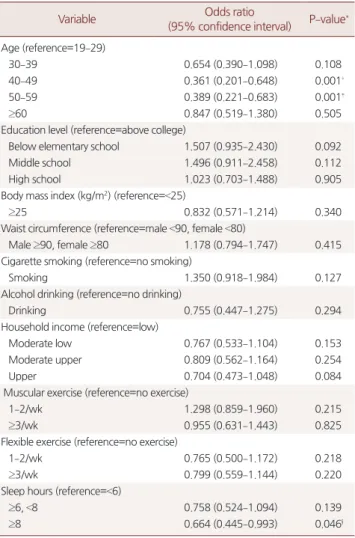
Table 1. Multiple logistic regression of body mass index and waist cir-
cumference for asthma (male)
Variable Odds ratio
(95% confidence interval) P–value* Age (reference=19–29)
30–39 0.654 (0.390–1.098) 0.108
40–49 0.361 (0.201–0.648) 0.001†
50–59 0.389 (0.221–0.683) 0.001‡
≥60 0.847 (0.519–1.380) 0.505
Education level (reference=above college)
Below elementary school 1.507 (0.935–2.430) 0.092
Middle school 1.496 (0.911–2.458) 0.112
High school 1.023 (0.703–1.488) 0.905
Body mass index (kg/m2) (reference=<25)
≥25 0.832 (0.571–1.214) 0.340
Waist circumference (reference=male <90, female <80)
Male ≥90, female ≥80 1.178 (0.794–1.747) 0.415 Cigarette smoking (reference=no smoking)
Smoking 1.350 (0.918–1.984) 0.127
Alcohol drinking (reference=no drinking)
Drinking 0.755 (0.447–1.275) 0.294
Household income (reference=low)
Moderate low 0.767 (0.533–1.104) 0.153
Moderate upper 0.809 (0.562–1.164) 0.254
Upper 0.704 (0.473–1.048) 0.084
Muscular exercise (reference=no exercise)
1–2/wk 1.298 (0.859–1.960) 0.215
≥3/wk 0.955 (0.631–1.443) 0.825
Flexible exercise (reference=no exercise)
1–2/wk 0.765 (0.500–1.172) 0.218
≥3/wk 0.799 (0.559–1.144) 0.220
Sleep hours (reference=<6)
≥6, <8 0.758 (0.524–1.094) 0.139
≥8 0.664 (0.445–0.993) 0.046§
*Calculated by multiple logistic regression. †,‡Significantly (P<0.05) different from 19–29 age group. §Significantly (P<0.05) different from sleep hours <6 group.
Table 2. Multiple logistic regression of body mass index and waist cir-
cumference for asthma (female)
Variable Odds ratio
(95% confidence interval) P–value* Age (reference=19–29)
30–39 0.931 (0.567–1.529) 0.778
40–49 0.812 (0.483–1.365) 0.432
50–59 1.142 (0.679–1.923) 0.616
≥60 1.527 (0.886–2.631) 0.127
Education level (reference=above college)
Below elementary school 1.507 (0.941–2.413) 0.088
Middle school 1.123 (0.670–1.882) 0.659
High school 1.150 (0.796–1.662) 0.457
Body mass index (kg/m2) (reference=<25)
≥25 1.102 (0.834–1.457) 0.495
Waist circumference (reference=male <90, female <80)
Male ≥90, female ≥80 1.285 (0.964–1.714) 0.087 Cigarette smoking (reference=no smoking)
Smoking 1.281 (0.912–1.799) 0.153
Alcohol drinking (reference=no drinking)
Drinking 0.893 (0.689–1.156) 0.390
Household income (reference=low)
Moderate low 1.115 (0.833–1.491) 0.465
Moderate upper 0.859 (0.627–1.178) 0.346
Upper 0.923 (0.669–1.274) 0.625
Muscular exercise (reference=no exercise)
1–2/wk 1.074 (0.680–1.694) 0.760
≥3/wk 1.316 (0.870–1.989) 0.194
Flexible exercise (reference=no exercise)
1–2/wk 0.813 (0.583–1.135) 0.225
≥3/wk 0.934 (0.707–1.232) 0.628
Sleep hours (reference=<6)
≥6, <8 0.782 (0.593–1.031) 0.081
≥8 0.868 (0.641–1.177) 0.364
*Calculated by multiple logistic regression.
www.kafm.or.kr
박범석 외. 한국 성인의 비만 및 복부비만과 천식과의 상관성 연구
Korean J Fam Pract. 2017;7(6):941-944 943
Korean Journal of Family Practice
KJFP
은 유의 수준을 0.05를 기준으로 P<0.05일 때 유의한 것으로 보았다.
결 과
1. 연구 대상 분석
연구 대상자는 총 17,436명으로 7,387명은 남성이었고, 10,049명은 여성이었다.
2. 각 변수들과 천식과의 상관분석
전체 연구 대상에서 천식으로 진단받은 사람의 비율은 전체 3.3%
이며, 남성은 3.0%, 여성은 3.4%로 여성이 조금 더 높았으나 통계적으 로 유의한 차이는 없었다. 연령별로 60대 이상에서 천식 유병률이 가 장 높은 것으로 나타났고, 40대에서 낮은 것으로 나타났으며, 연령에 따라 천식 유병률은 통계적으로 유의한 차이를 보였다. 거주 지역, 결혼상태, 흡연상태, 중등도 신체활동 및 격렬한 신체활동, 체질량지 수에 따른 천식 유병률은 통계적으로 유의한 차이를 보이지 않았고 교육수준, 허리둘레, 음주여부, 개인소득, 수면시간과는 유의한 차이 를 보였다.
3. 다변량 로지스틱 회귀분석
남성에서 20대가 40대 연령군과 50대 연령군보다 천식 유병률이 높은 것으로 조사되었다. 여성에서는 20대가 다른 연령군에 비해 유 병률의 차이를 보이지 않았다. 교육수준, 체질량지수, 허리둘레, 흡 연, 음주, 개인 소득수준, 근력 운동, 유연성 운동에 따른 천식 유병 률은 통계적으로 유의한 차이를 보이지 않았다. 수면시간의 경우 남 성에서 6시간 미만으로 수면을 취하는 그룹이 8시간 수면을 취하는 그룹에 비해 천식 유병률이 높은 것으로 조사되었다(Tables 1, 2).
고 찰
본 연구에서는 만19세 이상 성인의 천식과 비만도 중 체질량지수 (BMI)와 복부비만을 기준으로 한 비만지표와의 상관성을 알아보고 자 하였다.
비만한 사람일수록 천식 유병률은 높아질 것이며, 복부비만 역시 같은 결과를 보일거라 예상하였지만 본 연구에서는 비만한 남성 및 여성 모두 그렇지 않은 사람에 비해 천식 유병률에 있어서 유의한 차이를 보이지 않았다. 복부비만의 경우도 남성 및 여성의 경우 복부 비만이 있는 사람들은 그렇지 않은 사람들보다 천식 유병률이 증가 하는 경향성을 보이긴 하나 통계적으로 유의한 차이를 보이지 않았 다. Chang 등7)의 연구결과에서는 여성의 경우 비만하지 않은 여성보
다 비만한 여성에서 천식 유병률이 1.69배 높은 것으로 나타나서 여 성에 있어서는 비만과 천식이 상관성이 있다는 결과가 도출되었다.
반면 Lee 등8)의 연구에서는 비만이 천식과의 상관성이 없다는 결과 를 보였다. 일부 연구결과에서 나타난 것과 같이 여성에서 비만과 천 식 간에 상관성을 보이고 있는 이유에 대해서 현재까지 정확히 알려 진 기전은 없으나, 남성보다는 여성에서 세기관지 크기가 작고 기도 과민성이 커서 천식 유병률이 여성에서 높다고 보고되었다. 본 연구 에서는 성별에 따라 천식 유병률 차이가 없는 것으로 나타났으며 여 성의 흡연율(11.0%)과 비만율(29.6%)이 다른 나라에 비해 낮아 이러 한 차이가 발생한 것으로 생각된다.
Brumpton 등9)의 연구결과에서는 체질량지수(BMI)로 비만은 아 니었지만 허리둘레만을 볼 때 복부비만으로 판정된 사람들은 일반 인에 비해 천식에 걸릴 확률이 1.44배 높게 나타났다. 또 복부비만이 면서 비만인 사람들이 천식을 앓을 확률은 1.81배로 높아졌다는 결 과가 보고되었다. 하지만 본 연구에서는 외국 연구와 달리 복부비만 의 기준이 다르고 복부비만 유병률에서도 차이가 나기 때문에 본 연 구와 차이가 발생하였다고 생각되며 이점에 대해서 국내에서 좀 더 많은 연구가 필요하다고 생각된다.
본 연구는 몇 가지 제한점을 가진다. 첫째, 국민건강영양조사에서 천식의 진단 기준이 직접적 검사와 진단을 바탕으로 하지 못하고 설 문조사를 통해 과거 진단 여부를 확인하는 것만을 통해 이루어졌다 는 점에서는 한계가 있다. 둘째로 본 조사 결과에서 일부 설문 항목 을 대답하지 않았거나 신체 계측을 받지 않아 천식과 비만에 영향 을 줄 수 있는 식이습관 같은 요인의 표본수가 적어 본 연구에 포함 시키지 못하였고, 이러한 점은 앞으로의 연구에서 보완해야 할 것이 다. 셋째, 국민건강영양조사를 이용한 단면연구로써, 비만 및 복부비 만과 천식 사이의 시간적 선후관계나 인과관계를 밝히기 어렵다는 제한점이 있다. 그렇지만 이번 연구는 우리나라 일반 인구를 대표하 는 신뢰성을 갖춘 통계인 국민건강영양조사의 자료를 분석하였다 는 장점이 있으며, 체질량지수(BMI)뿐만 아니라 복부비만과 천식과 의 상관성 관계에 대해 고찰해 보고자 한 것도 본 연구의 장점이라고 할 수 있다.
결론적으로 이번 연구를 통하여 국내 성인에서의 비만(BMI) 및 복부비만과 천식과의 상관성은 없는 것으로 나타났으며 향후 더 많 은 표본을 대상으로 한 추가적인 연구를 통해 이에 대한 관련성을 찾는 연구가 지속될 필요가 있다.
Bun-suk Park, et al. Relationship Obesity (BMI), Abdominal Obesity and Asthma
www.kafm.or.kr
944 Korean J Fam Pract. 2017;7(6):941-944
Korean Journal of Family Practice
KJFP
요 약
연구배경:
제5기 국민건강영양조사 자료를 이용하여 우리나라 성 인의 천식과 비만도 중 체질량지수(BMI)와 복부비만을 기준으로 한 비만지표와의 상관성을 알아보고자 한다.방법:
연구의 자료는 제5기 국민건강영양조사에서 건강 검진과 건 강의식행태조사 설문지를 통해 조사되었다.결과:
비만한 남성은 그렇지 않은 남성에 비해 천식 유병률에서 유 의한 차이를 보이지 않았으며, 여성의 경우도 마찬가지로 비만한 여 성은 그렇지 않은 여성에 비해 천식 유병률의 유의한 차이를 보이지 않았다. 복부비만의 경우도 남성 및 여성의 경우 복부비만이 있는 사람들은 그렇지 않은 사람들보다 천식 유병률이 증가하는 경향성 을 보이긴 하나 유의한 차이를 보이지 않았다.결론:
국내 성인에서의 비만(BMI) 및 복부비만과 천식과의 상관성은 없는 것으로 나타났으며 향후 더 많은 표본을 대상으로 한 추가적인 연구를 통해 이에 대한 관련성을 찾는 연구가 지속될 필요가 있다.중심단어:
천식; 비만; 복부비만; 체질량지수REFERENCES