Effects of a Peer Cervical Cancer Prevention Education Program on Korean Female College Students’ Knowledge, Attitude, Self-efficacy, and Intention
Mo, Hyun Suk1 · Choi, Keum Bong1 · Kim, Jin Sun2
1Chosun Nursing College, Gwangju
2Department of Nursing, Chosun University, Gwangju, Korea
Purpose: The purpose of this study was to evaluate the effectiveness of a peer cervical cancer prevention educa- tion program on Korean female college students’ knowledge, attitude, self-efficacy, and intention. Methods: A qua- si-experimental pretest-posttest design with a non-equivalent control group was used. The participants were 58 female college students in a metropolitan city in Korea. The sample consisted of an intervention group (n=28) that participated in a peer education program and a control group (n=30). Data were measured using self-administered questionnaires at two time points: prior to the intervention and after the intervention. Results: Compared to the control group, the experimental group reported significantly positive changes for knowledge, attitude, self-efficacy, and intent to practice cervical cancer prevention behaviors. Conclusion: The findings of this study indicated that a peer education program developed for Korean female college students was a useful and effective intervention strategy to promote cervical cancer prevention behaviors in Korean sociocultural contexts.
Key Words: Cervical cancer, Prevention, Health behavior, Peer group, Health education
Corresponding author: Kim, Jin Sun
Department of Nursing, Chosun University, 375 Seosuk-dong, Dong-gu, Gwangju 501-759, Korea.
Tel: +82-62-230-6327, Fax: +82-62-230-6329, E-mail: [email protected] - This article is a revision of the first author's doctoral dissertation from Chosun University.
투고일: 2013년 7월 3일 / 수정일: 2013년 12월 14일 / 게재확정일: 2013년 12월 19일
서 론
1. 연구의 필요성Cervical cancer is one of the most common types of cancer among women worldwide, and the number of cases is growing annually. It is the second leading cause of cancer death in women worldwide (Centers for Di- sease Control and Prevention [CDC], 2013) and the sixth leading cause of cancer death in Korean women (Statis- tics Korea, 2012). A significant cause of cervical cancer is the human papillomavirus (HPV), a sexually transmit- ted disease (STD) that affects 10.4% of Korean women.
HPV infection can occur in all age groups, but, as in oth- er countries, the highest rate of infection occurs among Korean women in their 20s (18.9%), when they are the most sexually active (Oh et al., 2009).
Because cervical cancer rarely presents with early
symptoms, prevention of cervical cancer may offer few- er risks and more benefits. According to cervical cancer prevention guidelines from the American Cancer Society
(2012), cervical cancer screening should begin at age 21, and regular screenings are even more critical for sex- ually active women. Over the past 20 years, the recom- mendation of the Pap test as a cervical cancer preven- tion behavior has significantly lowered the occurrence rate (Kim, Park, & Park, 2010). In 2007, a vaccine against HPV was developed and licensed by the Korea Food and Drug Administration for females aged 9~26 years (Rhee et al., 2010). Currently, this vaccine has been found to be the most effective known method in preventing cervical cancer among women who have not previously been exposed to HPV (CDC, 2013).
HPV infection is a critical cause of cervical cancer and an STD that has high prevalence among individuals in their 20s (CDC, 2013). Although the prevalence of cer- vical cancer is high in women in their 40s and 50s, the
risk of getting cervical cancer in the future starts in their 20s, a time during which they may have an increased likelihood of risky sexual behaviors. However, Korean women in their 20s and 30s are relatively less aware than women in their 40s and 50s of cervical cancer’s se- verity and the importance of early check-ups for cervical cancer, placing these age groups in a blind spot for cer- vical cancer check-ups (Han, 2011). Previous Korean studies have demonstrated low rates of condom use (Han, 2011; Kim, 2009), Pap testing (Kim, 2009), and HPV vaccinations (Kang & Moneyham, 2010; Kang &
Kim, 2011) among Korean female college students.
It has been suggested that a lack of knowledge about HPV and its link to cervical cancer had an impact on fe- male college students’ cervical cancer prevention be- haviors (Brewer & Fazekas, 2007). Previous studies have reported that educational interventions significantly in- crease knowledge about HPV and the acceptability of cervical cancer prevention behaviors (Chapman et al., 2010; Saha, Chaudhury, Bhowmik, & Chatterjee, 2010).
Chapman et al. (2010) identified a video-based educa- tional intervention as significantly increasing HPV awar- eness and HPV vaccine acceptability in women of young- er age groups. Educational interventions can potentially influence cervical cancer prevention behaviors by affect- ing behaviour change mediators such as knowledge, at- titudes, and self-efficacy (Shepherd, Frampton, & Harris, 2011). Therefore, providing HPV education could be an important first step in promoting cervical cancer pre- vention behaviors. Moreover, a recent Korean study (Kang & Kim, 2011) reported that 85.5% of female col- lege students expressed interest in receiving HPV pre- vention education.
Although many structurally diverse educational pro- grams are promising, peer-led education can be a good approach for sexual health education in college students because most college students share sexual knowledge with their peers and are influenced by their peers' sex- ual behaviors (Kim & Free, 2008). Previous studies dem- onstrated that peer sex education programs for young women or college students increased sexual health knowledge and decreased risky sexual behaviors (Da- vey-Rothwell, Tobin, Yang, Sun, & Latkin, 2011; Kim &
Free, 2008).
Although there have been several peer education in- tervention studies of HIV/STD prevention, few peer ed- ucation intervention studies on cervical cancer have been conducted (Ferrara, Langiano, & De Vito, 2012; McKee- ver,2008). McKeever (2008) provided a peer education intervention for female college students to reduce be-
haviors associated with cervical cancer risk. The results of this study revealed that female college students in the experimental group reported reduced participation in high-risk sexual behaviors one month post-test, demon- strating that peer education intervention among female college students was an effective method to reduce risky sexual behaviors. However, this study focused on re- ducing high-risk sexual behaviors rather than increasing cervical cancer prevention behaviors. No known Kore- an study has been published to identify the effect of a peer education intervention program on cervical cancer prevention behaviors. The findings from previous stud- ies may have limited generalizability to Korean female college students who have different cultural beliefs, and family and social norms; therefore a study conducted in a Korean sociocultural context is necessary.
Based on the theoretical framework of the Health Belief Model (HBM) (Rosenstock, Strecher, & Becker, 1988, 1994), this study was conducted to evaluate the ef- fects of peer cervical cancer prevention education pro- gram on Korean female college students’ knowledge, attitude, self-efficacy, and intention. Specifically, four hypotheses were tested in the present study. Compared with the control group, the students who participated in the peer education program were expected to show positive changes in 1) knowledge about cervical cancer prevention behaviors, 2) attitude towards cervical can- cer prevention behaviors, 3) self-efficacy for cervical cancer prevention behaviors, and 4) the intent to prac- tice cervical cancer prevention behaviors.
METHODS
1. Design and Sample
A pretest-posttest design with a non-equivalent con- trol group was used in this study. The participants were 58 female college students attending two 4-year nursing colleges in G metropolitan city, Korea. To avoid cross- contamination of information between the groups, the subjects in each group were recruited from two different colleges. The following inclusion criteria were applied:
female gender, ≥18 years of age, college freshman or sophomore, and not a recipient of the HPV vaccine.
The calculated sample size using the G*Power 3.0 program was 27 in each group to achieve a power of .80, a large effect size of 0.78, and a significance level of .05. An effect size was calculated from Kim (2009)’s study which evaluated the effect of a cervical cancer prevention education program on the intention of fe-
male college students to receive the HPV vaccination. In anticipation of a 20% drop-out rate, a recruitment goal of 34 participants each for the experimental and control groups was set. However, because of difficulties in re- cruiting participants, only 30 female college students for the experimental group and 31 for the control group were recruited. Eventually, 2 participants from the ex- perimental group and 1 from the control group dropped out for personal reasons, and the final number of partic- ipants was 28 in the experimental group and 30 in the control group.
2. Measures
A structured, self-administered questionnaire was used consisting of participants' characteristics, knowledge, at- titudes, self-efficacy for cervical cancer prevention be- haviors, and intent to practice cervical cancer preven- tion behaviors. All of the questions were developed or modified for this study by the researchers based on pre- vious relevant studies and literature review. The parti- cipants' characteristics included age, economic status, smoking, alcohol consumption, sexual experiences, HPV vaccination recommendations, and desire for cervical cancer education.
To determine the content validity of the questionnaire, a panel of experts including an Obstetric/Gynecologic (Ob/Gyn) nurse, an Ob/Gyn doctor, and three nursing professors was asked to advise on the accuracy and com- prehensiveness, relevance of the scale items and read- ability of the questionnaire. All of the included items showed a content validity index (CVI) value > .80 with five experts. Moreover, a pilot study was conducted us- ing 20 nursing students to check the comprehension level and time required to complete the questionnaires, and no specific problems were identified.
1) Knowledge about cervical cancer prevention behaviors A questionnaire was developed based on previous studies (Kang & Kim, 2011; Lee & Park, 2011) and a liter- ature review. The knowledge scale included 27 true or false items: 13 on HPV, 7 on cervical cancer, 5 on HPV vaccination, and 2 on condom use. The responses were coded so that each correct answer received a score of one, and each ‘incorrect’ or ‘unsure’ answer received a score of zero. The knowledge score was calculated by adding the scores for the correct answers. The total pos- sible score ranged from 0 to 27, with the higher scores reflecting higher levels of knowledge about cervical cancer prevention behaviors. The Kuder-Richardson
Formula 20 (KR-20) of the measure in this study was .85.
2) Attitude toward cervical cancer prevention behaviors Attitude was assessed using a questionnaire based on previous studies (Hsu et al., 2009; Kang & Kim, 2011) and HBM subscales. The questionnaire included 16 items on a 5-point Likert scale ranging from 1 (strongly dis- agree) to 5 (strongly agree): 2 on perceived susceptibility to cervical cancer, 3 on perceived seriousness, 3 on per- ceived benefits, 4 on perceived barriers, and 4 on cue to action. Subscale mean scores were obtained by summing and averaging the items (range 1-5). The possible total score range was 16-80, and a higher score indicated a more positive attitude toward cervical cancer prevention behaviors. Cronbach's ⍺ of the measure in this study ranged from .61 (perceived barriers) to .91 (perceived susceptibility).
3) Self-efficacy for cervical cancer prevention behaviors A self-efficacy scale was developed based on the HBM and a literature review. In this study, self-efficacy refers to personal evaluations of the ability to success- fully practice cervical cancer prevention behaviors. The scale included 8 items on a 5-point Likert scale ranging from 1 (very doubtful) to 5 (very confident): 3 on con- dom use, 2 on Pap tests, 1 on HPV vaccination, and 2 on safe sexual relationships. The possible score range was 8~40, and a higher score indicated greater self-efficacy for cervical cancer prevention behaviors. Cronbach's ⍺ of the measure in this study was .89.
4) Intent to practice cervical cancer prevention behaviors Intent was measured using a visual analog scale (VAS) that included 3 items: One each on condom use, Pap tests, and HPV vaccination. For each question, the partic- ipants were instructed to mark a 10 cm (100 mm) hori- zontal VAS. An answer of “0 cm” indicated “no inten- tion,” and “10 cm” indicated “strongest intention” to prac- tice cervical cancer behaviors. Cronbach's ⍺ of the meas- ure in this study was .76.
3. Description of Intervention
The peer education program, developed by the re- searchers and a peer sex education instructor, was based on previous studies (Davey-Rothwell et al., 2011; Kim &
Free, 2008; McKeever, 2008), a peer sex education pro- gram developed by Korean Red Cross (KRC, 2007), and the results of a focus group interview conducted for this study. The focus group interview was conducted with 7
female college students to analyze the demand for peer education programs promoting cervical cancer preven- tion behaviors among female college students and to se- lect teaching strategies. The researcher and a peer sex education instructor led a discussion of open-ended ques- tions for approximately 60 minutes. In the focus group interview, the subjects were asked about the extent and practice of their knowledge about cervical cancer, STDs, HPV and HPV vaccination, safe sex, condom use, and Pap tests as well as what and how they wanted to learn.
The important categories determined by the focus group interview were the lack of knowledge, the lack of cop- ing skills caused by that lack of knowledge, and the in- formation expected from cervical cancer prevention programs.
Peer education was chosen as the preferred educa- tional method. The educational content was structured around activities that were unburden some and enjoy- able for both the peer education program participants and the instructor. The educational media used were Power Point (PPT) presentations, video clips, activities, role-play, drawing, case studies, games, quizzes and de- bates.
The content validity of the developed peer education program was evaluated by a group of experts that in- cluded an Ob/Gyn nurse, an Ob/Gyn doctor, and three nursing professors. Content validity was evaluated for the five items related to program content to achieve the goal of this intervention and for the five items related to teaching materials. A 4-point Likert scale was used rang- ing from 1 (strongly disagree) to 4 (strongly agree). The results of this appraisal yielded a CVI of .95.
4. Implementation of the Peer Education Program The peer education intervention was led by three fe- male college students who had received a 40-hour “Peer Led Sexual Education” training course and certificates from KRC, one of whom was selected as a peer educa- tion leader. The other two were peer assistants to oper- ate the program smoothly. The peer education leader participated in the development process for the peer ed- ucation program for the present study and led a PPT lec- ture of the key concepts of HPV/STD, cervical cancer, and condom use, and the two peer assistants led the ac- tivity modules for each concept.
Before session 1, a pre-test was conducted for the ex- perimental group. The peer education program for the experimental group consisted of two sessions with a one-week interval. After session 2, a post-test was con-
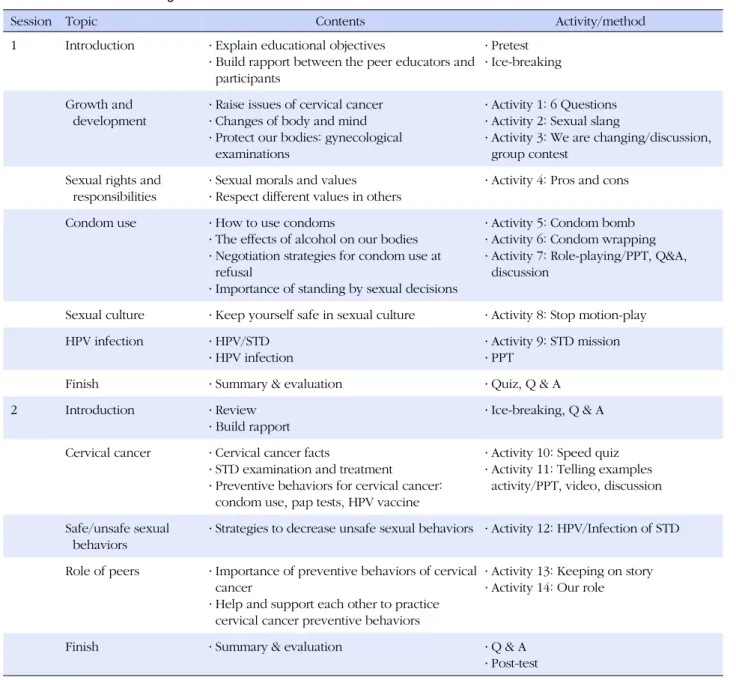
ducted for the experimental group. On the same day with the experimental group, a pre-test and a post-test were also conducted for the control group by a research assistant. The first session lasted four hours, and the sec- ond session lasted two hours. The content details are presented in Table 1.
5. Data Collection and Ethical Considerations Data were collected using a self-administered ques- tionnaire. The questionnaire took approximately 15 mi- nutes to complete. Data were collected at two points:
prior to and after the intervention. For both groups, data were collected in September 2011.
Approval to conduct this study was obtained from the Institutional Review Board at C University (IRB-13-001).
Permission to collect data was obtained after the resear- cher explained the research purposes and procedures to the head of each college. The participants were informed of the purposes of the study and the associated risks and benefits of participation. Written informed consent was obtained from each participant. They were also infor- med that their decision to participate in the research would not affect their status and that they could with- draw from the study at any time during the intervention.
To preserve the integrity of responses and personal pri- vacy, the subjects secured their anonymity with a pass- word or symbol known only to the participant. Upon completing the program and questionnaire, each partici- pant in both groups received a gift certificate as compen- sation for participating. The control group received PPT educational materials after this study was completed.
6. Data Analysis
The data were analyzed using SPSS (v. 17.0; SPSS Inc., Chicago). Chi-square, Fisher's exact probability, and t-tests were used to test the homogeneity of the charac- teristics between the groups. T-tests were used to test the homogeneity of the outcome variables between the groups and to test the hypotheses.
RESULTS
1. Baseline Participant Characteristics
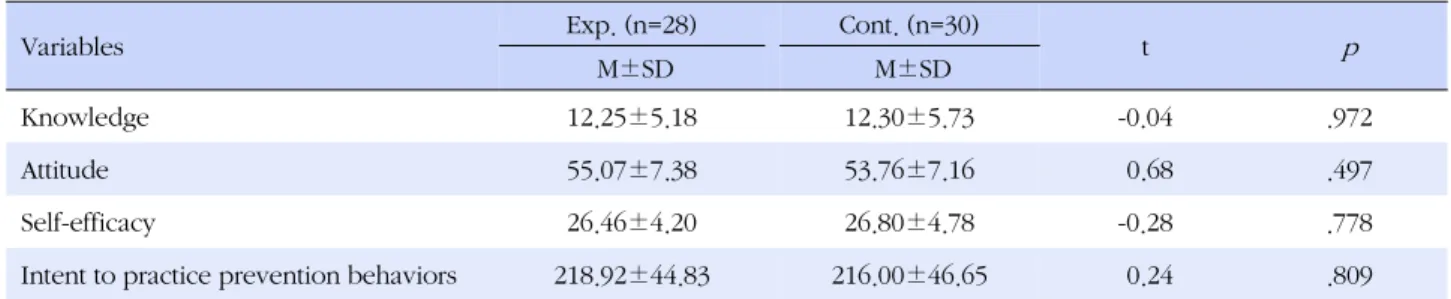
The results of the homogeneity test for characteristics between groups revealed that there were no statistically significant differences at baseline (Table 2). Moreover, the results of the homogeneity test for knowledge, atti-
Table 1. Peer Education Program to Promote Cervical Cancer Preventive Behaviors
Session Topic Contents Activity/method
1 Introduction ․ Explain educational objectives
․ Build rapport between the peer educators and participants
․ Pretest
․ Ice-breaking
Growth and development
․ Raise issues of cervical cancer
․ Changes of body and mind
․ Protect our bodies: gynecological examinations
․ Activity 1: 6 Questions
․ Activity 2: Sexual slang
․ Activity 3: We are changing/discussion, group contest
Sexual rights and responsibilities
․ Sexual morals and values
․ Respect different values in others
․ Activity 4: Pros and cons
Condom use ․ How to use condoms
․ The effects of alcohol on our bodies
․ Negotiation strategies for condom use at refusal
․ Importance of standing by sexual decisions
․ Activity 5: Condom bomb
․ Activity 6: Condom wrapping
․ Activity 7: Role-playing/PPT, Q&A, discussion
Sexual culture ․ Keep yourself safe in sexual culture ․ Activity 8: Stop motion-play
HPV infection ․ HPV/STD
․ HPV infection
․ Activity 9: STD mission
․ PPT
Finish ․ Summary & evaluation ․ Quiz, Q & A
2 Introduction ․ Review
․ Build rapport
․ Ice-breaking, Q & A
Cervical cancer ․ Cervical cancer facts
․ STD examination and treatment
․ Preventive behaviors for cervical cancer:
condom use, pap tests, HPV vaccine
․ Activity 10: Speed quiz
․ Activity 11: Telling examples activity/PPT, video, discussion
Safe/unsafe sexual behaviors
․ Strategies to decrease unsafe sexual behaviors ․ Activity 12: HPV/Infection of STD
Role of peers ․ Importance of preventive behaviors of cervical cancer
․ Help and support each other to practice cervical cancer preventive behaviors
․ Activity 13: Keeping on story
․ Activity 14: Our role
Finish ․ Summary & evaluation ․ Q & A
․ Post-test
tude, self-efficacy, and intent to practice cervical cancer prevention behaviors revealed that there were no statis- tically significant differences between the experimental and control groups at baseline (Table 3).
2. Hypothesis Testing
The four hypotheses in this study were supported.
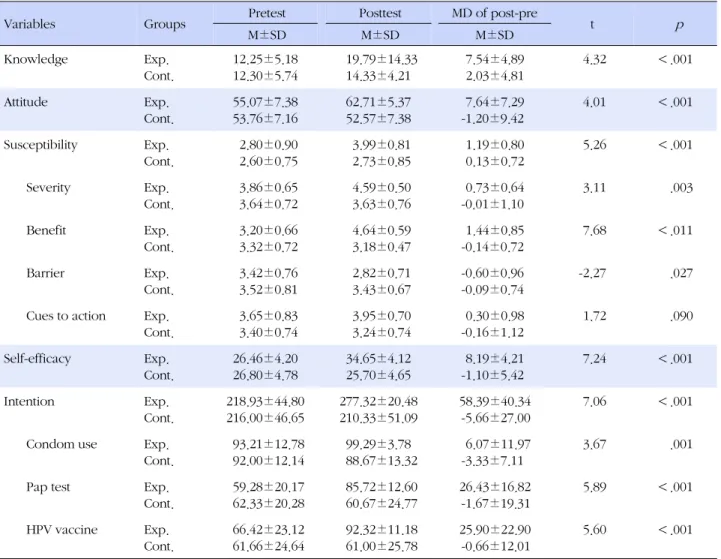
There were statistically significant differences between the groups in knowledge (t=4.32, p <.001), attitude (t=4.01, p <.001), self-efficacy (t=7.24, p <.001), and in- tent to practice cervical cancer prevention behaviors (t=7.06, p <.001). Moreover, all of the subcategories for
attitude (except cues to action) showed statistically sig- nificant differences between the two groups. The differ- ence of cues to action between the two groups was not statistically significant (t=1.72, p =.090). All of the sub- categories for intent to practice cervical cancer preven- tion behaviors showed statistically significant differen- ces between the two groups (Table 4).
DISCUSSION
In this study, a peer education program developed to promote cervical cancer preventive behaviors was effec- tive at improving knowledge levels about cervical can-
Table 2. Homogeneity Test for Characteristics between Groups (N=58)
Characteristics Categories Exp. (n=28) Cont. (n=30)
x2 or t p
n (%) or M±SD n (%) or M±SD
Age (year) 19.3±0.66 19.3±0.66 -0.28 .785
Economic status <Middle school
Middle school
≥Middle school
3 (10.7) 22 (78.6) 3 (10.7)
10 (33.3) 16 (53.3) 4 (13.3)
4.80 .091
Smoking† Yes
No
2 (7.1) 26 (92.9)
3 (10.0) 27 (90.0)
.999
Alcohol† Yes
No
26 (92.9) 2 (7.1)
27 (90.0) 3 (10.0)
.999
Sexual experience† Yes No
3 (3.6) 25 (96.4)
4 (13.3) 26 (86.7)
.999
Suggested HPV vaccination?
Yes No
17 (60.7) 11 (39.3)
14 (46.7) 16 (53.3)
1.15 .284
Educational need† Yes
No
27 (96.4) 1 (3.6)
27 (90.0) 3 (10.0)
.612
Exp.=experimental group; Cont.=control group.
†Fisher's exact probability test.
Table 3. Homogeneity Test for Outcome Variables between Groups at Baseline (N=58)
Variables Exp. (n=28) Cont. (n=30)
t p
M±SD M±SD
Knowledge 12.25±5.18 12.30±5.73 -0.04 .972
Attitude 55.07±7.38 53.76±7.16 0.68 .497
Self-efficacy 26.46±4.20 26.80±4.78 -0.28 .778
Intent to practice prevention behaviors 218.92±44.83 216.00±46.65 0.24 .809
Exp.=experimental group; Cont.=control group.
cer prevention behaviors among female college students in Korea. This finding was consistent with those from a previous study on a peer health education program that reported an increase in adolescents’ primary prevention knowledge about HPV (Ferrara et al., 2012). Previous studies reported that increased knowledge was asso- ciated with improved cervical cancer prevention behav- iors, such as condom use, Pap tests (Saha et al., 2010), and the intent to practice cervical cancer prevention be- haviors (Hsu et al., 2009; Kang & Kim, 2011). The partic- ipants in this study reported pre-intervention knowl- edge levels of 45.4% for the experimental group and 45.5% for the control group, neither reaching 50%. This was consistent with the findings from previous studies of female college students’ low knowledge of Pap tests (Head, Crosby, & Moore, 2009; Kim, 2009), HPV and HPV vaccination (Kang & Kim, 2011; Kim & Park, 2009).
Previous Korean studies found that female college stu- dents in the nursing major reported significantly higher knowledge than those in other majors because they learned about cervical cancer from courses in their ma- jor (Kang & Kim, 2011; Kim & Park, 2009). However, knowledge about cervical cancer prevention behaviors in this study’s participants was similarly low to that of other female college students and is consistent with the results of Kim and Ahn’s study (2007). As Kim and Ahn (2007) discussed in their study, it may related to one of inclusion criteria for this study, college freshman or sophomore nursing students, who have not yet learned about cervical cancer from courses in their major.
Because previous studies have reported that knowledge deficiency adversely affects cervical cancer preventive behaviors (Kang & Moneyham, 2010; Kang & Kim, 2011), further educational interventions for female col-
Table 4. Effects of a Peer Education Program (N=58)
Variables Groups Pretest Posttest MD of post-pre
t p
M±SD M±SD M±SD
Knowledge Exp.
Cont.
12.25±5.18 12.30±5.74
19.79±14.33 14.33±4.21
7.54±4.89 2.03±4.81
4.32 <.001
Attitude Exp.
Cont.
55.07±7.38 53.76±7.16
62.71±5.37 52.57±7.38
7.64±7.29 -1.20±9.42
4.01 <.001
Susceptibility Exp.
Cont.
2.80±0.90 2.60±0.75
3.99±0.81 2.73±0.85
1.19±0.80 0.13±0.72
5.26 <.001
Severity Exp.
Cont.
3.86±0.65 3.64±0.72
4.59±0.50 3.63±0.76
0.73±0.64 -0.01±1.10
3.11 .003
Benefit Exp.
Cont.
3.20±0.66 3.32±0.72
4.64±0.59 3.18±0.47
1.44±0.85 -0.14±0.72
7.68 <.011
Barrier Exp.
Cont.
3.42±0.76 3.52±0.81
2.82±0.71 3.43±0.67
-0.60±0.96 -0.09±0.74
-2.27 .027
Cues to action Exp.
Cont.
3.65±0.83 3.40±0.74
3.95±0.70 3.24±0.74
0.30±0.98 -0.16±1.12
1.72 .090
Self-efficacy Exp.
Cont.
26.46±4.20 26.80±4.78
34.65±4.12 25.70±4.65
8.19±4.21 -1.10±5.42
7.24 <.001
Intention Exp.
Cont.
218.93±44.80 216.00±46.65
277.32±20.48 210.33±51.09
58.39±40.34 -5.66±27.00
7.06 <.001
Condom use Exp.
Cont.
93.21±12.78 92.00±12.14
99.29±3.78 88.67±13.32
6.07±11.97 -3.33±7.11
3.67 .001
Pap test Exp.
Cont.
59.28±20.17 62.33±20.28
85.72±12.60 60.67±24.77
26.43±16.82 -1.67±19.31
5.89 <.001
HPV vaccine Exp.
Cont.
66.42±23.12 61.66±24.64
92.32±11.18 61.00±25.78
25.90±22.90 -0.66±12.01
5.60 <.001
Exp.=experimental group; Cont.=control group; MD of post-pre=mean difference of posttest-pretest.
lege students to increase knowledge about cervical can- cer prevention behaviors are warranted to promote be- haviors that prevent cervical cancer.
A peer education program developed to promote cer- vical cancer preventive behaviors for female college stu- dents had effects on the positive changes of attitudes to- ward cervical cancer prevention behaviors. These re- sults were consistent with those from previous studies, which demonstrated that peer-led sex education for teens had positive effects in changing the participants’
attitudes (Davey-Rothwell et al., 2011; Ferrara et al., 2012; Kim & Free, 2008).
In this study, participants’ perceptions of the severity of HPV and cervical cancer were high, but their per- ceived susceptibility was relatively low. This finding was similar to those from previous studies in which female college students failed to recognize that they could con- tract HPV and cervical cancer (Kang & Kim, 2011; Lopez
& McMahan, 2007; McKeever, 2008). Lopez and McMahan (2007) reported that a majority of 172 college women (83.1%) perceived an HPV infection and cervical cancer to be severe events, but only 15.6% of participants felt susceptible to HPV infection. One might think that the perceived severity of HPV and cervical cancer may have been high because the participants of this study were nursing students. However, a Korean study (Kang & Kim, 2011) that included female college students with other majors also identified a perception that the severity of HPV and cervical cancer was relatively high but that the susceptibility was relatively low. Moreover, participants in this study were college freshman or sophomore nurs- ing students, who had not yet learned about cervical cancer from courses in their major or had not had clin- ical practice at hospitals. Given that sexual experience is significantly related to the intent to practice cervical can- cer prevention behaviors among adolescents or young
women (Hsu et al., 2009; Read, Joseph, Polishchuk, &
Suss, 2010), participants’ low level of perceived suscep- tibility in this study may result from the study’s inclusion criteria. Almost 90% of the participants in this study had no sexual experience and therefore may or may not have perceived a low level of HPV infection or cervical cancer.
At baseline, participants in both groups perceived the benefits of the HPV vaccine to prevent cervical cancer, but they did not perceived the benefits of the HPV vac- cine to prevent genital warts and HPV infection. This may related to HPV vaccine marketing in Korea. Similar to the marketing in other Asian countries (Hsu et al., 2009; Pitts et al., 2009), the HPV vaccine in Korea has been marketed as an anticancer vaccine and not a vac- cine against an STD caused by HPV infection (Kang &
Kim, 2011). Therefore, female college students in Korea have not perceived benefits of the HPV vaccine to pre- vent genital warts and HPV and do not considered them- selves targets for HPV vaccination. However, partic- ipants’ perception of the benefits of the HPV vaccine to prevent genital warts and HPV in experimental groups was significantly increased by attending a peer educa- tional program. To increase the HPV vaccine’s accept- ability among female college women in Korea, the HPV vaccine should be marketed as a vaccine against an STD caused by HPV infection. Moreover, health educators should emphasize that, ideally, young women should get the vaccine before they become sexually active and exposed to HPV (CDC, 2013).
The barriers to cervical cancer preventive behaviors had statistically significant differences between the two groups. Previous studies revealed that the barriers to cervical cancer preventive behaviors were significantly related to the intent to practice these behaviors (Kim, 2009; Waller, Bartoszek, Marlow, & Wardle, 2009).
Several barriers to condom use have been reported, such as embarrassment, cost, moral values, ethnic and religious factors, gender inequality, and the lack of a dialogue between partners (Moore et al., 2008; Sarkar, 2008). Barriers to Pap tests include anxiety, embarrass- ment, and pain (Al-Naggar et al., 2010). Barriers to HPV vaccination include the high cost of the vaccine, anxiety about the vaccine’s side effects, and pain (Kwan et al., 2008; Waller et al., 2009). Participants in this study iden- tified the cost of HPV vaccine as a major barrier to in- tention to accept HPV vaccines. Currently, in Korea, HPV vaccines are provided upon request and at the re- cipients’ own expense because they are not covered by health insurance. To increase HPV vaccine accept-
ability, more efforts must be made to decrease the cost burden of the HPV vaccine, such as lower costs by group purchase, coverage by a national health in- surance system, or a school-based, government funded HPV vaccination program. Continuous efforts are neces- sary to reduce and/or eliminate the barriers to cervical cancer prevention behaviors.
Contrary to expectation, the peer educational pro- gram developed for this study was ineffective to change cues to action among female college students. One pos- sible explanation is that peer educational intervention programs may not be sufficient to change cues to action.
Sriranganathan et al. (2010) identified disadvantages of peer education, and one was that peer educators do not possess the same academic knowledge or professional experience as health educators. Moreover, female col- lege students in this study perceived that recom- mendations from health care providers or their mothers had greater impacts on their decision making for HPV vaccine uptake than peers or mass media. Intervention strategies to increase cues to action for female college students need to be developed to prompt HPV vaccine acceptability. In addition to peer education, health care providers’ or mothers’ recommendations can be helpful to promote HPV vaccine acceptability. In Korea, moth- ers’ recommendations are very important for female col- lege students’ decisions to accept the HPV vaccine, be- cause their parents usually pay for the vaccine in Korean culture.
According to HBM (Rosenstock et al., 1988, 1994), self-efficacy is considered an important predictor of health behavior. Maddux, Bradley, and Boykin (1995) suggested that self-efficacy affects both the initiation and the continuance of health behavior. The peer edu- cation program developed for female college students in this study was effective in increasing self-efficacy for cervical cancer prevention behaviors. This finding is in line with previous studies of education programs that promoted cervical cancer prevention behaviors and HIV prevention and were effective in increasing participants’
self-efficacy for related behaviors (Kaponda et al., 2011).
Moreover, previous studies reported that college stu- dents’ self-efficacy for condom use was a strong pre- dictive factor for the intent to use condoms (Lee, 2010;
Xiao, 2012). However, even after intervention, partic- ipants’ confidence about communication with their partners about safer sex and condom negotiation strat- egies (e.g., refusal of sex without a condom) in this study was relative lower than other abilities to successfully practice cervical cancer prevention behaviors. Previous
studies reported that negotiation strategies about con- dom use are important factors in increasing self-efficacy for condom use (French & Holland, 2013). Therefore, useful strategies including condom negotiation strat- egies should be developed for female college students to increase self-efficacy for cervical cancer preventive behaviors.
The peer education program developed for female college students in this study was effective at increasing the intent to practice cervical cancer prevention beha- viors. These results were similar to the findings from previous studies on HPV educational interventions that reported increases in the intention to get Pap tests and HPV vaccinations (Kim, 2009; Lee & Kim, 2011). There- fore, additional peer education programs must be devel- oped and evaluated to promote cervical cancer pre- ventive behaviors for female college students.
Korean society tends to be more sexually conserva- tive, and their openness about sexuality with others is lower than in Western culture (“Adolescent sexuality,”
2013). For example, premarital sex is generally stigma- tized as unacceptable behavior according to Korean cul- tural norms. A previous study (Wong, 2008) reported that young Asian women were concerned that obtaining the HPV vaccine may give others the impression that they were sexually active. Therefore, young Korean women may have a greater reluctance about obtaining the HPV vaccine to prevent STDs or about receiving pap testing. However, recommendations for HPV vaccina- tion have been primarily targeted at young women prior to sexual debut (CDC, 2013). Culturally acceptable edu- cational strategies to increase cervical cancer prevention behaviors among Korean female college students are necessary. First, sociocultural barriers to accepting cer- vical cancer prevention behaviors should be eliminated with scientific knowledge about cervical cancer and HPV.
School-based vaccination programs may also help re- duce the stigma of requesting vaccines for STDs. Even in sexually conservative Korean cultures, college students share sexual information with their peers and are influ- enced by their peers’ sexual behaviors. Therefore, peer- led education can be a more effective strategy for cer- vical cancer prevention education in the Korean socio- cultural context.
This study had some limitations, so these results should be viewed with caution. First, the participants in this study were selected from nursing students attending two uni- versities in a metropolitan city using convenience sam- pling. Therefore, possible selection bias cannot be ig- nored and may reduce the generalizability of the results.
Second, this study only assessed the intent to practice cervical cancer prevention behaviors rather than their actual practice. Because intention does not always reli- ably predict actual healthy behaviors practice (Albarra- cin, Johnson, Fishbein, & Muellerleile, 2001), future studies should focus on revealing the actual practice of behaviors. Moreover, actual sexual risk behaviors were not measured in this study. Further studies should meas- ure actual sexual risk behaviors and identify the effects of the level of sexual risk behaviors on actual initiation of the HPV vaccine. Finally, although the control group in this study was designated as the one that did not re- ceive educational intervention, other instructional meth- ods, such as traditional lectures, should be compared with a peer education intervention to verify the effects of peer education intervention.
CONCLUSIONS
The peer education program for promoting cervical cancer prevention behaviors developed in this study was effective in increasing knowledge, attitude, self-efficacy, and intent to practice cervical cancer prevention behav- iors among Korean female college students. Based on the results of this study, the following suggestions are provided regarding nursing research, education, prac- tice, and policies for promoting cervical cancer preven- tion behaviors for female college students.
First, more diverse education programs that are ap- propriate to the sociocultural context in Korea should continuously be developed and evaluated to promote cervical cancer prevention behaviors of female college students.
Second, peer education programs should be actively implemented to increase female college students’ cer- vical cancer prevention behaviors, and follow-up stud- ies should use scientifically rigorous designs to better evaluate their effects.
Third, the long-term effects of peer education pro- grams that promote cervical cancer prevention behav- iors should be evaluated.
Finally, in addition to personal efforts, national, school-based, and sociopolitical efforts are essential to promote cervical cancer prevention behaviors in fe- male college students.
REFERENCES
Adolescent sexuality. (2013). In Wikipedia. Retrieved March 2, 2013, from http://en.wikipedia.org/wiki/Adolescent_sexuality
Albarracin, D., Johnson, B. T., Fishbein, M., & Muellerleile, P. A.
(2001). Theories of reasoned action and planned behavior as models of condom use: A meta-analysis. Psychological Bulletin, 127, 142-161.
Al-Naggar, R. A., Low, W. Y., & Isa, Z. M. (2010). Knowledge and barriers towards cervical cancer screening among young women in Malaysia. Asian Pacific Journal of Cancer Pre- vention, 11, 867-873.
American Cancer Society. (2012). New screening guidelines for cervical cancer. Retrieved from http://www.cancer.org/
cancer/news/new-screening-guidelines-for-cervical-cancer Brewer, N. T., & Fazekas, K. I. (2007). Predictors of HPV vaccine
acceptability: A theory-informed, systematic review. Preven- tive Medicine, 45(2-3), 107-114. http://dx.doi.org/10.1016/
j.ypmed.2007.05.013
Centers for Disease Control and Prevention. (2013). Sexually transmitted diseases: Genital HPV infection-Fact sheet.
Retrieved from http://www.cdc.gov/hpv/whatishpv.html Chapman, E., Venkat, P., Ko, E., Orezzoli, J. P., Carmen, M. D., &
Garner, E. I. O. (2010). Use of multimedia as an educational tool to improve human papillomavirus vaccine accepta- bility: A pilot study. Gynecologic Oncology, 118(2), 103-107.
http://dx.doi.org/10.1016/j.ygyno.2010.04.010
Davey-Rothwell, M. A., Tobin, K., Yang, C., Sun, C. J., & Latkin C.
A. (2011). Results of a randomized controlled trial of a peer mentor HIV/STI prevention intervention for women over an 18 month follow-up. AIDS and Behavior, 15(8), 1654- 1663. http://dx.doi.org/10.1007/s10461-011-9943-9 Ferrara, M., Langiano, E., & De Vito, E. (2012). A school based
community randomized trial of the effect of peer health education on primary prevention knowledge, attitude and behaviors towards HPV among adolescents. Italian Journal of Public Health, 9(1), 20-32.
French, S. E., & Holland, K. J. (2013). Condom negotiation strategies as a mediator of the relationship between self- efficacy and condom use. Journal of Sex Research, 50(1), 48-59. http://dx.doi.org/10.1080/00224499.2011.626907 Han, K. H. (2011). The impact of health belief components on the
effectiveness of women's cancer prevention campaigns: A cross-national examination towards Korean and Japanese women. Korean Journal of Advertizing and Public Rela- tions, 13(2), 377-412.
Head, S. K., Crosby, R. A., & Moore, G. R. (2009). Pap smear knowledge among young women following the introduc- tion of the HPV vaccine. Journal of Pediatric and Adoles- cent Gynecology, 22(4), 251-256. http://dx.doi.org/10.1016/
j.jpag.2008.10.005
Hsu, Y. Y., Fetzer, S. J., Hsu, K. F., Chang, Y. Y., Haung, C. P., &
Chou C. Y. (2009). Intention to obtain human papilloma- virus vaccination among Taiwanese undergraduate women.
Sexually Transmitted Diseases, 36(11), 686-692. http://dx.
doi.org/10.1097/OLQ.0b013e3181ad28d3
Kang, H. S., & Moneyham, L. (2010). Attitudes toward and inten- tion to receive the human papilloma virus (HPV) vaccina- tion and intention to use condoms among female Korean college students. Vaccine, 28(3), 811-816. http://dx.doi.org/
10.1016/j.vaccine.2009.10.052
Kang, H. Y., & Kim, J. S. (2011). Knowledge, attitudes of human papillomavirus vaccine, and intention to obtain vaccine among Korean female undergraduate students. Women &
Health, 51(8), 759-776. http://dx.doi.org/10.1080/03630242.
2011.627091
Kaponda, C. P. N., Norr, K. F., Crittenden, K. S., Norr, J. L., Mc- creary, L. L., & Kachinwe, S. I. (2011). Outcomes of an HIV prevention peer group intervention for rural adults in Malawi.
Health Education & Behavior, 38(2), 159-170. http://dx.
doi.org/10.1177/1090198110378588
Kim, C. J., Park, T. C., & Park, J. S. (2010). Efficacy of human papillomavirus vaccines including cross protection: A review of recent evidence. Korean Journal of Obstetrics & Gy- necology, 53(2),103-118.
Kim, C. R., & Free, C. (2008). Recent evaluation of the peer-led approach in adolescent sexual health education: A system- atic review. International Family Planning Perspectives, 34(2), 89-96. http://dx.doi.org/10.1363/4014408
Kim, H. W. (2009). Effects of prevention education of human pa- pillomavirus linked to cervix cancer for unmarried female university students. Journal of Korean Academic Society of Nursing, 39(4), 490-498. http://dx.doi.org/10.4040/jkan.
2009.39.4.490
Kim, H. W., & Ahn, H. Y. (2007). Study on the knowledge of human papillomavirus in female university students. Ko- rean Journal of Women Health Nursing, 13, 13-20.
Kim, J. H., & Park, M. K. (2009). Study on the knowledge of cervical cancer and human papillomavirus and preventive behavior intention of female university students. Journal of Korean Academic Socity of Nursing Education, 115, 225- 231. http://dx.doi.org/10.5977/JKASNE.2009.15.2.225 Korean Red Cross. (2007). An adolescent peer group sexual
education. Retrieved from www.redcross.or.kr
Kwan, T. T., Chan, K. K., Yip, A. M. W., Tam, K. F., Cheung, A. N.
Y., Young, P. M., et al. (2008). Barriers and facilitators to human papillomavirus vaccination among Chinese adoles- cent girls in Hong Kong: A qualitative-quantitative study.
Sexually Transmitted Infection, 84(3), 227-232. http://dx.
doi.org/10.1136/sti.2007.029363
Lee, E. G., & Kim, H. O. (2011). Effects of HPV vaccination education on college women’s knowledge, health beliefs, and intention. Journal of Korean Academic Society of Nursing, 41 (5), 715-723. http://dx.doi.org/10.4040/jkan.
2011.41. 5.715
Lee, E. J., & Park, J. S. (2011). Knowledge about cervical cancer, health beliefs and human papillomavirus vaccination rate in female university students. Journal of Korean Oncology Nursing, 11(1), 65-73. http://dx.doi.org/10.1016/j.whi.
2012.09.003
Lee, H. K. (2010). Predictors of condom use intention according to experience of sexual intercourse in male college stu- dents. Korean Journal of Women Health Nursing, 16(2), 194-203. http://dx.doi.org/10.4069/kjwhn.2010.16.2.194 Lopez, R., & McMahan, S. (2007). College women’s perception
and knowledge of human papillomavirus (HPV) and cer- vical cancer. California Journal of Health Promotion, 5(3), 12-25.
Maddux, J., Bradley, L., & Boykin, A. (1995). Self-efficacy and health behavior: Prevention, promotion, and detection. In J. Maddux (Ed.), Self-efficacy, adaptation, and adjustment:
Theory, research, and application (pp. 173-202). New York, Plenum Press.
McKeever, A. (2008). Female college students' self-reported behavioral change after an educational intervention to reduce behaviors associated with cervical risk. Unpublished Doctoral Dissertation, Villanova University, Pennsylvania.
Moore, S. G., Dahl, D. W., Gorn, G. J., Weinberg, C. B., Park, J.,
& Jiang, Y. (2008). Condom embarrassment: Coping and consequences for condom use in three countries. AIDS Care, 20(5), 553-559. http://dx.doi.org/10.1080/095401207 01867214
Oh, J. K., Francesch, S., Kim, B. K., Kim, J. Y., Ju, Y. H., Hong, E.
K., et al. (2009). Prevalence of human papillomavirus and chlamydia trachomatis infection among women attending cervical cancer screening in Republic of Korea. European Journal of Cancer Prevention, 18(1), 56-61. http://dx.doi.
org/10.1097/CEJ.0b013e328305a0a6
Pitts, M. K., Smith, A., Croy, S., Lyons, A., Ryall. R., Garland, S., et al. (2009). Singaporean women’s knowledge of human pa- pillomavirus (HPV) and attitudes toward HPV vaccination.
Women & Health, 49 (4), 334-351. http://dx.doi.org/10.
1080/03630240903158420
Read, D. S., Joseph, M. A., Polishchuk, V., & Suss, A. L. (2010).
Attitudes and perceptions of the HPV vaccine in Caribbean and African-American adolescent girls and their parents.
Journal of Adolescnet Gynecology, 23, 242-245.
Rhee, J. E., Shin, J. E., Kim, M. Y., Kim, C. M., Chung, J. K., Min,
S. K., et al. (2010). Prevalence of human papillomavirus infection and genotype distribution among high-risk Korean women for prospecting the strategy of vaccine develop- ment. Journal of Virology, 7(1), 201-204.
Rosenstock, I. M., Strecher, V. J., & Becker, M. H. (1988). Social learning theory and the health belief model. Health Edu- cation Quarterly, 15 (2), 175-183.
Rosenstock, I. M., Strecher, V. J., & Becker, M. H. (1994). The health belief model and HIV risk behavior change. In R. J.
Diclemente & J. L. Peterson (Eds.), Preventing AIDS:
Theories of methods of behavioral interventions (pp. 5-24).
New York, NY: Plenum Press.
Saha, A., Chaudhury, A. N., Bhowmik, P., & Chatterjee, R. (2010).
Awareness of cervical cancer among female students of premier colleges in Kolkata, India. Asian Pacific Journal of Cancer Prevention, 11, 1085-1090.
Sarkar, N. N. (2008). Barriers to condom use. European Journal of Contraception & Reproductive Health Care, 13(2), 114- 122. http://dx.doi.org/10.1080/13625180802011302 Shepherd, J. P., Frampton, G. K., & Harris, P. (2011). Interventions
for encouraging sexual behaviours intended to prevent cer- vical cancer. Cochrane Database of Systematic Reviews, 4.
Art. No.: CD001035. http://dx.doi.org/10.1002/14651858.
CD001035.pub2
Sriranganathan, G., Jaworsky, D., Larkin, J., Flicker, S., Camp- bell, L., & Flynn, S., et al. (2010). Peer sexual health educa- tion: Interventions for effective programme evaluation.
Health Education Journal, 71(1), 62-71. http://dx.doi.org/
10.1177/0017896910386266
Statistics Korea. (2012). Annual Report on the Cause of Death Statistics. Retrieved from http://kostat.go.kr/portal/korea/
kor_nw/2/6/2/index.board
Waller, J., Bartoszek, M., Marlow, L., & Wardle, J. (2009). Barriers to cervical cancer screening attendance in England: A population-based survey. Journal of Medical Screening, 16 (4), 199-204. http://dx.doi.org/10.1258/jms.2009.009073 Wong, L. P. (2008). Young multiethnic women’s attitudes toward
the HPV vaccine and HPV vaccination. International Jour- nal of Gynecology & Obstetrics, 103(2), 131-5. http://dx.
doi.org/10.1016/j.ijgo.2008.07.005
Xiao, Z. (2012). Correlates of condom use among Chinese college students in Hunan province. AIDS Education and Preven- tion, 24, 469-482. http://dx.doi.org/10.1521/aeap.2012.24.
5.469