J Appl Biol Chem (2014) 57(2), 137−140 http://dx.doi.org/10.3839/jabc.2014.020
Online ISSN 2234-7941 Print ISSN 1976-0442 Original Article: Biochemistry/Molecular Biology
Molecular Cloning and Characterization of a Gene Encoding Thermostable Pectinase from Thermotoga maritima
Chung Ho Kim*
Received: 1 October 2013 / Accepted: 5 November 2013 / Published Online: 30 June 2014
© The Korean Society for Applied Biological Chemistry 2014
Abstract A gene encoding thermostable pectinase (TmPec) was isolated from hyperthermophilic microorganism, Thermotoga maritima. The open reading frame (ORF) of TmPec gene is 1,104 bp long and encodes 367 amino acid residues with a molecular weight of 40,605 Da. To analyze the enzymatic activity and biochemical properties, the ORF of TmPec gene excluding putative signal sequence of 27 amino acids was introduced into the E. coli expression vector, pRSET-B, and overexpressed in E. coli BL21.
Protein concentration of purified recombinant TmPec was 1.1 mg/
mL with specific activity of 56 U/mg protein on pectin. The recombinant TmPec showed the highest activity at around 85−
95oC, and at around pH 6.5. It was stable at temperature below 85oC. In the presence of Ca2+, the activity of recombinant TmPec was increased to 146.3% of normal level. In contrast, Ba2+ and Mn2+ showed strong inhibition to the recombinant TmPec.
Keywords pectin · pectinase · thermostable · Thermotoga maritima
Introduction
Pectins are ubiquitous in plant kingdom, as a major component of middle lamella, a thin layer of adhesive extracellular material (Hoondal et al., 2002). In many industrial processes for food, textile and paper manufacturing, enzymatic pectin degradation is a critical step (Kashyap et al., 2001).
Enzymes hydrolyzing pectins are called pectinases as a general term, and include polygalacturonases, pectin esterases, pectin lyases, and pectate lyases, depending on their mode of action (Alkorta et al., 1998). Pectinases are produced from a wide range of microorganisms such as bacteria (Dosanjh and Hoondal, 1996;
Kapoor et al., 2000; Kashyap et al., 2000), yeast (Blanco et al., 1999), fungi (Stratilova et al., 1996; Huang and Mahoney, 1999) and actinomycetes (Bruhlmann, 1995; Beg et al., 2000). Recently, pectinolytic enzymes isolated from mesophilic fungi and bacteria attract industrial attention. A few thermostable pectate lyases have been characterized (Kozianowski et al., 1997; Takao et al., 2000).
The thermophilic microorganisms capable of growing on pectin include Caldicellulosiruptor strains (Bredholt et al., 1999), a few Clostridia (Schink and Zeikus, 1983) and Desulfurococcus amylolyticus (Bonch-Osmolovskaya et al., 1998). Thermotoga maritima exerts optimal growth at 80oC (maximal growth at 90oC), and represents one of the most thermophilic eubacterial genus yet identified (Huber et al., 1986). T. maritima can metabolize many kinds of polysaccharides, such as xylan, starch and cellulose (Huber et al., 1986; Chhabra et al., 2002), facilitates the isolation of highly thermostable enzymes, and thereby provides valuable catalysts for industrial applications.
Genome sequence of T. maritima was analyzed completely (Nelson et al., 1999), disclosing a large number of genes encoding enzymes involved in pectin utilization, which include a candidate gene (TM0433) encoding a thermostable pectinase (TmPec). In the present study, the gene was cloned into pRSET expression vector to fuse with a histidine tag and expressed in E. coli.
Biochemical properties of the purified recombinant TmPec were characterized in detail.
Materials and Methods
Bacterial strains. Chromosomal DNA of Thermotoga maritima (ATCC 43589D) was purchased from ATCC for the cloning of the gene encoding TmPec. E. coli TOP10 was used for transformation C. H. Kim
Department of Food and Nutrition, Seowon University, Cheongju 361-742, Republic of Korea
*Corresponding author (C. H. Kim: [email protected])
This is an Open Access article distributed under the terms of the Creative Commons Attribution Non-Commercial License (http://creativecommons.
org/licenses/by-nc/3.0/) which permits unrestricted non-commercial use, distribution, and reproduction in any medium, provided the original work is properly cited.
138 J Appl Biol Chem (2014) 57(2), 137−140
and plasmid propagation, and E. coli BL21 for the expression of recombinant TmPec gene.
Enzymesand Reagents. Restriction enzymes and DNA modifying enzymes were purchased from Promega Inc. (USA) All enzymes were used as recommended by their manufacturers.
Ni2+-nitrilotriacetic acid (Ni2+-NTA) agarose resin was from Qiagen Inc. (USA). Pectin acid and other reagents were puchased from Sigma Chemical Co. (USA).
Construction of expression plasmid. The ORF of TmPec gene excluding putative signal sequence of 27 amino acids was introduced into the pRSET-B E. coli expression vector through polymerase chain reaction (PCR) amplification and overexpressed in E. coli BL21. The TmPec-specific primers were 5'-TTTGAAT TCATGTCTCTCAATGACAAACCT-3' and 5'-AAATTTGAATT CTTACTGAGCCGTATTTAG-3' containing translation initiation and termination codons (underlined), respectively. The PCR product was digested with EcoRI and cloned into the pRSET-B vector to produce pRBTmPec. Polymerase chain reaction was carried out in a volume of 50µL containing 10 mM Tris-HCl (pH 8.3), 1.5 mM MgCl2, 0.2 mM dNTPs, 100 ng of template DNA, 100 pmole of each primer, and 2.5 U of Taq DNA polymerase.
DNA was amplified as follows: 3 min at 94oC: followed by 30 cycles of 1 min at 94oC, 1 min at 52oC, and 2 min at 72oC; finally extension at 72oC for 5 min was allowed.
Expression and purification of recombinant TmPec. pRBTmPec was transformed into E. coli BL21, and induced by adding 0.7 mM IPTG at 37oC for 4 h. The cell pellet was resuspended on 4 mL of lysis buffer [50 mM NaH2PO4 (pH 8.0), 300 mM NaCl, and 10 mM imidazole] and sonicated for 4 min on ice. The crude extract containing the recombinant TmPec was purified by Ni2+- NTA-agarose column chromatography and eluted with a 10 to 250 mM imidazole gradient. The protein samples were analysed by sodium dodecyl sulfate-polyacrylamide gel electrophoresis (SDS- PAGE) (Kim et al., 2000). The protein concentration was determined by the Bradford method using bovine serum albumin as a standard (Bradford, 1976).
Enzyme assay of recombinant TmPec. Recombinant TmPec activity was assayed in a reaction mixture containing 0.5% citrus pectin, 50 mM sodium phosphate buffer (pH 6.5), 0.6 mM CaCl2, and 0.1 U of purified recombinant TmPec in a final volume of 300µL. After incubation at 85oC for 30 min, the amount of reducing sugars released during the reaction was determined by DNS method. One unit of recombinant TmPec was defined as the amount of enzyme that liberates 1µmol of reducing sugar per minute in the reaction mixture under this assay condition.
Determination of biochemical properties of recombinant TmPec.
The optimum pH on the activity of recombinant TmPec was determined in a series of 100 mM McIlvaine buffer with pH values from 4.0 to 6.0, sodium phosphate buffer with pH values from 6.0 to 8.0, glycine-NaOH buffer with pH values from 8.0 to 10.0. The optimum temperature on the activity of recombinant TmPec was determined with a series of water baths at temperatures ranging from 60 to 100oC.
Effects of temperature and metal ions. For thermostability
determination, the recombinant TmPec was incubated at 80, 85, 90, 95, and 100oC. The enzyme was extracted every 30 min for 180 min and the residual activity was determined.
To determine the effects of various metal ions, the recombinant TmPec was incubated with 1 mM of Ba2+, Ca2+, Cd2+, Co2+, Cu2+, Fe3+, K+, Mg2+, Mn2+, Na+, and Zn2+. After treatments using different temperatures and metal ions, the enzyme activities were assayed as described above.
Results and Discussion
Isolation and expression of a gene for TmPec. To isolate gene encoding thermostable pectinase (TmPec) from T. maritima, PCR was carried out using TmPec-specific primers, which were designed according to the GenBank analysis. A candidate gene (TM0433) for the pectin degradation has been identified in the T.
maritima genome (Nelson et al., 1999), based on the high- sequence similarity with a family 1 pectate lyase from B. halodurans (Kluskens et al., 2003). The ORF of TM0433 gene is 1,104 bp long and encodes 367 amino acid residues (TmPec protein) with a molecular weight of 40,605 Da. The first 27 amino acids of TmPec were predicted to be the signal sequence (Von Heijne, 1986; Kluskens et al., 2003). The TmPec gene excluding putative signal sequence of 27 amino acids (1,026 bp) was amplified by PCR. The PCR product was digested with EcoRI and introduced into the pRSET-B vector to produce pRBTmPec.
To analyze the enzymatic activity and biochemical properties of recombinant TmPec, the pRBTmPec was transformed, overexpressed in E. coli BL21, and analyzed through discontinuous SDS-PAGE.
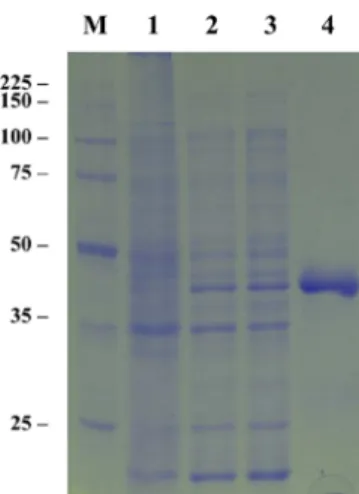
As shown in Fig. 1, recombinant TmPec was overexpressed in E.
coli BL21, and purified by Ni2+-NTA-agarose column chromatography.
Fig. 1 Expression of recombinant TmPec in E. coli. The ORF of TmPec gene was introduced into pRSET expression vector and expressed in E.
coli. Protein extracts prepared from induced E. coli were analyzed by 10% SDS-PAGE and stained with Coomassie Blue. Lane M: Molecular weight marker. Lane 1: total extract of E. coli. harboring pRSET plasmid only. Lane 2: total extract of E. coli harboring pRBTmPec. Lane 3:
soluble fraction of E. coli extract harboring pRBTmPec. Lane 4: purified recombinant TmPec.
J Appl Biol Chem (2014) 57(2), 137−140 139
The estimated molecular weight of recombinant TmPec containing hexahistidine domain derived from pRSET vector were approximately 47,000 Da. This value is in accord with the value calculated from deduced amino acids.
The pectinase activity of recombinant TmPec was assayed in a reaction mixture containing 0.25% citrus pectin and 2µL of purified recombinant TmPec. The reducing sugars were released from citrus pectin by rercombinant TmPec, showing that the rercombinant TmPec had pectin degradation activity. The protein concentration of purified recombinant TmPec was 1.1 mg/mL and showed a specific activity of 56 U/mg protein on pectin.
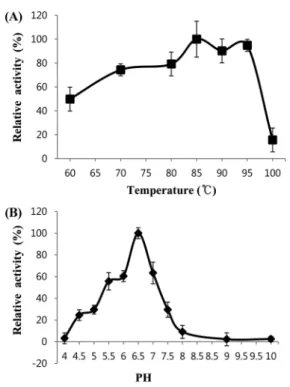
Biochemical properties of recombinant TmPec. The optimum temperature and pH of recombinant TmPec are shown in Fig. 2.
The optimum temperature on the activity of recombinant TmPec was tested at pH 6.5 from 60 to 100oC. The recombinant TmPec showed the highest activity at around 85−95oC (Fig. 2A), and retained more than 80% of its activity up to 95oC.
The optimum pH on the activity of recombinant TmPec was tested at 85oC in the pH range 4.0 to 10.0. The recombinant TmPec showed the highest activity at around pH 6.5 (Fig. 2B) and retained more than 60% of its activity in the range of pH 5.5–7.0.
Thermostability of recombinant TmPec. Effect of temperature
on the activity of recombinant TmPec are shown in Fig. 3. For thermostability determination, the recombinant TmPec was incubated at 80–100oC. The enzyme was extracted every 30 min for 180 min and the residual activity was determined. The recombinant TmPec retained over 90% of its activity after 180 min at 85oC; however, the activity was decreased after 30 min at 90oC (Fig. 3).
Effect of metal ions on the activity of recombinant TmPec. To determine the effect of metal ions on the activity of the recombinant TmPec, enzyme assay was carried out in the presence of various metal ions at 1 mM concentrations. The activity of recombinant TmPec was increased to 146.3% by Ca2+. On the other hand, Ba2+
and Mn2+ showed strong inhibition to the recombinant TmPec (Table 1).
The effect of Ca2+ was assayed at different CaCl2 concentration.
The recombinant TmPec showed the highest activity at 0.6 mM CaCl2 and further increase of CaCl2 concentration decreased the activity of the recombinant TmPec (data not shown).
The gene encoding thermostable pectinase (TmPec) was cloned from T. maritima, and overexpressed in E. coli through recombination into pRSET expression vector. Referring to the previous studies (Kluskens et al., 2003), the TmPec gene excluding signal sequence of 27 amino acids was amplified by PCR and Fig. 2 Optimum temperature and pH of recombinant TmPec. (A)
Optimum temperature of recombinant TmPec. A 0.5% of citrus pectin was incubated for 30 min with 0.1 U of purified recombinant TmPec at various temperatures in a final volume of 300µL of a reaction mixture containing 50 mM sodium phosphate buffer (pH 6.5) and 0.6 mM CaCl2. (B) Optimum pH. For the pH test, 50 mM McIlvaine buffer (pH 4–6), sodium phosphate buffer (pH 6–8), glycine-NaOH buffer (pH 8–10) were used. A 0.5% of citrus pectin was incubated at 85oC for 30 min with 0.1 U of purified recombinant TmPec at various pHs in a final volume of 300 µL. The data represent the mean of three independent experiments.
Fig. 3 Thermostability of recombinant TmPec. The recombinant TmPec was incubated at 80, 85, 90, 95, and 100oC. The enzyme was extracted every 30 min for 180 min and the residual activity was determined. The data represent the mean of three independent experiments.
Table 1 Effect of metal ions on the activity of recombinant TmPec
Metal ions Activity (%)
Control 100.0
Ba2+ 33.9
Ca2+ 146.3
Cd2+ 84.1
Co2+ 54.0
Cu2+ 124.7
Fe3+ 87.4
K+ 91.0
Mg2+ 57.3
Mn2+ 43.7
Na+ 101.0
Zn2+ 79.7
140 J Appl Biol Chem (2014) 57(2), 137−140
introduced into the pRSET-B vector to produce pRBTmPec. The recombinant TmPec contained extra 44 amino acids at the N- terminal region including 6-His region, T7 gene 10 leader, and polylinker site derived from pRSET-B vector. The extra 44 amino acids could affect the biochemical properties of recombinant TmPec. The recombinant TmPec showed the highest activity at around 85oC, and at around pH 6.5. These results were slightly different from the previous studies which reported the optimum temperature and pH were 90oC and 9.0 (Kluskens et al., 2003).
With its thermostable property, the recombinant TmPec has an excellent potential for applications in industrial scale biomass degradation and refining. Studies on the substrate specificity, other biochemical properties and the industrial use of recombinant TmPec are under progress.
Acknowledgment This work was supported by Seowon university.
References
Alkorta I, Garbisu G, Llama MJ, and Serra JL (1998) Industrial applications of pectic enzymes: a review. Process Biochem 33, 21–8.
Beg QK, Bhushan B, Kapoor M, and Hoondal GS (2000) Production and characterization of thermostable xylanase and pectinase from a Streptomyces sp. QG-11-3. J Ind Microbiol Biotechnol 24, 396–402.
Blanco P, Sieiro C, and Villa TG (1999) Production of pectic enzymes in yeasts. FEMS Microbiol Lett 175, 1–9.
Bonch-Osmolovskaya EA, Slesarev Al, Miroshnichenko ML, Svetlichnaya TP, and Alekseev VA (1998) Characteristics of Desulfurococcus amyloliticus sp. nov., a new extremely thermophlilic archaebacterium isolated from thermal springs of Kamchatka and Kunashir lsland.
Mikrobiologiya 57, 94–101.
Bradford MM (1976) A rapid and sensitive method for the quantitation of microgram quantities of protein utilizing the principle of protein-dye binding. Anal Biochem 72, 248–54.
Bredholt S, Sonne-Hansen J, Nielsen P, Mathrani lM, and Ahring BK (1999) Caldicelllulosiruptor kristjanssonii sp. nov., a cellulolytic, extremely thermophilic, anaerobic bacterium. lnt J Syst Bacteriol 49, 991–6.
Bruhlmann F (1995) Purification and characterization of an extracellular pectate lyase from an Amylocota sp. Appl Environ Microbiol 61, 3580–5.
Chhabra SR, Shockley KR, Ward DE, and Kelly RM (2002) Regulation of endo-acting glycosyl hydrolases in the hyperthermophilic bacterium Thermotoga maritima grown on glucan-and mannan-based polysaccharides.
Appl Environ Microbiol 68, 545–54.
Dosanjh NS and Hoondal GS (1996) Production of constitutive, themostable,
hyperactive exopectinase from Bacillus GK-8. Biotechnol Lett 18, 1435–
8.
Hoondal GS, Tiwari RP, Tewari R, Dahiya N, and Beg QK (2002) Microbial alkaline pectinases and their industrial applications: a review. Appl Microbiol Biotechnol 59, 408–18.
Huang LK and Mahoney RR (1999) Purification and characterization of an endopolygalacturonase from Verticilum alboatrum. J Appl Microbiol 86, 145–56.
Huber R, Langworthy TA, König H, Thomm M, Woese CR, Sleytr UB et al.
(1986) Thermotoga maritima sp. nov. represents a new genus of unique extremely thermophilic eubacteria growing up to 90oC. Arch Microbiol 144, 324–33.
Kapoor M, Beg QK, Bhushan B, Dadhich KS, and Hoondal GS (2000) Production and partial purification and characterization of a thermo- alkali stable polygalacturonase from Bacillus sp. MGcp-2. Process Biochem 36, 467–73.
Kashyap DR, Chandra S, Kaul A, and Tewari R (2000) Production, purification and characterization of pectinase from a Bacillus sp. DT7.
World J Microbiol Biotechnol 16, 277–82.
Kashyap DR, Vohra PK, Chopra S, and Tewari R (2001) Applications of pectinases in the commercial sector: a review. Bioresour Technol 77, 215–27.
Kim YH, Kwon TK, Park SS, Seo HS, Cheong J-J, Kim CH et al. (2000) Trehalose synthesis by sequential reactions of recombinant maltooligo- syltrehalose synthase and maltooligosyltrehalose trehalohydrolase from Brevibacterium helvolum. Appl Environ Microbiol 66, 4620–4.
Kluskens LD, van Alebeek G-JWM, Voragen AGJ, de Vos WM, and van der Oost J (2003) Molecular and biochemical characterization of the thermoactive family 1 pectate lyase from the hyperthermophilic bacterium Thermotoga maritima. Biochem J 370, 651–9.
Kozianowski G, Canganella F, Rainey FA, Hippe H, and Antranikian G (1997) Purification and characterization of thermostable pectate-lyases from a newly isolated thermophilic bacterium, Thermoanaerobacter italicus sp. nov. Extremophiles 1, 171–82.
Nelson KE, Clayton RA, Gill SR, Gwinn ML, Dodson RJ, Haft DH et al.
(1999) Evidence for lateral gene transfer between Archaea and bacteria from genome sequence of Thermotoga maritima. Nature (London) 399, 323–9.
Schink B and Zeikus JG (1983) Characterization of pectinolytic enzymes of Clostridium thermosulfurogenes. FEMS Microbiol Lett 17, 295–8.
Stratilova E, Breierova E, and Vadkertiova R (1996) Effect of cultivation and storage pH on the production of multiple forms of polygalacturonase by Aspergillus niger. Biotechnol Lett 18, 41–4.
Takao M, Nakaniwa T, Yoshikawa K, Terashita T, and Sakai T (2000) Purification and characterization of thermostable pectate lyase with protopectinase activity from thermophilic Bacillus sp. TS 47. Biosci Biotechnol Biochem 64, 2360–7.
Von Heijne G (1986) A new method for predicting signal sequence cleavage sites. Nucleic Acids Res 14, 4683–90.