369
©The Korean Society of Food Science and Technology
Deinococcus geothermalis 유래 maltogenic amylase의
유전자 발현 및 특성확인
정진우·정종현·서동호·김병용·박천석*
경희대학교 식품생명공학과 및 생명자원과학연구원
Molecular Cloning and Characterization of Maltogenic Amylase from
Deinococcus geothermalis
Jin-Woo Jung, Jong-Hyun Jung, Dong-Ho Seo, Byung-Yong Kim, and Cheon-Seok Park*
Department of Food Science & Biotechnology and Institute of Life Sciences & Resources, Kyung Hee University
Abstract A putative maltogenic amylase gene (DGMA) was cloned from the Deinococcus geothermalis DSM 11300 genome using the polymerase chain reaction. The gene encoded 608 amino acids with a predicted molecular mass of 68,704 Da. The recombinant DGMA was constitutively expressed using the pHCXHD plasmid. As expected, the
recombinant DGMA hydrolyzed cyclodextrins and starch to maltose and pullulan to panose by cleaving the
α-(1,4)-glycosidic linkages, as observed for typical maltogenic amylases. Characterization of the recombinant DGMA revealed that
the highest maltogenic amylase activity occurred at 40oC and pH 6.0. The half-life of catalytic activity at 65oC and 55oC
were 8.2 min and 187.4 min, respectively. DGMA mainly hydrolyzed β-cyclodextrin, soluble starch, and pullulan and its efficient ratio of those substrates was 9:4.5:1.
Keywords: maltogenic amylase, Deinococcus geothermalis, β-cyclodextrin, panose
서
론
Maltogenic amylase(MAase; EC 3.2.1.133)는 neopullulanase(NPase; EC 3.2.1.135)와 cyclomaltodextrinase(CDase; EC 3.2.1.54)와 함께 전분분해 효소인 α-amylase 계열의 효소에 포함되며 cyclodex-trin(CD)을 효과적으로 가수분해하는 효소로 알려져 있다. 이들 CD 분해효소들은 아미노산 서열의 유사도가 높은 편으로 상호 간 40-60%에 해당하는 높은 상동성을 보이며 구조적으로는 glycoside hydrolases(GH) family 13에 속해 (β/α)8원통형 구조를 기본 골격으로 하여 4군데의 공통적인 상동부위 서열을 공유하 면서 서로 차별되는 다양한 기질 특이성을 가지는 것으로 알려 져 있다(1,2). 특히 이들 효소들은 일반 α-amylase에 존재하지 않 은 130여개 아미노산으로 이루어진 N-말단 도메인을 가지고 있 는데 최근 연구 결과에서 N-말단 도메인 부위는 효소의 활성부 위(catalytic domain)로부터 독립적으로 구별되어, 효소의 oligomeric 구조 형성에 깊이 관여하는 것으로 보고되었다(3). Neopullulanase 효소는 Bacteroides thetaiotaomicron 95-1(4), alkalophilic
Bacil-lus(5), Bacillus polymyxa CECT155(6)등과 같은 미생물에서 발견 되었으며 α-D-(1,6)-glycosidic 결합과 α-D-(1,4)-glycosidic 결합을 가수분해하는 동시에 당을 전이하는 활성을 나타냈다(7). 특히 pullulan을 가수분해하여 기능성 당인 panose 및 glucose와 maltose 를 생산하는 것으로 보고되었다(8). 이와는 다르게 cyclomaltodex-trinase는 일반적인 starch 및 pullulan 등의 기질보다는 주로 cyclo-dextrin(CD)에 대해서 높은 활성으로 가수분해를 한다고 알려져 있다(9). Maltogenic amylase는 α-D-(1,6)-glycosidic 결합보다 α-D -(1,4)-glycosidic 결합을 더 잘 분해하며, 최종적으로 CD 와 soluble starch 기질을 주로 maltose 단위로 분해하기 때문에 ‘maltogenic amylase’로 명명되었다. 또한 이 외에도 maltogenic amylase 효소 들은 pullulan을 분해하여 panose를 생산하는 것으로 알려졌고, α-amylase 등 amylolytic enzyme들의 강력한 저해제로 알려진 acar-bose도 가수분해 할 수 있는 특성을 가지고 있다(10).
Deinococcus geothermalis DSM 11300은 Gram 양성균이며, 이 탈리아 나폴리의 Agnano의 온천에서 분리동정되었으며 D. geo-thermalis는 총 유전자 염기 서열이 보고되었다(11,12). D. geother-malis는 우라늄의 저항성을 가지는 세균이고, 55oC라는 비교적 높 은 온도에서 성장하는 특성을 가지고 있다(12). 또한 amylosucrase, branching enzyme을 비롯하여 다양한 전분 관련 효소를 생산하고 있다(13,14). 본 연구에서는 D. geothermalis DSM 11300로부터 기 존의 CD 분해효소들과 상동성은 낮으나 CD 분해효소들의 공통 적인 N-말단 도메인을 가지고 있는 것으로 확인된 dgeo_0475 유 전자를 이용하여 재조합 단백질을 생산, 정제하여 그 효소학적 특성을 알아보고자 하였다.
*Corresponding author: Cheon-Seok Park, Department of Food Sci-ence & Biotechnology and Institute of Life SciSci-ence & Resources, Kyung Hee University, Yongin, Gyeonggi 446-701, Korea
Tel: 82-31-201-2631 Fax: 82-31-204-8116 E-mail: [email protected]
Received March 5, 2011; revised April 14, 2011; accepted April 14, 2011
재료 및 방법
균주
본 연구에 사용한 D. geothermalis DSM 11300은 TGY 배지 (0.5% tryptone, 0.3% yeast extract 그리고 0.1% glucose)를 이용 하여 50oC에서 배양하였다. 클로닝 및 발현을 위하여 Escherichia
coli DH10B [F– araD139 ∆ (ara leu)7697 ∆lacX74 galU galK rpsL deoR Φ80lac Z∆M15 endA1 nupG recA1 mcrA ∆(mrr hsdRMS mcrBC)] 균주를 사용하였으며 Luria-Bertani(LB, BD Diagnostic Systems, Sparks, MD, USA) 배지를 이용하여 37°C에 서 배양하였다.
시약
T4 DNA ligase, Pfu DNA polymerase와 같은 restriction endo-nucleases, modifying enzymes는 New England Biolabs(Beverly, MA, USA)와 Solgent(Seoul, Korea)에서 구입해서 사용했다. 기질 로 사용한 soluble starch, β-cyclodextrin(β-CD)는 Sigma-Aldrich사 (St. Louis, MO, USA)제품을 사용하였으며 pullulan은 Wako사 (Osaka, Japan) 제품을 구입하였다. 또한 당 분석을 위해 What-man(Kent, UK)의 silica gel K5F thin-layer chromatography(TLC) 를 사용했다.
유전자 클로닝 및 염기서열 분석
D. geothermalis DSM 11300의 유전자는 GeneAllTM total DNA purification kit(GeneAll Biotechnology, Seoul, Korea)를 사용하여 추출하였다. 이미 알려져 있는 게놈 염기서열을 통해 확인한 MAase 유전자(dgeo_0475: GenBank accession number YP_603946)를 이용 하여 DGMA-F: 5'-CAT ATG AAC ATC ATC TTT GCC GAC C-3'와 DGMA-R: 5'-TCT AGA GGC CAA CAG CAA CCG CCC-3' primer를 제작하였다. DGMA-F primer부위에는 Nde I 제 한효소 인식 부위를 가지며 DGMA-R primer부위에는 Xho I 제 한효소 인식 부위를 가지고 있다. PCR은 Pfu DNA polymerase를 사용하였고 thermal cycler(ASTEC PC-320, ASTEC Inc, Fuku-oka, Japan)를 이용하여 maltogenic amylase유전자를 증폭하였다. PCR을 통해 얻은 단편은 pGEM T-easy 벡터(Promega, Madison, WI, USA)와 결합 후 E. coli DH10B에 형질전환하여 그 서열을 확인하였다.
효소의 생산 및 정제
E. coli에서 효율적인 단백질 발현을 위한 재조합 plasmid의 구 축은 PCR을 통해 얻은 maltogenic amylase유전자를 pGEM T-easy벡터에 결합하여 얻은 plasmid와 pHCXHD(15)를 각각 Nde I 과 Xho I 제한효소로 처리하여 gel extraction kit(Axygen scien-tific Inc, Union City, CA, USA)로 정제한 다음 얻어진 단편들을 연결하여 pHC-DGMA를 제조하였다. 구축된 재조합 plasmid는 효 율적인 발현을 위해 E. coli DH10B에 형질전환하여 ampicillin (100µg/mL)이 포함된 LB 배지에서 37oC에서 14시간 동안 배양 하였다. 배양된 균을 50 mL conical tube(SPL, Pocheon, Korea)에 나누어 담아 4oC, 4,000 rpm에서 15분간 원심분리하였다. 이렇게
원심분리된 균을 lysis buffer pH 7.0(50 mM NaH2PO4, 300 mM
NaCl and 10 mM imidazole)에 풀어서 sonicator를 사용하여 세포 벽을 파쇄하였다. Sonication은 10초 간격으로 30분간 output con-trol 4 micro tip limit에서 진행되었고 sonication이 끝난 후 4oC, 12,000 rpm에서 원심분리하여 최종적으로 20 mL의 crude extract 를 얻었다.
효소의 정제는 Ni-NTA affinity chromatography를 이용하였다. 먼저 chromatography column(0.8·4 cm, Bio-Rad, Hercules, CA, USA)에 Ni-NTA Superflow(Qiagen, Valencia, CA, USA) 1 mL을 넣었다. 정제에는 총 3가지 buffer가 사용되었으며 이는 lysis buffer, washing buffer pH 7.0(50 mM NaH2PO4, 300 mM NaCl and 20 mM imidazole), elution buffer pH 7.0(50 mM NaH2PO4, 300 mM NaCl and 250 mM imidazole)가 사용되었다. 1 mL의 crude extract를 column에 흘린 후 5 mL씩 두 번 washing buffer 를 이용하여 washing후 마지막으로 elution buffer 3 mL을 흘려 원 하는 단백질만을 모을 수 있었다. 이렇게 모아진 eluted enzyme 을 vivaspin(30,000 MWCO, Sartorius stedim, Goettingen, Ger-many)을 이용하여 효소의 최적 buffer인 40 mM sodium acetate buffer(pH 6.0)를 이용해 1 mL로 농축하였다.
효소활성 측정
효소의 활성 측정 방법은 환원당의 양을 측정 하는 DNS(dini-trosalicylic acid)방법을 사용하였다(16). 효소 반응액은 효소의 최 적 buffer인 sodium acetate(pH 6.0) 100 µL, DDW 100 µL, 1% pullulan 250µL를 사용하여 450 µL의 효소반응용액을 구성하였 다. 효소를 제외한 reaction mixture를 1.5 mL tube에 넣고 최적온 도(40oC)에서 5분간 pre-heating한 후 50 µL의 enzyme을 넣어 10
분 반응하였고, 반응은 DNS 용액 500 µL을 넣어서 종료시켰다. 대조구는 반응 중에 enzyme 대신 멸균수를 첨가한 것으로 사용 하였다. 이상의 reaction mixture는 DNS를 넣고 100oC에서 5분간
끓인 후 냉각시키고, 흡광도는 spectrophotometer(UV 1201, Shi-madzu, Kyoto, Japan)를 사용해서 575 nm에서 측정하였다.
효소의 최적 활성을 나타내는 조건을 찾기 위해 30-55oC 범위
의 온도와 3.0-9.0 범위의 pH조건에서 활성을 측정하였다. 먼저 최적 pH 조건을 찾기 위해 40oC에서 pH 3.0-9.0까지 실험하였다
(40 mM sodium citrate buffer pH 3.0, 4.0, 5.0, and 6.0; 40 mM sodium acetate buffer pH 4.0, 5.0, and 6.0; 40 mM sodium phosphate pH 6.0, 7.0, and 8.0; 40 mM Tris-HCl pH 7.0, 8.0, and 9.0). 활성을 나타내는 효과적인 온도는 40 mM sodium acetate pH 6.0에서 30-55oC까지 실험하였다. DGMA의 열 안정성은 45, 55, 65oC에서 관찰하였다. 활성측정은 위에 언급한
DNS 방법으로 수행하였고 동일한 조건하에서 측정되었다. 박막 크로마토그래피
효소의 가수분해반응 산물을 확인하기 위하여 Silica gel K5F thin layer chromatography plate(Whatman, Kent, UK)를 이용하여 TLC분석을 실시하였다. 전개 용매는 2-propanol:ethyl acetate:water =3:1:1(v/v/v)을 사용하였으며 전개 후 건조시킨 다음 dipping solution(methanol 950 mL, sulfuric acid 50 mL, 1-naphtol 3 g)을 이용하여 발색시켜 110oC에서 건조하여 확인하였다.
결과 및 고찰
Maltogenic amylase 유전자의 클로닝
D. geothermalis DSM 11300균주로부터 maltogenic amylase 유 전자를 클로닝하기 위하여 이미 밝혀진 dgeo_0475유전자 염기서 열(GenBank accession number YP_603946)을 바탕으로 primer를 설계하고 PCR 방법을 통해 maltogenic amylase로 예상되는 유전 자를 얻어내었다. PCR 단편은 pGEM-T-easy 벡터와 결합하여 그 시퀀스를 확인한 결과 이 유전자는 1,827 bp의 길이로 608개의 아미노산을 암호화하고 있으며 예상된 분자량은 약 68,704 Da이
었다. 이는 알려진 기존의 CD 분해효소와 비슷한 분자량을 보여 주고 있으나 단백질 서열을 NCBI의 BLAST 프로그램(http:// www.ncbi.nlm.nih.gov)과 alignment분석을 한 결과 Thermoactino-myces vulgaris R-47의 amylase II와 27%, Thermus sp. IM6501 maltogenic amylase(ThMA)와 27%, Geobacillus stearothermophi-lus neopullulanase와 26%의 낮은 상동성을 가지고 있는 것으로 나타났다(Table 1)(17-19). 하지만 DGMA는 다른 CD 분해효소들 과 같이 α-amylase의 공통적인 상동부위 conserved region(CR) I-IV가 존재하고 있으며 CD 분해효소들의 공통적인 특징인 N-말 단 도메인을 가지고 있었다(3). 특히 공통적인 상동부위인 (CR) I-IV 부분은 낮은 상동성에도 불구하고 다른 CD 분해효소와 매 우 유사함을 보여주고 있는 데 그 중 CR III 부분만은 다른 여 타 CD 분해효소와 다른 잔기를 가지고 있었다(Fig. 1). 대부분의 CD 분해효소의 CR III 부분은 활성 부위 중 하나인 glutamic acid 을 포함하여 ‘E(I/V/S)WH’로 이루어진 반면 DGMA는 ‘ERFF’로 존재하고 있었다. Maltogenic amylase 및 neopullulanase의 구조연 구에 따르면 CR III 부분은 기질 결합 시 +1 부위에 영향을 주 는 곳으로 알려져 있는 곳이다(3,18).
E. coli에서 maltogenic amylase의 발현 및 정제
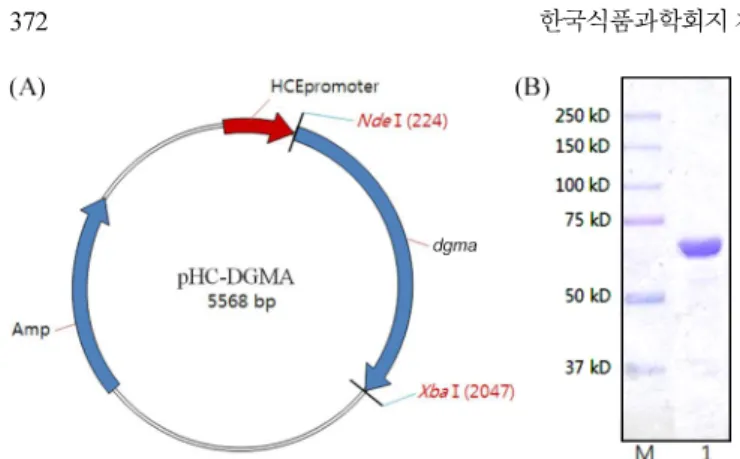
DGMA의 발현은 항시 발현 프로모터를 가지고 있는 pHCXHD 벡터를 이용하였다. 발현을 위해 Nde I과 Xho I 제한효소를 이 용하여 pHCXHD 벡터와 dgma 유전자가 들어있는 pGEM-T-easy 벡터에 각각 처리하여 단편을 얻어 발현벡터인 pHC-DGMA를 제 조하였으며 효소발현을 위한 숙주인 E. coli DH10B를 사용하였 다(Fig. 2A). Plasmid pHC-DGMA가 형질전환된 E. coli DH10B
를 37oC에서 14시간 배양한 후, 배양된 세포를 sonicator로 파쇄
하여 Ni-NTA affinity chromatography를 통해 단백질을 정제하였 다. 정제된 단백질은 SDS-PAGE를 통해 확인하였고 그 결과 아 미노산 서열에서 계산된 분자량과 일치하는 약 68 kDa 부근의 위 치에서 순수 분리된 DGMA의 단일 band를 확인할 수 있었다(Fig. 2B). 재조합 maltogenic amylase 반응의 최적 조건 정제된 DGMA의 효소활성은 환원당 측정법인 DNS방법을 이 용하여 측정하였다. 최적 온도 및 pH를 확인하기 위해 30-55oC 온도 범위와 pH 3.0-9.0의 범위에서 효소 활성을 측정한 결과 DGMA는 40oC의 온도에서 최고 활성을 보였으며 이 때 최적 pH 는 pH 6.0으로 나타났다(Fig. 3). pH 5.0 이하의 산성 조건에서는 효소의 활성이 80% 이상 감소하였으며 pH 8.0 이상에서도 50% 이상 효소의 활성이 감소하는 것으로 나타났지만 pH 6.0 과 7.0 사이에서 효소 활성의 70% 이상이 유지되었다. 이러한 효소의 최적 pH 범위는 현재까지 알려진 대부분의 Bacillus속의 CD 분 해효소가 pH 6.0-7.0 사이에서 최고 활성을 보여주는 것과 유사 하였다(Table 1)(8,20). 또한 효소의 열안정성은 65oC와 55oC 에서 반감기가 각각 8.2분과 187.4분으로 최적온도 이상에서 상당시간 효소활성이 유지됨을 보여주었다(Fig. 3C). DGMA의 경우 효소 의 최적온도가 40oC로 상대적으로 고온에서 잘 성장하는 것으로 알려진 D. geothermalis 균주의 생장온도보다 낮다. 이는 D. geo-thermalis에서 생산되는 다른 전분관련효소에서도 나타나는 특성 으로 amylosucrase의 경우 최적온도는 45oC, glycogen branching
enzyme의 경우는 최적온도가 34oC로 알려져 있다(13,14). Table 1. Comparison of biochemical properties of DGMA and those of other CD-degrading enzymes
Enzyme Microorganism Optimal
Temp.
Optimal
pH Substrate preference
Identity
(%) Reference Maltogenic amylse Deinococcus geothermalis 40.0 6.0 CD>SS≫PL 100 In this study Maltogenic amylse Lactobacillus gasseri 55.0 5.0 CD≫PL>SS 22 (21) Maltogenic amylse Thermus sp. IM6501 60.0 6.0 CD≫PL>SS 27 (19) Neopullulanase Bacillus stearothermophilus 55.0 6.0 PL≫SS 26 (22)
CDase Bacillus sp. I-5 45.0 6.5 CD≫PL≫SS 26 (9)
CDase Anoxybacillus flavithermus 57.5 6.5 CD≫SS>PL 25 (25)
Amylase I Thermoactinomyces vulgaris R-47 40.0 5.5 SS≫PL≫CD 25 (17) Amylase II Thermoactinomyces vulgaris R-47 40.0 6.0 PL >SS≫CD 27 (17) CD, Cyclodextrin; SS, Soluble starch; PL, Pullulan.
Fig. 1. Comparison of amino acid residues in the conserved region (I-IV) of D. geothermalis maltogenic amylase and various CD-degrading enzymes. Highly conserved amino acids are shade black. ThMA, Thermus sp. maltogenic amylase; LGMA, Lactobacillus gasseri maltogenic amylase; AFCDase, Anoxybacillus flavithermus CDase; I-5 CDase, Bacillus sp. I-5 CDase; BSNP, Bacillus stearothermophilus neopullulanase; TVA-I, Thermoactinomyces vulgaris R-47 amylase I; TVA-II, Thermoactinomyces vulgaris R-47 amylase II.
재조합 maltogenic amylase의 가수분해 특성 CD 분해효소들은 α-amylase가 가지는 기질 특이성과는 다른 특성을 가지고 있다. 이들 효소들은 starch를 비롯하여 CD와 pullulan 등 다양한 기질들에 대해 가수분해 활성을 가지고 있는 데 반하여 α-amylase는 CD, pullulan과 같은 기질을 분해하지 못 하는 것으로 알려져 있다. DGMA의 경우 CD 분해효소와 마찬 가지로 starch 뿐만 아니라 pullulan과 β-CD를 가수분해하는 특성 을 가지고 있는 것으로 나타났다(Fig. 4). TLC 를 통해 가수분해 산물을 확인하여 본 결과 β-CD와 반응하여 glucose와 maltose를 생성하였고 pullulan 또한 비교적 잘 분해하여 glucose 및 maltose 와 함께 미량의 panose를 생산하였다. 기존의 다른 maltogenic amylase는 α-D-(1,4)-glycosidic 결합을 가수분해 하여 panose를 주 로 생성하는 것으로 알려져 있으나 DGMA의 경우에는 pullulan 을 가수분해하여 소량의 panose만을 생성하고 대부분 glucose와 maltose를 생성했다. 이는 기질의 α-D-(1,4)-glycosidic 결합보다
α-D-(1,6)-glycosidic 결합을 먼저 가수분해하여 maltotriose를 먼저 생 성하기 때문으로 보이며 기존의 Lactobacillus gasseri의 maltogenic amylase가 α-D-(1,6)-glycosidic 결합의 가수분해를 α-D -(1,4)-glyco-sidic 결합보다 더 선호하는 것으로 보고된 바 있다(21).
Soluble starch를 가수분해 한 경우 panose와 함께 maltotet-raose(G4)와 maltohexaose(G6)가 남아있었으나 대부분의 분해 산 물들은 glucose 및 maltose로 확인되었다(Fig. 4). Cyclodextrinase, maltogenic amylase, 그리고 neopullulanase와 같은 대부분의 CD
분해효소들은 다른 기질에 비해 CD에 대한 활성이 starch 나 pullulan에 비해 높은 것으로 알려져 있다. Bacillus sp. I-5 유래의 cyclodextrinase의 경우 starch보다 β-CD를 13배 더 잘 분해하고 pullulan보다는 33배 더 잘 분해한다고 보고된 바 있으며(9), B. stearothermophilus에 존재하는 neopullulanase의 경우 starch 와 pullulan 보다 β-CD를 10배 정도 더 잘 분해한다고 알려져 있다 (22). 또한 maltogenic amylase도 마찬가지로 B. subtilis 유래 효소 인 경우 starch 및 pullulan보다 β-CD에 대한 가수분해 활성이 30 배 정도 높으며 Lb. gasseri의 maltogenic amylase는 β-CD, solu-ble starch, pullulan에 대한 활성 비율이 9:1:1.9로 보고된바 있다 (21,23). 이에 반해 DGMA는 β-CD에 대한 가수분해능력이 다른 기질에 비해 높기는 하였지만 soluble starch에 비하여 2배, pullu-lan 에 대해서는 9배 높은 것으로 나타나 기존의 CD 분해효소에 비해 차이가 있었다(Table 2). 뿐만 아니라 amylopectin과 glycogen 또한 pullulan과 비슷한 효율로 가수분해하였다. 일반적으로 CD Fig. 4. Hydrolysis pattern of recombinant DGMA on β-cyclodextrin, pullulan and soluble starch. Lane S, G1-G7 standard; CD, β-cyclodextrin; Pul, pullulan; SS, soluble starch. Fig. 2. Vector map of expression vector, pHC-DGMA (A) and
SDS-PAGE analysis of recombinant DGMA (B). Lane M, protein size marker; Lane 1, elute from Ni-NTA chromatography.
분해효소의 활성 부위는 α-amylase의 활성 부위보다 상대적으로 좁고 깊은 형태를 가지고 있기 때문에 starch나 pullulan과 같은 큰 기질보다 β-CD와 같이 작은 크기의 기질이 쉽게 효소의 활 성 부위와 결합할 수 있다고 알려져 있다(3). 반면 DGMA의 경 우 기존의 다른 CD 분해효소와 상동성도 낮으며 일차구조가 CD 분해효소 보다 T. vulgaris R-47 α-amylase I와 상대적으로 유사 한 점이 많은 것으로 미루어 아마도 구조적으로 활성부위 부분 이 기존의 CD 분해효소와 차이가 있을 것으로 예상된다(24). 또 한 DGMA 대부분의 기질을 glucose와 maltose로 분해하는 강한 가수분해 활성을 보여주고 있는데, 이는 앞서 언급했던 +1 결합 부위에 존재하는 CR III 부분의 영향이 큰 것으로 추측된다. 특 히 DGMA의 경우 soluble starch, pullulan등의 다당류 기질을 대 부분 glucose와 maltose로 가수분해하는 특성을 보여주고 있는데 이는 전분당 생산에 응용할 수 있을 것으로 예상된다.
요
약
D. geothermalis의 dgeo_0475 유전자로부터 만들어지는 효소를 정제하여 그 특성을 확인하였다. DGMA는 분자량이 약 68 kDa 크기의 효소로서 β-CD, soluble starch 및 pullulan을 가수분해하 는 CD 분해 효소임을 확인하였다. 효소의 최적 온도는 40oC 최
적 pH 는 6.0이며 대부분의 기질들을 glucose와 maltose로 가수 분해 하였고 pullulan 및 soluble starch로부터 미량의 panose를 생 성하였다. β-CD를 가장 잘 가수분해하나 기질간 상대적 활성차 이는 다른 CD 분해효소에 비하여 크지 않았다.
감사의 글
본 연구는 2008년도 경희대학교 교원연구년 지원(과제번호: 20080030)으로 수행된 결과입니다.문
헌
1. Lee HS, Kim MS, Cho HS, Kim JI, Kim TJ, Choi JH, Park C, Oh BH, Park KH. Cyclomaltodextrinase, neopullulanase, and maltogenic amylase are nearly indistinguishable from each other. J. Biol. Chem. 277: 21891-21897 (2002)
2. Park KH, Kim TJ, Cheong TK, Kim JW, Oh BH, Svensson B. Structure, specificity, and function of cyclomaltodextrinase, a multispecific enzyme of the α-amylase family. Biochim. Biophys. Acta 1478: 165-185 (2000)
3. Kim JS, Cha SS, Kim HJ, Kim TJ, Ha NC, Oh ST, Cho HS, Cho MJ, Kim MJ, Lee HS, Kim JW, Choi KY, Park KH, Oh BH. Crystal structure of a maltogenic amylase provides insights into a catalytic versatility. J. Biol. Chem. 274: 26279-26286 (1999)
4. Smith KA, Salyers AA. Characterization of a neopullulanase and an alpha-glucosidase from Bacteroides thetaiotaomicron 95-1. J.
Bacteriol. 173: 2962-2968 (1991)
5. Igarashi K, Ara K, Saeki K, Ozaki K, Kawai S, Ito S. Nucleotide sequence of the gene that encodes a neopullulanase from an alkalophilic Bacillus. Biosci. Biotech. Bioch. 56: 514-516 (1992) 6. Yebra MJ, Blasco A, Sanz P. Expression and secretion of Bacillus
polymyxa neopullulanase in Saccharomyces cerevisiae. FEMS Microbiol. Lett. 170: 41-49 (1999)
7. Takata H, Kuriki T, Okada S, Takesada Y, Iizuka M, Minamiura N, Imanaka T. Action of neopullulanase. Neopullulanase catalyzes both hydrolysis and transglycosylation at α-(1→4)- and α-(1→6)-glucosidic linkages. J. Biol. Chem. 267: 18447-18452 (1992) 8. Kamasaka H, Sugimoto K, Takata H, Nishimura T, Kuriki T.
Bacillus stearothermophilus neopullulanase selective hydrolysis of amylose to maltose in the presence of amylopectin. Appl. Envi-ron. Microb. 68: 1658-1664 (2002)
9. Kim TJ, Shin JH, Oh JH, Kim MJ, Lee SB, Ryu S, Kwon K, Kim JW, Choi EH, Robyt JF, Park KH. Analysis of the gene encoding cyclomaltodextrinase from alkalophilic Bacillus sp. I-5 and characterization of enzymatic properties. Arch. Biochem. Biophys. 353: 221-227 (1998)
10. Kim IC, Cha JH, Kim JR, Jang SY, Seo BC, Cheong TK, Lee DS, Choi YD, Park KH. Catalytic properties of the cloned amy-lase from Bacillus licheniformis. J. Biol. Chem. 267: 22108-22114 (1992)
11. Makarova KS, Omelchenko MV, Gaidamakova EK, Matrosova VY, Vasilenko A, Zhai M, Lapidus A, Copeland A, Kim E, Land M, Mavrommatis K, Pitluck S, Richardson PM, Detter C, Brettin T, Saunders E, Lai B, Ravel B, Kemner KM, Wolf YI, Sorokin A, Gerasimova AV, Gelfand MS, Fredrickson JK, Koonin EV, Daly MJ. Deinococcus geothermalis: The pool of extreme radia-tion resistance genes shrinks. PLoS One 2: e955 (2007)
12. Ferreira AC, Nobre MF, Rainey FA, Silva MT, Wait R, Burghardt J, Chung AP, da Costa MS. Deinococcus geothermalis sp. nov. and Deinococcus murrayi sp. nov., two extremely radiation-resis-tant and slightly thermophilic species from hot springs. Int. J. Syst. Bacteriol. 47: 939-947 (1997)
13. Palomo M, Kralj S, van der Maarel MJ, Dijkhuizen L. The unique branching patterns of Deinococcus glycogen branching enzymes are determined by their N-terminal domains. Appl. Environ. Microb. 75: 1355-1362 (2009)
14. Jung JH, Seo DH, Ha SJ, Song MC, Cha J, Yoo SH, Kim TJ, Baek NI, Baik MY, Park CS. Enzymatic synthesis of salicin gly-cosides through transglycosylation catalyzed by amylosucrases from Deinococcus geothermalis and Neisseria polysaccharea. Carbohyd. Res. 344: 1612-1619 (2009)
15. Park JM, Han NS, Kim TJ. Rapid detection and isolation of known and putative α-L-arabinofuranosidase genes using degener-ate PCR primers. J. Microbiol. Biotech. 17: 481-489 (2007) 16. Miller GL. Use of dinitrosalicylic acid reagent for determination
of reducing sugar. Anal. Chem. 31: 426-428 (1959)
17. Tonozuka T, Mogi S, Shimura Y, Ibuka A, Sakai H, Matsuzawa H, Sakano Y, Ohta T. Comparison of primary structures and sub-strate specificities of two pullulan-hydrolyzing α-amylases, TVA I and TVA II, from Thermoactinomyces vulgaris R-47. Biochim. Biophys. Acta 1252: 35-42 (1995)
18. Hondoh H, Kuriki T, Matsuura Y. Three-dimensional structure and substrate binding of Bacillus stearothermophilus neopullula-nase. J. Mol. Biol. 326: 177-188 (2003)
19. Kim TJ, Kim MJ, Kim BC, Kim JC, Cheong TK, Kim JW, Park KH. Modes of action of acarbose hydrolysis and transglycosyla-tion catalyzed by a thermostable maltogenic amylase, the gene for which was cloned from a Thermus strain. Appl. Environ. Microb. 65: 1644-1651 (1999)
20. Cha HJ, Yoon HG, Kim YW, Lee HS, Kim JW, Kweon KS, Oh BH, Park KH. Molecular and enzymatic characterization of a maltogenic amylase that hydrolyzes and transglycosylates acar-bose. Eur. J. Biochem. 253: 251-262 (1998)
21. Oh KW, Kim MJ, Kim HY, Kim BY, Baik MY, Auh JH, Park CS. Enzymatic characterization of a maltogenic amylase from Lactobacillus gasseri ATCC 33323 expressed in Escherichia coli. FEMS Microbiol. Lett. 252: 175-181 (2005)
22. Cheong KA, Kim TJ, Yoon JW, Park CS, Lee TS, Kim YB, Park Table 2. Substrate specificity of maltogenic amylase from
Deinococcus geothermalis
Substrate Relative activity (%)
β-Cyclodextrin 100
Soluble starch 50.8
Amylopectin 11.9
Pullulan 9.4
KH, Kim JW. Catalytic activities of intracellular dimeric neopul-lulanase on cyclodextrin, acarbose and maltose. Biotechnol. Appl. Bioc. 35: 27-34 (2002)
23. Cho HY, Kim YW, Kim TJ, Lee HS, Kim DY, Kim JW, Lee YW, Leed S, Park KH. Molecular characterization of a dimeric intracellular maltogenic amylase of Bacillus subtilis SUH4-2. Bio-chim. Biophys. Acta 1478: 333-340 (2000)
24. Ibuka A, Tonozuka T, Matsuzawa H, Sakai H. Conversion of
neopullulanase-α-amylase from Thermoactinomyces vulgaris R-47 into an amylopullulanse-type enzyme. J. Biochem. 123: 275-282 (1998)
25. Turner P, Labes A, Fridjonsson OH, Hreggvidson GO, Schonheit P, Kristjansson JK, Holst O, Karlsson EN. Two novel cyclodex-trin-degrading enzymes isolated from thermophilic bacteria have similar domain structures but differ in oligomeric state and activ-ity profile. J. Biosci. Bioeng. 100: 380-390 (2005)