https://doi.org/10.16956/kaes.2016.16.4.94
Endocrine Surgery
갑상선수술 후 유착
서울대학교 의과대학 서울대학교병원 외과, 서울대학교 의과대학 암연구소, 서울대학교암병원 갑상선센터 외과,
1서울대학교 의과대학 분당서울대학교병원 외과, 2서울대학교병원운영 서울특별시보라매병원 외과
김영민ㆍ김수진ㆍ이진욱ㆍ성찬용ㆍ김종규ㆍ유형원
1ㆍ채영준
2ㆍ최준영
1ㆍ이규언
Postoperative Adhesion after Thyroid Surgery
Purpose: Postoperative adhesion after thyroidectomy results in neck discomfort and swallowing difficulty. However, risk factors for adhesive symptom after thyroidectomy have not been well studied. This study evaluated symptoms related to postoperative adhesion after thyroidectomy.
Methods: The Glasgow-Edinburgh Throat Scale (GETS) questionnaire was used to evaluate postoperative adhesion. Patients who completed the GETS questionnaire either pre- or post- operatively were enrolled. Patient clinical and pathological details including age, gender, body weight, body mass index (BMI), tumor size, thyroid volume, extent of thyroidectomy, postoperative months, and neck thickness on ultrasonography and computed tomography (CT) were abstracted.
Results: Twenty-eight preoperative (22 females, six males) and 101 postoperative (83 females, 18 males) patients were enrolled. The mean age of the pre-operative enrollees was 52.1±11.7, and of post-operative enrollees 51.8±12.4 years. Patients who were within one month post-surgery had higher GETS scores than preoperative patients (27.4±20.1 vs.
6.5±11.1, P<0.001). Two months after surgery, GETS scores of postoperative patients did not differ significantly from the scores of the preoperative patients. There were no significant associations between clinical and pathologic features (age, tumor size, BMI, neck thickness on ultrasonography and CT) and GETS scores.
Conclusion: Postoperative adhesive symptoms were most severe at one month after surgery, while questionnaire scores two months after surgery were comparable with preoperative patients. Further studies will be required for better understanding of the natural course of postoperative adhesion after thyroidectomy.
Key Words: Thyroidectomy, Postoperative adhesion, Neck discomfort 중심 단어: 갑상선절제술, 수술 후 유착, 목 불편감
Young Min Kim, Su-jin Kim, Jin Wook Yi, Chan-Yong Seong, Jong-Kyu Kim, Hyeong Won Yu1, Young Jun Chai2, June Young Choi1, Kyu Eun Lee
Department of Surgery, Seoul National University Hospital and College of Medicine, Cancer Research Institute, Seoul National University College of Medicine, Division of Surgery, Thyroid Center, Seoul National University Cancer Hospital, Seoul, 1Department of Surgery, Bundang Seoul National University Hospital, Seongnam,
2Department of Surgery, Boramae Medical Center, Seoul, Korea
Received September 5, 2016, Accepted September 26, 2016 Correspondence: Su-jin Kim Department of Surgery, Seoul National University Hospital, Seoul National University College of Medicine, 101 Daehak-ro, Jongno-gu, Seoul 03080, Korea Tel: +82-2-2072-7208 Fax: +82-2-766-3975 E-mail: [email protected]
Copyright © 2016 Korean Association of Thyroid and Endocrine Surgeons; KATES. All Rights Reserved.
cc This is an Open Access article distributed under the terms of the Creative Commons Attribution Non-Commercial License (http://creativecommons.org/licenses/by-nc/4.0) which permits unrestricted non-commercial use, distribution, and reproduction in any medium, provided the original work is properly cited.
서 론
갑상선암의 발생률은 전세계적으로 꾸준히 증가 추세에 있으 며 우리나라의 경우에도 갑상선암의 발생률이 점차 증가하고 있 다. 이에 따라 갑상선절제술의 빈도 또한 지속적으로 증가하고 있다.(1,2) 갑상선암의 경우 환자의 5년 생존율은 95% 이상으로, 발생 빈도는 높지만 갑상선암으로 인한 사망률은 매우 낮기 때문에
수술적 치료를 받고 난 이후 삶의 질에 대한 관리가 중요하다.(1) 특히 최근 의료의 진단 및 치료기법의 발달로 암의 치료에 있 어서 환자의 생존 뿐 아니라 삶의 질을 유지하고자 하는 노력, 즉 수술 전후의 변화를 줄이기 위한 노력이 증대되고 있다. 갑상선 수술 후 발생할 수 있는 삶의 질 저하 요인으로는 통증이나 상처, 경부 불편감, 되돌이후두신경의 손상으로 인한 목소리 변화, 부 갑상선기능저하증에 따른 손발저림 등이 있을 수 있으며, 특히
None Unbearable
1 Feeling of something stuck in the throat 0 1 2 3 4 5 6 7
2 Pain in the throat 0 1 2 3 4 5 6 7
3 Discomfort/irritation in the throat 0 1 2 3 4 5 6 7
4 Difficulty in swallowing food 0 1 2 3 4 5 6 7
5 Throat closing off 0 1 2 3 4 5 6 7
6 Swelling in the throat 0 1 2 3 4 5 6 7
7 Catarrh down throat 0 1 2 3 4 5 6 7
8 Can’t empty throat when swallowing 0 1 2 3 4 5 6 7
9 Want to swallow all the time 0 1 2 3 4 5 6 7
10 Food sticking when swallowing 0 1 2 3 4 5 6 7
11 How much time do you spend thinking about your throat?
0 1 2 3 4 5 6 7
12 At present, how annoying do you find your throat sensation?
0 1 2 3 4 5 6 7
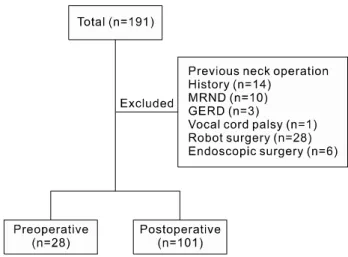
Table 1. The Glasgow-Edinburgh Throat Scale (GETS) questionnaire Fig. 1. Distribution of the patients included in the study. MRND =
Modified radical neck dissection; GERD = Gastroesopha- geal reflux disease.
많은 환자들이 수술 시 중요 구조물의 손상이 없었음에도 불구하 고 갑상선절제술 후 유착으로 인한 경부 압박감이나 불편감, 삼 킴곤란, 인후이물감 등을 호소하고 있다.(3-6)
하지만 현재까지 수술 후 유착으로 인해 발생하는 증상들에 대한 자료가 부족한 실정이며 유착의 중증도와 위험인자들에 대 한 자료가 거의 없다. 이에 따라 저자들은 본 연구에서 갑상선절 제술 후 발생하는 유착으로 인한 임상 양상과 그 위험인자를 알 아보고자 하였다.
방 법
2014년 3월부터 2015년 1월까지 서울대학교병원 갑상선외 과 외래를 방문한 환자들을 대상으로 경부 불편감 평가를 위해 단면적 설문조사를 시행하였다. 설문의 모든 항목에 대해 응답
하였으며 충분한 진료 기록을 분석할 수 있었던 환자를 대상으로 진행하였고, 각 환자당 한번의 설문조사를 시행하였다. 이전 목 부위 수술력이 있는 환자, 수술 전부터 목소리 변성이 있거나 후 두장애가 있는 환자, 이전 위식도역류증을 진단받은 환자들은 제외하였으며, 내시경 또는 로봇 수술을 받은 환자, 측경부 림프 절 절제술을 받은 환자들도 제외하였다(Fig. 1).
설문 조사는 Glasgow-Edinburgh Throat Scale (GETS, 총 84점 만점)을 시행하였고, 각 문항에 대하여 점수를 표시하도록 하였다(Table 1).(7) 한편 나이, 성별, 체중, 키, 체질량지수를 기 록하였고, 갑상선 수술을 받은 환자의 경우 종양의 크기, 절제된 갑상선 무게, 수술범위를 기록하였다. 또한 피부를 포함한 경부 의 두께가 수술 후 유착에 따른 경부불편감을 야기하는지 알아보 기 위하여, 수술 전 경부초음파와 경부 컴퓨터단층촬영 검사에 서 경부 피부두께를 측정하였다. 경부 피부두께는 갑상선 협부 (isthmus) 높이에서 상하절단면으로 초음파 및 컴퓨터단층촬영 영상을 얻은 뒤, 한 명의 저자가 피부에서부터 목넓은근 (platysma muscle)까지의 거리와 피부에서부터 갑상선 협부 (isthmus)까지의 거리를 측정하였다.
또한 수술시기에 따른 경부 불편감을 조사하기 위해 총 7개의 그룹(수술 전, 수술 후 1개월 이내, 수술 후 1개월에서 6개월 사 이, 수술 후 6개월에서 1년 사이, 1년에서 2년 사이, 2년에서 3년 사이 그리고 3년 이상)으로 나누어 점수를 비교해 보았다.
한편 각 시기별로 어떤 인자들이 경부불편감에 영향을 미치는 지 알아보고자 45세, 1 cm의 종양 크기, 체질량지수 25, 경부 피 부두께 중앙값을 기준으로 두 군으로 나누어 설문조사 점수를 비 교해 보았다.
통계처리는 SPSS 20.0 프로그램(SPSS Inc., Chicago, IL, USA) 을 이용하였고, GETS 점수를 비교하기 위해 Mann-Whitney test 를 이용하였으며, 유의 수준은 P<0.05로 하였다.
Characteristics N=101
Age, years (range) 51.8 (19∼82)
Sex (male:female) 18:83
Body mass index, kg/m2 24.0±3.2
Skin thickness at CT
(skin to platysma muscle), mm
4.8±1.9
Skin thickness at CT (skin to isthmus), mm 8.6±3.9 Skin thickness at US
(skin to platysma muscle), mm
1.4±0.4
Skin thickness at US (skin to isthmus), mm 4.4±1.5 Extent of thyroidectomy
Total thyroidectomy (%) 77 (76.2%)
Subtotal thyroidectomy (%) 4 (4.0%) Unilateral lobectomy (%) 20 (19.8%) Disease
Papillary thyroid cancer 89
Minimally invasive follicular carcinoma 2 Widely invasive follicular carcinoma 1
Benign nodule 9
Tumor size, cm 1.1±1.2
Median follow-up period, months (range) 19.9 (1∼187) US = Ultrasonography.
Table 2. Demographics and clinicopathologic characteristics of patients who underwent thyroidectomy
Fig. 2. The change of Glasgow-Edinburgh Throat Scale (GETS) scores according to postoperative period.
Evaluation time n GETS P
Preop 28 6.5 −
<1 month 11 27.36 0.000*
1∼6 months 37 9.78 0.101*
7∼12 months 14 9.36 0.249*
13∼24 months 12 8.17 0.130*
25∼36 months 15 8.47 0.917*
37 months∼ 12 10.75 0.493*
*Mann-Whitney test with preoperative GETS score.
Table 3. Glasgow-Edinburgh Throat Scale (GETS) score according to postoperative period
결 과
총 129명이 분석 대상에 포함되었으며, 이 중 수술 받은 환자 는 101명 이었고, 아직 수술을 받지 않은 환자는 28명이었다. 대 상환자 129명의 평균 나이는 51.8±1.1세였고, 그 중 여성은 105명(81.4%)이었다. 수술 받은 101명의 환자 중 갑상선유두암 으로 진단받은 환자는 89명(87.1%)이었고, 갑상선여포암으로 진단받은 환자가 3명(3.0%), 그 외 질환으로 진단받은 환자가 9 명(8.9%)이었다. 갑상선 전절제술을 시행 받은 환자는 총 77명 (76.2%)이었으며, 갑상선 엽절제술을 시행받은 환자가 20명 (19.8%), 갑상선 아전절제술을 시행 받은 환자는 4명(4.0%)이었 다. 수술 후 추적관찰기간의 중앙값은 7개월(범위, 1∼187)이었 다(Table 2). CT에서 측정한 피부에서부터 목넓은근(platysma muscle)까지의 거리의 중앙값은 4.8 cm이었고, 피부에서부터 갑상선 협부(isthmus)까지의 거리를 중앙값은 8.4 cm이었다.
초음파에서 측정한 피부에서부터 목넓은근(platysma muscle) 까지의 거리의 중앙값은 1.4 cm이었고, 피부에서부터 갑상선 협부(isthmus)까지의 거리를 중앙값은 4.2 cm이었다.
Table 3는 수술 전후 시기에 따른 GETS점수를 나타낸 표이 다. 수술 전 환자들의 평균 GETS점수는 6.5±11.1점이었고, 수 술 후 환자들의 평균 GETS점수는 11.4±14.5점으로 수술 후 환 자들에서 높은 점수를 나타내었으나 통계적 유의성은 없었다 (P=0.062). 수술 시기에 따라 GETS 점수를 비교해보면 수술 후 1개월째 평균이 27.4±20.1점으로 수술 전 환자군과 비교하여
가장 높았으며(P=0.000), 수술 후 2개월 이후부터는 수술전과 유의한 차이가 없었다(Fig. 2).
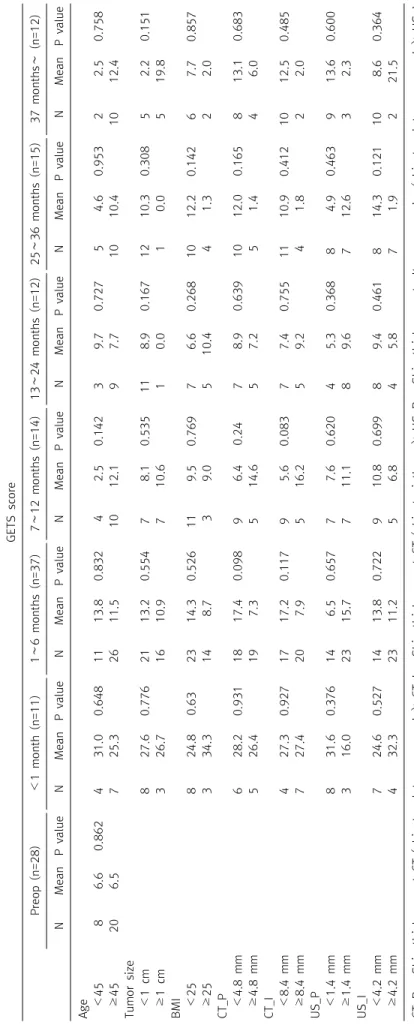
각 시기별로 45세, 1 cm의 종양 크기, 체질량지수 25, 경부 피 부두께 중앙값을 기준으로 두 군으로 나누어 설문조사점수를 비 교해 보았을 때 GETS 점수와 각 요인들과의 관계에서도 관련성 을 나타내지 않았다(Table 4).
고 찰
본 연구에서는 갑상선절제술을 시행 받은 환자를 대상으로 수 술 후 유착과 관련된 경부 불편감의 임상양상을 확인하고 그와 관련된 위험인자를 분석하였다. 이를 위해 기존 연구에서도 갑 상선 수술과 관련하여 삼킴곤란 및 인두불편감의 정도를 평가하 기 위해 널리 사용되고 있는 GETS 설문조사를 통하여 환자의 주 관적 증상을 정량화하였다.(7-10) 위험인자 분석을 위해서는 나 이, 종양의 크기, 체질량지수, 경부 두께와 설문조사 점수 간의 연관성을 확인하였다. 그 결과 수술 전 환자들의 GETS점수와 비 교하여 수술 후 1개월째 환자들의 경부 불편감이 가장 심하였고
GETS score Preop (n=28)<1 month (n=11)1∼6 months (n=37)7∼12 months (n=14)13∼24 months (n=12)25∼36 months (n=15)37 months∼ (n=12) NMeanP valueNMeanP valueNMeanP valueNMeanP valueNMeanP valueNMeanP valueNMeanP value Age <4586.60.862431.00.6481113.80.83242.50.14239.70.72754.60.95322.50.758 ≥45206.5725.32611.51012.197.71010.41012.4 Tumor size <1 cm827.60.7762113.20.55478.10.535118.90.1671210.30.30852.20.151 ≥1 cm326.71610.9710.610.010.0519.8 BMI <25824.80.632314.30.526119.50.76976.60.2681012.20.14267.70.857 ≥25334.3148.739.0510.441.322.0 CT_P <4.8 mm628.20.9311817.40.09896.40.2478.90.6391012.00.165813.10.683 ≥4.8 mm526.4197.3514.657.251.446.0 CT_I <8.4 mm427.30.9271717.20.11795.60.08377.40.7551110.90.4121012.50.485 ≥8.4 mm727.4207.9516.259.241.822.0 US_P <1.4 mm831.60.376146.50.65777.60.62045.30.36884.90.463913.60.600 ≥1.4 mm316.02315.7711.189.6712.632.3 US_I <4.2 mm724.60.5271413.80.722910.80.69989.40.461814.30.121108.60.364 ≥4.2 mm432.32311.256.845.871.9221.5 CT_P = Skin thickness at CT (skin to platysma muscle); CT_I = Skin thickness at CT (skin to isthmus); US_P = Skin thickness at ultrasonography (skin to platysma muscle); US_I = Skin thickness at ultrasonography (skin to isthmus).
Table 4. Association of clinicopathological features with Glasgow-Edinburgh Throat Scale score according to postoperative follow-up period
수술 후 2개월 이후부터는 유의한 차이를 보이지 않았다.
Walgenbach와 Junginger(11)는 잔존 갑상선 절제술(comple- tion thyroidectomy)의 시기에 따라 합병증 발생율이 차이를 보 인다고 발표하였는데, 첫번째 수술 후 8일째부터 3개월이내까 지가 합병증이 가장 많이 발생한다고 보고하였다. Glockzin 등 (12)도 첫번째 수술 후 4일째부터 3개월이내에 잔존 갑상선 절제 술을 한 경우 그 외의 시기보다 합병증 발생이 유의한 증가를 보 인다고 보고하였는데, 그 원인으로 수술 후 유착 가능성을 제시하 였다. 수술 후 1개월째 환자들의 경부 불편감이 가장 심하다는 본 연구의 결과는 이러한 기존의 연구결과와 합치된다고 할 수 있겠 다.
위험인자 분석에서는 나이 45세, 종양의 크기 1 cm, 체질량지 수 25, 경부두께 측정값의 중앙값을 기준으로 두 군으로 나누어 설문조사점수를 비교하였고, 두 군간에 유의한 차이가 관찰되지 않았다. 이는 각 요인변수 간의 편차가 크지 않고, 편차가 작은 것 에 비해 통계적 차이를 보이기에는 전체 환자수가 충분하지 않았 기 때문으로 사료된다. 예를 들어 피부에서 목넓은근까지 초음 파로 두께를 측정한 경우에 중앙값은 1.4 mm인데 1 mm 이상 2 mm 이하 범위 안에 83.2%의 환자가 포함되었고, 종양의 크기 1 cm을 기준으로 0.5 cm 이상 1.5 cm 이하 범위 안에 포함된 환 자가 60.3%였다.
본 연구에 포함된 갑상선절제술 후 환자는 총 101명으로 상대 적으로 적은 수의 환자군을 대상으로 했다는 점을 한계점으로 고 려해 볼 수 있겠다. 비록 설문조사를 통하여 증상을 객관화하려 는 노력이 있었지만, 갑상선절제술 후 경부불편감은 주요 구조 물의 손상 없이 호소하는 주관적인 증상이라는 점에서 환자들의 심리상태와 연관된 인자를 함께 분석하지 못한 점 또한 고려해야 할 부분으로 생각된다. 더불어 수술 후 neck discomfort을 일으 킬 수 있는 요인으로는 유착 외에도 기관 삽관에 따른 피열연골 의 손상(arytenoid trauma),(6) 후두 부위 혈류 공급의 변화 등 (13)이 원인이 될 수 있어, 이 요인들에 대한 추가적인 연구도 필 요 할 것으로 사료된다.
이번 연구는 외래에 방문한 환자들이 1회 작성한 설문조사를 토대로 한 단면조사로, 각각의 환자들의 시간적 경과에 따른 증 상 변화 연구가 아님도 한계점으로 생각된다. 이러한 한계점에 도 불구하고 본 연구는 갑상선절제술 후 유착과 관련된 임상양상 을 확인하고 그 위험인자를 분석하고자 한 첫 번째 연구로서 그 의의가 있다. 또한 갑상선절제술 후 시간에 따라 경부 불편감의 정도를 설문을 이용하여 객관적으로 평가했다는 점에서 수술 후 환자들의 증상 변화를 예측하는데 참고할 수 있을 것으로 생각된 다. 셋째로 환자의 경부 피부두께를 수술 전 경부초음파와 경부 컴퓨터단층촬영 검사를 통하여 측정하였는데, 비록 통계적인 유
의성은 없었지만 경부 두께가 수술 후 목 불편감에 영향을 미치 는지 객관화하여 분석을 시도하였다는 점에서 그 의의가 있다 하 겠다. 마지막으로 본 연구는 단면적으로 시행된 설문조사를 통 한 연구로서, 향후 전향적 추적연구를 위한 기본 바탕이 되어 줄 수 있을 것으로 기대된다.
결 론
갑상선 수술 후 유착증상은 수술 전후를 비교해 보았을 때 수 술 후 1개월째 가장 심하다. 갑상선 수술 후 유착에 대한 자연경 과에 대한 추가적인 연구가 필요하다.
REFERENCES
1. Cho BY, Choi HS, Park YJ, Lim JA, Ahn HY, Lee EK, et al. Changes in the clinicopathological characteristics and outcomes of thy- roid cancer in Korea over the past four decades. Thyroid 2013;23:797-804.
2. Jung KW, Park S, Kong HJ, Won YJ, Lee JY, Seo HG, et al. Cancer statistics in Korea: incidence, mortality, survival, and preva- lence in 2009. Cancer Res Treat 2012;44:11-24.
3. Lombardi CP, Raffaelli M, De Crea C, D'Alatri L, Maccora D, Marchese MR, et al. Long-term outcome of functional post-thy- roidectomy voice and swallowing symptoms. Surgery 2009;
146:1174-81.
4. Lombardi CP, Raffaelli M, D'alatri L, De Crea C, Marchese MR, Maccora D, et al. Video-assisted thyroidectomy significantly re- duces the risk of early postthyroidectomy voice and swallowing symptoms. World J Surg 2008;32:693-700.
5. Pereira JA, Girvent M, Sancho JJ, Parada C, Sitges-Serra A.
Prevalence of long-term upper aerodigestive symptoms after uncomplicated bilateral thyroidectomy. Surgery 2003;133:
318-22.
6. Stojadinovic A, Shaha AR, Orlikoff RF, Nissan A, Kornak MF, Singh B, et al. Prospective functional voice assessment in pa- tients undergoing thyroid surgery. Ann Surg 2002;236:823-32.
7. Deary IJ, Wilson JA, Harris MB, MacDougall G. Globus phar- yngis: development of a symptom assessment scale. J Psychosom Res 1995;39:203-13.
8. Consorti F, Mancuso R, Mingarelli V, Pretore E, Antonaci A.
Frequency and severity of globus pharyngeus symptoms in pa- tients undergoing thyroidectomy: a pre-post short term cross-sectional study. BMC Surg 2015;15:53.
9. Maung KH, Hayworth D, Nix PA, Atkin SL, England RJ. Thyroi- dectomy does not cause globus pattern symptoms. J Laryngol Otol 2005;119:973-5.
10. Holler T, Anderson J. Prevalence of voice & swallowing com- plaints in Pre-operative thyroidectomy patients: a prospective cohort study. J Otolaryngol Head Neck Surg 2014;43:28.
11. Walgenbach S, Junginger T. [Is the timing of completion thyroi- dectomy for differentiated thyroid carcinoma prognostic sig-
nificant?]. Zentralbl Chir 2002;127:435-8.
12. Glockzin G, Hornung M, Kienle K, Thelen K, Boin M, Schreyer AG, et al. Completion thyroidectomy: effect of timing on clinical complications and oncologic outcome in patients with differ-
entiated thyroid cancer. World J Surg 2012;36:1168-73.
13. Debruyne F, Ostyn F, Delaere P, Wellens W. Acoustic analysis of the speaking voice after thyroidectomy. J Voice 1997;11:479- 82.