102
Introduction
The unicuspid aortic valve (UAV) is a very rare congenital heart disease that often requires cardiac surgery. The UAV shares many features with the bicuspid aortic valve. It is often confounded with bicuspid aortic valve, which is a more com- mon congenital anomaly.
The estimated incidence of congenital UAV in the adult echocardiographic population was reported as about 0.02%. It was often discovered during surgery for aortic stenosis or post mortem.1) No case of UAV has been reported yet in Korea. We report the case of an asymptomatic patient presenting UAV with ascending aortic aneurysm, diagnosed by transthoracic echocardiography (TTE), transesophageal echocardiography (TEE), live three-dimensional (3-D) echocardiography, and 640-slice cardiac computed tomography (CT).
Case
A 50-year-old male was referred to our cardiovascular center for preoperative evaluation. He was scheduled to undergo cat-
aract operation. Electrocardiography revealed voltage criteria for left ventricular hypertrophy. He was asymptomatic and physical examination revealed a systolic cardiac murmur on right upper sternal border. TTE showed noncalcified unicus- pid aortic valve (Fig. 1), mild aortic stenosis (aortic valve area by planimetry = 1.64 cm2, mean pressure gradient = 14.6 mmHg), mild aortic regurgitation, and thickening at the basis of the left interventricular septum. An aneurysmal change of the ascend- ing aorta reached a size of 5.27 cm. TEE revealed an eccentric valvular orifice, with rounded border on the leaflet of the free edge and a posterior single commissural attachment zone (Fig.
2). Live 3-D echocardiography confirmed the valve morpholo- gy (Fig. 3). Cardiac CT was planned to investigate possible coexisting cardiac anomalies, including an aortic aneurysm.
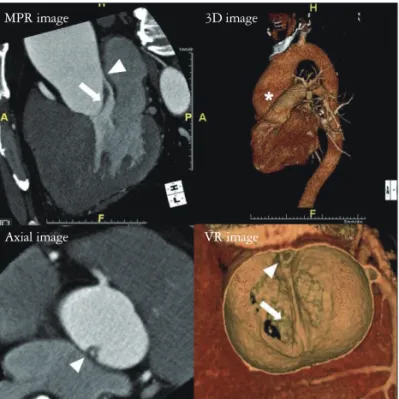
CT demonstrated valvular morphology with dilatation of the ascending aorta with 6 cm in maximum diameter (Fig. 4) and no stenotic segment of the coronary arteries. He was offered additional surgery for the ascending aortic aneurysm and the UAV, but he refused it.
pISSN 1975-4612/ eISSN 2005-9655 Copyright © 2011 Korean Society of Echocardiography www.kse-jcu.org DOI: 10.4250/jcu.2011.19.2.102
CASE REPORT J Cardiovasc Ultrasound 2011;19(2):102-104
Incidental Diagnosis of the Unicuspid Aortic Valve with Ascending Aortic Aneurysm in an Asymptomatic Adult
Seung-Dae Kang, MD1, Sang-Hoon Seol, MD2, Bo-Min Park, MD2, Dong-Kie Kim, MD2, Ki-Hun Kim, MD2, Doo-Il Kim, MD2, Jeong-Sook Seo, MD3, Dong-Soo Kim, MD3,
Hyun-Kuk Kim, MD4 and Jong-Woon Song, MD5
1Division of Cardiology, Department of Internal Medicine, Inje University College of Medicine, Ilsan Paik Hospital, Goyang, Korea
2Divisions of Cardiology, 4Pulmonology, Department of Internal Medicine,
5Radiology, Inje University College of Medicine, Haeundae Paik Hospital, Busan, Korea
3Division of Cardiology, Department of Internal Medicine, Inje University College of Medicine, Busan Paik Hospital, Busan, Korea
The unicuspid aortic valve is an extremely rare congenital anomaly. It usually presents with aortic stenosis and/or aortic regurgitation. Other cardiovascular complications, such as aortic dilatation and left ventricular hypertrophy can accompany it.
Herein, we present a case report of a 50-year-old asymptomatic male patient with unicuspid aortic valve, complicated by ascending aortic aneurysm.
KEY WORDS: Unicuspid aortic valve · Ascending aortic aneurysm.
• Received: February 21, 2011 • Revised: April 18, 2011 • Accepted: May 25, 2011
• Address for Correspondence: Sang-Hoon Seol, Division of cardiology, Department of Medicine, Inje University College of Medicine, Haeundae Paik Hospital, 1435 Jwa-dong, Haeundae-gu, Busan 612-030, Korea Tel: +82-51-797-3070, Fax: +82-51-797-3009, E-mail: [email protected]
• This is an Open Access article distributed under the terms of the Creative Commons Attribution Non-Commercial License (http://creativecommons.org/licenses/by-nc/3.0) which permits unrestricted non-commercial use, distribution, and reproduction in any medium, provided the original work is properly cited.
Incidental Diagnosis of Unicuspid Aortic Valve | Seung-Dae Kang, et al.
103 Discussion
The UAV is a very rare congenital heart anomaly. During embryonic development, the aortic valve is formed from three tubercles, the fusion of which results in a UAV.2) The first re- port of the UAV was made by Edwards, in 1958.3) In one study by Cleveland Clinic, the estimated incidence was 0.02
%.1) However, it was more frequent (up to 4-6 %) in patients undergoing surgery for pure aortic stenosis.4) The UAV was divided into 2 morphologic categories: one is the pin-hole shaped acommissural UAV, and the other is a slit-shaped uni- commissural UAV.5) The acommissural UAV is usually ac- companied by severe stenosis, therefore symptoms tend to be present at birth, and many patients undergo surgical interven- tion for severe stenosis during their infancy or childhood.6) The unicommissural form usually brings relatively larger ori- fice than acommissural form, thus it can be remained asymp- tomatic and hemodynamically stable until adulthood, which was the case in our patient. The UAV can be diagnosed by var- ious imaging modalities, such as TTE, TEE, live 3-D echocar- diography, cardiac CT, and/or magnetic resonanance imag-
ing.7)8) The 3-D echocardiography helps to delineate the accurate anatomy of the aortic valve. It is a useful diagnostic method with potential advantages over the conventional 2-D
Fig. 1. Transthoracic echocardiography at the parasternal short axis view shows posteriorly situated eccentric aortic valve orifice extending to the annulus. LA: left atrium, RA: right atrium, RV: right ventricle.
Fig. 2. Transesophageal echocardiographic mid-esophageal aortic short axis view (i.e. 50º view) is showing the unicuspid valve at systole (A) and diastole (B). A: In systole, the eccentric valvular orifice is extending to the annulus and showing a ‘tear drop’ opening. B: In diastole, there is posterior commissural attachment to the aorta. LA: left atrium, RA: right atrium, RV: right ventricle.
A B
Fig. 3. Live three-dimensional echocardiography demonstrates posterior funnel-shaped valve, with an eccentric orifice at systole (A) and posteriorly positioned commissural attachment at diastole (B). AV: aortic valve, MV: mitral valve.
A B
LA RA
RV
LA RA
RV
LA
RA
MV MV
AV AV
Journal of Cardiovascular Ultrasound 19 | June 2011
104
echocardiography in the diagnosis of the UAV.9) In contrast, the cardiac CT can be considered as a complementary diag- nostic tool because it clearly shows the great vessel anomalies, as well as the coronary arteries.10)
The UAV can also accompany with other cardiac anomalies, such as aortic regurgitation, aortic aneurysm, aortic dissection, patent ductus arteriosus, and the coarctation of aorta.11) The most common accompanying lesion is the isolated aortic ste- nosis.11) The ascending aortic aneurysm is known to be fre- quent in this condition, but information in the literature is limited to date.12) In the study conducted by Novaro et al.,1) the prevalence of ascending aortic dilatation was 48%. Agni- hotri et al.12) reported significant aortic dilatation in 50% of their investigated patients. The aortic dilatation seemed to be caused by medial changes in the aortic tissue, which in turn may be related to embryogenesis.13) The aortic root dilatation of more than 50 mm should be considered as an indication for surgery to repair the aortic root or replace the ascending aorta, as in the bicuspid aortic valves.14)
We report a very rare case of UAV with ascending aortic an- eurysm. The UAV with associated aortic aneurysm can be diag- nosed by various diagnostic modalities. The optimal treatment strategies should be selected according to the clinical situation.
References
1. Novaro GM, Mishra M, Griffin BP. Incidence and echocardiographic features of congenital unicuspid aortic valve in an adult population. J Heart Valve Dis 2003;12:674-8.
2. Sniecinski RM, Shanewise JS, Glas KE. Transesophageal echocardiogra- phy of a unicuspid aortic valve. Anesth Analg 2009;108:788-9.
3. Edwards JE. Pathologic aspects of cardiac valvular insufficiencies. AMA Arch Surg 1958;77:634-49.
4. Roberts WC, Ko JM. Frequency by decades of unicuspid, bicuspid, and tricuspid aortic valves in adults having isolated aortic valve replacement for aortic stenosis, with or without associated aortic regurgitation. Circulation 2005;111:920-5.
5. Anderson RH. Understanding the structure of the unicuspid and unicom- missural aortic valve. J Heart Valve Dis 2003;12:670-3.
6. Moller JH, Nakib A, Eliot RS, Edwards JE. Symptomatic congenital aortic stenosis in the first year of life. J Pediatr 1966;69:728-34.
7. Gibbs WN, Hamman BL, Roberts WC, Schussler JM. Diagnosis of congenital unicuspid aortic valve by 64-slice cardiac computed tomography.
Proc (Bayl Univ Med Cent) 2008;21:139.
8. Debl K, Djavidani B, Buchner S, Poschenrieder F, Heinicke N, Schmid C, Kobuch R, Feuerbach S, Riegger G, Luchner A. Unicus- pid aortic valve disease: a magnetic resonance imaging study. Rofo 2008;
180:983-7.
9. Chu JW, Picard MH, Agnihotri AK, Fitzsimons MG. Diagnosis of congenital unicuspid aortic valve in adult population: the value and limita- tion of transesophageal echocardiography. Echocardiography 2010;27:
1107-12.
10. Dursun M, Yilmaz S, Sayin OA, Ugurlucan M, Ucar A, Yekeler E, Tunaci A. Combination of unicuspid aortic valve, aortic coarctation, and aberrant right subclavian artery in a child: MR imaging and CTA find- ings. Cardiovasc Intervent Radiol 2007;30:547-9.
11. Mookadam F, Thota VR, Garcia-Lopez AM, Emani UR, Alharthi MS, Zamorano J, Khandheria BK. Unicuspid aortic valve in adults: a systematic review. J Heart Valve Dis 2010;19:79-85.
12. Agnihotri AK, Desai SC, Lai YQ, Fitzsimons MG, Hilgenberg AD, Vlahakes GJ. Two distinct clinical presentations in adult unicuspid aortic valve. J Thorac Cardiovasc Surg 2006;131:1169-70.
13. Butany J, Vaideeswar P, Dixit V, Lad V, Vegas A, David TE. Ascend- ing aortic aneurysms in unicommissural aortic valve disease. Cardiovasc Pathol 2009;18:11-8.
14. Bonow RO, Carabello BA, Chatterjee K, de Leon AC Jr, Faxon DP, Freed MD, Gaasch WH, Lytle BW, Nishimura RA, O’Gara PT, O’Rourke RA, Otto CM, Shah PM, Shanewise JS; American Col- lege of Cardiology/American Heart Association Task Force on Prac- tice Guidelines. 2008 focused update incorporated into the ACC/AHA 2006 guidelines for the management of patients with valvular heart disease:
a report of the American College of Cardiology/American Heart Association Task Force on Practice Guidelines (Writing Committee to revise the 1998 guidelines for the management of patients with valvular heart disease). En- dorsed by the Society of Cardiovascular Anesthesiologists, Society for Cardio- vascular Angiography and Interventions, and Society of Thoracic Surgeons.
J Am Coll Cardiol 2008;52:e1-142.
Fig. 4. The 640-slice cardiac computed tomography shows ascending aortic aneurysm (*) and thickened unicuspid valve (arrow) with eccentric unicommissural orifice (arrow head) in diastole. MPR: multiplanar reformation, 3D: three dimensional, VR: volume rendering.
MPR image
Axial image
3D image
VR image