http://dx.doi.org/10.4014/kjmb.1207.07027 pISSN 1598-642X eISSN 2234-7305
Antioxidant Activities of Bacterial Culture Extracts Isolated from Arctic Lichens
Kim, Mi-Kyeong1, Hyun Park2, and Tae-Jin Oh1*
1Institute of Biomolecule Reconstruction, Department of Pharmaceutical Engineering, SunMoon University, Asan 336-708, Korea
2Korea Polar Research Institute (KOPRI), Incheon 406-840, Korea Received : July 31, 2012 / Revised : August 24, 2012 / Accepted : October 15, 2012
Lichens are a symbiosis between fungi, algae and cyanobacteria. Our group recently studied the antioxidant properties of some bacterial species isolated from Arctic lichens and we confirmed that they possess high anti- oxidant activities. In this paper, we investigated the antioxidant capacity of 5 microorganisms newly isolated from 4 Arctic lichen species, Cladonia sp., Sterocaulon sp., Umbilicaria sp. and Cetraria sp., using various solvent extractions. We carried out 1,1-diphenyl-2-picryl-hydrazyl (DPPH) and 2,2'-azino-bis(3-ethyl ben- zothiazoline-6-sulphonic acid) (ABTS) free radical scavenging activity test and ferric reducing antioxidant power (FRAP) assay. Also total phenolic and flavonoid content assays were performed. Among the bacterial culture extracts of the tested lichen-microorganisms, ethyl acetate extracts of Burkholderia sordidicola S5- B(T) had not only a high antioxidant activity (72.9%) when compared with the ascorbic acid used as the con- trol (51.3%) in the DPPH assay, but also a high amount of phenolic content as well as flavonoid content. As a result, these lichen-microorganisms may be potentially useful sources of natural antioxidants.
Key words: ABTS, antioxidant activity, Arctic lichen, DPPH, TPC
Introduction
Reactive oxygen species such as hydroxyl radicals, peroxides and superoxide anions are important because they are major causes of oxidative damage causing carcino- genesis, mutagenesis, aging and cardiovascular diseases [6, 9]. Antioxidants inhibit or delay the oxidation process by blocking the initiation or propagation of oxidizing chain reactions and hence protect the human body from oxidative stress-related diseases [19]. They are also used to protect foods from rancidity, discoloration or deterioration due to auto-oxi- dation [12]. Although several strong synthetic antioxidants have already been reported such as butylated hydroxyanisole, butylated hydroxytoluene and tertiary butylhydroquinone, demand to develop less harmful antioxidants from natural sources is increasing because synthetic antioxidants have proven to be highly carcinogenic compound [9, 19].
Lichens are composed of fungi, algae, or cyanobacteria which are able to survive in extreme environmental condi- tions from desert to polar area. Lichens and their secondary metabolites have been widely used as food, dyes, perfumes, natural medicines and decoration [12]. Especially, their secondary metabolites have been investigated for a long time. Usnic acid, for example, is representative secondary metabolite found in several lichen species and has potential as antioxidant, antibiotic and antitumor drug [4, 11, 15].
Little is known about biological activities of lichen- associated bacterial symbionts [5], while lichen-forming fungi have been extensively described although study of lichen-forming fungi is difficult due to their very slow growth rates [18]. Diversity of bacterial community in lichen symbiosis has been reported and recent research suggested that these bacterial symbionts have antibacterial and antioxidant activity [8]. On this background, the aim of this study is to evaluate antioxidant activities of bacterial culture extracts isolated from the Arctic lichens.
*Corresponding author
Tel: +82-41-530-2677, Fax: +82-41-530-2279 E-mail: [email protected]
Materials and Methods
Collection and Identification of Lichen Samples
Lichen species are provided by the Korean Polar Research Institute (KOPRI). All species were identified by KOPRI and their 16S rRNA analysis results were sum- marized in Table 1. All sample numbers were also given from the KOPRI.
Culture Condition and Preparation of the Lichen- Bacterial Culture Extracts
The 5 microbial species were isolated by selective appropriate media [10, 16]. KOPRI 26643, 26645 and 26647 strains were isolated from ISP4 agar media [16]
while 26644 and 26646 strains were isolated from Bennett’s vitamin agar media [10] at 28oC. In addition, these 5 microbial species were inoculated on the corre- sponding media as shown above at 28oC for 10~13 days.
All the bacterial cultures were treated with various solvents (water, acetone, methanol, ethyl acetate, chloroform, ethanol, diethyl ether, and petroleum ether) at room temperature. And then the solvent was evaporated in vacuum at 40oC. The residuals were then dissolved with the same solvents and stored in a freezer at -20oC until further study.
Total Phenolic Contents (TPC) and Total Flavonoid Contents (TFC) assay
The total phenolic content in the lichen associated bacterial culture extract was evaluated by the Folin- Ciocalteu reagent according to the method of Slinkard and Singleton with some modifications [17]. 30 µL of the test extracts were mixed with 30 µL of 1 N Folin-Ciocalteu reagent (Sigma-Aldrich, USA) and the reaction mixture was mixed thoroughly. These mixtures are incubated for 3 min at room temperature and 600 µL of 2% Na2CO3 was added to the reaction mixture. The mixture was incubated for 30 min at room temperature and the absorbance was measured at 760 nm. Gallic acid used as the positive control and the reaction mixture without the extraction
sample was used as the negative control. The concentration of TPC was expressed in micrograms of gallic acid equivalent per milligram of lichen-bacterial culture extract.
Total flavonoid contents were evaluated by using modified colorimetric method [20]. The 500 µL of lichen-bacterial culture extracts was taken. The 1.5 mL of distilled water was added to it and subsequently mixed with 0.15 mL of 5% NaNO2 solution. After 6 min incubation, 10% AlCl3 solution was added and incubated for 6 min. And then 2 mL of 4% NaOH solution was added to the mixture, and distilled water was added to set the final volume to be 5 mL. After 15 min at room temperature, the absorbance was measured at 510 nm using a spectrophotometer (Biochrome, U.S.A.). Catechin was used as a standard compound for the quantification of total flavonoids. All the values were ex- pressed as g catechin equivalent (CE) per 100 g of extract.
A single extract was measured three times.
Free Radical Scavenging Activity using DPPH and ABTS
The free radical scavenging activity of the lichen-bac- terial culture extract was measured by 1,1-diphenyl-2-picryl- hydrazyl (DPPH) and 2,2'-azino-bis[3-ethyl benzothiazoline- 6-sulphonic acid] (ABTS) reagents. These assays are colorimetric method and their result can be read visually.
The DPPH radical scavenging assay is an easy rapid and sensitive method for the antioxidant screening of plant extracts. The DPPH free-radical scavenging activity of the 5 lichen-bacterial culture extract was determined by the method of Blois with some modifications [3]. 0.1 mM of DPPH was prepared in methanol. Then, 950 µL of DPPH solution was mixed with 50 µL of lichen-bacterial extraction samples with various solvents. The mixture was incubated for 30 min at room temperature, and the absorbance was measured at 517 nm using a UV-Visible spectrophotometer to determine the content of DPPH free radical. 1 mM of ascorbic acid (vitamin C) was used as positive controls and pure solvents without lichen-bacterial culture extract were used as a negative control. The ABTS assay is also frequently
Table 1. Microorganisms isolated from the Arctic lichen samples.
KOPRI No. Source Bacterial species (Closest strain) Similarity (%)
26643 Cladonia sp. Burkholderia sordidicola S5-B(T) 98.932
26644 Sterocaulon sp. Burkholderia sordidicola S5-B(T) 98.932
26645 Cetraria sp. Sphingomonas faeni MA-olki(T) 99.851
26646 Umbilicariasp. Burkholderia sordidicola S5-B(T) 98.932
26647 Umbilicaria sp. Burkholderia sordidicola S5-B(T) 98.932
used to measure antioxidant activities. For ABTS assay, the procedure followed the method of Arnao with some modi- fications [1]. 7.4 mM of ABTS was prepared in methanol.
ABTS was kept in the dark for 12 h to generate free radicals from the ABTS salt, and then 950 µL of ABTS solution was mixed with 50 µL of lichen-bacterial extraction samples.
The mixture was incubated for 30 min at room temperature and the absorbance was measured at 734 nm using a UV- Visible spectrophotometer. 1 mM of ascorbic acid was used as positive control and pure solvents without the test sample were taken as a negative control. Free radical scavenging activity was described as the inhibitory percentage of DPPH and ABTS was calculated according to the following equation. A single extract were measured three times.
scavenging activity (%)
= [1− (Abs sample/Abs control)] × 100
Ferric Reducing Antioxidant Power (FRAP) Assay The FRAP assay was carried out according to the modified Benzie and Strain method [2]. The 900 µL of FRAP reagent, freshly prepared and warmed at 37oC, was mixed with 90 µL of distilled water and 10 µL of samples in different concentrations. The FRAP reagent contained 2.5 mL of a 10 mM 2,4,6-tripyridyl-striazine (TPTZ) solution in 40 mM HCl, 2.5 mL of 20 mM FeCl3·6H2O and 25 mL of 0.3 mM acetate buffer pH 3.6. Absorbance was measured at the 593 nm using a spectrophotometer. Temperature was maintained at 37oC. The readings at 30 min were selected for calculation of FRAP values.
Results and Discussion
Total Phenolic and Flavonoid Contents of Micro- organisms
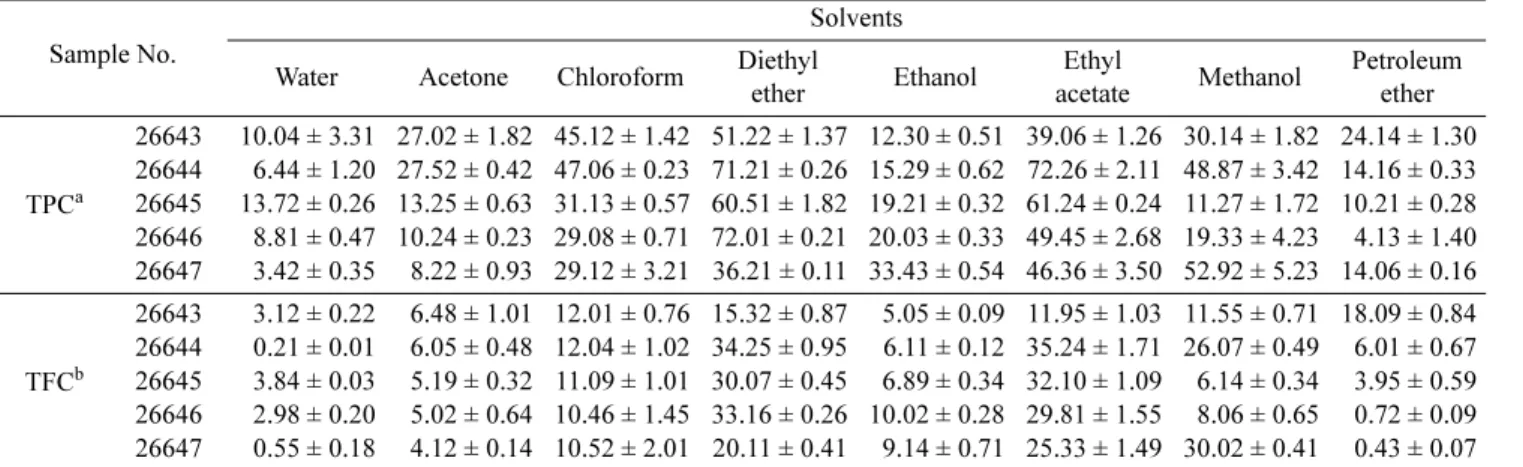
The fact that antioxidant activities of lichen-bacterial culture extracts are dependent on their phenolic constituents was previously demonstrated [7]. Thus, we evaluated the total phenolic contents of lichen-bacterial culture extracts (Table 2). Total 5 bacterial cultures were extracted in various solvents such as aqueous, acetone, methanol, ethyl acetate, chloroform, ethanol, diethyl ether, and petroleum ether.
Some lichen-bacterial species showed high-level of TPC, range of 3.42 (aqueous extract of Bulkholeria sordidicola S5-B(T), sample No. 26647) to 72.26 (ethyl acetate extract of Bulkholeria sordidicola S5-B(T), sample No. 26644).
Especially, extract of Bulkholeria sordidicola S5-B(T) had the highest TPC among the other bacterial species. Ethyl acetate and chloroform extracts showed high TPC than other solvents used. We also carried out TFC assay and results are summerized in Table 2. Total flavonoid content was in the order of 26644>26645> 26646>26647>26643, regardless of extraction solvents. Similar pattern was observed for total phenolic content although amount of phenolic is lower than TPC. Furthermore, it was found that both TPC and TFC were dependent on concentration of extracts (data not shown). Taken together, the high levels of TPC and TFC indicate that extracts of microorganisms, isolated from the Arctic lichen samples, might have antioxidant activity.
DPPH and ABTS Free Radical Scavenging Activities of Microorganisms
DPPH and ABTS assays using various solvent extracts
Table 2. Total phenolic and lavonoid contents of lichen-bacterial cell extracts.
Sample No.
Solvents Water Acetone Chloroform Diethyl
ether Ethanol Ethyl
acetate Methanol Petroleum ether
TPCa
26643 10.04 ± 3.31 27.02 ± 1.82 45.12 ± 1.42 51.22 ± 1.37 12.30 ± 0.51 39.06 ± 1.26 30.14 ± 1.82 24.14 ± 1.30 26644 6.44 ± 1.20 27.52 ± 0.42 47.06 ± 0.23 71.21 ± 0.26 15.29 ± 0.62 72.26 ± 2.11 48.87 ± 3.42 14.16 ± 0.33 26645 13.72 ± 0.26 13.25 ± 0.63 31.13 ± 0.57 60.51 ± 1.82 19.21 ± 0.32 61.24 ± 0.24 11.27 ± 1.72 10.21 ± 0.28 26646 8.81 ± 0.47 10.24 ± 0.23 29.08 ± 0.71 72.01 ± 0.21 20.03 ± 0.33 49.45 ± 2.68 19.33 ± 4.23 4.13 ± 1.40 26647 3.42 ± 0.35 8.22 ± 0.93 29.12 ± 3.21 36.21 ± 0.11 33.43 ± 0.54 46.36 ± 3.50 52.92 ± 5.23 14.06 ± 0.16
TFCb
26643 3.12 ± 0.22 6.48 ± 1.01 12.01 ± 0.76 15.32 ± 0.87 5.05 ± 0.09 11.95 ± 1.03 11.55 ± 0.71 18.09 ± 0.84 26644 0.21 ± 0.01 6.05 ± 0.48 12.04 ± 1.02 34.25 ± 0.95 6.11 ± 0.12 35.24 ± 1.71 26.07 ± 0.49 6.01 ± 0.67 26645 3.84 ± 0.03 5.19 ± 0.32 11.09 ± 1.01 30.07 ± 0.45 6.89 ± 0.34 32.10 ± 1.09 6.14 ± 0.34 3.95 ± 0.59 26646 2.98 ± 0.20 5.02 ± 0.64 10.46 ± 1.45 33.16 ± 0.26 10.02 ± 0.28 29.81 ± 1.55 8.06 ± 0.65 0.72 ± 0.09 26647 0.55 ± 0.18 4.12 ± 0.14 10.52 ± 2.01 20.11 ± 0.41 9.14 ± 0.71 25.33 ± 1.49 30.02 ± 0.41 0.43 ± 0.07
aTotal phenolic contents are expressed as gallic acid equivalents (mg GAE/g extract)
bTotal flavonoid contents are expressed as catechin equivalents (mg CE/g extract)
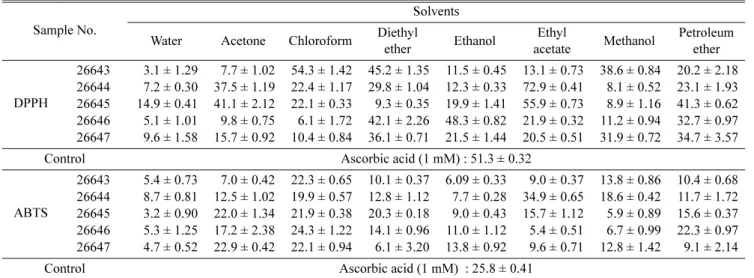
of 5 lichen-bacterial species are performed to evaluate the antioxidant activity (Table 3). The DPPH free radical scavenging activity of each lichen-bacterial culture extract was compared with that of the natural antioxidant, ascorbic acid (vitamin C). All the tested extracts and the control (ascorbic acid) exhibited DPPH and ABTS free radical scavenging activity was depend on concentration of extracts (data not shown). Also, the rate of scavenging activity was variable for each extract and each solvent. In case of DPPH assay, radical scavenging activities range from 3.1 (aqueous extract of Bulkholeria sordidicola S5-B(T), KOPRI 26643) to 72.9 (ethyl acetate extract of Bulkholeria sordidicola S5- B(T), KOPRI 26644). Similarly, radical scavenging activities in ABTS assay range from 3.2 (aqueous extract of KOPRI 26645) to 34.9 (ethyl acetate extract of KOPRI 26644).
Among 5 bacterial species, Bulkholeria sordidicola S5- B(T) showed stronger activity than ascorbic acid about 1.4 fold and 1.3 fold in DPPH and ABTS assay, respectively.
In almost all cases, extracts of bacterial species that have high amount of TPC showed high antioxidant activity.
However, such as chloroform extract of Burkholderia sordidicola S5-B(T) (KOPRI 26643) showed high anti- oxidant activities than chloroform extract of Burkholderia sordidicola S5-B(T) (KOPRI 26644) in spite of that total phenol contents of KOPRI 26643 is lower than KOPRI 26644 (Table 3). This indicates that all phenolics may not necessarily have same antioxidant activity. Some of them may have more potent activity and others have a moderate or even weak antioxidant activity. It is possible there are synergistic or antagonistic interactions of phenolic compounds with other phenolics, or differing types of components such as carbohydrates and proteins [14].
Ferric Reducing Antioxidant Power (FRAP) of Micro- organisms
We carried out ferric reducing antioxidant power to evaluate the reducing activity of microorganism extract. In this assay, antioxidant acts as reductant by performing reduction of ferric ion (Fe3+) to ferrous ion (Fe2+). So, determination of the ferrous ion formation can be used to Table 3. Evaluation of antioxidant properties using various solvents.
Sample No.
Solvents Water Acetone Chloroform Diethyl
ether Ethanol Ethyl
acetate Methanol Petroleum ether
DPPH
26643 3.1 ± 1.29 7.7 ± 1.02 54.3 ± 1.42 45.2 ± 1.35 11.5 ± 0.45 13.1 ± 0.73 38.6 ± 0.84 20.2 ± 2.18 26644 7.2 ± 0.30 37.5 ± 1.19 22.4 ± 1.17 29.8 ± 1.04 12.3 ± 0.33 72.9 ± 0.41 8.1 ± 0.52 23.1 ± 1.93 26645 14.9 ± 0.41 41.1 ± 2.12 22.1 ± 0.33 9.3 ± 0.35 19.9 ± 1.41 55.9 ± 0.73 8.9 ± 1.16 41.3 ± 0.62 26646 5.1 ± 1.01 9.8 ± 0.75 6.1 ± 1.72 42.1 ± 2.26 48.3 ± 0.82 21.9 ± 0.32 11.2 ± 0.94 32.7 ± 0.97 26647 9.6 ± 1.58 15.7 ± 0.92 10.4 ± 0.84 36.1 ± 0.71 21.5 ± 1.44 20.5 ± 0.51 31.9 ± 0.72 34.7 ± 3.57
Control Ascorbic acid (1 mM) : 51.3 ± 0.32
ABTS
26643 5.4 ± 0.73 7.0 ± 0.42 22.3 ± 0.65 10.1 ± 0.37 6.09 ± 0.33 9.0 ± 0.37 13.8 ± 0.86 10.4 ± 0.68 26644 8.7 ± 0.81 12.5 ± 1.02 19.9 ± 0.57 12.8 ± 1.12 7.7 ± 0.28 34.9 ± 0.65 18.6 ± 0.42 11.7 ± 1.72 26645 3.2 ± 0.90 22.0 ± 1.34 21.9 ± 0.38 20.3 ± 0.18 9.0 ± 0.43 15.7 ± 1.12 5.9 ± 0.89 15.6 ± 0.37 26646 5.3 ± 1.25 17.2 ± 2.38 24.3 ± 1.22 14.1 ± 0.96 11.0 ± 1.12 5.4 ± 0.51 6.7 ± 0.99 22.3 ± 0.97 26647 4.7 ± 0.52 22.9 ± 0.42 22.1 ± 0.94 6.1 ± 3.20 13.8 ± 0.92 9.6 ± 0.71 12.8 ± 1.42 9.1 ± 2.14
Control Ascorbic acid (1 mM) : 25.8 ± 0.41
Free radical scavenging activity was described as the inhibitory percentage of DPPH and ABTS.
Table 4. Ferric reducing antioxidant power activity of extracts.
Sample No.
Solvents Water Acetone Chloroform Diethyl
ether Ethanol Ethyl
acetate Methanol Petroleum ether 26643 0.07 ± 0.01 0.10 ± 0.01 0.14 ± 0.02 0.12 ± 0.01 0.11 ± 0.02 0.21 ± 0.06 0.10 ± 0.01 0.13 ± 0.01 26644 0.19 ± 0.02 0.21 ± 0.03 0.51 ± 0.02 0.15 ± 0.01 0.19 ± 0.02 0.72 ± 0.14 0.18 ± 0.23 0.18 ± 0.02 26645 0.15 ± 0.01 0.18 ± 0.01 0.31 ± 0.01 0.20 ± 0.02 0.15 ± 0.02 0.56 ± 0.11 0.13 ± 0.03 0.16 ± 0.02 26646 0.13 ± 0.01 0.19 ± 0.03 0.27 ± 0.03 0.21 ± 0.02 0.17 ± 0.02 0.43 ± 0.05 0.11 ± 0.06 0.13 ± 0.01 26647 0.10 ± 0.01 0.20 ± 0.04 0.25 ± 0.01 0.21 ± 0.02 0.18 ± 0.01 0.33 ± 0.05 0.10 ± 0.01 0.15 ± 0.03
Ascorbic acid 6.81 ± 0.44
Free reducing antioxidant power activities are expressed as mM Fe(II)/mg extract and ascorbic acid was used as control.
expect the reducing power of samples, and results are summarized in Table 4. The FRAP value for the ethyl acetate extract of KOPRI 26644 was high. This sample has high level of phenolic and flavonoid contents, and also it’s free radical scavenging activity was good in both DPPH and ABTS assay. Although some value is lower than standard compound, all our microorganisms, isolated from the Arctic lichen samples, has antioxidant activity.
In this paper, we isolated various microorganisms from the Arctic lichens and evaluated their antioxidant activities using various solvent extractions. The results showed that ethyl acetate extract of Bulkholeria sordidicola S5-B(T) exhibits a stronger activity than ascorbic acid about 1.4 fold and 1.3 fold in DPPH and ABTS assay, respectively. Also, amount of their total phenolic component and total fla- vonoid contents was higher than other extraction samples.
Therefore, these strains might be potentially useful natural antioxidants which might be able to replace several synthetic antioxidant compounds proven to be highly carcinogenic.
Interestingly, Bulkholeria sordidicola S5-B(T) was isolated from several lichen species, but their antioxidant activity showed some variations (Table 2). Even their 16S rRNA sequence similarity was almost same in phylogenetic analysis (Fig. 1), media compositions such carbon source and/or nitrogen source may effect on their active compound.
Therefore, further investigation is needed about their corre- lation between media composition and active compounds.
These active compounds are may control UV protection system on lichen. In respect of the cosmetics/pharmaceu- tical industry, these properties are very significant because these active compounds might be able to replace several synthetic antioxidant compounds which known to be car- cinogenic. Lichens are well adapted to the polar area where they have limited nutrients. In previously study, some group found that antioxidant activity of crude extract from polar lichen was more effective than other lichen species
from tropical and temperate region [13]. Although it’s different with us because we investigated antioxidant activity of lichen-associated bacteria, our results showed similar pattern with previous study. In addition to, this kind of study that investigation of lichen-associated bacteria symbiont will help understand unique mechanisms of lichen ecology in extreme condition.
ACKNOWLEDGEMENTS
This study was supported by the functional genomics on polar organisms (PE12020) grants funded by the Korea Polar Research Institute (KOPRI).
REFERENCES
1. Arnao, M. B., A. Cano., and M. Acosta. 2001. The hydro- philic and lipophilic contribution to total antioxidant activity.
Food Chem. 73: 239-244.
2. Benzie, I. F. F. and J. J. Strain. 1996. The ferric reducing antioxidant ability of plasma (FRAP) as a measure of “anti- oxidant power” : the FRAP assay. Anal. Biochem. 239: 70- 76.
3. Blois, M. S. 1958. Antioxidant determinations by the use of a stable free radical. Nature 26: 1199-1200.
4. Boustie, J. and M. Grube. 2005. Lichens - a promising source of bioactive secondary metabolites. Plant Genet. Resource 3:
273-287.
5. Cardinale, M., A. M. Puglia, and M. Grube. 2006. Molecu- lar analysis of lichen-associated bacterial communities.
FEMS Microbiol. Ecol. 57: 484-495.
6. Devasagayam, T. P., J. C. Tilak, K. K. Boloor, K. S. Sane, S.
S. Ghaskadbi, and R. D. Lele. 2004. Free radicals and anti- oxidants in human health: Current status and future pros- pects. J. Assoc. Physicians India 52: 794-804.
7. Gardner, P. T., T. A. C. White, D. B. McPhail, and G. G.
Duthie. 2000. The relative contributions of vitamin C, caro- tenoids and phenolics to the antioxidant potential of fruit juices. Food Chem. 68: 471-474.
8. Gonzalez, I., A. Ayuso-Sacido, A. Anderson, and O. Genil- Fig. 1. Phylogenetic relationship of 5 bacterial strains. B. sordidicola 1, KOPRI 26643 (from Cladonia sp.); B. sordidicola 2, KOPRI 26644 (Sterocaulon sp.); S. faeni, KOPRI 26645 (Cetraria sp.); B. sordidicola 3, KOPRI 26646 (Umbilicaria sp.); and B. sordidicola 4, KOPRI 26647 (Umbilicaria sp.).
loud. 2005. Actinomycetes isolated from lichens: Evaluation of their diversity and detection of biosynthetic gene se- quences. FEMS Microbiol. Ecol. 54: 401-415.
9. Grice, H. C. 1986. Safety evaluation of butylated hydroxytol- uene (BHT) in the liver, lung and gastrointestinal tract. Food Chem. Toxicol. 24: 1127-1130.
10. Iwasa, T., H. Yamamoto, and M. shibata. 1970. Studies on validamycins, new antibiotics, Streptomyces hygroscopicus var. limoneus nov. var., validamycin producing organism. J.
Antibiot. 12: 596-602.
11. Muller, K. 2001. Pharmaceutically relevant metabolites from lichens. Appl. Microbiol. Biotechnol. 56: 9-16.
12. Oksanen, I. 2006. Ecological and biotechnological aspects of lichens. J. Microbial. Biotechnol. 73: 723-734.
13. Paudel, B., H. Bhattarai, J. Lee, S. Hong, H. Shin, and J.
Yim. 2008. Antioxidant activity of polar lichens from King George Island (Antarctica). Polar Biol. 31: 605-608.
14. Rice-Evans, C. A., N. J. Miller, and G. Paganga. 1997. Anti- oxidant properties of phenolic compounds. Trends Plant Sci.
2: 152-159.
15. Richardson, D. H. S. 1998. Medicinal and other economic aspects of lichens. In:Galun, M. (ed) Handbook of lichenol- ogy, CRC Press, USA, Vol. 3: 98-108.
16. Shirling, E. B. and D. Gottlieb. 1966. Methods for character- ization of Streptomyces species. Int. J. Sys. Bacteriol. 16:
313-340.
17. Slinkard, K. and V. L. Singleton. 1977. Total phenol analy- sis: Automation and comparison with manual methods. Am.
J. Enol. Vitic. 28: 49-55.
18. Wang, X. Y., X. L. Wei, H. Luo, J. A. Kim, H. S. Jeon, Y. J.
Koh, and J. S. Hur. 2010. Plant hormones promote growth in lichen-forming fungi. Kor. Soc. Mycol. 38: 176-179.
19. Wichi, H. P. 1988. Enhanced tumor development by butylat- edhydroxyanisole (BHA) from the prospective of effect on forestomach and oesophageal squamous epithelium. Food Chem. Toxicol. 26: 717-723.
20. Zhishen, J., T. Mengcheng, and W. Jianming. 1999. The determination of flavonoid contents in mulberry and their scavenging effects on super oxide radicals. Food Chem. 64:
555-559.
국문초록
북극 지의류로부터 분리한 미생물 배양 추출액의 항산화 활성 김미경1·박현2·오태진1*
1선문대학교 제약공학과
2극지연구소
지의류는 곰팡이, 조류 및 남조균류의 공생체이다. 본 연구팀은 최근 북극 지의류로부터 분리한 몇몇 미생물 종의 항산화 활성에 대하여 연구하였고, 그들의 높은 항산화 활성을 확인하였다. 본 연구에서는 Cladonia sp., Sterocaulon sp., Umbilicaria sp. 및 Cetraria sp. 총 4종류의 지의류로부터 5종의 미생물을 새롭게 분리하였고 배양 후, 다양한 용매 추출법으로 그들의 항산화능을 조사하였다. DPPH와 ABTS 자유 라디컬 소거능 측정법 및 FRAP 분석 등을 수 행하였다. 또한 총 폴리페놀함량과 총플라보노이드 함량 분석 역시 수행하였다. 지의류 유래 미생물 배양 추출액 중, Burkholderia sordidicola S5-B(T) 유사 미생물 종의 에틸아세테이트 추출액은 DPPH 분석에서 대조군인 아스코르빈 산 (51.3%)에 비해 72.9%로 높은 항산화 활성을 보였을 뿐만 아니라, 높은 플라보노이드와 폴리페놀 함량을 나타내 었다. 결과적으로, 이러한 지의류 유래 미생물 종들은 잠재적으로 천연 항산화제의 원천소재로서 이용가능할 것이다.