• 검색 결과가 없습니다.

Multiple Ascending Aortic Mural Thrombi and Acute Necrotizing Mediastinitis Secondary to Acute Pancreatitis

N/A
N/A
Protected

Academic year: 2021

Share "Multiple Ascending Aortic Mural Thrombi and Acute Necrotizing Mediastinitis Secondary to Acute Pancreatitis"

Copied!
4
0
0

로드 중.... (전체 텍스트 보기)

전체 글

(1)

ISSN: 2233-601X (Print) ISSN: 2093-6516 (Online)

− 401 −

Received: October 16, 2015, Revised: November 9, 2015, Accepted: November 10, 2015, Published online: October 5, 2016

Corresponding author: Joon Bum Kim, Department of Thoracic and Cardiovascular Surgery, Asan Medical Center, University of Ulsan College of Medicine, 88 Olympic-ro 43-gil, Songpa-gu, Seoul 05505, Korea

(Tel) 82-2-3010-5416 (Fax) 82-2-3010-6966 (E-mail) [email protected]

© The Korean Society for Thoracic and Cardiovascular Surgery. 2016. All right reserved.

This is an open access article distributed under the terms of the Creative Commons Attribution Non-Commercial License (http://creativecommons.org/

licenses/by-nc/4.0) which permits unrestricted non-commercial use, distribution, and reproduction in any medium, provided the original work is properly cited.

Multiple Ascending Aortic Mural Thrombi and Acute Necrotizing Mediastinitis Secondary to Acute Pancreatitis

Byung Kwon Chong, M.D. 1 , Jae Kwang Yun, M.D. 1 , Joon Bum Kim, M.D., Ph.D. 1 , Do Hyun Park, M.D., Ph.D. 2

1
Department of Thoracic and Cardiovascular Surgery and

2

Division of Gastroenterology, Department of Internal Medicine, Asan Medical Center, University of Ulsan College of Medicine

The formation of aortic thrombi is an extremely rare complication of acute pancreatitis. Here we report a case of acute pancreatitis complicated by a paraesophageal pseudocyst, necrotizing mediastinitis, and the for- mation of multiple thrombi in the ascending aorta. The patient was successfully treated by surgical therapy, which included extensive debridement of the mediastinum and removal of the aortic thrombi under car- diopulmonary bypass. Although esophageal resection was not carried out concomitantly, the lesions were re- solved and the patient remained free of complications over 2 years of follow-up care.

Key words: 1. Pancreatitis, Acute Necrotizing 2. Aorta

3. Thrombosis 4. Mediastinitis

5. Esophageal Diseases

Case report

A 66-year-old male patient with a history of hy- pertension and heavy alcoholism was referred to Asan Medical Center for further evaluation of an ab- dominal distension that had developed 15 days prior.

On admission, the patient described mild abdominal pain and anorexia. The patient had experienced 6 kg of weight loss during the previous 2 months. A phys- ical examination revealed fever (38.2

o

C) and abdomi- nal tenderness. Laboratory investigations revealed an elevated white cell count of 10.6×10

9

/L and a C-re- active protein level of 6.69 mg/dL (the reference val- ue is <0.6 mg/dL). Other findings were unrem- arkable, including serum amylase/lipase levels and the results of liver function tests. Esophagogastroduo-

denoscopy (EGD), colonoscopy, and enhanced abdom- inopelvic computed tomography (CT) were performed under suspicion of a cancer of gastrointestinal origin.

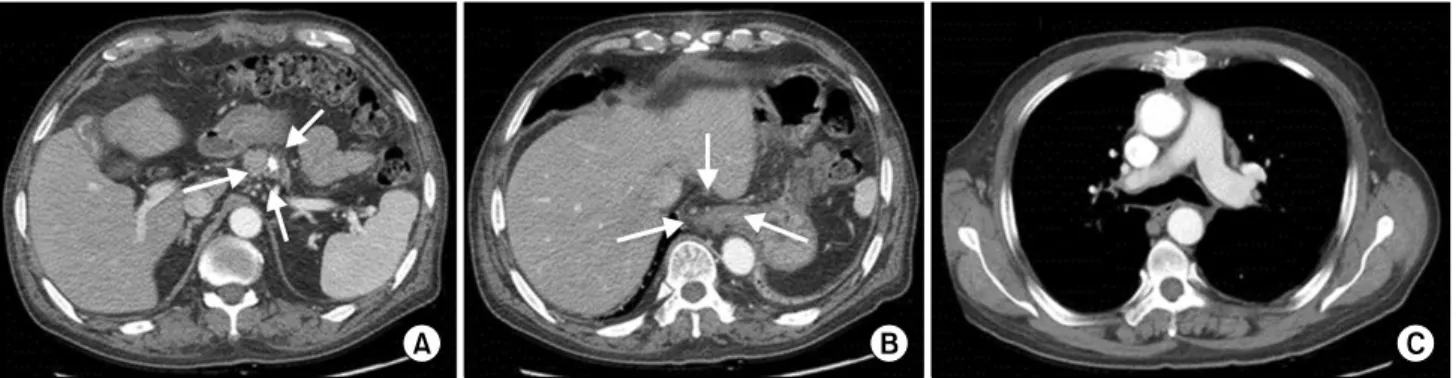
Abdominopelvic CT revealed chronic calculous chol- ecystitis, pancreatic duct stone, and associated peri- pancreatic fat necrosis accompanied by peri- esophageal fluid collection and a moderate amount of ascites (Fig. 1A, B), which were indicative of acute necrotizing pancreatitis. Subsequent laboratory tests showed elevated pancreatic enzymes (serum levels of amylase and lipase of 773 U/L and 589 U/L, re- spectively). Additional enhanced chest CT showed an incidental tubular low attenuated lesion within the lumen of the ascending aorta (Fig. 1C). Ascitic fluid examinations showed exudative fluid that was neg- ative for malignant cells. Under the impression of

Korean J Thorac Cardiovasc Surg 2016;49:401-404 □ CASE REPORT □

http://dx.doi.org/10.5090/kjtcs.2016.49.5.401

(2)

Byung Kwon Chong, et al

− 402 −

Fig. 1. Axial view of abdominal and chest contrast-enhanced computed tomography on admission. (A) Pancreatic duct stone and peri- pancreatic fat necrosis was found (arrows). (B) Periesophageal fluid collection and a moderate amount of perigastric ascites can be seen (arrows). (C) A tubular low attenuated portion was found in the ascending aorta (arrows).

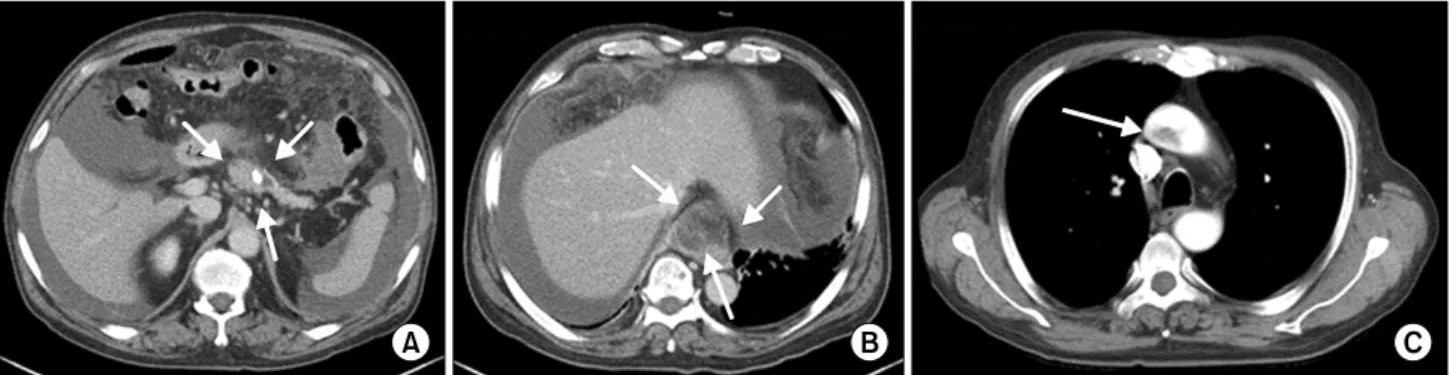
Fig. 2. Axial view of aortic contrast-enhanced computed tomography on day 16 of hospitalization. (A) An increased extent of peripancre- atic fat necrosis was found (arrows). (B) Marked wall thickening and septation of the distal esophagus was seen (arrows). (C) Multiple floating masses in the ascending aorta (arrows) and acute necrotizing mediastinitis were found.

acute necrotizing pancreatitis complicated by exuda- tive ascites resulting in periesophageal fluid collec- tion, the patient remained in a fasting state, and re- ceived intravenous (IV) fluids and broad-spectrum antibacterial therapy.

Due to persistent fever and elevating C-reactive pro- teins despite these treatments, the patient underwent follow-up abdominal CT 2 weeks later, which re- vealed a newly developed left kidney infarction, pleural effusion, and pericardial effusion. In addition, marked thickening of the distal esophageal wall and an in- creased extent of loculated paraesophageal fluid were also found on the CT imaging (Fig. 2). A subsequent chest CT revealed multiple floating masses in the as- cending aorta and mediastinal fat necrosis (Fig. 2). The aortic mass was confirmed to be highly mobile on transesophageal echocardiography (TEE). Therefore, we proceeded with urgent surgery, which included mediastinal debridement and removal of aortic throm-

bi under cardiopulmonary bypass. In the operating room, we found severe necrotizing mediastinitis with multifocal abscess formation and 2 of the highly mo- bile thrombi attached loosely to the aortic intima in the ascending aorta. The total pump and aortic clamping times were 52 minutes and 23 minutes, respectively. After mediastinal debridement and re- moval of the mobile thrombi, the inflammatory ante- rior pericardium was further resected, which was fol- lowed by massive irrigation (>10 L) of the whole surgical field. Additionally, we found the inflamed distal esophagus to be suggestive of an infected pse- udocyst and planned to perform distal esophageal re- section; however, the patient’s family declined further esophageal procedures in consideration of the addi- tional surgical risks.

Postoperatively, vital signs were stable and the pa-

tient fasted for 2 weeks until the absence of an eso-

phageal fistula or perforation on EGD was confirmed.

(3)

Thrombi and Mediastinitis Secondary to Pancreatitis

− 403 −

Fig. 3. Axial view of aortic contrast-enhanced computed tomography one year after the operation. A marked decrease of (A) peripancre- atic fat necrosis and (B) the distal esophageal pseudocyst were found (arrows). (C) Aortic mural thrombi were not seen in the ascending aorta (arrows).

The patient was given IV antibacterial therapy for 4 weeks. In addition, the patient underwent anticoagu- lation with IV heparin, which was switched to oral warfarin to prevent potential thromboembolism. The patient was discharged without complication on post- operative day 29. Postoperative echocardiography de- monstrated normal ventricular function and no rem- nant aortic thrombi. The patient was able to ingest full meals, and a follow-up CT confirmed significant im- provement of the lesions in the distal esophagus, which had been thickened diffusely with fat necrosis (Fig. 3). Two years after surgery, the patient was do- ing well clinically, without any complications.

Discussion

This was an extremely rare case of a patient with multiple aortic mural thrombi and necrotizing media- stinitis caused by acute pancreatitis. Although most cases of acute pancreatitis are self-limited, one-fourth of patients have been reported to develop vascular complications, such as hemorrhage into a pseudocyst, erosion of the peripancreatic arteries, splanchnic ve- nous thrombosis, and formation of pseudoaneurysms [1]. Arterial thrombus formation, however, is very uncommon, and aortic involvement is extremely rare.

In a review of the literature, we were only able to find 3 cases of aortic mural thrombi formation sec- ondary to acute pancreatitis, all of which involved the retropancreatic aorta [2,3]. To our knowledge, this is the first report in the literature describing thrombi in the ascending aorta. Initially, we sus- pected a cancer of gastrointestinal origin as the etiol- ogy of ascites. After performing abdominal CT, acute

necrotizing pancreatitis with paraesophageal fluid collection was diagnosed. We initially thought that the intramural aortic mass on the chest CT was a pseudolesion due to motion artifacts that turned out to be multiple floating thrombi in the ascending aor- ta according to subsequent CT evaluations and TEE.

Primary aortic thrombosis is defined as the devel- opment of thrombosis without underlying atheroma- tous lesions in the aorta [2]. The etiologies of primary aortic thrombosis are diverse, ranging from chemo- therapy to treat cancer to heparin-induced thrombo- cytopenia and inflammatory bowel disease [4]. In ad- dition, primary aortic thrombosis has been reported to occur in extremely rare cases of acute pancreatitis.

Although the pathophysiology of acute pancreatitis leading to aortic thrombosis is not clear, several hy- potheses have been suggested. First, acute severe pancreatitis emits proteolytic enzymes that injure the vascular wall directly, which may result in its acting as a nidus for intraluminal thrombus formation [4,5].

Second, the activation of thrombogenic factors from pancreatitis, such as fibrinogens and platelets, can al- so be triggered by the release of trypsin into the blood stream [5]. Lastly, acute pancreatitis possibly can lead to hypovolemia, which can increase the risk of vascular stasis and vasospasm [5].

After the second set of imaging evaluations in the

present case, we assumed that the acute pancreatitis

had progressed and was complicated by a paraeso-

phageal pseudocyst, which subsequently developed

into phlegmonous esophagitis and resultant acute

mediastinitis. These inflammatory processes in the

mediastinum might have been facilitated by the thro-

mbogenic environment in the proximal aorta.

(4)

Byung Kwon Chong, et al

− 404 − In conclusion, we experienced a rare case of acute pancreatitis resulting in necrotizing mediastinitis, pa- raesophageal pseudocyst, and multiple aortic thrombi.

It was successfully treated by medical therapies com- bined with an urgent operation in which mediastinal debridement and complete removal of the aortic thrombi were performed.

Conflict of interest

No potential conflict of interest relevant to this ar- ticle was reported.

References

1. Mallick IH, Winslet MC. Vascular complications of pancr- eatitis. JOP 2004;5:328-37.

2. Verbeeck N, Cavez N, Plawny L, Weber J, Lens V. Primary aortic thrombosis: role of enhanced multislice CT demon- strated in three exceptional cases. JBR-BTR 2014;97:

76-80.

3. Hahn TL, Dalsing MC, Sawchuk AP, Cikrit DF, Lalka SG.

Primary aortic mural thrombus: presentation and treat- ment. Ann Vasc Surg 1999;13:52-9.

4. Novacek G, Haumer M, Schima W, et al. Aortic mural thrombi in patients with inflammatory bowel disease: re- port of two cases and review of the literature. Inflamm Bowel Dis 2004;10:430-5.

5. Kumaran C, Chung AF, Ooi LP, Chow PH, Wong WK. Coeliac

artery trunk thrombosis in acute pancreatitis causing total

gastric necrosis. ANZ J Surg 2006;76:273-4.

수치

Fig. 1. Axial view of abdominal and chest contrast-enhanced computed tomography on admission
Fig. 3. Axial view of aortic contrast-enhanced computed tomography one year after the operation

참조

관련 문서

We report here a case of drug-induced acute pancreatitis proved by elimination and single, low dose challenge test in a child with Crohn disease.. A 14-year-old boy

Herein, we report one patient who developed severe hypertriglyceridemia (>1000 mg/dL) after quetiapine administration, resulting in acute pancreatitis.. An analysis of

We report a case of a 28-year-old female SLE patient who initially presented with acute abdominal pain and elevated pancreatic enzyme levels.. The patient was diagnosed

Here, we report a case of a duode- nal duplication cyst on the second and third portion of the duodenum in an old aged man with obstructive jaundice and acute pancreatitis, which

We concluded that acute pancreatitis with portal vein thrombosis was the cause of chylous ascites in this currently reported case.. In this case, an inflammatory process of

In this study, we report arterial spin labelling perfusion, proton MR spectroscopy and susceptibility-weighted MR findings of acute necrotizing encephalopathy in a child

We present the case of a patient who developed ischemic liver disease and portal vein thrombosis during the course of acute pancreatitis.. Case: A 50-year-old man was admitted

We report an interesting case of sarcoidosis simultaneously involving the gastrointestinal tract, pancreas, and kidney and presenting as severe acute kidney injury