
Printed in the Republic of Korea http://dx.doi.org/10.5012/jkcs.2014.58.1.44
Synthesis of 1,2,3,4-Tetrahydroquinolines Using AlCl
3in Aqua Mediated
Farahnaz K. Behbahani* and Parisa Ziaei
Department of Chemistry, Karaj branch, Islamic Azad University, Karaj, Iran.
*E-mail: [email protected]
(Received October 13, 2013; Accepted December 17, 2013)
ABSTRACT. Catalytic performance of Lewis acids have been investigated in the synthesis of 1,2,3,4-tetrahydroquinolines via cyclocondensation reaction of aniline derivatives with cyclic enol ethers such as 3,4-dihydro-2H-pyran and 2,3-dihydrofuran.
The catalytic activity of various of these catalysts in different solvents was compared with other classical catalysts such as KSF clay (1.5 g), InCl3 (10−20 mol%), ZrOCl2 (10 mol%), Sc(OTf)3 (3 mol%), PANI−InCl3 (10 mol%), I2 (20 mol%), InCl3
(5 mol%), 4-npa (25 mol%) and Cellulose−SO3H (0.03 g).
Key words: Catalytic, Pyran, Furan, Tetrahydroquinoline, Synthesis
INTRODUCTION
Tetrahydroquinoline derivatives exist in the variety of nat- ural products and pharmaceutical agents that show broad biological activities.1 Several synthetic procedures for the preparation of tetrahydroquinoline derivatives have been reported.2 Also three-component-reaction of a substituted aniline, an aryl aldehyde, and an electron-rich olefin using Lewis acid has also been reported.3 Recently, tetrahydro- quinolines have been synthesized via a diamino coupling of aniline derivatives and cyclic enol ethers catalyzed by InCl3 in water4 or CH3CN,5 KSF clay,6 Sc(OTf)3 in [Bmim]PF6,7 iodine molecular,8 ZrOCl2,9 PANI−InCl3,10 4-npa,11 Cellulose− SO3H12 and FeCl3−NaI and TMSCl–NaI by aryl azids13,14 have also been reported. However, a number of modified methods under improved conditions have been reported, many of them suffer from drawbacks such as utilizing of sti- ochemetric amounts of reagents including FeCl3−NaI (1.5:1, reagent:substrate), iodine (20 mol%) in CH2Cl2,InCl3 (5 mol%), KSF clay (1.5 g) and TMSCl–NaI (1.5:1, reagent:
substrate). Owing to their significant biological activity, there is still a need for a simple, green and general procedure for the one-pot synthesis of tetrahydroquinolines under cata- lytic conditions.
On the other hand, Lewis acids accelerate a wide range of organic reactions by binding to and thereby activating reac- tants. This activation often results in rate increases of many orders of magnitude compared with the thermal reaction.
Lately, AlCl3 has been employed for the synthesis of 5- benzoylacenaphthene,15 selective synthesis of 2-aryl-2H- and 4-aryl-4H-3,5-diformylpyrans from acetal with aromatic alde- hydes,16 catalytic asymmetric arylation of aldehydes,17 cat-
alytic beckmann rearrangement of ketoximes,18 conversion of isopropenyl acetate into 3-acetyl- and 3,5-diacetyl-2,6- dimethyl-4H-pyran-4-ones,19 one-pot four-component syn- thesis of 1,4-dihydropyridines and their aromatization,20 hydrosilylation of alkynes with hydropolysilanes,21 cycload- ditions of activated cyclopropanes and aromatic aldehydes,22 synthetic routes to sterically hindered unsymmetrical diaryl ketones via arylstannanes,23 one-pot preparation of 1,1,3- triheteroaryl compounds of crotonaldehyde and indole,24 1- substituted 1,2,3,4-tetrahydrobenz[g]isoquinoline-5,10- diones,25 synthesis of 5-amino-4-arylazo-3-methyl-1H- pyrazoles and 5-aryl-3-methylpyrazole[3,4-e] [1,2,3,4]
tetrazines26 and oxidation of alcohol.27
The replacement of environmental hazardous catalysts in various processes, with green catalysts, solvent-free and on water reaction is of the innovative trends. In recent years, with the increase of environmental consciousness in chemical research and industry, efficient, economic and clean pro- cedures have received increased attention. Thus, water has become an intriguing reaction medium, and has particu- larly captured the interest of organic chemists.30−33 Reac- tions previously thought impossible in water are now a reality. In many cases the catalyst and/or the aqueous medium can be recovered and reused, thereby reducing the environment impact of the reaction process.34 Many Lewis acids also work well in aqueous medium,35 and even AlCl3, SnCl2 and TiCl4 which are previously used under anhydrous conditions are excellent catalysts in water.31
Ongoing previously our research to introduce the green protocol for the synthesis of heterocyclic compounds using eco-friendly catalysts,28,29 we interest to report catalytic synthesis of pyrano-and furano-quinoline derivatives using
aryl amines, 3,4-dihydro-2H-pyran (DHP) and 2,3-dihydro- furan (DHF) in water or solvent-free and in the presence of Lewis acids as catalyst under mild condition (Scheme 1).
RESULTS AND DISCUSSION
In this study, the effect of various parameters such as cat- alyst type, solvent type, temperature, and reaction time on the yield of products were studied and compared with those obtained using other reagents. That also found AlCl3 catalyst in water as a solvent is an eco-friendly catalyst for afore- mentioned cyclocondensation reaction.
Effect of the Solvent
The cyclocondensation reaction of 4-methoxyaniline with cyclic enol ethers, such as 3,4-dihydro-2H-pyran was car- ried out in various solvents, such as water, acetonitrile, eth- anol, dimethylsulfoxide, toluene, carbon tetrachloride and under solvent-free condition. We found that water is the most effective solvent (Table 1). It is noteworthy to men- tion that heating of the reactants in neat water without any catalyst did not give the products even in prolonged reac- tion time.
Effect of the Catalyst Type
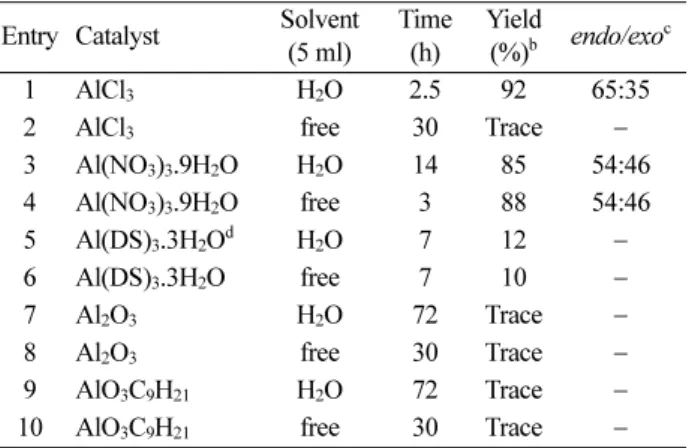
Comparison of AlCl3, Al(NO3)3.9H2O, Al(DS)3.3H2O, Al2O3, AlO3C9H21 showed that the higher activity could be achieved with AlCl3 (Table 2). Although it is difficult to offer an explanation for the different activity between these
Lewis acids, certainly there is a relationship between the cation activity and structure of anion. By changing the con- stituent anion the acid strength of Al3+ as well as its catalytic activity is able to vary in a wide range.
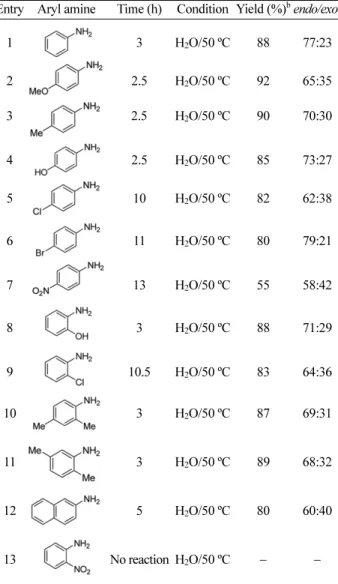
This methodology has been generalized by reaction of series of substituted aryl amines with 3,4-dihydro-2H-pyran and 2,3-dihydrofuran to give pyrano-and furano-quino- lines as illustrated in Table 3. The results showed that aryl amines bearing electron donating groups are more reactive than those of with electron withdrawing groups. Further- more by employing 4-nitroaniline, the desired products could be obtained upon reaction with 3,4-dihydro-2H-pyran under similar conditions in longer reaction time and less yield (Table 3, entry 7). In most cases, the products were obtained as a mixture of endo- and exo-isomers. In all cases the exist- ence of the endo isomer is predominant. The ratio of iso- mers was determined from the 1H NMR spectra of the products. The stereochemistry of the isomers was assigned Scheme 1. Synthesis of pyrano- and furano [3,2-c]quinolines.
Table 1. Comparison catalytic synthesis of 1,2,3,4-tetrahydroquinolines using AlCl3 and varying solvents.a
Entry Solvent (5 ml) Catalyst (mol%) Temp (ºC) Time (h) Yield(%)b endo/exoc
1 free 15 25 72 Trace −
2 free 15 50 30 Trace −
3 H2O 10 50 15 85 65:35
4 H2O 15 25 48 30 −
5 H2O 15 50 2.5 92 65:35
6 H2O 20 50 2.5 92 65:35
7 CH3CN 15 50 55 Trace −
8 EtOH 15 50 55 Trace −
8 DMSO 15 50 12 70 −
10 Toluene 15 50 16 Trace −
11 CCl4 15 50 16 Trace −
aReaction condition: 4-methoxyaniline (1.0 mmol), 3,4-dihydro-2H-pyran (2.2 mmol). bIsolated yield. cDetermined by 1H NMR spectroscopy.
Table 2. Synthesis of 1,2,3,4-tetrahydroquinolines using different Al3+salts (15 mol%)a
Entry Catalyst Solvent (5 ml)
Time (h)
Yield
(%)b endo/exoc
1 AlCl3 H2O 2.5 92 65:35
2 AlCl3 free 30 Trace −
3 Al(NO3)3.9H2O H2O 14 85 54:46 4 Al(NO3)3.9H2O free 3 88 54:46
5 Al(DS)3.3H2Od H2O 7 12 −
6 Al(DS)3.3H2O free 7 10 −
7 Al2O3 H2O 72 Trace −
8 Al2O3 free 30 Trace −
9 AlO3C9H21 H2O 72 Trace −
10 AlO3C9H21 free 30 Trace −
aReaction condition: 4-methoxyaniline (1.0 mmol) and 3,4-dihy- dro-2H-pyran (2.2 mmol) at 50 ºC. bIsolated yield. cDetermined by
1H NMR spectroscopy. dAluminum tris (dodecyl sulfate) trihydrate.
on the basis of coupling constants and chemical shifts of protons which was accordant with the presentation of the literature.13 It is noteworthy that our method has several advantages including mild conditions, good yields, short reaction times and simple operation and work-up. Addi- tionally, the protocol does not require anhydrous sol- vents adopted the principles of green chemistry point of view.
The plausible mechanism of the product formation is shown in Scheme 2. Z. Lei and co-worker27 have previ- ously been reported that AlCl3 is hydrolyzed to oligomers [Al2(OH)nCl6−n]m in aqueous phase, the hydrolyzed prod- ucts have been regarded as water-soluble supporter the in situ formed Al−OH was possibly applied as key intermedi- ate for alcohol oxidation. On the other hand AlCl3 is a hard Lewis acid that coordinates hard basic centers like the oxy- gen atom of a carbonyl group and that of enol ether activating the reagent for a nucleophilic attack. Thus either AlCl3 or Al−OH may catalyzed an aza-Diels–Alder process of 2- azadiene which is generated in situ from cyclic enol ether and aniline derivatives using Al+3 catalyst, with another equivalent of cyclic enol resulting in the formation of trahy- droquinoline.
To show the merits and advantages of using AlCl3 as a catalyst in the synthesis of 4-(9-methoxy-3,4,4a,5,6,10b- hexahydro-2H-pyrano[3,2-c]quinolin-5-yl)butan-1-ol (Table 3, entry 2), our protocol was compared with previously reported methods (Table 5). From the results reported, the advantages of our method are evident regarding the yields of the reactions which are very important in chemical industry especially when it is combined by green reaction condi- tions.
Scheme 2. The proposed reaction mechanism for AlCl3 -cata- lyzed pyrano quinoline derivative.
Table 3. Synthesis of 1,2,3,4-tetrahydropyanoquinolines using AlCl3.a
Entry Aryl amine Time (h) Condition Yield (%)bendo/exoc
1 3 H2O/50 ºC 88 77:23
2 2.5 H2O/50 ºC 92 65:35
3 2.5 H2O/50 ºC 90 70:30
4 2.5 H2O/50 ºC 85 73:27
5 10 H2O/50 ºC 82 62:38
6 11 H2O/50 ºC 80 79:21
7 13 H2O/50 ºC 55 58:42
8 3 H2O/50 ºC 88 71:29
9 10.5 H2O/50 ºC 83 64:36
10 3 H2O/50 ºC 87 69:31
11 3 H2O/50 ºC 89 68:32
12 5 H2O/50 ºC 80 60:40
13 No reaction H2O/50 ºC − −
aReaction condition: aryl amine (1.0 mmol), DHP (2.2 mmol) and AlCl3 (15 mol%). bIsolated yield. cDetermined by 1H NMR spec- troscopy.
Table 4. Synthesis of 1,2,3,4-tetrahydrofuranoquinolines using AlCl3.a Entry Aryl amine Time (h) Condition Yield (%)bendo/exoc
1 2.5 H2O/R.T. 88 78:22
2 1.45 H2O/R.T. 90 75:25
3 1.45 H2O/R.T. 86 80:20
4 1.45 H2O/R.T. 83 80:20
5 8 H2O/50 ºC 79 77:23
6 8 H2O/50 ºC 82 82:18
7 10 H2O/50 ºC 59 52:48
8 7 H2O/50 ºC 81 67:33
9 2 H2O/R.T. 80 74:26
10 2 H2O/R.T. 86 66:34
11 5 H2O/R.T. 82 56:44
aReaction condition: aryl amine (1.0 mmol), DHF (2.2 mmol) and AlCl3 (15 mol%). bIsolated yield. cDetermined by 1H NMR spec- troscopy.
EXPERIMENTAL Materials and Methods
1H NMR spectra were recorded on a Bruker ARX 300 MHz using CDCl3 and DMSO as the solvent and TMS as an internal standard. IR spectra were recorded on KBr pel- lets using a FT-IR Bruker Tensor 27 spectrometer. The reac- tions were monitored by TLC. All solvents and reagents were purchased from Aldrich and Merck with high-grade quality and used without any purification and Al(DS)3.3H2O was prepared via previously reported protocol in litera- ture.36 All products were known and their physical and spectral data were compared with those of authentic sam- ples (lit. [4-14]).
General Procedure for the Synthesis of 1,2,3,4-Tetrahy- dropyranoquinolines Using AlCl3. A Typical Procedure
A mixture of aniline derivatives (1 mmol), cyclic enol ether (2.2 mmol) and of AlCl3 (15.0 mol%) in water (5.0 ml) was stirred at ambient temperature or at 50 ºC for an appro- priate time (Table 3,4). The progress of the reaction was monitored by TLC (ethyl acetate:n-hexane 2:3). Upon comple- tion of the reaction, ethylacetate (15×2) was added and the organic layer was separated. After drying of organic phase (Na2SO4), and evaporation of the solvent, the crude prod- uct was afforded which was directly subjected to thin layer chromatography. The product was as a mixture of endo/exo isomers. The aqueous layer that remained after the work-up of the reaction can be reused.
Physical and Spectra Data for New Products 5-(4-hydroxybutyl)-3,4,4a,5,6,10b-hexahydro-2H-pyr- ano[3,2-c]quinolin-7-ol (entry 8, Table 3)
IR (KBr, cm−1): 3412.13, 2937.56, 2859.81, 1615.09, 1509.02, 1448.08, 1377.66, 1204.37, 1073.40, 860, 743.04.
endo-isomer 1H NMR (DMSO, 300 MHz): δ 1.25−1.7 (m, 10H), 1.9 (m, 1H, H6), 3.25 (m, 1H), 3.35−3.42 (m, 2H), 3.54 (t, J = 6.2 Hz, 2H), 4.5 (s, 1H, OH), 4.94 (d, J = 5.46, 1H, H5), 6.43 (t, J = 7.6, 1H, Ar−H), 6.55 (d, J = 7.5, 1H, Ar−
H), 6.67 (d, J = 7.5, 1H, Ar−H).
exo-isomer 1H NMR (DMSO, 300 MHz): δ 1.25−1.7 (m, 10H), 1.8 (m, 1H, H6), 3.32 (m, 1H ), 3.4 (m, 3H), 3.72 (m, 1H), 4.16 (s, 1H, OH), 4.33 (d, J = 2.45, 1H, H5), 6.32 (t, J = 7.6, 1H, Ar−H), 6.53 (d, J = 7.5, 1H, Ar−H), 7.61 (d, J = 7.5, 1H, Ar−H).
4-(7,9-dimethyl-3,4,4a,5,6,10b-hexahydro-2H-pyrano[3,2- c] quinolin-5-yl)butan-1-ol (entry 11, Table 3)
IR (KBr, cm−1): 3391.28, 2932.78, 2854.42, 1589.90, 1507.42, 1466.06, 1378.23, 1211.64, 1056.65, 861.78, 790.
endo-isomer 1H NMR (CDCl3,300 MHz): δ 1.4−1.8 (m, 10H), 2.1 (m, 1H, H6), 2.3 (s, 6H), 3.36 (m, 1H), 3.61 (m, 2H), 3.65 (t, J = 6.43, 2H), 5 (d, J = 5.46, 1H, H5), 6.46 (d, J
= 7.4,1H, Ar−H), 6.87 (d, J = 7.4, 1H, Ar−H).
exo-isomer 1H NMR (CDCl3,300 MHz): δ 1.4−1.8 (m, 10H), 1.95 (m, 1H, H6), 2.2 (s, 6H), 3.51 (m, 1H), 3.73 (m, 3H), 3.99 (m, 1H), 4.4 (d, J = 2.33, 1H, H5), 6.46 (d, J = 7.4, 1H, Ar−H), 6.87 (d, J = 7.4, 1H, Ar−H).
3-(6-chloro-2,3,3a,4,5,9b-hexahydrofuro[3,2-c]quino- lin-4-yl)propan-1-ol (entry 8, Table 4)
IR (KBr, cm−1): 3426.20, 2941.11, 2848.95, 1598.87, 1510.12, 1464.34, 1375.00, 1205.08, 1077.68, 867.48, 743.17.
endo-isomer 1H NMR (CDCl3,300 MHz): δ 1.72−1.86 (m, 5H), 1.92−2.01 (m, 1H), 2.60 (m, 1H), 3.43 (m, 1H), 3.53 (m, 2H) , 3.65 (m, 2H), 5.08 (d, J = 7.0, 1H), 6.65 (t, J = 7.3, 1H), 7.12 (d, J = 7.8, 1H), 7.17 (d, J = 7.9, 1H).
exo-isomer 1H NMR (CDCl3,300 MHz): δ 1.72−1.86 (m, 5H), 1.92−2.01 (m, 1H), 2.62 (m, 1H), 3.65 (m, 2H), 3.77 (m, 2H), 3.96 (m, 1H), 4.55 (d, J = 5.25, 1H), 6.59 (t, J
Table 5. Comparison synthesis of 4-(9-methoxy-3,4,4a,5,6,10b-hexahydro-2H-pyrano [3,2-c] quinolin-5-yl)butan-1-ol using varying catalysts
Catalyst Condition amine/enolethera Time (h) Yield(%)b endo/exoc Ref.
InCl3 (10−20%) H2O, 50 °C 2: (4−6) 10 62 66:34 4
InCl3 (5%) CH3CN, r.t 5:12 3.5 87 85:15 5
KSF Clay (1.5 g) CH3CN, r.t 5:12 3.5 88 95:5 6
Sc(OTf)3 (3%) [bmim]PF6, r.t 2:5 3.5 87 95:5 7
I2 (20%) CH3CN, r.t 1:2 0.8 83 33:67 8
ZrOCl2 (10%) H2O, 50 °C 1:3 2 72 68:32 9
PANI-InCl3 (10%) H2O, 50 °C 0.5:1.5 5 90 59:41 10
4-npa (25% ) CH3CN, 50 °C 1:2.5 3.5 86 45:55 11
Cellulose-SO3H (0.03 g) CH3CN, r.t 5:10 4.5 74 79:21 12
AlCl3 (15%) H2O, 50 °C 1:2.2 2.5 92 65:35 This work
aAryl amine: 4-methoxyaniline, enolether: DHP. bIsolated yield. cDetermined by 1H NMR spectroscopy.
= 7.3, 1H), 7.12 (d, J = 7.8, 1H), 7.20 (d, J = 7.9, 1H).
3-(6,8-dimethyl-2,3,3a,4,5,9b-hexahydrofuro[3,2-c]quin- olin-4-yl)propan-1-ol (entry 10, Table 4)
IR(KBr, cm−1): 3418.59, 2933.96, 2857.92, 1588.07, 1505.30, 1455.47, 1378.91, 1213.52, 1058.02 , 865.678, 794.48.
endo-isomer 1H NMR (CDCl3,300 MHz): δ 1.60−1.92 (m, 5H), 1.98−2.02 (m, 1H), 2.25 (s, 6H), 2.60 (m, 1H), 3.32 (m, 1H), 3.80 (m, 2H), 3.90 (m, 2H), 5.26 (d, J = 8.523, 1H), 6.55 (d, J = 7.45, 1H), 7.88 (d, J = 7.47, 1H).
exo-isomer 1H NMR (CDCl3,300 MHz): δ 1.60−1.92 (m, 5H), 1.98−2.02 (m, 1H), 2.25 (s, 6H), 2.60 (m, 1H), 3.69 (m, 2H), 3.74 (m, 2H), 3.98 (m, 1H), 4.57 (d, J = 5.025, 1H), 6.55 (d, J = 7.45, 1H), 7.88 (d, J = 7.47, 1H).
CONCLUSION
In summary, we reported efficient, simple and green con- ditions for the synthesis of tetrahydro pyrano and furano quinoline derivatives as endo/exo isomers. The employed catalyst for this process is rather inexpensive, non-stinking, nontoxic hence this is a practical protocol.
Acknowledgments. The publication cost of this paper was supported by the Korean Chemical Society.
REFERENCES
1. Jia, Z. X.; Luo, Y. C.; Xu, P. F. Org. Lett. 2011, 13, 833−
835.
2. Katritzky, A. R.; Rachwal, S.; Rachwal, B. Tetrahedron 1996, 52, 15031−15070.
3. Ma, Y.; Qian, C.; Xie, M., Sun, J. J. Org. Chem. 1999, 64, 6462−6467.
4. Zhang, J.; Li, C.-J. J. Org. Chem. 2002, 67, 3969−3971.
5. Yadav, J. S.; Reddy, B. V. S.; Rao, R. S.; Kumar, S. K.;
Kunwar, A. C. Tetrahedron 2002, 58, 7891−7896.
6. Yadav, J. S.; Reddy, B. V. S.; Sadasiv, K.; Reddy, P. S. R.
Tetrahedron Lett. 2002, 43, 3853−3856.
7. Yadav, J. S.; Reddy, B. V. S.; Gayathri, K. U.; Prasad, A.
R. Synthesis 2002, 17, 2537−2541.
8. Lin, X.-F.; Cui, S.-L.; Wang, Y.-G. Tetrahedron Lett. 2006, 47, 4509−4512.
9. Nagawade, R. R.; Shinde, D. B. Chin. Chem. Lett. 2006, 17, 1137−1140.
10. Kantam, M. L.; Roy, M.; Roy, S.; Subhas, M. S.; Sreedhar, B.;
Choudary, B. M.; De, R. L. J. Mol. Catal. A: Chem. 2007, 265, 244−249.
11. Srinivasa, A.; Mahadevan, K. M.; Hosamani, K. M.; Hulikal, V. Monatsh. Chem. 2008, 139, 141−145.
12. Kumar, A.; Srivastava, S.; Gupta, G. Tetrahedron Lett.
2010, 51, 517−520.
13. Kamal, A.; Prasad, B. R.; Ramana, A. V.; Babu, A. H.;
Reddy, K. S. Tetrahedron Lett. 2004, 45, 3507−3509.
14. Kamal, A.; Prasad, B. R.; Khan, M. N. A. J. Mol. Catal.
A: Chem. 2007, 274, 133−136.
15. Chen, M.; Li, D.; Luo, Y.; He, M.; Xie, J.; Li, H.; Yuan, X. J. Ind. Eng. Chem. 2011, 17, 14−17.
16. Horikawa, N.; Obora, Y.; Ishii, Y. Synlett 2011, 6, 857−861.
17. Fan, X.-Y.; Yang, Y.-X.; Zhuo, F.-F.; Yu, S.-L.; Li, X.; Guo, Q.-P.; Du, Z.-X.; Da, C.-S. Chem. Eur. J. 2010, 16, 7988−
7991.
18. Liu, L.-F.; Liu, H.; Pi, H.-J.; Yang, S.; Yao, M.; Du, W.;
Deng, W.-P. Synth. Commun. 2011, 41, 553−560.
19. Novikov, V. L.; Shestak, O. P.; Denisenko, V. A. Russ.
Chem. Bull. 2010, 59, 1600−1604.
20. Das Sharma, S.; Hazarika, P.; Konwar, D. Catal. Commun.
2008, 9, 709−714.
21. Kato, N.; Tamura, Y.; Kashiwabara, T.; Sanji, T.; Tanaka, M. Organometallics 2010, 29, 5274−5282.
22. Yang, G.; Shen, Y.; Li, K.; Sun, Y.; Hua, Y. J. Org. Chem.
2011, 76, 229−233.
23. Lo Fiego, M. J.; Silbestri, G. F., Chopa, A. B.; Lockhart, M. T. J. Org. Chem. 2011, 76, 1707−1714.
24. Shiri, M.; Zolfigol, M. A.; Ayazi-Nasrabadi, R. Tetrahedron Lett. 2010, 51, 264−268.
25. Shinkevich, E.; Deblander, J.; Matthijs, S.; Jacobs, J.; Kimpe, N. D.; Tehrani, K. A. Org. Biomol. Chem. 2011, 9, 538−548.
26. Yang, B.; Lu, Y.; Chen, C.-J.; Cui, J.-P.; Cai, M.-S. Dyes Pigm. 2009, 83, 144−147.
27. Wu, S.; Ma, H.; Lei, Z. Tetrahedron 2010, 66, 8641−8647.
28. (a) Behbahani, F. K.; Yektanezhad, T.; Khorrami, A. R.
Heterocycles 2010, 81, 2313−2321. (b) Behbahani, F. K.;
Sadeghi, M. J. Korean Chem. Soc. 2013, 57, 357−360.
29. Behbahani, F. K.; Ziaei, P.; Fakhroueian, Z.; Doragi, N.
Monatsh. Chem. 2011, 142, 901−906.
30. Grieco, P. A., Ed. Organic Synthesis in Water; Blackie Academic and Professional: Londan, 1998; pp 1−46.
31. Zhao, Y.; Ge, Z.-M.; Cheng, T.-M.; Li, R.-T. Synlett 2007, 10, 1529−1532.
32. Kobayashi, S.; Manabe, K. Acc. Chem. Res. 2002, 35, 209−
217.
33. Tanaka, K.; Toda, F. Chem. Rev. 2000, 100, 1025−1074.
34. Fringuelli, F.; Pizzo, F.; Tortoioli, S.; Vaccarol, L. J. Org.
Chem. 2003, 68, 8248−8251.
35. Amantin, D.; Fringuelli, F.; Pizzo, F.; Vaccarol, L. J. Org.
Chem. 2001, 66, 4463−4467.
36. Firouzabadi, H.; Iranpoor, N.; Nowrouzi, F. Chem. Com- mun. 2005, 789−791.
![Table 5. Comparison synthesis of 4-(9-methoxy-3,4,4a,5,6,10b-hexahydro-2H-pyrano [3,2-c] quinolin-5-yl)butan-1-ol using varying catalysts](https://thumb-ap.123doks.com/thumbv2/123dokinfo/5298885.154234/4.892.87.809.883.1089/table-comparison-synthesis-methoxy-hexahydro-quinolin-varying-catalysts.webp)
