Printed in the Republic of Korea
단 신
울금 추출물의 구성 성분 분석과 m-Chloroperoxybenzoic Acid와의 반응
박국태* ․ 최성목 ․ 김동진 ․ 변상욱 ․ 박용덕 ․ 강준구 ․ 조성윤 ․ 김진명 한국교원대학교 화학교육과
(2009. 3. 27 접수)
Constituent Analysis of Turmeric (Curcuma longa L) Extract and Its Reaction with m-Chloroperoxybenzoic Acid
Kuk-Tae Park*, Sung-Mok Choi, Dong-Jin Kim, Sang-Wook Byeon, Young-Duk Park, Jun-Gu Kang, Sung-Yoon Cho, and Jin-Myung Kim
Department of Chemistry Education, Korea National University of Education, Chungbuk 363-791, Korea (Received March 27, 2009)
주제어: 울금, m-Chloroperoxybenzoic Acid, 항산화 기능
Keywords: Turmeric (Curcuma longa L), m-Chloroperoxybenzoic Acid, Antioxidative Activity
Recently many researchers have been trying to extract biologically active materials from natural resources, and to discover natural products that have an excellent efficacy while being nontoxic to human body.1 Natural products are generally proved to be safe since they have been selected and utilized for a long time as herbal medicines. Since various herbal medicines with antioxidative activity are being utilized in daily life, antioxidative foods or additives are being developed and commercialized.2 Turmeric is a herbal medicine which has various physiological effects.3-6
Turmeric, also called Curcuma Longa L, is a perennial herb, which belongs to the Zingiberaceae family and originates from India and Tropical Asia.
Turmeric is also called ulgum, gulgum, okgum, and simhwang in Korea. The constituents of turme- ric differ according to the area it is grown, but the main constituents are known as curcumin, tumer- one, and dicafferoyl methane.7
Turmeric is used as a food additive for its anti- bacterial effect, and it has a high antioxidative activity8 compared to other herbal medicines.9 It has also been discovered that a-tumerone, which
is one of the constituents of turmeric, has an activity of destroying the cell lines of leukemia without side effects.10 Furthermore, extract from turmeric is used as a natural dye for the yellow color.11,12
Many researches have been conducted on the antioxidative activity of turmeric,13-15and it has been found out that turmeric prevents aging by eliminating active oxygen. Excessive active oxygen is known to be the cause of ageing and related diseases because it attacks the cells of the human body.15 Though the physiological effect on some constituents of turmeric is known,16 it is not known on which constituent acts as an antioxidant. Further- more, since most of the physiological effects of turmeric are discovered through clinical tests,8,9 no specific research has been reported on how turmeric acts as an antioxidant.
Therefore, this research was conducted to analyze the constituents and find out the antioxidative activity of the turmeric extract through a kinetic experiment on the reaction of turmeric extract and
m-chloroperoxybenzoic acid (m-CPBA), which is
an oxidative reagent with a high reactivity andstereoselectivity.17
EXPERIMENTAL
Materials and measurements. Acetic acid (Showa
Chemicals Inc., 99%) and ethanol (Hayman Limited, 99.9%) were used as the solvents in this experi- ment. m-Chloroperoxybenzoic acid (m-CPBA, Aldrich Chemical Company, Inc., 57-86%) was purified by literature methods18 and recrystallized from CH2Cl2. The turmeric was purchased from a herbal medicine store. The UV/VIS spectrum was measured on a Hewlett Packard HP 8452A diode- array UV/VIS spectrophotometer. The IR spectrum was measured by Bruker Vector-22 IR spectro- photometer with a KBr pellet. The GC/MS data was obtained by HP-6890 Plus gas chromatography and the mass spectrometer of the HP-5973 MSB in the Hazardous Substance Research Team of Korea Basic Science Institute Seoul Branch. The mass spectrum was analyzed using the mass spectral library search database Wiley 275000.Preparation of turmeric extract. 1.06 g of turme-
ric and 130 mL of ethanol were placed in the 250 mL round bottomed flask with a reflux condenser and refluxing it for 33 hours. Ethanol extract was cooled at room temperature. The supernatant of ethanol extract was filtered and evaporated by a rotary vacuum evaporator to give a reddish orange colored turmeric extract. Turmeric extract was dried in a vacuum (below 10 mmHg) desiccator for 12 hours in room temperature, and it used as a reagent.Preparation of stock solutions. The molecular
weight of the turmeric extract was estimated to be about 210, which was calculated by considering the molecular weight and the relative abundance of the constituents from the GC/MS data (Table 1). The 1.0 × 10⁻² M stock solution of turmeric extract was made by dissolving turmeric extract 0.0027 g (0.01 mmol) in acetic acid and making the amount of the solution 1 mL. The 1.0 × 10⁻¹ M stock solution of m-CPBA was made by dissolv- ing m-CPBA 0.0173 g (0.1 mmol) in acetic acid and making the amount of the solution 1 mL.Fresh stock solutions were always made before using.
Reaction of turmeric with m-CPBA. Reaction
of turmeric with m-CPBA in acetic acid was monitored from measurements of the decrease in UV/VIS absorbance at 418 nm. UV/VIS absor- bances were measured using a 1-cm quartz cell sealed by a rubber stopper. The temperature of the thermostated cell block in UV/VIS spectrophoto- meter was maintained at a constant temperature (±0.01 oC) using NESLAB model EX-210 constant temperature bath and circulator. After putting a small magnetic bar in 1-cm quartz cell and flushing it with dry nitrogen, 2.0 mL acetic acid was injected and the cell was sealed with a rubber stopper. Acetic acid in the cell was kept in the thermostated cell block for more than 20 minutes in the desired temperature of the reaction. For the reaction con- ditions, an appropriate amount of stock solutions was injected at the same time, and the decrease in UV/VIS absorbance was measured at 418 nm as a function of reaction time.
The reaction condition was a pseudo-first-order reaction, in which the concentration of m-CPBA was 20 times lager than the concentration of turmeric extract. The kinetic study of the reaction of turmeric extract and m-CPBA in the acetic acid was performed by varying the reaction temperature range of 30-50 oC, when the mole ratio of turmeric extract and m-CPBA was varied to 1:20, 1:40, 1:80. The pseudo-first-order reaction rate constants were obtained from the slopes of plots of ln (A∞ -
A
0)/(A∞ - At) vs. time derived from k = 1/t ln (a/a -x). The values of the activation parameters were
obtained by using the Arrhenius plot at three different temperatures and the Eyring equation.19RESULTS AND DISCUSSION
The UV/VIS wavelength maximum of the turmeric extract appeared at 418 nm (εmax 370), because of a long chain conjugation or a poly- nuclear aromatic chromophore. The IR absorption peak of the turmeric extract was shown at 3378 cm-1 as a broad band, which corresponds to theTable 1. Gas chromatogram data and mass spectral data of turmeric extract Peak Retention Time,
min Peak height Relative
abundance, % Molecular weight Molecular formula
1 9.054 8366 2.780 150 C9H10O2
2 9.769 5983 0.638 - -
3 10.510 3985 0.134 - -
4 10.867 31657 1.792 202 C15H22
5 11.356 3527 0.170 - -
6 12.044 6763 0.574 - -
7 12.388 13308 1.252 164 C11H16O
8 13.156 1288414 80.674 216 C15H20O
9 13.672 107897 8.619 218 C15H22O
10 14.307 3296 0.280 110 C7H10O
11 14.717 18735 2.349 218 C15H22O
12 15.021 1917 0.243 - -
13 15.312 1577 0.175 - -
14 15.471 1704 0.322 - -
H2C
CH3 H3C
CH3
O
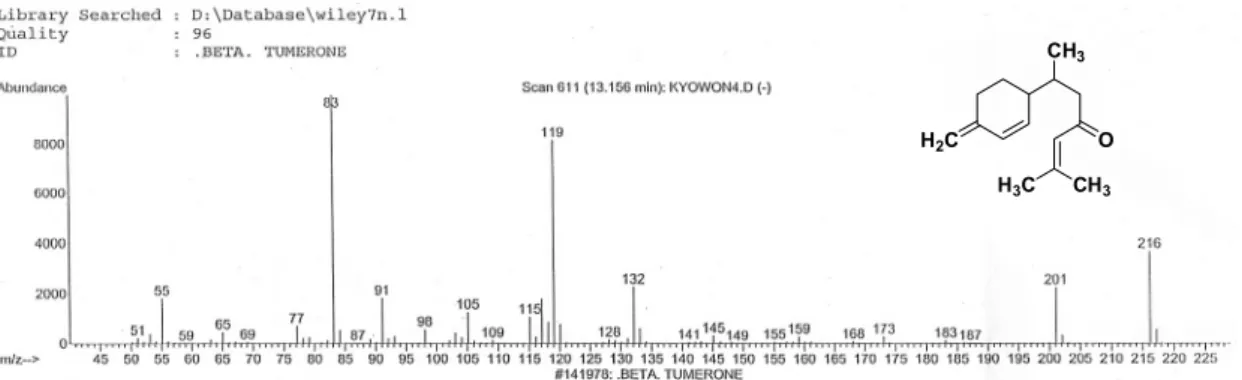
Fig. 1. Mass spectrum and molecular structure of β-turmerone which gas chromatogram retention time was 13.156 minute.
hydrogen bonds of -OH bonds of the constituent and ethanol residue. The IR absorption peaks at the 3015-2925 cm-1 region correspond to C-H bonds. The IR absorption peaks shown at the 1600-1700 cm-1 region correspond to the C=O bonds and C=C bonds, and those at the 1600-1400 cm-1 region correspond to the aromatic rings of the aromatic compounds.
The GC/MS data of the turmeric extract is shown in Table 1. The gas chromatogram data revealed that there are at least 14 constituents in the turmeric extract. Only 7 compounds could be identified by MS database Wiley 275000, and it was difficult to identify for the other 7 constituents with the GC/MS data alone.20 Furthermore, the constituents C15H20O and C15H22O which had a
retention time of 13.156 min and 13.672 min, respectively constituted 89.29% of the overall abundance (Table 1).
Through the mass spectrum and the mass spectral library search database, the molecule structures of 7 constituents of turmeric extract could be identi- fied. They were 2-methoxy-5-cinylphenol (C9H10O2), 1-(1,5-dimethyl-4-hexenyl)-4-methylbenzene (C15H22), 1-(2-methoxy-1-methylethyl)-2-methyl- benzene (C11H16O), β-turmerone (C15H20O), a-turme- rone (C15H22O), 2,3,5-trimethylfuran (C7H10O), and a-atlantone (C15H22O). Among these consti- tuents, β-turmerone (Figure 1) constituted 80.67%
abundance (Table 1).
In order to perform a kinetic study on the reaction between turmeric extract and m-CPBA,
Table 2. Pseudo first order reaction rate constants for the reaction of turmeric extracts with m-CPBA at mole ratio and temperature in acetic acid
Mole ratio k × 104, sec-1
30 oC 40 oC 50 oC
1:20 1.336 2.259 4.331
1:40 2.812 5.396 9.920
1:80 5.180 9.404 17.467
1/T ×103
-6 -6.5 -7 -7.5 -8 -8.5
-9
3.096 3.195 3.300
ln k
1:80
Fig. 2. The Arrhenius plots for the reaction of turmeric extracts with m-CPBA at the mole ratio in acetic acid.
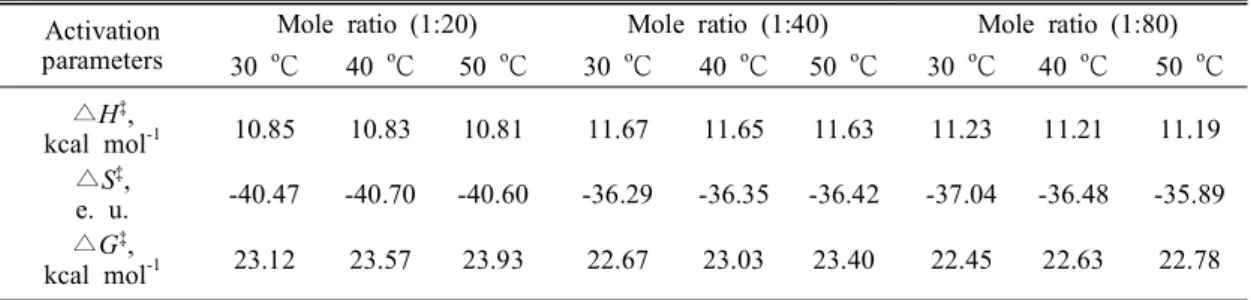
Table 3. Thermodynamic activation parameters for the reaction of turmeric extracts with m-CPBA at mole ratio and temperature in acetic acid
Activation parameters
Mole ratio (1:20) Mole ratio (1:40) Mole ratio (1:80) 30 oC 40 oC 50 oC 30 oC 40 oC 50 oC 30 oC 40 oC 50 oC
△H‡,
kcal mol-1 10.85 10.83 10.81 11.67 11.65 11.63 11.23 11.21 11.19
△S‡,
e. u. -40.47 -40.70 -40.60 -36.29 -36.35 -36.42 -37.04 -36.48 -35.89
△G‡,
kcal mol-1 23.12 23.57 23.93 22.67 23.03 23.40 22.45 22.63 22.78
the decrease in UV/VIS absorbance was measured at 418 nm as a function of reaction time, The reaction temperature was 30 oC, 40 oC, and 50 oC when the mole ratio of turmeric extract and
m-CPBA was 1:20, 1:40, and 1:80, respectively.
As a function of reaction time, the absorbance decreased at the 418 nm and increased at the 340 nm, which showed the occurrence of oxidative cleavage reactions. The UV/VIS wavelength maxi- mum of the reaction product shifted to the short wavelength region compared to that of the turmeric extract, which means that the molecular structures of the turmeric extract are cleaved by the reactions.
In other words, the π electron conjugation system of the turmeric extract is cleaved by the oxidative reactions.
The pseudo first order reaction rate constants were obtained from the first order reaction rate law by measuring the absorbance at the UV/VIS λmax
418 nm of the turmeric extract, varying the reaction temperature 30 oC, 40 oC, and 50 oC when the mole ratio of the turmeric extract and m-CPBA was 1:20, 1:40, and 1:80, respectively (Table 2).
The Arrhenius plot of the reaction of turmeric extract and m-CPBA in the acetic acid is shown on
Figure 2. Using this plot the activation energy
(Ea) was found to be 11.46 kcal/mol. 12.27 kcal/mol, 11.83 kcal/mol, when the mole ratio was 1:20, 1:40, and 1:80, respectively. In addition, the thermodynamic activation parameters, which were the activation enthalpy △H‡, activation entropy
△
S
‡, and the activation free energy △G‡, were determined according to the reaction conditions (Table 3).The activation energy was found to be 11.46- 12.27 kcal/mol by varying the reaction tempera- ture to 30 oC, 40 oC, and 50 oC when the mole ratios of the turmeric extract and m-CPBA in the acetic acid were 1:20, 1:40, and 1:80. The reaction rate constant increased 1.7-1.9 times when the reaction temperature increased 10 oC. The activa- tion entropy was a big negative, -35.89 ~ -40.70 e.
u. to the reaction conditions (Table 3).
Reactions that have an activation energy of below 19 kcal/mol in organic chemical reactions occur spontaneously at room temperature or at below room temperature.21 Since the oxidation reaction of turmeric extract and m-CPBA can occur easily because of the low activation energy of 12.27 kcal/mol, turmeric extract can easily interact with oxidative reagent. This kinetically shows that turmeric extract has an antioxidative activity that can remove highly active oxygen. The activation entropy having a big negative of -35.89 ~ -40.70 e. u., shows that turmeric extract can form a stable transition state with active oxygen, which has a high degree of freedom.22 Furthermore, this shows that turmeric extract easily reacts with active oxygen and can act as an antioxidant. Whereas the detailed reaction mechanism of the antioxidative activity of the turmeric extract can be examined by a kinetic study of each constituent of the turmeric extract.
Acknowledgement. This work was supported
by 2009 KNUE Research Grant from Korea National University of Education.REFERENCES
1. Yun, H. J.; Heo, S. K.; Yun, H. J.; Park, W. H.; Park, S. D. The Korea Association of Herbology, 2007, 22, 65.
2. Nam, S. H.; Kang, M. Y. J. Korean Soc. Agric.
Chem. Biotechnol. 2000, 43, 141.
3. Yu, Z. F.; Kong, L. D.; Chen, Y. Journal of Ethno- pharmacology, 2002, 87, 161.
4. Eigner, D.; Scholz, D. Journal of Ethnopharmacology, 1999, 67, 1.
5. Sung, H. K.; Choi, S. H.; Ahn, K. S. Korean J.
Oriental Medical Pathology, 1999, 13, 66.
6. Shahin, S. A.; Naresh, K.; Abhinav, L.; Angad, S.;
Hallihosur, S.; Abhishek, S.; Utpal, B. Food Research International, 2008, 41, 1.
7. Park, Y. K. Kor. J. Herbology, 2001, 16, 42.
8. Negi, P. S.; Chauhan, A. S.; Sadia, G. A.; Rohini- shree, Y. S.; Ramteke, R. S. Food Chem. 2005, 92, 119.
9. Cousins, M.; Adelberg, J.; Chen, F.; Rieck, J.
Industrial Crops and Products, 2007, 25, 129.
10. Aratanechemuge, Y.; Komiya, T.; Moteki, H.;
Katsuzaki, H.; Imai, K.; Hibasami, H. International Journal of Molecular Medicine, 2002, 9, 481.
11. Cho, S. S.; Song, H. S.; Kim, B. H. Journal of the Korean Society of Clothing and Textiles, 1997, 21, 1051.
12. Yang, J. S. Journal of Korea Society of Color Studies, 2004, 18, 103.
13. Surh, Y. J. Food and Chemical Toxicology, 2002, 40, 1091.
14. Wisanu, T.; Boonsom, L.; Saisunee, L. Food Chem.
2009, 112, 494.
15. Tuba, A.; İlhami, G. Chemico-Biological Interactions, 2008, 174, 27.
16. Araújo, C.; Leon, L. Mem Inst Oswaldo Cruz, Rio deJaneiro, 2001, 96, 724.
17. Fieser, L. F.; Fieser, M. Reagents for Organic Synthesis; John Wiley & Sons, Inc.: New York, U.
S. A., 1967; pp 459-463.
18. Schwartz, N. N.; Blumbergs, J. H. J. Org. Chem.
1964, 29, 1976.
19. Frost, A. A.; Pearson, R. G. Kinetics and Mechanism;
2nd ed.; John Wiley & Sons, Inc.; New York, U. S.
A., 1961; Chapter 5, pp 77-102.
20. Pavia, D. L.; Lampman, G, M.; Kriz, G. S. Intro- duction to Spectroscopy; 4th ed.; Harcourt, Inc.:
Florida, U. S. A., 2009; pp 497-498.
21. McMurry, J. Organic Chemistry; 7th ed.; Brooks/
Cole Publishing Co.: California, U. S. A., 2008; p 159.
22. Park, K.-T.; Lee, C.-K.; Hahn, C.-S. J. Org. Chem.
1979, 44, 4501.