Printed in the Republic of Korea
NH N O
Cl Cl
O N
carmustine
N Cl Cl HOOC
chlorambucil
4-(2-Chloroethyl) semicarbazide의 히드라존 유도체 합성:
새로운 종류의 세포독성요법제
O. I. El-Sabbagh*, M. E. El-Sadek, M. E. Aboukull, and H. M. Shallal
Department of Medicinal Chemistry, Faculty of Pharmacy, Zagazig University, Zagazig, Egypt (2008. 10. 26 접수)
Synthesis of Hydrazone Derivatives of 4-(2-Chloroethyl) semicarbazide : A New Class of Cytotoxic Agents
O. I. El-Sabbagh*, M. E. El-Sadek, M. E. Aboukull, and H. M. Shallal
Department of Medicinal Chemistry, Faculty of Pharmacy, Zagazig University, Zagazig, Egypt E-mail: elsabbagh [email protected]
(Received Octorber 26, 2008)
요 약. 새로운 종류의 히드라존 유도체는 4-(2-chloroethyl) semicarbazides로 부터 합성되었고, 인간 두 뇌(U251)와 간(Hepg2)의 암세포 에 대해 항증식성을 보였다. 히드라존 화합물은 벤즈알데히드, 아세토 페논, 3-formylindole 유도체이다. 아세토페논 유도체중에 3e (p-methoxy substituted)와 and 3f (p-nitro substituted)는 Hepg2 세포 (각각IC
50= 6 ,8 µg/mL) 에 대해 가장 높은 세포독성활성을 보인다. 3-Formylindole 유도체중에 4a (hydrazone of 3-formylindole)은 U251 (IC
50= 21 µg/mL)와 Hepg2 (IC
50= 7 µg/mL)에 강한 세포독성활성을 보인다.
주제어: 히드라존, 2-(Chloroethyl)요소들, 4-(2-Chloroethyl) semicarbazides, 세포독성요법 활성
ABSTRACT. A new series of hydrazone derivatives were synthesized from 4-(2-chloroethyl)semi- carbazide and their antiproliferative activity against human brain (U251) and liver (Hepg2) carcinoma cell lines were evaluated. The hydrazone compounds are benzaldehyde (2a-2g), acetophenone (3a-3f), and 3-formylindole derivatives (4a-4d). Among the acetophenone derivatives, 3e (p-methoxy substituted) and 3f (p-nitro substituted) showed the highest cytotoxic activity against Hepg2 cell line (IC50 = 6 and 8 µg/ml, respectively). Among the 3-formylindole derivatives, 4a (hydrazone of 3-formylindole itself) showed a pronounced cytotoxic activity against both U251 (IC50 = 21 µg/ml) and Hepg2 (IC50 = 7 µg/ml).
Keywords: Hydrazones, 2-(Chloroethyl)ureas, 4-(2-Chloroethyl) semicarbazides, Cytotoxic activity
INTRODUCTION
1-Aryl-3-(2-chloroethyl)ureas (CEUS) were found to exhibit better cytotoxicity1 than the parent drugs i.e. chlorambucil and carmustine.2-6 These deriva- tives as for examples 1-(4-tert-butylphenyl)-3-(2- chloroethyl) urea (A) and 1-(4-Iodophenyl)-3-(2- chloroethyl) urea (B) were designed as hybrid based on the conjugation of aromatic ring of chlo-
rambucil as the prosthetic group and the cytotoxic 2-chloroethylnitrosourea moiety of carmustine as the pharmacophore.7
NH O H3C O
(C) HN H
N O
Cl H3C
CH3 H3C
HN H N O
Cl I
(A) (B)
R = H,CH3 ,F,Cl,OCH3 ,OCH2C6H5, NO2
R
NH O
HN H
N O
Cl
NH
R O
HN NH NH O
Cl (D)
(E)
R = H,F,Cl,OCH3 ,OCH2C6H5
The SAR of the CEU derivatives showed that the unnitrosated derivatives were the only active ones; meanwhile, the exocyclic urea function and the 2-chloroethyl group were essential for activity;
moreover, the preferred aryl groups were 4-substi- tuted phenyl with alkyl or an indanyl group.8 This class was found to irreversibly alkylate β-tubulin inside the cancer cell causing the cytotoxic effect.9 Unfortunately, these derivatives caused many side effects such as developing resistance through P-glycoprotein overexpression and modification of topoisomerase I.10
On the other side, a series of synthetic indole derivatives11,12 such as compound D-64131(C) have proven to have significant antitumoral activity both in vitro and in vivo.
In our previous work, a series of benzamides (D) and 2-indolecarboamides (E) derivatives of the 4-(2-chloroethyl)semicarbazide were prepared13 as a new class of cytotoxic agents. These deriva- tives were structurally related to 1-aryl-3-(2-chlo- roethyl) ureas derivatives with some structural variations whereas the aryl moiety whether p-sub- stituted phenyl (D) or 5-substituted indolyl (E) was linked indirectly to (2-chloroethyl)urea function through carbonylamino moiety. It was found that semicarbazides containing 2-indolyl carbonyl moiety (E) especially those having electron-donor substituents at position 5 of the indole ring like methoxy (IC50 = 8 µg/ml against U251) and benzyloxy (IC50 = 21 µg/ml against Hepg2) showed a higher cytotoxic activity than their corresponding benzoyl derivatives(D) against human brain (U251) and liver (Hepg2)carcinoma cell lines.
In continuation to our previous work, a new series of hydrazone derivatives belonging to p-substituted benzaldehyde or p-substituted aceto- phenone were synthesized from 4-(2-chloroethyl) semicarbazide to study, firstly, the effect of different substituents on the cytotoxic activity. Secondly, we studied also the effect of replacement of p-sub- stituted phenyl belonging to benzaldehyde hydra- zone of the 4-(2-chloroethyl)semicarbazide by 5-substituted indolyl moieties upon the resultant cytotoxic activity against human brain and liver carcinoma cell lines.
Discussions A) Chemisrty
To achieve the first aim, a new series of hydra- zones derived from p-substituted benzaldehyde (2a-g) and p-substituted-acetophenone (3a-f) were prepared as shown in Scheme 1.
The novel and valuable key intermediate, 4-(2- chloroethyl) semicarbazide intermediate (1), was prepared for the first time by adding 2-chloroethyl isocyanate dropwise to excess hydrazine hydrate in ethanol. Both the sequence of addition and room temperature were very important in order to mini- mize the formation of the expected side products.
The intermediate 1 should be used directly in the next step, because it is very hygroscopic. Its structure was confirmed using the elemental analyses and mass spectroscopy.
The novel hydrazone derivatives of the 4-(2- chloroethyl)semicarbazide 2a-g or 3a-f were pre-
NH2NH+2ClCH2CH2NCO
EtOH / AcOH 1
R
O H
R
N
H H
N H
N O
Cl H2N
HN H N O
Cl EtOH
R
N CH3
HN H N O
Cl
2a-g 3a-f
R
O CH3
a: R = H b: R = CH3 c: R = F d: R = Cl e: R = OCH3 f: R = OCH2C6H5 g: R = NO2
a: R= H b: R= CH3 c: R= Br d: R = Cl e: R = OCH3 f: R = NO2
Scheme 1
NH R
dioxane / AcOH 1 O
NH R
N
NH N
H O
Cl H2N
HN H N O
Cl
a: R = H b: R = Cl c: R = OCH3 d: R = OCH2C6H5 4a-d
Scheme 2
pared by condensation of intermediate 1 with the corresponding p-substituted benzaldehyde or aceto- phenones in ethanol containing few drops of glacial acetic acid (Scheme 1).
To achieve the second aim, p-substituted phenyl of benzaldehyde hydrazone (2) was replaced by 5-substituted indolyl moiety at position 1 of the semicarbazide (4) as shown in Scheme 2.
Thus, the novel 1-[(5-substituted-1H-indol-3- yl)methylidene]-4-(2-chloro ethyl)semicarbazides (4a-d) were synthesized by stirring the interme- diate 1 with the corresponding 5-substituted-1H- indole-3-carboxaldehyde in dioxane 14 containing few drops of glacial acetic acid at room tempera-
ture for two hours.
The new compounds were characterized using melting points and thin layer chromatography techniques in different solvent systems. Moreover, the structures of the novel compounds were deter- mined using elemental analyses and various spec- tral data. From the mass spectra, the absence of molecular ion peaks for compounds 2b, 4c, 4d and the appearance of M+ - HCl (M+ - 36.5) peaks were observed, indicating the instability of molecular ion peak which undergoes rapid fragmentation and also the low relative intensity of such peak in some compounds such as 2a (3.8%) and 4b (5.9%).
The structure of some compounds as for example 4d which showed M+ -36.5 peak in the mass spectra was established using 1H-NMR. It confirmed the presence of straight chain for chloroethyl semicar- bazide moiety through appearance of two peaks at various chemical shift 3.52 and 3.69 ppm for the two methylene groups as well as the appearance of two peaks at 6.78 and 10.05 ppm for the NH groups in addition to singlet peak at 8.07 ppm due to azomethine proton.
B) Cytotoxic evaluation
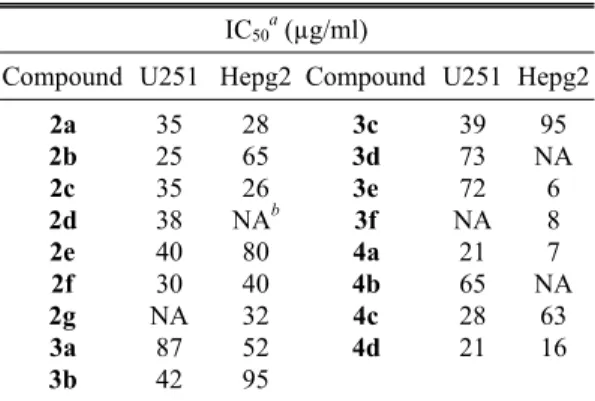
The new compounds 2a-g, 3a-f and 4a-d were evaluated for their in vitro cytotoxic activity against human brain (U251) and liver carcinoma (Hepg2)
Table 1. Cytotoxic evaluation for compounds 2a-g, 3a-f and 4a-d against U251 and Hepg2.
IC50a (µg/ml)
Compound U251 Hepg2 Compound U251 Hepg2
2a 35 28 3c 39 95
2b 25 65 3d 73 NA
2c 35 26 3e 72 6
2d 38 NAb 3f NA 8
2e 40 80 4a 21 7
2f 30 40 4b 65 NA
2g NA 32 4c 28 63
3a 87 52 4d 21 16
3b 42 95
aIC50: Dose which required to inhibit cell growth by 50%.
bNA: not active i.e., it has IC50 more than 100 µg/ml.
cell lines as well as their structure activity relation- ship (SAR) were studied. These targets were evalua- ted at four concentration values (10, 25, 50, 100 µg/ml) using the sulforhodamine B (SRB) assay15 and the results were displayed in Table 1. Given compounds were considered significantly active when their IC50 values were lesser than 100 µg/ml.
It was observed through analysis of table 1 that variable results were obtained depending not only on the type of the used cell line but also on the type of substitution at position 1 of the semicarbazides as seen in comparison of hydrazone derived from benzaldehyde (2a-g) with that of acetophenone (3a-f).
Firstly, regarding the U251 cell line, it could be concluded that cytotoxic activity has been increased in the order 3 < 2 as seen in comparison of the unsubstituted or methyl or chloro derivatives belonging to the general formulas 3 with that of 2.
Secondly, for Hepg2 cell line, the cytotoxic activity has increased in the order 2 < 3 as observed from IC50 values for compounds 3e (6 ug/ml) and 3f (8 ug/ml) which showed the higher cytotoxic activity than their corresponding 2 derivatives.
Table 1 revealed that replacement of phenyl ring of the parent compound 2a, (IC50 = 35 ug/ml against U251 and 53 ug/ml against Hepg2) by indole moiety as seen in compound 4a, (IC50 = 21 ug/ml against U251 and 7 ug/ml against Hepg2) led to an increase in the cytotoxic activity against the assigned cell
lines. The last phenomena was also observed upon comparing the IC50 values for compounds 2e, 2f which have an electron donating substituents with their corresponding indole derivatives 4c, 4d.
Thus, hydrazones 4a, 4c, 4d containing an indole moiety were more active than their corresponding p-substituted phenyl derivatives.
It was also found that all chloro derivatives 2d, 3d and 4b have no cytotoxic activity upon Hepg2 which could arise from biochemical variations between different cancer cell phenotypes.
CONCLUSIONS
The main objective of this study was to synthe- size new hydrazone derivatives of 4-(2-chloroe- thyl)semicarbazide and exploration of their poten- tial cytotoxic activity.
SAR studies revealed that:
• Regarding human brain carcinoma cell line, the hydrazones of the 4-(2-chloroethyl)semi- carbazide derived from p-substituted benza- ldehyde especially derivative 2b exhibited the highest cytotoxic activity while in case of human liver carcinoma cell line, hydrazones 3e, 3f belonging to acetophenone gave the highest cytotoxic activity.
• It could be concluded that replacement of p-substituted phenyl group of benzaldehyde hydrazones (2a, 2e, 2f) by indole moiety (4a, 4c, 4d) led to enhancement of the cytotoxic activity against the assigned cell lines.
• It was also found that semicarbazide 4a bearing an indole moiety was the most active one against the two cell lines and recommended for further future optimization to be potential candidate for new anticancer agents.
EXPERIMENTAL A) Chemistry
Materials and Methods
Melting points were determined with a Gallen- kamp digital melting point apparatus in open
capillaries and are uncorrected. IR spectra (KBr, cm-1) were recorded on Bruker or Testscan Shima- dzu FT 8000 spectrometer. 1HNMR spectra were determined on a Varian Gemini 90 and a Bruker AC. 200 MHz instrument using DMSO-d6 as a solvent and TMS as an internal standard (chemical shifts in δ, ppm). Mass spectra were measured on a GCMS-QP1000EX-SHIMADZU with an ionization energy equals to 70 eV. Elemental analyses were determined using Heraew and Vario EL-III (Elemn- tar), CHNS analyzer (Germany) at Microanaly- tical Center, (Faculty of Science, Cairo University) and National Researches Centre, Egypt. All the results of elemental analyses corresponded to the calculated values within experimental error. TLC was performed on silica gel G (Fluka), and spots were visualized by UV irradiation (254 nm).
Starting materials were purchased from Lancaster Synthesis Corporation (U.K.).
1. 4-(2-chloroethyl) semicarbazide. A solution of 2-chloroethylisocyanate (10 mmol) in EtOH (10 ml) was added dropwise to a stirred solution of hydrazine hydrate (15 mmol) in EtOH (20 ml).
The resulting solution was stirred at rt for 12 h. The separated precipitate was dissolved in CHCl3 and then filtered over anhydrous Na2SO4. The dried chloroformic solution was added to equal volume of petroleum ether (60-80) which led to separation of white precipitate in the form of clusters. The in- termediate 1 was filtered, air dried and then used directly for preparation of final products.
Yield: 20%; m.p.: 62-64 ℃; MS: m/z (rel. int.) = 138 (M+, 68.3), 102 (44.4), 63 (100). Anal. Calcd.
for C3H8ClN3O: C, 26.19; H, 5.86; N, 30.55.
Found: C, 25.96; H, 6.05; N, 30.65.
General procedure for the preparation of 2a-g and 3a-f. To a solution of the appropriate carbonyl starting material (1 mmol) in EtOH (10 ml) and 10 drops glacial acetic acid was added equimolar amount of 1. The resulting mixture was stirred for 2 h then added to 50 mLice-cold water. The result- ing precipitate was filtered under vacuum, washed with water and finally crystallized from EtOH.
2a. 1-Benzylidene-4-(2-chloroethyl) semicarba- zide. Yield: 53%; m.p.: 112-113 ℃; IR: υ = 3410,
3189 (NH), 3093 (CH, aromatic), 2957(CH, alipha- tic), 1685 (C=O), 1605(C=N),1543 (C=C) cm-1; MS: m/z (rel. int.) = 227 (M++2, 2.0), 226(M++1, 2.5),225 (M+, 3.8), 188 (9.3), 147 (3.6), 119 (100), 91 (17). Anal. Calcd. for C10H12ClN3O: C, 53.22;
H, 5.36; N, 18.62. Found: C, 53.03; H, 5.66; N, 18.45.
2b. 1-(p-Methylbenzylidene)-4-(2-chloroethyl) semicarbazide. Yield: 79%; m.p.: 148-150 ℃; IR: υ
= 3414, 3174 (NH), 3090 (CH, aromatic), 2944 (CH, aliphatic), 1674 (C=O), 1613(C=N), 1537 (C=C) cm-1; MS: m/z (rel. int.) = 202(M+-36.5, 13.8), 133 (87.9), 91 (64.9), 73 (100). Anal. Calcd.
for C11H14ClN3O: C, 55.12; H, 5.89; N, 17.53.
Found: C, 55.24; H, 5.41; N, 17.3.
2c. 1-(p-Fluorobenzylidene)-4-(2-chloroethyl) semicarbazide. Yield: 80%; m.p.: 161-163 ℃; IR:
υ = 3431, 3182 (NH), 3090 (CH, aromatic), 2953 (CH, aliphatic), 1685 (C=O), 1610(C=N), 1540 (C
= C), 1225 (C-F) cm-1; MS: m/z (rel. int.) = 245 (M++2, 6.6), 244(M++1, 8.1),243 (M+, 19), 208 (0.7), 165 (3.0), 137 (100), 109 (9.3), 95 (29.05), 63 (35.7). Anal. Calcd. for C10H11ClFN3O: C, 49.29; H, 4.55; N, 17.25. Found: C, 49.24; H, 4.62;
N, 17.20.
2d. 1-(p-Chlorobenzylidene)-4-(2-chloroethyl) semicarbazide. Yield: 73%; m.p.: 175-177 ℃; IR:
υ = 3408, 3184 (NH), 3091 (CH, aromatic), 2944 (CH, aliphatic), 1678 (C=O), 1607(C = N), 1532 (C = C) cm-1; 1H NMR (90 MHz, δ): 3.45-3.50 (m, 2H, CH2), 3.70-3.80 (m, 2H, CH2), 7.35 (t, 1H, NHCH2), 7.40-7.45 (d, 2H, ArH), 7.75-7.80 (d, 2H, ArH), 7.85 (s, 1H, CH = N), 10.60 (s, 1H, C = NNH) ppm; MS: m/z (rel. int.) = 259 (M+, 6.6), 222 (5), 181 (2.7), 154 (61.3), 119 (25.6), 73 (100).
Anal. Calcd. for C10H11Cl2N3O: C, 46.17; H, 4.26;
N, 16.15. Found: C, 46.39; H, 4.35; N, 16.09.
2e. 1-(p-Methoxybenzylidene)-4-(2-chloroethyl) semicarbazide. Yield: 65%; m.p.: 167-168 ℃; IR:
υ = 3401, 3181 (NH),3014 (CH, aromatic), 2948 (CH, aliphatic), 1694(C=O), 1605(C=N), 1534 (C=C) cm-1; MS: m/z (rel. int.) = 255 (M+, 39.5), 220(10.4), 219 (11.7), 150 (6.1), 165 (56.5), 149 (60.2), 133(81.6), 63(100.0). Anal. Calcd. for C11H14ClN3O2: C, 51.67; H, 5.52; N, 16.43. Found:
C, 51.81; H, 5.60; N, 16.33.
2f. 1-(p-Benzyloxybenzylidene)-4-(2-chloroethyl) semicarbazide. Yield: 60%; m.p.: 145-147 ℃; IR:
υ = 3403, 3186 (NH), 3092 (CH, aromatic), 2959 (CH, aliphatic), 1687 (C=O), 1606(C=N), 1550 (C=C) cm-1; 1H NMR (200 MHz, δ): 3.42-3.48 (m, 2H, CH2), 3.66-3.68 (m, 2H, CH2), 5.14 (s, 2H, OCH2), 7.02-7.05 (d, 2H, ArH), 7.18-7.22 (t, 1H, NHCH2,exch.), 7.33-7.47 (m, 5H, ArH), 7.64-7.67 (d,2H,ArH),7.79(s,1H,CH=N);10.29(s,1H,NNH, exch.)ppm; Anal. Calcd. For C17H18ClN3O2: C, 61.54; H, 5.47; N, 12.66. Found: C, 61.77; H, 5.68;
N, 12.18.
2g. 1-(p-Nitrobenzylidene)-4-(2-chloroethyl) semicarbazide. Yield: 75%; m.p.: 190-192 ℃; IR:
υ = 3420, 3200 (NH), 3082 (CH, aromatic), 2940 (CH, aliphatic), 1682(C=O), 1598(C=N), 1575 (C=C), 1537,1335(NO2) cm-1; MS: m/z (rel. int.) = 273(M++2,6.0),272(M++1,3.8), 271 (M+, 13.4), 270 (3.4), 235 (3.7), 166 (6.1), 165 (51.4), 63 (100.0). Anal. Calcd. for C10H11ClN4O3: C, 44.37;
H, 4.10; N, 20.70. Found: C,44.56 ; H,4.22 ; N,20.60.
3a. 1-(1-Phenylethylidene)-4-(2-chloroethyl) semicarbazide. Yield: 37%; m.p.: 120-121 ℃; IR:
υ = 3415, 3185 (NH), 3077 (CH, aromatic), 2939 (CH, aliphatic), 1677 (C=O), 1613 (C=N), 1533 (C=C) cm-1; MS: m/z (rel. int.) = 240(M++1, 1.8), 239 (M+, 15.3), 133 (62.23), 77 (100), 63 (64.0).
Anal. Calcd. for C11H14ClN3O: C, 55.12; H, 5.89;
N, 17.53. Found: C, 55.02; H, 5.95; N, 17.36.
3b. 1-[1-(p-Methylphenyl)ethylidene]-4-(2-chlo- roethyl) semicarbazide. Yield: 55%; m.p.: 148-150
℃; IR: υ = 3415, 3189 (NH), 3085 (CH, aromatic), 2946 (CH, aliphatic), 1671 (C=O), 1619 (C=N), 1530 (C=C) cm-1; 1H NMR (200 MHz, δ): 2.16 (s, 3H, CH3C=N), 2,31(s, 3H, ArCH3), 3,47-3.52 (m, 2H, CH2), 3.65-3.69 (m, 2H, CH2), 7.17-7.72 (d, 2H, ArH), 7.71-7.74 (d, 2H, ArH),8.10(br s, 1H, NHCH2, exch), 9.45 (s, 1H, C=NNH, exch.)ppm;
m/z (rel. int.) = 255(M++2, 4.5),254(M++1, 5.0), 253 (M+, 11.7), 218 (2.5), 175 (5.6), 147 (100), 117 (29.2), 91 (61.2). Anal. Calcd. for C12H16ClN3O:
C, 56.80; H, 6.36; N, 16.56. Found: C, 56.42; H, 6.51; N, 16.65.
3c. 1-[1-(p-Bromophenyl)ethylidene]-4-(2-chlo-
roethyl) semicarbazide. Yield: 40%; m.p.: 177-179
℃; IR: υ = 3413, 3195 (NH), 3086 (CH, aromatic), 2957 (CH, aliphatic), 1676 (C=O), 1608 (C=N), 1523 (C=C) cm-1; 1H NMR (90 MHz, δ): 2.15 (s, 3H, CH3C=N), 3.45-3.55 (m, 2H, CH2), 3.65-3.75 (t, 2H, CH2), 7.35 (t, 1H, NHCH2), 7.55-7.60 (d, 2H, ArH), 7.80-7.85 (d, 2H, ArH), 9.65 (s, 1H, C=NNH)ppm; MS: m/z (rel. int.) = 320(M++1, 3.2), 319 (M+, 9.1), 280 (11.3), 213 (49.7), 212 (49.0), 182 (24.6), 103 (66.7), 63 (100). Anal.
Calcd. for C11H13BrClN3O : C, 41.47; H, 4.11; N, 13.19. Found: C, 41.64; H, 4.02; N, 13.30.
3d. 1-[1-(p-Chlorophenyl)ethylidene]-4-(2-chlo- roethyl) semicarbazide. Yield: 32%; m.p.: 160-162
℃; IR: υ = 3416, 3185 (NH), 3078 (CH, aromatic), 2940 (CH, aliphatic), 1676 (C=O), 1613 (C=N), 1533(C=C)cm-1; MS: m/z (rel. int.) = 275 (M++2, 7.7),273 (M+, 14.2), 238 (10.2), 195 (14.8), 167 (73.3), 137 (17.4), 103 (53.6), 63 (100). Anal.
Calcd. for C11H13Cl2N3O : C, 48.19; H, 4.78; N, 15.33. Found: C, 48.06; H, 4.63; N, 15.51.
3e. 1-[1-(p-Methoxyphenyl)ethylidene]-4-(2-chlo- roethyl) semicarbazide. Yield: 59%; m.p.: 155-157
℃; IR: υ = 3405, 3192 (NH), 3083 (CH, aromatic), 2947(CH, aliphatic), 1675 (C=O), 1608 (C=N), 1533(C=C) cm-1; MS: m/z (rel. int.) = 269 (M+, 36.9), 233 (10.5), 191 (12.7), 163(100), 134 (43.6), 63 (67.0). Anal. Calcd. for C12H16ClN3O2 : C, 53.43; H, 5.98; N, 15.58. Found: C, 53.45; H, 5.94;
N, 15.63.
3f. 1-[1-(p-Nitrophenyl)ethylidene]-4-(2-chloro- ethyl) semicarbazide. Yield: 87%; m.p.: 251-253
℃; IR: υ = 3436, 3182 (NH), 3092 (CH, aromatic), 2972 (CH, aliphatic), 1679 (C=O), 1613 (C=N), 1575(C=C)cm-1; MS: m/z (rel. int.) = 284 (M+, 13.1), 249 (7.3), 179 (100), 149(4.2), 103 (14.1), 63 (32.88). Anal. Calcd. for C11H13ClN4O3 : C, 46.41; H, 4.60; N, 19.68. Found: C, 46.41; H, 4.57;
N, 19.79.
General procedure for the preparation of 4a-d To a solution of the appropriate 5-substituted-1- H-indole-3-carboxaldehyde (1 mmol) in dioxane (10 ml), an equimolar amount of 1 and glacial acetic acid (10 drops) were added. The resulting mixture was stirred for 2 h and then added to 50
mL ice-cold water. The separated product was filtered under vacuum, washed with water, and finally crystallized from EtOH.
4a. 1-[(1H-indol-3-yl) methylidene]-4-(2-chloro- ethyl) semicarbazide. Yield: 54%; m.p.: 176-178
℃; IR: υ = 3399-3210 (NH), 3056 (CH, aromatic), 2979, (CH, aliphatic), 1663 (C=O), 1621 (C=N), 1544(C=C) cm-1; 1H NMR (90 MHz, δ): 3.45-3.54 (m, 2H, CH2), 3.65-3.75 (t, 2H, CH2), 6.85 (t, 1H, NHCH2), 7.10-8.20 (m, 5H, ArH + CH of fused pyrole), 8.05 (s, 1H, HC=N), 10.05 (s, 1H, C=
NNH), 11.50 (s, 1H, NH of indole)ppm; MS: m/z (rel. int.) = 264 (M+, 21.5), 228 (19.5), 185 (12.2), 158 (22.3),142(100.0), 129 (72.5), 116 (22.9), 63 (59.0). Anal. Calcd. for C12H13ClN4O: C, 54.45;
H, 4.95; N, 21.17. Found: C, 54.54; H, 5.36; N, 20.79.
4b. 1-[(5-Chloro-1H-indol-3-yl)methylidene]-4- (2-chloroethyl) semicarbazide.Yield: 50%; m.p.:
219-221 ℃; IR: υ = 3389-3173, (NH), 3091 (CH, aromatic), 2913 (CH, aliphatic), 1656 (C=O), 1610 (C=N), 1543(C=C) cm-1; MS: m/z (rel. int.) = 300 (M+ 2, 4.3), 298 (M+, 5.9), 262 (28.5), 193 (14.3), 163 (100), 151 (12.1), 63 (42.8). Anal. Calcd. for C12H12Cl2N4O: C, 48.18; H, 4.04; N, 18.73. Found:
C, 48.18; H, 4.37; N, 18.44.
4c.1-[(5-Methoxy-1H-indol-3-yl)methylidene]- 4-(2-chloroethyl)semicarbaz ide. Yield: 71%; m.p.:
189-190 ℃; IR: υ = 3418-3230 (NH), 3081 (CH, aromatic), 2933, (CH, aliphatic), 1657 (C=O), 1619 (C=N), 1538 (C=C) cm-1; MS: m/z (rel. int.) = 259 (M+-36.5, 17.4), 172 (69.6),160 (23.2), 116(62.3), 87(100.0), 63(97.1). Anal. Calcd. for C13H15ClN4O2: C, 52.98; H, 5.13; N, 19.01. Found: C, 52.95; H, 5.54; N, 18.82.
4d.1-[(5-benzyloxy-1H-indol-3-yl)methyl- idene]-4-(chloroethyl)semicarbazi de. Yield: 37%;
m.p.: 162-163 ℃; IR: υ = 3420-3170 (NH), 3094 (CH, aromatic), 2930 (CH, aliphatic), 1667 (C=O), 1621 (C=N),1577 (C=C, aromatic) cm-1; 1H NMR (200 MHz, δ): 3,52-3.56 (m, 2H, CH2), 3.69-3.73 (t, 2H, CH2), 5.16 (s, 2H, OCH2), 6.78 (t, 1H, NHCH2, exch.), 6.87-7.71 (m, 9H, ArH + CH of fused pyrole), 8.07 (s, 1H, HC=N), 10.05 (s, 1H, C=NNH, exch.), 11.34 (s, 1H, NH of indole,
exch.)ppm; MS: m/z (rel. int.) = 334 (M+-36.5, 30.1), 265 (19.4), 248 (11.7),146(28.1), 91 (100.0), 63 (17.9). Anal. Calcd. for C19H19ClN4O2: C, 61.54; H, 5.16; N, 15.11. Found: C, 61.20; H, 5.53;
N, 14.87.
B) Cytotoxic activity evaluation. The Sulforho- damine B (SRB) assay of Skehan 15 was used to evaluate the cytotoxic activity of the semicabaz- ides 2a-g,3a-f and 4a-d against two cell lines, U251 and Hepg2. These assays were performed at the Cancer Biology Department, Pharmacology Unit, National Cancer Institute, Cairo, Egypt. Cells were plated in 96-multiwell plates (104 cells/well) for 24 h before treatment with the compound to al- low attachment of the cells to the wall of the plate.
Using DMSO (0.02%) and saline solution as sol- vent system,16,17 different concentrations of the compounds under test (10, 25, 50, 100 µg/mL) were added to the cell monolayer. Triplicate wells were prepared for each dose. Monolayer cells were incubated with the compound under test for 48 h at 37℃and in atmosphere of 5% CO2. After 48 hours, cells were fixed, washed and stained with Sulforhodamine B stain. Excess stain was washed with acetic acid and then after attached stain was recovered with Tris EDTA buffer. Color intensity was measured in an ELISA reader. IC50
value was determined for each tumor cell line for the specified compound, calculated by an avail- able computerized program, which was defined as the concentration of drug to produce a 50% reduc- tion in the viability relative to the control and re- sults were recorded in table 1.
Acknowledgments. The authors would like to thank the Cancer Biology Department, Pharma- cology Unit, National Cancer Institute, Cairo, Egypt for performing cytotoxic activity assay.
REFERENCES
1. Lacroix, J.; Gaudreault, R.; Page, M.; Joly, P. Anti- cancer Res. 1988, 8, 595.
2. Dolan , M.; Moschel, R.; Pegg, A. Proc. Natl. Acad.
Sci. 1990, 87, 5368.
3. DeVita, V.; Crabone P.; Owens A.; Gold G. L.; Krant
M. J.; Edmonson J. Cancer Res. 1965, 25(11), 1876.
4. Schabel, F.; Johnston, T.; McCaleb, G.; Mont- gomery, J. A.; Laster, W. R.; Skipper, H. E. Cancer Res. 1963, 23, 725.
5. Coggiola , B.; Pagliai, F.; Allegrone, G.; Genazzani, A. A.; Tron, G. C. Bioorg. & Med. Chem. Lett. 2005, 15, 3551.
6. Sun, C.; Wirsching, P.; Janda, K. D. Bioorg. & Med.
Chem. Lett. 2002, 12, 2213.
7. Petitclerc, E.; Réna, G.; Marquis, C.; Janvier, R.;
Lacroix, J.; Legault, J.; Mounetou , E.; Gaudreault, R. Cancer Res. 2004, 64, 4654.
8. Mounetou, E.; Legault, J.; Lacroix, J.; Gaudreault, R. J. Med. Chem. 2001, 44, 694.
9. Legault, J.; Gaulin, J.; Mounetou, E.; Boldue, S.;
Lacroix, J.; Poyet, P.; Gaudreault, R. Cancer Res.
2000, 60, 985.
10. Gaudreault, R.; Alaoui, M.; Batist, G.; Bechard, P.;
Lacroix, J.; Poyet, P. Cancer Chemother. Phar- macol. 1994, 33, 489.
11. Gastpar, R.; Goldbrunner, M.; Marko, D.; Angerer, E. J. Med. Chem. 1998, 41, 4965.
12. Bacher, G.; Beckers, T.; Emig, P.; Klenner, T.;
Kutscher, B.; Nickel, B. Pure Appl. Chem. 2001, 73, 1459.
13. El-Sadek, M. E.; Aboukull, M.; El-Sabbagh, O.I.;
Shallal, H. M. Khim. Farm. Zh. 2007, 41, 12.
14. Gorbinov, V.; Kost, A.; Sagitullin, R. Khim. Farm.
Zh. 1968, 9, 12; (Chem. Abstr. 1969, 70, 19856a).
15. Skehan, P.; Storeng, R.; Scudiero, D.; Monks, A.;
McMahon, J.; Vistica, D.; Warren, J.; Bokesch, H.;
Kenny, S.; Boyd, M. J. Natl. Cancer Inst. 1990, 82, 1107.
16. Hartley, J. M.; Spanswick, V. J.; Gander, M.; Giaco- mini, G.; Whelan, J.; Souhami, R. L.; Hartley, J. A.
Clin. Cancer Res. 1999, 5, 507.
17. Tsai, N. M.; Lin, S. Z.; Lee, C. C.; Chen, S. P.; Su, H.
C.; Chang, W. L.; Harn, H. J. Clin. Cancer Res. 2005, 11, 3475.