A Study on the Social Characteristics
of Environment-friendly Farmers
Heo Jang Fellow
박 석 두 (연 구 위 원)김 수 석 (부연구위원)
성 주 인 (연 구 원)
Throughout the world, the agricultural sector is striving to find out ways to overcome relative disadvantages compared to other manufacturing and service sectors. Korean agriculture is also in the vortex of globalization and stringent competition within and without.
The environment-friendly agriculture is regarded as an alternative agriculture in this era; it not only protects natural environment and human health but also opens a new way to improve agricultural profitability. The number of farm households and the share of production from this type of agriculture have rapidly increased since mid-1990s. Although the start had been retarded in Korea, we look forward to a more speedy expansion of the farming for a long time.
This study has focused upon social characteristics of the farmers who are engaged in this farming. It is surprisingly rare which have dealt with this aspect in academic world, especially in sociological field, implying that this work will work as a milestone for further research.
The author expresses gratitude for those farmers who sincerely filled out questionnaires. Researchers in the Korea Rural Economic Institute, Professor Chul-kyu Kim in Korea University, and Dr. Mi-young Huh in Pusan University provided valuable comments and suggestions in the process of the study.
December, 2003
Dr. Lee Jung-Hwan
President Korea Rural Economic Institute
CONTENTS
Introduction ··· 1 Literature Review ··· 3 Research Design ··· 9 Results ··· 11 Discussions ··· 23 Conclusions ··· 26 References ··· 33 Appendix ··· 28 Abstract(in Korean) ··· 31INTRODUCTION
For the past decades, the environment-friendly (hereafter EF) farming has become widely known to people in general as well as to farmers in Korea.1 The number of
EF farmers in Korea has steadily increased since early 1990s; from 32 certified farm households in 1994 to 31,342 (11,928 certified, and 19,414 declared farmers) in 2002.2 As of the end of July 2003, the number of certified farmers (18,126 farmers)
have already surpassed that of the last year. Although they still occupy a meager portion of the total farmers (below 1.5%), the increase has been very speedy. Considering the positive involvement by the Korean Ministry of Agriculture and Forestry and interests from farmers in general, more and more farmers will try to adopt the EF farming at least for the next ten years. Also, for the substantial period, organic foods-at least the unprocessed produce or meats-will continue to enjoy price premiums despite that they will become commonplace.3
The EF farming is nowadays recognized as an alternative agriculture to the conventional agriculture in two senses. Firstly, EF products are sold in markets with high prices providing more profits per sale than conventional products. Under
1
Although this term is very frequently used in Korea, it is not well defined except in legislation. In legal term, the environment-friendly farming or EF farming includes not only organic farming, which does not use any chemicals in cultivation, but also low-input farming.
2
Until this year, officially recognized EF farmers have been constituted of two groups; one group of farmers who were certified by public agency, and the other farmers who declared that they did EF farming and registered the fact. From 2003, only the certified farmers are officially recognized as EF farmers.
3
The outlook is from an online magazine, "HartBeat-Trends for 2003" (January 31st, 2003) issued by Hartman Group, Inc., U.S.
the situation of severe fluctuation of agricultural products' prices and income instability, more and more farmers will be interested in the EF farming. Secondly, the farming refrains from input-intensive modern type of agriculture, which will be good not only to agricultural environment but also to the whole society (Heo, 2003). The former type of understanding stems from economic consideration while the latter from ecological consideration.
Public understanding and governmental subsidy for the EF farming had started as late as early 1990s in Korea. Since then, the state introduced a certification scheme for EF produces and created a special division in the Ministry of Agriculture and Forestry. The division ardently launched a “Five Year Plan for Environment-friendly Farming” which promised more active commitment by the state in the development of EF farming for the next five years. The plan was reestablished in 2002. In 1997, the Korean National Assembly passed a law, entitled “Environment-friendly Agriculture Act,” which has been modified in 2001. Although the state involvement had started quite recently, sustainable farming in Korea has nearly three decades' long history; it had been started as an agricultural movement closely associated with community development or religious activities. Hundreds of self-determined farmers had announced that they would not apply the high-intensive, soil-killing modern type of farming and made direct contracts with urban consumers to supply agricultural products grown with organic, soil-saving farming methods (Heo, 2001). Overcoming public ignorance and even suppression from the state which had been obsessed with increased agricultural productivity, these innovative farmers had managed to maintain and expand their organizations, and some of which later developed to be nation-wide ones, like the Korean Organic Farming Association or Chungnong-hoi. Institutionally, it constitutes a social movement; in which participants have clear objectives and shared them with other members (Michelsen, 2001). In that sense, the EF farming has been a social phenomenon in Korea.
Quite a few studies, mostly by economists, have been performed to prove or disprove the profitability of the EF farming in production, management and marketing compared to the conventional products. However, few works are found which deal with the social aspects of the Korean environment-friendly farmers, and they are in most cases superficial in analysis.
With the social base of EF farming continuously expanding since the early 1990s, the EF farmers' demographic composition, ideological orientations, and their modes of social relationship have been diversified. The EF farmers may no more be uniform in characteristics, and diversification and differentiation among themselves will proceed further in the future. It is, therefore, crucial to understand who the EF farmers are.
This research has the purpose to understand theoretically and empirically social characteristics of Korean EF farmers particularly focusing upon three aspects: first, personal features or characteristics; second, beliefs and values; and last, social relationships. It will examine previous works which have dealt with these aspects. Key issues will be derived and some of them are going to be tested against data collected through mail survey. Where needed, comparison and contrast will be attempted between the findings of this research and the previous research results.
LITERATURE REVIEW
Previous sociological literatures on EF farmers are reviewed below focusing upon three issues to be covered by this paper: their demographic or personal features, beliefs and values, and social relationships.
Demographic and personal features of the EF farmers
Padel (2001: 44), after surveying broad works, concludes that the organic farmers tend to have urban background and high level of education, and are younger than conventional farmers. These are the typical characteristics that are to be found among those who do not hesitate in taking innovative technologies in rural community.
A few literatures have provided survey results showing similar tendency. First of all, it is argued that the EF farmers are younger (Yang and Lee, 2000; Park et al., 1999; Lighthall, 1995), or at least not older (Lee et al., 2002), than the conventional farmers. Lighthall (1995) argues that younger farmers show greater propensity towards innovation such as low-input operations. In some other studies, it is found that the EF farmers are more educated than farmers in general (Lee et al., 2002; Yang and Lee, 2000).
The Organic Farming Research Foundation (OFRF), an American consulting corporation, has provided very extensive features of the U.S. organic farmers (Walz, 1999; 2003). The organization conducted several surveys of the same kinds targeting the American organic farmers. The OFRF asked questions about their information resources, products grown and marketed, marketing, management, organic certification, farm management, and so on. In the 1999 survey, average age of the 1,192 respondents was 47.5. Eighteen percent of total respondents indicated having graduate degrees and about 10 years of organic farming history. It shows that, in the U.S. too, the EF farmers have social characteristics differentiated from the rest farmers.
Such tendency corresponds with the argument by Mertig and Dunlap (2001: 118, 132). They maintain that the people in the “new class,” typically those with high levels of education and white-collar occupation, are more willing to accept the “environmentalism,” while age places negative effects on it. Although it is not necessarily true that the adoption of EF farming stems from the sympathy with environmentalism, certainly there exist close associations.
The scale of farming characterizes the EF farming, too. EF farmers, normatively, cultivate small scale of lands and diversified crops. Bager and Proost's (1997: 90) review shows that small-scale farmers tend to have more environment-friendly attitudes. Scholars like Coombes and Campbell (1998) relate the phenomenon of organic farming with political economic tradition of theory. They argue that the characteristics of organic farming as simple commodity production let this sector thrive even within dominant capitalist or conventional mode of production (CMP). The relation of organic sector with conventional sector is thus called a “dependent reproduction” of small-scale organic production under the CMP. The argument implies the strong point of organic farming as been practiced in small-scale and oriented toward niche market.
Even though the thesis of relative advantage emphasizes the capacity of survival of small-scale organic farming, it may only mean that it cannot be an alternative agricultural “paradigm.” That is, it is impossible for the organic farming to replace the conventional farming. Rather than the organic or EF farming will occupy a majority of farmlands, it will be ghettoized to the small-scale, family farm-type farms. Buck, Getz and Guthman's (1997) “organic vegetable commodity chain” argument presents a newly emerging tendency in organic sector in which big corporate “capitalizes” even this sector. In this sense, EF farmers are becoming integrated to the present agribusiness capital that occupies “from farm to table” (Buck, Getz, and Guthman, 1997).
At any rate, the argument has rationales that the organic or EF farming is relatively easy to apply on small plot of lands. One of the reasons may be that the farming techniques and substitute materials are under- or un-developed so that the farmers with large-scale lands dare not to readily adopt the farming in lands of large size.
As a whole, the works focused upon the social features of Korean EF farmers are rare, although social concerns for them are increasing.
Beliefs and values of the EF farmers
It is a crucial theme for sociologists whether the EF farmers think differently from the rest of farmers. Hassanein and Kloppenburg (1995) maintain that the livestock breeders in Wisconsin who practice grass feeding have positive, proactive attitudes and worldview that are not to be found among conventional breeders. Their cognitive praxis represents a peculiarity of the farmers practicing sustainable agriculture.
Different belief and value orientations may affect their farming practices even within the boundary of organic farming. Kaltoft (1999), after performing an in-depth case study for six Danish farmers who adopt organic farming techniques such as application of manure, explains that there exist differentiated views on the relation between mind and matter or human and the nature. The author expresses the differentiation as “non-dualistic thinking versus dualistic thinking.” The differences to a certain degree determined the degree of product diversity and whether they would adopt liquid manure or compost (Kaltoft, 1999: 48).
Recently, a few American scholars have made a theoretical contribution regarding the belief and worldview of farmers. Beus and Dunlap (1990; 1991) offered an argument about what they call “alternative-conventional agriculture paradigm (ACAP)”. They introduced the framework through content analysis of written works of leading figures in both conventional and sustainable agriculture circles. They invented ACAP scale to measure the basic beliefs and values of agriculturists. Later, Chiappe and Flora (1998) added two items, arguing that the previous one lacked in gender aspect: quality family life and spirituality.
Since then, quite a few scholars have applied the scale to empirical research, concluding that it has utility in understanding the cognitive aspects of farmers practicing sustainable farming (Beus and Dunlap, 1994; Allen and Bernhardt, 1995; Chiappe and Flora, 1998; Rickson et al., 1999; Abaidoo and Dickinson, 2002).
They found that farmers practicing sustainable agriculture had beliefs and values close to the alternative agriculture paradigm which represented a fundamentally new paradigm. In that the term “paradigm” extends to the level of prominent worldview of contemporary people, the new alternative agriculture paradigm includes wide spectrum. That is, it integrates the views on the structure of agriculture, lifestyle and culture of farming, rural communities, specialization in agriculture, and so forth as well as ecological sustainability of agriculture (See the full text of scale items at the Appendix. Beus and Dunlap, 1991: 455; Abaidoo and Dickinson, 2002: 115). The ACAP framework looks quite useful in that it may shed lights on the relations between one's belief/value and actual practice of EF farming. Huh and Kim (2002) were the first authors who applied it to Korean farmers, although they centered on female farmers only. Their findings are corresponding with what the ACAP thesis argued; female farmers practicing sustainable farming are more inclined toward the alternative agriculture paradigm, more readily accepting the value of sustainability. More interestingly, those with high satisfaction with farm works show more inclination to the alternative farming, while the pursuit for economic profitability rather than the ecological consideration is more stronger among the female farmers with high living conditions and low gender equality perception. Their application is, however, limited in that they selected only those items from the ACAP scale which are thought to be reliable in analysis; only nine items are put in the analysis. In that the items are not applicable in quite readily manner to the different societal context, screening of the items may be essential. In the process, however, the utility of the ACAP scale has been inevitably hurt. In order to utilize the analytic strength of the scale, it is necessary to keep the items intact as far as possible.
Social relationship of the EF farmers
graziers who feed livestock in Wisconsin. Three dimensions of cognitive praxis of the farmers are figured: technology, cosmology, and organization. According to their research, the graziers adapt the technology that is acquired to fit to the local situation. They describe this process as creation and production of “local knowledge,” rather than just being entrapped within the conventional “technological treadmill.” Their organizational networks work to reinforce the process. Through conferences, meetings or fieldwork, they exchange the produced local knowledge. The networks are also contributory to the formation of a cosmology unique to them, that is, a positive, proactive worldview. The research shows the importance of social relationships among farmers who practice the “unconventional” sustainable farming.
The fact that social networks are important sources of information is demonstrated by a national survey administered to the U.S. organic farmers (Walz, 1999). According to the survey, organic farmers' first personal contact for production information is “other farmers,” and for marketing information it is “buyers.” Contacts with formal agents from government agencies or university researchers come close to the last. Thus, “Networks are ahead of the university” (Hassanein and Kloppenburg, 1995: 735).
Social relations among EF farmers have not been under academic concern in Korea, which is understandable in that the scholarly interests in their social characteristics have just started. Recently a few sociological studies have dealt with social relations among farmers. Among them are the works which have interested in diverse aspects; the relations with family and relatives among commercial farmers (Kim, 2001), change in social structure and relations among rural villages (Joung et al., 1995), change in everyday life style as reflected into different rural economic strata since economic crisis of Korea in 1998 (Song and Park, 2001), the social relations between village leaders and the rest residents (Heo and Chung, 2002), and so on. However, the scholarly interests in the social relations of EF farmers are also lacking, too.
RESEARCH DESIGN
Questionnaire
A structured questionnaire was prepared by author, and reviewed by researchers at the Korea Rural Economic Institute at a roundtable meeting. Particular efforts had been placed in translating the English wording of ACAP scale items into Korean. Two scholars with Ph.D. degree in sociology reviewed the translation and suggested some modifications, which were accepted. Pretest was performed for five certified farmers living in Yangpyong County before main survey. Then the questionnaire was finalized.
Questionnaire includes questions about personal characteristics, social positions in community and village, degree of commitment, farming career, farm size, crops, certification, key sources of information, ACAP items, and so on.
Samples
Farmers were selected from a list of EF certified farmers. The list had been made available from the internet homepage of the National Agricultural Products Quality Management Service (NAQS). Although there are other accredited agencies, for instance, Heuksalim, the NAQS currently issues certificates to more than ninety percent of the certified farmers in Korea and so it was easy to select farmers with diverse characteristics.4
4) Besides NAQS and Heuksalim, accredited agencies are the Korean Rural Restoration Society of the Dacalogue Stone Country, Yangpyong Environment-friendly Agriculture 21, and the Korean Organic Farming Association. Among them, only the NAQS is the public agency.
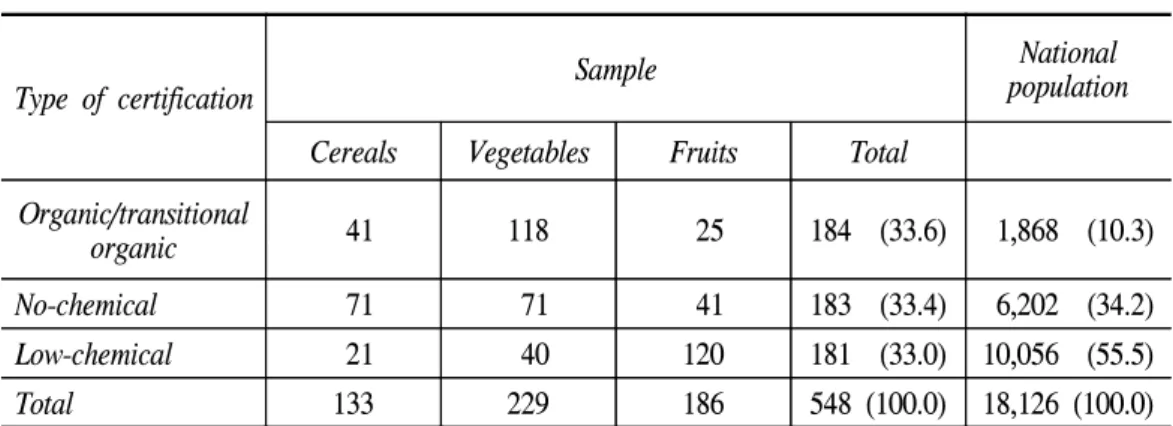
In selection, disproportional sampling method was used; factors as certificate types and certified crops were taken into consideration. In particular, each certificate type was intentionally selected at the alomost same proportion, that is, 33.6%, 33.4%, and 33.0%, although, in the national population, the proportions are 10.3%, 34.2%, and 55.5% for each category of certificate types. Within each group, individual farmers were randomly selected.
Different size of samples for each group reflects the relative toughness in practicing EF farming for different crops. For instance, it is almost implausible in Korea with current technologies to grow fruits in organic ways, while growing vegetables or cereals without chemical herbicides and insecticides is relatively simple. Thus, the organic-fruit combination includes only small numbers of sample, whereas moderate numbers of sample were selected for no-chemical-cereals or no-chemical-vegetables combinations. The following Table 1 shows the selection results.
Table 1. Selection of samples
Type of certification Sample
National population Cereals Vegetables Fruits Total
Organic/transitional organic 41 118 25 184 (33.6) 1,868 (10.3) No-chemical 71 71 41 183 (33.4) 6,202 (34.2) Low-chemical 21 40 120 181 (33.0) 10,056 (55.5) Total 133 229 186 548 (100.0) 18,126 (100.0)
Data collection
Questionnaire was mailed to each farmer in the sample with return envelope. The survey lasted for about a month, and 170 farmers filled out the questionnaire and returned it recording 31.0% of response rate, which is not so bad. The actual
distribution of certificate types of crops which the respondents has acquired approximately fits to the above rule of sample assignment; the proportions of organic/transitional organic, no chemical, and low chemical are 30.4%, 30.7%, and 38.9%, respectively.
In data cleaning, responses were verified or made clear by calling directly to the respondents for some cases. Cross-tabulation and statistical tests were the major tools in analysis and a linear regression method was also used.
RESULTS
Personal characteristics
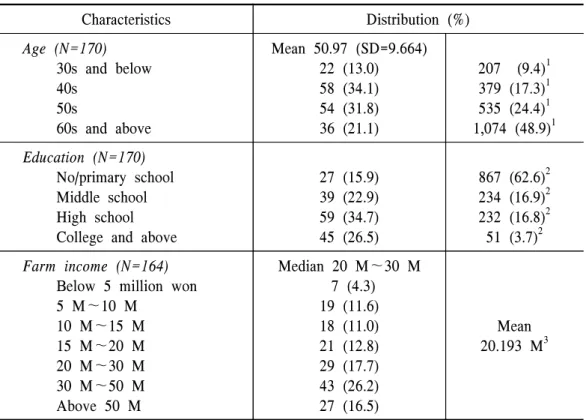
Table 2 shows respondents' mean age is 50.97 (standard deviation 9.664) selected survey results on the personal characteristics of the respondents. Age cohorts of 40s and 50s take almost two-thirds (65.9%) of total respondents, while only thirty-six respondents or 21.1% are in sixties and seventies. It is in sharp contrast to the national age distribution of farm and fishery workers of Korea. In the national distribution, almost half of them (48.9%) are over sixties, while only 26.7% of farmers are forties and below.
Respondents' educational attainments are substantially high; 34.7% of all respondents have graduated high school, and 26.5% have college or higher degrees. It means that over 60% have twelve years' schooling or more. National data shows that the educational level of general farmers (heads of farm households) is not so high; 62.6% of them had received formal education of six years or less. The EF farmers belong to a very educated group in rural villages.
Regarding the gross agricultural income, the most frequent category is between thirty to forty million won; about a quarter of respondents (25.3%) belong to it. 39.7% of the farmers report the annual income of less than twenty million won.
However, their income level seems higher than that of general Korean farmers.
Table 2. Statistics on personal characteristics (1)
Characteristics Distribution (%) Age (N=170) 30s and below 40s 50s 60s and above Mean 50.97 (SD=9.664) 22 (13.0) 58 (34.1) 54 (31.8) 36 (21.1) 207 (9.4)1 379 (17.3)1 535 (24.4)1 1,074 (48.9)1 Education (N=170) No/primary school Middle school High school College and above
27 (15.9) 39 (22.9) 59 (34.7) 45 (26.5) 867 (62.6)2 234 (16.9)2 232 (16.8)2 51 (3.7)2 Farm income (N=164)
Below 5 million won 5 M∼10 M 10 M∼15 M 15 M∼20 M 20 M∼30 M 30 M∼50 M Above 50 M Median 20 M∼30 M 7 (4.3) 19 (11.6) 18 (11.0) 21 (12.8) 29 (17.7) 43 (26.2) 27 (16.5) Mean 20.193 M3
1 Age distribution of farming and fishery workers in Korea as a whole in 2001. Unit is thousand. Source: Ministry of Agriculture and Forestry (2002).
2 Distribution of educational level of heads of farm households in Korea as a whole in 2000. Unit is thousand. Source: www.nso.go.kr.
3 Averaged farm income of farmers in Korea as a whole in 2001. Source: Ministry of Agriculture and Forestry (2002).
The median category of respondents' farm income is between twenty million won and thirty million won, while averaged farm income of general Korean farmers is slightly over twenty million won (20,193 thousand won in 2001).
Age and educational attainment distributions of Korean EF farmers are compared with the data from a survey on American organic farmers (Table 3). The latter
group of farmers is even younger and more highly educated than the former one. Averaged age is 47.5, and 57% completed college or above level of education.
Table 3 Social characteristics of American organic farmers
Characteristics Distribution (%) Age (N=1,192) 30s and below 40s 50s 60s and above Mean 47.5 27 39 22 12 Education (N=1,192)
Below High school High school College and above
5 38 57 Source: Walz (1999).
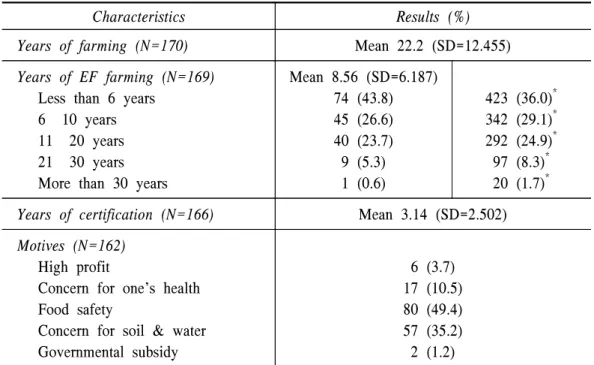
On the average, the respondents have operated farming for 22.2 years, and EF farming for 8.56 years (see the Table 4 below). More than seventy percent (70.4%) of respondents have ten or fewer years of EF farming history. Comparing with Korean EF farmers, the U.S. organic farmers have slightly longer history of organic farming as shown at the table below. 34.9% of respondents have been farming organically for more than ten years.
In our survey, it is shown that only 3.14 years have on the average passed since respondents acquired certification. That is, the acquirement of certificates is a very recent phenomenon. At the risk of over-simplification, it can be said that the respondents had started the EF farming after about 14 years of conventional farming, and then they managed to acquire certification after about 5 years. For the reasons or motives to turn to EF farming, almost half of the respondents (49.4%) tell the food safety for consumers, followed by environmental concern for
soil and water (35.2%). Economic considerations (high profit and governmental subsidy) come last, showing 3.7% and 1.2%, respectively.
Table 4. Statistics on personal characteristics (2)
Characteristics Results (%) Years of farming (N=170) Mean 22.2 (SD=12.455)
Years of EF farming (N=169)
Less than 6 years 6 10 years 11 20 years 21 30 years More than 30 years
Mean 8.56 (SD=6.187) 74 (43.8) 45 (26.6) 40 (23.7) 9 (5.3) 1 (0.6) 423 (36.0)* 342 (29.1)* 292 (24.9)* 97 (8.3)* 20 (1.7)*
Years of certification (N=166) Mean 3.14 (SD=2.502)
Motives (N=162)
High profit
Concern for one's health Food safety
Concern for soil & water Governmental subsidy 6 (3.7) 17 (10.5) 80 (49.4) 57 (35.2) 2 (1.2)
* Distribution of years of organic farming of American organic farmers. N=1,174. Source: Walz (1999).
For each reason for shifting to EF farming, how early or lately do the farmers have decided the shift? At the Table 5, it is found that those farmers who have health concern as the primary reason for the transition to EF farming had done it earliest (12.8 years ago on the average). Contrarily, those who shifted to the EF farming to receive the governmental subsidy started it only two years ago. It means that the state support has not been a good incentive for deciding the transition, while farmers who came to recognize the negative effects of chemical inputs on personal health tended to make up their minds to adopt the low- or no-chemical input farming earlier than anyone else. Those farmers who pursued better profit or ecological consideration did the transition about seven to nine years ago. ANOVA test proves the statistically significant differentiation of the mean
years.
Table 5. Mean years of EF farming by motives
Motives High profit concernHealth Safe foods Soil/water protection Gov'tal subsidy F-test
Mean years (SD) 8.67 (3.72) 12.82 (6.23) 7.17 (5.51) 8.89 (6.26) 2.00 (1.41) F=4.074 P=.004
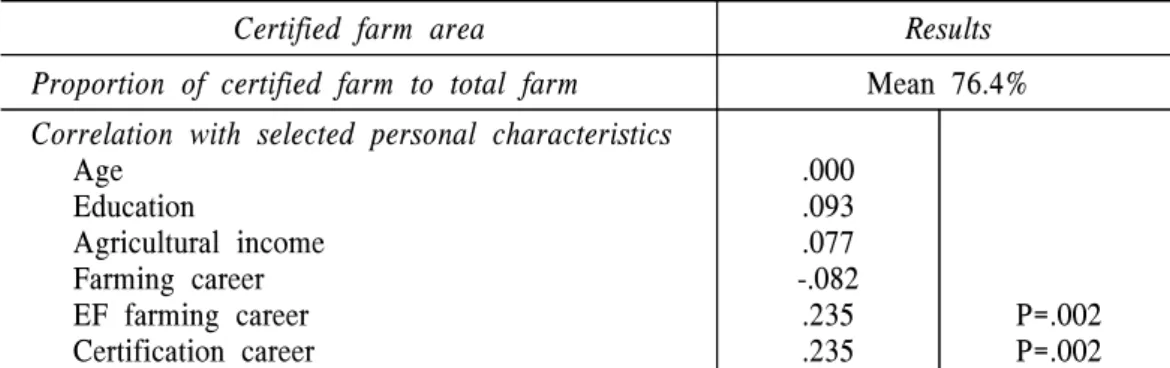
Many EF farmers do not practice EF farming on all their lands; they reserve a part of the lands for conventional farming. This may support the argument that it is relatively easy to apply the EF farming on small-scale plot of land. This survey asked farmers about the area of total cultivation and the area of EF farming. According to the responses, the farmers devote about three fourths of their lands (76.4%) to the EF farming (Table 6). 66 farmers out of 168 (39.3%) say that they practice EF farming on all of their lands.
Difference in certified farm area is not significantly correlated with such personal characteristics as age, education level, agricultural income, and farming career. It is, however, closely related with the years of environment-friendly farming and the years of certification (correlation coefficients are in both cases .235 and statistically significant). That is, as years of EF farming and certified farming careers increase, farmers tend to expand the share of the lands devoted to the EF farming. It implies that the farmers either get used to the EF farming or come to think positively about its potentials.
Certified farm area Results Proportion of certified farm to total farm Mean 76.4%
Correlation with selected personal characteristics
Age Education Agricultural income Farming career EF farming career Certification career .000 .093 .077 -.082 .235 .235 P=.002 P=.002
Table 7 Mean proportion of certified farm by motives
Motives Mean proportion of certified farm to total farm High profit
Concern for one's health Food safety
Concern for soil & water Governmental subsidy 65.0% 86.1% 77.3% 71.3% 67.4% P=.249
Those who started EF farming for profit or for governmental subsidy practice EF farming on smaller part of land than those whose major concerns were their own health or food safety (Table 7). For the former group of farmers, the proportion of certified farm is below 70% (65%, 67.4%), compared to the proportion for the latter group (86.1%, 77.3%). Although the relations fail to satisfy statistical criteria (P=.249), it provides an interesting hypothesis to be tested further; focusing upon economic consideration forces the farmers to hesitate about too fast expansion of EF farming portion.
There may be some factors which will affect the farmers' decision to reserve a part of their lands for conventional farming, and, as seen above, make the farmers hesitate about expansion particularly for those with economic motives. The farmers may still believe that it is too risky to adopt at once the new farming because technology is not yet developed or available at the moment for some intended
crops. Reduction or complete removal of chemical applications will severely harm the productivity. Or, although organic or low-input products enjoy better prices and higher profits than conventional products in market, farmers may still worry about price fluctuations and difficulties in marketing due to, for instance, lack of public awareness. Producers may think their farming is not well supported by public authorities.
So many respondents (83.3%) feel that the governmental policy support is not sufficient; 61.4% report difficulties in marketing; and 55.8% are not satisfied with
Table 8. Satisfaction with some factors
Production
technology Productivity Price premium Marketing
Governmental support Satisfied Unsatisfied Don't know 65.0 33.1 1.8 50.3 49.1 0.6 41.7 55.8 2.5 35.0 61.4 3.7 7.7 83.3 9.0 N 166 163 163 163 156
prices (see Table 8). For the production technologies and productivity, 33.1% and 49.1% feel unsatisfied. That is, farmers feel more worried about the lack of governmental support and marketing than difficulties in production process.
Beliefs and values
The ACAP scale as espoused by Beus and Dunlap (1991; 1992) is constituted of 24 items. In this research, this survey followed the process exactly in the same way as the originators have done. For each item, respondents are asked to choose a number between 1 to 5. Half of the items are reverse-coded in computing the total scores so that a 1 always represents a strong conventional response while a 5
represents a strong alternative response. Possible range of total scores is thus 24 through 120, the low number representing strong endorsement of conventional agriculture. Two cases in which more than half of the responses to the ACAP items were missing were eliminated from the analysis, while the rest in which less than half of the responses were missing were assigned the item mean values. The following Table 9 shows statistics for total scores; they are compared with those from a research performed by Beus and Dunlap in 1991. The comparison shows quite impressive outcomes with respect to the farmers in both countries. Overall, Korean certified EF farmers have very similar features with the Washington State's certified organic farmers measured by ACAP scale. Not unlike the latter farmers, the former farmers' value orientations toward environmental
Table 9. Comparison of ACAP scores between Korean and the U.S. farmers
This survey Beus and Dunlap (1991)
PC OF FB
Mean total score Median Mode Range Standard deviation N 95.0 95 92 67-120 11.97 168 108.1 112 114 75-120 10.70 104 96.5 97 96 59-120 14.54 103 74.1 73 68 43-105 13.08 146 PC = Sample from those who completed permaculture design course or subscribers of a
permaculture activist newsletter in the State of Washington OF = Sample from certified organic farmers in the State of Washington FB = Sample from the State of Washington Farm Bureau
agriculture are weaker than are the permaculture activists but stronger than are the people in an organization composed of proponents for conventional agriculture (Farm Bureau).
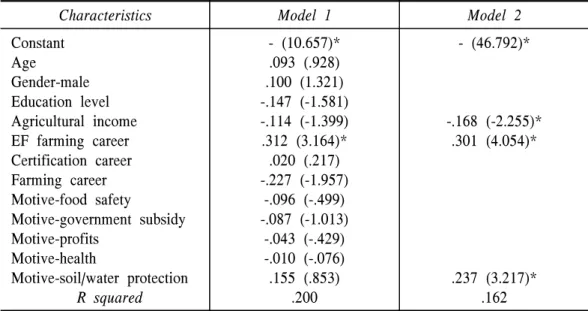
Next analysis is to test the relationships between personal characteristics and beliefs/values towards alternative agriculture as represented by ACAP scores. In a regression analysis to see the relations, twelve characteristics were entered and
those which were unable to satisfy selection criteria were removed in stepwise manner. Eventually, three characteristics remained as statistically significant; agricultural income, environment-friendly farming career, and the motive to save soil and protect water. The Table 10 summarizes the process.
Many of the personal characteristics of education, age, and gender, and other dummy variables of personal motives proved to fail to explain the differences in beliefs and values surrounding environment. With regard to the years experiencing environment-friendly farming, however, there exists a clear-cut relationship; those who adopted EF farming long time ago are more on inclined to alternative agricultural values and beliefs (in Model 2, the standardized coefficient is .301). It means that as farmers operate EF farming longer, they tend to reinforce their beliefs in EF farming. Meanwhile, more recent entry into the EF farming is less based upon ideological responsibility toward nature and environment.
Among five personal motives, only the motive to save soil and protect water is closely related with the ideological inclination toward values of alternative agriculture. Those who adopted EF farming based upon the consideration for soil and water-agricultural environment-tend to show more acceptance of environment- friendliness.
The fact that agricultural income is inversely correlated with alternative agriculture value provides an interesting hypothesis to be verified in the future study; ideological pursuit of alternative agriculture is based upon the value position that looks down upon economic consideration.
Beus and Dunlap (1991) performed a reliability test to assess the internal Table 10. Linear regression coefficients between ACAP scores and characteristics
Characteristics Model 1 Model 2 Constant Age Gender-male Education level Agricultural income EF farming career Certification career Farming career Motive-food safety Motive-government subsidy Motive-profits Motive-health Motive-soil/water protection R squared - (10.657)* .093 (.928) .100 (1.321) -.147 (-1.581) -.114 (-1.399) .312 (3.164)* .020 (.217) -.227 (-1.957) -.096 (-.499) -.087 (-1.013) -.043 (-.429) -.010 (-.076) .155 (.853) .200 - (46.792)* -.168 (-2.255)* .301 (4.054)* .237 (3.217)* .162
* Model 1 includes all selected characteristic variables, while model 2 is set after backward variable elimination with the removal criteria, .10. Five motive variables and gender are dummies. Numbers in parentheses are t-values, and variables with starred numbers are statistically significant in each model with the test level of .05.
consistency by examining the correlation between responses to individual items and the sum of responses to all of the other items. The assessment of internal consistency is to determine whether the responses reflect a coherent world view as can be called a belief system of a person.
The following Table 11 is provided to compare the results of reliability analysis of two samples. Beus and Dunlap's (1991) sample included environmental agricultural activists and certified organic farmers of the State of Washington, as
Item* Corrected item-total correlations
This survey Beus and Dunlap (1991) A B C D E F G H I J K L M N O P Q R S T U V W X .45 .23 .37 .37 .32 .26 .40 .31 .37 .42 .50 .27 .45 .33 .30 .41 .15 .32 .28 .26 .19 .47 .31 .39 .58 .41 .61 .53 .55 .54 .52 .56 .64 .49 .66 .60 .70 .67 .62 .52 .50 .60 .67 .58 .50 .39 .61 .67
Coefficient alpha .81 (standardized) .93 * Refer to the full text of items shown at the Appendix.
shown at the above table. The U.S. survey shows high item-total correlations ranging from .39 to .70 with a high alpha coefficient of .93. Item-total correlations of sample of our survey are low, and two items (items Q and U) have correlation coefficients below .20. Alpha coefficient of .81 is also lower than U.S. survey results.
In spite of the relatively low item-total correlation coefficients, the reasonable level of alpha coefficient from reliability test tells that the Korean EF farmers of this survey show a moderate level of internal consistency as measured by the
ACAP scale.
Social relationships
This part is primarily concerned with the social activities of the EF farmers. The strength and width of one's social activities can be measured by several ways. Here, the number of official positions the respondents assume for the present or assumed in the past is firstly checked.
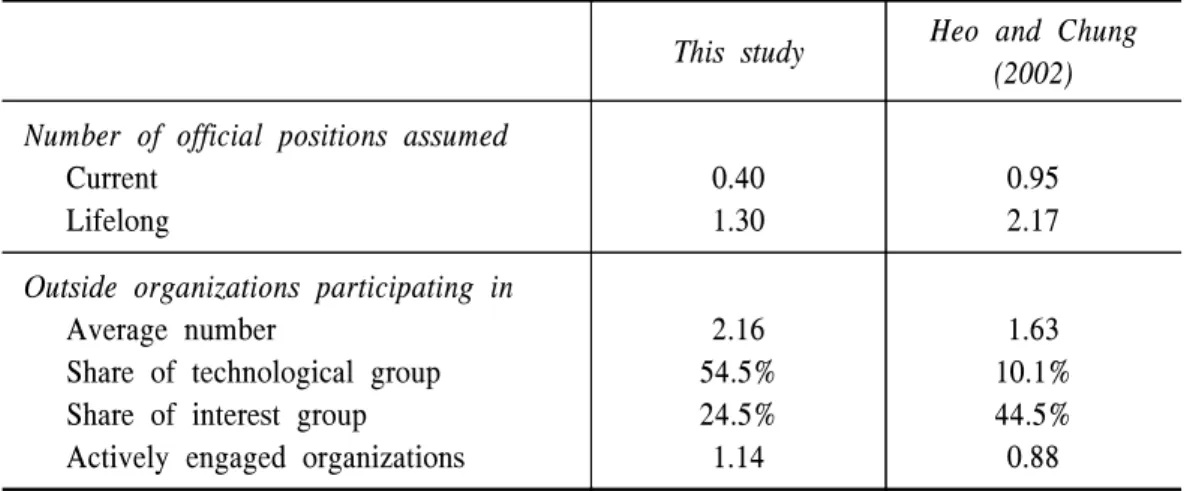
Due to the human power drain in the rural society, it is the case that the official positions in a village, for instance, the head of Ri (Ri-jang) or the head of Youth Group (Chongnyunhoi-jang), are filled by a circle of people. They have repeatedly assumed official positions in the village (Heo and Chung, 2002). The average number of positions that a respondent currently occupies is 0.4, while the average number of positions that he/she has occupied so far is 1.30 in total. Heo and Chung (2002) administered a similar survey to rural village leaders and opinion leaders. In their survey, on the average the leaders currently assume 0.95 position and have assumed 2.17 positions so far. It implies that the EF farmers are not so actively assuming the formal positions within their villages as general leaders (see Table 12).
Taking into account of the activities at organizations existing outside the village boundary, however, it shows a totally different shape. The number of outside organizations that a respondent is affiliated is on the average 2.16, which is far higher than the case of rural village leaders who are participating 1.63 outside organizations.
Looking at the kinds of the organizations, respondents of this study show striking differences from village leaders covered by the previous study. More than half of respondents (54.5%) join agricultural technological organizations, such as Grape Study Groups or Association of Organic Agriculture, while 10.1% of village leaders participate in such groups. Instead, the share of farmers' interest groups,
such as Korean Advanced Farmers Federation, is 24.5% for the EF farmers, compared to 44.5% for village leaders. It implies that the EF farmers are more willingly participating in the organizations which are more technically specialized. In terms of degree of organizational commitment, 41.6% of respondents reply that they do not have organizations outside of community in which they were deeply committed. However, the number of organizations per respondent in which the farmers actively participate is 1.14. Compared with the previous study for village leaders who are actively engaged in 0.88 organizations per person on the average, the EF farmers of this study are more actively committed to the organizational activities.
Table 12. Participation in outside organizations
This study Heo and Chung (2002) Number of official positions assumed
Current Lifelong 0.40 1.30 0.95 2.17
Outside organizations participating in
Average number
Share of technological group Share of interest group Actively engaged organizations
2.16 54.5% 24.5% 1.14 1.63 10.1% 44.5% 0.88
A comparative analysis above shows an important point. That is, although the EF farmers in this study do not take official positions within their villages as many as other leaders, they have broad social networks outside the communities; in particular they focus upon organizations which would provide technological information, which is crucial in performing unconventional agriculture, EF farming. Farmers also greatly rely on other information sources, such as newspapers,
magazines, and internet. Fifty percent of respondents replied that they frequently use the newspaper to get agricultural information, and 37.6% and 28.2% of respondents make use of magazine and internet, respectively, for agricultural information.
DISCUSSIONS
So far, this study introduced survey results in three aspects: personal characteristics, beliefs and values, and social relationship of the EF farmers. Below are presented brief discussions based on the findings.
Not unlike the expectations from previous studies, the EF farmers of this study are substantially younger and more educated than the general farmers. Although the causal direction cannot be determined between the level of farm income and the adoption of EF farming in our survey, it is certain that those farmers practicing EF farming earn more than general farmers on the average. It can be safely argued from the results that the environment-friendly agriculture tends to be readily accepted by those relatively risk-loving young farmers equipped with high level of human capital as represented by education.
The adoption of EF farming in Korea is a very recent phenomenon. Seven EF farmers out of ten had started it within the past ten years, and four out of those seven adopted it only five or fewer than five years ago. It implies that the EF farming sector is still at the expanding stage. In this sense, it can be expected that those who practice the EF farming will increase for a considerable time.
Despite the expansion, EF farming is not operated on every plot of the farmlands of an individual farmer. It can be arguably said that this “part-space” EF farming is a general phenomenon, although the degree is differentiated among farmers; many empirical researches report similar pattern of farming. In surveys
administered to the U.S. organic farmers, it is found that 36% of respondents have mixed organic and conventional operations; and the proportion of organic farms among total farms is 66.4% on the average (184 acres out of 277 acres) (Walz, 2003). According to an in-depth study of a Korean village, only three out of 28 farmers operate EF farming on more than half of their total farm lands (Shim, 2001). Another survey reports that almost all (97.6%) surveyed EF farmers' farm lands under EF farming are below 2/3 hectare, which is smaller than the average land size of Korean farmers, which is about 1.4 hectare (Lee et al., 2002). With regard to the reasons for reserving a part of the lands for conventional farming, making their EF farming a small-scale operation, several factors are presented. Many farmers are not satisfied with governmental support and marketing channels as well as prices, as found from the survey. It implies that these are the factors which may prevent the scale of EF farming from being expanded, and, therefore, it will be necessary to improve government's role for the EF farmers and accessibility to markets.
For a substantial period of time, such part-space EF farming will continue to exist as long as such factors as technological underdevelopment, productivity fluctuation, price instability, marketing insecurity, and insufficient governmental support remain problems to the farmers. From this study, however, an outlook is derived; that is, as farmers practice EF farming longer, they would expand the portion of EF farming among their total lands. It is evidenced by high correlation between the proportion of EF farmlands and years of EF farming. There may be diverse factors that affect the farmers' decision of expansion. Some of them are: increased technological confidence by EF farmers, improved marketing circumstances, or decreased risk in productivity as ecological conditions of agricultural environment-such as soil and water quality, probability of crop diseases-get better after years of low- or no-input farming. It is left for the future study to find out empirically the relationships among the factors.
The ACAP scale was applied here to find out that Korean EF farmers show a similar worldview as the U.S. organic farmers. Also, the reliability test proves that they have a certain cognitive coherence. But the findings with regard to the ACAP scale need to be carefully interpreted for several reasons. It is because relatively lower internal consistency of Koran EF farmers than that of American organic farmers, as evidenced by alpha coefficients, may in fact stem from the lack of applicability of the scale itself. Some of the items have very low level of correlations with total scale, implying that they may not be most pertinent to the context of Korean agriculture. The scale and items are contrived within the context of the U.S. agricultural system, and their careless application to other society will be problematic.
The alternative agricultural paradigm tends to get stronger as farmers perform EF farming continuously. Based upon the observation, it can be said that the longer practice of EF farming will result in the change of the farmer's agricultural/rural values to more alternative ways.
The EF farmers of this survey show distinct social relationships. Their width and strength of social ties with outside are high, which is shown from the number of organizations in which they join as well as the degree of their commitment to them. They are in particular interested in agricultural technology organizations, which would provide them with a lot of know-how or local knowledge in the EF farming sector in diverse forms.
The relatively high level of reliance on social networks by the EF farmers may indicate the technological under- or un-development of EF farming. Before the emergence of modern or “conventional” farming, human societies have operated “unconventional,” but sustainable farming for thousands of years. Nevertheless, EF farming in modern times as alternative agriculture is placed under totally different economic and ecological conditions. EF farming technologies need to be systematized and materials substituting chemical inputs should be developed, tested,
and made readily available to farmers, and so on. Diverse social networks in formal and informal shapes are contributory to the formation and dissemination of local experiences and EF technologies to others.
It is not certain what kinds of social impacts the diverse social networks and strong commitment with outside organizations will be placed upon the local community or traditional social relationship within the village. As Padel (2001) argues, the farmers operating EF or organic farming are either innovators, using the term of innovation-diffusion theory. In their own villages, such innovators tend not to be in harmonious relationships with the rest people. Their social impacts on local communities will be meaningful only after more early adopters of EF farming emerge in the villages.
CONCLUSIONS
This research tries to elucidate social characteristics of Korean farmers who obtained certificates in environment-friendly farming. Sociological studies on this group of people have been amazingly rare, which also reflects the short history of the EF farming in Korea, although there had been forerunners in about thirty years ago.
Personal characteristics, beliefs and values, and social relationship of the EF farmers are focal points of the research. The farmers are in many social respects distinguishable from others, which will be expectedly positive for further development of the sector. However, the farming is not fully adopted on the farm even among these farmers. This “part-space” EF farming, which is so named in this paper, is a strategy under various conditions disadvantageous to the farmers, such as difficulties in finding marketing channels, productivity fluctuation, and lack of state subsidization. As those conditions improve, and with the passage of time
spent for EF farming, it will proceed towards “full-space” EF farming, based on the observations in this study.
Although it is found that the EF farmers have beliefs and worldview inclined toward alternative agriculture, there still exists an issue of utilizing an analytic framework devised in different socio-ecological contexts. Scale items need to be modified and sophisticated to fit to the local situations.
The EF farmers in this study have deep and wide social relationships and networks, which will be another positive point for the sector. They innovate, diffuse, and adopt technologies among themselves rather than merely following formal directions. Partly, it is because the public agencies are reluctant to authorize local knowledge which is not always based upon formal science. It again reflects paradigmatic discrepancy between innovative farmers and mainstream agriculturists. Still, it is left for the future research to know the kinds, objectives, and roles of the networks.
This paper did not adopt the qualitative methodology such as in-depth interview with key informants. That would have been useful in having a deeper understanding of not only the characteristics of the farmers but also the social and economic networks formed among them and within communities. The methodology will require investigation into a few carefully selected villages and it will be left for future research.
APPENDIX
Items of Alternative-Conventional Agricultural Paradigm
Conventional paradigm Alternative paradigm
A. Meeting U.S. food needs with fewer and fewer farmers is a positive outcome of technological progress. B. Farmland should be farmed so as to
maximize annual profits, even if this threatens the long-term productive capacity of the land.
C. Large inputs of energy into agriculture should be continued as long as it is profitable to do so.
D. The primary goal of farmers should be to maximize the productivity, efficiency and profitability of their farms.
E. The amount of farmland owned by an individual or corporation should NOT be limited, even if the ownership of land becomes much more concentrated than at present.
F. Agricultural scientists and policy-makers should expand efforts to develop biotechnologies and other innovation in order to increase food supplies.
G. Good farming depends mainly on applying the findings of modern agricultural science. H. The future success of American agriculture
will NOT be affected if rural communities continue to decline.
A. Meeting U.S. food needs with fever and fever farmers is a negative outcome of our free market system. B. Farmland should be farmed so as to
protect the long-term productive capacity of the land, even if this means lower production and profits.
C. High energy use makes U.S. agriculture vulnerable and should be greatly reduced.
D. The primary goal of farmers should be to improve the quality of their products and to enhance the longterm condition of their farms.
E. The amount of farmland owned by an individual or corporation should be limited in order to encourage land ownership by as many people as possible.
F. Agricultural scientists and policy-makers should recognize that there are limits to what nature can provide and adjust their expectations accordingly.
G. Good farming depends mainly on personal experience and knowledge of the land. H. Healthy rural communities are absolutely
essential for American agriculture's future success.
Conventional paradigm Alternative paradigm
I. Large to very large farms can best serve America's agricultural needs. J. Farm traditions and culture are outdated
and of little use in modern agriculture. K. Farming is first and foremost a business
like any other.
L. Farmers should use primarily synthetic fertilizers and pesticides in order to maintain adequate levels of production.
M. Most people should live in cities and leave farming to those who do it best. N. Modern agriculture is a major cause of
ecological problems and must be greatly modified to become ecologically sound. O. Farmers should farm only as much land
as they can personally care for.
P. Farms should be specialized in one or at most a few crops.
Q. Soil and water are the sources of all life and should therefore be strictly conserved.
R. Farmers should purchase most of their goods and services just as other consumers do.
S. The key to agriculture's future success lies in learning to imitate natural ecosystems and farm in harmony with nature.
I. Small to medium-size farms can best serve America's agricultural needs. J. Farm traditions and culture help maintain respect
for the land and are essential for good farming. K. Farming is first of all a way of life and
second a business.
L. Farmers should use primarily natural fertilizers and production methods such as manure, crop rotations, compost and biological pest control.
M. Many more people should live on farms and in rural areas than do so at present. N. Modern agriculture is a minor cause of ecological
problems and needs to be only fine-tuned periodically in order to be ecologically sound. O. Farmers should farm as much as land as
they profitably can.
P. Farms should be diversified and include a large variety of crops.
Q. Soil and water are the basic factors of production and should be used so as to maximize production.
R. Farmers should produce as many of their own goods and services as possible.
S. The key to agriculture's future success lies in the continued development of advanced technologies that will overcome nature's limits.
Conventional paradigm Alternative paradigm
T. Most farms should specialize in either crops or livestock.
U. Production, processing, and marketing of agricultural products is best done at local and regional levels.
V. The successful farmer is one who earns enough from farming to enjoy an above average standard of living.
W. Technology should be used to make farm labor more rewarding and enjoyable, but not to replace it.
X. The abundance and relatively low prices of food in the United States are evidence that American agriculture is the most successful in the world.
T. Most farms should include both crops and livestock.
U. Production, processing, and marketing of agricultural products is best done at national and international levels.
V. The successful farmer is one who truly enjoys farming even if it provides only a below average standard of living. W. Farm labor should be replaced whenever
possible by more efficient machines and other technologies.
X. High energy use, soil erosion, water pollution, etc. are evidence that U.S. agriculture is not nearly as successful as many believe it to be.
요 약
1990년대 초 이래 친환경농업의 사회적 기반이 끊임없이 확대되어 오면서 친환경 농업을 실천하는 농가의 인구학적 구성, 이념적 지향, 사회적 관계들 역시 다양해지 고 있다. 이들 내부의 사회적 분화는 앞으로도 계속될 것이며, 따라서 친환경농가가 사회적으로 어떠한 사람들인지를 이해하는 것이 중요하다. 이 연구는 한국의 친환 경농업 실천농가의 사회적 특성을 이론적, 경험적으로 이해하는 것을 목적으로 하 며, 특히 이들의 개인적 특성, 가치관 및 사회적 관계에 초점을 맞추고자 한다. 이를 위하여 개인의 특성과 마을 내외부에서의 사회적 지위, 사회집단에의 참여 정도, 영농경력, 경작규모, 재배작물, 인증, 농사정보 수집원, 대안-관행농업 패러다 임(ACAP) 지표 등에 관한 설문서를 작성하였다. 설문대상 농가는 국립농산물품질 관리원에서 인증을 받은 농가 중에서 인증내용을 고려하여 무작위 추출하였고 총 170명의 응답내용이 최종 분석에 활용되었다. 기존연구와 마찬가지로 이 연구 결과 친환경농업 실천농가는 일반 농가에 비하여 평균적으로 젊고 학력이 높으며 수입도 약간 많은 것으로 나타났다. 친환경농업 경 력은 짧아서 대체로 10명 가운데 7명은 10년이 되지 않았으며, 그 가운데 4명은 5년 이하이었다. 친환경농업이 확대되고 있긴 하지만 아직도 각 농가는 자신의 농지 가운데 일부 에서만 이를 실천하고 있다. 그 이유는 아직 농민들이 정부의 지원이나 판매처, 가 격 등에서 만족하거나 안심하지 않기 때문이다. 앞으로도 기술이나 생산성, 판매의 불안정, 정부지원 부족 등이 계속되는 한 이러한 “일부분 친환경농업”의 형태는 계 속될 전망이다. 미국에서 개발된 대안-관행농업 패러다임(ACAP)에 따른 가치관 측정지표들을 사 용하여 조사대상자들의 가치관을 측정하였다. 그 결과 미국의 유기농가와 비슷한 결과를 나타내었다. 아울러 의식에서의 내적 일관성도 어느 정도 유지하고 있었다. 친환경농업을 실천한 기간이 오래될수록 대안농업 패러다임으로의 지향이 높아지는 것으로 나타났다. 친환경농가들이 가지고 있는 대외 사회적 관계의 망은 넓고 그 강도도 높았다. 이들은 특히 농업기술과 관련한 집단에 많이 참여하고 있는데 이를 통하여 친환경 농업에 필요한 노하우 및 정보를 입수하게 된다. 이는 아직 친환경농업 기술이 발 달하지 않았으며 따라서 농민들은 여러 가지 공식적, 비공식적 네트워크를 통하여 기술을 배우고 전수하고 있음을 의미한다.
REFERENCES
Abaidoo, Samuel, and Harley Dickinson. 2002. “Alternative and Conventional Agricultural Paradigms: Evidence From Farming in Southwest Saskatchewan.”
Rural Sociology 67(1): 114-131.
Allen, John C. and Kevin Bernhardt. 1995. “Farming Practices and Adherence to an Alternative-Conventional Agricultural Paradigm.” Rural Sociology 60(2): 297-309. Bager, Torben and Jet Proost. 1997. “Voluntary Regulation and Farmers'
Environmental Behaviour in Denmark and the Netherlands.” Sociologia
Ruralis 37(1): 79-96.
Beus, Curtis E. and Riley E. Dunlap. 1990. “Conventional versus Alternative Agriculture: The Paradigmatic Roots of the Debate.” Rural Sociology 55(4): 590-616.
Beus, Curtis E. and Riley E. Dunlap. 1991. “Measuring Adherence to Alternative vs. Conventional Agricultural Paradigms: A Proposed Scale.” Rural Sociology 56(3): 432-460.
Beus, Curtis E. and Riley E. Dunlap. 1994. “Agricultural Paradigms and the Practice of Agriculture.” Rural Sociology. 59(4). 620-635.
Buck, Daniel, Christina Getz, and Julie Guthman. 1997. “From Farm to Table: The Organic Vegetable Commodity Chain of Northern California.” Sociologia
Ruralis 37(1): 3-20.
Chiappe, Marta B. and Cornelia Butler Flora. 1998. “Gendered Elements of the Alternative Agriculture Paradigm.” Rural Sociology 63(3): 372-393.
Coombes, Brad and Hugh Campbell. 1998. “Dependent Reproduction of Alternative Modes of Agriculture: Organic Farming in New Zealand.” Sociologia Ruralis 38(2): 127-145.
Hassanein, Neva, and Jack R. Kloppenburg, Jr. 1995. “Where the Grass Grows Again: Knowledge Exchange in the Sustainable Agriculture Movement.”
Rural Sociology 60(4): 721-740.
Heo, Jang. 2003. “Environment-friendly Agriculture as Alternative Agriculture: Possibilities and Limitations.” Paper presented at the Conference held by the Korean Rural Sociological Association. Korea University, Seoul, Korea. (in Korean)
Heo, Jang. 2001. “Sociological Aspects of Sustainable Agriculture and Its Practice: The Korean Case.” Journal of Rural Development 24(2): 273-298.
Heo, Jang and Ki-whan Chung. 2002. A Research on the Roles and Structure of
Rural Village Leadership. Korea Rural Economic Institute: Seoul, Korea. (in
Korean)
Huh, Mee-young and Jong Duk Kim. 2002. “Environmental-Oriented Farm Households' Women and Their Acceptance of Sustainability in Korea.” The
Journal of Rural Society 12(2): 5-28. (in Korean)
Joung, Myoung-chae, Naewon Oh, Kyoung-hwan Choi, Dae-shik Park, and Sangmoon Lee. 1995. Long-term Change and Development of Korean Rural Society and
Economy: The Comprehensive Report of 10th Year's Survey Results. Korea
Rural Economic Institute: Seoul, Korea. (in Korean)
Kim, Hung-Ju. 2001. “The Family and Kinship Consciousness of Commercialized Facility Peasantry.” The Journal of Rural Society 11(1): 79-106. (in Korean) Lee, Jong-sung, Ju-sung Oh, Sang-yong Ha, Won-jin Yang, Won-bok Chung, Dae-soo
Chung, Soon-jae Jeong. et al. 2002. “An Analysis of Production on Environmental Friendly Agriculture in Korea.” Korean Journal of Organic
Agriculture 10(2): 29-50. (in Korean)
Lighthall, David R. 1995. “Farm Structure and Chemical Use in the Corn Belt.”
Rural Sociology 60(3): 505-520.
Michelsen, Johannes. 2001. “Recent Development and Political Acceptance of Organic Farming in Europe.” Sociologia Ruralis 41(1): 3-20.
Ministry of Agriculture and Forestry. 2001. Major Statistics of Agriculture and
Padel, Susanne. 2001. “Conversion to Organic Farming: A Typical Example of the Diffusion of an Innovation?” Sociologia Ruralis 41(1):
Park, Hyun-Tae, Chang-Yong Kang, and Eun-Mee Jeong. 1999. Marketing
Improvement in Environment-Friendly Agricultural Products. Korea Rural
Economic Institute: Seoul, Korea. (in Korean)
Rickson, Roy E. Paul Saffigna, and Richard Sanders. 1999. “Farm Work Satisfaction and Acceptance of Sustainability Goals by Australian Organic and Conventional Farmers.” Rural Sociology 64(2): 266-283.
Shim, Unjong. 2001. “Formation and Development of Organic Farming Cultural Community.” Master thesis submitted to the Mokpo University. (in Korean) Song, Jeong Key and Chae Kyu Park. 2001. “The Change of Social Class and Daily
Lives of Rural Residents.” The Journal of Rural Society 11(2): 37-66. (in Korean)
Walz, Erica. 2003. 4th National Organic Farmers' Survey: Sustaining Organic Farms in a Changing Organic Marketplace. www.ofrf.org.
Walz, Erica. 1999. Final Results of the Third Biennial National Organic Farmers'
Survey. Santa Cruz, CA: Organic Farming Research Foundation.
Yang, Won-mo and Chul-gyu Lee. 2000. “Production and Marketing in Environment-friendly Horticulture: Especially in Chonnam and Chonbuk Province.” Korean Journal of Organic Agriculture 8(3): 53-75. (in Korean)