Birth Outcomes of Koreans by Birthplace of Infants and Their Mothers, the United States versus Korea, 1995-2004
The acculturation effect of immigrant women on birth outcomes varies by race. We examined birth outcomes of three groups of births for the period 1995-2004, USA births to the USA-born Korean mothers, USA births to the non-USA-born Korean mothers, and births in Korea. In singleton USA births to both Korean parents, average birth weight was 3,294 g for the USA-born Korean mothers and 3,323 g for the non-USA-born Korean mothers. However, this difference was not significant, once controlled for other maternal sociodemographic, obstetric and medical factors. Low birth weight and prematurity prevalence were not different by maternal nativity between these two singleton groups.
Average birth weight of all births including multiplets in Korea was 3,270 g, compared to 3,297 g for all USA-born infants including multiplets and births either to both or one Korean parents. This difference might have reflected a significantly lower educational attainment of mothers in Korea compared to Korean mothers in the USA. Low birth weight rate was consistently lower in infants born in Korea compared to the USA-born, but this difference became less, 4.2% and 4.6% respectively by 2004. These observations suggest that in the USA acculturation effect of Korean immigrants on birth outcomes is negligible.
Key Words: Birth Weight; Infant, Low Birth Weight; Infant, Premature; United States;
Korean Infants; Acculturation; Maternal Nativity Jae Woo Lim1, Jung Ju Lee2,
Chang Gi Park3, Sudhir Sriram3, and Kwang-sun Lee3
Department of Pediatrics1, Konyang University College of Medicine, Daejeon; Department of Pediatrics2, Chung-Ang University Hospital, Seoul, Korea; Department of Pediatrics3, University of Chicago Comer Children’s Hospital, Chicago, USA Received: 19 December 2009
Accepted: 16 February 2010 Address for Correspondence:
Kwang-sun Lee, M.D.
MC6060, Pediatrics, The University of Chicago Comer Children’s Hospital, 5841 South Maryland Avenue, Chicago, Illinois 60637, USA
Tel: +773.702-6210, Fax: +773.702-0764 E-mail: [email protected]
DOI: 10.3346/jkms.2010.25.9.1343 • J Korean Med Sci 2010; 25: 1343-1351
INTRODUCTION
The USA Census in the year 2000 showed that there were 10,171,820 Asians, 3.61% of the USA population (1). Among all Asians, there were 1,072,682 Koreans, 10.5% of all Asians or 0.38% of the USA population and by the size, ranked the fifth following, Chinese, Filipinos, Asian Indians, and Vietnamese. About 22.3% of these Koreans were born in the USA. The size of Korean population in the USA has significantly increased in the last several decades, considering there were only 357,393 Koreans present in the USA in the 1980. Births to Korean parents have increased in the USA reaching 12,222 births in the year 2004.
The USA National Center for Health Statistics began to report births to Korean parents, separating them out from Asian Pacif- ic Islanders and other Asian group in 1992. Before then, it was difficult to study birth outcomes of Korean births in the USA. To the present, we are aware of only three studies on Korean birth outcomes (2-4). One study was limited to examining intrauterine growth retardation and prematurity by maternal nativity and not examined birth weight, or very low and low birth weight (2). Two other studies examined births in a single state, Hawaii and Cali- fornia, but birth outcomes in Korean births were not examined in detail (3, 4). None of these studies compared birth outcomes of the USA-born Korean infants to the infants born in Korea.
In Korea over the last several decades, number of foreign res- idents and interracial marriages, particularly between Korean man and non-Korean Asians, has gradually increased (5). Al- though there have been a significant number of births from these two groups, at present their detailed birth outcomes are not known, since these births cannot be separately identifiable.
Maternal sociodemographic and biologic factors are strongly associated with pregnancy outcomes. Birth outcomes vary among different racial ethnic groups (6) and also, by maternal nativity, native-born versus foreign-born, possibly reflecting the effects of acculturation, particularly considering potential differential social and environmental effects on birth outcomes by mother’s upbringing and her current environment (7-16).
The objective of our study is to explore potential differences in birth outcomes in USA-born Korean infants by mother’s birth place, and to compare birth outcomes of the USA-born Korean infants to infants born in Korea.
MATERIALS AND METHODS Study population and variables
Our study used the 1995 through 2004 National Center for Health Statistics (NCHS) linked live birth and infant death certificate data files, which contain selected information on resident live
births. Before 1992, NCHS classified births to Asians or Pacific Islanders into Chinese, Japanese, Hawaiian, Filipino, and other Asians or Pacific Islanders. Then, Korean births were not sepa- rately identified. In 1992, seven states with the largest Asian or Pacific Islander populations began to provide NCHS with addi- tional birth data, reclassifying previously coded other Asians and Pacific Islanders into Asian Indian, Korean, Vietnamese, Samo- an, Guamanian, and remaining other Asian or Pacific Islanders.
NCHS stated that at least two-thirds of each of these additional Asian and Pacific Islander groups in the USA lived in the seven- State reporting area, California, Hawaii, Illinois, New Jersey, New York, Texas, and Washington. This reporting system was adopt- ed by other additional states, increasing to total of 14 states by 2003. The latest available data on USA births is for the year 2005, but information on mother’s birth place is not included. In the period from 1995 through 2004, NCHS reported 106,213 infants born to Korean parents, either to both Korean parents (n=67,619), or to parents at least one being either Korean mother or Korean father (n=38,594).
Part I Study–Comparison of birth outcomes, USA–births to the USA-born Korean mothers vs. USA births to the non- USA-born Korean mothers
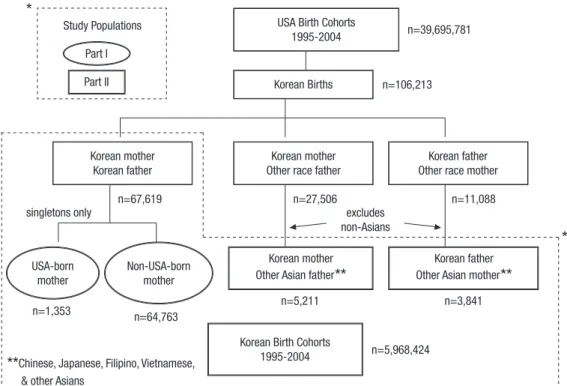
This part of our study compares birth outcomes of live births from USA-born Korean women to those of live births from non- USA-born Korean women. For this part, we selected 66,116 sin- gleton live births to both Korean parents by excluding 1,412 mul- tiple births and 91 births with missing information on birth place
of mother (Fig. 1).
We examined birth outcomes of these births by birth place of mother, controlling for maternal sociodemographic and medical and obstetric status. Birth outcomes include birth weight, ges- tational age, very low birth weight (<1,500 g), low birth weight (<2,500 g), <32 weeks of gestation, and <37 weeks of gestation.
Maternal sociodemographic variables include maternal age, educational level, marital status, alcohol use and smoking. Ob- stetric factors include parity, adequacy of prenatal care, and pres- ence or absence of the following complications, preeclampsia, fetal distress, prolonged rupture of membranes, meconium-stain- ed amniotic fluid, placental abruption, placenta previa, incom- petent cervix, and genital herpes infection. Medical status in- cludes presence or absence of the following diseases: diabetes mellitus, anemia, chronic hypertension, and renal disease.
Part II Study–Comparison of birth outcomes, USA-born Korean infants vs. infants born in Korea
This part of the study compares birth outcomes of USA-born Korean infants to those of infants born in Korea (Fig. 1). For this comparison, all USA-born Koreans were selected, including sin- gleton and multiple births to both Korean parents or to either Korean mother or Korean father. Korean birth cohort data in- cluded births to foreign mothers and fathers, mostly Asians. Thus, for the comparison, USA-born Korean infant group included infants born to both Korean parents and infants born to biracial Korean parents with either mother or father being Chinese, Viet- namese, Filipino, Japanese, or other Asians but not Hawaiian,
Study Populations
*
*
USA Birth Cohorts
1995-2004 n=39,695,781
n=106,213
n=5,968,424
**Chinese, Japanese, Filipino, Vietnamese, & other Asians
n=11,088 n=27,506
n=67,619 singletons only
n=1,353 n=64,763
n=5,211 n=3,841
excludes non-Asians Korean Births
Korean mother Korean father
USA-born
mother Non-USA-born
mother
Korean mother Other race father
Korean mother
Other Asian father** Korean father Other Asian mother**
Korean Birth Cohorts 1995-2004
Korean father Other race mother Part I
Part II
Fig. 1. Selection of study populations for the Part I and Part II of the study.
Guamanian or Asian Indian and excluded white, African Amer- ican, Hispanics, and American Indians. This selection was pur- poseful to similarly match major proportions of intermarriages in Korea. Information on birth outcomes on infants born in Korea are from the published aggregated data (5, 17, 18). Although there have been a significant number of births from non-Korean moth- ers or fathers in Korea, none of these published data reported birth outcomes by maternal or paternal race.
Statistical analysis
For group comparison, we used paired t, ANOVA, and chi-square tests. To test independent effect of mother’s birth place on indi- vidual birth outcomes (birth weight, low birth weight, and pre- maturity), we used both logistic and multiple linear regression analyses. Statistical significance was accepted when P value was
<0.05. For all statistical analyses, we used a statistical software, STATA 10 (Stata Corp., College Station, TX, USA).
RESULTS
Part I Study–Comparing USA-born Korean Infants of both Korean parents by mother’s birth place
In this part, we only examined 66,116 singleton live births born to both Korean parents in the USA in the period from 1995 through 2004. Although there was an increase in number of births over the study period from 1995 to 2004, this increase would have par- tially reflected additional live births from newly included states to the database (Table 1). Almost 98% of births in this period were from foreign-born Korean mothers. However, number of births to USA-born Korean mothers progressively increased from 0.8%
of all Korean births in 1995 to 3.5% in 2004. This may reflect a pro- gressive increase in size of the second generation Koreans in re- productive ages. During this period maternal sociodemographic
characteristics had changed, average maternal age slightly in- creased from 30.1 to 31.5 yr of age, more than high school edu- cation, from 71.9% to 88.8%, married proportion from 96.9% to 97.6%, and adequate participation in prenatal care from 81.3%
Table 1. Characteristics of singleton live births to Korean mother and Korean father, USA, 1995-2004*
Parameters 1995 1996 1997 1998 1999 2000 2001 2002 2003 2004 All
Live births (n) 6,235 5,879 5,876 5,733 6,176 7,202 7,011 7,205 7,422 7,377 66,116
Birth weight (mean, g) 3,328 3,336 3,336 3,345 3,320 3,326 3,312 3,320 3,308 3,308 3,323
Gestational age (mean, weeks) 39.36 39.33 39.31 39.23 39.19 39.25 39.16 39.22 39.17 39.17 39.23
Birth weight <1,500 g (%) 0.47 0.54 0.39 0.52 0.65 0.6 0.57 0.56 0.49 0.43 0.52
Birth weight <2,500 g (%) 3.92 3.74 3.52 3.74 4.02 3.42 3.61 3.69 3.56 3.09 3.62
Gestation <32 weeks (%) 0.63 0.68 0.68 0.82 0.88 0.86 0.67 0.73 0.72 0.5 0.71
Gestation <37 weeks (%) 5.3 5.23 5.46 5.61 5.43 5.26 5.63 5.44 5.46 5.15 5.39
Non-USA-born Korean mother (%) 99.17 98.89 98.43 98.50 98.17 98.17 97.53 97.47 97.33 96.48 97.95
USA-born Korean mother (%) 0.83 1.11 1.57 1.50 1.83 1.83 2.47 2.53 2.67 3.52 2.05
Maternal age (mean, yr) 30.06 30.30 30.46 30.62 30.57 30.83 30.99 31.20 31.38 31.54 30.83
>12 yr of education (%) 71.88 75.07 77.71 78.95 80.96 82.78 83.46 85.07 86.52 88.77 81.54
Married (%) 96.89 96.31 97.45 97.73 97.65 98.04 97.99 98.07 97.43 97.64 97.55
Parity (mean, n) 1.98 2.01 2.03 2.01 2.01 2.00 1.98 1.98 1.94 1.91 1.98
Adequate prenatal care (%) 81.30 80.79 81.30 81.30 82.68 82.45 82.20 82.61 83.49 84.32 82.33
Alcohol use (%) 0.06 0.42 0.07 0.21 0.10 0.16 0.14 0.11 0.30 0.14 0.17
Tobacco use (%) 1.64 1.54 1.16 1.48 1.17 1.24 1.16 0.83 0.83 0.51 1.13
*The data is based on information from 7 states (Califronia, Hawaii, Washington, Texas, Illinois, New Jersey, and New York) where more than two-thirds of Asian births occurred including Koreans. By 2003, the data were from 14 states. In estimating means and rates, live births with unknown status for an item are excluded.
Table 2. Comparison of live births to both Korean parents by mother’s birth place, USA, 1995-2004*
USA-born mothers Immigrant mothers
Number 1,353 64,763
Maternal age (yr, mean±SD) 29.3±4.1† 30.9±3.9†
Education, >12 yr (%) 91.0† 79.8†
Married (%) 94.6† 97.6†
Parity (mean±SD) 1.8±1.0† 2.0±1.1†
Alcohol use (%) 0.6† 0.2†
Smoking (%) 1.8 1.1
Adequate prenatal care (%) 82.34† 77.74†
Diabetes mellitus (%) 1.8 1.7
Anemia (%) 0.9 1.0
Herpes infection (%) 0.7† 0.2†
Chronic hyprtension (%) 0.5† 0.2†
Renal disease (%) 0.2 0.1
Preeclampsia (%) 0.00 0.04
Fetal distress (%) 2.9 2.4
MSAF (%)‡ 3.3 4.0
PROM (%)§ 2.4† 1.5†
Abruptio placenta (%) 0.1 0.3
Placenta previa (%) 0.1† 0.4†
Incompetent cervix (%) 0.2 0.1
Birth Outcome
Birth weight (mean±SD) 3,294±457† 3,323±473†
Gestation (mean±SD) 39.3±1.9 39.2±2.0
Birth weight <1,500 g (%) 0.4 0.5
Birth weight <2,500 g (%) 3.8 3.6
Gestation <32 weeks (%) 0.4 0.7
Gestation <37 weeks (%) 4.8 5.3
*Value for each item is estimated excluding births with unknown status for a given item; †P<0.05 or less for the diffrence between two groups; ‡Meconium-stained amniotic fluid; §Prolonged rupture of membranes.
to 84.3%. Alcohol use and smoking during pregnancy were low, about 0.2% and 1.1% in this period.
Mean birth weight of singleton Korean infants in the USA did not show any significant change, averaging about 3,323 g for the entire period. Gestational age at birth showed a trend of slight decrease from 39.4 to 39.2 weeks. High risk birth weight out- comes, low birth weight (<2,500 g) and prematurity (<37 weeks of gestation) rates fluctuated around the average of 3.6% and 5.4%, respectively (Table 1).
Considering the difference in maternal environment of their growing-up and current period, we expected that birth outcomes of USA-born infants would be different by birth place of their mothers. Average birth weight was slightly lighter in infants of the USA-born Korean mothers, 3,294 g, compared to 3,323 g for the infants of non-USA-born Korean mothers (P<0.05). Other birth outcomes, average gestational age, very low and low birth weight rates, and prevalence of gestational ages <32 weeks and
<37 weeks were not different between these two groups of infants by birth place of their mothers. However, two groups of Korean mothers were different from each other in their sociodemograph- ic factors and health status. Compared to non-USA-born Kore- an mothers, USA-born Korean mothers had several favorable attributing factors for birth outcomes with slightly but significant- Table 3. Multiple linear regression on birth weight and gestational age of live births
to both Korean parents, USA, 1995-2004
Birth weight (g) Gestation (weeks) Coeffi -
cient 95% CI P value Coeffi -
cient 95% CI P
value Maternal birth place
USA
Non-USA 25 -2~52 0.06 0.00 -0.01~0.11 0.99
Maternal education (yr) <12
=12 >12 Unknown
-21 -20 -47
-60~18 -59~18 -93~0
0.30 0.30 0.05
-0.01 -0.02 0.00
-0.17~0.16 -0.19~0.14 -0.20~0.19
0.91 0.77 0.97 Maternal age (yr)
<19 20-24 25-29 30-34 35-39 >=40
50 58 64 60 27
-47~148 -38~154 -32~160 -36~156 -72~125
0.31 0.23 0.19 0.22 0.59
0.29 0.34 0.21 -0.05 -0.18
-0.13~0.70 -0.07~0.75 -0.20~0.62 -0.46~0.36 -0.60~0.24
0.18 0.11 0.31 0.81 0.39 Parity
1 2 4 or more Unknown
-356 81 78
48~64 67~95 15~141
0.00 0.00 0.02
-0.23 -0.35 -0.11
-0.26~-0.20 -0.41~-0.29 -0.39~0.16
0.00 0.00 0.41 Marital status
Married
Unmarried -26 -50~-3 0.03 -0.01 -0.11~0.09 0.91 Prenatal care
Adequate Intermediate Inadequate Unknown
-24 -74 -58
-35~-14 -95~-53 -74~-42
0.00 0.00 0.00
-0.06 -0.17 -0.43
-0.11~-0.02 -0.26~-0.08 -0.52~-0.34
0.01 0.00 0.00 Medical complications
Present Absent
Unknown 11
21 -10~32 -23~64 0.32
0.35 0.32
0.10 0.23~0.41 -0.08~0.28 0.00
0.27 Obstetric complications
Present Absent Unknown
65 23
52~79 -18~65
0.00 0.27
0.18 0.25
0.13~0.24 0.08~0.43
0.00 0.00 Smoking
Present Absent Unknown
75 113
26~125 57~168
0.00 0.00
0.13 0.23
-0.07~0.34 0.00~0.46
0.20 0.05 Alcohol use
Present Absent
Unknown 100
53 -25~225 -7.4~180 0.12
0.41 0.27
0.04 -0.25~0.79 -0.49~0.57 0.31
0.87 Constant (intercept) 2,996 2,833~3,159 0.00 38.41 37.72~39.09 0.00
Table 4. Risk of low birth weight and prematurity in births to both Korean parents, USA, 1995-2004
Low birth weight Prematurity (<37 weeks)
Adj OR* 95% CI Adj OR* 95% CI
Maternal birth place USA
Non-USA 1.00
0.92 -
0.69-1.23 1.00
1.03 -
0.79-1.32 Maternal education (yr)
<12 =12 >12
1.00 0.96 0.76
- 0.66-1.40 0.53-1.10
1.00 1.02 0.88
- 0.73-1.43 0.63-1.22 Maternal age (yr)
<19 20-24 25-29 30-34 35-39 >=40
1.00 0.66 0.65 0.64 0.86 1.39
- 0.30-1.45 0.30-1.39 0.30-1.37 0.40-1.87 0.63-3.04
1.00 0.63 0.57 0.60 0.83 1.05
- 0.30-1.31 0.28-1.17 0.29-1.24 0.40-1.70 0.50-2.20 Parity
1 2-3 4 or more
1.00 0.86 0.98
- 0.79-0.95 0.84-1.14
1.00 1.15 1.43
- 1.06-1.24 1.26-1.62 Marital
Married
Unmarried 1.00
1.33 -
1.06-1.67 1.00
1.27 -
1.04-1.55 Prenatal care
Adequate Intermediate Inadequate
1.00 1.16 1.64
- 1.02-1.31 1.34-2.01
1.00 1.05 1.47
- 0.95-1.17 1.24-1.75 Medical complications†
Present
Absent 1.00
0.66 -
0.54-0.81 1.00
0.68 -
0.58-0.81 Obstetric complications‡
Present
Absent 1.00
0.38 -
0.34-0.42 1.00
0.45 -
0.41-0.50 Tobacco use
Present
Absent 1.00
0.61 -
0.41-0.93 1.00
0.81 -
0.55-1.20 Alcohol use
Present
Absent 1.00
0.53 -
0.20-1.38 1.00
0.91 -
0.32-2.57
*Odds ratio adjusted for all other variables listed; †Medical complications include dia- betes mellitus, anemia, chronic hypertension, and renal diseases; ‡Obstetric complica- tions include preeclampsia, fetal distress, prolonged rupture of membranes, meconium- stained amniotic fluid, abruptio placenta, placenta previa, and genital herpes infection.
ly younger age, better education, and more adequate prenatal care (all differences, P<0.05) (Table 2). At the same time, the USA- born Korean mothers had several unfavorable factors for birth outcomes and were more likely unmarried, had more alcohol use, and their pregnancies were more often complicated with chronic hypertension, herpes infection, and prolonged rupture of membranes (P<0.05). All of the above maternal factors are known to influence birth outcomes. First, we examined contri- bution of each of maternal factors to birth weight and gestation- al age, using multiple linear regression (Table 3). Infants of non- USA-born Korean mothers was about 25 g heavier in this analy- sis, but this difference was statistically insignificant (P=0.06). In general, increasing parity, married status, not smoking during pregnancy, adequate prenatal care, and absent obstetric com- plications, all favored for heavier birth weight. Gestational age was not affected by mother’s birth place but by some of the other maternal factors (Table 3).
Then, we examined an independent effect of mother’s birth place on other birth outcomes, the risks for very low or low birth weight, and prematurity, gestational age at birth <32 weeks or
<37 weeks, using logistic regression. Although as in multiple linear regression, some maternal factors were associated with low birth weight or prematurity outcomes. However, birth place of mothers was not related to the risks for either low birth weight or prematurity (Table 4).
Part II Study–Comparison of birth outcomes, USA-born Korean infants vs. infants born in Korea
In the first part of our study, we showed that birth outcomes of
USA-born Korean infants differed little by mother’s birth place, when estimated both with and without adjusting maternal so- ciodemographic, obstetric, and medical factors. This observa- tion suggests that change in maternal environment by migration to the USA may have little effect on birth outcomes of their off- spring. To examine this observation further, we compared birth outcomes of USA-born Korean infants to infants born in Korea.
Among births in Korea a small proportion but a significant num- ber of infants would have been born to a Korean mother or a Korean father with a foreign spouse, mostly Asians. Thus, im- prove our comparison between two groups of Korean infants, born in the USA and born in Korea, we included all infants born to both Korean parents and born to either Korean mothers or Korean fathers married to other Asian spouse. Birth outcomes of these two groups of Korean infants are shown on Table 5. Over the period 1995 to 2004, average birth weight of the USA-born infants was about 30 g heavier than infants born in Korea. This difference became small, 20 g or lesser in the years 2001 to 2004.
However, the rates of very low and low birth weight, and prema- turity were higher in the USA-born infants (Fig. 2). This seems paradoxical but owing to a small proportion of low birth weight incidence (4.8% in the USA-born and 3.6% in Korean-born), this difference in low birth weight rate had little effect on overall aver- age birth weight.
Although small, how can we then explain this consistent dif- ference in birth outcomes between these two groups? Although both groups of mothers giving births in the USA and in Korea showed improved educational status over the period, the pro- portion of mothers attaining more than high school education
Table 5. Comparison of birth outcomes of infants born in Korea to USA-born Korean infants*
1995 1996 1997 1998 1999 2000 2001 2002 2003 2004 All
Infants born in Korea† Live births (n) Mean birthweight (kg) Birth weight <1,500 g (%) Birth weight <2,500 g (%) Gestation <32 weeks (%) Gestation <37 weeks (%)
715,020 3.29 0.16 3.03 0.28 2.56
691,226 3.29 0.17 3.10 0.33 3.08
668,344 3.28 0.20 3.26 0.37 3.17
634,790 3.27 0.22 3.46 0.41 3.49
614,233 3.25 0.24 3.58 0.50 3.86
634,501 3.26 0.24 3.80 0.44 3.78
554,895 3.26 0.36 3.94 0.75 4.31
492,111 3.27 0.36 3.99 0.69 4.40
490,543 3.26 0.39 4.07 0.66 4.53
472,761 3.26 0.39 4.16 0.56 4.65
5,968,424 3.27 0.26 3.59 0.48 3.69 Mother
>12 yr education (%) Mean age (yr) Married (%)
25.5 - -
27.3 28.1 99.1
29.3 28.3 99.4
32.3 28.5 99.3
34.4 28.7 99.2
37.4 29.0 99.1
40.5 29.3 99.0
44.0 29.5 98.9
48.0 29.7 98.8
52.0 30.0 98.7
35.9 29.0 99.1 USA-born Korean infants‡
Live births (n) Mean birthweight (kg) Birth weight <1,500 g (%) Birth weight <2,500 g (%) Gestation <32 weeks (%) G estation <37 weeks (%)
6,950 3.31 0.59 4.55 0.71 5.70
6,630 3.31 0.82 4.83 0.95 6.27
6,690 3.32 0.57 4.43 0.80 6.26
6,617 3.31 0.73 4.91 1.11 6.80
7,180 3.30 0.79 5.16 1.01 6.48
8,358 3.30 0.75 4.49 1.00 6.20
8,221 3.28 0.78 4.94 0.82 6.83
8,522 3.29 0.68 5.17 0.78 6.90
8,716 3.28 0.69 4.70 1.08 6.48
8,787 3.27 0.61 4.63 0.70 6.61
76,671 3.30 0.70 4.78 0.89 6.47 Mother
>12 yr education (%) Mean age (yr) Married (%)
71.3 30.0 96.4
74.8 30.2 95.8
77.6 30.4 96.4
79.0 30.6 96.5
80.6 30.5 96.6
82.6 30.8 97.1
83.1 30.9 97.0
85.0 31.2 97.2
86.4 31.4 96.8
88.7 31.6 97.0
81.4 30.8 96.7
*Data on infants born in Korea were from Korea National Statistical Office (Reference); †Includes all singleton and multiple births occurred in Korea; ‡Includes all singleton and multiple USA-born Korean infants to Korean-Korean and Korean-other Asian pairs of parents.
was consistently and remarkably higher in mothers giving births in the USA; for the period average 81% in the USA vs. 36% in Korea (Table 5). On the other hand, maternal age was slightly higher (30.8 vs. 29.0 yr of age) and marital status was a little lower (97%
vs. 99%) in mothers giving birth in the USA Other potential expla- nation might come from the difference in composition of paren- tal races in these two groups. Korean birth cohort data lacked information on parental race. Thus, we cannot estimate the effect of parental race on birth outcomes. As shown in Table 6, birth outcomes of the USA-born Korean infants were unfavorable when one of their parents was not Korean but other Asian. Differences in birth outcomes, average birth weight, low birth weight rate, and prematurity, were consistently more pronounced when its mother was other Asian than its father, suggesting maternal race has a stronger effect on birth outcomes. Average birth weight of
USA-born Korean infants to Vietnamese mother was 162 g light- er, compared to those born to both Korean parents. Low birth weight rate and prematurity were more than twice greater in those born to Filipino mothers compared to those born to both Korean parents. The differences in birth outcomes would pos- sibly narrow or abolish by adjusting the differences in all perti- nent maternal factors. However, at this moment, we were not able to obtain all maternal information on individual births in Korea that was required for this adjustment.
There are two other recent publications on birth outcomes for infants born in Korea. Shin and his associates reported aver- age birth weight of 3,212 g, low birth weight rate of 7.8% and pre- maturity of 6.9% in live births in 164 hospitals in the year 2001 (17). Lee and his associates reported average birth weight of 3,195 g, low birth weight rate of 8.0% and prematurity of 9.1% in Fig. 2. Birth outcomes of the USA-born Korean infants and infants born in Korea. The group includes both singletons and multiples and born to both or one Korean parents.
VLBWR, very low birth weight rate; LBWR, low birth weight rate.
%% %%
0.9 0.8 0.7 0.6 0.5 0.4 0.3 0.2 0.1 0.0
6 5 4 3 2 1 0
1.2 1 .0 0.8 0.6 0.4 0.2 0.0
8 7 6 5 4 3 2 1 0
1995 1997 1999 2001 2003
1995 1997 1999 2001 2003
1995 1997 1999 2001 2003
1995 1997 1999 2001 2003
VLBWR (<1,500 g)
LBWR (<2,500 g)
Prematurity (<32 weeks)
Prematurity (<37 weeks)
USA-born born in Korea
USA-born born in Korea
USA-born born in Korea
USA-born born in Korea
Table 6. Birth outcomes of USA-born infants to Korean parents, 1995-2004*
Spouse
Korean father
Spouse
Korean mother Number Birth weight <2,500 g
(%) <37 weeks
(%) Number Birth weight <2,500 g
(%) <37 weeks (%)
Korean 67,619 3,303.75 4.57 6.17 Korean 67,619 3,303.75 4.57 6.17
Chinese 1,071 3,283.76 5.88 6.71 Chinese 1,890 3,272.33 5.93 9.09
Vietnamese 276 3,142.14 7.97 8.70 Vietnamese 338 3,282.39 4.44 7.40
Filipino 739 3,162.99 9.52 13.44 Filipino 639 3,230.75 7.37 8.44
Japanese 879 3,183.06 6.87 7.14 Japanese 1,177 3,247.94 6.43 9.09
Other Asians 876 3,236.30 6.62 8.56 Other Asians 1,167 3,297.98 4.54 7.88
All† 3,841 3,216.48 7.13 8.67 All† 5,211 3,268.12 5.81 8.63
*Includes all singleton and multiple live births; †Excludes births to both Korean parents.
live births in 51 hospitals in the year 2003 (18). Birth outcomes from these two studies are much unfavorable, compared to the national birth cohort data in Korea and to our current USA-born Korean infant data. This difference could be primarily attribut- able to the difference in the study population, these latter two studies including high-risk populations of major medical cen- ters and omitting well babies from small hospitals.
DISCUSSION
It has been repeatedly demonstrated that mother’s sociodemo- graphic factors are closely associated with birth outcomes. These include maternal education, age, place of birth, parity, marital status, smoking, alcohol use, prenatal care status, and medical and obstetric complications. Increased migration of Koreans to the USA over the last several decades has resulted in a sizable number of births to Koreans in the USA. We suspected that change in parental, particularly maternal environment would affect birth outcomes of their offspring. Thus, we examined birth outcomes of three groups of births, USA births to USA-born Korean moth- ers, USA births to non-USA-born Korean mothers, and births in Korea.
Although we have limited data, particularly on infants born in Korea, there was no evidence that among these three groups, birth outcomes were remarkably different. To begin with, there was 29 g difference in birth weight between the two USA-born Korean singleton infant groups by maternal nativity, 3,294 g for infants of the USA-born Korean mothers and 3,323 g for infants of the non-USA-born Korean mothers. This slight difference by maternal nativity was not statistically significant, once controlled for other maternal factors. Other birth outcomes namely, low birth weight and prematurity were not different by maternal na- tivity when whether not adjusted or adjusted for other maternal sociodemographic, medical, and obstetric factors.
We expected that birth outcome of USA-born Korean infants would differ by birth place of mother. People migrated to a for- eign country would have adapted to new cultural and social en- vironment. This acculturation process of migrants is quite com- plex, including educational attainment, marital status, age at and number of childbirths, health risk behaviors, and social habits such as smoking and alcohol use (19-22). All these acculturated parental factors would affect birth outcomes of their offspring.
A large number of studies examined the acculturation effect on birth outcomes using maternal nativity as a proxy (7-16). The acculturation effect on birth outcomes appears to vary by race, even after adjustment of common maternal factors, namely, ma- ternal age, parity, marital status, education and prenatal care.
Black, Chinese, and Hispanic women migrated to the USA had more favorable birth outcomes in their offspring compared to the USA-born women of the same race (7-11). In non-Hispanic white, Japanese, and Filipino, birth outcomes did not differ by
maternal nativity (7, 11). However, USA-born Asian women had better birth outcomes in their offspring compared to the foreign- born Asian women (11). For birth outcomes of the USA-born Korean infants, there are three previous studies (2-4). Mor and her associates examined birth outcomes in Hawaii in the period 1979-1989 (3). In their study, Korean ethnicity was a risk factor for very low birth weight and birth before 33 weeks of gestation, but not for overall prematurity or low birth weight. Maternal nativity did not alter birth outcomes. Qin and Gould examined birth outcomes of six Asian sub-populations in California by maternal nativity (4). In their study, Korean births had no dif- ference in low birth weight and preterm outcomes by maternal nativity. However, foreign-born Korean mothers were older, had a higher parity, and less privately insured for delivery, compared to the USA-born Korean mothers. These other differences in ma- ternal status were not adjusted in their outcome analysis. Exam- ining the USA-born Korean infants in the USA for the period 1995-1997, Cho and his associates found a higher rate of pre- maturity and intrauterine growth retardation in infants born to USA-born mothers, compared to non-USA-born mothers, but this difference disappeared when adjusted for the prenatal care status (2). However, this study did not report birth weight out- comes, namely very low and low birth weight, and mean birth weight.
The variation in the effect of maternal nativity on birth out- comes among different races may reflect the degree of diver- gence by race in their acculturation process, or the level of dif- ference in socioeconomic, social and cultural factors, and health care behaviors between the USA-born and foreign-born wom- en. Lack of this effect on Korean birth outcomes may suggests that the first few generations of Korean immigrants in the USA tend to sustain and practice their culture with probably less ex- posure to unfavorable acculturation process compared to Afri- can Americans or Hispanics.
Average birth weight for the USA births including multiplets to both Korean parents was 3,304 g. This average birth weight decreased only 7 g to 3,297 g when added the USA births to a Korean parent with non-Korean Asian spouse. In general, aver- age birth weight of infants born to biracial parents is closer to average birth weight of infants of mother’s race, rather than fa- ther’s. This little difference in average birth weight reflected that a larger proportion of births from interracial marriage were to Korean mothers with other Asian spouses than to Korean fathers with other Asian spouses and among foreign spouses, Chinese were the most common. Birth outcomes of Chinese were close to Koreans. It is notable that births to Korean father and Viet- namese, Filipino, or Japanese mother had a significantly less birth weight compared to births to Korean mother and one of these other Asian fathers. Similar observations were made in births in Korea when infants were born to non-Korean Asian mothers (23). Average birth weight of all infants including mul-
tiplets born in Korea was about 3,270 g, 27 g lighter than 3,297 g for all USA-born infants either both or one Korean parents. This difference might have reflected a significantly lower average ed- ucational attainment of mothers in Korea compared to Korean mothers in the USA and also, possibly different biracial compo- sition of intermarriages between two groups.
Low birth weight and prematurity rates were consistently lower in infants born in Korea, but progressively increased over time;
by the year 2004, low birth weight rate in Korea was 4.2% similar to 4.6% for the USA-born Koreans. In the period 1995 to 2004, overall low birth weight rate increased 37%, but very low birth weight (<1,500 g) rate increased in much greater degree, 144%.
This trend is similar as observed in Japanese data (24) and sug- gests that with advance in neonatal care in Korea there might have been increasing reports of births such as very small birth weights or extremely low gestational age as live births rather than stillbirths. In any rate, this difference in low birth weight rate be- tween two groups of Korean infants was quite small, compared to differences observed among other racial groups (Fig. 3).
There are two major limitations in this study. Although having detailed information on births in the USA, the number of infants born to Korean parents was small, compared to a much larger number of births in Korea. However, birth outcome data from the Korea National Statistical Office were lacking detailed infor- mation, particularly for maternal race, prenatal care status, and maternal medical and obstetric complications that limited de- tailed comparison. In Korea, rate of interracial marriages has increased gradually over the last two decades, reaching 34,640 marriages in 2004, 11.2% of all marriages in that year (25). Among these interracial marriages, the proportion of Korean men mar- rying foreign women increased from 57.9% in 2000 to 77.8% in 2008. About 87% of foreign wives were Asians, in a decreasing order, Chinese, Vietnamese, Filipinos, and Japanese. In 2006,
the Korea National Statistical Office began to report the number of children from interracial marriages and this number reached 58,007 by 2008. In 2008, there were 891,341 foreign residents in Korea and of these 408,471 were women. Although there have been an increasing number of births from interracial marriages and also, from foreign residents, their births are not identifiable by parental races and their impact on overall births in Korea is not known. Recently, Korea Institute for Health and Social Affairs recommended a sweeping change in collection of birth outcome data (26). Once adopted, this change will yield improved detail- ed birth data in Korea, comparable to those in other advanced countries.
In conclusion, our study failed to show any convincing evi- dences that birth outcomes among three groups, the USA-born infants to the USA-born Korean mothers, the USA-born infants to migrated Korean mothers, and infants born in Korea, were different. Rather, our study suggests that birth outcomes of USA- born infants were not different by maternal nativity. The USA- born Korean infants would have birth outcomes similar to in- fants born in Korea, once adjusted for differences in maternal characteristics and accounted for underreporting of live births in small birth weight group. These observations suggest that in Korean migrants to the USA acculturation effect on birth out- comes is either absent or negligible. We should state that birth outcome data from a selected group of hospitals in Korea would tend to represent births skewed to a high-risk population not reflecting nation’s births as a whole. Although lacking detailed information, the birth data from Korea National Statistical Office appears to be more reliably reflecting all births in Korea. With improved birth data in Korea, one would confidently test this contention by controlling for all other confounding factors on birth outcomes. The USA birth data has been linked to infant death data with much detailed information. Investigators in Korea would benefit using this USA data on Korean births in their future comparisons not only for birth characteristics but also for detailed studies on morbidity and mortality outcomes.
REFERENCES
1. Reeves TJ. Bennett CE. We the People: Asians in the United States. Census 2000 Special Reports. Available at http://www.census.gov/prod/2004pubs/
censr-17.pdf [accessed on December 2009].
2. Cho Y, Song SE, Frisbie WP. Adverse birth outcomes among Korean Amer- icans: the impact of nativity and social proximity to other Koreans. Popul Res Policy Rev 2005; 24: 263-82.
3. Mor JM, Alexander GR, Kieffer EC, Baruffi G. Birth outcomes of Korean women in Hawaii. Public Health Rep 1993; 108: 500-5.
4. Qin C, Gould JB. Maternal Nativity Status and Birth Outcomes in Asian Immigrants. J Immigr Minor Health 2008. Available at http://www.spring- erlink.com/content/vn3551542807ut7q/fulltext.pdf [accessed on Decem- ber 2009].
5. Korea National Statistical Office. Korean Statistical Information Service.
Fig. 3. Very low and low birth weight rates of the USA born infants by maternal race, 1995-2004.
C/S American, Central/South American; Amer. Indian, American Indian; NH White, non-Hispanic White; NH Black, Non-Hispanic Black.
%
Korean Chinese
Mexican C/S American
Vietnamese NH White
Cuban Amer. Indian
Hawaiian Japanese
Filipino Asian Indian
Puerto Rican NH Black 14
12 10 8 6 4 2 0
VLBWR (<1,500 g) LBWR (<2,500 g)
Population dynamics (marriage and divorce) Database. Available at http://www.kosis.kr/[accessed on December 2009].
6. Wong LF, Caughey AB, Nakagawa S, Kaimal AJ, Tran SH, Cheng YW.
Perinatal outcomes among different Asian-American subgroups. Am J Obstet Gynecol 2008; 199: 382.e1-6.
7. Singh GK, Yu SM. Adverse pregnancy outcomes: differences between US- and foreign-born women in major US racial and ethnic groups. Am J Public Health 1996; 86: 837-43.
8. Wingate MS, Alexander GR. The healthy migrant theory: variations in pregnancy outcomes among US-born migrants. Soc Sci Med 2006; 62:
491-8.
9. Howard DL, Marshall SS, Kaufman JS, Savitz DA. Variations in low birth weight and preterm delivery among blacks in relation to ancestry and nativity: New York City, 1998-2002. Pediatrics 2006; 118: e1399-405.
10. Li Q, Keith LG, Kirby RS. Perinatal outcomes among foreign-born and US-born Chinese Americans, 1995-2000. J Immigr Minor Health 2010;
12: 282-9.
11. Acevedo-Garcia D, Soobader MJ, Berkman LF. The differential effect of foreign-born status on low birth weight by race/ethnicity and education.
Pediatrics 2005; 115: e20-30.
12. Alexander GR, Baruffi G, Mor J, Kieffer E. Maternal nativity status and pregnancy outcome among U.S.-born Filipinos. Soc Biol 1992; 39: 278-84.
13. Alexander GR, Mor JM, Kogan MD, Leland NL, Kieffer E. Pregnancy outcomes of US-born and foreign-born Japanese Americans. Am J Pub- lic Health 1996; 86: 820-4.
14. Hayes DK, Lukacs SL, Schoendorf KC. Heterogeneity within Asian sub- groups: a comparison of birthweight between infants of US and non-US born Asian Indian and Chinese mothers. Matern Child Health J 2008;
12: 549-56.
15. Gould JB, Madan A, Qin C, Chavez G. Perinatal outcomes in two dissim- ilar immigrant populations in the United States: a dual epidemiologic paradox. Pediatrics 2003; 111: e676-82.
16. Forna F, Jamieson DJ, Sanders D, Lindsay MK. Pregnancy outcomes in
foreign-born and US-born women. Int J Gynaecol Obstet 2003; 83: 257-65.
17. Shin SM, Chang YP, Lee ES, Lee YA, Son DW, Kim MH, Choi YR. Low birth weight, very low birth weight rates and gestational age-specific birth weight distribution of Korean newborn infants. J Korean Med Sci 2005;
20: 182-7.
18. Lee JJ, Kim MH, Ko KO, Kim KA, Kim SM, Kim ER, Kim CS, Son DW, Shim JW. The study of growth measurements at different gestational ages of Korean newborn: the survey and statistics. J Korean Soc Neonatol 2006;
13: 47-57.
19. Cabral H, Fried LE, Levenson S, Amaro H, Zuckerman B. Foreign-born and US-born black women: differences in health behaviors and birth outcomes. Am J Public Health 1990; 80: 70-2.
20. Markides KS, Krause N, Mendes de Leon CF. Acculturation and alcohol consumption among Mexican Americans: a three-generation study. Am J Public Health 1988; 78: 1178-81.
21. Marin G, Perez-Stable EJ, Marin BV. Cigarette smoking among San Fran- cisco Hispanics: the role of acculturation and gender. Am J Public Health 1989; 79: 196-8.
22. Zambrana RE, Scrimshaw SC, Collins N, Dunkel-Schetter C. Prenatal health behaviors and psychosocial risk factors in pregnant women of Mexican origin: the role of acculturation. Am J Public Health 1997; 87:
1022-6.
23. Park HO, Lim JW, Jin HS, Shim JW, Kim MH, Kim CS, Kim ER, Kim SY, Park SK, Lee JJ. Comparative study of newborns of Asian immigrant and Korean women. Korean J Pediatr 2009; 52: 1119-26.
24. Lee KS. Perinatal and infant mortality: Historic perspective. Acta Pedi- atr Japonica 1992; 28: 599-609.
25. Seol DH. Child raising and education of marriage-based immigrants in Korea: On the focus of infants. Korean J Pediatr 2009; 52: 403-9.
26. Han YJ, Suh K, Oh HC, Shin SM, Hong JS, Choi JS, Lee NH. A study on the estimation of low-birth weight. Seoul: Korean Institute for Health and Social Affair. 2007; Policy Report 2007-53: 77-83.