• 검색 결과가 없습니다.

SURVEY OF DUSTY ACTIVE GALACTIC NUCLEI BASED ON THE MID-INFRARED ALL-SKY SURVEY CATALOG

N/A
N/A
Protected

Academic year: 2021

Share "SURVEY OF DUSTY ACTIVE GALACTIC NUCLEI BASED ON THE MID-INFRARED ALL-SKY SURVEY CATALOG"

Copied!
6
0
0

로드 중.... (전체 텍스트 보기)

전체 글

(1)

(Received July 01, 2012; Accepted August 20, 2012)

ABSTRACT

Many observations have found evidence of the presence of a large number of heavily obscured Active Galactic Nuclei (AGNs). However, the nature of this population is only poorly understood because heavy obscuration by dust prevents one from finding them at optical wavelengths. Mid- infrared AGN searches can overcome this obstacle by penetrating through dust and by detecting direct emission from the dust torus. Thus, we can identify most of the AGN population, including type-2 and buried AGNs. Using the AKARI mid-infrared all-sky survey, we performed an AGN search in the nearby universe. Utilizing the 2MASS photometry, we selected mid-infrared-excess sources and carried out near-infrared spectroscopic observations in the AKARI Phase 3. During these follow-up observations, we have found three galaxies that show strong near-infrared red continuum from hot dust with a temperature of about 500 K, but do not show any AGN features in other wavelengths. The most suitable explanation of near-infrared continuum is the presence of central AGNs. Therefore, we conclude that they are AGNs obscured by dust. We performed X-ray observations of the two galaxies with SUZAKU. No detections in the 0.4-10 keV suggest that the column density may be much higher than N H = 10 23.5 cm −2 . Comparing the masses of the host galaxies with those of the SDSS AGNs, we find that the host galaxies of the dusty AGNs discovered with AKARI are less massive populations than those of optically selected AGNs.

Key words: infrared: galaxies; galaxies: active; galaxies: nuclei

1. INTRODUCTION

Many observations have found evidence of the pres- ence of a large number of active galactic nuclei (AGNs) that are heavily obscured by dust (e.g. Sanders &

Mirabel, 1996; Imanishi et al., 2008; Maiolino et al., 1998). These AGNs contribute to the local black hole mass density, and are potentially important contribu- tors to the cosmic X-ray background (e.g. Ueda et al., 2003). However, the nature of this population, even in the local universe, is still poorly understood, because of the strong selection bias against finding them in optical

wavelengths.

Optical quasar surveys find AGNs with essentially blue continuum. However, investigations using the ra- dio, X-ray and infrared have revealed a substantial fraction of dust-reddened AGN – including type-2 and buried AGN – missed by optical surveys. For example, using IRAS 25 µm/60 µm colors far-infrared searches already indicated that the local space density of AGN may be significantly higher than the expectation from optical searches (Low et al., 1988). The study of IRAS 12 µm galaxies assembled the largest unbiased sample

http://pkas.kas.org 265

(2)

Fig. 1. F (18 µm)/F (9 µm) vs. F (9 µm)/F (K

S

) diagram based on detections of the AKARI mid-infrared all-sky survey (gray dots). The solid line represents the selection criteria. The red squares and arrows indicate the sources which are observed with the AKARI/IRC.

of Seyfert galaxies at the time (Rush et al., 1993). The Search for red AGNs (J −K S > 2) in the 2MASS survey data reveals new type-1 AGN at redshifts z < 0.8 with moderate luminosities (Cutri et al., 2002). The FIRST- 2MASS study finds about 20% radio-loud quasars that do not appear as AGNs in the UV (Glikman et al., 2004). Although the contribution of the 2MASS red AGN to the cosmic X-ray background may be as high as 30%, a considerable fraction of the AGN popula- tion might still be missed. The combination of about 10 deg 2 ISOCAM Parallel Mode Survey at 6.7 µm with 2MASS also provided the higher surface density of about 2 deg −2 down to R < 18 mag than the 1.35 deg −2 of the SDSS AGNs (Leipski et al., 2005).

As mentioned above, new surveys expanded AGN samples. There might remain AGNs which are missed from current AGN surveys. Thus we performed a new AGN survey using the AKARI mid-infrared all-sky sur- vey with improved sensitivities and spatial resolution over previous space surveys at the same wavelengths (Ishihara et al., 2010). While the infrared search is not affected by dust extinction, the disadvantage of heavy extinction in optical surveys can turn into a valuable detection tool, when observing dust-surrounded AGN at near-infrared and mid-infrared wavelengths. The re- radiation of dust heated by the strong radiation field of an AGN should be seen as infrared excess.

Throughout the paper, we assume a flat cosmology with Ω = 0.3, Λ = 0.7, and H 0 = 70 km s −1 Mpc −1 .

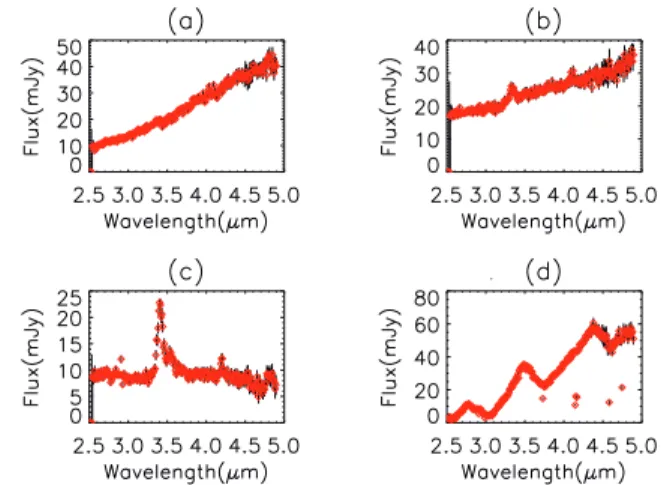
Fig. 2. Examples of spectra for (a) an AGN, (b) an AGN with star formation activity, (c) star-forming galaxy, and (d) a star.

2. AGN SEARCH USING THE AKARI MID- INFRARED ALL-SKY SURVEY

The initial identification of the AKARI mid-infrared all-sky survey sources involves association with the 2MASS catalog. We compared AKARI mid-infrared flux with the 2MASS K S −band photometry in the high galactic latitude, |b| ≥ 30 , after we excluded re- gions around the Large and Small Magellanic Clouds, and then found the mid-infrared-excess sources. The flux ratio, F (9 µm)/F (K S ) (or F (18 µm)/F (K S ), if F (9 µm) is not available), of AGNs is higher than that of normal galaxies. In Figure 1, we show the F (18 µm)/F (9 µm) vs. F (9 µm)/F (K S ) diagram.

We set selection criteria of F (9 µm)/F (K S ) > 2 or F (18 µm)/F (K S ) > 2. As a result, we have about 1,500 mid-infrared-excess sources. However, some of the sources that have as strong polycyclic aromatic hy- drocarbons (PAH) emissions in the wavelength of 6-9 µm as M82 show similar excess in the flux ratios. To examine the origin of the mid-infrared excess, we per- formed follow-up observations using the near-infrared spectroscopic capabilities of the AKARI/IRC in the Phase 3 mission program “Mid-infrared Search for Ac- tive Galactic Nuclei (MSAGN)”.

In MSAGN, 92 sources have been observed. 44 spec- tra out of 92 show red continuum from hot dust which indicates the presence of an AGN, while 35 star-forming galaxies show a strong PAH emission feature at 3.3 µm.

The remaining 13 objects are red stars. Examples of

near-infrared spectra are shown in Figure 2. Figure

2 (a) shows steep red continuum from hot dust in an

(3)

Fig. 3. Spectral energy distributions of (left) LEDA 84274 and (right) IRAS 01250+2832. The blue lines show the AKARI near-infrared spectroscopy. Squares and triangles represent the AKARI all-sky survey and IRAS data, respectively. Crosses show the 2MASS photometry. The solid lines (black) represent model SEDs of Sc and Ell13 galaxy templates (Polletta et al., 2007) for LEDA 84274 and IRAS 01250+2832, respectively. The model line normalized at the 2MASS photometry.

Dashed lines (red) represent the galaxy template plus blackbody components, the temperatures of which are 600 K, 300 K and 93 K for LEDA 84274 and 510 K and 100 K for IRAS 01250+2832.

AGN. Figure 2 (b) also shows red continuum as well as emission lines of PAH at 3.3 µm and Brα at 4.05 µm due to the coexistence of star formation and AGN activity. Figures 2 (c) and (d) show spectra of a star- forming galaxy with a strong PAH emission line and a red star with absorption features. The nature of star- forming galaxies is discussed in Yamada et al. in this volume. In addition, we also performed optical spec- troscopy of our targets with Lick 3 m, KPNO 2.1 m and SAAO 1.9 m telescopes.

During the follow-up observations, we found three dusty AGNs, LEDA 84274, IRAS 01250+2832, and AKARI-IRC J0235220-651537. They have steep red continuum in AKARI near-infrared spectra, but do not show any AGN features in optical observations. Oyabu et al. (2011) have already reported that LEDA 84274 and IRAS 01250+2832 probably had AGNs. Instead, AKARI-IRC J0235220-651537 is newly reported in this paper and detailed information is given in the next sec- tion.

As shown in Figure 3, the spectral energy distribu- tions (SEDs) of LEDA 84274 and IRAS 01250+2832 can not be explained with normal galaxy SED tem- plates due to the red continuum in the near-infrared.

Therefore, we need blackbody components with the temperatures of 600 K and 500 K for LEDA 84274 and IRAS 01250+2832, respectively. Especially, dust com- ponent with such high temperature is expected to be

very compact when we assume an optically thick com- ponent. For IRAS 01250+2832, we performed high- resolution near-infrared imaging with the IRCS/AO188 of the Subaru telescope in the J-, H-, K S -, L-, and M −bands. The L− and M −band imaging supports that the 500 K dust component is more compact than the diffraction limit of ∼ 0.1 arcsec, while the extended component of the host galaxy is clearly seen in the J-, H- and K S -bands. Thus, it seems to be very reason- able to explain this component with the presence of an AGN.

3. AKARI-IRC J0235220-651537

In order to reveal the nature of dusty AGNs, we need

more objects. In this section, we describe a new

dusty AGN, AKARI-IRC J0235220-651537, discovered

at z = 0.019. Table 1 summarizes the properties of

AKARI-IRC J0235220-651537. Figure 4 shows the

near-infrared spectrum. We identify a steep red con-

tinuum, the PAH emission feature at 3.3 µm, and CO

ro-vibrational absorption features at 4.7 µm. However,

in the optical spectrum obtained from the 6dF galaxy

survey (Jones et al., 2009), we only detect Hα, Hβ, two

[NII], and two [SII] lines, while there are no [OIII] emis-

sion lines which are an indicator of AGN activity. The

optical emission line ratios are consistent with those of

a star-forming galaxy.

(4)

Fig. 4. AKARI near-infrared spectrum of AKARI-IRC J0235220-651537. The thin vertical lines represent 1σ error.

Figure 5 presents the SED of AKARI-IRC J0235220- 651537. The SED model is also overplotted in the fig- ure. In order to explain the discrepancy between the AKARI near-infrared spectrum and the model, we need to add a 450K dust component. From the near-infrared spectrum, we obtained the PAH flux at 3.3 µm of 8.2±2.0×10 −14 ergs s −1 cm −2 . The infrared luminosity at 8-1000 µm is estimated to be L IR = 2.4 × 10 10 L ¯ . And the luminosity ratio of L PAH /L IR = 0.6 × 10 −3 is similar to that of normal star-forming galaxies (Ya- mada et al., in this volume).

AKARI-IRC J0235220-651537 shows near-infrared red continuum from hot dust with the temperature of 450 K, although the optical emission line ratios are in the range of a star-forming galaxy and the luminos- ity ratio of L PAH /L IR is consistent with that of star- forming galaxies. Only the near-infrared continuum from 450 K hot dust suggests the presence of an AGN.

Then, the coexistence of star formation and dusty AGN can explain our observational result.

4. SUZAKU X-ray OBSERVATIONS

X-ray observations can provide important information on the energy source, but not all galaxies are detected in the ROSAT all-sky survey faint source catalogue with an upper limit of 1.3 × 10 −13 ergs s −1 cm −2 in the 0.1-2.4 keV band (Voges et al., 2000). Thus, hard X-ray observations are important. We performed X- ray observations with SUZAKU/XIS on July 2011 and February 2011 for LEDA 84274 and IRAS 01250+2832, respectively. The exposure time for each object is 50

Fig. 5. Same as Figure 3 except for AKARI-IRC J0235220-651537. Dotted lines represent each blackbody component, the temperatures of which are 450 K and 70 K.

ksec. However, none of them was detected in the 0.4- 10 keV band. The detection limit is expected to be

∼ 1 × 10 −13 ergs s −1 cm −2 when we assume that the photon index is 1.5 and a column density of the ab- sorber is N H ∼ 10 23.5 cm −2 .

According to the empirical relation between X-ray and mid-infrared luminosities of nearby AGNs (Gah- ndi et al., 2009), the X-ray luminosity of our target is expected to be ∼ 3 × 10 43 ergs s −1 or more. In the case of N H ∼ 10 23.5 cm −2 , the expected flux is

∼ 2 × 10 −13 ergs s −1 cm −2 . No detections from our observations suggest that for our targets the column density is much higher or the central engine is not well matured.

5. HOST GALAXIES OF DUSTY AGNs

In the local universe, the masses of black holes in AGNs correlate with the global properties of their host galax- ies, such as the stellar velocity dispersion and lumi- nosity of the spheroidal component (e.g. Kormendy &

Richstone, 1995). These tight correlations indicate a close link between black hole growth and galaxy evolu- tion (Ferrarese & Merritt, 2000). In order to know the role of dusty AGNs in this context, we investigate the host galaxies of the dusty AGNs.

The masses of these host galaxies are calculated to

be 6 × 10 9 M ¯ , 4 × 10 9 M ¯ , and 3 × 10 9 M ¯ for LEDA

84274, IRAS 01250+2832, and AKARI-IRC J0235220-

651537, respectively, by using the 2MASS K S photom-

etry and the mass-to-luminosity ratio, M host /L K

S

∼ 1.

(5)

AKARI 160 µm 1.77± 1.64 Jy

L

IR

2.4 × 10

10

L

¯

Compared with the host galaxy in the SDSS AGN sam- ple, the masses of which are M gal = 10 9.5−12 (Kauffman et al., 2003), our galaxies seem to be the least massive population that harbor an AGN.

To examine the galaxy stellar population, the 4,000

˚ A discontinuities D n (4000) are measured to be 1.1 and 1.6 for LEDA 84274 and IRAS 01250+2832, respec- tively. According to D n (4000), LEDA 84274 seems to be a late-type galaxy. The star formation activ- ity of 20-30 M ¯ year −1 in LEDA 84274 is also con- firmed based on the information of optical and near- infrared spectra and the far-infrared luminosity. On the other hand, IRAS 01250+2832 is an early-type galaxy and star formation activity is not seen in any wave- length. For AKARI-IRC J0235220-651537, the opti- cal spectrum from the 6dFGRS does not have enough quality to estimate the 4,000˚ A discontinuity, but the emission lines in optical wavelengths indicate moder- ate star forming activity of several M ¯ year −1 . The re- sult is consistent with the far-infrared luminosity. The AKARI near-infrared spectra display similar red con- tinuum in the three galaxies, while their host galaxies have different properties.

If dusty AGNs are young systems growing up at present (Sanders et al., 1998; Haas et al., 2003), the less massive host galaxies might raise the idea that the for- mation of the most massive systems occurred at early epochs and that of small systems happens at present (Cowie et al., 1996; Heckman et al., 2004). This dis- cussion is based on a study with a limited sample. We need to inquire further into this with a larger sample.

be buried because the present signatures of AGNs are seen in the near- and mid-infrared, not in the optical.

We performed X-ray observations of the two galaxies with SUZAKU. No detections in the 0.4-10 keV sug- gest that the column density may be much higher than N H = 10 23.5 cm −2 . Comparing the masses of the host galaxies with those of the SDSS AGNs, we find that the host galaxies of the dusty AGNs discovered with AKARI are less massive populations than optically se- lected AGNs.

ACKNOWLEDGEMENTS

SO is supported by the Grand-in-Aid for Scientific Research from the Japan Society for the Promotion of Science (No. 22740134).

REFERENCES

Cowie, L., Songaila, A., Hu, E. M., & Cohen, J.

G., 1996, New Insight on Galaxy Formation and Evolution From Keck Spectroscopy of the Hawaii Deep Fields, AJ, 112, 839

Cutri, R. M., Nelson, B. O., Francis, P. J., & Smith, P.

S., 2002, The 2MASS Red AGN Survey, ASPC, 284, 127

Ferrarese, L. & Merritt, D., 2000, A Fundamental Relation between Supermassive Black Holes and Their Host Galaxies, ApJL, 539, 9

Heckman, T. M., et al., 2004, Present-Day Growth of Black Holes and Bulges: The Sloan Digital Sky Survey Perspective, ApJ, 613, 109

Imanishi, M., et al., 2008, Systematic Infrared 2.5-5 m Spectroscopy of Nearby Ultraluminous Infrared Galaxies with AKARI, 60, 489

Ishihara, D., et al., 2010, The AKARI/IRC Mid-

Infrared All-Sky Survey, 2010, A&A, 514, 1

(6)

Jones, D. H., et al., 2009, The 6dF Galaxy Survey: Fi- nal Redshift Release (DR3) and Southern Large- Scale Structures, MNRAS, 399, 683

Kauffman, G., et al., 2003, The Host Galaxies of Ac- tive Galactic Nuclei, MNRAS, 346, 1055

Kormendy, J. & Richstone, D., 1995, Inward Bound—

The Search For Supermassive Black Holes In Galactic Nuclei, ARA&A, 33, 581

Gahndi, P., et al., 2009, Resolving the Mid-Infrared Cores of local Seyferts, A&A, 502, 457

Glikman, E., et al., 2004, FIRST-2Mass Sources below the APM Detection Threshold: A Population of Highly Reddened Quasars, ApJ, 607, 60

Haas, M., et al., 2003, The ISO View of Palomar- Green Quasars, A&A, 402, 87

Leipski, C., et al., 2005, The ISO-2MASS AGN Sur- vey: on the Type-1 Sources, A&A, 440L, 5 Low, F. J., Cutri, R. M., Huchra, J. P., & Kleinmann,

S. G., 1988, Infrared Color-Selected Quasars and Seyfert 1 Galaxies, ApJL, 327, 41

Maiolino, R., et al., 1998, Heavy Obscuration in X-ray Weak AGNs, A&A, 338, 781

Oyabu, S., et al., 2011, AKARI Detections of Hot Dust in Luminous Infrared Galaxies. Search for Dusty Active Galactic Nuclei, A&A, 529, 1220 Polletta, M., et al., 2007, Spectral Energy Distribu-

tions of Hard X-Ray Selected Active Galactic Nu- clei in the XMM-Newton Medium Deep Survey, ApJ, 663, 81

Rush, B., Malkan, M. A., & Spinoglio, L., 1993, The Extended 12 Micron Galaxy Sample, ApJS, 89, 1 Sanders, D. B., Soifer, B. T., Elias, J. H., Neugebauer, G., & Matthew, K., 1988, Warm Ultraluminous Galaxies in the IRAS Survey - the Transition from Galaxy to Quasar?, ApJ, 328, 35

Sanders, D. B. & Mirabel, I., 1996, Luminous Infrared Galaxies, ARA&A, 34, 749

Ueda, Y., Akiyama, M., Ohta, K., & Miyaji, T., 2003, Cosmological Evolution of the Hard X-Ray Ac- tive Galactic Nucleus Luminosity Function and the Origin of the Hard X-Ray Background, ApJ, 598, 886

Voges, W., et al., 2000, ROSAT All-Sky Survey Faint

Source Catalogue, IAU Circ, 7432, 3

수치

Fig. 1. F (18 µm)/F (9 µm) vs. F (9 µm)/F (K S ) diagram based on detections of the AKARI mid-infrared all-sky survey (gray dots)
Fig. 3. Spectral energy distributions of (left) LEDA 84274 and (right) IRAS 01250+2832
Fig. 4. AKARI near-infrared spectrum of AKARI-IRC J0235220-651537. The thin vertical lines represent 1σ error.

참조

관련 문서

• 이명의 치료에 대한 매커니즘과 디지털 음향 기술에 대한 상업적으로의 급속한 발전으로 인해 치료 옵션은 증가했 지만, 선택 가이드 라인은 거의 없음.. •

After choosing the type of bike, the next step is the right bike size. the right size for you from

Based on the results of this field survey, the Suwon City organized a 'Cam Meeting' with Chairman Chey, which turned out to be a well taken free, uninhibited

The numbers of unemployed and the monthly unemployment rates are estimates based on results of the LFS which is a continuous household survey carried out in Member States on

웹 표준을 지원하는 플랫폼에서 큰 수정없이 실행 가능함 패키징을 통해 다양한 기기를 위한 앱을 작성할 수 있음 네이티브 앱과

Equipped with the nonresponse survey data of the latest (2012) KGSS, an annually conducted national sample survey that keeps maintaining a notable reputation of ‘quality

_____ culture appears to be attractive (도시의) to the

- quadriceps tendon 이 슬개골 하연에서 tibial tuberocity에 부착.