9
월출산 국립공원의 고등균류 분포
장석기*
원광대학교 환경조경학과
Distribution of Higher Fungi in Wolchulsan National Park
Seog-Ki Jang*
Department of Environmental Landscape Architecture, College of Life Science & Natural Resource, Wonkwang University, Iksan 570- 749, Korea
ABSTRACT : The result of the survey on higher fungi in the Wolchulsan National Park from April 2009 to October 2011 is as follows. During the survey, total of 1 kingdoms 2 divisions 5 classes 18 orders 56 families 133 genera and 298 species were surveyed, Basidiomycota has 12 orders 47 families 120 genera 278 species, Ascomycota 6 orders 9 families 13 genera 20 species.
As for Basidiomycota, Agaricomycetes has 46 families 118 genera 276 species. The most occurred fungi were Russulaceae with 37 species, followed by Boletaceae, Amanitaceae, Agaricaceae and Polyporaceae. Various species of most higher fungi occurred during the period with average temperature of 26.0~27.9, max. 32.0~34.9, min. 24.0~25.9, and over 100 mm of precipitation.
KEYWORDS : Climatic environment factor, Ectomycorrhizal fungi, Higher fungi, Wolchulsan National Park
서 론
월출산 국립공원은 전라남도 영암군과 강진군에 걸쳐 위 치하고 있으며, 천황봉(809 m)을 주봉으로 대부분 지역이 암석 노출이 심한 험준한 지형을 보이고 있다. 이 지역은 전체적으로 교목층은 굴참나무, 졸참나무, 신갈나무, 상수 리나무 및 붉가시나무 등 참나무속(Quercus)과 소나무 및 리기다소나무 등 소나무속(Pinus) 등이 우점하고 있고 관 목층으로는 동백나무, 사스레피나무, 병꽃나무, 당단풍, 철 쭉꽃, 사람주나무, 쇠물푸레나무, 진달래, 윤노리나무 등이 분포하고 있는 난대림과 온대림이 혼생하고 있는 추이대
(ecotone) 특성을 지닌 지역으로 고등균류의 다양한 서식 환경을 제공하고 있다.
고등균류는 세계적으로 25,000여종이, 우리나라에도 2,000여종 이상 보고[1] 되고 있으며, 대부분이 담자균문과 자낭균문에 포함되고 그 종류 및 서식환경 또한 다양하다.
산림에서는 기생균 역할, 분해자 역할 및 공생균 역할 등으 로 산림 생태계 순환에 필수적인 역할[2]을 한다. 특히, 수 목과 공생관계 역할을 하는 외생균근균은 대부분의 수목 뿌리와 결합하여 수분상승, 영양분 흡수 및 대사, 수목의 적절한 생장 및 병원체에 대한 보호[3,4] 등 중요한 역할을 하고 있다.
외생균근균의 종다양성 및 군집구조는 벌채[5,6], 오염[7, 8] 등 인위적인 요인, 외생균근균 수목들의 밀도[9-11], 잎 의 계절적 특성(낙엽수 또는 상록수)[12], 낙엽의 질[13] 등 수목 특성, 토양유기물함량[14], 토양 질소 및 탄소함량[15, 16] 등 토양 특성 등 매우 다양한 요인들에 의해서도 영향 이 있는 것으로 보고되었다. 특히, 지구온난화로 인한 기 후변화는 외생균근균의 매우 적은 군집구조 및 확산의 제 약 등으로 군집 및 풍부도에도 큰 영향[17]이 있는 것으로 나타났다.
따라서 본 연구는 월출산국립공원을 대상으로 고도 및 조사 시기에 따른 고등균류의 분포상을 조사하여 종다양성 확보의 기초 자료 제공 및 기후환경 요인들이 고등균류 분 포에 미치는 영향을 구명하고자 한다.
*Corresponding author E-mail: [email protected] Received November 20, 2013 Revised February 26, 2014 Accepted March 19, 2014
This is an Open Access article distributed under the terms of the Creative Commons Attribution Non-Commercial License (http://
creativecommons.org/licenses/by-nc/3.0/) which permits unrestricted non-commercial use, distribution, and reproduction in any medium, provided the original work is properly cited.
Kor. J. Mycol. 2014 March, 42(1): 9-20 http://dx.doi.org/10.4489/KJM.2014.42.1.9 pISSN 0253-651X
© The Korean Society of Mycology
재료 및 방법
조사 기간
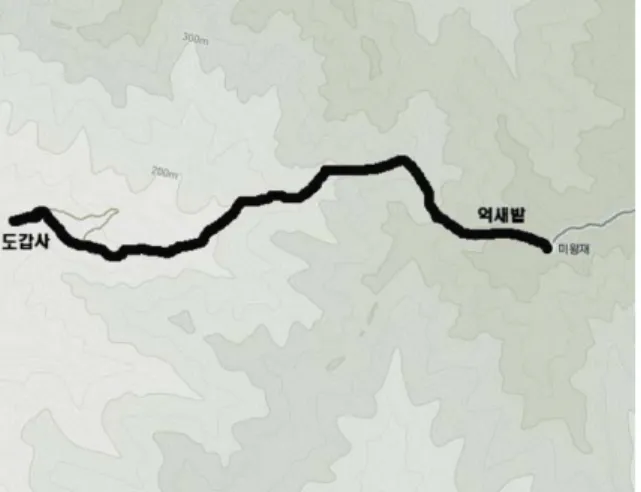
조사는 출입이 가능한 등산로를 중심으로 월출산을 조사 하였으며 특히, 고등균류 발생이 가장 양호하다고 판단되 는 도갑사→도갑사계곡→억새밭 구간을 집중적으로 Line Transect Method에 의해 좌우 각각 10 m를 조사 범위에 포 함하여 2009년 4월부터 2011년 10월 까지 총 41회(2009년 10회, 2010년 14회 및 2011년 17회)를 조사하였다(Fig. 1).
채집 및 방법
조사 기간 동안 발생된 균류는 갓, 주름살, 대 및 대주머 니 등 특성에 따라 구별이 가능한 균류는 현장에서 동정을 하였으며, 미동정된 균류는 채집 장소, 채집일 및 서식환경 등을 기입한 후 자실체가 손상되지 않도록 봉투에 넣어 원 광대학교 환경생태학실험실로 운반한 후, Melzer용액, KOH 또는 Guaiacol 등에 의한 화학적 반응 검사 및 현미경을 이 용하여 담자기, 담자포자, 낭상체 등을 관찰한 후 종의 분 류, 동정하는 데 참고하였다. 균류 분류는 주름버섯목[18], 민주름버섯목[19], 고약버섯류[20-25] 및 구멍장이버섯류 [26,27]의 분류체계 등을 참조하였으며, 최종분류는 CABI 의 Index Fungorum (http://www.indexfungorum.org/)의 분 류체계에 따랐다.
기후환경 및 자료분석
기후환경 자료는 조사지역인 영암군 영암읍 낭주로 133 (영암읍사무소)에 설치되어있는 자동기상관측장비(AWS;
Automatic Weather System)의 자료를 참고하였으며, 조사 기간 동안 기후환경 자료는 조사 다음 날부터 조사 당일까 지의 평균값을 이용하였다(Table 1). 자료 분석은 조사 기 간 동안 발생한 균류를 각각의 기후환경 요인[온도(평균온 도, 최고온도, 최저온도), 강수량]을 6단계로 구분한 후 고 등균류의 서식환경별에 따른 종 발생에 대한 차이를 알아 보고자 ANOVA을 실시하고 Duncan's test로 비교하였다
Fig. 1. Map of surveyed area in Wolchulsan National park.
Table 1. Climatic data in Yeongam gun from April 2009 to October 2011
Elements Period
Air temperature (oC) Rainfall Mean Max. Min. (mm)
10 Apr. 2009 10.4 18.5 2.7 0.0
30 May 19.0 26.0 13.8 57.0
14 Jun. 20.6 25.9 16.1 11.0 20 Jul. 26.2 29.3 23.5 363.0 03 Aug. 24.1 28.7 21.0 109.0
14 26.3 30.6 23.1 100.0
03 Sep. 25.0 30.3 20.5 38.0
18 22.0 28.5 16.6 4.0
08 Oct. 18.7 25.3 13.4 33.5
14 15.0 22.4 8.9 4.0
22 Jun. 2010 23.4 28.6 19.6 1.5
30 24.0 28.2 21.0 30.0
06 Jul. 25.6 29.0 23.3 23.5
19 25.1 29.2 22.1 127.5
24 27.3 31.9 24.6 66.5
29 25.8 30.5 23.4 50.0
03 Aug. 28.6 33.3 25.0 0.0
20 28.1 32.3 25.0 218.5
24 28.6 34.1 24.4 0.0
03 Sep. 27.2 31.0 24.7 203.0
18 25.0 30.1 21.4 46.0
25 22.5 28.3 18.2 2.5
07 Oct. 17.6 23.5 12.3 24.5
14 17.0 23.3 12.2 1.0
06 May 2011 15.2 20.7 9.2 13.5
20 19.2 24.7 14.2 86.5
02 Jun. 19.3 24.6 15.2 16.5
17 22.1 27.3 17.8 26.5
05 Jul. 24.6 28.7 21.5 271.0
16 25.5 28.4 23.6 230.5
20 28.5 34.2 23.9 0.0
30 26.8 30.7 23.9 6.5
05 Aug. 27.6 31.7 24.2 52.0
16 26.7 29.8 24.6 177.5
22 22.8 25.9 21.0 42.0
27 23.8 27.0 21.2 6.0
02 Sep. 26.0 31.4 22.1 0.0
08 23.1 28.6 18.1 0.0
23 22.1 27.3 18.3 11.5
03 Oct. 17.6 23.5 12.2 5.5
12 15.3 23.5 8.1 0.0
(SPSS 12.0K).
결과 및 고찰
고등균류의 다양성
고등균류를 조사한 결과 총 1계 2문 5강 18목 56과 133 속 298종이 조사되었으며, 이에 대한 결과는 Table 2와 Appendix 1과 같다.
조사 결과, 담자균문은 12목 47과 120속 278종이, 자낭균 문은 6목 9과 13속 20종이 조사되었다. 담자균문의 경우 담 자균강(Agaricomycetes)은 11목 46과 118속 276종이, 붉은 목이강(Dacrymycetes)은 1목 1과 2속 2종이 조사되었다.
자낭균문은 두건버섯강(Leotiomycetes)은 3목 4과 4속 5종 이, 주발버섯강(Pezizomycetes)은 1목 3과 3속 5종, 동충하 초강(Sordariomycetes)은 2목 2과 6속 10종으로 대부분의
Table 2. List of higher fungi collected from 2009 to 2011 in Wolchulsan National Park
Family Genus Species
Fungi
Basidiomycota
Agaricomycetes
Agaricales 20 54 134
Auriculariales 1 2 4
Boletales 7 20 43
Cantharellales 2 4 7
Geastrales 1 1 2
Gomphales 1 1 2
Hymenochaetales 3 5 5
Phallales 1 3 3
Polyporales 5 21 30
Russulales 3 5 44
Thelephorales 2 2 2
Dacrymycetes
Dacrymycetales 1 2 2
Ascomycota
Leotiomycetes
Helotiales 2 2 3
Leotiales 1 1 1
Rhytismatales 1 1 1
Pezizomycetes
Pezizales 3 3 5
Sordariomycetes
Hypocreales 1 3 5
Xylariales 1 3 5
Total 56 133 298
Appendix 1. Detailed list of higher fungi collected from 2009 to 2011 in Wolchulsan National Park
Scientific name
Surveyed species (year) 2009 2010 2011 Fungi
Basidiomycota Agaricomycetes Agaricales Agaricaceae
Agaricus arvensis ○ ○
Agaricus moelleri ○ ○
Agaricus silvaticus ○ ○
Agaricus subrutilescens ○ ○ ○
Coprinus comatus ○
Cyathus stercoreus ○ ○
Cystoderma amianthinum ○ ○
Cystolepiota pseudogranulosa ○
Lepiota cristata ○
Lepiota fusciceps ○ ○
Lepiota otsuensis ○
Lepiota praetervisa ○ ○
Leucocoprinus cygneus ○
Leucocoprinus fragilissimus ○
Leucocoprinus subglobisporus ○
Macrolepiota detersa ○
Macrolepiota procera ○ ○
Calvatia craniiformis ○ ○ ○
Lycoperdon lividum ○
Lycoperdon perlatum ○ ○ ○
Lycoperdon umbrinum ○
Amanitaceae
Amanita abrupta ○
Amanita castanopsidis ○
Amanita ceciliae ○ ○
Amanita cheelii ○ ○
Amanita citrina ○ ○
Amanita excelsa ○
Amanita farinosa ○ ○ ○
Amanita fuliginea ○
Amanita fulva ○ ○ ○
Amanita gemmata ○
Amanita griseofarinosa ○
Amanita gymnopus ○
Amanita hemibapha ○ ○
Amanita longistipitata ○
Appendix 1. Continued Scientific name
Surveyed species (year) 2009 2010 2011
Amanita longistriata ○ ○
Amanita melleiceps ○
Amanita neo-ovoidea ○ ○ ○
Amanita pantherina ○ ○ ○
Amanita porphyria ○ ○ ○
Amanita pseudoporphyria ○ ○ ○
Amanita rubescens ○ ○ ○
Amanita spissacea ○ ○ ○
Amanita spreta ○
Amanita subjunquillea ○
Amanita vaginata ○ ○ ○
Amanita verna ○ ○ ○
Amanita virgineoides ○ ○
Amanita virosa ○ ○ ○
Amanita volvata ○ ○ ○
Clavariaceae
Clavaria fragilis ○
Cortinariaceae
Cortinarius elatior ○
Cortinarius obtusus ○
Cortinarius purpurascens ○ ○
Cortinarius salor ○ ○
Cortinarius violaceus ○
Descolea flavoannulata ○
Hebeloma vinosophyllum ○
Entolomataceae
Entoloma album ○
Entoloma cyanoniger ○
Entoloma kauffmanii ○ ○
Entoloma lividocyanulum ○
Entoloma rhodopolium ○
Inocephalus murrayi ○ ○ ○
Fistulinaceae
Porodisculus pendulus ○
Hydnagiaceae
Laccaria amethystea ○ ○ ○
Laccaria laccata ○ ○
Laccaria vinaceoavellanea ○ ○ ○
Hygrophoraceae
Ampulloclitocybe clavipes ○
Hygrocybe cantharellus ○
Appendix 1. Continued Scientific name
Surveyed species (year) 2009 2010 2011
Hygrocybe conica ○ ○
Hygrocybe cuspidata ○
Hygrophorus russula ○ ○
Inocybaceae
Crepidotus applanatus ○
Crepidotus badiofloccosus ○
Crepidotus cesatii ○
Crepidotus luteolus ○
Crepidotus mollis ○ ○
Inocybe asterospora ○ ○ ○
Inocybe calospora ○
Inocybe cincinnata ○
Inocybe cookei ○
Inocybe lutea ○
Inocybe niigatensis ○ ○
Inocybe nodulosospora ○ ○
Inocybe rimosa ○ ○
Inocybe umbratica ○
Lyophyllaceae
Asterophora lycoperdoides ○ ○ ○
Marasmiaceae
Marasmius maximus ○ ○ ○
Marasmius pulcherripes ○ ○ ○
Marasmius siccus ○
Megacollybia platyphylla ○ ○
Pleurocybella porrigens ○
Mycenaceae
Mycena alcalina ○
Mycena alphitophora ○ ○ ○
Mycena galericulata ○ ○ ○
Mycena haematopus ○
Mycena polygramma ○
Mycena pura ○ ○ ○
Mycena stylobates ○ ○
Panellus stipticus ○
Omphalotaceae
Gymnopus confluens ○ ○ ○
Gymnopus dryophilus ○ ○ ○
Marasmiellus candidus ○ ○ ○
Marasmiellus ramealis ○ ○ ○
Rhodocollybia butyracea ○ ○ ○
Appendix 1. Continued Scientific name
Surveyed species (year) 2009 2010 2011 Physalacriaceae
Armillaria mellea ○
Armillaria tabescens ○ ○ ○
Cyptotrama asprata ○ ○ ○
Hymenopellis radicata ○ ○ ○
Xerula pudens ○ ○
Pluteaceae
Pluteus cervinus ○
Psathyrellaceae
Coprinellus disseminatus ○ ○ ○
Coprinellus micaceus ○ ○ ○
Lacrymaria lacrymabunda ○ ○ ○
Psathyrella candolleana ○ ○
Psathyrella piluliformis ○
Pterulaceae
Pterula multifida ○ ○
Schizophyllaceae
Schizophyllum commune ○ ○ ○
Strophariaceae
Agrocybe pediades ○
Agrocybe praecox ○
Gymnopilus junonius ○ ○
Gymnopilus liquiritiae ○ ○
Hypholoma fasciculare ○ ○ ○
Pholiota adiposa ○ ○ ○
Tricholomataceae
Arrhenia epichysium ○ ○ ○
Clitocybe candicans ○ ○
Clitocybe fragrans ○ ○
Clitocybe gibba ○ ○
Gymnopus peronatus ○ ○
Lepista nuda ○
Phyllotopsis nidulans ○
Tricholoma saponaceum ○ ○
Tricholomopsis rutilans ○ ○
Auriculariales Auriculariaceae
Auricularia auricula-judae ○ ○ ○
Auricularia nigricans ○ ○ ○
Exidia glandulosa ○
Exidia uvapassa ○ ○
Appendix 1. Continued Scientific name
Surveyed species (year) 2009 2010 2011 Boletales
Boletaceae
Aureoboletus thibetanus ○ ○
Austroboletus fusisporus ○
Austroboletus gracilis ○ ○
Boletellus chrysenteroides ○
Boletellus elatus ○
Boletellus emodensis ○
Boletus auripes ○ ○
Boletus pseudocalopus ○
Boletus pulverulentus ○ ○
Boletus reticulatus ○ ○
Boletus subtomentosus ○ ○ ○
Boletus subvelutipes ○ ○
Frostiella russellii ○
Harrya chromapes ○ ○
Heimioporus japonicus ○ ○ ○
Leccinum extremiorientale ○ ○
Leccinum scabrum ○ ○
Leccinum versipelle ○
Phylloporus bellus ○ ○ ○
Pulveroboletus ravenelii ○ ○ ○
Retiboletus nigerrimus ○ ○
Retiboletus ornatipes ○
Strobilomyces confusus ○ ○ ○
Tylopilus alboater ○ ○
Tylopilus eximius ○ ○ ○
Tylopilus felleus ○
Tylopilus fumosipes ○
Tylopilus neofelleus ○ ○ ○
Tylopilus valens ○
Tylopilus virens ○
Xanthoconium affine ○ ○ ○
Xerocomellus chrysenteron ○ ○ ○
Xerocomellus rubellus ○ ○ ○
Calostomataceae
Calostoma japonicum ○ ○
Diplocystidiaceae
Astraeus hygrometricus ○ ○
Gyroporaceae
Gyroporus castaneus ○ ○
Appendix 1. Continued Scientific name
Surveyed species (year) 2009 2010 2011 Rhizopogonaceae
Rhizopogon roseolus ○
Sclerodermataceae
Scleroderma areolatum ○
Scleroderma citrinum ○ ○ ○
Scleroderma flavidum ○
Suillaceae
Suillus bovinus ○ ○ ○
Suillus granulatus ○ ○
Suillus grevillei ○
Cantharellales Cantharellaceae
Cantharellus cibarius ○ ○ ○
Cantharellus cinnabarinus ○ ○ ○
Cantharellus minor ○ ○ ○
Craterellus cornucopioides ○
Craterellus lutescens ○
Gloeocantharellus pallidus ○
Clavulinaceae
Clavulina coralloides ○ ○
Geastrales Geastraceae
Geastrum fimbriatum ○
Geastrum triplex ○ ○
Gomphales Gomphaceae
Ramaria flaccida ○
Ramaria formosa ○
Hymenochaetales Hymenochaetaceae
Coltricia cinnamomea ○ ○ ○
Hymenochaete xerantica ○ ○
Onnia orientalis ○
Repetobasidiaceae
Rickenella fibula ○ ○
Schizoporaceae
Hyphodontia sambuci ○
Phallales Phallaceae
Jansia boninensis ○
Phallus luteus ○
Appendix 1. Continued Scientific name
Surveyed species (year) 2009 2010 2011
Pseudocolus schellenbergiae ○ ○ ○
Polyporales Fomitopsidaceae
Daedalea dickinsii ○ ○
Postia caesia ○
Ganodermataceae
Ganoderma applanatum ○ ○
Ganoderma lucidum ○ ○ ○
Meruliaceae
Abortiporusbiennis ○
Hydnophlebiachrysorhiza ○
Irpexconsor ○
Stereopsis burtiana ○ ○
Phanerochaetaceae
Terana caerulea ○
Polyporaceae
Abundisporus roseoalbus ○
Crustodontia chrysocreas ○ ○
Cystidiophorus castaneus ○
Daedaleopsis tricolor ○ ○
Datronia mollis ○
Lenzites betulina ○ ○ ○
Lenzites styracina ○ ○ ○
Microporus vernicipes ○ ○ ○
Perenniporia fraxinea ○ ○
Perenniporia minutissima ○
Perenniporia subacida ○
Polyporus alveolarius ○
Polyporus arcularius ○
Polyporus varius ○ ○
Pycnoporus cinnabarinus ○ ○
Trametes gibbosa ○
Trametes orientalis ○
Trametes versicolor ○ ○ ○
Trichaptum abietinum ○ ○
Trichaptum biforme ○
Tyromyces chioneus ○
Russulales Auriscalpiaceae
Artomyces pyxidatus ○
Russulaceae
Appendix 1. Continued Scientific name
Surveyed species (year) 2009 2010 2011
Lactarius acris ○
Lactarius akahatsu ○
Lactarius camphoratus ○
Lactarius chrysorrheus ○ ○ ○
Lactarius controversus ○ ○
Lactarius gerardii ○ ○ ○
Lactarius hatsudake ○ ○
Lactarius hygrophoroides ○
Lactarius piperatus ○ ○ ○
Lactarius quietus ○ ○
Lactarius subplinthogalus ○ ○
Lactarius subzonarius ○ ○ ○
Lactarius volemus ○ ○ ○
Russula aeruginea ○
Russula alboareolata ○ ○ ○
Russula aurea ○
Russula bella ○ ○ ○
Russula castanopsidis ○ ○
Russula compacta ○ ○
Russula cyanoxantha ○
Russula delica ○
Russula densifolia ○ ○
Russula emetica ○ ○ ○
Russula flavida ○ ○
Russula grata ○ ○
Russula japonica ○
Russula kansaiensis ○
Russula nigricans ○
Russula rosea ○ ○
Russula rubescens ○ ○
Russula sanguinea ○ ○ ○
Russula senecis ○ ○ ○
Russula sororia ○ ○
Russula subnigricans ○ ○ ○
Russula vesca ○ ○
Russula violeipes ○
Russula virescens ○ ○
Stereaceae
Stereum gausapatum ○
Stereum hirsutum ○
Stereum ostrea ○ ○
Appendix 1. Continued Scientific name
Surveyed species (year) 2009 2010 2011
Stereum umbrinum ○
Xylobolus frustulatus ○
Xylobolus spectabilis ○
Thelephorales Bankeraceae
Phellodon melaleucus ○
Thelephoraceae
Thelephora palmata ○
Dacrymycetes Dacrymycetales Dacrymycetaceae
Calocera cornea ○ ○ ○
Dacryopinax spathularia ○
Ascomycota Leotiomycetes Helotiales Dermateaceae
Chlorociboria aeruginosa ○ ○
Helotiaceae
Bisporella citrina ○ ○
Bisporella sulfurina ○ ○
Leotiales Leotiaceae
Leotia lubrica ○ ○ ○
Rhytismatales Cudoniaceae
Spathularia flavida ○
Pezizomycetes Pezizales Helvellaceae
Helvella elastica ○ ○
Helvella lacunosa ○
Helvella macropus ○ ○
Pezizaceae
Peziza violacea ○
Pyronemataceae
Aleuria aurantia ○
Sordariomycetes Hypocreales Cordycipitaceae
Cordyceps kyusyuensis ○
고등균류는 담자균문 중 담자균강에 속하는 것으로 나타 났다.
이를 분류군별로 구분하면 주름버섯목이 20과 54속 134 종이, 그물버섯목은 7과 20속 43종, 무당버섯목 3과 5속 44종 및 구멍장이버섯목 5과 21속 30종으로 4목의 종수가 총 251종으로 전체 발생 종수의 84.2%로 대부분을 차지한 것으로 조사되었다. 가장 많이 발생된 균류는 무당버섯과 로 37종이었으며, 그물버섯과(33종), 광대버섯과(29종), 주 름버섯과(21종) 및 구멍장이버섯과(20종) 순으로 나타났다.
동정된 고등균류 중 외생균근성버섯은 16과 34속 138종 (46.3%), 낙엽 및 목재부후균은 28과 63속 98종(32.9%), 지 상균은 22과 38속 56종(18.8%) 및 기타 2과 4속 6종(2.0%) 인 것으로 나타났다. 이는 치악산에서 조사된 고등균류 131 속 274종 중 외생균근성버섯 32.7%, 부생균 63% 및 기생균 4%이었다는 보고[28]와 내장산에서 조사된 고등균류 총 418종 중 외생균근성버섯 40.4%, 낙엽 및 목재부후균 39.2%, 지상균 18.4% 이었다는 보고[29]와 비교했을 때 외 생균근성버섯의 발생이 높았으나, 오대산에서 조사된 고등 균류 총 281종 중 외생균근성버섯 49.1%, 부생균 49.5% 및 기생균 1.4%이었다는 보고[30]보다는 낮은 것으로 조사되 었다. 이 같은 결과는 조사 지역의 임황 조건, 지황 조건, 기후 환경 및 조사 시기 등에 따른 차이 때문인 것으로 판 단된다.
조사시기별 고등균류 분포
연도별에 따른 고등균류 발생(Fig. 2)을 보면 2011년이 총 49과 105속 228종으로 가장 높았고 2010년(총 41과 86 속 170종), 2009년(총 41과 82속 153종) 순으로 나타났다.
종(Species)수 분포는 2010년 7월이 118종으로, 과(Family)
및 속(Genus)수는 2011년 8월이 35과 66속으로 가장 많이 조사되었으며, 2009년 4월에는 1종도 조사되지 않았다.
이를 월별로 종합한 결과(Fig. 3), 7월이 46과 94속 196종 으로 가장 발생이 많았으며, 8월(43과 92속 171종), 9월(38 과 74속 120종)의 순이었으며, 4월과 5월(4과 5속 5종)은 종 발생이 없거나 매우 적었다. 이 같은 결과는 조사기간 동안 온도, 습도 및 강수량 등 기후환경이 고등균류의 발생 에 영향을 준 것으로 판단되며, 이는 외생균근균의 군집 구 성에 기후조건이 영향을 끼친다는 보고[31]와 유사하였다.
월별에 따른 우점균류(Table 3)를 보면, 주름버섯과, 광대 Appendix 1. Continued
Scientific name
Surveyed species (year) 2009 2010 2011
Cordyceps polyarthra ○ ○ ○
Isaria sinclairii ○ ○
Ophiocordyceps gracilioides ○
Ophiocordyceps nutans ○ ○ ○
Xylariales Xylariaceae
Annulohypoxylon truncatum ○ ○ ○
Daldinia concentrica ○ ○
Xylaria carpophila ○
Xylaria hypoxylon ○
Xylaria polymorpha ○ ○
Total 153 170 228
Fig. 2. The number of higher fungi during the surveying periods in Wolchulsan National Park.
Fig. 3. The species number of higher fungi according to the month in Wolchulsan National Park.
버섯과, 그물버섯과, 구멍장이버섯과 및 무당버섯과 등 5과 는 7월부터 9월까지 지속적으로 조사되었으며, 특히 그물 버섯과, 무당버섯과 및 광대버섯과는 기타 균류에 비해 발 생이 높은 것으로 나타났다.
이는 내장산[32]과 치악산[33]에서 조사된 고등균류 중 그물버섯과, 무당버섯과, 구멍장이버섯과 등이 다양하게 발 생되었다는 보고와 유사한 결과를 보였다.
고도별 고등균류 분포
고도별에 따른 고등균류 분포(Fig. 4)를 보면 2011년
100~199 m에서 46과 104속 200종으로 가장 많이 조사되었 으며, 2010년과 2011년 400 m 이상에서는 7종으로 가장 적 게 나타났다. 이를 종합한 결과(Fig. 5), 100~199 m에서 54 과 127속 267종으로 가장 많았고 200~299 m(42과 85속 160종), 300~399 m(18과 31속 46종) 순이었으며 400 m 이 상(10과 12속 14종)에서는 가장 적은 균류가 조사되어 고 도가 높아짐에 따라 종 감소가 높았다. 이 같은 결과는 고 도에 따라 종 다양성 및 군집구성에 영향을 준다는 보고 [34]와 유사한 것으로 나타났다.
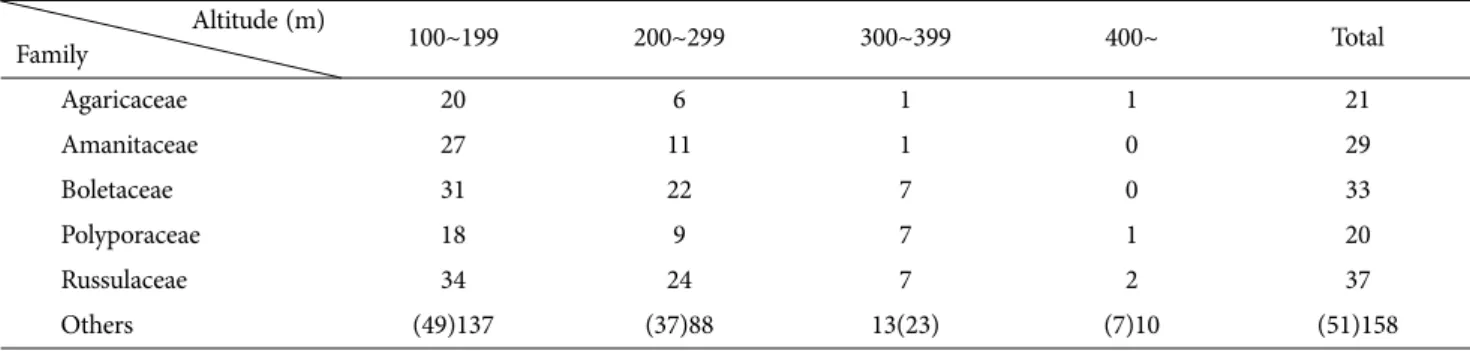
고도별에 따른 우점균류 분포(Table 4)를 보면 100~299 m에서는 우점균류의 발생이 가장 많았으며, 400 m 이상에 서는 우점균류 및 기타 균류 발생이 현저히 적어지는 것으 로 나타났다. 이 같은 결과는 이 지역이 많은 암반 및 바위 들의 노출이 많은 능선부 지역으로 고도 상승에 따른 기후 환경 변화에 따른 영향이 기타 지역에 비해 컸기 때문으로 판단된다. 이는 외생균근균의 군집 구조에 기후변화에 따 라 영향이 있다는 보고[35-37]와 유사하였다.
기후환경 요인별 분포
고등균류 서식환경별에 대한 기후환경 요인별에 따른 결 과는 Table 5, 6, 7 및 8과 같다. 평균온도별(Table 5)에서는 외생균근성버섯과 낙엽·목재부후균은 24.0oC 이상에서, 지상균은 28.0oC 이상일 때 유의성이 나타났으며 특히, 외 생균근성버섯과 낙엽·목재부휴균은 26.0~27.9oC에서, 지 상균은 28.0~28.9oC일 때 유의성이 높은 것으로 나타났다.
Table 3. Distribution of higher fungal species during the surveying periods in Wolchulsan National Park Month
Family Apr. May Jun. Jul. Aug. Sep. Oct.
Agaricaceae 0 1 2 14 10 6 4
Amanitaceae 0 0 0 24 20 12 0
Boletaceae 0 0 1 26 23 12 0
Polyporaceae 0 0 1 10 11 12 5
Russulaceae 0 0 2 32 18 17 2
Others 0 (3)4 (17)26 (41)90 (38)89 (33)61 (22)29
( ) ; No. of Family.
Fig. 4. The number of higher fungi according to the altitude during the surveying periods in Wolchulsan National Park.
Fig. 5. The number of higher fungal species according to the altitude in Wolchulsan National Park.
최고온도별(Table 6)의 경우 외생균근성버섯과 낙엽·목 재부휴균은 30oC 이상에서, 지상균은 32oC 이상일 때 유의 성을 보였으며 특히, 외생균근성버섯과 지상균은 32.0~34.9
oC에서, 낙엽·목재부휴균은 30.0~31.9oC에서 높은 유의성 이 나타났다.
최저온도별(Table 7)에서는 외생균근성버섯은 24.0~25.9
oC에서, 낙엽·목재부휴균은 지상균은 22.0oC 이상에서 유 의성이 나타났으며 대부분의 균류는 24.0~25.9oC에서 높은 유의성이 나타났다.
강수량별(Table 8)에서는 모든 균류가 강수량이 100.0 mm 이상일 때 유의성이 높은 것으로 나타났다.
이상의 결과, 대부분의 고등균류는 평균온도 26.0~27.9
oC, 최고온도 32.0~34.9oC, 최저온도 24.0~25.9oC 및 강수량 Table 4. Distribution of higher fungal species according to the altitude in Wolchulsan National Park
Altitude (m)
Family 100~199 200~299 300~399 400~ Total
Agaricaceae 20 6 1 1 21
Amanitaceae 27 11 1 0 29
Boletaceae 31 22 7 0 33
Polyporaceae 18 9 7 1 20
Russulaceae 34 24 7 2 37
Others (49)137 (37)88 13(23) (7)10 (51)158
( ) ; No. of Family.
Table 5. Duncan,s multiple range test between mean air temperature and species of higher fungi according to habitat environmental characteristics
Mean
A.T. (oC) E.M.F. L.W.F. G.F. O.F.
~17.9 1.5714b 4.0000b 1.7143cd 0.0000d 18.0~21.9 0.4000b 2.4000b 0.6000d 0.0000d 22.0~23.9 5.2500b 5.7500b 2.6250abc 0.2500cd 24.0~25.9 18.5556a 12.2222a 4.3333abc 0.6667bc 26.0~27.9 22.0000a 13.8750a 5.0000ab 1.3750a 28.0~28.9 21.2500a 12.0000a 6.2500a 1.0000ab
*The mean difference is significant at the 0.05 level.
Mean A.T.; Mean Air Temperature, E.M.F.; Ectomycorrhizal Fungi, L.W.F; Litter Decomposing and Wood Rotting Fungi, G.F.; Groun- ding Fungi, O.F.; Others Fungi.
Table 6. Duncan,s multiple range test between maximum air temperature and species of higher fungi according to habitat environmental characteristics
Max.
A.T. (oC) E.M.F. L.W.F. G.F. O.F.
~23.9 1.5714c 4.0000b 1.7143bc 0.0000b 24.0~25.9 2.8000bc 4.0000b 1.0000c 0.0000b 26.0~27.9 3.0000bc 4.5000b 2.5000bc 0.2500ab 28.0~29.9 15.0833ab 10.7500ab 4.6667ab 0.7500ab 30.0~31.9 20.0000a 12.4444a 3.5556abc 1.0000a 32.0~34.9 21.2500a 12.0000a 6.2500a 1.0000a
*The mean difference is significant at the 0.05 level.
Max. A.T.; Maximum Air Temperature, E.M.F.; Ectomycorrhizal Fungi, L.W.F; Litter Decomposing and Wood Rotting Fungi, G.F.;
Grounding Fungi, O.F.; Others Fungi.
Table 7. Duncan,s multiple range test between minimum air temperature and species of higher fungi according to habitat environmental characteristics
Min.
A.T. (oC) E.M.F. L.W.F. G.F. O.F.
~12.9 1.5714c 4.0000c 1.7143bc 0.0000c 13.0~16.9 0.6667c 3.1667c 0.6667c 0.0000c 17.0~19.9 3.2000c 4.8000bc 1.8000bc 0.4000bc 20.0~21.9 14.7143b 10.2857ab 4.5714ab 0.4286bc 22.0~23.9 19.8889ab 13.0000a 5.1111a 1.0000ab 24.0~25.9 24.2857a 13.5714a 5.2857a 1.2857a
*The mean difference is significant at the 0.05 level.
Min. A.T.; Minimum Air Temperature, E.M.F.; Ectomycorrhizal Fungi, L.W.F; Litter Decomposing and Wood Rotting Fungi, G.F.;
Grounding Fungi, O.F.; Others Fungi.
Table 8. Duncan,s multiple range test between Rainfall and species of higher fungi according to habitat environmental characteristics
Rainfall
(mm) E.M.F L.W.F G.F O.F
~0.9 11.4286abc 5.4286ab 3.2857ab 0.5714bc 1.0~9.9 5.6250bc 6.6250ab 3.2500ab 0.2500bc 11.0~19.9 0.2500c 2.7500b 0.5000b 0.0000c 20.0~49.9 7.5000bc 10.6250a 2.6250b 0.1250bc 50.0~99.9 17.8000ab 10.0000ab 2.6000b 0.8000ab 100.0~ 23.1111a 13.1111a 6.1111a 1.3333a
*The mean difference is significant at the 0.05 level.
E.M.F.; Ectomycorrhizal Fungi, L.W.F; Litter Decomposing and Wood Rotting Fungi, G.F.; Grounding Fungi, O.F.; Others Fungi.
은 100 mm 이상인 시기에 다양한 종들이 발생하는 것으로 나타났다. 이 같은 결과는 외생균근성 버섯 발생에 강수량 및 온도[38] 등이 영향을 준다는 보고와 유사하였다.
적 요
2009년 4월부터 2011년 10월까지 월출산국립공원 고등 균류를 조사한 결과는 다음과 같다. 조사기간 동안 고등균 류는 총 1계 2문 5강 18목 56과 133속 298종이었으며, 담 자균문은 12목 47과 120속 278종이, 자낭균문은 6목 9과 13속 20종이 조사되었다. 대부분의 고등균류는 담자균문 중 담자균강에 속하는 것으로 나타났다. 주름버섯목이 20 과 54속 134종이, 그물버섯목은 7과 20속 43종, 무당버섯목 3과 5속 44종 및 구멍장이버섯목 5과 21속 30종으로 4목의 종수가 총 251종으로 전체 발생 종수의 84. 2%로 대부분을 차지한 것으로 조사되었다. 가장 많이 발생된 균류는 무당 버섯과로 37종이었으며, 그물버섯과(33종), 광대버섯과(29 종), 주름버섯과(21종) 및 구멍장이버섯과(20종) 순으로 나 타났다. 월별 분포에서는 7월(46과 94속 196종)이 가장 많 았고 8월(43과 92속 171종), 9월(38과 74속 120종)의 순이 었다. 고도별에서는 100~199 m(54과 127속 267종)에서 가장 많았고 200~299 m(42과 85속 160종), 300~399 m(18 과 31속 46종) 순으로 나타났다. 대부분의 고등균류는 평균 온도 26.0~27.9oC, 최고온도 32.0~34.9 oC, 최저온도 24.0~
25.9oC 및 강수량은 100 mm 이상인 시기에 다양한 종들이 발생하는 것으로 나타났다.
감사의 글
이 논문은 2009~2011년도 월출산국립공원 자연자원조사 및 자원모니터링 조사비 지원에 의해 연구되었습니다.
REFERENCES
1. Lee TS. Rearrangement of Korean recorded mushrooms. Kor Soc For Environ Res; 2013.
2. Taylor AF, Martin F, Read DJ. Fungal diversity in ectomycor- rhizal communities of Norway spruce [Picea abies (L.) Karst]
and beech (Fagus sylvatica L.) along north-south transects in Europe. In: Schulze ED, editor. Carbon and nitrogen cycling in European forest ecosystems-ecological studies. Berlin:
Springer-Verlag; 2000. p. 343-365.
3. Baxter JW, Dighton J. Ectomycorrhizal diversity alters growth and nutrient acquisition of grey birch (Betula populifolia) seedlings in host-symbiont culture conditions. New Phytol 2001;152:139-149.
4. Dahlberg A. Community ecology of ectomycorrhizal fungi:
an advancing interdisciplinary field. New Phytol 2001;150:
555-562.
5. Jones MD, Durall DM, Cairney JW. Ectomycorrhizal fungal communities in young forest stands regenerating after clear-
cut logging. New Phytol 2003;157:399-422.
6. Heinonsalo J, Koskiahde I, Sen R. Scots pine bait seedling performance and root colonizing ectomycorrhizal fungal com- munity dynamics before and during the 4 years after forest clear-cut logging. Can J For Res 2007;37:415-429.
7. Parrent JL, Morris WF, Vilgalys R. CO2-enrichment and nu- trient availability alter ectomycorrhizal fungal communities.
Ecology 2006;87:2278-2287.
8. Andrew C, Lilleskov EA. Productivity and community struc- ture of ectomycorrhizal fungal sporocarps under increased atmospheric CO2 and O3. Ecol Lett 2009;12:813-822.
9. Ishida TA, Nara K, Hogetsu T. Host effects on ectomycorrhi- zal fungal communities: insight from eight host species in mixed conifer-broadleaf forests. New Phytol 2007;174:430- 440.
10. Dickie IA, Dentinger BTM, Avis PG, McLaughlin DJ, Reich PB. Ectomycorrhizal fungal communities of oak savanna are distinct from forest communities. Mycologia 2009;101:473- 483.
11. Peay KG, Kennedy PG, Bruns TD. Rethinking ectomycorrhi- zal succession: are root density and hyphal exploration types drivers of spatial and temporal zonation? Fungal Ecol 2011;4:
233-240.
12. Morris MH, Smith ME, Rizzo DM, Rejmánek M, Bledsoe CS.
Contrasting ectomycorrhizal fungal communities on the roots of co-occurring oaks (Quercus spp.) in a California woodland.
New Phytol 2008;178:167-76.
13. Aponte C, García LV, Marañón T, Gardes M. Indirect host effect on ectomycorrhizal fungi: leaf fall and litter quality ex- plain changes in fungal communities on the roots of co-occur- ring Mediterranean oaks. Soil Biol Biochem 2010;42:788-796.
14. Kernaghan G. Mycorrhizal diversity: cause and effect? Pedo- biologia 2005;49:511-520.
15. Twieg BD, Durall DM, Simard SW, Jones MD. Influence of soil nutrients on ectomycorrhizal communities in a chrono- sequence of mixed temperate forests. Mycorrhiza 2009;19:
305-316.
16. Kjøller R, Nilsson LO, Hansen K, Schmidt IK, Vesterdal L, Gundersen P. Dramatic changes in ectomycorrhizal commu- nity composition, root tip abundance and mycelial produc- tion along a stand-scale nitrogen deposition gradient. New Phytol 2012;194:278-286.
17. Peay KG, Bruns TD, Kennedy PG, Bergemann SE, Garbelotto M. A strong species-area relationship for eukaryotic soil micro- bes: island size matters for ectomycorrhizal fungi. Ecol Lett 2007;10:470-480.
18. Singer R. The Agaricales in modern taxonomy. 4th ed. Koe- nigstein: Koeltz Scientific; 1986.
19. Donk A. A conspectus of the families of Aphyllophorales, Rijksherharium, Leiden. Persoonia 1964;3:199-324.
20. Eriksson J, Ryvarden L. The Corticiaceae of North Europe.
Vol. 2. Aleurodiscus-Confertobasidium. Oslo: Fungiflora 1973;
59-286.
21. Eriksson J, Ryvarden L. The Corticiaceae of North Europe.
Vol. 3. Coronicium-Hyphoderma. Oslo: Fungiflora 1975;287- 546.
22. Eriksson J, Ryvarden L. The Corticiaceae of North Europe.
Vol. 4. Hyphodermella-Mycoacia. Oslo: Fungiflora 1976;547- 886.
23. Eriksson J, Hjortstam K, Ryvarden L. The Corticiaceae of North Europe. Vol. 5. Mycoaciella-Phanerochaete. Oslo: Fungi- flora 1978;887-1048.
24. Eriksson J, Hjortstam K, Ryvarden L. The Corticiaceae of North Europe. Vol. 6. Phlebia-Sarcodontia. Oslo: Fungiflora 1981;1049-1276.
25. Eriksson J, Hjortstam K, Ryvarden L. The Corticiaceae of North Europe. Vol. 7. Schizopora-Suillosporium. Oslo: Fungi- flora 1984;1279-1449.
26. Gilbertson RL, Ryvarden L. North American Polypores. Vol.
1. Oslo: Fungiflora 1986;1-433.
27. Gilbertson RL, Ryvarden L. North American Polypores. Vol.
2. Oslo: Fungiflora 1987;437-885.
28. Park YJ. Studies on the monitoring of fungal flora in Chiak- san National Park. Kangwon Natl. University; 2003.
29. Jang SK. Distribution of higher fungi in NaeJangSan National Park. Kor J Mycol 2007;35:11-27.
30. Kim NK. Studies on the flora of soil microorganisms and higher fungi by forest types in the Odaesan National Park.
Kangwon National University; 2006.
31. Ohenoja E. Effect of weather conditions on the larger fungi at different forest sites in northern Finland in 1976-1988. Acta Univ Ouluensis Ser A Sci Rerum Nat 1993;243:1-69.
32. Jang SK, Kim SW. Relationship between higher fungi distri- bution and climatic factors in Naejangsan National Park. Kor J Mycol 2012;40:19-38.
33. Park YJ, Sung JM, Kim YS, Seok SJ, Han SK. Studies on the monitoring of fungal flora in Chiaksan national park. Kang- won National University J Agr Life Environ Sci 2004;15:56-78.
34. Bahram M, Põlme S, Kõljalg U, Zarre S, Tedersoo L. Regional and local patterns of ectomycorrhizal fungal diversity and community structure along an altitudinal gradient in the Hyrcanian forests of northern Iran. New Phytol 2012;193:465- 473.
35. Watling R. Dawyck Botanic Garden: the Heron Wood Crypto- gamic Project. Bot J Scotl 2004;56:109-118.
36. Gange AC, Gange EG, Sparks TH, Boddy L. Rapid and recent changes in fungal fruiting patterns. Science 2007;316:71.
37. Kauserud H, Stige LC, Vik JO, Økland RH, Høiland K, Sten- seth NC. Mushroom fruiting and climate change. Proc Natl Acad Sci USA 2008;105:3811-3814.
38. Park YW, Koo CD, Lee HY, Ryu SR, Kim TH, Cho YG. Rela- tionship between macrofungi fruiting and environmental fac- tors in Songnisan National Park. Kor J Environ Ecol 2010;24:
657-679.