Kor J Fish Aquat Sci 46(6),843-850,2013 한수지 46(6), 843-850, 2013
Original Article
843 서 론
벌레문치(Lycodes tanakae)는농어목(Percifomes) 등가시치
과(Zoarcidae)에속하는어종으로우리나라동해중부이북을
비롯하여, 일본북부, 연해주및오호츠크해역에걸쳐분포하 며 200-700 m의수심에서서식한다(Choi et al., 2002). 초기 생활사인자치어시기에는비교적낮은수심에서서식하다가 성장하면서점차깊은수심으로이동하여해저의바닥에잠입 하는습성을가지고있다(Balanov et al., 2006; Saveliev et al.,
2011). 벌레문치는주로동해구기선저인망이나연안자망과같
은어구에의해어획되며, 해저니질의함량이많은강릉과동해 지역에서어획량이많고일명 ‘장치’로알려져있으며상업적으 로중요한어종이다(NFRDI, 2012).
등가시치과에 관한연구는 러시아 Primor'e 해역과타타르 해협에서 벌레문치의체급별식성연구(Saveliev et al., 2011,
2012)를 비롯하여 등가시치류와 베링해에 서식하는 라리벌
레문치(Lycodes raridens)의식성연구(Huh and Baeck, 2000;
Balanov et al., 2006, 2011)와등가시치류의산란과분포수심 에관한연구(Ronisz et al., 1999; Balanov et al., 2011) 등이있 다. 우리나라의어류식성에관한연구로는전갱이(Trachurus
Article history;
Received 14 October 2013; Revised 11 November 2013; Accepted 9 December 2013
*Corresponding author: Tel: +82. 33. 660. 8566 Fax: +82. 33. 661. 8513 E-mail address: [email protected]
Kor J Fish Aquat Sci 46(6) 843-850, December 2013 http://dx.doi.org/10.5657/KFAS.2013.0843 pISSN:0374-8111, eISSN:2287-8815
ⓒ The Korean Society of Fishereis and Aquatic Science. All rights reserved
동해 중부연안 벌레문치(Lycodes tanakae)의 식성
최영민·윤병선*·김효선·박정호·박기영1·이재봉2·양재형2·손명호
동해수산연구소 자원환경과, 1강릉원주대학교, 2독도수산연구센터
Feeding Habits of Lycodes tanakae in the Coastal Waters of the middle East Sea, Korea
Young Min Choi, Byoung Sun Yoon*, Hyo Seon Kim, Jeong Ho Park , Kie Young Park1, Jae Bong Lee2, Jae Hyeong Yang2 and Myoung Ho Sohn
Fisheries Resources and Environment Division, East Sea Fisheries Research Institute, National Fisheries Research & Development Institute, Gangneung 210-861, Korea
1Department of Marine Bioscience, Gangneung-Wonju National University, Gangneung 210-702, Korea
2Dokdo Fisheries Research Center, East Sea Fisheries Research Institute, National Fisheries Research & Development Institute, Pohang 791-110, Korea
The feeding habits of Lycodes tanakae Eelpout were studied with 722 specimens collected from March 2011 to December 2012 in the coastal waters of the middle East Sea. The main prey of L. tanakae were fish, molluscs and arthropods. Nevertheless annelida, echinodermata and others were found in small amounts in the stomach contents. The L. tanakae stomach was empty of contents in 50.9% of specimens. While smaller size specimens of L. tanakae (less than 40 cm) fed mainly on euphausiids and amphipods, the larger specimens (more than 40 cm) fed on the fish Allolepis hollandi and Icelus cataphractus, and the molluscs Berryteuthis magister and Watasenia scintillans. The main prey items of L. tanakae varied seasonally. The fish Lycodes nakamurai was the dominat prey from November to January during its spawning season. Euphausiids and amphipods of the arthropods were the dominant prey from February to April. The molluscs Berryteuthis magister and Watasenia scintillans were the dominant prey from May to September. The diversity index (H') of diets showed variations by length class and month; the highest values were 2.61 in the length class of 51-55 cm, and the monthly highest were 2.68 in September with 23 species and 2.65 in November with 18 species. The highest dominance index (D') of diets was 0.57 in the length class of 31-35 cm, and the monthly highest was 0.71 in February. Cluster analysis divided prey groups into four groups by length class and three groups by monthly prey items. The gonad index gradually increased during the process of maturation while, contrary, stomach content index decreased during this period.
Key words: Lycodes tanakae, East Sea, Feeding habits, Stomach contents, Diversity index, Dominance index
되었고, 벌레문치에대한연구는근육의생화학적구성(Lee et al., 2012)에대한연구가수행되었을뿐식성에관한연구는이 루어지지않았다.
동해안의 해저에는 가시베도라치, 주먹물수배기, 청자갈치, 분홍꼼치(Careproctus rastrinus) 등의어류를비롯하여갈고리 흰오징어(Barryteuthis magister), 대게류(Chionoecetes spp.) 및진흙새우(Argis lar) 등다양한유용생물이서식하고있어이 들자원의보존을위한다각적인생태연구가필요하다. 본연구 는동해안의심해어종인벌레문치의위내용물분석과섭식생태 구명을통한영양단계및먹이연쇄등심해생태계일부를이해 하고생태계자원관리를위한과학적기초자료를제공하기위 하여실시하였다.
재료 및 방법
위내용물 분석
벌레문치는 2011년 3월부터 2012년 12월까지강원도동해
연안의 100-800 m 수심에서동해구기선저인망과자망어업에
의해어획된것을위판장에서매월채집하였다(Fig. 1). 벌레문 치의위내용물은어체생물측정후복부를절개하고위를분리 하여바로분석을실시하였고위내용물중에서발견된먹이생 물은육안또는해부현미경을사용하여관찰한후 Kim et al.
(2005), Hong (2006), NFRDI (2001, 2005) 등의도감을이용 하여동정하였다.
위내용물의먹이생물은종별로개체수를계수하였고각먹이 생물의크기는 0.1 mm 단위까지, 중량은습중량으로 0.01 g 단 위까지측정하였다. 먹이생물중요성의척도에대한지수는개 체수비(Number of individuals, %N), 습중량비(Wet weight,
%W) 및출현빈도(Frequency of occurrence, %F)들을고려한 Pinkas et al. (1971)의상대중요성지수(IRI, Index of Relative Importance)를이용하였다.
IRI=(N+W)×F
전장에따른벌레문치의먹이생물변화를파악하기위해서 5 cm간격으로구분하여각전장별먹이생물을관찰하였으며, 또 한계절에따른변동을파악하기위하여월별먹이생물조성을 분석하였다.
먹이생물의 생태지수
벌레문치위내용물에서관찰된먹이생물의다양도과우점도
를 파악하기위해각먹이생물군의풍도(Pi)를기반한 Pielou (1977)의종다양도지수(H')를사용하였고,
H'=-∑(Pi)(lnPi), P= ni N
ni = 각각의전장별(월별)에서출현한 i 번째종의개체수 N = 각각의전장별(월별)에서출현한총개체수
Simpson (1949)의종우점도지수(D')를각각사용하였다. D'=∑(Pi)2
군집분석
위내용에서출현한먹이생물 조성의유사성을파악하기 위 해전장별·월별로 3회이상출현한먹이생물의종수(Cij)와각 그룹의개체수(Si,Sj)를바탕으로하는 Bray-curtis 유사도지수 (BC; Bray-Curtis, 1957)를사용하여유사도를분석하여백분 율로나타내었으며, 유사도분석에서종수와개체수사이의자 료간편중을피하기위하여 fourth root로변환하였다.
BCij=2Cij /(Si+Sj)
각각의전장별(월별)로분석된유사도를바탕으로전장별(월 별) 유사성의차이를분석하기위하여수지도(dendrogram)를 작성하고, 다차원척도분석(MDS, Multi Dimensional Scaling) 을실시하여 2차원공간에서의군집구조의차이를파악하기위 해집괴분석(cluster analysis)을실시하였으며, 그룹간연결방 식에는 complete linkage 방식을사용하였다. 전장·월별로분리 된그룹사이의먹이생물의유사성차이를유발하는종을분석 하고이들이먹이생물유사성의차이에기여하는정도를분석 Fig. 1. Map showing the sampling area of Lycodes tanakae caught by the eastern sea Danish seine and gill net in the coastal waters of middle East Sea.
0 20 40 60 80
Echinodermata Others Sipunculida Pisces Mollusca Arthropoda Annelida
Frequency(%)
Prey Organisms
Weight Number
128°30´E 129°00´E 129°30´E 130°00´E36°30´N 37°00´N
36°30´
37°00´ Jukbyun
Hupo Gyeongbuk
East Sea
>25 30 100%
80%
60%
40%
20%
0%
3.0 0.8
0.6 0.4 0.2 0.0 Diversity
Dominance 2.5
2.0 1.5 1.0 0.5
35 40 45 50 55 60 65 70 75 80 <85
>25 30 35 40 45 50 55 60 65
81~96
76~80 61~65 66~70
71~75
56~60 46~50 51~55 41~45
36~40 31~35
26~30 16~25
70
Stress: 0.1
Stress: 0.11
81~96 76~80 71~75 66~70 61~65 51~55 56~60 46~50 41~45 36~40 31~35 26~30 16~25
0 20 40 60 80 100
75 80 <81
Total length (cm)
Total length (cm)
Similarity
IRI (%)Diversity ( )H´ Dominance ( )D´
3.0
0.8 1.0
0.6 0.4 0.2 0.0 Diversity
Dominance 2.5
2.0 1.5 1.0 0.5
Diversity ( )H´ Dominance ( )D´
Jan Feb 100%
80%
60%
40%
20%
0% Mar Apr May Jun Jul Aug Sep Oct Nov Dec
Jan. Feb. Mar. Apr. May. Jun. Jul. Aug. Sep. Oct. Nov. Dec.
Month
Month
200 0.8
1.0
0.6 0.4 0.2 0.0 GSI
Female
MSI
150 250
100 50 0
GIGI SCISCI
200 0.8
1.0
0.6 0.4 0.2 0.0 Male
150 250
100 50 0
Jan. Feb. Mar. Apr. May. Jun. Jul. Aug. Sep. Oct. Nov. Dec.
Month
IRI (%)
Pisces Mollusca Arthropoda Annelida Echinodermata Sipunculida Other
Dec.
Feb. Jan.
Mar.
Apr. May.
Jun.
Jul.
Sep. Aug. Oct.
Nov.
Pisces Mollusca Arthropoda Annelida Echinodermata Sipunculida Other
벌레문치 식성 845
하기위하여 SIMPER 분석을실시하였으며, 이들의분석에는
PRIMER V5.0을사용하여실시하였다(Clarke and Warwick, 2001).
산란시기와 위내용물 조성
벌레문치의산란시기와체중에따른위내용물중량간의관계 를알아보기위하여벌레문치의전중(TW, Total Weight)에대 한생식소중량(GW, Gonad Weight) 비율인생식소중량지수 (GI, Gonad Index)와위내용물중량(SCW, Stomach Content Weight) 비율인위내용물 중량지수(SCI, Stomach Contents Index; Watanabe et al., 2004)를비교하였다.
GI = GW/TW×100 SCI=SCW/TW×100
결 과
먹이생물 조성
벌레문치는총 722개체를분석하였으며위내용물이없었던
개체는총 368개체로 50.9%의공복율을보였으며위내용물이
발견된 354개체의위내용물을분석하였다. 벌레문치의위내용 물에서발견된먹이생물은어류(Pisces) 17종, 연체동물(Mol- lusca) 9종, 절지동물(Arthropoda) 13종, 환형동물(Annelida) 3 종, 극피동물(Echinodermata) 1종, 성구동물(Sipunculida) 1종 으로총 44종이발견되었다.
출현먹이생물의총개체수비는절지동물이 59.0%로가장높 았고어류와연체동물이각각 18.9%, 18.0%로나타났다. 생체 량비는연체동물이 55.0%로가장많은비중을차지하였고다
음으로어류가 37.0%이었다. 개체수비에서는상대적으로크기
가작은절지동물, 환형동물등이차지하는비율이높았고생체 량비에서는크기가큰연체동물과어류의비율이높게나타났 다(Fig. 2).
전장별 먹이생물의 조성
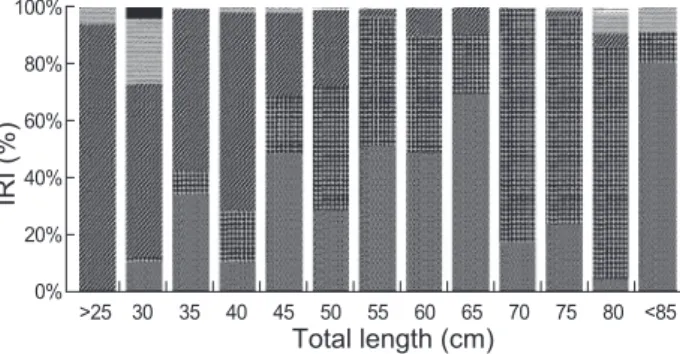
벌레문치전장(25 cm미만-80 cm이상)을 13개계급으로구분 하여위내용물의먹이생물을관찰한결과, 16-40 cm의소형군 에서절지동물이 상대중요성지수에서 56.8-94.0% 범위로우 점하였으며, 전장이 작을수록 단각류와 난바다곤쟁이류(Eu-
phausiacea sp.)를 섭식하고 전장이커지면서 진흙새우를 주
로섭식하는것으로나타났다. 전장 41-65 cm에서주요먹이생 물은어류와연체동물로서어류는상대중요성지수에서 28.9- 69.7%의범위를보였는데, 전장 41-55 cm에서는큰눈등가시 치(Anisarchus macrops), 점줄횟대(Cottiusculus schmidti), 멸 치(Engraulis japonicus) 등과같이크기가작은개체들을섭식 하였고 전장 56-65 cm에서는청자갈치와 줄가시횟대(Icelus cataphractus)와같이크기가큰개체들을주로섭식하였다. 연 체동물은상대중요성지수에서 20.3-45.4%의범위를보였는데, 41-55 cmm 전장에서는매오징어(Watasenia scintillans)와살 오징어(Todarodes pacificus) 등을주로섭식하였고, 56-65 cm 전장에서는매오징어와함께눈큰낙지(Octopus megalops)와 대문어(Octopus dofleini)를 주로섭식하는것으로나타났다. 66-80 cm체급의대형군에서는 갈고리흰오징어(Berryteuthis magister)와매오징어등의두족류가 72.7-81.6%로서주류를
이루었고 81-96 cm의초대형군에서는미확인된어류가 80.5%
로대부분을차지하고있었다(Fig. 3).
전장별 먹이생물의 생태지수
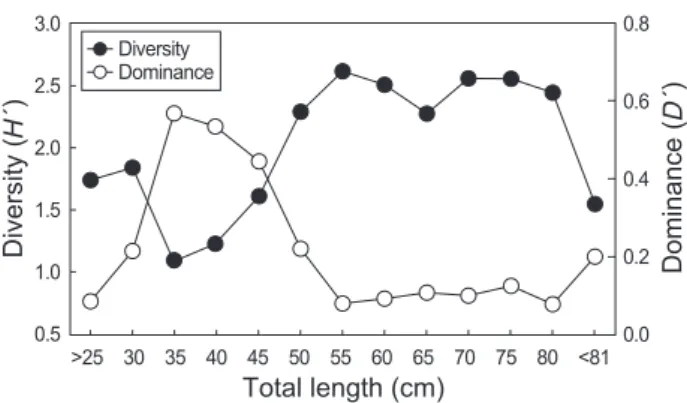
벌레문치가섭이한먹이생물의종수와개체수에대한종다양 도와종우점도를전장별로분석한결과, 종다양도는 51-55 cm 에서 2.61로가장높았으며 66-70 cm와 71-75 cm 전장군에서 각각 2.55와 2.54로다른전장군에비해비교적높게나타났다. 반면, 31-35 cm, 36-40 cm, 41-45 cm 전장군에서는각각 1.09, 1.22, 1.60으로나타나 51 cm이상의전장군에비해종다양도가 낮은값으로나타났다.
Fig. 2. Frequency on total individual numbers and wet weight of the prey organisms of Lycodes tanakae in the coastal waters of middle East Sea.
Fig. 3. Variation of diet composition (%IRI) of Lycodes tanakae according to total length class in the coastal waters of middle East Sea.
0 20 40 60 80
Echinodermata Others Sipunculida Pisces Mollusca Arthropoda Annelida
Frequency(%)
Prey Organisms
Weight Number
128°30´ 129°00´ 129°30´ 130°00´
128°30´E 129°00´E 129°30´E 130°00´E36°30´N 37°00´N 37°30´N 38°00´N
36°30´
37°00´
37°30´
38°00´
Gangneung
Donghae Samcheok
Jukbyun
Ssampling area
Hupo Gangwon
Gyeongbuk
East Sea
>25 30 100%
80%
60%
40%
20%
0%
3.0 0.8
0.6 0.4 0.2 0.0 Diversity
Dominance 2.5
2.0 1.5 1.0 0.5
35 40 45 50 55 60 65 70 75 80 <85
>25 30 35 40 45 50 55 60 65
81~96
76~80 61~65 66~70
71~75
56~60 46~50 51~55 41~45
36~40 31~35
26~30 16~25
70
Stress: 0.1
Stress: 0.11
81~96 76~80 71~75 66~70 61~65 51~55 56~60 46~50 41~45 36~40 31~35 26~30 16~25
0 20 40 60 80 100
75 80 <81
Total length (cm)
Total length (cm)
Similarity
IRI (%)Diversity ( )H´ Dominance ( )D´
3.0
0.8 1.0
0.6 0.4 0.2 0.0 Diversity
Dominance 2.5
2.0 1.5 1.0 0.5
Diversity ( )H´ Dominance ( )D´
Jan Feb 100%
80%
60%
40%
20%
0% Mar Apr May Jun Jul Aug Sep Oct Nov Dec
Jan. Feb. Mar. Apr. May. Jun. Jul. Aug. Sep. Oct. Nov. Dec.
Month
Month
GSI MSI
GI SCI
200 0.8
1.0
0.6 0.4 0.2 0.0 Male
150 250
100 50 0
IRI (%)
Pisces Mollusca Arthropoda Annelida Echinodermata Sipunculida Other
Dec.
Feb. Jan.
Mar.
Apr. May.
Jun.
Jul.
Sep. Aug. Oct.
Nov.
Pisces Mollusca Arthropoda Annelida Echinodermata Sipunculida Other
0 20 40 60 80
Echinodermata Others Sipunculida Pisces Mollusca Arthropoda Annelida
Frequency(%)
Prey Organisms
Weight Number
128°30´ 129°00´ 129°30´ 130°00´
128°30´E 129°00´E 129°30´E 130°00´E36°30´N 37°00´N 37°30´N 38°00´N
36°30´
37°00´
37°30´
38°00´
Gangneung
Donghae Samcheok
Jukbyun
Ssampling area
Hupo Gangwon
Gyeongbuk
East Sea
>25 30 100%
80%
60%
40%
20%
0%
3.0 0.8
0.6 0.4 0.2 0.0 Diversity
Dominance 2.5
2.0 1.5 1.0 0.5
35 40 45 50 55 60 65 70 75 80 <85
>25 30 35 40 45 50 55 60 65
81~96
76~80 61~65 66~70
71~75
56~60 46~50 51~55 41~45
36~40 31~35
26~30 16~25
70
Stress: 0.1
Stress: 0.11
81~96 76~80 71~75 66~70 61~65 51~55 56~60 46~50 41~45 36~40 31~35 26~30 16~25
0 20 40 60 80 100
75 80 <81
Total length (cm)
Total length (cm)
Similarity
IRI (%)Diversity ( )H´ Dominance ( )D´
3.0
0.8 1.0
0.6 0.4 0.2 0.0 Diversity
Dominance 2.5
2.0 1.5 1.0 0.5
Diversity ( )H´ Dominance ( )D´
Jan Feb 100%
80%
60%
40%
20%
0% Mar Apr May Jun Jul Aug Sep Oct Nov Dec
Jan. Feb. Mar. Apr. May. Jun. Jul. Aug. Sep. Oct. Nov. Dec.
Month
Month
200 0.8
1.0
0.6 0.4 0.2 0.0 GSI
Female
MSI
150 250
100 50 0
GIGI SCISCI
200 0.8
1.0
0.6 0.4 0.2 0.0 Male
150 250
100 50 0
Jan. Feb. Mar. Apr. May. Jun. Jul. Aug. Sep. Oct. Nov. Dec.
Month
IRI (%)
Pisces Mollusca Arthropoda Annelida Echinodermata Sipunculida Other
Dec.
Feb. Jan.
Mar.
Apr. May.
Jun.
Jul.
Sep. Aug. Oct.
Nov.
Pisces Mollusca Arthropoda Annelida Echinodermata Sipunculida Other
최영민ㆍ윤병선ㆍ김효선ㆍ박정호ㆍ박기영ㆍ이재봉ㆍ양재형ㆍ손명호 846
종우점도는 31-35 cm에서 0.57로가장높았고 36-40 cm, 41- 45 cm의전장군에서각각 0.53과 0.44로다른전장군에비해 비교적높았다. 반면, 51-80 cm의전장범위에서는 0.10-0.13 의낮은우점도를보였으며종우점도는종다양도의변동과는 대체적으로반대경향을보였다(Fig. 4).
전장별 먹이생물의 유사성 분석
벌레문치의크기에따른먹이생물조성의유사성을파악하기 위해 13개의크기군에대한군집분석을실시한결과 4개의그 룹(Ⅰ: 16-40 cm, Ⅱ : 41-65 cm, Ⅲ : 66-80 cm, Ⅳ : 81-96 cm) 으로구분되었다. 그룹Ⅰ에서가장많이섭이한먹이는절지동 물로상대중요성지수에서평균 70.2%를차지하였는데그중에 서단각류(35.9%)와진흙새우(17.0%)가가장중요한먹이원으 로나타났다. 그룹Ⅱ의주요먹이생물은어류와연체동물로각 각평균 37.4%와 34.1%를차지하였는데, 어류중에서는청자 갈치(13.6%)와멸치(7.3%)가주로나타났고, 연체동물중에서 는매오징어(16.8%)와대문어(6.6%)가주로관찰되었다. 그룹
Ⅲ에서주요먹이생물은연체동물이평균 78.6%를차지할정 도로극우점하는경향을보였는데이중에서갈고리흰오징어 (45.7%)와매오징어(21.2%)를주로섭식하는것으로나타났으 며, 그룹Ⅳ에서주요먹이생물은어류로상대먹이중요성지수 에서 80.5%를차지하였다(Fig. 5). 벌레문치의성숙체장은 60 cm 이상으로전장별먹이생물의유사성은성숙체장보다작은 개체들에서는절지동물이나크기가작은연체동물과어류를주 로섭이하였고성숙체장이상의개체들은크기가큰연체동물 과어류를주로섭식하는것으로나타났다
월별 위내용물 조성의 변화
벌레문치의월별위내용물조성의상대중요성지수변화를살 펴보면, 1월에는어류가 88.3%의높은비율을차지하였고 2월 부터 4월까지는절지동물이각각 86.3%, 64.6%, 58.3%의비율
을차지하였는데주로단각류와진흙새우를섭이하였다. 5월에 는절지동물의비율이감소한반면, 연체동물의비율이 83.9%
로높게차지하였고주로매오징어를섭이하였다. 6월에는어 류와함께연체동물의비율이각각 51.6%와 35.7%를차지하 며중요한먹이생물로나타났으며, 7월부터 9월까지는연체동 물이각각 92.1%, 84.5%, 57.1%의높은비율을차지하였고갈 고리흰오징어와매오징어, 살오징어를주로섭이하였다. 10월 부터는연체동물의비율이감소하기시작하고어류가 92.1%
의높은비율을차지하였으며주로청자갈치를섭이하였다. 11 월과 12월에도어류가각각 64.6%와 83.2%의비율을차지하 였고먹갈치(Lycodes nakamurai)를주로섭이하였다(Fig. 6).
월별 먹이생물의 생태지수
먹이생물의종수와개체수를바탕으로먹이생물의종다양도 와종우점도를월별로분석한결과, 종다양도는가을철인 9월과 11월에각각 2.68과 2.65로가장높게나타났다. 9월에출현한 종수는총 23종으로어류와연체동물을주로섭식하는것으로 Fig. 4. Variation of diversity (H') and dominance (D') on the
stomach contents of Lycodes tanakae according to total length in the coastal waters of middle East Sea.
Fig. 5. Dendrogram of cluster analysis and non-metric multidimensional scaling ordination plot by similarity of diets and total length classes of Lycodes tanakae.
Fig. 6. Variation of diet composition (%IRI) of Lycodes tanakae according to month in the coastal waters of middle East Sea.
0 20 40 60 80
Echinodermata Others Sipunculida Pisces Mollusca Arthropoda Annelida
Frequency(%)
Prey Organisms
Weight Number
128°30´ 129°00´ 129°30´ 130°00´
128°30´E 129°00´E 129°30´E 130°00´E36°30´N 37°00´N 37°30´N 38°00´N
36°30´
37°00´
37°30´
38°00´
Gangneung
Donghae Samcheok
Jukbyun
Ssampling area
Hupo Gangwon
Gyeongbuk
East Sea
>25 30 100%
80%
60%
40%
20%
0%
3.0 0.8
0.6 0.4 0.2 0.0 Diversity
Dominance 2.5
2.0 1.5 1.0 0.5
35 40 45 50 55 60 65 70 75 80 <85
>25 30 35 40 45 50 55 60 65
81~96
76~80 61~65 66~70
71~75
56~60 46~50 51~55 41~45
36~40 31~35
26~30 16~25
70
Stress: 0.1
Stress: 0.11
81~96 76~80 71~75 66~70 61~65 51~55 56~60 46~50 41~45 36~40 31~35 26~30 16~25
0 20 40 60 80 100
75 80 <81
Total length (cm)
Total length (cm)
Similarity
IRI (%)Diversity ( )H´ Dominance ( )D´
3.0
0.8 1.0
0.6 0.4 0.2 0.0 Diversity
Dominance 2.5
2.0 1.5 1.0 0.5
Diversity ( )H´ Dominance ( )D´
Jan Feb 100%
80%
60%
40%
20%
0% Mar Apr May Jun Jul Aug Sep Oct Nov Dec
Jan. Feb. Mar. Apr. May. Jun. Jul. Aug. Sep. Oct. Nov. Dec.
Month
Month
200 0.8
1.0
0.6 0.4 0.2 0.0 GSI
Female
MSI
150 250
100 50 0
GIGI SCISCI
200 0.8
1.0
0.6 0.4 0.2 0.0 Male
150 250
100 50 0
Jan. Feb. Mar. Apr. May. Jun. Jul. Aug. Sep. Oct. Nov. Dec.
Month
IRI (%)
Pisces Mollusca Arthropoda Annelida Echinodermata Sipunculida Other
Dec.
Feb. Jan.
Mar.
Apr. May.
Jun.
Jul.
Sep. Aug. Oct.
Nov.
Pisces Mollusca Arthropoda Annelida Echinodermata Sipunculida Other
0 20 40 60 80
Echinodermata Others Sipunculida Pisces Mollusca Arthropoda Annelida
Frequency(%)
Prey Organisms
Weight Number
128°30´E 129°00´E 129°30´E 130°00´E36°30´N 36°30´
Hupo
>25 30 100%
80%
60%
40%
20%
0%
3.0 0.8
0.6 0.4 0.2 0.0 Diversity
Dominance 2.5
2.0 1.5 1.0 0.5
35 40 45 50 55 60 65 70 75 80 <85
>25 30 35 40 45 50 55 60 65
81~96
76~80 61~65 66~70
71~75
56~60 46~50 51~55 41~45
36~40 31~35
26~30 16~25
70
Stress: 0.1
Stress: 0.11
81~96 76~80 71~75 66~70 61~65 51~55 56~60 46~50 41~45 36~40 31~35 26~30 16~25
0 20 40 60 80 100
75 80 <81
Total length (cm)
Total length (cm)
Similarity
IRI (%)Diversity ( )H´ Dominance ( )D´
3.0
0.8 1.0
0.6 0.4 0.2 0.0 Diversity
Dominance 2.5
2.0 1.5 1.0 0.5
Diversity ( )H´ Dominance ( )D´
Jan Feb 100%
80%
60%
40%
20%
0% Mar Apr May Jun Jul Aug Sep Oct Nov Dec
Jan. Feb. Mar. Apr. May. Jun. Jul. Aug. Sep. Oct. Nov. Dec.
Month
Month
200 0.8
1.0
0.6 0.4 0.2 0.0 GSI
Female
MSI
150 250
100 50 0
GIGI SCISCI
200 0.8
1.0
0.6 0.4 0.2 0.0 Male
150 250
100 50 0
Jan. Feb. Mar. Apr. May. Jun. Jul. Aug. Sep. Oct. Nov. Dec.
Month
IRI (%)
Pisces Mollusca Arthropoda Annelida Echinodermata Sipunculida Other
Dec.
Feb. Jan.
Mar.
Apr. May.
Jun.
Jul.
Sep. Aug. Oct.
Nov.
Pisces Mollusca Arthropoda Annelida Echinodermata Sipunculida Other 0
20 40 60 80
Echinodermata Others Sipunculida Pisces Mollusca Arthropoda Annelida
Frequency(%)
Prey Organisms
Weight Number
128°30´E 129°00´E 129°30´E 130°00´E36°30´N 37°00´N
36°30´
37°00´ Jukbyun
Hupo Gyeongbuk
East Sea
>25 30 100%
80%
60%
40%
20%
0%
3.0 0.8
0.6 0.4 0.2 0.0 Diversity
Dominance 2.5
2.0 1.5 1.0 0.5
35 40 45 50 55 60 65 70 75 80 <85
>25 30 35 40 45 50 55 60 65
81~96
76~80 61~65 66~70
71~75
56~60 46~50 51~55 41~45
36~40 31~35
26~30 16~25
70
Stress: 0.1
Stress: 0.11
81~96 76~80 71~75 66~70 61~65 51~55 56~60 46~50 41~45 36~40 31~35 26~30 16~25
0 20 40 60 80 100
75 80 <81
Total length (cm)
Total length (cm)
Similarity
IRI (%)Diversity ( )H´ Dominance ( )D´
3.0
0.8 1.0
0.6 0.4 0.2 0.0 Diversity
Dominance 2.5
2.0 1.5 1.0 0.5
Diversity ( )H´ Dominance ( )D´
Jan Feb 100%
80%
60%
40%
20%
0% Mar Apr May Jun Jul Aug Sep Oct Nov Dec
Jan. Feb. Mar. Apr. May. Jun. Jul. Aug. Sep. Oct. Nov. Dec.
Month
Month
200 0.8
1.0
0.6 0.4 0.2 0.0 GSI
Female
MSI
150 250
100 50 0
GIGI SCISCI
200 0.8
1.0
0.6 0.4 0.2 0.0 Male
150 250
100 50 0
Jan. Feb. Mar. Apr. May. Jun. Jul. Aug. Sep. Oct. Nov. Dec.
Month
IRI (%)
Pisces Mollusca Arthropoda Annelida Echinodermata Sipunculida Other
Dec.
Feb. Jan.
Mar.
Apr. May.
Jun.
Jul.
Sep. Aug. Oct.
Nov.
Pisces Mollusca Arthropoda Annelida Echinodermata Sipunculida Other