서 론
참홍어(Beringraja pulchra)는 홍어목(Rajiformes) 홍어과 (Rajidae)에 속하는 어류로, 우리나라를 비롯한 오호츠크해, 동 중국해 등에 분포한다(Kim et al., 2005). 홍어과 어류는 전 세 계에 8속 88여 종(Nelson et al., 2016), 국내에 5속 11종이 서식 하는 것으로 알려져 있다(NIBR, 2011). 우리나라의 참홍어는 주로 서해안에 서식하고, 근해연승, 쌍끌이기선저인망, 안강망, 자망 등에 의해 어획되고 있으며, 연간 산란량이 적고 부화기 간이 5개월 이상으로 길어 자원으로 가입하는 기간이 긴 어종 으로 알려져 있다(Jo et al., 2010). 서해 연근해에서 어획되고 있는 참홍어의 생산량은 1990년대 중반까지 2,000∼3,000M/T 수준이었으나, 이후 급감하여 200∼500M/T 수준으로 극히 낮 은 어획을 보여 자원관리가 절실히 필요하게 됨에 따라 2007년 부터 참홍어가 자원회복 관리대상종으로 지정되었고(NFRDI,
2009), 국제적으로도 보호 어종으로 보호되어 세계자원보전 연맹(IUCN)의 적색목록에 “Vulnerable” 단계로 등록되어 있다 (https://www.iucnredlist.org).
참홍어는 식용으로 가장 널리 이용되는 종으로 코를 자극하 는 암모니아 향과 톡 쏘는 맛으로 주로 서해와 남해에서 상업 적으로 많이 판매되고 있다. 예로부터 우리나라에서는 참홍어 를 흑산도와 영산포를 중심으로 하는 남도지방에서 회와 삼합, 찜, 탕, 무침 등의 다양한 요리로 즐겨 왔다(Yoon, 2008). 참홍 어는 호남지역에서 기호성이 높은 토속음식으로 간주되어 왔 으나 그 독특한 맛과 특유의 풍미로 최근 전국적으로 선호되 고 있는 대표적인 고급 식품 중의 하나로 자리를 잡고 있다 (Park, 2009).
이와 같이 우리나라 서해안에서 기호식품으로 이용되는 참홍 어는 수산자원으로서의 경제성이 매우 높은 어종이지만 생태학 적 연구는 미비한 실정이다. 참홍어의 생태에 관한 연구로는 한국산 홍어류 어류의 분류학적 연구(Jeong, 1999), 성숙과 산란 (Yeon et al., 1997), 난각 특징과 자어의 형태(Jo et al., 2010), 어 획 특성(Jo et al., 2011), 산란 특성과 인공부화(Kang et al., 2013),
—232 — http://www.fishkorea.or.kr
* Corresponding author: Maeng Jin Kim Tel: 82-32-745-0617, Fax: 82-32-745-0569, E-mail: [email protected] ISSN: 1225-8598(Print), 2288-3371(Online)
Accepted: December 27, 2018
인천 연안에 출현하는 참홍어 (Beringraja pulchra)의 식성
정경숙·박 준·손명호·이형빈·한송헌·조현수1·김맹진*
국립수산과학원 서해수산연구소 자원환경과, 1군산대학교 해양과학대학 해양생산시스템전공
Feeding Habits of the Mottled Skate, Beringraja pulchra in the Coastal Waters of Incheon, Korea by Gyeong-Suk Jeong, Jun Park, Myoung-Ho Sohn, Hyungbeen Lee, Song-Hun Han, Hyun-Su Jo1 and Maeng Jin Kim*(Fisheries Resources and Environment Division, West Sea Fisheries Research Institute, National Institute of Fisheries Science, Incheon 22383, Republic of Korea; 1Major of Marine Production System, College of Ocean Science and Technology, Kunsan National University, Gunsan 54150, Republic of Korea)
ABSTRACT The feeding habits of Beringraja pulchra were studied using 203 specimens collected from February 2017 to March 2018 in the coastal waters of Incheon, Korea. The size of B. pulchra ranged from 31.1 to 77.7cm in disc width(DW) and the stomachs of 16 specimens were empty. B.
pulchra was a carnivore that mainly consumed fishes and shrimps, but also ate various benthic crustaceans and other invertebrates with small amounts. The main prey items in the diets of shrimps and fishes were Crangon hakodatei and Ammodytes personatus, respectively. The proportion of fishes in prey items increased with size-related while that of shrimps decreased. With increasing disc width of B. pulchra, the mean number of preys per stomach(mN/ST) and the mean weight of preys per stomach(mW/ST) were increased.
Key words: Feeding habits, Beringraja pulchra, mottled skate, Incheon
지리적 분포 특성과 어획량 변동(Jang et al., 2014), 표지방류조 사에 의한 이동 및 성장률(Im and Jo, 2015) 등이 있다. 현재까 지 우리나라에서 채집된 다양한 어류의 섭식특성에 대한 연구 는 부유성 어류뿐만 아니라 저서성 어류를 포함하여 수행되고 있고(Nam et al., 2013; Jeong et al., 2015), 이러한 결과는 서식 생물 상호간의 영양단계 및 서식 종에 대해서 어느 정도 이해 할 수 있다. 그러나 서해 대표 어종인 참홍어의 식성에 대한 연 구는 Yeon et al.(1999)의 연구를 제외하고 지금까지 우리나라 에서 보고가 없는 실정이다.
따라서 이 연구에서는 인천 연안에 서식하고 있는 참홍어의 위내용물 분석을 통하여 주요 먹이생물을 알아보고 성장에 따 른 먹이생물 조성의 차이를 파악하여 향후 참홍어 자원회복을 위한 관리방안 마련의 기초 자료를 제공하고자 한다.
재료 및 방법
이 연구에 사용된 참홍어는 2017년 2월부터 2018월 3월까지 인천 주변해역에서 쌍끌이기선저인망(bottom pair trawl) 및 안 강망(stow net)에 의해 어획된 개체를 이용하여 분석하였다. 그 러나 여름시기인 6~8월에는 참홍어가 채집이 안 되었는데, 이 시기에는 참홍어 금어기가 포함되어있고, 쌍끌이저인망어업이 조업을 안 해서 시료 채집을 못하였다.
채집된 참홍어의 체반폭(disc width)은 31.1∼77.7cm(평균 56.4cm), 체중은 474.2∼9,830.0g(평균 3,345.7g)의 범위를 보 였다(Fig. 1). 시료는 실험실로 옮겨 개체별로 체반폭(disc width) 을 0.1cm와 체중(body weight)을 0.1g 단위로 측정한 뒤, 어 체에서 위를 분리하여, 위내용물을 분석하였다. 위내용물은 NFRDI(2001), Kim et al.(2005), Hong et al.(2006) 등을 참고 하여 가능한 종 수준까지 동정한 후, 섭식된 먹이 생물의 중요 도를 파악하기 위하여 동정된 먹이생물들의 출현개체를 계수 하고, 습중량을 정밀저울을 이용하여 0.01g 단위까지 측정하였
다. 참홍어 203개체의 위내용물 분석한 결과, 16개체(공복률 7.9%)는 위 내용물이 없었다. 위내용물이 발견된 187개체는 다음과 같은 식을 이용하여 각 먹이 생물의 출현빈도(%F), 개 체수(%N) 그리고 습중량비(%W)를 구하였다.
%F=Ai/Atotal×100
%N=Ni/Ntotal×100
%W=Wi/Wtotal×100
여기서, Ai는 위 내용물 중 해당 먹이생물이 발견된 참홍어의 개체수이고, N은 먹이를 섭식한 참홍어의 총 개체수, Ni(Wi)는 해당먹이생물의 개체수(습중량), Ntotal(Wtotal)은 전체먹이개체 수(습중량)이다.
구해진 값들을 이용하여 Pinkas et al.(1971)의 식에 따라 참 홍어가 섭식한 먹이생물의 상대중요성지수(index of relative importance, IRI)를 구하였고, 백분율로 환산하여 상대중요성 지수비(%IRI)로 나타내어 섭식된 먹이의 상대적 중요성을 표 현하였다.
IRI=(%N+%W)×%F
체장별 먹이조성의 변화를 파악하기 위하여 참홍어 시료를 가장 작은 개체와 큰 개체를 고려하여 4개의 체장군별로 각각 구분하여 먹이생물의 위내용물 조성을 파악하였고, 유사성 분 석(analysis of similarity, ANOSIM)을 실시하여 유의성 검정하 였다.
또한 먹이섭식 특성을 파악하기 위해 크기별 개체당 먹이의 평균 개체수(mean number of preys per stomach, mN/ST)와 개 체당 먹이의 평균 중량(mean weight of preys per stomach, mW/ST)을 구하였고(Chung et al., 2014), 분산분석(analysis of variance, ANOVA)을 이용하여 유의성을 검정하였다.
결 과
1. 위내용물의 조성
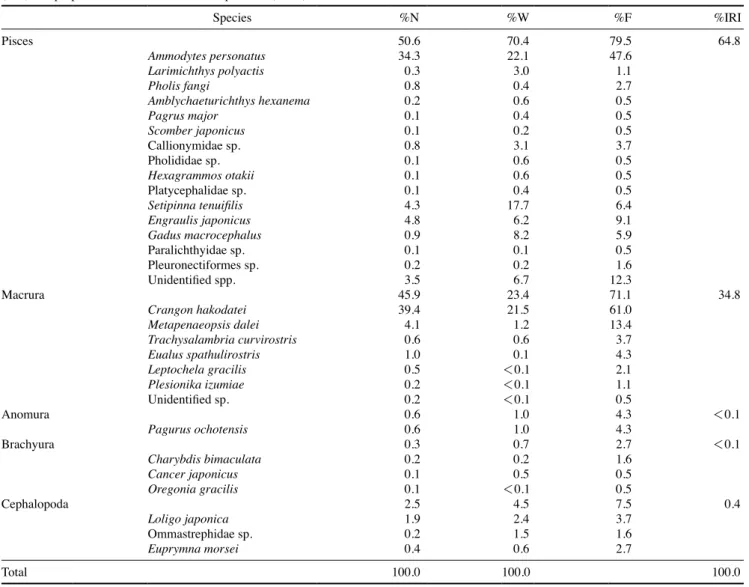
먹이를 섭식한 187개체의 위내용물을 분석 결과, 5개 분류 군 28종의 먹이생물이 출현하였다(Table 1). 참홍어의 가장 중 요한 먹이생물은 출현빈도 79.5%, 개체수비 50.6%, 습중량비 70.4%, 상대중요성지수비 64.8%를 차지하는 어류(Pisces)였 다. 어류 중에서도 까나리(Ammodytes personatus)가 개체수비 34.3%, 습중량비 22.1%로 가장 중요한 먹이생물이었다. 그 다 음으로 반지(Setipinna tenuifilis), 대구(Gadus macrcephalus), 멸치(Engraulis japonicus) 순으로 많이 섭식하였다. 어류 다 음으로 중요한 먹이생물은 출현빈도 71.1%, 개체수비 45.9%, 습중량비 23.4%, 상대중요성지수비 34.8%를 차지하는 새우 Fig. 1. Length-frequency distribution of Beringraja pulchra collected
in coastal waters of Incheon, Korea.
No. of individuals
Disc width(cm)
류(Macrura)였다. 새우류 중에서는 마루자주새우(Crangon hakodatei)가 습중량비 21.5%로 가장 중요한 먹이생물이었다.
그 다음으로 산모양깔깔새우(Metapenaeopsis dalei), 꽃새우 (Trachysalambria curvirostris) 순으로 많이 섭식하였다. 그 외 두족류(Cephalopoda), 집게류(Anomura), 게류(Brachyura)가 출현하였으나 상대중요성지수비 0.4% 이하로 그 양은 많지 않았다. 따라서 참홍어는 어류와 새우류를 주로 섭식하는 것 을 알 수 있다.
2. 성장에 따른 먹이조성의 변화
참홍어의 성장에 따른 먹이조성 변화를 파악하기 위하여 참 홍어 시료를 4개의 크기군으로 구분하여 위 내용물을 조사하였 다(Fig. 2). 가장 작은 크기군인 50cm 이하의 크기군에서 상대 중요성지수비가 가장 높은 것은 61.5%를 차지한 어류였고, 그
다음으로 38.2%를 차지한 새우류였다. 그 다음으로 50cm 이상 60cm 미만의 크기군에서는 새우류의 상대중요성지수가 36.3%
로 감소하였으며, 어류는 61.3%으로 유사하였다. 60cm 이상 Table 1. Diet composition of the stomach contents of Beringraja pulchra by percentage of prey frequency(%N), prey number(%N), prey weight (%N) and proportion of index of relative importance(%IRI)
Species %N %W %F %IRI
Pisces 50.6 70.4 79.5 64.8
Ammodytes personatus 34.3 22.1 47.6
Larimichthys polyactis 0.3 3.0 1.1
Pholis fangi 0.8 0.4 2.7
Amblychaeturichthys hexanema 0.2 0.6 0.5
Pagrus major 0.1 0.4 0.5
Scomber japonicus 0.1 0.2 0.5
Callionymidae sp. 0.8 3.1 3.7
Pholididae sp. 0.1 0.6 0.5
Hexagrammos otakii 0.1 0.6 0.5
Platycephalidae sp. 0.1 0.4 0.5
Setipinna tenuifilis 4.3 17.7 6.4
Engraulis japonicus 4.8 6.2 9.1
Gadus macrocephalus 0.9 8.2 5.9
Paralichthyidae sp. 0.1 0.1 0.5
Pleuronectiformes sp. 0.2 0.2 1.6
Unidentified spp. 3.5 6.7 12.3
Macrura 45.9 23.4 71.1 34.8
Crangon hakodatei 39.4 21.5 61.0
Metapenaeopsis dalei 4.1 1.2 13.4
Trachysalambria curvirostris 0.6 0.6 3.7
Eualus spathulirostris 1.0 0.1 4.3
Leptochela gracilis 0.5 <0.1 2.1
Plesionika izumiae 0.2 <0.1 1.1
Unidentified sp. 0.2 <0.1 0.5
Anomura 0.6 1.0 4.3 <0.1
Pagurus ochotensis 0.6 1.0 4.3
Brachyura 0.3 0.7 2.7 <0.1
Charybdis bimaculata 0.2 0.2 1.6
Cancer japonicus 0.1 0.5 0.5
Oregonia gracilis 0.1 <0.1 0.5
Cephalopoda 2.5 4.5 7.5 0.4
Loligo japonica 1.9 2.4 3.7
Ommastrephidae sp. 0.2 1.5 1.6
Euprymna morsei 0.4 0.6 2.7
Total 100.0 100.0 100.0
Fig. 2. Ontogenetic changes in composition of Beringraja pulchra di- ets based on %IRI(index of relative importance) among size classes.
Percentage of IRI
Disc length(cm)
70cm 미만의 크기군에서는 어류의 비율이 74.4%로 증가하였 으며, 새우류가 27.4%로 감소하였다. 70cm 이상의 크기군에 서는 어류가 88.2%의 상대중요성지수비로 확인할 수 있었으 며, 새우류는 11.6%로 지속적으로 감소하였다. 따라서 작은 크 기 때에는 새유류의 비율이 높았으며 크기가 커질수록 섭식된 먹이생물 중 어류가 차지하는 상대중요성지수비는 점점 높아 지는 경향을 보였다(ANOSIM, p<0.05). 그 이외 먹이생물인 두족류, 게류, 집게류에서는 성장에 따른 뚜렷한 섭식 경향을 보 이지 않았다. 또한 크기군별 개체당 개체수 및 습중량를 조사 한 결과, 참홍어가 성장함에 따라 개체당 평균 개체수는 70cm 이하까지는 지속적으로 증가하다가 이후 감소하였고 평균 중 량은 성장함에 따라 지속적으로 증가하였다(ANOVA, p<0.05) (Fig. 3).
고 찰
많은 연구자들은 홍어류의 식성에 대한 연구를 수행한 바 있 다. Jeong et al. (2015)은 가덕도 주변해역에서 서식하는 홍어 가 새우류를 주요 먹이생물로 보고하였고, 동해의 북부 러시아 해역에 출현하는 참홍어는 십각류와 어류를 섭식하는 것으로 보고되었으며(Antonenko et al., 2011), 캘리포니아 중부 해역에 서식하는 Raja rhina는 어류와 새우류를 주로 섭식하였다(Rob- inson et al., 2007). 지중해 중서부에 서식하는 Raja brachyura 와 Raja miraletus는 주로 갑각류와 어류를 섭식하는 것으로 보 고하였다(Follesa et al., 2010). 이 연구에서 참홍어는 어류와 새우류를 주로 섭식하는 것으로 나타나 앞에 보고된 홍어류의 연구결과와 유사한 섭이특성을 나타냈으며, 이 연구결과를 볼 때, 참홍어는 저서 육식성어류(bottom carnivorous fish)임을 알 수 있었다.
이 연구에서 개체수 기준으로 참홍어의 가장 중요한 먹이생 물은 마루자주새우로 나타났다. 마루자주새우는 우리나라 전
해역에 널리 분포하고 인천 및 충남해역에 우점하는 어종으로 알려져 있다(Song et al., 2008; Kim et al., 2013). 하지만 이전 연구에서 참홍어의 가장 중요한 먹이 생물은 자주새우로 이 연 구와는 차이를 보였다(Yeong et al., 1999). 이는 형태적으로 매 우 유사하여 마루자주새우가 자주새우로 오동정된 결과로 생 각된다. 또한 마루자주새우를 포함한 자주새우류는 가덕도 (Jeong et al., 2015), 서해(Hong et al., 2000) 및 태안(Baeck et al., 2011)에서 서식하는 저서성 어류인 홍어의 가장 중요한 먹 이생물로 알려져 있다.
이 연구에서 마루자주새우로 다음으로 까나리가 두 번째로 참홍어의 중요한 먹이생물로 나타났다. 까나리는 냉수성 어종 으로 인천연안에 넓게 분포하고 저층에 서식하는 특성(Kim et al., 1994; Song et al., 2008) 때문에 참홍어가 까나리를 주로 섭식하는 것으로 생각되며, 이전 연구에서도 자주새우, 꽃새우 다음으로 세 번째로 중요한 먹이생물로 보고된 바 있다(Yeon et al., 1999). 따라서 인천 주변해역에서 마루자주새우와 까나 리가 풍부하게 출현하여 먹이 포식을 위한 에너지 사용 효율이 높기 때문에 참홍어의 섭식 대상이 된 것으로 판단된다.
참홍어는 성장함에 따라 까나리를 포함한 다양한 어류를 섭 식하였으며, 특히 마루자주새우의 비율은 체장이 커짐에 따라 감소하여 위내용물 조성에 변화를 보였다. 즉 작은 크기군에 서는 새우류의 비율이 높았으나 크기가 증가함에 따라 어류의 비율이 지속적으로 증가하는 경향을 보여 소형 갑각류에서 어 류를 주먹이원으로 전환한 것으로 판단되었다. 이는 성장에 따른 일반적인 먹이생물의 변화로, 주로 섭식되는 먹이의 에 너지 효율과 관련이 있는 것으로 추측된다(Gerking, 1994). 체 장이 증가함에 따라 에너지 효율이 높은 먹이생물로의 전환은 입과 위 크기의 증가, 강한 턱, 유영능력의 향상 등 형태학적 발달로 인한 먹이탐색능력의 향상과 소화능력의 증가 때문인 것으로 판단된다(Robinson et al., 2007). 한편 두족류, 게류 및 집게류 등의 먹이생물에는 성장에 따른 뚜렷한 변화를 보이지 않았다.
참홍어의 개체당 평균 먹이생물의 개체수는 가장 작은 크기 군에서 가장 큰 크기군으로 갈수록 증가하는 양상을 보였으며, 새우류와 같은 소형 먹이생물의 섭식이 줄어들고 어류의 섭식 이 증가하는 60~70cm 크기군부터 크게 증가하였다. 개체당 평 균 먹이생물의 습중량은 지속적으로 증가하는 양상을 보였는 데 이는 성장에 따라 더 많은 먹이생물을 요구하는 일반적인 특징인 것으로 판단되었다. 가덕도 주변해역의 홍어의 경우 크 기가 커짐에 따라 평균 먹이생물의 개체수는 감소하여 본 연 구와 차이를 보였다(Jeong et al., 2015). 이는 참홍어가 일정한 크기에서는 크기와 관계없이 마루자주새우를 주로 섭식하는 특성과 홍어와 달리 대형어종으로 서식 및 생존을 위해 많은 에너지가 필요로 하기 때문으로 생각된다.
Fig. 3. Variation of mean number of preys per stomach(mN/ST) and mean weight of preys per stomach(mW/ST) of Beringraja pulchra among size classes.
mW/ST(g) mN/ST(g)
Disc length(cm)
요 약
인천 주변해역에 출현하는 참홍어의 식성을 분석하기 위해 2017년 2월부터 2018월 3월까지 총 203개체를 채집하였다. 참 홍어의 체반장은 31.1∼77.7cm의 범위였으며, 16개체는 공복 상태였다. 참홍어는 주로 어류와 새우류를 섭식하는 육식성 어 류로 확인되었으며, 그 외 다양한 저서 갑각류와 무척추동물을 소량 섭식하였다. 가장 중요한 먹이생물로 새우류인 마루자주 새우의 섭식비율이 가장 높았고, 어류는 까나리의 섭식비율이 높았다. 참홍어의 체장이 커질수록 새우류의 비율은 감소하였 으며 어류의 비율은 증가하는 경향을 보였다. 또한 성장함에 따 라 평균 먹이생물의 개체수와 중량은 증가하였다.
사 사
이 연구는 국립수산과학원 시험연구사업(R2018029)의 지 원에 의해 수행되었습니다.
REFERENCES
Antonenko, D.V., S.F. Solomatov, A.A. Balanov, S.T. Kim and P.V.
Kalchugin. 2011. Occurrence of skate Raja pulchra(Rajidae, Rajiformes) in Russian waters of the Sea of Japan. J. Ich- thyol., 51: 426-431.
Baeck, G.W., C.I. Park, H.C. Choi, S.H. Huh and J.M. Park. 2011.
Feeding habits of ocellate spot skate, Okamejei kenojei (Müller & Henle, 1841), in coastal waters of Taean, Korea.
J. Appl. Ichtyol., 27: 1079-1085. (in Korean)
Chung, S.W., B.G. Kim, J.H. Kim, M.G. Kim and K.N. Han. 2014.
Feeding ecology of Collichthys lucidus in the Han River es- tuary, Korea. Korean J. Ichthyol., 26: 303-309.(in Korean) Follesa, M.C., A. Mulas, S. Cabiddu, C. Porcu, A.M. Deiana and A.
Cau. 2010. Diet and feeding habits of two skate species, Raja brachyura and Raja miraletus(Chondrichthyes, Rajidae) in Sardinian waters(central-western Mediterranean). Italian J.
Zoology, 77: 53-60.
Gerking, S.D. 1994. Feeding ecology of fish. Academic Press, Sand- iego, U.S.A., p. 416.
Hong, S.H., I.J. Yeon, Y.J. Im, H.J. Hwang, T.S. Ko and Y.C. Park.
2000. Feeding habits of Okamejei kenojei in the Yellow Sea.
Nat’l. Fish. Res. Dev. Inst. Korea, 58: 1-11. (in Korean) Hong, S.Y., K.Y. Park, C.W. Park, C.H. Han, H.L. Suh, S.G. Yun,
C.B. Song, S.G. Jo, H.S. Lim, Y.S. Kang, D.J. Kim, C.W.
Ma, M.H. Son, H.K. Cha, K.B. Kim, S.D. Choi, K.Y. Park, C.W. Oh, D.N. Kim, H.S. Shon, J.N. Kim, J.H. Choi, M.N.
Kim and I.Y. Choi. 2006. Marine Invertebrates in Korean Coasts. Academy Publishing Co. Inc., Seoul, pp. 302-409.
Hwang, S.D. 1998. Diel and seasonal variations in species composi- tion of fishery resources collected by a bag net off Kongun- san-gundo. Korean J. Ichthyol., 10: 155-163. (in Korean) Im, Y.J. and H.S. Jo. 2015. Migration and growth rate of mottled
skate, Beringraja pulchra by the tagging release program in the Yellow Sea, Korea. J. Kor. Soc. Fish. Technol., 51: 227- 234. (in Korean)
Jang, M.H., H.S. Jo, D.H. Kwon, B.Y. Cha, J.H. Hwang, K.N. Han and Y.J. Im. 2014. Geographical distribution and catch fluc- tuations of mottled skate, Beringraja pulchra in the eastern Yellow Sea. Korean J. Ichthyol., 26: 295-302. (in Korean) Jeong, C.H. 1999. A review of taxonomic studies and common names
of Rajid fishes(Elasmobranchii, Rajidae) from Korea. Kore- an J. Ichthyol., 11: 198-210. (in Korean)
Jeong, J.M., H.J. Kim, G.W. Baeck, S.J. Ye and S.H. Huh. 2015.
Feeding habits of ocellate spot skate, Okamejei kenojei in the coastal waters of Gadoek-do, Korea. J. Kor. Soc. Fish.
Technol., 51: 265-271. (in Korean)
Jo, H.S., E.J. Kang, Y.R. Cho, H.C. Seo, Y.J. Im and H.J. Hwang.
2010. Characteristics of multi-embryo egg capsule and lar- vae of mottled skate Raja pulchra from Korea. Korean J.
Ichthyol., 22: 217-224.(in Korean)
Jo, H.S., H.J. Hwang, D.H. Kwon, G.S. Jeong, K.H. Choi, B.Y. Cha and Y.J. Im. 2011. Fishing characters of skate ray, Raja pul- chra by the offshore longline fishery in Heuksan-do, Korea.
J. Kor. Soc. Fish. Tech., 47: 403-410. (in Korean)
Jo, H.S., K.H. Kim, M.J. Kim, H.J. Kim, D.H. Kwon, Y.J. Im, M.S.
Heu and J.S. Kim. 2013. A comparison of the taste and nutri- tional properties of domestic mottled skate Beringraja pul- chra according to the area caught, sex and weight. Korean J.
Fish. Aquat. Sci., 46: 129-138. (in Korean)
Kang, H.W., Y.R. Jo, D.Y. Kang, G.S. Jeong and H.S. Jo. 2013.
Spawning characteristics and artificial hatching of female mottled skate, Beringraja pulchra in the west coast of Ko- rea. Dev. Reprod., 17: 247-255.
Kim, I.S., Y. Choi, C.R. Lee, Y.J. Lee, B.J. Kim and J.H. Kim. 2005.
Illustrated Book of Korean Fishes. Kyo-Hak Publishing Co.
Ltd., Seoul, p. 74.(in Korean)
Kim, U.K., Y.M. Kim and Y.S. Kim. 1994. Commercial Fishes of the Coastal and Offshore Waters in Korea. Yemoonsa press, Pusan, Korea, p. 299.(in Korean)
Kim, S.Y., Y.J. Im, H.S. Jo, B.Y. Cha, D.H. Kwon and H.J. Hwang.
2013. Fishing characteristics of bean traw fishery in the coastal waters of Chungnam Province, Korea, J. Korean Soc. Mar. Env. Saf., 31: 459-466.
Nelson, J.S., T.C. Grande and M.V.H. Wilson. 2016. Fishes of the World. 5th ed. John Wiley and Sons Inc., New York, p. 90.
NFRDI. 2001. Shrimp of the Korea Waters. MOMAF, Nat’l. Fish.
Res. Dev. Inst. p. 188.
NFRDI. 2009. Status and recommendation on the fisheries resourc- es under rebuilding plan in 2009. TR-2009-FR-010, p. 309.
NIBR. 2011. Fish species of Korea. In: National list of species of Korea (Vertebrates). NIBR (National Institute of Biological
Resources), pp. 3-189.
Park, J.S. 2009. Symbolization of skates and local festivals - A case study at Yeongsanpo and Heuksando. Korean Cultural Studies, 33: 487-519. (in Korean)
Pinkas, L., M.S. Oliphant and I.L.K. Iverson. 1971. Food habits of albacore, bluefin tuna and bonito in California waters. Fish.
Bull., 152: 1-105.
Robinson, H.J., G.M. Cailliet and D.A. Ebert. 2007. Food habits of the longnose skate, Raja rhina(Jordan and Gilbert, 1880), in central California waters. J. Environ. Biol. Fish., 80: 165- Song, M.Y., M.H. Sohn, Y.J. Im, J.B. Kim, H.Y. Kim, I.J. Yeon and 179.
H.J. Hwang. 2008. Seasonal variation in the species compo- sition of bag-net catch from the coastal waters of Incheon,
Korea. J. Kor. Fish. Soc., 41: 272-281.(in Korean)
Wotton, R.J. 1990. Ecology of teleost fishes. Chapan Hall, New York, p. 404.
Yeon, I.J., S.H. Hong, Y.C. Park, J.S. Lee, S.T. Kim and H.K. Cha.
1997. The reproduction of Raja pulchra Liu in the Yellow Sea. Bull. Nat’l. Fish. Res. Dev. Inst. Korea, 53: 23-36. (in Korean)
Yeon, I.J., S.H. Hong, H.K. Cha and S.T. Kim. 1999. Feeding habits of Raja pulchra in the Yellow Sea. Bull. Nat’l. Fish. Res.
Dev. Inst. Korea, 57: 1-11.
Yoon, H.S. 2008. Commodification of the skate food and Chollado regional identity - From the common/ritual food to the cui- sine. Localities, 32: 399-424. (in Korean)