서 론
점망둑(Chaenogobius annularis)은 농어목(Perciformes) 망 둑어과(Gobiidae)에 속하는 어종이다. 망둑어과 어류는 전 세 계적으로 212속 1,875종이 보고되었으며 그중 27속 59종이 우리나라에 서식하고 있다(Kim et al., 2005). 점망둑은 우리 나라 전 연안과 홋카이도 남부를 포함한 일본 해역에 분포하 고 바위와 암벽으로 이루어진 조간대의 돌 틈에 서식하며 산 란 시기는 4월에서 7월경이다(Baek et al., 1985). 전장(TL) 은 약 7 cm로 소형 어류에 속한다. 주요 먹이생물은 옆새우류 (Gammaridea), 갯지렁이류(Polychaeta), 요각류(Copepoda) 및 게류(Brachyura) 등 육식성으로 알려져 있다(Kim, 2004).
점망둑은 비상업성 어종이지만 연안 생태계에서 중요한 수 산자원의 먹이생물이 되기도 하며 연안 생태계의 먹이사슬에 서 매우 중요한 위치를 차지하고 있다(Takagi, 1996; Sudo and Kajihara, 2008).
지금까지 우리나라 연안에서 서식하는 망둑어과 어류의 생 태학적인 연구는 꾸준히 수행되어 왔다(Baik, 1970; Im and Lee, 1990; Choi et al., 1996). 점망둑에 관한 선행연구로는 자 치어기 형태에 관한 연구(Kim, 1975), 성 성숙과 산란에 관 한 연구(Baek et al., 1985), 생식 기구에 관한 연구(Baek and Lee, 1985), 호르몬 대사에 관한 연구(Baek et al., 2004), 성숙 기 난모세포에서의 호르몬에 관한 연구(Baek, 2008), 집단유 전과 발달과정에 관한 연구(Shotaro et al., 2012), 서식환경에 관한 연구(Hwang et al., 2012) 등과 같은 생태학적인 연구가 있다. 식성 연구는 서해 연안에 서식하는 점망둑의 식성(Kim, 2004)과 경남 거제 연안 잘피밭에 출현하는 점망둑 치어의 식 성(Kim et al., 2016)에 관한 연구가 있다. 서해 연안의 조간대 는 연성 기질인 펄 성분의 갯벌로 이루어져 있고 남해안은 대 부분 경성 기질인 암반 조간대로 점망둑의 서식환경이 다르며 (Jung et al., 2012; Seo et al., 2013), 남해의 암반 조간대에 출 현하는 점망둑 성어의 식성에 관한 연구는 현재까지 미진한 상태이다.
점망둑은 식용으로 이용하지 않고 상업적으로 가치는 낮으 나 해안가 근처 조간대에 서식하며 환경의 변화에 쉽게 영향
—267 — http://www.fishkorea.or.kr
* Corresponding author: Gun Wook Baeck Tel: 82-55-772-9156, Fax: 82-55-772-9159, E-mail: [email protected]
ISSn: 1225-8598(Print), 2288-3371(online)
accepted: December 23, 2016
통영 연안 조간대의 조수웅덩이에 출현하는 점망둑 (Chaenogobius annularis)의 식성
조갑자·김현지·박종혁·최희찬·백근욱
*
경상대학교 해양식품생명의학과, 해양생물교육연구센터
Feeding habits of longchin goby, Chaenogobius annularis in the tidepools at the intertidal zone of tongyeong, Korea
by Gab Ja Cho, Hyeon Ji Kim, Jong Hyeok Park, Hee Chan Choi and Gun Wook Baeck*(Department of Seafood & aquaculture Science/Marine Bio-education & research center, gyeongsang national university, tongyeong 53064, republic of Korea)
AbstrAct The feeding habits of Chaenogobius annularis were studied based on gut contents analysis of 315 individuals, collected from September 2014 to August 2015 in the tidepools at the intertidal zone of Tongyeong, Korea. The size of C. annularis ranged from 17.0 to 54.0 mm in standard length (SL). C. annularis mainly consumed copepods (especially Tigriopus japonicus). Its diets included seaweeds, cirripeds, mysids and amphipods. C. annularis showed ontogenetic changes in feeding habits. Small individuals fed mainly on copepods. As body size increased, the portion of seaweed increased, whereas the consumption of copepods decreased.
Key words: Chaenogobius annularis, feeding habits, tidepool
을 받는다. 최근 국가해양교육원에서 성인과 학생들을 대상으 로 갯벌, 조간대에서 환경교육을 실시하며 통영의 조간대에서 교육이 계속되고 있다(Jeong et al., 2010). 이러한 시기에 점망 둑의 식성 연구는 이들의 생태적 지위와 생태계의 다양성을 이해하는 데 중요한 역할을 할 것이며, 특히 암반 조간대의 생 물 다양성을 파악하는 데 중요한 자료를 제공할 것이다. 따라 서 본 연구의 목적은 점망둑의 소화관 내용물 분석을 통해 주 요 먹이생물의 종류, 성장에 따른 먹이생물 변화를 조사하여 점망둑의 식성을 밝히는 데 있다.
재료 및 방법
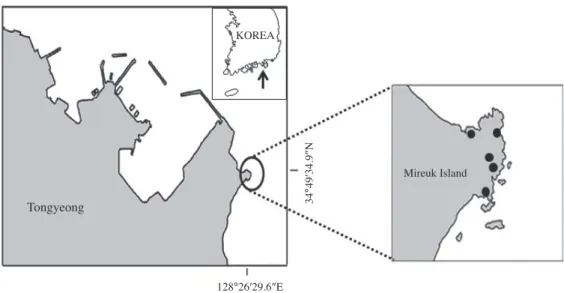
본 연구에 사용된 시료의 채집 장소는 경상남도 통영시 큰 발개1길에 위치한 삼칭이 해안로를 따라 형성된 암반 조간대 지역의 수심 최저 5cm에서 최고 50cm로 이루어진 5개의 조 수웅덩이에서 2014년 9월부터 2015년 8월까지 1년간 매월 1 회 간조 시에 소형 aqua fish net(망구 12.5×10cm, 망목 1 mm)을 이용해 채집하였다.
채집된 점망둑 시료는 사후 소화를 방지하기 위해 채집 즉시 현장에서 10% 중성 포르말린 용액에 고정한 뒤, 실험실로 운 반하여 분석하였다. 채집된 개체를 대상으로 디지털버니어캘 리퍼스를 이용해 표준 체장(1.0mm)을 재고, 습중량은 전자저 울로 0.1g까지 측정하였다. 소화관 내용물 분석은 각각의 개 체에서 소화관을 분리하여 해부현미경(LEICA L2) 하에서 먹 이생물을 종류별로 구분하였고 가능한 종 수준까지 동정하였 다(Yoon, 1988; Hong et al., 2006; Lee, 2008; Jang, 2010). 동정 한 먹이생물은 종류별로 크기(장축, 단축)를 측정하고 개체수
를 계수하였으며 이후 높이 계산식과 부피 계산식(Takatsu et al., 2007)을 참고하여 높이를 구한 후 부피를 계산하였고, 해 조류는 평면형에 가까워 육면체 부피공식을 이용해 값을 구하 였다.
소화관 내용물의 분석 결과는 각 먹이생물에 대한 출현 빈 도(%F), 먹이생물의 개체수비(%N)와 부피(%V)로 나타내었 으며, 다음 식을 이용하여 구하였다.
%F=Ai/N×100
%N=Ni/Ntotal×100
%V=Vi/Vtotal×100
여기서, Ai는 위내용물 중 해당 먹이생물이 발견된 점망둑 의 개체수이고, N은 먹이를 섭식한 점망둑의 총 개체수, Ni
(Vi)는 해당 먹이생물의 개체수(부피), Ntotal(Vtotal)은 전체 먹 이 개체수(부피)이다. 먹이생물의 상대중요성지수(index of importance, IRI)는 Pinkas et al.(1971)의 식을 이용하여 구하 였으며 상대중요성지수는 백분율로 환산하여 상대중요성지수 비(%IRI)로 나타내었다.
IRI=(%N+%V)×%F
점망둑 시료는 표준체장(SL) 10mm 간격으로 나누어 각 체 장군별 먹이생물을 분석하였다(Class I: 10~20mm, n=14;
Class II: 20~30mm, n=85; Class III: 30~40mm, n=145;
Class IV: 40<mm, n=71). 그리고 체장에 따른 먹이섭식 특 성 파악을 위해 체장군별 먹이의 평균 개체수(mean number of preys per stomach, mN/ST)와 체장군별 먹이의 평균 부피 (mean volume of preys per stomach, mV/ST)를 구하였다.
Tongyeong
Mireuk Island
128°26′29.6″E
34°49′34.9″N
KOREA
Fig. 1. Location of the study area for collecting specimens of Chaenogobius annularis(●).
결 과
1. 체장 분포
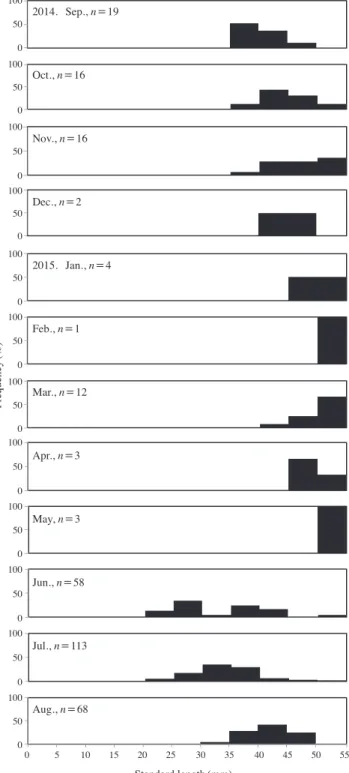
본 연구에 사용된 점망둑은 총 315개체였고 표준 체장 (Standard length, SL) 17.0~54.0mm의 범위를 보였다(Fig. 2).
30~40mm 체장군의 개체가 전체 개체수의 46.0%를 차지하 였고 계절별로는 하계(6~8월)에 75.9%로 가장 많이 채집되 었다. 2015년 6월에 평균 체장이 2.8±0.8cm로 가장 작았으 며, 2015년 5월에 평균 체장이 4.9±0.1cm로 가장 크게 나타 났다.
2. 소화관 내용물 조성
본 연구에서 채집된 점망둑 315개체 중에서 먹이생물을 전 혀 섭식하지 않은 점망둑은 27개체로 8.6%의 공복율을 나타 내었다. 소화관 내용물 분석 결과(Table 1), 점망둑의 가장 중 요한 먹이생물은 출현 빈도 71.2%, 개체수비 51.2%, 부피비 1.2%, 상대중요성지수비 50.5%를 차지한 요각류(Copepoda) 로 나타났다. 요각류 중 출현 빈도 50.3%, 개체수비 37.5%, 부 피비 0.7%를 차지한 Tigriopus japonicus가 가장 중요한 먹이 생물로 확인되었다. 요각류 다음으로 중요한 먹이생물은 출현 빈도 27.1%, 개체수비 11.1%, 부피비 76.1%, 상대중요성지수 비 32.0%를 차지한 해조류(Seaweed)였다. 그 다음으로 만각 류(Cirripedia), 곤쟁이류(Mysidacea), 단각류(Amphipoda)가 각각 상대중요성지수비 6.3%, 3.9%, 3.0%를 차지하였으며, 그 외 곤충류(Insecta), 패충류(Ostracoda), 복족류(Gastropoda), 이매패류(Bivalvia), 등각류(Isopoda), 응애류(Mites) 등 다양 한 생물을 섭식하였지만 그 양은 많지 않았다. 본 연구에서 점 망둑은 요각류와 해조류, 단각류 및 곤쟁이류가 전체 부피비 의 84.3%를 차지하였으며 특히 해조류가 부피비 76.1%를 차 지하여 저서성 무척추동물과 해조류를 주로 섭식하는 잡식성 어류(Omnivore)임을 확인하였다.
3. 성장에 따른 먹이조성의 변화
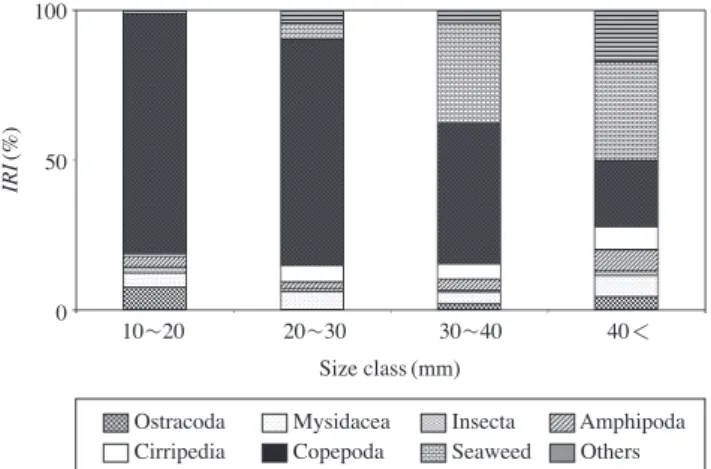
점망둑의 체장군별 먹이생물 변화를 분석한 결과(Fig. 3), 가장 작은 체장군인 10~20mm에서는 요각류가 상대중요성 지수비 80.3%로 가장 중요한 먹이생물이었다. 그 다음은 패 충류로 상대중요성지수비 7.6%를 차지하였다. 그 외 곤쟁이 류, 단각류, 곤충류가 4.7%, 3.6%, 1.9%를 나타내었다. 20~30 mm 체장군에서는 요각류가 상대중요성지수비 75.8%를 차지 하였고 곤쟁이류와 만각류가 상대중요성지수비 5.6%, 5.4%로 그 다음을 차지하였다. 30~40mm 체장군에서도 요각류의 상 대중요성지수비가 47.1%로 나타나 주요 먹이생물이었고 해조 류가 33.3%를 차지하였다. 곤쟁이류, 단각류, 만각류도 3.9%,
3.8%. 5.2%를 차지하며 먹이생물의 한 부분을 차지하였다.
40<mm 체장군에서는 해조류가 상대중요성지수비 33.1%를 차지하였고 요각류는 22.2%로 감소하였으며 만각류가 7.7%, 단각류가 7.3%, 복족류가 5.6%로 증가하였다. 점망둑의 체장 군별 평균 먹이생물 개체수(mN/ST)는 체장군에 따라 증가하
Frequency(%)
100 50 0
2014. Sep., n=19
Oct., n=16
Nov., n=16
Dec., n=2
2015. Jan., n=4
Feb., n=1
Mar., n=12
Apr., n=3
May, n=3
Jun., n=58
Jul., n=113
Aug., n=68 100
50 0 100 50 0 100 50 0 100 50 0 100 50 0 100 50 0 100 50 0 100 50 0 100 50 0 100 50 0 100 50
0 5 10 15 20 25 30 35 40 45 50 550
Standard length(mm)
Fig. 2. Monthly variations in standard length frequency of Chaeno- gobius annularis.
다가 40<mm 체장군에서 감소하는 양상을 보였으며, 체장군 별 평균 먹이생물 부피(mV/ST)는 체장군의 크기와 함께 증가 하였다(Fig. 4).
고 찰
본 연구에서 점망둑의 채집기간 동안 매월 채집 개체수는 달랐지만 매월 출현하는 것을 알 수 있었고, 하계(6~8월)에 채집된 개체수가 타 계절에 비해 높았다. 이것은 조수웅덩이 의 어류는 치어의 유입에 기인하여 늦봄과 여름에 종과 개체 수가 높아진다(Arakaki and Tokeshi, 2006)는 선행연구의 결과 와 일치하였다.
해산 망둑어과 어류에 관한 연구에 따르면 소형 개체의 많 은 종에서 우리나라 전 해역에서 가장 우점하는 요각류가 주요 먹이생물로 나타난다고 알려져 있으며(Kim and Noh, 1997; Kim, 2000; Seo et al., 2013), 본 연구에서도 점망둑의 가장 중요한 먹이생물은 요각류로 이전 연구들과 비슷한 결 과를 나타냈다. 본 연구에서 점망둑이 섭식한 요각류는 대부 분 저서성 요각류인 Harpacticoida였는데, Harpacticoida를 섭 식하는 망둑어과 어류들은 생활사 전반에 걸쳐 섭식하는 군 table 1. Composition of the gut contents of Chaenogobius annularis
by frequency of occurrence, number, volume and index of relative importance(IRI).
Prey organisms %F %N %V %IRI
Paltyhelminthes Turbellaria 0.7 + + +
Nematoda 1.0 0.8 0.2 +
Rotifera 0.3 + + +
Mollusca Bivalvia 15.6 2.0 2.2 0.9
Crassostrea gigas 8.0 0.4 2.0 Unidentified Bivalvia 7.6 1.6 0.2 Gastropoda 17.7 1.1 4.2 1.3 Heminerita japonica 3.1 0.2 0.7 Monodonta labio 1.4 0.1 0.5 Thais clavigera 0.3 + 0.1 Littorina littorea 2.1 0.1 0.3 Patellidae 4.5 0.3 0.2 Unidentified Gastropoda 0.3 0.4 2.3
Annelida Polychaeta 1.0 0.1 0.1 +
Arthropoda Amphipoda 32.3 3.5 3.4 3.0 Corophiidae 33.7 2.6 2.5
Hyperiidae 0.3 + +
Caprellidae 6.9 0.6 0.7 Gammaridae 2.8 0.2 0.2
Brachyura 1.7 0.1 0.1 +
Pachygrapsus crassipes 0.3 + + Unidentified Brachyura 1.4 0.1 + Cirripedia 27.4 14.2 2.7 6.3 Chthamalus challengeri 5.2 0.3 + Unidentified Cirripedia 24.7 13.9 2.7 Copepoda 71.2 51.2 1.2 50.5 Tigriopus japonicus 50.3 37.5 0.7 Euterpina acutifrons 26.7 8.4 0.1 Microsetella sp. 34.0 4.9 0.1 Sapphirina sp. 1.7 0.1 + Unidentified Copepoda 5.2 0.4 0.3
Isopoda 16.3 1.5 1.7 0.7
Insecta 16.0 2.2 2.4 1.0
Chironomidae adult 6.9 1.3 1.4 Chironomidae larvae 1.0 0.1 + Psychodidae larvae 8.0 0.8 0.8 Unidentified Insecta 1.0 + 0.2
Macrura 3.1 0.2 0.2 +
Mites 11.5 1.3 1.0 0.3
Mysidacea 38.5 3.9 3.6 3.9
Ostracoda 0.1 6.5 0.3 +
Squillidae 1.7 0.1 0.4 +
Protista Seaweed 27.1 11.1 76.1 32.0 Pyropia sp. 24.0 6.8 49.1 Unidentified Seaweed 8.7 4.3 27.0
Unidentified species 2.8 0.2 0.2 +
Total 100.0 100.0 100.0
+: less than 0.1%
IRI(%)
100
50
0 10~20 20~30 30~40 40<
Size class(mm)
Ostracoda Mysidacea Insecta Amphipoda Cirripedia Copepoda Seaweed Others Fig. 3. Ontogenetic changes in composition of the gut contents by
%IRI of Chaenogobius annularis.
mN/ST
mN/ST mV/ST
mV/ST
500 400 300 200 100 0 -100
0.8 0.6 0.4 0.2 0
-0.2
10~20 20~30 30~40 40<
Size class(mm)
Fig. 4. Variation(mean±standard deviation) of mean number of preys per stomach(mN/ST) and mean volume of preys per stomach (mV/ST) of Chaenogobius annularis among size class.
과 어린시기에 주로 섭식하다가 성장하면서 다른 먹이생물로 먹이생물을 전환하는 군으로 크게 2가지로 나누어 볼 수 있 다(Kim et al., 2014). 경남 거제연안 잘피밭에 출현하는 점망 둑 치어 식성 연구(Kim et al., 2016)와 본 연구를 비교한 결과, 10~20 mm 체장군에서 각각 주요 먹이생물은 Harpacticoida 로 나타났다. 본 연구에서 20mm 이상 모든 체장군의 소화관 내용물에서도 Harpacticoida가 발견되어 생활사 전반에 걸쳐 Harpacticoida를 섭식하는 어류로 판단된다.
점망둑의 주요 먹이생물은 요각류였고, 다음으로 많이 섭식 한 먹이생물은 해조류로 나타났다. 해조류를 섭식한 망둑어과 의 어류를 살펴보면, 만경강 유역에 서식하는 풀망둑의 소화 관에서는 2~4월경에 갈조류(Phaeophyta)를 섭식한 개체가 관 찰되었고(Lee, 1990), 한강 하구역에 위치한 장봉도에 서식하 는 풀망둑은 참김(Pyropia tenera)을 주로 섭식하였으며(Seo and Hong, 2006), 통영 주변해역에 출현하는 별망둑의 위내용 물에서도 해조류가 높게 나타났다(Baeck et al., 2010). 본 연구 에서 점망둑의 경우, 해조류 중에서 Pyropia sp.가 동계(12~2 월)에 높게 나타났다. Pyropia sp.가 속한 홍조류(Rhodophyta) 는 통영 연안의 암반 조간대 전역에 출현 빈도가 높은 것으로 나타났으며(Oh et al., 2015), 점망둑은 암반에 부착한 해조류 를 섭식한 것으로 판단된다. 서해 연안 조간대에 서식하는 점 망둑의 식성에 대한 연구에서는 서식환경은 연성 기질의 수로 와 조수웅덩이였고 주요 먹이생물은 옆새우류(Gammaridea), 갯지렁이류(Polychaeta), 요각류, 게류(Brachyura) 등 육식성으 로 알려져 있으나(Kim, 2004), 본 연구의 서식환경은 암반으 로 이루어진 얕고 좁은 조수웅덩이로 점망둑의 주요 먹이생물 은 요각류, 해조류, 만각류, 곤쟁이류, 단각류 등을 섭식하는 잡 식성 어류인 것으로 판단된다.
본 연구에서 채집된 점망둑은 다른 해산어류와 다르게 곤 충류를 섭식하는 경향을 나타냈다. 해외에서는 강물이 유입 되는 기수역에 조성된 조간대의 망둑어과 어류에서 수서곤충 인 파리목(Diptera), 깔따구과 유충(Chironomidae larvae)의 곤충류 섭식이 이미 확인되었다(Gkenas, 2011; Kirilenko and Shemonaev, 2012). 또한 국내에서도 별망둑이 해산 망둑어과 어류 중 위내용물에서 곤충이 발견되었다(Baeck et al., 2010).
본 연구의 점망둑 소화관 내용물에서 곤충류가 출현한 것은 시료를 채집한 지역 주변에 숲이 조성되어 있으며 곤충류와 곤충류 유충이 빗물로 인해 점망둑이 서식하는 조수웅덩이로 유입되었을 가능성이 크다고 판단된다.
성장에 따라 먹이생물 크기가 증가하는 것은 많은 해산어류 에서 나타나는 특징이며(Kanou and Kohno, 2001), 날개망둑 (Favonigobius gymnauchen)과 줄망둑(Acentrogobius pflaumi), 서해 연안에 서식하는 점망둑의 경우에도 성장함에 따라 먹 이생물 크기가 증가하는 결과를 나타냈다(Huh and Kwak, 1998a, b; Kim, 2004). 이러한 양상은 어류의 체장이 증가하면
서 몸의 형태와 생태가 바뀌어 노력당 에너지 효율이 더 높 은 먹이를 섭식할 수 있게 된 것이다(Wainwright and Richard, 1995). 본 연구에서도 점망둑은 어린 개체일수록 작은 크기인 요각류를 섭식하는 비율이 높았으나 체장이 증가할수록 비교 적 큰 크기인 해조류와 만각류, 복족류 등의 비율이 높아지는 결과가 나타났다.
요 약
채집기간 동안 총 315개체의 점망둑(Chaenogobius annu- laris)이 채집되었으며, 8.6%의 공복률을 보였다. 점망둑의 가 장 중요한 먹이생물은 상대중요성지수비 50.5%를 차지한 요 각류(Copepoda)였다. 요각류 다음으로 해조류(Seaweed)가 우 점하였으며, 그 외 곤쟁이류(Mysidacea), 만각류(Cirripedia), 단각류(Amphipoda) 등도 섭식하였으나 그 양은 많지 않았다.
점망둑은 성장함에 따라 요각류의 섭식은 감소하였고 해조류 의 섭식이 증가하였다.
REFERENCES
Arakaki, S. and M. Tokeshi. 2006. Short-term dynamics of tide pool fish community: diel and seasonal variation. Environ. Biol.
Fish., 76: 221-235.
Baeck, G.W., C.I. Park, J.M. Jeong, M.C. Kim, S.H. Huh and J.M.
Park. 2010. Feeding habits of Chaenogobius gulosus in Coastal waters of Tongyeong, Korea. Korea J. Ichthyol., 22:
41-48.
Baek, H.J. 2008. Production of C21-Steroids in longchin goby, Chasmichthys dolichognathus during Oocyte Maturation.
Dev. Reprod., 12: 107-112.
Baek, H.J. and T.Y. Lee. 1985. Experimental studies on the mecha- nism of reproductive cycle in the longchin goby Chasmich- thys dolichognathus(HILGENDORF). Bull. Korean Fish.
Soc., 18: 243-252.
Baek, H.J., H.B. Kim, T.Y. Lee and B.D. Lee. 1985. On the ma- turity and spawning of the longchin goby Chasmichthys dolichognathus(HILGENDORF). J. Korean Fish. Soc., 18:
477-483.
Baek, H.J., M.H. Park, Y.D. Lee, H.B. Kim, J.W. Kim and M.S.
Yoo. 2004. Effect of Bisphenol A on ovarian steroidogen- esis in longchin goby(Chasmichthys dolichognathus). J.
Kor. Fish. Soc., 37: 192-196.
Baik, E.I. 1970. Length-weight relationship of Synechogobius has- ta. Bull. Kor. Fish. Soc., 3: 117-119.
Choi, Y., I.S. Kim, B.S. Ryu and J.Y Park. 1996. Ecology of Syn- echogobius hasta(Pisces: Gobiidae) in the Keum River Estuary, Korea. J. Kor. Fish. Soc., 29: 115-123.
Gkenas, C., S. Malavasi and I. Leonardos. 2012. Diet and feeding habits of Economidichthys pygmaeus(Perciformes: Gobii- dae) in Lake Pamvotis, NW Greece. J. Appl. Ichthyol., 28:
75-81.
Hong, S.Y., K.Y. Park, C.W. Park, C.H. Han, H.L. Suh, S.G. Yun, C.B. Song, S.J. Jo, H.S. Lim, Y.S. Kang, D.J. Kim, C.W.
Ma, M.H. Son, H.K. Cha, K.B. Kim, S.D. Choi, K.Y. Park, C.W. Oh, D.N. Kim, H.S. Shon, J.N. Kim, J.H. Choi, M.H.
Kim and I.Y. Choi. 2006. Marine invertebrates in Korean coasts. Academybook, 487pp.
Huh, S.H. and S.N. Kwak. 1998a. Feeding habits of Acentrogobius pflaumii in eelgrass(Zostera marina) bed in Kwangyang Bay. Korean J. Ichthyol., 10: 24-31.
Huh, S.H. and S.N. Kwak. 1998b. Feeding habits of Favonigo- bius gymnauchen in the eelgrass(Zostera marina) bed in Kwangyang Bay. J. Korean Fish. Soc., 31: 372-379.
Hwang, U.G., E.Y. Min and J.C. Kang. 2012. Effect of salinity on survival and growth of 3 gobiidae. Korean J. Environ. Biol., 30: 9-14.
Im, Y.J. and T.W. Lee. 1990. Species composition and biology of major species of gobiid fish in Cheonsu Bay of the Yellow Sea, Korea. Korean J. Ichthyol., 2: 183-202.
Jang, C.Y. 2010. Invertebrate Fauna of Korea. National Institute of Biological Resources, 21.
Jeong, H.S., J.H. Lee and Y.O. Jeong. 2010. Development and Ap- plication of Marine Environment Education Program for Coastal Elementary School Students. Journal of Korean Practical Arts Education, 23: 27-40.
Jung, S.W., J.G. Park, D.H. Jeong and D.I. Lim. 2012. Korean sea- sonal changes in water masses and phytoplankton commu- nities in the western part of south coastal waters, Korea. J.
Environ. Biol., 30: 328-338.
Kanou, K. and H. Kohno. 2001. Early life history of a seahorse, Hippocampus mohnikei, in Tokyo Bay, Japan Ichthyol.
Res., 48: 361-368.
Kim, B.G., J.H. Kim, S.W. Chung and K.N. Han. 2014. Feeding ecology of Luciogobius guttatus(Pisces; Gobiidae) in the Youngjong tide pool, Incheon, Korea. Korean J. Ichthyol., 26: 202-211.
Kim, H.J., J.H. Park, J.M. Jeong, S.J. Ye and G.W. Baeck. 2016.
Feeding habits of juvenile Chaenogobius annularis in an eelgrass bed in the coastal waters of Geoje, Korea. J. Kore- an Soc. Fish. Technol., 52: 176-182.
Kim, I.S., Y. Choi, C.R. Lee, Y.J. Lee and J.H. Kim. 2005. Illustrat- ed Book of Korean Fishes. Kohak Publishing, 615pp.
Kim, J.Y. 2000. Feeding habits of Acanthogobius luriidus inhabit- ing the intertidal zone of the western coast of Korea. Korea J.
Fish. Aquat. Sci., 13: 309-316.
Kim, J.Y. 2004. Feeding habits of Chasmichthys dolichognathus in
the intertidal zone in the west coast of Korea. KNU Fish.
Sci. Res., 4: 363-374.
Kim, J.Y. and Y.T. Noh. 1997. Feeding habits of Acanthogobius elongatus from the Kunsan coast intertidal zone, Neacho-do in the west coast of Korea. Fish. Soc., 30: 413-422.
Kim, Y.U. 1975. On the morphology of larval and young stages of Chasmichthys dolichognathus HILGENDORF. J. Korean Fish. Soc., 8: 225-233.
Kirilenko, E.V. and E.V. Shemonaev. 2012. Feeding of the round goby Neogobius melanostomus(Perciformes, Gobiidae) in two Volga Reservoirs. J. Ichthyol., 52: 291-295.
Lee, C.L. 1990. The structure and function of estuarine ecosystem of Manggyong river on the dynamics of the fish communi- ties. Kor. J. Ecol., 267-283.
Lee, Y.P. 2008. Marine algae of Jeju. Academybook, 447pp.
Oh, J.C., J.K. Ahn, C.D. Kim, J.B. Jeong and H.G. Choi. 2015.
Seasonal variations in the macroalgal flora and community structure in Hallyeohaesang National Park on the south coast of Korea. Korean J. Fish. Aquat. Sci., 48: 768-775.
Pinkas, L., M.S. Oliphant and I.L.K. Iverson. 1971. Food habits of albacore, bluefin tura and bonito in California waters. Fish.
Bull., 152: 1-105.
Seo, I.S. and J.S. Hong. 2006. Feeding ecology of javelin goby(Ac- anthogobius hasta) and fine spot goby(Chaeturichtys stig- matias) in the Jangbong tidal flat, Incheon, Korea. J. Kor.
Fish. Soc., 39(special issue): 165-179.
Seo, M.H., K.S. Shin, M.C. Jang and H.Y. Soh. 2013. Occurrence patterns of zooplankton present in ports of Korea during summer. Korean J. Environ. Biol., 31: 448-457.
Shotaro, H., K. Manami, I. Minoru and K. Akihiro. 2012. Evidence of the restricted gene flow within a small spatial scale in the Japanese common intertidal goby Chaenogobius annularis.
Mar. Ecol., 33: 481-489.
Sudo, H. and N. Kajihara. 2008. Food habits of juvenile devil sting- ers Inimicus japonicus and their changes with growth in the Zostera marina seagrass bed in Mano Bay, Sado Island.
Nippon Suisan Gakkaishi, 74: 827-831.
Takagi, K. 1996. Distributions and ecology of the gobioid fishes in the Japanese waters. J. Tokyo Univ. Fish., 52: 87-127.
Takatsu, T., Y. Siziki, A. Shimizu, K. Imura, Y. Hiraoka and N.
Shiga. 2007. Feeding habits of stone flounder Platichthys bicoloratus larvae in Mutsu Bay, Japan. Fisheries science, 73: 142-155.
Wainwright, P.C. and B.A. Richard. 1995. Scaling the feeding mechanism of the largemouth bass(Micropterus salmoides):
Motor pattern. J. Exp. Biol., 5: 1161-1171.
Yoon, I.B. 1988. Illustrated encyclopedia of fauna & flora of Korea vol. 30 aquatic instcts. Ministry of Education.