한수지 54(1), 73-79, 2021
73
Copyright © 2021 The Korean Society of Fisheries and Aquatic Science pISSN:0374-8111, eISSN:2287-8815 Korean J Fish Aquat Sci 54(1),73-79,2021
Original Article
서 론
고등어
(Scomber japonicus)
는농어목(Perciformes)
고등어과(Scombridae)
에속하는어류로,
우리나라,
일본,
동중국해등을 비롯한태평양,
대서양,
인도양의온대및열대해역에넓게분 포하는것으로알려져있다(Collette and Nauen, 1983; Kim et
al., 2005).
고등어는우리나라주변해역에서계절적인회유를하는대표적인부어류로큰어군을형성하여이동하는데
(Cha et al., 2004), 3-6
월에제주도와대마도주변해역에서산란을하 고(Cha et al., 2002; Kim et al., 2020b),
산란기이후7-8
월에동 해와서해로북상하여섭식활동을하다가11
월경에는월동을위해다시남해로남하하는것으로알려져있다
(Choi, 2003).
고등어는 멸치
(Engraulis japonicus),
살오징어(Todarodes pacificus),
갈치(Trichiurus lepturus)
와함께국내연근해어업 생산량에서높은비율을차지하며,
소비량이많은대중적인어 종이다.
국내연간어획량은1996
년에42
만톤이어획되었고,
이후1997
년부터15
만톤수준으로감소추세를보이며, 2019
년에는
101,121
톤이어획되었는데그중대형선망어업에의해어획된양은
87,991
톤으로국내고등어생산량의약87%
를차지할뿐만아니라국내대형선망어업생산량의약
61%
를차지 한다.
따라서현재우리나라에서는고등어자원을관리하기위 해1999
년부터총허용어획량(total allowable catch, TAC)
제 도를시행하고있으며,
추가적으로2016
년부터수산자원관리법시행령에따라전장
21 cm
이하의포획금지체장과4
월부터
6
월까지의기간중1
개월의범위로금어기를실시하고있다(Kim et al., 2020b).
어류에대한생물생태학적인연구는자원의상태파악과효 율적인관리를위해필수적이다
.
그중섭식생태에관한연구는 포식자와피식자의상호관계에대해파악할수있으며,
대상생 물에대한어업이생태계에어떠한영향을미칠것인지예측할 수있다(Huh et al., 2010; Huh et al., 2012; Melnychuk et al.,
2017).
따라서고등어의식성연구는표층및중층생태계의먹이사슬을파악하는데도움이될수있으며
,
어업에의한자원량 변동을예측할수있는생태계기반자원관리및평가에대한 생물학적정보를제공할수있다.
국내에서Cha et al. (2004)
과Yoon et al. (2008)
등고등어의식성에관한연구가이루어져있남해에 출현하는 고등어(Scomber japonicus)의 위내용물 조성
성기창·김도균·진수연·서호영 1 ·백근욱*
경상대학교 해양식품생명의학과/해양산업연구소/해양생물교육연구센터, 1전남대학교 해양융합과학과
Diet Composition of the Chub Mackerel Scomber japonicus in the Coastal Waters of the South Sea of Korea
Gi Chang Seong, Do-Gyun Kim, Suyeon Jin, Ho Young Soh
1
and Gun Wook Baeck*Department of Seafood and Aquaculture Science/Institute of Marine Industry/Marine Bio-Education and Research Center, College of Marine Science, Gyeongsang National University, Tongyeong 53064, Korea
1Department of Ocean Integrated Science, Chonnam National University, Yeosu 59626, Korea
The feeding habits of Chub mackerel Scomber japonicus were investigated using 329 specimens collected from coastal waters of the South Sea of Korea. S . japonicus is mainly a piscivore, consuming small fish such as Engraulis japonicus ( %RI : 81.0 %). The diet of Chub mackerel also includes small quantities of thaliaceans, euphausiids, and amphipods. We calculated the trophic level as 3.92 for S . japonicus . The dietary composition of S . japonicus did not show significant differences with size, but differed with season. As the body size of S . japonicus increased, the mean weight of prey within the stomach ( mW/ST ) increased (One-way ANOVA, P<0.05).
Keywords: Diet composition, Chub mackerel, Scomber japonicus
*Corresponding author: Tel: +82. 55. 772. 9156 Fax: +82. 55. 772. 9159 E-mail address: [email protected]
This is an Open Access article distributed under the terms of the Creative Commons Attribution Non-Commercial Licens (http://creativecommons.org/licenses/by-nc/3.0/) which permits unrestricted non-commercial use, distribution, and reproduction in any medium, provided the original work is properly cited.
Received 14 January 2021; Revised 26 January 2021; Accepted 16 February 2021 저자 직위: 성기창(대학원생), 김도균(대학원생), 진수연(대학원생), 서호영 (교수), 백근욱(교수)
https://doi.org/10.5657/KFAS.2021.0073
Korean J Fish Aquat Sci 54(1), 73-79, February 2021
성기창
ㆍ
김도균ㆍ
진수연ㆍ
서호영ㆍ
백근욱74
지만이는
10
년이상지난과거자료이며,
어류의식성은시·
공 간적으로크게변화하기때문에지속적인해양환경및어업환 경에의해변화하는해양환경에대응하여고등어자원의효율 적인이용과관리를위해서는지속적으로섭식생태에대한생 물학적정보확보가매우중요하다.
따라서본연구의목적은우리나라남해에출현하는고등어 의위내용물분석을통하여
1)
주먹이생물과영양단계를파악하고
, 2)
계절별먹이생물조성, 3)
크기군별먹이생물조성을알아보며
,
이를통해고등어의기초생태학적자료를제공하 는것이다.
재료 및 방법
본연구에사용된고등어시료는
2019
년3
월부터2020
년2
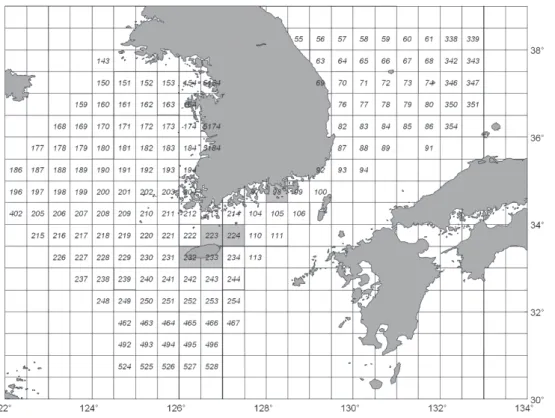
월 까지우리나라남해에위치한98, 223, 224, 232, 233
해구에서 정치망(set net)
과대형선망(large purse seine)
을통해채집되었다
(Fig. 1).
채집된고등어는빙장처리후실험실로운반하여전장
(total length, TL)
과체중을각각0.1 cm
와0.1 g
까지측정한뒤위를적출하여
10%
포르말린용액에고정하였다.
해부현미경아래에서위내용물을분석하였으며
,
출현한먹이생물은가능한종
(Species)
수준까지동정하였고,
소화가진행되어분류가어려운경우에는과
(Family)
또는목(Order)
수준 으로나타내었다(Kaname, 1988; Kim et al., 2005; Hong et al.,
2006).
동정된먹이생물은종류별로크기를측정하였으며,
중량을
0.0001 g
까지측정하였다.
위내용물분석결과는각먹이생물에대한출현빈도
(%F),
중 량비(%W)
로나타내었으며,
다음식을이용하여구하였다.
%F= A
i×N
100%W= W
i ×W
total 100여기서
, A
i는위내용물중해당먹이생물이발견된고등어의개 체수이고, N
은먹이를섭식한고등어의총개체수, W
i는해당 먹이생물의중량, W
total는전체먹이생물의중량이다.
먹이생물 의순위지수(ranking index, RI)
는Song et al. (2006)
의식을이 용하여구하였으며,
순위지수는백분율로 환산하여순위지수 비(%RI)
로나타내었다.
RI=%F×%W
계절별먹이생물조성을알아보기위하여봄
(3, 4, 5
월; n=99),
여름(6, 7, 8
월; n=63),
가을(9, 10, 11
월; n=48),
겨울(12, 1, 2
월
; n=21)
로 구분하였으며,
크기군별 먹이생물 조성을 알아보기 위하여
20 cm
간격으로3
개의 크기군(small: <10 cm,
Fig. 1. Location of sampling areas in the coastal waters of the South Sea of Korea (█).
고등어의 위내용물 조성
75
n=13; medium: 10-30 cm, n=42; large: ≥30 cm, n=176)
으로 구분하였다.
또한크기군별먹이섭식특성을파악하기위해크 기군별개체당평균먹이생물중량(mean weight of preys per stomach, mW/ST)
을구하였으며,
일원배치분산분석(One-way ANOVA, Excel 2014)
을이용하여유의성을검정하였다.
고등 어의크기군사이의먹이생물중복도는dietary overlap index
를이용하여다음과같이구하였다(Schoener, 1970).
C
xy=1-0.5( ∑
ni=1
|P
xi-P
yi| )
여기서
, P
xi와P
yi는그룹x
와y
그룹의먹이중발견된i
종의중량 비(%W)
이며,
중복도값이0.6
이상이면유의하게중복되는것 으로간주하였다(Wallace, 1981).
생태적지위를파악하기위한영양단계
(trophic level, TL
k)
는Cortés (1999)
의식을이용하여구하였다.
TL
k=1+ ∑
nj=1
|P
j×TL
j|
여기서
, P
j는 먹이생물분류군j
가 차지하는순위지수비이고, TL
j는먹이생물분류군j
의영양단계이다.
먹이생물분류군의 영양단계는Pauly et al. (1998), Cortés (1999), Ebert and Biz- zarro (2007)
를참고하여평균값으로사용하였다.
결 과
주 먹이생물 및 영양단계
본연구에사용된고등어는총
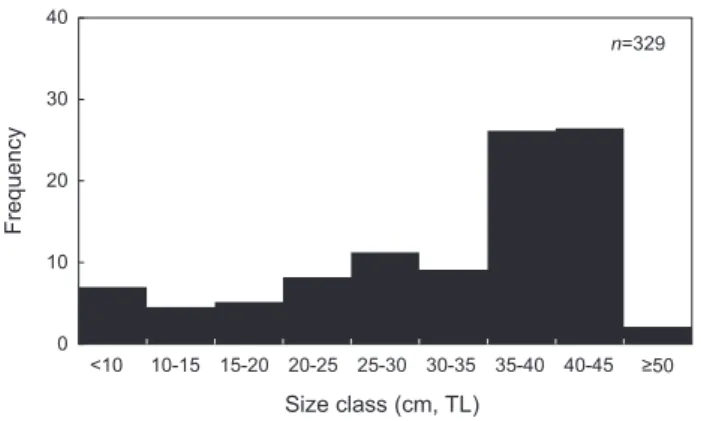
329
개체였으며,
전장은7.5-
47.5 cm
의범위를보였고,
먹이생물을전혀섭식하지않은개체는
98
개체로29.8%
의공복율을보였다(Fig. 2).
위내용물이 발견된231
개체의먹이생물을분석한결과(Table 1),
고등어의 주먹이생물은64.5%
의출현빈도와65.7%
의중량비를 차지하여
81.0%
의순위지수비를나타낸어류(Pisces)
였으며,
그중24.2%
의출현빈도와45.9%
의중량비를차지한멸치(Engrau- lis japonicus)
가가장우점한먹이생물로나타났다.
어류다음 으로중요한먹이생물은29.9%
의출현빈도와30.5%
의중량비를차지하여
17.4%
의순위지수비를나타낸살파류(Salpidae)
였다
.
그외에난바다곤쟁이류(Euphausiacea),
단각류(Amphi-
poda)
등이출현하였으나1.0%
이하의순위지수비를보여그양은매우적었다
.
또한고등어생태적지위를알아보기위해영 양단계를살펴본결과(Table 2),
먹이생물의영양단계가1.00- 3.20
의범위를보여고등어의영양단계는3.92
의값을나타내Fig. 2. Length-frequency distribution of chub mackerel Scomber japonicus collected in the coastal waters of the South Sea of Korea.
0 10 20 30 40
<10 10-15 15-20 20-25 25-30 30-35 35-40 40-45 ≥50
Fr eq uency
Size class (cm, TL)
n=329
0 20 40 60 80 100
Spring Summer Autumn Winter
RI (%)
Season
Pisces Thaliacea Euphausiacea Amphipoda Others
0 20 40 60 80 100
Small Medium Large
RI (%)
Size class (cm, TL)
Pisces Thaliacea Euphausiacea Amphipoda Others
0.0 1.0 2.0 3.0 4.0 5.0
Small Medium Large
mW/ST (g)
Size class (cm, TL)
mW/STTable 1. Composition of the stomach contents by frequency of oc- currence (%F), wet weight (%W) and ranking index (%RI) of chub mackerel Scomber japonicus collected in the coastal waters of the South Sea of Korea
Prey organism %F %W %RI
Amphipoda 24.7 1.4 0.7
Gammaridae 5.2 +
Hyperiidae 10.4 1.4
Hyperia spp. 0.4 +
Parathemisto japonica 3.0 0.1 Unidentified Hyperiidae 8.2 1.3
Unidentified Amphipoda 9.1 +
Copepoda 6.9 + +
Decapoda 10.4 + +
Brachyura 10.0 +
Brachyura larvae (megalopa) 10.0 +
Macrura 0.4 +
Euphausiacea 25.5 2.0 1.0
Isopoda 0.4 + +
Stomatopoda 2.2 + +
Oratosquilla oratoria 2.2 +
Cephalopoda 3.0 0.3 +
Pisces 64.5 65.7 81.0
Engraulis japonicus 24.2 45.9 Larimichthys polyactis 2.6 7.1
Myctophum nitidulum 1.3 0.8
Scomber japonicus 1.3 1.1
Unidentified Pisces 35.1 10.8
Polychaeta 0.9 + +
Seaweeds 0.4 + +
Thaliacea 29.9 30.5 17.4
Salpidae 29.9 30.5
Total 100.0 100.0
+, less than 0.1%.
성기창
ㆍ
김도균ㆍ
진수연ㆍ
서호영ㆍ
백근욱76
었다
.
계절별 먹이생물 조성
계절별먹이생물조성의차이를분석한결과
(Fig. 3),
봄철에는어류와살파류가각각
45.7%
와49.5%
의순위지수비를나타내어가장중요한먹이생물이었으며
,
여름철에는어류와살파류가각각
80.4%
와19.5%
의순위지수비를나타내봄철에비해어류의비율은증가하였고
,
살파류의비율은감소하였다.
또한가을철과겨울철에는어류가각각99.9%
와94.9%
의순 위지수비를나타내가장중요한먹이생물이었으며,
살파류는출현하지않았다
.
본연구에서고등어의계절별영양단계는봄 철3.65,
여름철3.91,
가을철4.06,
겨울철4.01
의값을나타내 었다.
또한계절간의먹이생물중복도를분석한결과(Table 3),
봄철과가을철,
봄철과겨울철간에는먹이생물중복도는각각0.41
과0.45
의중복도값을보여유의하게중복되지않았지만나머지계절간에서는먹이생물중복도가
0.68
이상으로유의하 게중복되었다.
크기군별 먹이생물 조성
크기군별먹이생물조성의차이를분석한결과
(Fig. 4), small
크기군에서는어류만을섭식하였으며, medium
크기군에서는 어류,
난바다곤쟁이류,
단각류,
살파류가 각각85.9%, 6.4%,
4.5%, 2.9%
의순위지수비를나타내었다. Large
크기군에서는어류
,
살파류,
난바다곤쟁이류,
단각류가각각76.8%, 22.1%,
0.7%, 0.4%
의순위지수비를나타내어고등어의모든크기군에서어류가가장우점한먹이생물이었다
.
본연구에서고등어의 크기군별영양단계는small
크기군4.06, medium
크기군3.96,
Fig. 3. Diet composition of chub mackerel Scomber japonicus col-lected in the coastal waters of the South Sea of Korea based on the ranking index (%RI) by season (Spring, n=99; Summer, n=63;
Autumn, n=48; Winter, n=21).
0 10 20 30 40
<10 10-15 15-20 20-25 25-30 30-35 35-40 40-45 ≥50
Fr eq uency
Size class (cm, TL)
n=329
0 20 40 60 80 100
Spring Summer Autumn Winter
RI (%)
Season
Pisces Thaliacea Euphausiacea Amphipoda Others
0 20 40 60 80 100
Small Medium Large
RI (%)
Size class (cm, TL)
Pisces Thaliacea Euphausiacea Amphipoda Others
0.0 1.0 2.0 3.0 4.0 5.0
Small Medium Large
mW/ST (g)
Size class (cm, TL)
mW/STFig. 4. Ontogenetic changes in composition of stomach contents of chub mackerel Scomber japonicus collected in the coastal wa- ters of the South Sea of Korea based on the ranking index (%RI) among size classes (Small: <10 cm, n=13; Medium: 10-30 cm, n=42; Large: ≥30 cm, n=176).
0 10 20 30 40
<10 10-15 15-20 20-25 25-30 30-35 35-40 40-45 ≥50
Fr eq uency
Size class (cm, TL)
n=329
0 20 40 60 80 100
Spring Summer Autumn Winter
RI (%)
Season
Pisces Thaliacea Euphausiacea Amphipoda Others
0 20 40 60 80 100
Small Medium Large
RI (%)
Size class (cm, TL)
Pisces Thaliacea Euphausiacea Amphipoda Others
0.0 1.0 2.0 3.0 4.0 5.0
Small Medium Large
mW/ST (g)
Size class (cm, TL)
mW/STTable 2. Prey categories used to calculate standardized diet com- positions and trophic levels of chub mackerel Scomber japonicus
Group Trophic level
Amphipoda 2.53
Copepoda 2.27
Decapoda 2.41
Euphausiacea 2.22
Isopoda 2.63
Stomatopoda 2.41
Cephalopoda 3.20
Pisces 3.06
Polychaeta 2.30
Seaweeds 1.00
Thaliacea 2.30
Mean trophic levels of each prey type are from Pauly et al. (1998), Cortés (1999) and Ebert and Bizzarro (2007).
Table 3. Proportional diet overlap coefficients (Schoener’s index) of chub mackerel Scomber japonicus collected in the coastal wa- ters of the South Sea of Korea by season (Spring, n=99; Summer, n=63; Autumn, n=48; Winter, n=21)
Season Spring Summer Autumn
Summer 0.68
Autumn 0.41 0.73
Winter 0.45 0.73 0.80
고등어의 위내용물 조성
77
large
크기군3.88
의값을나타내었다.
또한고등어의크기군사이의먹이생물중복도를분석한결과
(Table 4),
모든크기군사이에서먹이생물중복도가
0.65
이상으로유의하게중복되었다
.
고등어의크기군별개체당평균먹이생물중량은small
크기군에서
0.6 g, medium
크기군에서1.2 g, large
크기군에서4.0 g
을나타내큰크기군으로갈수록개체당평균먹이생물중량은증가하는경향을보였으며
(Fig. 5),
통계적으로유의한차이를보였다
(mW/ST, One-way ANOVA, F=5.668, P<0.05).
고 찰
본연구에서 고등어의주먹이생물은 어류였으며
,
그중멸 치가 가장 우점하였다.
고등어의 식성에 대한 선행연구에서 도멸치가주먹이생물이었으며(Cha et al., 2004; Yoon et al., 2008),
삼치(Scomberomorus niphonius),
농어(Lateolabrax japonicus),
눈볼대(Doederleinia berycoides),
붕장어(Conger
myriaster)
등의식성연구에서도중요한먹이생물로보고되었다
(Huh et al., 2006; Huh et al., 2009; Huh et al., 2011; Kim et al., 2020a).
멸치는생활사단계에따라이용하는먹이생물 이 상이하여 자치어단계에서는 요각류 전기유생(Copepoda
nauplii)
과 후기유생(Copepodite)
을 먹이로이용하고,
성장함 에따라요각류성체(Adult)
와십각류유생(Decapoda larvae)
등을섭식하며,
상위포식자의먹이원이되어먹이사슬을연결 하는생태적으로중요한역할을한다(Kim et al., 2013; Jeong
et al., 2017).
또한우리나라남해는계절에따라서대마난류와남해고유연안수등다양한수괴가접하여생물생산력이풍부 하기때문에멸치가서식하기좋은환경으로해역내에멸치가 풍부하게출현하는것으로알려져있다
(Choo and Kim, 1998;
Park et al., 2004; Kim and Pang, 2005; Ko et al., 2010).
본연구에서전장
7.5-47.5 cm
의고등어의위내용물조성을분석한결과
,
어류가81.0%
의순위지수비를나타내가장중요한먹이생물이었는데과거우리나라근해
(
서해남부,
제주도주변,
대마 도주변해역)
에서채집된체장21.1-45.4 cm
의고등어(Cha et al., 2004)
와남해에서채집된가랑이체장23.4-37.5 cm
의고등 어(Yoon et al., 2008)
의경우에도어류가각각58.5%
와62.2%
의상대중요도지수비를차지하여가장중요한먹이생물인것 으로나타났다
.
따라서고등어는어류,
갑각류(Crustacea),
두 족류(Cephalopoda)
등을 섭식하는육식성 어종(Carnivorous
fish)
으로판단된다.
또한본연구에서대형선망으로채집된전장
37.5 cm
이상의고등어가약4.0 cm
의개체를섭식하는공 식현상이3
회관찰되었는데대형선망어획시에강한탐식성을 보이는고등어성어가자치어를섭식하여나타난결과인것으 로추측된다.
선행연구를 참고하여 남해에 서식하는 삼치
,
만새기(Cory- phaena hippurus),
태평양참다랑어(Thunnus orientalis)
의영양 단계를알아본결과(Huh et al., 2006; Yoon et al., 2015; Jeong et al., 2017),
각각3.97, 4.08, 4.09
의값을나타내었으며,
본연 구에서고등어의영양단계는3.92
의값을나타내이를통해고 등어는남해의표층및중층생태계에서멸치와같은소형부어 류와삼치,
만새기,
태평양참다랑어와같은중∙
대형부어류의 먹이사슬을이어주는역할을하기때문에생태학적으로중요 한위치에있는것으로판단된다.
본연구에서고등어의계절별먹이생물조성을분석한결과
,
모든계절에서어류가우점하였지만특히봄철과여름철에는 살파류를포함하여난바다곤쟁이류,
단각류,
게류(Brachyura),
요각류등다양한먹이생물이섭식되었다.
과거남해에서식하 는고등어의식성연구에서봄철과여름철에는게류유생,
화살 벌레(Chaetognatha),
단각류,
난바다곤쟁이류등다양한먹이 생물을 섭식하였지만가을철과 겨울철에는 어류의섭식비율 이급격히증가하였다(Yoon et al., 2008).
살파류는먹이생물 로서영양학적가치가있으며(Lucas, 1994; Pond and Sargent,
1998),
고등어,
다랑어류와같은어류의먹이생물로보고되었다
(Sever et al., 2006; Cardona et al., 2012).
또한남해에서난류의영향으로
4, 5, 6
월에대량출현하는것으로보고되었다(Kang et al., 2000; Kang et al., 2019).
따라서본연구에서고 등어는봄철과여름철에대량발생한살파류를섭식한것으로 Fig. 5. Variation of mean weight of preys per stomach (mW/ST,g/stomach) of chub mackerel Scomber japonicus collected in the coastal waters of the South Sea of Korea (Small: <10 cm, n=13;
Medium: 10-30 cm, n=42; Large: ≥30 cm, n=176).
0 10 20 30 40
<10 10-15 15-20 20-25 25-30 30-35 35-40 40-45 ≥50
Fr eq uency
Size class (cm, TL)
n=329
0 20 40 60 80 100
Spring Summer Autumn Winter
RI (%)
Season
Pisces Thaliacea Euphausiacea Amphipoda Others
0 20 40 60 80 100
Small Medium Large
RI (%)
Size class (cm, TL)
Pisces Thaliacea Euphausiacea Amphipoda Others
0.0 1.0 2.0 3.0 4.0 5.0
Small Medium Large
mW/ST (g)
Size class (cm, TL)
mW/STTable 4. Proportional diet overlap coefficients (Schoener’s index) of chub mackerel Scomber japonicus collected in the coastal wa- ters of the South Sea of Korea among size classes (Small: <10 cm, n=13; Medium: 10-30 cm, n=42; Large: ≥30 cm, n=176)
Size class (cm, TL) Small Medium
Medium 0.68
Large 0.65 0.79
성기창
ㆍ
김도균ㆍ
진수연ㆍ
서호영ㆍ
백근욱78
판단되며
,
계절에따른먹이생물의출현량차이는고등어의먹 이섭식에영향을미치는것으로판단된다.
우리나라주변해역에서식하는많은어류들은일반적으로성 장함에따라먹이전환양상을보이는데본연구에서고등어의 크기군별먹이생물조성을분석한결과
,
모든크기군에서어류 가우점하였으며,
먹이전환양상은보이지않았다.
이러한결과 는작은크기군의고등어의경우크기가작은멸치를따라이동 하다정치망내에서멸치를섭식하여모든크기군에서어류가 우점했을가능성이있으며,
고등어는환경내에풍부하게출현 하는멸치를섭식하는기회주의적섭식경향을보여나타난결 과로도추측된다.
따라서고등어의성장에따른먹이생물조성 변화에대해정확히파악하기위해서는지속적으로다양한어 구를통해채집된샘플의식성연구를수행해야할것으로사료 되며,
본연구에서채집되지않은전장7.5 cm
미만의개체들을 포함한다양한크기군의식성연구가추가적으로수행되어야할 것으로생각된다.
어류는성장함에따라입의크기와복강용적이증가하며
,
유 영능력과포획능력이향상되면서먹이생물의크기또는양이 증가된다(Gerking, 1994; Huh et al., 2009; Huh et al., 2011).
선행연구에따르면우리나라에서식하는고등어는성장함에따 라게유생
,
난바다곤쟁이류,
요각류등의크기가작은먹이생물 의섭식은감소하고,
비교적크기가큰어류의섭식은증가하였 으며(Cha et al., 2004; Yoon et al., 2008), Canary Island
해역 에서식하는고등어는작은크기군에서요각류를주로섭식하 다가성장함에따라곤쟁이류와어류의섭식이증가하는것으 로보고되었다(Castro and Santana-del-pino, 1995).
본연구에 서고등어의전장이커짐에따라개체당평균먹이생물중량이 증가하는양상을나타내었다.
이는다른선행연구에서보고된 결과와같이일반적인현상으로고등어가성장함에따라증가 하는에너지요구량을만족시키기위해먹이생물의중량을늘 리는것으로판단된다.
고등어는해역에따라먹이생물조성의변화를나타내기때문 에기초생태학적자료의신뢰도를높이기위해서는지속적인 관찰및연구가수행되어야할것으로생각되며
,
장기적인식성 연구는향후환경변화를모니터링할수있는지표로사용될수 있을것으로생각된다.
사 사
이논문은
2020
년해양수산부재원으로해양수산과학기술진흥원의지원을받아수행된연구임
(ICT
기반수산자원관리연 구센터).
References
Cardona L, De Quevedo IÁ, Borrell A and Aguilar A. 2012.
Massive consumption of gelatinous plankton by Mediter-
ranean apex predators. PLoS One 7, e31329. https://doi.
org/10.1371/journal.pone.0031329.
Castro JJ and Santana-del-pino Á. 1995. Feeding preference of
Scomber Japonicus in the Canary-Islands area. Sci Mar 59,
325-333.Cha BY, Gong YG, Lee CH and Kim DH 2004. Feeding ecol- ogy of pacific mackerel Scomber japonicus Korean waters.
J Kor Fish Res 6, 14-22.
Cha HK, Choi YM, Park JH, Kim JY and Sohn MH. 2002.
Maturation and spawning of the chub mackerel, Scomber
japonicus Houttuyn in Korean waters. J Korean Soc Fish
Res 5, 24-33.Choi YM. 2003. Stock assessment and management implica- tions of chub mackerel, Scomber japonicus in Korean water.
Ph.D. Dissertation, Pukyong National University, Busan, Korea.
Choo HS and Kim DS. 1998. The effect of variations in the Tsushima warm currents on the egg and larval transport of anchovy in the southern sea of Korea. Korean J Fish Aquat Sci 31, 226-244.
Collette BB and Nauen CE. 1983. FAO species catalogue, Vol.
2. Scombrids of the world. An annotated and illustrated catalogue of tunas, mackerels, bonitos and related species known to date. FAO Fish Synop 125, 1-137.
Cortés E. 1999. Standardized diet compositions and trophic levels of sharks. ICES J Mar Sci 56, 707-717. https://doi.
org/10.1006/jmsc.1999.0489.
Ebert DA and Bizzarro JJ. 2007. Standardized diet composi- tions and trophic levels of skates (Chondrichthyes: Raji- formes: Rajoidei). Environ Biol Fish 80, 221-237. https://
doi.org/10.1007/s10641-007-9227-4.
Gerking SD. 1994. Feeding ecology of fish. Academic Press, San Diego, CA, U.S.A.
Hong SY, Park KY, Park CW, Han CH, Suh HL, Yun SG, Song CB, Jo SG, Lim HS, Kang YS, Kim DJ, Ma CW, Son MH, Cha HK, Kim KB, Choi SD, Park KY, Oh CW, Kim DN, Shon HS, Kim JN, Choi JH, Kim MH and Choi IY. 2006.
Marine invertebrates in Korean coasts. Academybook, Seoul, Korea, 479.
Huh SH, Lee DJ, Choo HG, Park JM and Baeck GW. 2010.
Feeding habits of olive flounder Paralichthys olivaceus collected from coastal waters off Taean, Korea. Korean J Fish Aquat Sci 43, 756-759. https://doi.org/10.5657/
kfas.2010.43.6.756.
Huh SH, Nam KM, Park JM, Jeong JM and Baeck GW. 2012.
Feeding habits of the marbled flounder, Pleuronectes yoko-
hamae in the coastal waters off Tongyeong, Korea. Korean
J Ichtyol 24, 77-83.Huh SH, Oh HS, Park JM and Baeck GW. 2011. Feeding habits of the blackthroat seaperch Doederleinia berycoides in the southern sea of Korea. Korean J Fish Aquat Sci 44, 284-289.
https://doi.org/10.5657/KFAS.2011.0284.
고등어의 위내용물 조성
79
Huh SH, Park JM and Baeck GW. 2006. Feeding habits of span- ish mackerel Scomberomorus niphonius in the southern sea of Korea. Korean J Fish Aquat Sci 39, 35-41. https://doi.
org/10.5657/kfas.2006.39.1.035.
Huh SH, Park JM, Park SC, Jeong DS, Park CI and Baeck GW.
2009. Feeding habits of Lateolabrax japonicus in the coastal waters off Dolsan-do, Yeosu. Korean J Ichtyol 21, 23-27.
Kaname O. 1988. New illustrated encyclopedia of the fauna of Japan. Hokuryu-Kan Publishing Co., Ltd., Tokyo, Japan, Kang HK, Kim GR, Kang JH, Kim MJ and Noh JH. 2019. Mass 803.
occurrence of the salp Salpa fusiformis during spring 2017 in the Southern Waters of Korea and the Northern East China Sea. Ocean Polar Res 41, 135-145. https://doi.org/10.4217/
OPR.2019.41.3.135.
Kang YS, Jo YJ, Go WJ, Kim SS, Jeon KA and Oh HJ. 2000.
Swarm of salps (Tunicata: Thaliaca) and its impact on ma- rine ecosystem in the south sea of Korea. J Korean Soc Oceanogr 5, 47-58.
Kim IS, Choi Y, Lee CL, Lee YJ, Kim BJ and Kim JH. 2005.
Illustrated book of Korean fishes. Kyohaksa, Seoul, Korea, Kim KR, Nam KM, Park KH, Kim BS, Han MI, Kwak JW and 615.
Baeck GW. 2020a. Diet composition of whitespotted conger
Conger myriaster in the coastal waters of Geoje Island, Ko-
rea. Korean J Ichtyol 32, 103-109. https://doi.org/10.35399/ISK.32.2.10.
Kim MJ, Youn SH, Kim JY and Oh CW. 2013. Feeding char- acteristics of the Japanese anchovy Engraulis japonicus ac- cording to the distribution of zooplankton in the coastal wa- ters of southern Korea. Korean J Environ Biol 31, 275-287.
https://doi.org/10.11626/KJEB.2013.31.4.275.
Kim SH and Pang IC. 2005. Distribution and characteristic of transport mechanism of eggs and larvae of anchovy, En-
graulis japonica, in the southwestern sea of Korea in July
and November, 2001. Korean J Fish Aquat Sci 38, 331-341.https://doi.org/10.5657/kfas.2005.38.5.331.
Kim SR, Kim JJ, Park HW, Kang SK, Cha HK and Baek HJ.
2020b. Maturity and spawning of the chub mackerel Scomb-
er japonicus in the Korean Waters. Korean J Fish Aquat Sci
53, 9-18. https://doi.org/10.5657/KFAS.2020.0009.Ko JC, Seo YL, Kim HY, Lee SK, Cha HK and Kim JI. 2010.
Distribution characteristics of eggs and larvae of the ancho- vy Engraulis japonica in the Yeosu and Tongyeong coastal waters of Korea. Korean J Ichtyol 22, 256-266.
Lucas CH. 1994. Biochemical composition of Aurelia aurita in relation to age and sexual maturity. J Exp Mar Biol Ecol 183, 179-192. https://doi.org/10.1016/0022-0981(94)90086-8.
Melnychuk MC, Peterson E, Elliott M and Hilborn R. 2017.
Fisheries management impacts on target species status.
Proc Nat Acad Sci 114, 178-183. https://doi.org/10.1073/
pnas.1609915114.
Jeong JM, Choi JH, Im YJ and Kim JN. 2017. Feeding hab- its of dolphinfish Coryphaena hippurus in the South Sea of Korea. Korean J Fish Aquat Sci 50, 541-546. https://doi.
org/10.5657/KFAS.2017.0541.
Park JH, Im YJ, Cha HK and Suh YS. 2004. The relationship between oceanographic and fishing conditions for anchovy
Engraulis japonica, in the southern sea of Korea. J Korean
Soc Fish Res 6, 46-53.Pauly D, Trites AW, Capuli E and Christensen V. 1998. Diet com- position and trophic levels of marine mammals. ICES J Mar Sci 55, 467-481. https://doi.org/10.1006/jmsc.1998.0428.
Pond DW and Sargent JR. 1998. Lipid composition of the pelagic tunicate Dolioletta gegenbauri (Tunicata, Thalia- cea). J Plankton Res 20, 169-174. https://doi.org/10.1093/
plankt/20.1.169.
Schoener TW. 1970. Nonsynchronous spatial overlap of liz- ards in patchy habitats. Ecology 51, 408-418. https://doi.
org/10.2307/1935376.
Sever TM, Bayhan B, Bilecenoglu M and Mavili S. 2006.
Diet composition of the juvenile chub mackerel Scomber
japonicus in the Aegean Sea (Izmir Bay, Turkey). J Appl
Ichthyol 22, 145-148. https://doi.org/10.1111/j.1439- 0426.2006.00705.x.Song HJ, Baeck GW, Kim SA and Huh SH. 2006. Feeding hab- its of Todarodes pacificus (Cephalopods: Ommastrephidae) in the coastal waters of Busan, Korea. Korean J Fish Aquat Sci 39, 42-48. https://doi.org/10.5657/kfas.2006.39.1.042.
Wallace Jr RK. 1981. An assessment of diet-overlap indexes.
Trans Am Fish Soc 110, 72-76. https://doi.org/10.1577/1548- 8659(1981)110%3C72:AAODI%3E2.0.CO;2.
Yoon SC, Yoo JT, Lee SI, Kim ZG and Choi KH. 2015. Feeding habits of the Pacific bluefin tuna Thunnus orientalis in the southern sea of Korea. J Korean Soc Fish Technol 51, 553- 560. https://doi.org/10.3796/KSFT.2015.51.4.553.
Yoon SJ, Kim DH, Baeck GW and Kim JW. 2008. Feeding hab- its of chub mackerel Scomber japonicus in the South Sea of Korea. Korean J Fish Aquat Sci 41, 26-31. https://doi.
org/10.5657/kfas.2008.41.1.026.