1. INTRODUCTION
During the past 20 years, there has been in- creasing interest in the use of wood pellets al- ternative to fossil fuels for heat and power generation. For example, global consumption of wood pellets in 2008 was 11 million tons on an oven-dry basis, and the figure is projected to
increase to more than 22 million tons by 2014 (IWMG, 2010). In South Korea, wood pellet production began in a plant operated by the National Forestry Cooperative Federation in 2009, and demand for wood pellets as a source of energy are expected to increase greatly in the near future (Han, 2014).
Most of the land in South Korea is included
Original Article
Effect of Moisture Content of Sawdust and Length to Diameter Ratio of a Hole in Flat-die Pelletizer on The Fuel Characteristics of
Wood Pellets Produced with Quercus mongolica, Pinus densiflora, Pinus rigida and Larix kaempferi 1
In Yang 2 ⋅Seong-ho Kim 2 ⋅Gyu-Seong Han 2,†
ABSTRACT
This study was conducted to identify the potential of Quercus mongolica (QUM), Pinus densiflora (PID) and Pinus rigida (PIR) as a raw material for pellet production. Larix kaempferi (LAK), which has mostly been used for pellet production in Korea, was also used as a control. All specimens contained very minimal amounts of sulfur and chlorine. Ash content of LAK was the lowest, followed by PID, PIR and QUM. For the size dis- tribution, the mass fraction between 0.42 mm and 0.25 mm was the highest in PIR. Most fuel characteristics of the produced wood pellets improved with the use of 12% moisture content (MC) particles and the increase of the ratio of length to diameter of a hole in flat-die (L/D ratio). When the MC, bulk density and durability of QUM, PID, PIR and LAK pellets was compared with the standards of the KFRI and ISO, the use of wood par- ticles of 12% MC and flat-die with an L/D ratio of 5.00 for PID particles are suitable for high-quality pellets in the aspects of all fuel characteristics. For PIR and QUM, further work is needed to seek the optimum con- ditions for the production of high-quality and durable pellets.
Keywords : wood pellet, moisture content, ratio of length to diameter of die hole, bulk density, durability
1 Date Received March 8, 2017, Date Accepted April 30, 2017
2 Department of Wood and Paper Science, College of Agriculture, Life & Environments Sciences, Chungbuk National University, Cheongju 28356, Republic of Korea
† Corresponding author: Gyu-Seong Han (e-mail: [email protected])
in the temperate climatic zone. Quercus mon- golica (Mongolian oak), Pinus densiflora (red pine), Pinus rigida M. (pitch pine) and Larix kaempferi (larch) are the major species growing on the land, making up approximately 72 per- cent of total growing-stock volume (Korea Forest Service, 2014). Among the species, for the production of wood pellets, larch has most- ly been used until a recent date because wood pellets produced with the sawdust have high durability and calorific value (Ahn et al., 2014;
Lee et al., 2013). On the other hand, Mongolian oak, red pine and pitch pine have hardly been used for producing wood pellets despite their easy availability. The reasons are as follows; 1) Mongolian oak and red pine have extensively been used as raw materials for the productions of furniture, palettes and plywood, and consequently its average prices are higher than that of larch (Fugita and Sano, 2000) it is well known that pitch pine is inappropriate to be used as a raw material for wood pellet pro- duction due to its high resin content (Shi et al., 2011) most importantly, wood pellets fabricated with Mongolian oak and red pine had lower qualities than those with larch, when produced with the same pelletizing conditions for larch pellets. For example, durability and bulk density of pellets produced with Mongolian oak and red pine were lower than those of larch (Kim et al., 2015). These results are probably due to the differences of physicochemical properties in wood particles used for pellet productions. Each wood species used as raw material has its own specific polymeric characteristics, and thus will
be applied specific temperature, pressure and moisture characteristics to form a pellet.
Therefore, the pelletizing process is quite mate- rial specific (Brackley and Parrent, 2011), and consequently it is necessary to find optimal pel- letizing conditions for using Mongolian oak, red pine and pitch pine as raw materials of wood pellets with acceptable durability and bulk density.
Fuel characteristics of wood pellets depend upon the physiochemical properties, size and shape of wood particles used for producing wood pellets. Hence, a lot of research has been conducted to investigate the numerous factors affected affecting fuel characteristics of wood pellets, including production parameters and equipment processing variables. For example, chemical composition, size and moisture content of wood particles, steam conditioning and pre- heating of feed, addition of binders and densifi- cation equipment variables (forming pressure, die dimension and speed, gap between roller and die, etc.) on the fuel characteristics of wood pellets have been extensively investigated (Ahn et al., 2014; Bergström et al., 2008;
Brackley and Parrent, 2011; Kaliyan and Morey, 2009; Lee et al., 2013; Lehtikangas, 2001; Li and Liu, 2000; Mani et al., 2006;
Obernberger and Thek, 2004; Stakl et al., 2004).
Although several studies related to the pro-
duction of wood pellets have been conducted in
South Korea, no studies have been provided
any information relative to the pellet production
from Mongolian oak, red pine and pitch pine.
Therefore, in the present work, wood pellets were produced with Mongolian oak, red pine, pitch pine and larch using by a pilot-scale flat-die pelletizer, and the effects of wood spe- cies, moisture content of the wood particles and the ratio of length to diameter of a hole in flat-die on the fuel characteristics of the pro- duced wood pellets were examined. In addition, chemical composition, size distribution of wood particles and elemental analysis of each raw material were measured to investigate the rela- tionship between the physicochemical properties of the wood particles and the fuel character- istics of wood pellets produced with the wood particles.
2. MATERIALS and METHODS 2.1. Raw Materials
Mongolian oak (Quercus mongolica, QUM), Korean red pine (Pinus densiflora, PID), pitch pine (Pinus rigida, PIR) and Japanese larch (Larix kaempferi, LAK) were used as raw ma- terials for pellets production. QUM, PID, PIR
and LAK were initially harvested throughout Kyungki and Gangwon districts in South Korea, debarked and cut into logs. The logs were then ground into wood particles using by chopping mill (YM-450BM, Yulim Co. Ltd., Gyeongsan, South Korea) installed at the central distribution center of the National Forestry Cooperative Federation (Yeoju, South Korea), and then the wood particles were dried in large-sized dryer.
A moisture level of the wood particles ranged from 6.1% to 13.1% depending on the species.
Hereinafter, we will refer to the mass fraction of water as moisture content (MC). The wood particles were transported to Chungbuk National University (Cheongju, South Korea), and then screened through a sieve with size opening 6.4 mm (4 mesh). The wood particles were humidi- fied by spraying water or dried in me- dium-sized dryer (for tobacco leaves) to adjust to MC of 10%. The wood particles were used as raw materials in the pelletizing process (Fig. 1).
QUM, PID, PIR and LAK particles were pulverized to powder using a Polytron me- dium-capacity homogenizer (PT-MR 2500 E;
Kinematica AG; Lucerne, Switzerland), and
Mongolian oak Red pine Pitch pine Larch
Fig. 1. Images of wood particles used for pellet production.
then screened through a sieve with size opening of 0.42 mm (60 mesh). The fine powder passed through the sieve was used to analyze elemental and chemical compositions as well as to identi- fy the ash content and calorific value of QUM, PID, PIR and LAK.
2.2. Elemental Analysis
For the elementary analysis, a fine powder of 2 mg was put into the reactor chamber and combusted at the temperature of 990 ℃, with a sufficient supply of oxygen (Yang et al., 2016).
The fine powder was converted into a gas mix- ture with complete oxidation. The gas mixture was passed to a gas chromatographic system with helium gas as a carrier gas, and separated into CO 2 , N 2 , H 2 O and SO 2 gases. Each gas was transformed to an electrical signal using a thermal conductivity detector. The calibration of each gas was done through the elementary anal- ysis of standard samples provided by the instru- ment manufacturer, and then the contents of carbon, hydrogen, nitrogen and sulfur were measured (Flash 2000 Organic Elemental Analyzer, Thermo Fisher Scientific, Waltham, USA). The amount of chlorine content was de- termined by the inductively coupled plasma - atomic emission spectroscopy (ICP - AES, Optima 4300 DV, PerkinElmer, Waltham, USA). The results of elementary analysis were calculated based on the average of three measurements.
2.3. Quantitative and Qualitative Analysis of Ash
For the measurement of ash contents, 1 g of the oven-dried fine powder was placed into a dried and pre-weighed porcelain crucible, and then burned away the specimen in the muffle furnace at 575 ℃ for 6 h (ASTM, 2005a). The crucible was weighed after cooling to room temperature in a desiccator. Ash content was calculated as the ratio of weights of ash and original specimen.
Qualitative analysis of ash contained in each specimen was measured according to the stand- ard for the quality of wood pellets designated by the National Institute of Forest Science (NIFOS, 2016). For instance, fine powder of each specimen (0.5 g) was dissolved by 65%
nitric acid solution, and then the insoluble con- stituent was separated on a glass filter (1G4).
Subsequently, chromium (Cr), lead (Pb), nickel (Ni) and zinc (Zn) included in the insoluble constituent were analyzed by ICP - AES, and arsenic (As), cadmium (Cd), mercury (Hg) and copper (Cu) by ICP - mass spectrometry (ICP - MS).
2.4. Calorific Value
The adiabatic oxygen bomb calorimeter (Parr
6400 Automatic Isoperibol Calorimeter, Parr
Instrument Inc., Moline, Illinois, USA) was
used for the determination of calorific value of
each specimen based on the standard for the
quality of wood pellet designated by the NIFOS
(2016). Initially, 1 g of each specimen was placed in a nickel crucible and burned inside the bomb calorimeter. The specimen was ig- nited by a pure cotton thread in the presence of oxygen. Upon the ignition, the released heat was transferred to the temperature sensor (White, 1987; Kim et al., 2010). The increase in temperature was used to calculate the calo- rific value of the specimen. The calorific value was expressed in MJ/kg. Each specimen was tested three times to obtain most accurate results.
2.5. Analysis of Chemical Composition
Moisture content of each specimen was de- termined using an oven-drying method (ASTM, 2005b). For the determination of holocellulose and lignin contents, standard procedures of the Association of Official Analytical Chemists and National Renewable Energy Laboratory were used, respectively (A.O.A.C., 1990; Effland, 1977).
2.6. Particle Size Distribution
Size distribution of wood particles, which were ground, screened and then dried to 10%
MC, was determined by a Rio-Tap sieve shaker (CG - 211 - 8, Tyler Industrial Products, U.S.A.).
Sieves of 18, 40 and 60 meshes with corre- sponding opening size of 1.00, 0.42 and 0.25 mm, respectively, were used for wood particles passed through the screen of 6.4 mm size.
Sieving time was controlled at 10 min for each
test. Each specimen was tested ten times to ob- tain most accurate results.
2.7. Pellet Production
Prior to pelletizing, the wood particles dried to MC of 10% was humidified to 12% MC to examine the relationship between MC of wood particles and the MC, bulk density and dura- bility of wood pellets. For the humidification, 10% MC particles of 10 kg were spread on the large tray, and then the tray was put on a scale.
After that, 200 g of de-ionized water was sprayed on the particles of the tray for fixing the MC of wood particles to 12%, respectively.
The particles, which were adjusted to MC, were placed in a sealable plastic bag and stored in refrigerator before being analyzed.
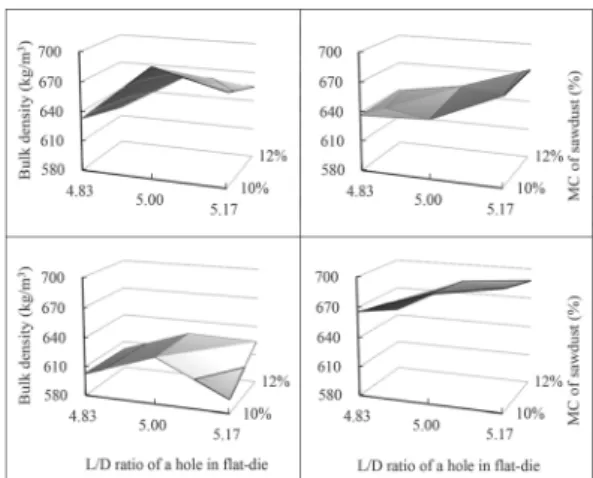
Wood particles were converted to pellets by using a flat-die pelletizer (engine power: 15 kW) developed by Sun Brand Industrial Co., Ltd. (Damyang, Jeonnam). Production rate for the pelletizer is approximately 130 kg/h. Die of the pelletizer has 192 holes with a diameter of 6 mm and a length of 29, 30 and 31 mm, and thus the ratios of length to diameter of a hole in flat-die (L/D ratio) were 4.83, 5.00 and 5.17, respectively. The pelletizer also consists of two rollers with a diameter of 18.5 cm. There was no gap between the rollers and die, and rotating speed of the rollers was adjusted to 98.4 rpm.
The average diameter of wood pellets fabricated
with the pelletizer ranged from 6.3 mm to 6.8
mm. Average length of the wood pellets varied
with the L/D ratio and type of wood particles.
The produced wood pellets were collected at 10-minute intervals, and then placed in an in- cubation room (25 ℃ and 50% RH) for at least 24 h before testing the fuel characteristics of wood pellets.
2.8. Moisture Content, Bulk Density and Durability Tests for Wood Pellets
Moisture content of the produced wood pel- lets was determined using an oven-drying meth- od (ASTM, 2005b). Bulk density measurement of wood pellets was performed according to ASABE S269.5 (ASABE, 2012). For instance, wood pellets were filled by pouring into a cy- lindrical container of 5-liter volume (diameter:
16.7 cm; height: 22.8 cm) from a height of 61 cm above the top edge of the container. After that, excess wood pellets on top of the contain- er were scraped off with a straight edge. For tapped density, the loosely filled container was tapped on the laboratory bench three times in a vertical direction to allow settling, and then the weight of the filled container was recorded.
Bulk density of the wood pellets was de- termined from the resulting weights (Yang et al., 2015). The measurement of bulk density was repeated three times.
For the measurement of durability, 500 g of wood pellets were placed in a tumbling can and tumbled at 50 rpm for 10 min. Subsequently, the tumbled pellets were sieved through a 0.5-mm sieve to remove crumbs attached on the surface of wood pellets, and then weighed to the nearest thousandth of a gram. The durability
of the wood pellets was calculated as the ratio of the weight after tumbling to that before tum- bling (NIFOS, 2016).
2.9. Experimental Design and Statistical Analysis
The effects of wood species (QUM, PID, PIR and LAK), moisture content (10 and 12%) and L/D ratio (4.83, 5.00 and 5.17) on the fuel characteristics of the produced wood pellets were examined first. A factorial design (4 × 2
× 3) was adopted as the experimental design in this study.
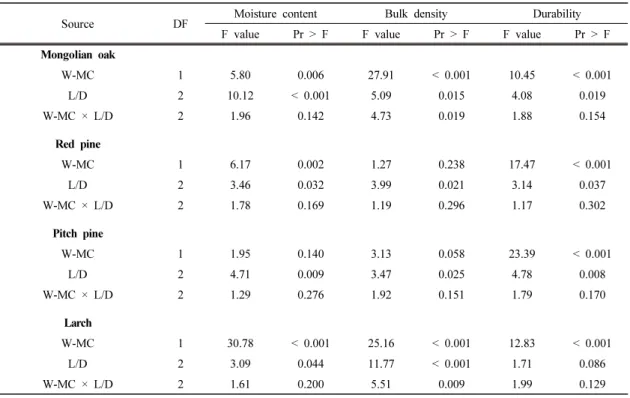
The statistical analysis was carried out using the SAS software package for personal computers. One-way analysis of variance (ANOVA) was used to analyze the effects of each variable on the moisture content, bulk density and durability of pellets at a 0.05% lev- el of significance. If a significant effect was found in a variable, the Student t-test was used to determine any significant difference between the moisture contents, bulk densities and dura- bilities of the wood pellets produced under each condition ( α = 0.05).
3. RESULTS and DISCUSSION 3.1. Elements Contents
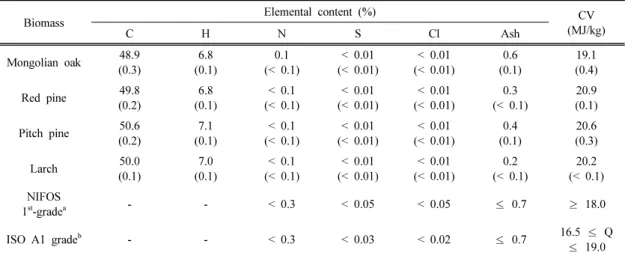
The elemental analysis of QUM, PID, PIR
and LAK is given in Table 1. Carbon content
of PIR was the highest followed by LAK, PID
and QUM. From these results, it could confirm
that higher lignin and extractives contents of softwood compared to those of hardwood is closely associated with the higher carbon con- tent of PIR, LAK and PID (Regland and Aerts, 1991). All specimens contained approximately 7% hydrogen, but PIR and LAK contained more hydrogen than PID and QUM (Pentura, 1979). On the other hand, QUM had more ni- trogen than PID, PIR and LAK, but there were no differences among the nitrogen contents of PID, PIR and LAK. Additionally, traces of sul- fur and chlorine were detected in all specimens. Contents of nitrogen, sulfur and chlorine contained in all specimens easily met the specifications of NIFOS standard for 1 st -grade wood pellets and International Organization for Standardization (ISO) standard for A1-grade wood pellets (NIFOS, 2016; IOS, 2014).
3.2. Ash Content
Table 1 also shows the amount of ash con- tained in each specimen. Ash content of LAK was the lowest, followed by PID, PIR and QUM. However, ash content of all specimens tested in this study satisfied the standards of NIFOS for 1 st -grade and ISO for A1-grade wood pellets (NIFOS, 2016; IOS, 2014).
When the ashes were qualitatively analyzed, no arsenic and mercury was found in any speci- mens, and no nickel in PID and PIR were de- tected (Table 2). On the other hand, cadmium, chrome, copper, lead and zinc were found in all specimens, but the amounts were greatly below the specifications of NIFOS standard for 1 st -grade and ISO standard for A1-grade wood pellets (NIFOS, 2016; IOS, 2014).
Biomass Elemental content (%) CV
(MJ/kg)
C H N S Cl Ash
Mongolian oak 48.9 (0.3)
6.8 (0.1)
0.1 (< 0.1)
< 0.01 (< 0.01)
< 0.01 (< 0.01)
0.6 (0.1)
19.1 (0.4)
Red pine 49.8
(0.2)
6.8 (0.1)
< 0.1 (< 0.1)
< 0.01 (< 0.01)
< 0.01 (< 0.01)
0.3 (< 0.1)
20.9 (0.1)
Pitch pine 50.6
(0.2)
7.1 (0.1)
< 0.1 (< 0.1)
< 0.01 (< 0.01)
< 0.01 (< 0.01)
0.4 (0.1)
20.6 (0.3)
Larch 50.0
(0.1)
7.0 (0.1)
< 0.1 (< 0.1)
< 0.01 (< 0.01)
< 0.01 (< 0.01)
0.2 (< 0.1)
20.2 (< 0.1) NIFOS
1 st -grade a - - < 0.3 < 0.05 < 0.05 ≤ 0.7 ≥ 18.0
ISO A1 grade b - - < 0.3 < 0.03 < 0.02 ≤ 0.7 16.5 ≤ Q
≤ 19.0 Number in parenthesis is a standard deviation of mean for the element content, ash content and calorific value of each biomass.
a
This indicates the specification of 1st-grade wood pellets in the standard designated by National Institute of Forest Service.
b
This indicates the specification of A1-grade wood pellets in the standard designated by International Organization for Standardization (ISO 17225-2).
Table 1. Ultimate and calorific content (CV) analysis of Mongolian oak (Quercus mongolica), red pine (Pinus
densiflora), pitch pine (Pinus rigida) and larch (Larix kaempferi) used in this study
3.3. Calorific Value
Average calorific values of QUM, PID, PIR and LAK are presented in Table 1. PID showed the highest calorific value followed by PIR, LAK and QUM, but the calorific value of PID did not differ statistically from that of PIR. The low calorific value of QUM is probably due to its low carbon and lignin contents, as shown in Tables 1 and 3. In general, calorific value of a lignocellulosic material is proportional to its carbon and lignin contents (Cordero et al., 2001; Dhamodaran, et al., 1989; White, 1987).
Contents of lignin and carbon contained in QUM were lower than those of PID, PIR and LAK, and consequently calorific value of QUM might be lower than those of PID, PIR and LAK. However, calorific values of all speci- mens were higher than that of the specifications of NIFOS standard for 1 st -grade and ISO stand- ard for A1-grade wood pellets (NIFOS, 2016;
IOS, 2014).
3.4. Chemical Composition
Table 3 presents the chemical composition of QUM, PID, PIR and LAK. Amounts of hol- ocellulose, lignin and extractives included in each specimen did not differ largely from those of other studies. For instance, QUM, which was used solely as a hardwood in this study, ex- hibited higher holocellulose content than PID, PIR and LAK. Among the softwood specimens, PID contained more holocellulose than LAK, and the holocellulose content of PIR was the lowest. On the contrary, QUM had a low lignin content, and PIR was found to have a high lig- nin content. For extractives content, LAK was the highest followed by PIR, PID and QUM.
However, the content of organic compounds, such as terpenoids, fats and phenolic sub- stances, extracted by acetone was the highest in
Biomass As Cd Cr Cu Pb Hg Ni Zn
Mongolian oak ND 0.1
(< 0.1)
1 (< 0.1)
2 (< 0.1)
1
(< 0.1) ND < 0.1 (< 0.1)
3 (< 0.1)
Red pine ND 0.2
(< 0.1)
1 (< 0.1)
2 (< 0.1)
1
(< 0.1) ND ND 6
(< 0.1)
Pitch pine ND 0.2
(< 0.1)
1 (< 0.1)
2 (< 0.1)
1
(< 0.1) ND ND 8
(< 0.1)
Larch ND 0.1
(< 0.1)
2 (< 0.1)
2 (< 0.1)
1
(< 0.1) ND < 0.1 (< 0.1)
4 (< 0.1) NIFOS
1 st -grade a ≤ 1.0 ≤ 0.5 ≤ 10 ≤ 10 ≤ 10 ≤ 0.05 ≤ 10 ≤ 100
ISO A1 grade b ≤ 1.0 ≤0.5 ≤ 10 ≤ 10 ≤ 10 ≤ 0.1 ≤ 10 ≤ 100
ND means that each element was not detected.
a
This indicates the specification of 1st-grade wood pellets in the standard designated by National Institute of Forest Service.
b
This indicates the specification of A1-grade wood pellets in the standard designated by International Organization for Standardization (ISO 17225-2).
Table 2. Qualitative analysis of Mongolian oak (Quercus mongolica), red pine (Pinus densiflora), pitch pine
(Pinus rigida) and larch (Larix kaempferi) used in this study (Unit: mg/kg)
PIR and the lowest in QUM, respectively (Sjostrom and Alen, 1989). The organic com- pounds might be closely related to the increase of calorific value, and consequently the high content of the acetone-extracted organic comp ounds in PIR and PID seems to contribute to its higher calorific value compared to LAK.
3.5. Particle Size Distribution
Particle size, along with moisture content, is one of the most significant factors affecting overall pellet quality. Fig. 2 shows the mass fraction of four groups of sizes for wood par- ticles used for pellets production. For the size category > 0.1 mm, the mass fraction of LAK
was the most followed by QUM, PID and PIR.
For the size category between 0.1 mm and 0.42 mm, on the contrary, PIR showed the highest mass fraction followed by QUM, PID and
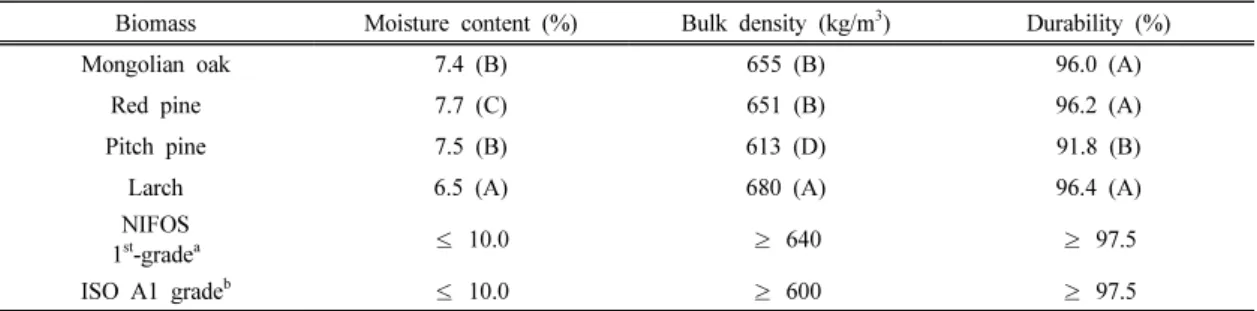
Biomass Moisture content (%) Bulk density (kg/m 3 ) Durability (%)
Mongolian oak 7.4 (B) 655 (B) 96.0 (A)
Red pine 7.7 (C) 651 (B) 96.2 (A)
Pitch pine 7.5 (B) 613 (D) 91.8 (B)
Larch 6.5 (A) 680 (A) 96.4 (A)
NIFOS
1 st -grade a ≤ 10.0 ≥ 640 ≥ 97.5
ISO A1 grade b ≤ 10.0 ≥ 600 ≥ 97.5
Same capital letters in each column are not significantly different from each other at p = 0.05 (Student t-test).
a
This indicates the specification of 1st-grade wood pellets in the standard designated by National Institute of Forest Service.
b