상온 및 상압하에서 3성분계 {1,2-dichloropropane + 1,3-dioxolne + 1,4-dioxane}의 과잉 몰엔탈피 예측
Excess Molar Enthalpies for the Ternary System {1,2-dichloropropane + 1,3-dioxolne + 1,4-dioxane}
at T =298.15 K and p =101.3 kPa
이영세1
, 김문갑2‡
Young-Sei Lee
1
, Moon-Gab Kim2‡
<Abstract>
The excess molar enthalpies
at T =298.15 K and p =101.3 kPa of ternary system {1,2-dichloropropane (1,2-DCP) + 1,3-dioxolane+ 1,4-dioxane} were predicted by using the binary contribution model of Radojkovič with correlated sub-binary Redlich-Kister parameters. Excess partial molar enthalpies
were also calculated for the binary systems {1,2-dichloropropane + 1,3-dioxolane}, {1,2-dichloropropane + 1,4-dioxane} and {1,3-dioxolane + 1,4-dioxane} using adjustable parameters of Redlich-Kister equation.
By extrapolation of excess partial molar enthalpies to infinite dilution, limiting excess partial molar enthalpies
∞of each component were also obtained. The ternary excess molar enthalpies excess partial molar enthalpies of these sub-binary systems have been calculated by using our previously reported results.
Keywords : Excess partial molar enthalpy, Excess molar enthalpy, 1,2-Dichloropropane, 1,3-Dioxolane, 1,4-Dioxane
1
종신회원, 경북대학교 나노소재공학부, 교수, 工博
2
교신저자, 종신회원, 경북대학교 나노소재공학부, 교수, 工博 E-mail address: [email protected]
1
Department of Chemical Engineering, Kyungpook National University, Professor, Ph. D.
2
Corresponding Author, Department of Chemical Engineering, Kyungpook National University, Professor, Ph. D.
1. 서 론
1,2-Dichloropropane (1,2-DCP)는 perchloro ethylene이나 carbon tetrachloride 혹은 여러 관 련 염소계 화합물을 제조하는데 중간체화합물 로 이용되고 있으며, 산업현장에서는 금속 및 비철금속 등을 세정하기 위해 다른 화합물과 혼합하여 세척에 필요한 세정제로 사용되고 있
다. 혼합공정에 있어서 열·물리적 성질
(thermophysical properties)은 공정설계에 중 요한 정보를 제공하며 혼합물의 분자간 상호작
용(molecular interaction)의 형태와 크기 등을 결정하는데 유용하다
1-2). 더욱이 과잉몰성질 (excess molar properties)을 통한 성분들의 분 자간 상호작용(molecular interaction)의 예측은 혼합공정에 필수적인 인자를 제공한다.
1,2-DCP를 기질로 하여 2성분계 과잉몰성질 측정에 관한 일련의 연구로서
3-8), 본 연구에서 는 상온 및 상압에서 3성분계 {1,2-DCP(1) + 1,3-dioxolane(2) + 1,4-dioxane(3)}의 과잉몰엔
탈피
를 예측하였다. 이를 위해 3성분계
를 구성하는 3개의 각 2성분계 간에 상관된
Redlich-Kister
9)parameters를 이용하였고, Radojkovič 의 binary contribution model
10)에 적용하여 예 측하였다. 그리고 3성분계를 구성하는 각 2성분 계 {1,2-DCP + 1,3-dioxolane}, {1,2-DCP + 1,4-dioxane} 및 {1,3-dioxolane + 1,4-dioxane}에 대해 상온 및 상압에서 과잉부분몰엔탈피 (excess partial molar enthalpies)
를 구하였 다. 또한 무한희석에서의 각 성분의 한계과잉부 분몰엔탈피 (limiting excess partial molar enthalpies)
∞를 구하였다. 여기서 3성분계를 구성하는 2성분계 {1,2-DCP + 1,3-dioxolane}, {1,2-DCP + 1,4-dioxane}의 과잉몰엔탈피
는 기 발표된 자료 [3]를 이용하였으며, 2성분계 {1,3-dioxolane + 1,4-dioxane}의 과잉몰엔탈피 는 Kim
11)의 data를 이용하여 계산하였다.
2. 이론
2.1. 부분몰성질(partial molar properties) 혼합물의 성질은 일정한 온도와 압력에서는 유지되므로, 같은 조건하에서 어떤 크기인자 (extensive property)든 부분몰성질로부터 얻어 질 수 있다. 또한 혼합물 속에 있는 분자들의 주변 환경은 조성에 따라 변하기 때문에 혼합 물 중 각 성분의 부분몰성질 (partial molar properties)는 혼합물의 조성에 따라 변하며,
균일상에서 열역학적 성질 (thermodynamic properties)은 온도, 압력 및 상을 구성하는 개별 화학종의 몰수의 함수이며 Eq. (1)과 같다.
⋯ (1)
의 전미분은 Eq. (2)와 같다.
(2)
여기서 마지막 항이 부분몰성질을 나타내며 Eq. (3)과 같이 정의된다.
(3)
Eq. (2)에서 T 와 P 를 일정하게 두고, 순수물 질 1 mole에 대해 적용하여 정리하면 잘 알려 진 혼합물의 성질 을 부분몰성질
의 합으 로 구할 수 있는 Eq. (4)가 얻어진다.
(4)
여기서 은 다양한 열역학 특성치(U, H, S, G, V 등)의 일반기호로서 로 대치될 수 있다.
2.2. 과잉몰성질(excess molar properties)
과잉몰성질은 용액의 실제 열역학적 특성치
과 같은 T, P 및 조성하에 있는 이상용액(순 수용액)의 특성치 값 와의 차이로 정의되며, 이를 본 연구의 대상인 엔탈피로 적용시키면 과잉몰엔탈피(excess molar enthalpies) 는 Eq. (5)와 같다.
(5)
유사하게 과잉부분몰엔탈피(excess partial molar enthalpies)
는 Eq. (6)과 같다.
(6)
여기서
와
는 각각 부분몰엔탈피와 순 수성분의 몰엔탈피이다.
Eq. (4)를 2성분계에 대해 적용하여 양변을 미분하고, Gibbs/Duhem 식의 특별한 경우(일정 한 T와 P)와 함께 정리하면 2성분계 각 성분의 부분몰엔탈피는 Eqs. (8-9)와 같다.
(7)
(8)
Eqs.(8-9)의
는 조성의 함수로 나타낼 수
있는 Redlich-Kister 식(Eq.(9))을 이용하여 구 한다.
(9)
여기서 파라미터
는 실험값
에 대해 선 형회귀법을 사용하여 Eq. (9)에 의해 얻어진 값 과의 차의 합을 최소자승법을 이용하여 구하였 다. 최적의 파라미터
의 수는 F-test
12)와 표 준편차 의 변동을 고려하여 결정하였다.
exp
(10)
여기서 n 은 파라미터의 수이며 N 은 실험 data수이다.
각 성분의 부분몰엔탈피(partial molar enthalpies) 는 Redlich-Kister equation (Eq. (9))을 각 조 성
에 대해 미분한 결과를 Eqs. (7-8)에 대입 하여 정리하면 Eqs. (11-12)가 된다.
(11)
(12)
여기서
는 각 순수성분의 표준생성열 (standard molar enthalpy of formation)
을 이용하여 계산할 수 있다.
2성분계 각 성분의 과잉부분몰엔탈피(excess partial molar enthalpies)
와
는 정의에 따라
와
의 관계식 으로부터 Eqs. (13-14)와 같이 나타낼 수 있다.
(13)
(14)
무한희석(infinite dilution)에서 각 성분의 부 분몰엔탈피 ∞ 는 Eq. (11)에 대해서는
그리고 Eq. (12)에 대해서는
를 각각 적용 하여 얻어지며 Eqs. (15-16)이 된다.
∞
(15)
∞
(16)
또한 무한희석(infinite dilution)에서의 과잉부 분몰엔탈피
∞는 Eq. (6)과 유사하게
∞
∞
의 관계로부터 Eqs. (17-18)이 얻어진다.
∞
(17)
∞
(18)
2.3. 3성분 과잉몰엔탈피(ternary excess molar enthalpies) 예측
3성분계 이상 다성분계의 열역학적 특성치를
실험에 의하지 않고 다성분계를 구성하는 순수
성분들의 성질로부터 예측하는 것이 편리하기
는 하나 실제적으로는 혼합에 따른 효과
(mixing effects) 때문에 종종 부정확한 결과를
가져온다. 따라서 다성분계를 구성하는 2성분계
들 사이의 성질을 이용하여 다성분계의 혼합에
따른 성질을 추산하기 위해 제시된 식은
Radojkovic et al .
8)외에 Scatchard et al .
13),
Tsao and Smith
14), Kohler
15), Rastogi et al .
16),
Jacob and Fitzner
17)등이 있다. 본 연구에서는
Redlich-Kister 식을 근거로 제시된 Radojkovic
식을 이용하여 3성분계 {
1,2-DCP +
0.0 0.2 0.4 0.6 0.8 1.0 -350
-300 -250 -200 -150 -100 -50 0 50
H
m E/J m o l
-1x
1Fig.1. Excess molar enthalpies for the three binary systems at T =298.15 K. Experimental results; (▲), {
1,2-DCP +
1,3-dioxolane};
(■), {
1,2-DCP(1) +
1,4-dioxane}; (●), {
1,3-dioxolane(2) +
1,4-dioxane}. Continuous curves were calculated from Eq. (9) using parameters listed in Table 1. The horizontal axis shows the first component, For
and
see Ref. [3], and for
see Ref. [11].
1,3-dioxolane +
1,4-dioxane}의 과잉몰엔탈피
를 추산하였다. 3성분계를 구성하는 3개의
2성분계 {1,2-DCP + 1,3-dioxolane}, {1,2-DCP + 1,4-dioxane} 및 {1,3-dioxolane + 1,4-dioxane}
사이로부터 얻어진 상관관계를 이용하여 Radojkovič 의 binary contribution model에 적용하여 계산 하였다.
Radojkovic식은 Eq.(19)와 같다.
(19)
Table 1. Adjustable parameters,
of in Eq. (10) and standard deviations, σ in Eq. (11) at T =298.15 K and P =101.3 kPa
Binary
systems
/
1,2-DCP+1,3-
dioxolane -751.2 364.2 -91.7 1.1 1,2-DCP+1,4-
dioxane -1160.3 546.3 -24.4 1.4 1,3-dioxolane+
1,4-dioxane 53.1 -3.9 2.1 5.8 0.06
여기서
,
및
는 Table 1의 Redlich-Kister 식의 2성분 파라미터를 이용하 였고, 3성분 몰분율
,
, 및
을 Eq. (9)에 적용시켜 구한 과잉몰엔탈피이다.
3. 결과 및 고찰
2성분계 {1,2-DCP(1) + 1,3-dioxolane(2)}, {1,2-DCP(1) + 1,4-dioxane(3)} 및 {1,3-dioxolane(2) + 1,4-dioxane(3)}의 과잉부분몰엔탈피
와 무한 희석에서의 과잉부분몰엔탈피 ∞ 를 계산하 기 위해 사용된 Redlich-Kister 파라미터는 전 술한 바와 같이 최적의 파라미터수를 F-test와 표준편차의 변동을 고려하여 재계산하였다. 실 험값
[3, 10]의 fitting 결과값과 표준편차와 함께 Table 1에 나타내었다. 또한 3개의 2성분 계의 과잉몰엔탈피
를 Fig. 1에 나타내었다.
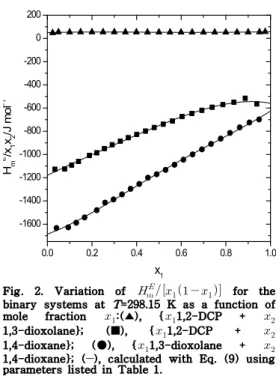
Fig. 2의
로부터, {1,3-dioxolane(2) + 1,4-dioxane(3)}의 경우 다른 2성분계에 비해 조성에 대한 의존성이 거의 없음을 알 수 있다.
이 두 분자는 물리·화학적 성질이 유사하여 혼 합시의 거동은 이상성(ideality)으로부터 거의
0.0 0.2 0.4 0.6 0.8 1.0
-1600 -1400 -1200 -1000 -800 -600 -400 -200 0 200
H
m E/x
1x
2/J m o l
-1x
1Fig. 2. Variation of
for the binary systems at T =298.15 K as a function of mole fraction
:(▲), {
1,2-DCP +
1,3-dioxolane}; (■), {
1,2-DCP +
1,4-dioxane}; (●), {
1,3-dioxolane +
1,4-dioxane}; (―), calculated with Eq. (9) using parameters listed in Table 1.
벗어나지 않는 양상을 보이고 있음을 알 수 있
다. 각 2성분계에 대한 과잉부분몰엔탈피를
Fig. 3에 나타내었다.
Table 2. Excess partial molar enthalpies
∞(Jmol
-1) of 1st component at infinite dilution in 2nd component and excess partial molar enthalpies
∞(Jmol
-1) of 2nd component at infinite dilution in 1st component at T =298.15 K and P =101.3 kPa
Systems:
∞/
∞
1,2-DCP +
1,3-dioxolane -1207.1 -478.7
1,2-DCP +
1,4-dioxane -1731.0 -638.3
1,3-dioxolane +
1,4-dioxane 53.3 57.1
2성분계 {1,2-DCP(1) + 1,3-dioxolane(2)}, {1,2-DCP(1) + 1,4-dioxane(3)}에 대한 과잉부 분몰엔탈피
경우 1,4-dioxane이 1,3-dioxolane 보다 구배가 큰 현상은 혼합시 이종의 분자간 상호작용이 동종의 분자간 상호 작용보다 우세함을 나타내는데, 이는 양 분자의 구조상 1,3-dioxolane 분자의 동종 간 회합효과 (association effect)가 1,4-dioxane의 효과보다 강하여 1,2-DCP와의 상호작용이 상대적으로 미 약하여 나타나는 결과로 설명되어 질 수 있다.
이는 Fig. 1과도 일치하고 있다.
0.0 0.2 0.4 0.6 0.8 1.0
-1800 -1600 -1400 -1200 -1000 -800 -600 -400 -200 0 200
-1800 -1600 -1400 -1200 -1000 -800 -600 -400 -200 0 200
H2E/J mol-1
H
1E/J m o l
-1x
1Fig. 3. Excess partial molar enthalpies
(black symbols) and
(white symbols) and their values at infinite dilution for the three binary systems at T =298.15 K as a function of mole fraction
:(▲, △ ), {
1,2-DCP +
1,3-dioxolane}; (■, □ ), {
1,2-DCP +
1,4-dioxane}; (●, ○ ), {
1,3-dioxolane +
1,4-dioxane}; (―), calculated with Eqs. (14) and (15) using parameters listed in Table 1.
무한희석(infinite dilution)에서 각 성분의 과 잉부분몰엔탈피
∞를 Table 2에 나타내었다.
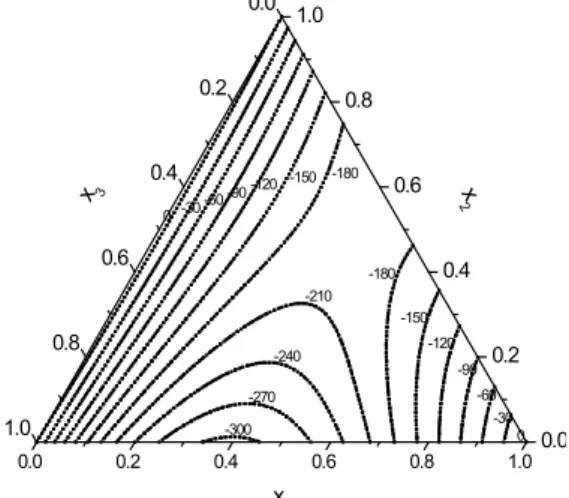
3성분계 {1,2-DCP(1) + 1,3-dioxolane(2) + 1,4-dioxane(3)}의 과잉몰엔탈피
는 Fig. 4 에 나타내었다. 3성분계를 구성하는 각 2성분계 사이의 과잉몰엔탈피
로부터 예측된 결과와 같이 2성분계 {1,3-dioxolane + 1,4-dioxane}이 주로 존재하는 일부 영역을 제외하고는 전 조 성범위에서 이상성으로부터 음의 편차를 보여 주고 있다.
0.0 0.2 0.4 0.6 0.8 1.0
0.0
0.2
0.4
0.6
0.8
1.0 0.0
0.2 0.4 0.6 0.8 1.0
-30 -30-60
-180 -120 -150
-90 2
x x
3x
1-300 -270
-240 -210
-180
-150 -120 -90
-60 0
0