Bacillus sp. 발효를 이용한 감자 칩의 아크릴아마이드 저감화
⁃연구노트⁃
이중재1․오명근1․장윤혁2․이영승1․진용익3․장동칠3․김성환4․정윤화1․김미숙1
1단국대학교 식품영양학과, 2경희대학교 식품영양학과
3농촌진흥청 고령지농업연구소, 4중부대학교 식품영양학과
Reduction of Acrylamide Formation in Potato Chips Fermented by Bacillus sp.
Joongjae Lee1, Myeonggeun Oh1, Yoon Hyuk Chang2, Youngseung Lee1, Yong-Ik Jin3, Dong-Chil Chang3, Sung-Hwan Kim4, Yoonhwa Jeong1, and Misook Kim1
1Department of Food Science and Nutrition, Dankook University
2Department of Food and Nutrition, Kyung Hee University
3Highland Agriculture Research Institute, RDA
4Department of Food Science and Nutrition, Joongbu University
ABSTRACT The market for potato chips has expanded due to increased consumption of seasoned potato chips.
However, the deep-frying process facilitates development of a browning color and formation of acrylamide. The ob- jective of this work was to minimize browning color and acrylamide formation by fermentation prior to deep-frying.
Potato slices were fermented by using three Bacillus strains, B. licheniformis (BL), B. methylotrophicus (BM), and B. subtilis, for 6 h at 30°C. In all fermentation groups, contents of total sugars in potato slices decreased. The color of fermented potato chips improved compared to the control. BM potato chips showed the best color values (76.33 in L value, 5.67 in a value, and 34.79 in b value). All fermentation processes reduced levels of acrylamide in deep-fried potato chips. Fermentation of potato slices for 2 h by BL reduced up to 96.1% acrylamide content. It was concluded that the fermentation process can positively affect color development and acrylamide formation.
Key words: acrylamide, color development, Bacillus, fermentation, potato chip
Received 23 October 2015; Accepted 6 November 2015 Corresponding author: Misook Kim, Department of Food Science and Nutrition, Dankook University, Yongin, Gyeonggi 16890, Korea E-mail: [email protected], Phone: +82-31-8005-3986
서 론
감자는 세계 5대 식용작물 중 하나로 수확한 후 상온 또는 저온 저장고에 저장, 유통되어 식용으로 소비되고 있으며, 국내에서는 주로 조리용으로 감자가 사용되어왔다(1). 과거 에 감자는 주로 주식으로 이용됐으나 최근에는 감자 칩, 감 자튀김, 감자 스낵 등 가공식품 형태의 기호용 식품으로 다 양하게 이용되고 있다. 2014년 후반기부터 조미된 감자 칩 의 열풍으로 감자 칩의 수요가 급격하게 증가하였으며 소비 자들의 관심이 증가하고 있다(2).
감자 칩의 품질에 영향을 미치는 인자로는 감자의 품종, 저장방법, 환원당 함량 등이 있으며, 칩 제조 시 튀김온도, 튀김시간, 슬라이스 두께 등이 있다(3). 특히 감자를 고온에 서 가공처리 시 감자 속에 있는 환원당과 아미노태 질소화합 물 사이에서 Maillard 반응이 발생하는데, 이는 감자 칩의 갈변을 일으키는 melanoidins을 생성할 뿐만 아니라 발암 물질인 아크릴아마이드를 형성하므로 Maillard 반응을 저해
시키기 위한 연구가 진행되고 있다(4).
아크릴아마이드는 식품을 고온에서 조리할 때 생성되는 화학물질로 발암 가능성이 있는 물질이라고 2002년에 스웨 덴 국립식품청(SNFA, Swedish National Food Adminis- tration)에서 최초로 보고하였다. 아크릴아마이드의 위험성 이 알려진 이후 여러 국가에서 아크릴아마이드의 함량을 모 니터링한 결과 프렌치프라이, 감자 칩, 비스킷 등 고온에서 유탕 처리한 가공식품에서 아크릴아마이드 함량이 높은 것 으로 밝혀졌다(5). 이에 따라 아크릴아마이드를 감소시키는 방법에 관한 관심이 증대되면서 2013년에 유럽식품・음료산 업협회(CIAA, Confederation of the Food and Drink In- dustries of the United Nations)에서는 식품 제조업체나 가정에서 아크릴아마이드를 감소시키기 위한 지침서를 제 시하였다. 우리나라 식품의약품안전처에서는 아크릴아마이 드의 안전 목표를 1 mg/kg 이하로 설정하여 식품업체에서 자율적으로 관리하도록 하고 있다(6).
식품 가공 중 생성되는 아크릴아마이드 함량을 줄이기 위 하여 전구체인 아스파라긴이나 환원당이 적은 개량품종 된 감자를 사용하는 등 다양한 방법들이 시도되었다. Maillard 반응물질인 아스파라긴이나 환원당을 감소시켜 Maillard 반 응을 억제하는 방법으로 칩 가공 시에 Maillard 반응 저해물
질을 처리하여 가공, 데치기(blanching), 산도 조절, 저온진 공 가공 등이 있다. 이러한 방법들은 일부 실행 중이지만 비용이 많이 들거나 공정에 어려움이 있다고 하여(7,8) 감자 발효를 통해 아크릴아마이드를 감소시키는 방안이 제시된 바 있다. Manan 등(9)은 Lactobacillus plantarum으로 감 자슬라이스를 발효시켜 환원당을 60% 감소시켰다고 보고 하였다. 또한 Slinde 등(10)은 세 가지 종의 lactobacilli 변 형 균을 이용하여 당근 슬라이스를 발효시켜 환원당 함량을 75% 감소시켰다고 보고하였다. 이전의 연구에서는 환원당 함량을 감소시켜 아크릴아마이드 저감화를 예측해 보았다 면, Baardseth 등(11)은 L. plantarum으로 감자 스틱을 발 효시켜 환원당 함량과 아크릴아마이드 함량을 감소시켰다.
해외의 감자 발효에 관한 연구는 Lactobacillus sp.를 이용 한 연구가 주로 진행되어왔다.
본 연구는 청국장, 간장 등 콩 발효식품에 널리 존재하고 있으며, 생장력이 좋은 Bacillus sp.를 감자에 발효시켜 감 자 칩을 제조하였을 때 색도와 아크릴아마이드 형성에 어떠 한 영향을 미치는지 알아보았다.
재료 및 방법
재료
감자(Solanum tuberosum L., Nonghyup, Sejong, Ko- rea)는 2015년 6월 세종특별자치시 장기면에서 수확된 수 미(Superior) 품종을 구입하여 4°C에서 냉장 보관하며 시료 로 이용하였다.
Bacillus sp. 접종
미생물자원센터(Daejeon, Korea)에서 분양받은 Bacillus licheniformis(KCTC 1026, BL), B. subtilis(ATCC 6633, BS)와 간장에서 분리한 B. methylotrophicus MKSY2013 (BM)을 발효 균주로 선정하였다. BL, BS, BM은 nutrient broth(BD Difco, Sparks, MD, USA)에 접종하여 24시간 동 안 배양기(HB-101S, Hanbaek Co., Ltd., Bucheon, Ko- rea)에서 배양하였다. 균을 배양한 배지를 3,424×g-force, 5°C에서30분간 원심분리 후 상등액을 제거하여 균을 분리 하였다.
감자슬라이스 발효
감자를 물로 세척하여 껍질을 벗긴 후 Smart Multi Cut- ter(Progressive International Inc., Guangzhou, China)를 이용하여 1.5 mm 두께의 슬라이스로 절단하고 멸균 식염수 에 1:2(w/v) 비율로 침지한 다음 상기 분리 균 107~108 cells/
mL를 접종하였다. 감자슬라이스는 30°C로 설정한 배양기 (HB-101S, Hanbaek Co., Ltd.)에서 6시간 동안 정치발효 를 하였다. BM, BS, BL로 0, 2, 4, 6시간 발효시킨 감자슬라 이스를 각각 급속 냉동시켜 동결건조 한 후 믹서기(BL120, Home Culture Appliances Ltd., Shenzhen, China)를 이용
하여 분쇄하였다. 분말을 밀봉하여 4°C에 보관하며 총당과 환원당 함량 측정 실험의 시료로 사용하였다.
감자 칩 제조
시간별로 발효된 감자를 10초간 물로 씻어 1분간 상온건 조한 후 튀김기(DS-100, Daeshin Co., Incheon, Korea)에 서 한 부분(100 g)씩 총 네 부분을 180°C에서 2분간 유탕 처리하였다. 튀김기름은 팜유(Lotte palm oil, Lotte, Se- langor, Malaysia)와 미강유(Serim rice bran oil, Serim, Yeongi, Korea)를 8:2로 혼합하여 이용하였다.
총당과 환원당 함량 측정
Phenol-sulfuric acid 법(12)을 모방하여 감자 분말 시료 1 g을 증류수 100 mL(w/v%)로 정용한 50배 희석한 용액을 1 mL 취한 후 5% phenol 1 mL와 진한 황산 5 mL를 가하여 혼합한 다음 30분간 반응시켜 분광광도계(Cary 60 UV- Vis, Agilent Technologies Inc, Santa Clara, CA, USA)로 470 nm에서 흡광도를 측정하였다. 환원당 함량은 DNS(di- nitrosalicylic acid) 법(13)을 모방하여 감자 분말 시료 1 g에 증류수 25 mL로 정용한 다음 30°C에서 424×g로 1시 간 교반한 후 3,424×g-force, 5°C에서 20분간 원심분리 한 용액의 상등액 1 mL에 DNS 시약 1 mL를 가해 끓는 수욕 상에서 10분간 발색시킨 뒤 535 nm에서 흡광도를 측 정하였다.
아크릴아마이드 함량 측정
아크릴아마이드 함량은 식품의약품안전처 분석 방법(14) 에 따라 액체 질량분석기(HPLC/MS/MS)에 MRM(multiple reaction monitoring)을 이용하여 분석하였다. 제조한 감자 칩을 믹서기(Home Culture Appliances Ltd.)를 이용하여 균질화한 후 1 g을 정밀히 취하여 50 mL 폴리프로필렌 코니 컬 튜브에 넣고 내부표준용액 1 mL와 물 9 mL를 가한 다음 잘 혼합하여 진탕기에 넣어 636×g로 20분 동안 추출한 후 원심분리기를 이용하여 19,080×g로 30분 동안 원심분리 하였다. 이후 원심분리 하고 얻어진 물층 5 mL를 여과튜브 에 옮기고 14,840×g로 10분간 다시 원심분리 하여 상등액 을 얻었다. 메탄올 3.5 mL와 물 3.5 mL로 활성화시킨 OASIS HLB SPE 카트리지에 상등액 1.5 mL를 넣어 통과시 킨 후 물 0.5 mL를 흘려버리고 물 1.5 mL를 용출시켜 모은 용액을 메탄올 2.5 mL와 물 2.5 mL로 활성화한 Bond Elut- Accucat SPE 카트리지에 1.5 mL를 넣은 후 처음 0.5 mL를 흘려버리고 이후 얻어진 1 mL를 액체 질량분석기(API 5000 LC/MS/MS System, AB Sciex Pte. Ltd., Wood- lands, Singapore)의 분석 시료로 사용하였다. 질량분석기 분석조건은 Table 1과 같다.
색도 측정
각 시험군의 색도는 감자 칩을 믹서기(Home Culture
Table 1. HPLC/MS/MS instrument condition Parameters Condition Tandem mass
spectrometer HPLC Column
Isocratic mobile phase Flow rate Injection volume Ionization type
API 5000 LC/MS/MS system Agilent 1260 HPLC Full System Aqua C18 HPLC column (2×250 mm), 5 μm Water (0.1% acetic acid+0.5%
methanol) 0.2 mL/min 20 μm ESI (positive)
Table 2. Total sugar contents of potato during bacterial fermentation (mg/g) Bacterial species1) Fermentation period (h)
0 2 4 6
BL BM BS
34.32±0.04a2) 34.32±0.04a 34.32±0.04a
29.49±0.13b 31.60±0.11b 23.60±0.00b
27.01±0.07c 27.16±0.13c 20.34±0.00c
18.75±0.33d 24.08±0.07d 17.04±0.07d
1)BL, potato chips fermented by B. licheniformis; BS, potato chips fermented by B. subtilis; BM, potato chips fermented by B.
methylotrophicus.
2)Means with the same letter in the same row are not significantly different (α=0.05).
Appliances Ltd.)로 분쇄하여 균질화한 후 색차계(Model CR-300, Minolta, Tokyo, Japan)를 이용하여 Hunter 값 (L=명도, a=적색도, b=황색도)을 측정하였다.
통계분석
실험 결과는 3회 반복으로 수행한 평균값과 표준편차로 나타냈고, 각 실험 결과에 대한 통계분석은 Minitab 16 (Minitab Inc., State College, PA, USA) 통계 프로그램을 이용하여 일원배치 분산분석을 시행하였다. 각 실험군 평균 간의 유의적 차이는 Tukey test로 검증하였다.
결과 및 고찰
발효 감자의 총당 및 환원당 함량
초기 접종 균수는 7.5×10⁷~2.7×10⁸ CFU/mL이며 발효 6시간 동안 균수와 pH 변화는 거의 없었다. 모든 실험군에 서 pH는 5.72~6.11의 범위였으며 발효에 따른 큰 차이는 보이지 않았다(data not shown). 본 연구에서는 감자슬라이 스를 식염수에 침지시킨 용액을 Bacillus sp.의 영양원으로 사용하였기 때문에 합성배지처럼 세균 성장을 위한 충분한 영양 공급이 이루어지지 않았을 것으로 생각한다. 이는 Palmen 등(15)의 연구에서 Bacillus sp.의 유도기가 pH 6.5 에서 최소 7시간이었던 것과 비교하여 아직 유도기에 머물 러 균체량과 pH 변화가 거의 없는 것으로 보인다.
당류는 감자의 발효과정 중 Bacillus 등 미생물의 대사 에너지로 이용되며 미생물이 생산한 효소의 작용으로 생성 되거나 분해된다. 감자분말 총당 함량은 Table 2와 같다.
실험에 사용된 수미감자의 총당 함량은 34.32±0.04 mg/g으
로 Kim 등(12)의 연구에서 나타난 수미감자의 총당 함량인 32.61±1.15 mg/g과 유사한 값을 나타내었다. 모든 실험군 의 총당 함량은 발효시간이 경과할수록 감소하는 경향을 나 타냈으며, 발효 6시간 동안 총당 함량은 29.84~51.45% 감 소하였다. 특히 감자슬라이스의 총당 함량 감소 속도는 BS 가 가장 빨라 발효 2시간 후 총당 함량은 23.60±0.00 mg/g 으로 감소하였으며, 6시간 후에는 17.04±0.07 mg/g으로 약 50% 감소하였다. 감자의 총당 함량이 감소하는 것은 Bacillus가 생육하는 동안 생산되는 amylase에 의한 전분 의 가수분해 때문이다(16). 이는 청국장을 제조하기 위하여 B. amyloliquefaciens을 접종하였을 때 6시간 이내에 amy- lase 활성이 높게 나타나 발효 초기에 전분분해가 일어나 총당 함량 감소에 기여하였다는 Lee 등(17)의 연구와 유사 하였다. Amylase를 생산하는 대표적인 Bacillus sp.로는 B.
subtilis, B. stearothermophilus, B. licheniformis 그리고 B. amyloliquefaciens 등이 있다고 알려졌다(18).
감자슬라이스가 발효하는 동안 총당 함량은 지속해서 감 소하는 반면 환원당 함량은 감소하였다가 증가하는 현상이 나타났다. 가공 중 감자의 환원당은 아크릴아마이드의 생성 기전인 Maillard 반응을 일으키는 핵심인자로 작용한다 (19). 감자의 환원당 함량은 품종별로 유의적 차이가 있으며 Kumar 등(20)은 저장조건이 감자의 당 함량 변화에 크게 영 향을 미친다고 하였다. 본 연구에서 사용한 수미감자의 환원 당 함량은 654 mg/100 g이었다. 국내 생산 감자의 환원당 함량은 조풍(1,210 mg/100 g)이 가장 높으며 세풍(1,160 mg/100 g), 수미(753 mg/100 g), 남서(322 mg/100 g), 대 서(245 mg/100 g) 순이다(13). 미생물 발효를 통해 감자슬 라이스의 환원당 변화를 관찰하였고, 그 결과는 Table 3과 같다. BL 감자슬라이스는 초기 4시간 동안 환원당 함량이 감소했지만 BM과 BS는 2시간 동안 감소한 후 모두 발효 6시간까지 증가하였다. 초기 환원당 감소는 감자슬라이스 내 존재하는 환원당을 Bacillus sp.가 성장에 필요한 기질로 이용한 결과이며, 이후 Bacillus sp.의 대사를 통해 생성된 amylase 활성 증가로 인해 환원당이 증가하였을 것으로 생 각된다.
발효 감자 칩의 색도
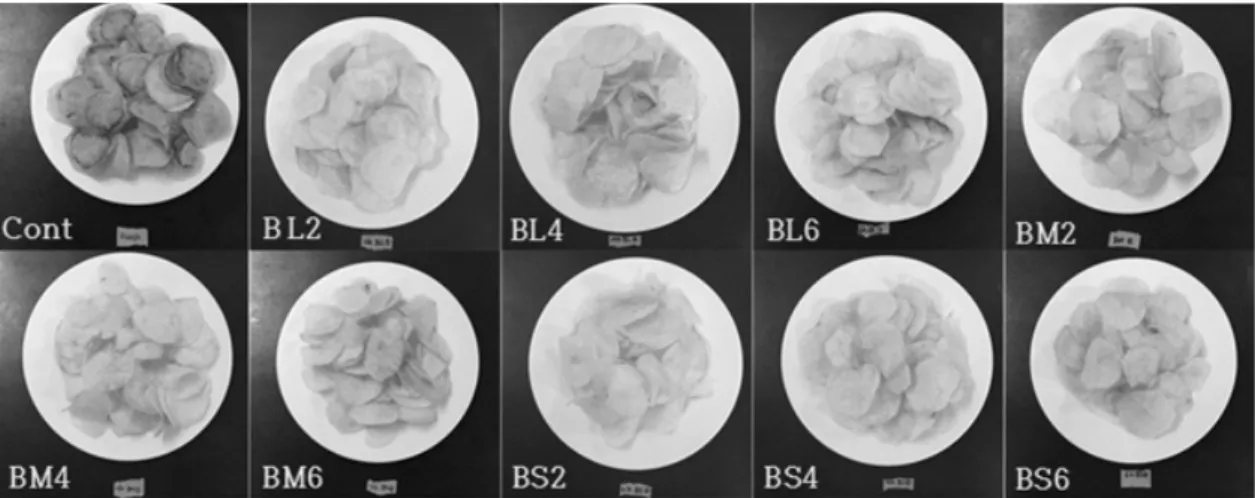
발효시킨 감자슬라이스를 감자 칩으로 가공 후 색은 대조 구와 큰 차이가 있었다(Fig. 1). Table 4는 감자 칩의 색도를 측정한 결과이다. Kaaber 등(21)의 연구에서는 가공 전 감
Table 3. Reducing sugar contents of potato during bacterial fermentation (mg/100 g) Bacterial species1) Fermentation period (h)
0 2 4 6
BL BM BS
654.40±8.97a1) 654.40±8.97b 654.40±8.97b
425.92±6.74b 320.64±1.85d 334.38±4.42d
273.52±8.12c 532.10±16.36c 495.02±12.54c
364.76±6.52d 802.71±2.97a 743.53±26.52a
1)BL, potato chips fermented by B. licheniformis; BS, potato chips fermented by B. subtilis; BM, potato chips fermented by B.
methylotrophicus.
2)Means with the same letter in the same row are not significantly different (α=0.05).
Fig. 1. Effect of fermentation on the color development of potato chips. Cont, non-fermented potato chips; BL2, potato chips fermented for 2 h by B. licheniformis; BL4, potato chips fermented for 4 h by B. licheniformis; BL6, potato chips fermented for 6 h by B. licheniformis; BM2, potato chips fermented for 2 h by B. methylotrophicus; BM4, potato chips fermented for 4 h by B. methylo- trophicus; BM6, potato chips fermented for 6 h by B. methylotrophicus; BS2, potato chips fermented for 2 h by B. subtilis; BS4, potato chips fermented for 4 h by B. subtilis; BS6, potato chips fermented for 6 h by B. subtilis.
Table 4. Hunter color values of deep-fried potato chips
Bacterial species1) Time2) L3) a b
Control 59.22±0.02d4) 13.38±0.03a 38.44±0.06a
BL
2 4 6
75.16±1.79ab 73.14±0.61abc 69.25±2.02c
5.07±1.16d 7.59±0.15bcd 10.43±1.65ab
31.95±0.79f 35.00±0.97bcd 34.92±1.12bcd
BM
2 4 6
73.54±4.02abc 76.33±1.56a 73.64±1.24abc
6.65±2.62cd 5.67±0.22d 6.79±1.02cd
34.53±0.52cde 34.79±0.85cd 34.93±0.04bcd
BS
2 4 6
73.51±3.73abc 72.86±0.16abc 75.67±1.19ab
5.81±3.13d 8.03±0.29bcd 5.87±0.18d
32.40±0.19f 35.74±1.13bc 36.83±0.92ab
1)Control, non-fermented potato chips; BL, potato chips fermented by B. licheniformis; BS, potato chips fermented by B. subtilis;
BM, potato chips fermented by B. methylotrophicus.
2)Fermentation period (h).
3)Color measurement recorded as L, lightness; a, red; b, yellow.
4)Means with the same letter in the same column are not significantly different (α=0.05).
자슬라이스의 환원당 함량이 낮을수록 감자 칩으로 가공 후 에는 L 값이 증가하였고 a, b 값은 모두 감소하여 환원당 함량과 색도 간에 상관관계를 나타내었다. 마찬가지로 본 연구에서도 감자슬라이스의 환원당 함량과 감자 칩 색도 간 의 경향성을 확인할 수 있었다. b 값과 환원당 함량에 따른 상관관계(R=0.479, P<0.001)에서는 환원당 함량이 증가할
수록 b 값이 비례하여 증가하는 것을 알 수 있었다. Brands 등(22)은 고온에서 환원당과 아미노태 질소화합물이 Mail- lard 반응을 일으켜 갈색을 나타내는 melanoidins를 형성한 다고 하였으며, 이러한 이유로 환원당 함량이 높을수록 mel- noidins를 많이 형성하여 b 값이 높아진 것으로 생각된다.
Rodriguez-Saona와 Wrolstad(23)는 순위법(ranking test)
Fig. 2. Acrylamide contents of non-fermented and fermented potato chips. BL, potato chips fermented by B. licheniformis;
BS, potato chips fermented by B. subtilis; BM, potato chips fer- mented by B. methylotrophicus.
을 이용하여 6개의 감자 칩 색도를 평가한 결과 가장 좋은 평가를 받은 감자 칩의 L 값은 68.70, a 값은 2.68, b 값은 26.09인 반면에 가장 좋지 않은 평가를 받은 감자 칩의 L 값은 49.89, a 값은 8.33, b 값은 16.69였으며, 색도 중 L 값의 증가가 중요하였다고 보고하였다. Bacillus sp.로 발효 시킨 감자 칩의 평균 색도 값은 L 값 73.70, a 값 6.94, b 값 34.23으로 대조구에 비하여 L 값은 14.49 상승하였으며, a 값, b 값은 각각 6.44, 4.22 감소하여 대조구에 비해 감자 칩으로 적합한 색도를 나타내었다.
아크릴아마이드 함량
발효 감자 칩의 아크릴아마이드 함량을 분석한 결과는 Fig. 2와 같다. Friedman(24)의 연구에서는 시중에 판매되 는 감자 칩의 환원당 함량이 30~3,200 μg/kg을 나타내었 다. 본 연구에 시료로 이용된 수미감자를 감자 칩으로 가공 한 결과 아크릴아마이드 함량은 3,893 μg/kg으로 높은 수치 를 나타내었다. Bacillus sp.로 감자슬라이스를 2시간 발효 시켜 감자 칩을 제조한 결과 BL은 2시간 후 아크릴아마이드 함량이 96.1%로 가장 많이 감소하였으며, BM은 4시간 발 효 후 94.4%, BS는 2시간 발효 후 93.6% 감소되어 모든 발효 감자 칩에서 아크릴아마이드 함량이 큰 폭으로 감소된 것을 알 수 있었다. Baardseth 등(11)은 감자를 Lactoba- cillus sp.로 발효하여 아크릴아마이드 함량이 71% 감소한 프렌치프라이를 제조한 바 있다. Kim 등(25)은 lysine, gly- cine, cysteine 등을 이용하여 가공식품의 아크릴아마이드 의 함량을 80% 이상 감소시켰으며, 이외에도 감자 자체 내 아크릴아마이드의 전구체 함량을 줄이는 방법, 가열하는 동 안 아크릴아마이드 생성량을 줄이는 방법 등에 관한 다양한 연구가 시도되었다(7,26).
결론적으로 감자 칩의 아크릴아마이드 함량을 줄이기 위 하여 도입한 Bacillus sp.를 이용한 발효는 간단하면서도 비 교적 단시간 내 생성 가능한 아크릴아마이드 함량을 93%
이상 줄이는 데 효과적이었으며, 이러한 결과는 감자 칩 등
고온에서 가열 처리하는 전분 가공식품 생산에서 안전성을 확보하는 데 도움을 줄 수 있을 것으로 판단된다.
요 약
본 연구에서는 Bacillus sp.를 이용하여 감자슬라이스를 발 효시킨 후 성분을 분석하고, 감자 칩으로 가공하여 색도와 아크릴아마이드 함량을 알아보았다. B. licheniformis, B.
methylotrophicus, B. subtilis 각각을 7.5×10⁷~2.7×10⁸ CFU/mL 접종하여 6시간 동안 발효한 결과 균수의 증가는 보이지 않는 유도기였음에도 불구하고 총당 함량은 감소하 였으며, 환원당 함량 변화에 영향을 미쳤다. 감자 칩의 색도 는 대조구에 비하여 실험구의 L 값이 증가하였으며, a 값과 b 값은 감소하여 감자 칩으로 적합한 색도를 나타내었다.
발효 감자 칩의 아크릴아마이드 함량은 평균 약 94% 감소하 였다.
감사의 글
본 논문은 농촌진흥청 공동연구사업(과제번호: PJ01123904) 의 지원에 의해 이루어진 것으로 이에 감사드립니다.
REFERENCES
1. Ha JH, Ha SD, Kang YS, Hong KP, Bae DH. 2007. Micro- biological, nutritional, and rheological quality changes in frozen potatoes during storage. Korean J Food Sci Technol 39: 663-668.
2. Food news. 2014. How will be maintained boom of honey butter chips. http://www.foodnews.co.kr/news/articleView.
html?idxno=53159 (accessed Jun 2015).
3. Kaur A, Singh N, Ezekiel R. 2008. Quality parameters of potato chips from different potato cultivars: Effect of prior storage and frying temperatures. Int J Food Prop 11: 791- 803.
4. Stadler RH, Blank I, Varga N, Robert F, Hau J, Guy PA, Robert MC, Riediker S. 2002. Food chemistry: Acrylamide from Maillard reaction products. Nature 419: 449-450.
5. Tareke E, Rydberg P, Karlsson P, Eriksson S, Törnqvist M.
2002. Analysis of acrylamide, a carcinogen formed in heat- ed foodstuffs. J Agric Food Chem 50: 4998-5006.
6. Ministry of Food and Drug Safety. 2014. Knowledge of food safety. http://www.foodsafetykorea.go.kr/portal/board/board Detail.do?menu_no=268&bbs_no=bbs001&ntctxt_no=2226 6&menu_grp=MENU_GRP01 (accessed Oct 2015).
7. Jung MY, Choi DS, Ju JW. 2003. A novel technique for limitation of acrylamide formation on fried and baked corn chips and in French fries. J Food Sci 68: 1287-1290.
8. Kita A, Brathen E, Knutsen SH, Wicklund T. 2004. Effective ways of decreasing acrylamide content in potato crisps dur- ing processing. J Agric Food Chem 52: 7011-7016.
9. Manan JK, Joshi GJ, Saxena AK, Kalra CL, Berry SK. 1987.
Improvement in colour of deep fat fried potato chips from cold stored potatoes by lactic acid fermentation (Lactobacil- lus plantarum). J Food Sci Technol 24: 139-141.
10. Slinde E, Skrede G, Aukrust T, Blom H, Baardseth P. 1993.
Lactic acid fermentation influence on sugar content and col-
our of deep-fried carrot chips. Food Res Int 26: 255-260.
11. Baardseth P, Blom H, Skrede G, Mydland LT, Skrede A, Slinde E. 2006. Lactic acid fermentation reduces acrylamide formation and other Maillard reactions in French fries. J Food Sci 71: C28-C33.
12. Kim HN, Yu SY, Yoon WB, Jang SM, Jang YJ, Lee OH.
2014. Analysis of nutritional components and physicochem- ical properties of hot-air dried Jerusalem artichoke (Helian- thus tuberosus L.) powder. Korean J Food Sci Technol 46:
73-78.
13. Kwon OY, Kim HJ, Oh SH, Lee JH, Kim HC, Yoon WK, Kim HM, Park CS, Kim MR. 2006. Nutrient composition of domestic potato cultivars. J East Asian Soc Dietary Life 16: 740-746.
14. Chung HW, Park SK, Choi D. 2007. Determination of acryl- amide in food products. Anal Sci Technol 20: 164-169.
15. Palmen TG, Scheidle M, Huber R, Kamerke C, Wilming A, Dittrich B, Klee D, Büchs J. 2013. Influence of initial pH values on the lag phase of Escherichia coli and Bacillus licheniformis batch cultures. Chem Ing Tech 85: 863-871.
16. Oh HI, Eom SM. 2008. Changes in microflora and enzyme activities of cheonggukjang prepared with germinated soy- beans during fermentation. Korean J Food Sci Technol 40:
56-62.
17. Lee NR, Go TH, Lee SM, Hong CO, Park KM, Park GT, Hwang DY, Son HJ. 2013. Characteristics of Chungkoo- kjang prepared by Bacillus amyloliquefaciens with different soybeans and fermentation temperatures. Korean J Microbiol 49: 71-77.
18. Sivaramakrishnan S, Gangadharan D, Nampoothiri KM, Soccol CR, Pandey A. 2006. α-Amylases from microbial sources-an overview on recent developments. Food Tech- nol Biotechnol 44: 173-184.
19. Mottram DS, Wedzicha BL, Dodson AT. 2002. Food chem- istry: acrylamide is formed in the Maillard reaction. Nature 419: 448-449.
20. Kumar D, Singh BP, Kumar P. 2004. An overview of the factors affecting sugar content of potatoes. Ann Appl Biol 145: 247-256.
21. Kaaber L, Sundt TW, Slinde E. 1995. Production of chips from potato cultivars (Solanum tuberosum L.) with high sugar content using lactic acid fermentation. Potato Res 38:
39-45.
22. Brands CM, Wedzicha BL, van Boekel MA. 2002. Quantifi- cation of melanoidin concentration in sugar-casein systems.
J Agric Food Chem 50: 1178-1183.
23. Rodriguez-Saona LE, Wrolstad RE. 1997. Influence of pota- to composition on chip color quality. Amer Potato J 74: 87- 106.
24. Friedman M. 2003. Chemistry, biochemistry, and safety of acrylamide. A review. J Agric Food Chem 51: 4504-4526.
25. Kim CT, Hwang ES, Lee HJ. 2005. Reducing acrylamide in fried snack products by adding amino acids. J Food Sci 70: C354-C358.
26. Grob K, Biedermann M, Biedermann-Brem S, Noti A, Imhof D, Amrein T, Pfefferle A, Bazzocco D. 2003. French fries with less than 100 g/kg acrylamide. A collaboration between cooks and analysts. Eur Food Res Technol 217: 185-194.