Anti-MRSA Properties of Prodigiosin from Serratia sp. PDGS 120915
Keunho Ji, Tae Hyug Jeong and Young Tae Kim*
Department of Microbiology, Pukyong National University, Busan 608-737, Korea
Received November 3, 2014 /Revised December 3, 2014 /Accepted December 8, 2014
Prodigiosin, a member of natural red pigment family, is produced by Serratia marcescens, and charac- terized by a common pyrrolylpyrromethane skeleton. This pigment has been reported with the effects of anticancer, immunosuppressant, antifungal, and algicidal activities. Methicillin-resistant Staphylococcus aureus (MRSA) is a major cause of hospital infections. In this study, anti-MRSA properties of prodigio- sin isolated from Serratia sp. PDGS 120915 were investigated. We identified and purified prodigiosin using high performance liquid chromatography (HPLC) and evaluated anti-MRSA activity. Purified prodigiosin inhibited the growth of MRSA. The minimum inhibitory concentrations (MICs) of prodi- giosin were determined to 32 μg/ml against the MRSA strains. Fractional inhibitory concentration (FIC) indices of ampicillin and penicillin were indicated synergistic effects of prodigiosin on MRSA.
Key words :
Anti-MRSA, prodigiosin, red pigment, Serratia
*Corresponding author
*Tel : +82-51-629-5616, Fax : +82-51-629-5619
*E-mail : [email protected]
This is an Open-Access article distributed under the terms of the Creative Commons Attribution Non-Commercial License (http://creativecommons.org/licenses/by-nc/3.0) which permits unrestricted non-commercial use, distribution, and reproduction in any medium, provided the original work is properly cited.
Journal of Life Science 2015 Vol. 25. No. 1. 29~36 DOI : http://dx.doi.org/10.5352/JLS.2015.25.1.29
Introduction
When antibiotics began making their way into clinical use, they were hailed as miracle drugs; however, miracles did not last forever [20]. Various microorganisms have sur- vived for many years through adapting to antimicrobial agents [13]. Since penicillin was first introduced in 1943, 40%
of hospital isolated S. aureus showed penicillin resistance in 1950, and increased by 80% in 1960 [4, 6, 12]. The pen- icillin-resistant strain was overcome with penicillinase-stable penicillins, including methicillin, oxacillin, cloxacillin and flucloxacillin, but only two year later, methicillin-resistant Staphylococcus aureus (MRSA) was reported in England [10].
MRSA became the most problematic gram-positive bacte- rium in public health because of its wide-resistance of anti- biotics except few antibiotics [9, 22]. The genus Serratia, a member of the Enterobacteriaceae, is comprised of a group of bacteria that are related both phenotypically and by DNA sequence. Some species and biotypes of Serratia produce a nondiffusible red pigment, prodigiosin, or 2-methyl-3-amyl- 6methoxyprodigiosene [21]. MRSA is a major pathogen that is associated with nosocomial infection. Vancomycin and tei-
coplanin have been used for the treatment of MRSA-medi- ated infections; however, vancomycin-intermdeiate and – resistant S. aureus (VISA and VRSA) have been reported.
Thus, development of new drugs or alternative therapies is required for regulation of antibiotics-resistance pathogens.
The purpose of this study is to identify and isolate bac- teria which produce anti-MRSA substances, and to inves- tigate the efficacy of novel compounds on the negative regu- lation of MRSA.
Materials and Methods Bacterial strains and medium
Clinical MRSA isolates were generously provided by the Dong-A University Hospital (Busan, Korea). All strains were aerobically cultivated at 37℃ in Mueller-Hinton broth (MHB; Difco, USA).
Disk diffusion assay
The antibacterial activity was evaluated by disc diffusion
assay described by the Clinical and Laboratory Standards
Institute [5]. In briefly, bacterial strains were cultured in
PPES-II and LB at 25℃ until the cell concentrations reached
to about 0.5 of optical density at 600 nm. 1 ml of bacterial
culture containing approximately 10
4CFU/ml was spread
on MHA (Mueller-Hinton Agar; Difco, USA) plate and a pa-
per disc (6 mm in diameter) containing 1 mg of each extract
was then placed on the plate. After incubating 24 hr at 25℃,
the diameter of inhibition zone was measured. The experi-
ment was done three times and the means values were
presented.
Measurement of minimum inhibitory concentration (MIC)
MIC means the lowest concentration of antimicrobials that needs to inhibit the growth of microorganisms after overnight incubation [8]. MICs were performed by a two-fold serial dilution method in MHB, as described by the National Committee for Clinical Laboratory Standards [15].
The MIC assays were conducted in triplicates.
Isolation and identification of anti-MRSA substance- producing microorganisms
In order to isolate a bacterium producing anti-MRSA sub- stance, sea and stream water were collected. The samples were smeared on a PPES-II agar medium (0.2% polypepton, 0.1% proteose peptone, 0.1% yeast extract, 0.1% soytone, 0.001% ferric citrate and 2.5% NaCl) [18] and Luria-Bertani agar medium (1% tryptone, 0.5% yeast extract, 0.5% NaCl) [14], respectively and incubated at 25℃ for 5days. The an- ti-MRSA activity was estimated by a growth inhibition assay. MRSA were spread on MHA plate and a paper disc containing a cell-free culture broth of each isolated bacte- rium was then placed on the plate. After 2 days at 25℃, a strain, which made a clear zone indicating the MRSA growth inhibition, was selected. The isolated strain was named “PDGS 120915” and stored at -70℃.
The identification of the isolated strain was carried out by conventional biochemical test and 16S rRNA gene se- quence analysis. Biochemical test was carried out using the API 20NE kit (BioMerieux, France). DNA was extracted from the organism and the 16S rRNA gene was amplified by PCR using the universal primers 8F (AGAGTRTTGATCCTGG- CTCAG) and 1492R (CGGTACCTTGTTACGACTT). The PCR product was sequenced using capillary DNA Sequencer.
The analysis of nucleotide sequence was performed using the BLASTN at the National Center for Biotechnology Information.
Optimum culture conditions of isolated strain Temperature, pH and NaCl concentration were examined to determine the optimum culture condition in LB medium.
For the temperature, cells were aerobically incubated in LB broth medium at the following temperatures; 4, 15, 20, 25, 28, 30, 37 and 42℃. The pH range for growth was de- termined by incubating cells in LB broth at the range of pH
4-14. NaCl tolerance was tested on LB broth medium supple- mented with NaCl 0-10% (w/v).
Pigment extraction and characterization
50 ml of isolated PDGS 120915 was pre-cultured for 24 hr at 25℃, and then re-inoculated in 200 ml LB broth. 200 ml of bacterial culture was centrifuged at 10,000× g for 20 min at 4℃. The supernatant was discarded and equal vol- ume of ethyl acetate : acetone (1 : 1) or ethanol : HCl (9.5 : 0.5) was used to re-suspend the pellet. The mixture was shaken for 2 hr vigorously, centrifuged at 10,000 ×g for 20 min at 4℃. Thus extracted pigment then dried and used for further analysis. Absorption spectra were measured using a spectrophotometer at room temperature in a wavelength range from 240 to 600 nm. Serratia marcescens recognized as prodigiosin biosynthesis strain was used for comparative analysis. A high performance liquid chromatography (HPLC) analysis was performed using XTerra MS C18 reverse-phase column (125Å, 2.5 μm, 2.1 mm × 20 mm, Waters) with Bio-Rad HPLC system (Bio-Rad, USA). Also, peaks of two samples were compared by the concentration gradient meth- od used 0.3 ml/min flow rate, 100% methanol and distilled water.
Synergistic effect between extract and β-lactams against MRSA
The interaction between extract and β-lactam, including ampicillin, penicillin and oxacillin against MRSA were as- sessed by the checkerboard method [16]. The synergy be- tween extract and the antibiotics was evaluated as a frac- tional inhibitory concentration (FIC) index. The FIC was cal- culated as the MIC of an antibiotic or extract in combination, divided by the MIC of the antibiotic or extract alone, as follows. The FIC was then summed to derive the FIC index, which indicated synergy when the index values were: = 0.5, synergic; > 0.5 to = 1, additive; > 1 to = 2, independent and
> 2, antagonistic.
FIC
A= MIC
Ain combination / MIC
A, FIC
B= MIC
Bin combination / MIC
BFIC Index = FIC
A+ FIC
BResults and Discussion
Isolation and identification of an anti-MRSA sub- stance producing microorganism
A bacterial strain PDGS 120915, which exhibits an an-
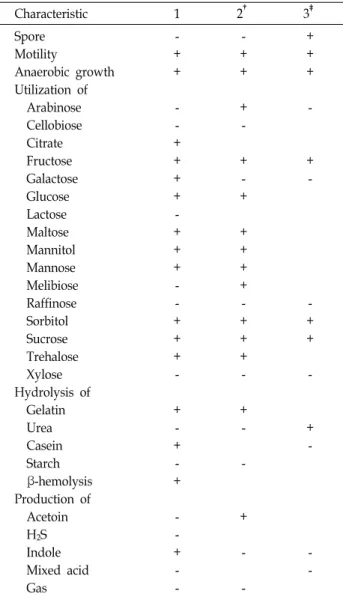
Table 1. Biochemical characteristics of Serratia sp. PDGS 120915 and other Serratia species
Characteristic 1 2† 3‡
Spore Motility
Anaerobic growth Utilization of Arabinose Cellobiose Citrate Fructose Galactose Glucose Lactose Maltose Mannitol Mannose Melibiose Raffinose Sorbitol Sucrose Trehalose Xylose Hydrolysis of Gelatin Urea Casein Starch β-hemolysis Production of Acetoin H2S Indole Mixed acid Gas
- + +
- - + + + + - + + + - - + + + -
+ - + - +
- - + - -
- + +
+ -
+ - +
+ + + + - + + + -
+ -
-
+
-
-
+ + +
-
+ -
- + +
-
+ -
- -
Strains: 1, Serratia sp. PDGS 120915; 2, Serratia marcescens; 3, Serratia marcescens subsp. sakuensis.
†Data are from Grimont and Grimont (1978).
‡Data are from Ajithkumar Bindu et al. (2003).
Table 2. Enzymatic activity features of Serratia sp. PDGS 120915 and other Serratia species
Characteristic 1 2† 3‡
Arginine dihydrolase Lysine decarboxylase Ornithine decarboxylase Cytochrome oxidase Catalase
Alkaline phosphatase Esterase (C4) Esterase Lipase (C8) Lipase (C14) Leucine arylamidase Valine arylamidase Cystine arylamidase Trypsin
α-chymotrypsin Acid phosphatase
Naphthol-AS-BI-phosphohydrolase α-galactosidase
β-galactosidase β-glucuronidase α-glucosidase β-glucosidase
N-acetyl-β-glucosaminidase α-monnosidase
α-fucosidase
- + + - + - + + - - - - - - + + - - - - - + - -
- + +
+ -
+
Strains: 1, Serratia sp. PDGS 120915; 2, Serratia marcescens; 3, Serratia marcescens subsp. sakuensis.
†Data are from Grimont and Grimont (1978).
‡Data are from Ajithkumar Bindu et al. (2003).
ti-MRSA activity, was isolated from stream water collected in Busan, Korea. In order to identify this strain, biochemical and genetical analysis were performed. Gram negative rod and the color of colony was red on LB agar plate. The results of biochemical tests were listed in Table 1. The strain utilized citrate, fructose, galactose, glucose, maltose, mannitol, man- nose, sorbitol, sucrose and trehalose, and hydrolyzed gelatin and casein. In addition, enzyme activities were positive as on lysine decarboxylase, ornithine decarboxylase, catalase, esterase, lipase, acid phophatase, naphthol-AS-BI-phospha- hydrolase and N-acetyl-β-glucosaminidase (Table 2).
To confirm the genetic characterization of strain PDGS
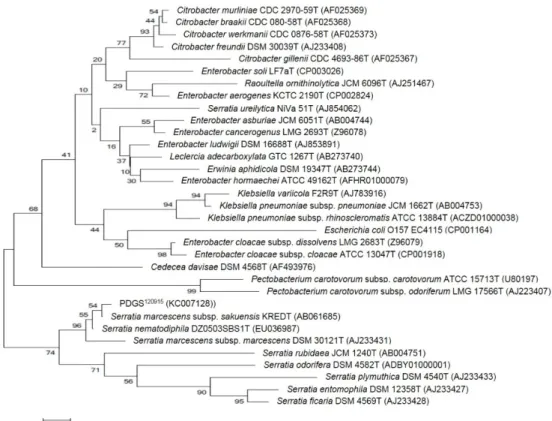
120915, 16S rRNA gene sequencing was carried out as de- scribed above. The 16S rRNA sequences of strain PDGS 120915 was aligned by comparison with available sequences from GENBANK. According to the 16S rRNA analysis, strain PDGS 120915 was 98% similar to Serratia marcescens subsp.
sakuensis KRED
T. The 16S rRNA sequence was submitted in GENBANK and the accession number is KC007128 (Fig. 1).
Based on these results, the isolated PDGS 120915 was identi- fied to be Serratia sp.
Optimum culture conditions of Serratia sp. PDGS 120915
To verify the optimum culture condition of Serratia sp.
PDGS 120915, effects of culture conditions on growth rate
and amount of pigment production were examined. Related
to growth rate and amount of pigment production, bacterial
growth was observed after 8 hr, but pigment biosynthesis
was not continued after 12 hr (Fig. 2A). Our results were
consistent with a previous study demonstrating the biosyn-
Fig. 1. Neighbor-joining tree based on 16S rRNA sequence, showing relationships between PDGS 120915 and highly homologous group. Number at the nodes are levels of bootstrap support, based on neighbor-joining analyses of 1,000 resample datasets.
thesis of prodigiosin through quorum sensing [19].
However, results from bacterial growth and pigment biosyn- thesis were different with other studies. Isolated Serratia sp.
PDGS 120915 grew in broad range at pH 5-12. Optimal growth of Serratia sp. PDGS 120915 was observed at pH 5, but optimal prodigiosin production of the bacteria was ob- served at pH 7. (Fig. 2B). These results consider that sup- pressed or non-expressed synthesis of prodigiosin are in- hibition of enzyme and membrane transport protein activities. Growth rate and pigment production were meas- ured in the range of 4~42℃. In case of Serratia sp. PDGS 120915, optimal temperature for growth and pigment pro- duction were 25℃ (Fig. 2C). However, other bacteria such as Zooshikella ganghwensis and Hahella chejuensis were 30℃, and Serratia marcescens grew at 28℃ [11]. These results might be caused by the habitat difference such as marine, soil and stream water. However, a complete block in prodigiosin pro- duction was observed at 37℃, showing that the similar re- sult from the previous study [17]. To investigate effects of NaCl concentration on bacterial growth and secondary me- tabolites biosynthesis, the growth rate and amount of pig- ment production were measured at the range of 0~10% NaCl concentration. Bacterial growth indicated 1.0 or more OD
value at the range of 0~6% NaCl concentration. Optimal growth condition was observed at 1%. In contrast with growth condition, maximum pigment was produced at 0%, and the production was reduced sharply as the concen- tration increased (Fig. 2D). Collectively, it is considered that Na
+was not necessary for stability of cell membrane and enzyme activity at the growth of Serratia sp. PDGS 120915.
Furthermore, this is considered that the Serratia sp. PDGS 120915 was adapted in stream water after originated from soil.
Characteristics of pigment
The absorption spectrum of the pigment extract from Serratia sp. PDGS 120915 and Serratia marcescens was given in Fig. 3. According to the recent study, prodigiosin pro- duction was observed at a wavelength at 535-540nm [1].
Maximum absorbance of pigment from Serratia sp. PDGS 120915 and Serratia marcescens was observed at 534 nm and 536 nm, respectively. From the results HPLC, each extracted pigments were showed peak at 39.5min and 39.8min (Fig.
4).
A B
C D
Fig. 2. Effect of culture conditions on the production of pigment. A. Growth curve; B. pH; C. Temperature (℃); D. NaCl concentration (%).
Fig. 3. UV spectrum of prodigiosin isolated from Serratia sp.
PDGS 120915 and Serratia marcescens. Line; Serratia sp.
PDGS 120915, dotted line; Serratia marcescens.
Anti-MRSA activity of Serratia sp. PDGS 120915 Serratia sp. PDGS 120915 exhibited the anti-MRSA activity as shown in Fig. 5. Previous studies with S. marcescens dem-
onstrated that secondary metabolite production was in- hibited at higher temperatures [2, 3]. When Serratia sp. PDGS 120915 spotted on the lawns of MRSA isolates and incubated at 30℃, the inhibitory zone was produced. In order to eluci- date the anti-MRSA activity according to bacterial growth phase, the strongest anti-MRSA activity was observed after stationary phase of growth. These results indicated that the anti-MRSA compound was produced by quorum sensing, and was highly produced after stationary phase.
Synergic effects between prodigiosin and β-lactams against MRSA
The β-lactams group of antibiotics includes enormous va-
riety of natural and semi-synthetic compounds, which in-
hibit several enzymes associated with the final step of pepti-
doglycan synthesis [7]. As shown in Table 3, the MICs of
ampicillin against two standard MRSA strains (KCCM 40510
and 40511) were significantly reduced from 512 to 0.5 μg/ml
when the MRSA strains were incubated with 32 μg/ml of
prodigiosin. The synergistic effect against MRSA was veri-
A
B
Fig. 4. HPLC profile of prodigiosin from Serratia sp. PDGS 120915 (A) and Serratia marcescens (B).
Fig. 5. Anti-MRSA activity of prodigiosin from Serratia sp. PDGS 120915. (A) MRSA (KCCM 40510), (B) MRSA (KCCM40511).
Table 3. Minimum inhibitory concentration (MIC) of prodigiosin and β-lactams against methicillin-resistant S. aureus (MRSA)
Strain Source MIC (μg/ml)
Prodigiosin Ampicillin Penicillin Oxacillin
MRSA (KCCM40510) MRSA (KCCM40511)
Standard strain Standard strain
128 128
512 512
512 256
128 128
Table 4. MICs and FICa indices of prodigiosin in combination with β-lactams against MRSA
Strain
Ampicillin Penicillin Oxacillin
MIC (μg/ml) FIC MIC (μg/ml) FIC MIC (μg/ml) FIC
A B b A B b A B b
MRSA40510 MRSA40511
512 512
16 16
0.251 0.251
512 256
16 32
0.258 0.258
128 128
128 128
1.250 1.250 A, without prodigiosin; B and b, prodigiosin at 32ug/ml
a The FIC was calculated as the MIC of prodigiosin or each antibiotics in combination divided by MIC of prodigiosin of each antibiotic alone. The FIC index was obtained by the sum of FICs. The FIC index indicated synergy: 0.5, synergic; >0.5 to 1, additive;
>1 to 2, independent; >2, antagonistic.
fied in combination with prodigiosin and β-lactams group.
The synergy was evaluated in terms of a FIC index, as de- scribed in Materials and Methods. FIC indices of ampicillin, penicillin and oxacillin were 0.251, 0.258 and 1.250, re- spectively (Table 4). These results indicated the synergistic
effects of prodigiosin-ampicillin and prodigiosin-penicillin
combinations on MRSA growth suppression. However, pro-
digiosin-oxacillin combination did not exhibit the synergistic
effect on MRSA growth. It is hypothesized that prodigiosin
may synergize the activity of β-lactams, which inhibit cell
wall synthesis. Differences in the synergistic effects of an- ti-MRSA substance and β-lactams group combinations were also reported in epigallocatechin gallate (EGCg) and dieckol.
EGCg showed synergy effects with penicillin and oxacillin.
Similarly, Dieckol exhibited synergistic effects on MRSA growth in combination with penicillin and ampicillin.
In this study, it is expected that Serratia sp. PDGS 120915-derived prodigiosin can be used as potential anti- biotics, and contributes to the development of alternative an- tibiotic agents against MRSA.
Acknowledgement
This work was supported by a Research Grant of Pukyong National University (2013 Year).
References
1. Allen, E. G. 1967. Conditions of the colour change of prodigiosin. Nature 216, 929-931.
2. Bar-Ness, R. et al. 1988. Increased cell surface hydro- phobicity of a Serratia marcescens NS 38 mutant lacking wet- ting activity. J. Bacteriol. 170, 4361-4364.
3. Blizzard, J. L. and Peterson, G. E. 1963. Selective inhibition of proline-induced pigmentation in washed cells of Serratia marcescens. J. Bacteriol. 85, 1136-1140.
4. Chambers, H. F. 2001. The changing epidemiology of Staphylococcus aureus? Emerg. Infect. Dis. 7, 178.
5. CLSI, 2009. Clinical and Laboratory Standards Institute (CLSI) Performance Standards for Antimicrobial Disc Diffusion Susceptibility Tests 19th ed. Approved standard.
Linical and Laboratory Standards Institute, Wayne, PA.
6. Finland, M. 1979. Emergence of antibiotic resistance in hospitals. Rev. Infect. Dis. 1, 4-21.
7. Foster, T. J. 2004. The Staphylococcus aureus “superbug”. J.
Clin. Invest. 114, 1693-1696.
8. Grierson, D. S. and Afolayan, A. J. 1999. Antibacterial activ- ity of some indigenous plants used for the treatment of wounds in the Eastern Cape, South Africa. J. Ethnopharmacol.
66, 103-106.
9. Isnansetyo, A., Cui, L., Hiramatsu, K. and Kamei, Y. 2003.
Antibacterial activity of 2, 4-diacetylphloroglucinol pro-
duced by Pseudomonas sp. AMSN isolated from a marine alga, against vancomycin-resistant Staphylococcus aureus. Int J. Antimicrob. Agents 22, 545-547.
10. Jevons, M. P and Parker, M. T. 1964. The evolution of new hospital strains of Staphylocuccus aureus. J. Clin. Pathol. 17, 243-250.
11. Kim, J. S., Kim, M. C., Lee, K. J. and Heo, M. S. 2009.
Isolation and optimal culture conditions of prodigiosin-like pigment produced by Zooshikella sp. JE34. Kor. J. Microbiol.
Biotechnol. 37, 219-225.
12. Lee, D. S. 2009. Isolation and Characterization of Anti- MRSA (Methicillin-Resistant Staphylococcus aureus) Substances from Marine Organisms. Microbiology. Pukyong National University, Busan, Korea.
13. Levy, S. B. 1998. The challenge of antibiotic resistance. Sci.
Am. 278, 32-39.
14. Miller, H. 1987. Practical aspects of preparing phage and plasmid DNA: growth, maintenance, and storage of bacteria and bacteriophage. Methods Enzymol. 152, 145-170.
15. National Committee for Clinical Laboratory Standards.
2004. Method for dilution antimicrobial susceptibility testing for bacteria that grow aerobically. Apporved standard M7-A6, 7th ed. National Committee for Clinical Laboratory Standards, Wayne, PA, USA.
16. Norden, Carl, W., Heidi, W. and Eva, K. 1979. Comparison of techniques of measurement of in vitro antibiotic synergism. J. Infect. Dis. 140, 629-633.
17. Pryce, L. H. and Terry, F. W. 2000. Spectrophotometric assay of gene expression: Serratia marcescens pigmentation.
Bioscience 26, 3-13.
18. Taga, N. 1968. Some ecological aspects of marine bacteria in the Kuroshio. Cur. Bull. Misak. Mar. Biol. Kyoto Univ. 12, 65-76.
19. Thomson, N. R., Crow, M. A., McGowan, S. J., Cox, A. and Salmond, G. P. 2000. Biosynthesis of carbapenem antibiotic and prodigiosin pigment in Serratia is under quorum sens- ing control. Mol. Microbiol. 36, 539-556.
20. Travis, J. 1994. Reviving the antibiotic miracle? Science 264, 360-362.
21. Williams, R. P and Qadri, S. M. H. 1980. The pigment of Serratia. pp. 31-79. In: Con Graevenitz A, Rubin SJ. (Eds) The genus of Serratia. Boca Raton, CRC Press.
22. Witte, W. 1999. Antibiotic resistance in gram-positive bac- teria: epidemiological aspects.