Vol. 24, No. 7 (2014)
370
역 - 마이셀 공정에 의한 CoAl
2O
4무기안료 나노 분말의 합성 및 특성
손정훈·배동식†
국립창원대학교 신소재공학과
Synthesis and Characterization of CoAl
2O
4Inorganic Pigment Nanoparticles by a Reverse Micelle Processing
Jeong-Hun Son and Dong-Sik Bae
†School of Nano & Advanced Materials Eng., Changwon National Univ., Changwon, Korea
(2014년 5월 2일 접수: 2014년 6월 16일최종수정: 6월 25일채택)
Abstract Inorganic pigments have high thermal stability and chemical resistance at high temperature. For these reasons, they are used in clay, paints, plastic, polymers, colored glass and ceramics. CoAl2O4 nano-powder was synthesized by reverse-micelle processing the mixed precursor(consisting of Co(NO3)2 and Al(NO3)3). The CoAl2O4 was prepared by mixing an aqueous solution at a Co:Al molar ratio of 1:2. The average particle size, and the particle-size distribution, of the powders synthesized by heat treatment (at 900; 1,000; 1,100; and 1,200oC for 2h) were in the range of 10-20 nm and narrow, respectively. The average size of the synthesized nano-particles increased with increasing water-to-surfactant molar ratio. The synthesized CoAl2O4 powders were characterized by X-ray diffraction analysis(XRD), field-emission scanning electron microscopy(FE- SEM) and color spectrophotometry. The intensity of X-ray diffraction of the synthesized CoAl2O4 powder, increased with increasing heating temperature. As the heating temperature increased, crystal-size of the synthesized powder particles increased.
As the R-value(water/surfactant) and heating temperature increased, the color of the inorganic pigments changed from dark blue- green to cerulean blue.
Key words inorganic - pigment, CoAl2O4, spinel, reverse micelle, nanoparticle.
1.
서 론안료는 물이나 기타 용매에 용해되지 않는 물질로써 염 료와 구분된다. 이러한 안료는 무기 안료와 유기 안료 로 구분 지을 수 있는데, 무기 안료는 우수한 내열성, 내화학성 등의 특성을 나타내어 점토, 페인트, 도자기, 타 일, 유리, 각종 세라믹 제품 등의 색상을 표현하는데 많 이 응용되고 있다.1-4)
여러 가지 무기 안료 중에서 CoAl2O4는 청색을 발색 하는 대표적인 재료로 알려져 있다. CoAl2O4는 스피넬 구 조를 가지며, AB2O4의 일반식을 가진다. A2+이온이 4면 체 위치에 위치하며, B3+이온이 8면체 위치에 위치한다.
A자리와 B자리에 여러 가지 원소들을 치환하면 다양한
색깔의 안료를 얻을 수 있다.5-16) 그리고 동일한 성분의 안료라도 합성되는 입자의 사이즈나 형상, 열처리 온도에 따라 다양한 발색을 한다고 보고되고 있다.1-3,5-16)
나노 재료는 벌크 재료와 비교하여 우수한 물리·화 학적 특성을 가지는데,17-19) 최근 나노 크기의 안료 합성 과 그 응용에 대한 연구가 활발히 진행 중이다.4,20-24)
무기 안료 분말을 제조하는 방법은 고상법, 졸-겔법, 공 침법, 수열합성법, 역-마이셀법 등 다양한 방법들이 보고 되고 있다.22,25-31)이 중에서 역-마이셀법은 여러 가지 액 상법 중에서 간단한 공정으로 나노 크기의 세라믹 분말 을 합성할 수 있고, 합성 시 입자의 크기제어가 용이한 장점이 있는 공정이다.12,32-37)
본 연구에서는 역-마이셀법을 이용하여 나노 크기를 가
†Corresponding author
E-Mail : [email protected] (D. S. Bae, Changwon Nat'l Univ.)
©Materials Research Society of Korea, All rights reserved.
This is an Open-Access article distributed under the terms of the Creative Commons Attribution Non-Commercial License (http://creative- commons.org/licenses/by-nc/3.0) which permits unrestricted non-commercial use, distribution, and reproduction in any medium, provided the original work is properly cited.
지는 청색 CoAl2O4 무기 안료 분말을 합성하였다. 공정 변수인 R(Water/Surfactant)값과 열처리 온도에 따라 합 성되는 입자의 사이즈 및 형상 그리고 발색과의 관계를 연구하였다.
2.
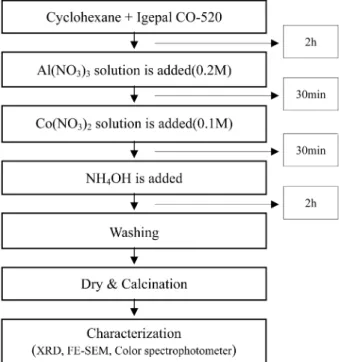
실 험역-마이셀 공정에 의한 CoAl2O4 무기 나노 안료 분말 합성 실험공정은 Fig. 1에 나타내었다. 용매인 Cyclo- hexane(99.9+% DEAJUNG) 50 ml에 계면활성제인 Igepal CO-520(poly oxyethy-lene nonylphenyl ether, SIGMA- ALDRICH)을 20.05 g 첨가하였다. 0.1M 농도의 Co(NO3)2· 6H2O(Cobalt(II)nitrate hexahydrate, DAEJUNG)수용액과, 0.2M 농도의 Al(NO3)3·9H2O(Aluminum nitrate nonhy- drate, SIGMA-ALDRICH)를 3.25~6.5 ml첨가 한 후, 촉 매인 NH4OH(25.0~28.0 %, DAEJUNG)를 2.5~5 ml 첨 가하여 충분히 교반 하였다. 실험의 공정 변수인 R = [Water]/[Surfactant]의 비율을 조정하여 마이크로 에멀젼 의 크기를 제어할 수 있고, 최종합성물인 CoAl2O4 의 크 기를 제어할 수 있다. 에탄올을 이용하여 5회 세척 후 100oC에서 24시간 건조하여 회갈색의 분말을 얻었다. 건 조된 분말을 열처리 온도에 따른 특성을 알아보고자 900~1200oC, 2시간 열처리하였다. 합성된 CoAl2O4 무기 나노 안료 분말의 형상과 크기는 전계 방사형 주사전자 현미경(Field Emission Scanning Electron Microscopy, CZ/MIRA I LMH)을 이용하여 관찰하였고, 결정구조를
분석을 위해 X-ray diffraction(XRD, MiniFlexII, Rigaku) 를 측정하였다. 합성된 안료의 색상은 국제조명위원회 (CIE)의 표색계(L*, a*, b*)를 기준으로 Color spectropho- tometer(ColorMate, SCINCO)를 통하여 분석하였다. CIE 색 공간에서 L*값은 색의 명도(L* = 0 검은색, L* = 100 흰색)를 나타내며, a*값은 빨강과 초록(−a*=초록색, +a*
=빨강색)을 나타내고, b*값은 노랑과 파랑(−b*=파랑색, +b*=노랑색)을 나타낸다.
3.
결과 및 고찰합성된 CoAl2O4 무기 나노 안료의 결정구조를 관찰하 기 위해 XRD 분석을 실시 하였다. Fig. 2 는 합성된 분말의 R값(Water/Surfactant)에 따른 XRD 분석 결과이 다. 모든 조건에서 단일상의 Spinel peak가 나타났다. R 값이 증가할수록 XRD peak의 강도가 증가하는 것을 확
Fig. 1. Experimental procedure of the synthesis of CoAl2O4 nano- particles by a reverse micelle processing.
Fig. 2. XRD patterns of CoAl2O4 powders calcinations at 1100oC for 2h as a function of R value(water /surfactants molar ratio) : (a) R = 4, (b) R = 6 and (c) R = 8.
Fig. 3. XRD patterns of CoAl2O4 nanoparticles synthesized at R = 8 and various calcination temperatures; (a) 900oC, (b)1000oC, (c) 1100oC and (d) 1200oC.
인할 수 있는데, 합성된 분말의 결정성이 증가함을 나 타낸다. Fig. 3 은 CoAl2O4 나노 무기 안료의 하소 온 도에 따른 XRD 분석 결과이다. 동일한 합성조건(R = 8) 에서 하소 온도가 증가함에 따라 XRD peak의 강도가 증가하는 것을 확인할 수 있다. Table 1, 2는 Scherrer equation (1)을 이용하여 결정의 크기를 계산하였다.
(1)
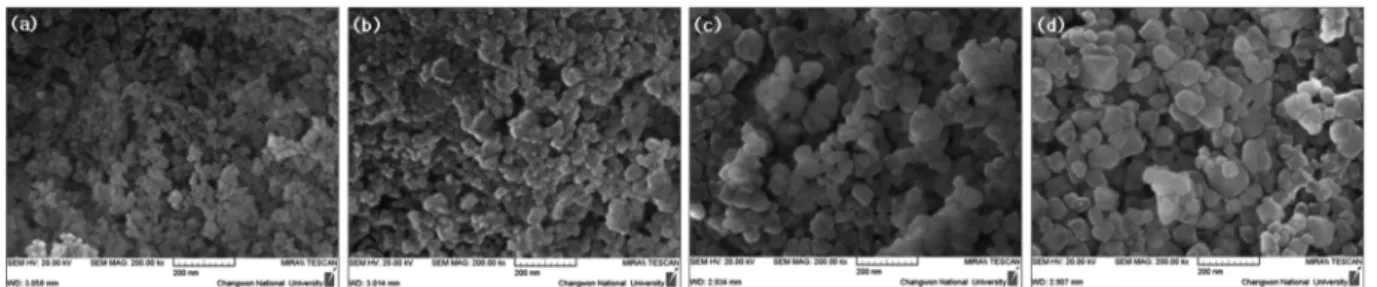
(311)면에 대하여 R값과 하소 온도가 증가할수록 반가 폭이 감소하며 결정의 크기가 증가하는 것을 알 수 있 었다. 합성된 분말의 입자 크기 및 형상을 알아보기 위 하여 FE-SEM 분석을 실시하였다. Fig. 4 는 CoAl2O4
나노 무기 안료의 R값에 따른 FE-SEM 미세구조 사진 을 나타내었다. 합성된 입자는 구형에 가까운 형상이었 으며, 입자의 크기는 대략 R = 4는 20 nm이하, R = 6은 20~30 nm, R = 8은 30~50 nm를 관찰할 수 있었으며, R 값이 증가함에 따라 입자의 크기가 증가하는 경향을 볼 수 있었다. Fig. 5 은 CoAl2O4 나노 무기 안료의 하소 온도에 따른 FE-SEM 미세구조 사진을 나타내었다. 900
oC에서 하소한 분말은 아주 미세한 크기의 분말이었고, 온 도가 증가함에 따라 분말의 크기가 증가하는 것을 관찰 할 수 있었다. 합성된 분말은 거의 구형에 가까운 형상 이 관찰되었다.
Fig. 6 은 합성된 안료의 R값에 따른 색상과 CIE L*a*b* 값을 나타내었다.R값에 따라 L*값은 27.94 → 33.15로, a*값은 −17.49 → −4.57로, b*값은 −19.85 → −39.50으로 나타났는데, R값 증가에 따라 색깔이 청록색에서 점점 밝은 청색으로 변화되는 것을 확인할 수 있었다. Fig. 7 은 동일한 R값으로 합성된 분말의 하소 온도에 따른 색 상과 CIE L*a*b* 값을 나타내었다. 하소 온도에 따라 L* 값은 22.41 → 34.79로, a*값은 −15.22 → −0.46로, b*값은
−11.28 → −43.34으로 나타났는데, 하소 온도가 증가함에 따라 색깔이 청록색에서 점차 밝은 청색으로 변화되는 것을 관찰할 수 있었다.
4.
결 론역-마이셀 공정을 이용하여 나노 크기의 청색 CoAl2O4
d 0.9 λ
B⋅cosθ ---
=
Table 1. Crystal size of CoAl2O4 powders calcinations at 1100oC for 2h as a function of R value(water /surfactants molar ratio) : (a) R = 4, (b) R = 6 and (c) R = 8.
(a) (b) (c)
FWHM (311) 0.2985 0.2881 0.2734
Crystal size (nm) 27.76 28.53 30.31
Table 2. Crystal size of CoAl2O4 nanoparticles synthesized at R = 8 and various calcination temperatures; (a) 900oC, (b)1000oC, (c) 1100oC and (d) 1200oC.
(a) (b) (c) (d)
FWHM (311) 0.6205 0.3468 0.2734 0.2266 Crystal size (nm) 13.36 23.90 30.31 36.57
Fig. 4. FE-SEM image of CoAl2O4 powders calcinations at 1100oC for 2h as a function of R value(water /surfactants molar ratio) : (a) R = 4, (b) R = 6 and (c) R = 8.
Fig. 5. FE-SEM image of CoAl2O4 nanoparticles synthesized at R = 8 and various calcination temperatures; (a) 900oC, (b)1000oC, (c) 1100oC and (d) 1200oC.
무기 안료 분말을 합성하였다. XRD 결과 단일상의 CoAl2O4 Peak가 관찰되었고, R값(Water/Surfactant)과 하 소 온도가 증가할수록 결정성이 커지는 경향을 나타내 었다. FE-SEM결과 합성된 입자의 크기는 50 nm 이하였 고, 형상은 구형이었다. 공정변수인 R값(Water/Surfactant) 을 제어하여 입자의 크기를 조절할 수 있었다. 안료의 색깔은 청록색에서 R값과 하소 온도가 증가함에 따라 점 점 밝은 청색으로 발색이 변화되는 것을 확인할 수 있 었다.
감사의 글
본 연구는 한국연구재단 ERC 지원사업(2011-0030058) 의 연구결과로 수행되었습니다.
References
1. V. D. l. Luz, M. Prades, H. Beltrán and E. Cordoncillo, J. Eur. Ceram Soc., 33, 3359 (2013).
2. K. I. Lilova, A. Navrotsky, B. C. Melot and R. Seshadri, J. Solution Chem., 183, 1266 (2010).
3. D. Rangappa, T. Naka, A. Kondo, M. Ishii, T. Kobayashi and T. Adschiri, J. Am. Chem. Soc., 36, 129 (2007).
4. I. S. Ahmed, H. A. Dessouki and A. A. Ali, Spectrochim Acta, 71, 616 (2008).
5. S. R. Prim, A. Garcia, R. Galindo, S. Cerro, M. Llusar, M. V. Folgueras and G. Monros, Ceram. Int., 39, 6981 (2013).
6. S. Mestre, M. D. Palacios and P. Agut, J. Eur. Ceram.
Soc., 32, 1995 (2012).
7. I. S. Ahmed, H. A. Dessouki and A. A. Ali, Polyhedron, 30, 584 (2011).
8. M. F. Zawrah, Mater. Sci. Eng., 382, 362 (2004).
9. M. Gaudon, L. C. Robertson, E. Lataste, M. Duttine, M.
Ménétrier and A. Demourgues, Ceram. Int., 40, 5201 (2014).
10. M. Gaudon, A. Apheceixborde, M. Menetrier, A. Le Nestour, and A. Demourgues, Inorg. Chem., 48, 19 (2009).
11. M. Dondi, C. Zanelli, M. Ardit, G. Cruciani, L. Mantovani, M. Tribaudino and G. B. Andreozzi, Ceram. Int., 39, 9533 (2013).
12. A. E. Giannakas, A. K. Ladavos, G. S. Armatas and P.
J. Pomonis, Appl. Surf. Sci., 253, 6969 (2007).
13. A. Dandapat and G. De, ACS Appl. Mater. Interfaces, 4, 228 (2012).
14. G. George, V. S. Vishnu and M. L. P. Reddy, Dyes Fig. 6. The color coordinates(CIE L*a*b*) and digital photographs of CoAl2O4 powder calcination at 1100oC for 2h as a function of R value(water /surfactants molar ratio) : (a) R = 4, (b) R = 6 and (c) R = 8.
Fig. 7. The color coordinates(CIE L*a*b*) and digital photographs of CoAl2O4 nanoparticles synthesized at R = 8 and various calci- nation temperatures; (a) 900oC, (b) 1000oC, (c) 1100oC and (d) 1200oC.
Pigments, 88, 109 (2011).
15. P. L. náková, M. Trojan, J. Luxová and J. Trojan, Dyes Pigments, 96, 264 (2013).
16. A. F. Osorio, E. P. Villanueva and J. C. Fernandez, Mater. Res. Bull, 47, 445 (2012).
17. B. Balusamy, Y. G. Kandhasamy, A. Senthamizhan, G.
C h a n d r a s e k a r a n , M . S . S u b r a m a n i a n a n d K . Tirukalikundram S, J. Rare Earths, 30, 12 1298 (2012).
18. M. Mozaffari, M. EghbaliArani and J. Amighian, J.
Magn. Magn. Mater., 322, 3240 (2010).
19. J. Yoshida, M. Stark, J. Holzbock, N. Hüsing, S.
Nakanishi, H. Iba, H. Abea and M. Naito, J. Power Sourc., 226, 122 (2013).
20. P. M. T. Cavalcante, M. Dondi, G. Guarini, M. Raimondo and G. Baldi, Dyes Pigments, 80, 226 (2009).
21. J. L. Wang, Y. Q. Li, Y. J. Byon, S. G. Mei and G. L.
Zhang, Powder Technol., 235, 303 (2013).
22. H. E. H. Sadek, R. M. Khattab, A. A. Gaber and M. F.
Zawrah, Spectrochim. Acta Mol. Biomol. Spectros., 125, 353 (2014).
23. J. H. Kim, B. R. Son, D. H. Yoon, K. T. Hwang, H. G.
Noh, W. S. Cho and U. S. Kim, Ceram. Int., 38, 5707 (2012).
24. R. KantSharma and R. Ghose, Ceram. Int., 40, 3209 (2014).
25. V. S. Vishnu and M. L. Reddy, Sol. Energ. Mater. Sol.
Cells, 95, 2685 (2011).
26. S. Jose and M. L. Reddy, Dyes Pigments, 98, 540 (2013).
27. Y. Chen, Y. Zhang and S. Feng, Dyes Pigments, 105, 167 (2014).
28. F. Yu, J. Yang, J. Ma, J. Du and Y. Zhou, J. Alloys Compd., 468, 443 (2009).
29. R. Ianos, R. Lazau and P. Barvinschi, Adv. Powder Tech., 22, 396 (2011).
30. A. F. Costa, P. M. Pimentel, F. M. Aquino, D. M. A.
Melo, M. A. F. Melo and I. M. GSantos, Mater. Lett., 112, 58 (2013).
31. H. S. Hafez and E. El-fadaly, Spectrochim. Acta Mol.
Biomol. Spectros., 95, 8 (2012).
32. H. Fathi, J. P. Kelly, V. R. Vasquez, and O. A. Graeve, Langmuir, 28, 9267 (2012).
33. H. Matsune, T. Tago, K. Shibata, K. Wakabayashi and M.
Kishida, J. Nanopart. Res., 8, 1083 (2006).
34. M. Han, C. R. Vestal, and Z. John Zhang, J. Phys. Chem.
B, 108, 583 (2004).
35. Y. Vahidshad, H. Abdizadeh, M. Akbari Baseri and H. R.
Baharvandi, J. Sol-Gel Sci. Technol., 53, 263 (2010).
36. P. Setua, R. Pramanik, S. Sarkar, C. Ghatak, S. K. Das, and N. Sarkar, J. Phys. Chem. B, 114, 7557 (2010).
37. D. B. Zhang, H. M. Cheng and J. M. Ma, J. Mater. Sci.
Lett., 20, 439 (2001).