Journal of the Korean Crystal Growth and Crystal Technology Vol. 28, No. 4 (2018) 166-169
https://doi.org/10.6111/JKCGCT.2018.28.4.166
p-ISSN 1225-1429 e-ISSN 2234-5078
Effect of raw materials for the synthesis of TiO 2 powders by a hydrothermal processing
Jungju Park*
,**, Yeon Bin Choi*, Jung Hun Son* and Dong-Sik Bae*
,†*Department of Advanced Materials Science and Engineering, Changwon National University, Changwon 51140, Korea
**Divsion of Research Institute, HanKyung TEC Co., Ltd., Jinju 52611, Korea (Received July 9, 2018)
(Revised July 30, 2018) (Accepted August 10, 2018)
Abstract TiO
2nanoparticles were prepared under high temperature and pressure conditions by precipitation from titanium tetrachloride (TiCl
4) and titanium isopropoxide (TTIP). TiO
2powders were obtained in the temperature range of 150
oC~
190
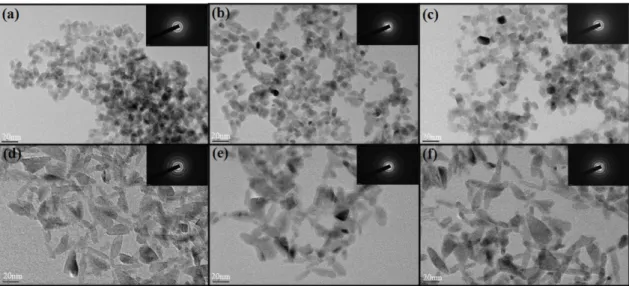
oC for 4 h. The microstructure and phase of the synthesized particles were studied by TEM and XRD. TEM and X-ray diffraction pattern shows that the synthesized particles were crystalline. The average sizes of the synthesized particles from titanium tetrachloride and titanium isopropoxide were below 20 nm and 10 nm, respectively. The average size of the synthesized particles increased with increasing reaction temperature. The effects of synthesis parameters, such as the reaction temperature and pH value are discussed.
Key words TiO
2nanoparticles, Powders morphology, Titanium precursors, Hydrothermal processing
1. Introduction
Recently, the synthesis of nanometer-sized particles has been investigated extensively because of their novel electrical, optical, magnetic, and chemical properties [1].
The effect of particle size on the electronic and optical properties of these nanosized particles during the growth of the crystallite from the molecular level to the bulk material is an area of fundamental interest [2].
Nano-sized titania as a semiconductor photocatalyst has proved to be the most suitable for widespread envi- ronment application, such as air purification, water dis- infections, hazardous waste remediation and water purification. This is due to its biological and chemical inertness, strong photo oxidization power, cost effective- ness and long-term stability against photo and chemical corrosion [3-13]. Many studies on the synthesis of superfine TiO
2powder have been done using titanium compounds, such as titanium alkoxides (Ti(OR)
4) [14, 15] or titanium tetrachloride (TiCl
4) [16] as the starting materials.
Hydrothermal processe is widely applied to obtain metal oxide nanoparticles [17]. The method have a potential for the direct preparation of crystalline ceramic powders and offer a low-temperature alternative to con- ventional powder synthesis techniques in the production
of oxide powders [18]. This process can produce fine, high-purity, stoichiometric particles of single and multi- component metal oxides. Furthermore, if process condi- tions such as solute concentration, reaction temperature, and reaction time are carefully controlled, a desire shape and size of the particles can be produced [19, 20]. These powders could be sintered at low temperature without calcination and milling steps [21].
The object of this study was to prepare TiO
2nanopar- ticles using titanium tetrachloride (TiCl
4) and titanium isopropoxide (TTIP) as precursor via a hydrothermal method.
2. Experiment
The preparation TiO
2nanoparticles were schemati- cally illustrated in Fig. 1. TiO
2precursors were precipi- tated from 0.1 M TiCl
4solution or 0.1 M TTIP solution by slowly adding KOH with rapid stirring. pH value of starting solutions varied between 7 and 11. After 30 min of stirring the solution was placed in a 1000 ml stain- less steel pressure vessel. Hydrothermal treatment was carried out at 150~190
oC for 4 h and cooled naturally to room temperature. The reaction products were washed five times by repeated centrifugation, and then dried at 80
oC for 24 hours in air.
The recovered powders were analyzed for phase com- position using X-ray diffraction (XRD, Philips X’pert
†
Corresponding author
†
![Fig. 3. TEM images (inset SAED patterns) of the synthesized TiO 2 nanoparticles by hydrothermal reaction at 150 o C for 4 h as a function of pH value: TTIP [(a) pH 7, (b) pH 9 (c) pH 11], TiCl 4 [(d) pH 7, (e) pH 9, (f) pH 11].](https://thumb-ap.123doks.com/thumbv2/123dokinfo/5154891.588322/2.892.103.790.501.763/images-inset-patterns-synthesized-nanoparticles-hydrothermal-reaction-function.webp)