Vol. 22, No. 6 (2012)
298
†Corresponding author
E-Mail : [email protected] (D. S. Bae)
Synthesis of Fe/SiO
2Core-Shell Nanoparticles by a Reverse Micelle and Sol-Gel Processes
Jeong Hun Son and Dong Sik Bae
†School of Nano & Advanced Materials Engineering, Changwon National Univ., Gyeongnam 641-773, Korea (Received May 26, 2012 : Received in revised form June 10, 2012 : Accepted June 11, 2012)
Abstract
Fe/SiO2 core-shell type composite nanoparticles have been synthesized using a reverse micelle process combined with metal alkoxide hydrolysis and condensation. Nano-sized SiO2 composite particles with a core-shell structure were prepared by arrested precipitation of Fe clusters in reverse micelles, followed by hydrolysis and condensation of organometallic precursors in micro-emulsion matrices. Microstructural and chemical analyses of Fe/SiO2 core-shell type composite nanoparticles were carried out by TEM and EDS. The size of the particles and the thickness of the coating could be controlled by manipulating the relative rates of the hydrolysis and condensation reaction of TEOS within the micro-emulsion. The water/surfactant molar ratio influenced the Fe particle distribution of the core-shell composite particles, and the distribution of Fe particles was broadened as R increased. The particle size of Fe increased linearly with increasing FeNO3 solution concentration. The average size of the cluster was found to depend on the micelle size, the nature of the solvent, and the concentration of the reagent.The average size of synthesized Fe/SiO2 core-shell type composite nanoparticles was in a range of 10-30 nm and Fe particles were 1.5-7 nm in size. The effects of synthesis parameters, such as the molar ratio of water to TEOS and the molar ratio of water to surfactant, are discussed.
Key words
Fe/SiO2 nanoparticles, core-shell type nanoparticles, sol-gel process, reverse micelle process.1. Introduction
Recently, the synthesis of nanometer-sized particles of metals, semiconductors and metal oxides has been investi- gated extensively because of their novel electrical, optical, magnetic, and chemical properties. Exciting potential ap- plications of metal nanoparticles in catalysis,
1-6)DNA sequencing,
7-9)non-linear optical devices,
10)biological sen- sor,
11,12)information storage
13)and plasmonics
14)are mainly due to their optical
15)and electronic properties.
16)Compos- ites formed by silver ions or nano-clusters embedded in ceramics or glasses have recently attracted much attention as promising materials for applications in optoelectronics,
17)separation membranes.
18)The synthesis of nanoparticles and control of their properties are important in many critical areas of modern technology such as catalysis, ceramic processing, solar energy conversion, pharmaceu- tics, and photography. Many approaches have been ex- plored for the preparation of spherical ultrafine particles, including the use of colloids, polymers, glasses, and mi- celles to successfully control aggregation.
19,20)Many new and unusual physical and chemical properties also arise as particles attain nanosize dimensions.
21,22)There is increasing recognition that aqueous synthesis offers growth control
capabilities that can be conveniently exploited in preparing these desirable fine particles.
23,24)Compared to conven- tional solid-state reaction methods, solution-based synthesis results in higher levels of chemical homogeneity. This is especially important when multi-component oxides are being prepared The object of this study was to prepare Fe core-shell SiO
2nanoparticles by a combined reverse micelle and sol-gel processing.
2. Experimental Procedure
The experimental procedure used to prepare Fe/SiO
2core-shell type composite nanoparticle is illustrated in Fig.
1. Micro-emulsions of total volume 20 mL consisting of 4 g of Igepal CO-520 (Aldrich Chemical Co.), 10 mL of cyclohexane (Aldrich Chemical Co.), 0.65-1.30 mL of 0.02 M, 0.04M, 0.06M and 0.08M Fe(NO
3)
3(Nonahydrate, 99.9%, reagent grade, Aldrich Chemical Co.) solution.
The average of the synthesized particles was controlled by varying the ratio R = [water]/[surfactant]. The micro- emulsion was mixed rapidly, and after 30 min of equili- bration, one drop (~0.05 mL) of hydrazine hydrate (9M N
2H
4X·H
2O, Aldrich Chemical Co.) was added as a re- ducing agent. After nanosize water droplets formed while stirring, TEOS (Tetraethyl orthosilicate, 98%, 9Aldrich Chemical Co.) was added into the stirred micro-emulsion.
The amount of TEOS was varied according to the different
molar ratios of water to TEOS, H = [water]/[TEOS], which is the most important factor dictating the size of the nanoparticle. NH
4OH was injected into the microemulsion to accelerate the condensation reaction of metal alkoxide precursors. Reverse micelles were prepared from a nonionic surfactant, poly (oxyethylene) nonylphenly ether (Igepal CO-520, Aldrich Chemical Co.), which was used without further purification. Other chemicals, such as TEOS (Tetra- ethyl orthosilicate, Aldrich Chemical Co.), cyclohexane, and NH
4OH (Aldrich Chemical Co., 28%) were used as received. The structure, size and morphology of the re- sulting composite nanoparticles were examined by trans- mission electron microscope (TEM, Jeol 2000FXII, Japan).
For TEM studies, samples were prepared by adding drops of freshly prepared cluster solution on a carbon film sup- ported on a Cu grid.
3. Results and Discussion
Nanometer-sized SiO
2composite particles with a core- shell structure have been prepared by arrested precipitation of Fe clusters in reverse micelles, followed by hydrolysis and condensation of organometallic precursors in the micro-emulsion matrices. The core particles are formed by a homogeneous nucleation and growth process, the shells are most likely formed through heterogeneous nucleation and growth. These two steps are different in mechanism, controlling the formation of the nanoparticles is very sensitive to modest processing changes. The first step is rapid, complete reduction of the metal to the zero valence state. The second step is growth via reagent exchanges between micelles.
25)Nucleation and growth of Fe particles is likely to be a diffusion-controlled process through interaction between micelles, but it may be influence by many other factors such as phase behavior and solubility, average occupancy of reacting species in the aqueous pool, and the dynamic behavior of the micro-emulsion.
25)Metal-organic deriva- tives within the micro-emulsion reaction matrix undergo a hydrolysis reaction and two possible condensation reaction, which can be represented as follows.
26,27)M(OR)
n+ H
2O → M(OR)
n-1(OH) + R(OH) (1) M(OR)
n+ M(OR)
n-1(OH) →
M
2O(OR)
2n-2(OH) + R(OH) (2) M(OR)
n-1(OH) + M(OR)
n-1(OH) →
M
2(OR)
2n-2+ H
2O (3)
As a first approximation, it may be assumed that the reverse micelle aggregates present in the solution are not affected by the addition of TEOS molecules or by sub-
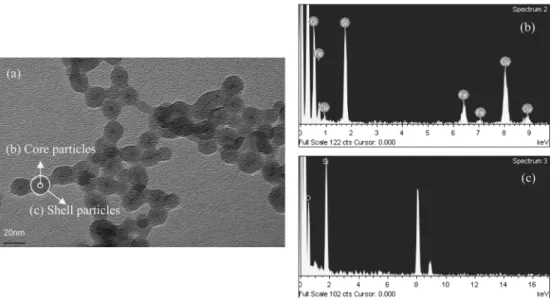
Fig. 2. Energy disperse spectrum of Fe Fe/SiO2 core-shell type compositenanoparticles by TEM-EDS analysis: (a) TEM, (b) Core and (c) Shell.
Fe Reverse Micelles
Add Hydrazine Reduction of Fe
Equilibration
Add TEOS, NH4OH Hydrolysis and Condensation
Washing/Recovery
Characterization
Fig. 1. Experimental procedure for the synthesis of Fe/SiO2 core-shell type composite nanoparticles by reverse micelle and sol-gel processing.
sequent reactions, and in particular that the aggregation numbers of the micelles remain unchanged. The TEOS molecules would then interact rapidly with the water mol- ecules inside the reverse micelles, forming partially hydro- lyzed species. These hydrolyzed species remain bound to the micelles due to their enhanced amphiphilic character.
It is likely that hydrolysis occurs within each reverse micelle, whereas condensation (particle growth) may occur also by intermicellar contracts. Therefore, the size of the composite particles depends on the relative rates of the hydrolysis and condensation reactions. Fig. 2 shows the spectrum of Fe/SiO
2core-shell type composite nanopar-
Fig. 4. The average particle size of the Fe Fe/SiO2 core-shell type composite nanoparticles synthesized at R = 6, X = 1, C = 0.02M and different concentration H values: (a) H = 50, (b) H = 100, (c) H = 200 and (d) shell particle size.
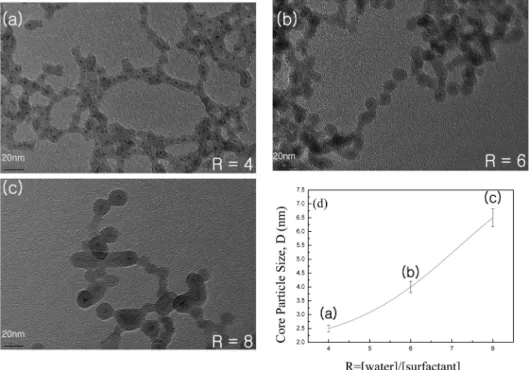
Fig. 3. Fe size of the Fe Fe/SiO2 core-shell type composite nanoparticles synthesized at H = 100, X = 1, C = 0.02M and different concentra- tion R values: (a) R = 4, (b) R = 6 and (C) R = 8.
ticles by TEM - EDS analysis. Due to the low atomic number of the cluster nano-composites the core-shell struc- ture is hardly recognized in these electron micrographs.
However, the EDS analysis indicates the existence of the Fe cluster.
Influence of the processing parameters on the formation of nano-composite has been studied. For a constant H value, the growth rate and particle size increase with increasing R. Fig. 3 shows that Fe size of the Fe/SiO
2core-shell type composite nanoparticles synthesized at H = 100, X = 1, C = 0.02M and different concentration R values : (a) R = 4, (b) R = 6 and (c) R = 8. For a constant R value, the growth rate and particle size decrease with increasing H. Fig. 4 shows that Fe size of the Fe/SiO
2core-shell type composite nanoparticles synthesized at R = 6, X = 1, C = 0.02M and different concentration H values:
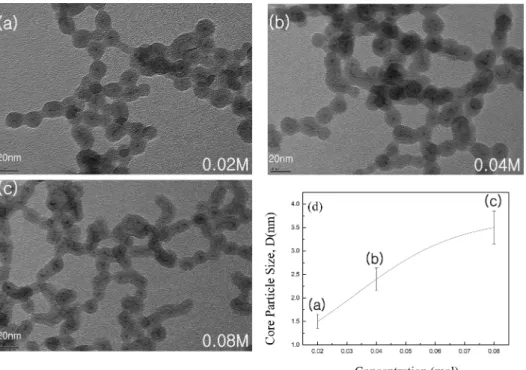
(a) H = 50, (b) H = 100 and (c) H = 200. Fig. 5 shows that Fe size of the Fe Fe/SiO
2core-shell type composite nanoparticles synthesized at R = 4, H = 50, X = 1 and dif- ferent concentration values : (a) 0.02M, (b) 0.04M and (c) 0.08M. Fe size of the Fe/SiO
2core-shell type composite nanoparticles increased with increasing the concentration of solution.
4. Conclusion
Spherical Fe/SiO
2core-shell type composite nanoparticles with a uniform size distribution have been prepared using self-assembly molecules, in conjunction with the hydrolysis
and condensation of organometallic precursors. The water/
surfactants molar ratio influenced the distribution of Fe/
SiO
2core-shell type composite nanoparticles and the dis- tribution of Fe particles was broadened as R increased.
The distribution of Fe particle size of Fe/SiO
2core-shell type composite nanoparticles increased linearly with in- creasing FeNO
3solution concentration. The average size of synthesized Fe core-shell SiO
2nanoparticles were about in the size range of 10-30 nm and Fe particles 5-15 nm.
The average size of the cluster was found to depend on the micelle size, the nature of the solvent, and the concentra- tion of the reagent.
Acknowledgments
This study was financially supported by a Changwon National University(2011), Korea.
References
1. G. Schmid, Chem. Rev., 92, 1709 (1992).
2. J. L. Bars, U. Specht, J. S. Bradley and D. G. Black- mond, Langmuir, 15, 7621 (1999).
3. Y. Li, X. M. Hong, D. M. Collard and M. A. El-Sayed, Org. Lett., 2, 2385 (2000).
4. Y. Li and M. A. El-Sayed, J. Phys. Chem. B, 105, 8938 (2001).
5. J. Dai and M. L. Bruening, Nano Lett., 2, 497 (2002).
6. J. W. Yoo, D. Hathcock and M. A. El-Sayed, J. Phys.
Fig. 5. Fe size of the Fe Fe/SiO2 core-shell type composite nanoparticles synthesized at R = 4, H = 50, X = 1 and different concentration values:
(a) 0.02M, (b) 0.04M, (c) 0.08M and (d) core particle size.
Chem., 106, 2049 (2002).
7. R. A. Reynolds, C. A. Mirkin and R. L. Letsinger, J.
Am. Chem. Soc., 122, 3795 (2000).
8. D. Zanchet, C. M. Micheel, W. J. Parak, D. Gerion, S. C.
Williams and A. P. Alivisatos, J. Phys. Chem. B, 106, 11758 (2002).
9. J. M. Nam, S. J. Park and C. A. Mirkin, J. Am. Chem.
Soc., 124, 3820 (2002).
10. P. Galletto, P. F. Brevet, H. H. Girault, R. Antoine and M.
Broyer, J. Phys. Chem. B, 103, 8706 (1999).
11. C. A. Mirkin, R. L. Letsinger, R. C. Mucic and J. J.
Storhoff, Nature, 382, 607 (1996).
12. M. Han, X. Gao, J. Z. Su and S. Nie, Nat. Biotechnol., 19, 631 (2001).
13. S. Sun, C. B. Murray, D. Weller, L. Folks and A. Moser, Science, 287, 1989 (2000).
14. S. A. Maier, M. L. Brongersma, P. G. Kik, S. Meltzer, A. A. G. Requicha and H. A. Atwater, Adv. Mater., 13, 1501 (2001).
15. W. P. McConnell, J. P. Novak, L. C. Brousseau III, R. R.
Fuierer, R. C. Tenent and D. L. Feldheim, J. Phys. Chem.
B, 104, 8925 (2000).
16. S. Chen and Y. Yang, J. Am. Chem. Soc., 124, 5280 (2002).
17. G. De1, L. Tapfer, M. Catalano, G. Battaglin, F. Caccavale, F. Gonella, P. Mazzoldi and R. F. Haglund, Appl. Phys.
Lett., 68, 3820 (1996).
18. T. Kokugan, A. Trianto and H. Takeda, J. Chem. Eng.
Jpn., 31, 596 (1998).
19. Y. Wang and N. Herron, J. Phys. Chem., 95, 525 (1991).
20. Y. M. Tricot and J. H. Fendler, J. Phys. Chem., 90, 3369 (1986).
21. Y. Wang and W. Mahler, Optic. Comm., 61, 233 (1987).
22. N. Ichinose, Introduction to Fine Ceramics: Applications in Engineering, p. 3, John Wiley & Sons, New York, USA (1987).
23. N. Ichinose, Y. Ozaki and S. Kashu, Superfine Particle Technology, p. 24, Springer, New York, USA (1988).
24. C. J. Brinker and G. W. Scherer, Sol-Gel Science : The Physics and Chemistry of Sol-Gel Processing, p. 2, Academic Press, San Diego, USA (1990).
25. A. E. Neeves and M. H. Birnboim, J. Opt. Soc. Am. B, 6, 787 (1989).
26. K. Osseo-Asare and F. J. Arrigada, Ceramic Trans., 12, 3 (1990).
27. T. Li, J. Moon, A. A. Morrone, J. J. Mecholsky, D. R.
Talham and J. H. Adair, Langmuir, 15, 4328 (1999).