• 검색 결과가 없습니다.

Characterization of TiO<sub>2</sub> Synthesized in Acidic Conditions at Low Temperature by Sol-gel Method

N/A
N/A
Protected

Academic year: 2021

Share "Characterization of TiO<sub>2</sub> Synthesized in Acidic Conditions at Low Temperature by Sol-gel Method"

Copied!
6
0
0

로드 중.... (전체 텍스트 보기)

전체 글

(1)

DOI: 10.4150/KPMI.2010.17.5.409

Characterization of TiO 2 Synthesized in Acidic Conditions at Low Temperature by Sol-gel Method

Thanh Binh Nguyen, Moon-Jin Hwang

a

, Seon Sam Lee

b

, Dong Eon Choe

b

, and Kwang-Sun Ryu *

Department of Chemistry, University of Ulsan, Daehak-ro 93, Nam-gu, Ulsan, 680-749, Korea

a

Energy Harvest-Storage Research Center, University of Ulsan, Daehak-ro 93, Nam-gu, Ulsan, 680-749, Korea

b
Sunkyoung Watech Co., Ltd. 322-Dong, Onsaneup Hwasanri, Uljugun, Ulsan, 689-896, Korea (Received August 30, 2010; Revised September 27, 2010; Accepted October 8, 2010)

Abstract Titanium dioxide (TiO

2

), which is one of the most basic materials in our daily life, plays a key role for environment purification. We synthesized TiO

2

nanoparticles by the hydrolysis reactions of titanium tetrai- sopropoxide using HNO

3

as a peptizing agent or CH

3

COOH as a chelating agent in the sol-gel method. The pow- der consisted of a rod shape or a spherical shape according to the concentration and kind of acid. The physical properties of TiO

2

nanoparticles were investigated with X-ray diffraction, SEM, BET analysis, and UV-Vis spec- trophotometer.

Keywords : TiO

2

, Nanoparticles, Photocatalyst, Sol-gel procedure

1. Introduction

TiO

2

nanoparticles have attracted much interest from many researchers due to their wide applica- tions such as the white pigment, sensors, catalysts, and photocatalysts. TiO

2

photocatalysts have been extensively used for environmental applications because of its high oxidative power, nontoxicity, photostabil- ity, and water insoluble properties under most condi- tions [1-7]. TiO

2

with a controllable size distribution and morphology has been obtained by using sol-gel process methods. The chemistry of the sol-gel pro- cess is mainly based on hydrolysis (1) and polycon- densation (2, 3) of titanium alkoxides leading to the formation of an extended network [3].

Ti–OR + H

2

O Ti–OH + ROH (1) Ti–OH + OR-Ti Ti–O–Ti + ROH (2) Ti–OH + OH–Ti Ti–O–Ti + H

2

O (3)

The morphologies and crystal phase of the result- ing product derived from the sol-gel process are strongly affected by kinetics of hydrolysis and con- densation reactions of alkoxide precursor, chemical compounds, and experimental conditions [3]. The basic requirements for photoactive materials are high crystallinity, large surface area, and higher concen- tration of surface hydroxyl group, etc [8, 9]. The crystalline TiO

2

synthesized at low temperature will be able to give many noticeable advantages. For instances, this preparation method allows a wider selection of support materials such as plastic, wood, or cotton. It will offer a benefit for the control of the crystal size and for the fine nanocrystalline. This method also saves energy and overall cost during the TiO

2

preparation process. It can be a practical prepa- ration method. The various techniques using sol-gel method have been applied to produce TiO

2

powder [2-5].

*Corresponding Author : [Tel : +82-52-259-2763; E-mail : [email protected]]

(2)

In this work, the physical properties of TiO

2

syn- thesized in acidic conditions at the mild reaction temperature were analyzed. TiO

2

nanoparticles con- sisted of anatase, rutile, or anatase and rutile mixed phase. The TiO

2

preparation process at low tempera- ture can allow not only the simple and economic synthesis method but also the responsible TiO

2

prod- uct with larger surface areas.

2. Materials and Experimental

The sol-gel process was carried out using titanium tetraisopropoxide (TTIP) (98%, Sigma-Aldrich Chem- icals Ltd., USA), isopropyl alcohol (IPA) (99.5%

anhydrous, Sigma-Aldrich Chemicals Ltd., USA), HNO

3

(Dae Jung Chemical Co., Korea), CH

3

COOH (Dae Jung Chemical Co., Korea), and distilled water.

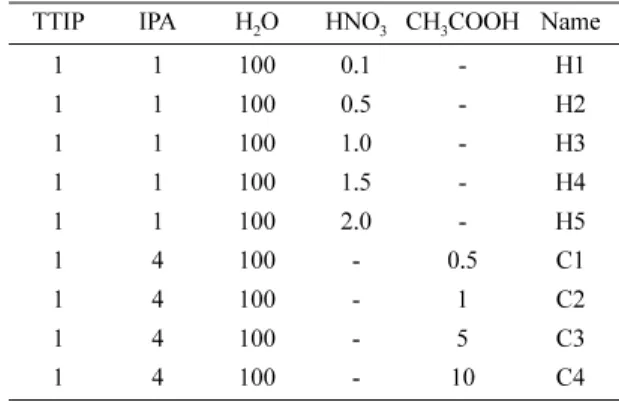
The molar ratio of materials and the name of sam- ples are listed in Table 1. The solution A with TTIP and IPA and the solution B with H

2

O and acid were mixed in ambient conditions for 50 hours and then heated at 80°C for 10 hours. After separating and several washing with ultrasonic wave, TiO

2

powder was dried at 100°C.

Table 1 summarizes the molar ratio of the materi- als. In the case of H1 sample, the molar ratio of TTIP, IPA, H

2

O, and HNO

3

was 1, 1, 100, and 0.1, respectively. When we changed the molar ratio of HNO

3

acid, we obtained H2, H3, H4, and H5 sam- ples. Similarly, we obtained C1, C2, C3, and C4 by

changing the molar ratio of CH

3

COOH acid.

The X-ray diffraction (XRD, Rigaku ultra-X, Rigaku Co., Cu K

α

radiation, 40 kV, 120 mA, Japan) pat- terns of TiO

2

powder were measured at step scan rate of 0.02°/sec in the 2 θ range (10-80°) to identify the crystalline phase of TiO

2

. The morphologies were analyzed using scanning electron microscopy (SEM, Supra 40, Carl Zeiss Co., Ltd., Germany). The absorption spectra were recorded on UV-Vis spectro- photometer (OPTIZEN POP, Mecasys Co., Ltd., Korea) using the normal incident transmittance. The specific surface areas were calculated by BET method (nanoPOROSITY-XQ, Mirae Scientific Instruments Co., Korea).

3. Results and Discussion

Fig. 1 shows the TiO

2

phase variation of the X-ray diffraction patterns according to the different molar ratio of HNO

3

acid. As increasing amount of HNO

3

acid, the anatase phase changed into the rutile phase.

The phase of H1 sample was confirmed to be prima- rily anatase phase. H2 sample is intermediate period of the changed process. H3 sample had only the rutile phase. However, the peaks of the sample H4 showed not only the rutile phase but also the anatase phase. Therefore, the concentration of acid may be

Table 1. The molar ratio of the starting materials TTIP IPA H

2

O HNO

3

CH

3

COOH Name

1 1 100 0.1 - H1

1 1 100 0.5 - H2

1 1 100 1.0 - H3

1 1 100 1.5 - H4

1 1 100 2.0 - H5

1 4 100 - 0.5 C1

1 4 100 - 1 C2

1 4 100 - 5 C3

1 4 100 - 10 C4

Fig. 1. X-ray diffraction patterns of TiO

2

prepared using

HNO

3

(A : Anatase phase, R : Rutile phase, B : Brookite

phase).

(3)

limited at 1.5 molar ratio. We continuously increased HNO

3

acid to 2.0 molar ratio. The phase of H5 sam- ple was similar to H4 sample. It demonstrated that there is a limited concentration of HNO

3

acid. Some research results showed about the stable properties of rutile TiO

2

phase, especially, rutile phase with nanorod morphology [5, 8-11].

Fig. 2 shows the X-ray diffraction patterns of TiO

2

powder synthesized in the different molar ratio of CH

3

COOH and shows all samples have only ana- tase phase. Fig. 2 indicates that the concentration of CH

3

COOH acid do not affect to the phase of TiO

2

. Fig. 2. X-ray diffraction patterns of TiO

2

prepared using

CH

3

COOH.

Fig. 3. SEM images of TiO

2

prepared using HNO

3

((a) H1, (b) H2, (c) H3, (d) H4, and (e and f) H5).

(4)

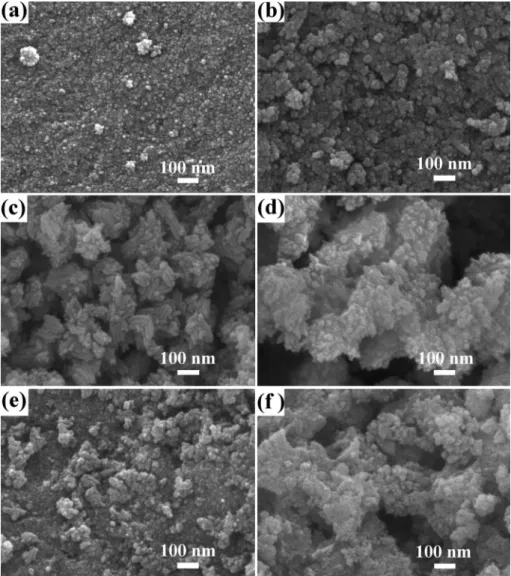
Fig. 3(a) shows the surface of H1 powder with about 10 nm particle size. When the molar ratio of HNO

3

acid was increased to 0.5, the surface of the obtained H2 powder became uniform form. H3 pow- der shows the nanorod shape with about 50 nm length and 20 nm diameter, as shown in Fig. 3(c).

This is similar to the results of other methods [8, 9, 11]. However, the reaction time and the reaction temperature were more short and low when we com- pared to other methods [9, 11]. In H4 sample, the particles were aggregated to create particles with larger size. Especially, Fig. 3(e) and 3(f) show the surface of H5 powder with irregular surface mor- phologies. The very small particles were observed along with the large particles aggregated in some areas of H5 sample. When we increased the molar ratio of HNO

3

acid, the size of TiO

2

particles and the degree of aggregation were also increased.

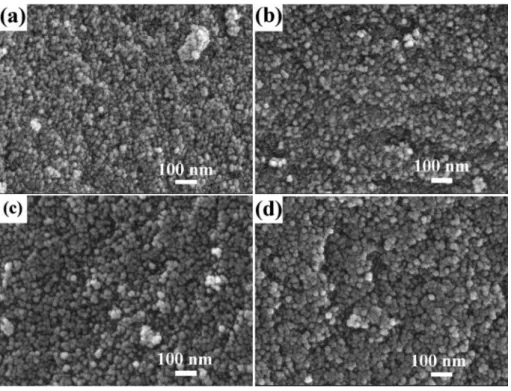
Fig. 4 shows the surface of TiO

2

powder with reg- ular morphology. The size of particles was about 10 nm. The surface of TiO

2

prepared using CH

3

COOH

was smooth. However, the surface had some points where particles are agglomerated. Fig. 4 shows that the concentration of CH

3

COOH does not affect to the surface of TiO

2

.

Fig. 5 shows the nitrogen adsorption-desorption isotherms for the TiO

2

prepared by the different molar ratio of HNO

3

. According to the classification Fig. 4. SEM images of TiO

2

prepared using CH

3

COOH ((a) C1, (b) C2, (c) C3, and (d) C4).

Fig. 5. Nitrogen adsorption-desorption isotherms for TiO

2

prepared using HNO

3

.

(5)

[12], H1 sample exhibited a typical type II isotherm and type E hysteresis loops which are attributed to the existence of ink-bottle type pores and mesopo- res. Other samples have the narrow pores or the nar- row slit-like pores because loops of the samples were very small and narrow. The BET surface areas of H1, H2, H3, H4, and H5 were 174.29, 181.15, 129.54, 198.73, and 136.86 m

2

/g, respectively. These surface areas are larger than the results of previous methods [4, 5, 10].

Fig. 6 shows the nitrogen adsorption-desorption isotherms for the TiO

2

powders prepared using CH

3

COOH acid. All samples indicated isotherm type IV. The hysteresis loops in the adsorption-des- orption curve indicate that C1, C2 and C4 sample had type E hysteresis loop that can be attributed to

“ ink-bottle ” pores. C3 sample showed the narrow hysteresis loop caused by its particle arrangement with a narrow pore size. The BET surface areas of C1, C2, C3, and C4 were 243.80, 229.72, 265.53, and 236.27 m

2

/g, respectively. This results are simi- lar to that of SEM and X-ray diffraction. These sur- face areas are also larger than the results of previous methods [4, 6, 11].

Fig. 7 shows the UV-Vis absorption spectra of TiO

2

using HNO

3

acid. The absorption edge occurred below the wavelength of 350 nm. When we increased the concentration of HNO

3

acid, the second peak

was decreased. However, the second peak of H2 was higher than that of H1 peak because H2 is an inter- mediate stage changing from anatase to rutile phase.

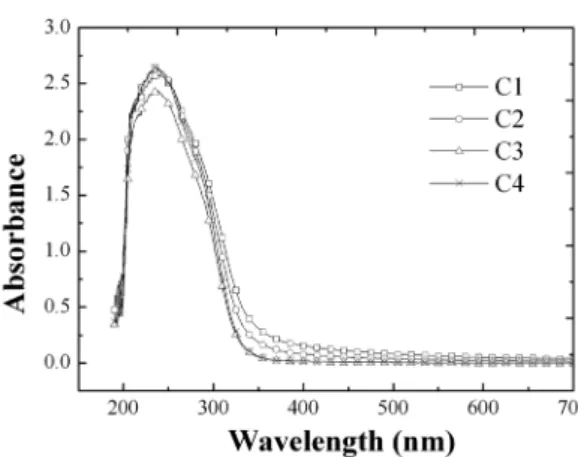
Fig. 8 shows the UV-Vis absorption spectra of TiO

2

prepared using CH

3

COOH acid. The absorp- tion edge is similar to that of TiO

2

using HNO

3

acid.

The absorption results showed the similar pattern for all samples because of their same properties with anatase phase.

4. Conclusions

A sol-gel method with acid hydrolysis was applied to synthesize TiO

2

nanoparticles and to grow TiO

2

crystal phase at low temperature. The hydrolysis process was carried out at room temperature for 50 Fig. 6. Nitrogen adsorption-desorption isotherms for TiO

2

prepared using CH

3

COOH. Fig. 7. UV-Vis spectra of TiO

2

prepared using HNO

3

.

Fig. 8. UV-Vis spectra of TiO

2

prepared using CH

3

COOH.

(6)

hours and at 80

o

C for 8 hours in the various concen- tration of HNO

3

or CH

3

COOH acid in order to achieve the fine nanocrystalline TiO

2

. The results of the X- ray diffraction analysis showed that H1 sample had mainly the anatase phase whereas H3 sample had only the rutile phase. The physical properties of C1 sample was similar to that of C2 and C4 sample when we compared with the results of SEM and UV- Vis spectrum but C1 sample had the larger surface area compared to the surface area of C2 and C4. C3 sample had the largest surface area originated from their regular TiO

2

particles array. In future work, we will investigate the degradation efficiency of methyl- ene blue containing TiO

2

powder under UV irradia- tion.

Acknowledgment

This work (Grants No. 00039007-1) was supported by Business for constructing annex research centers for companies institute funded Korea Small and Medium Business Administration in 2010.

References

[1] M. Kaneko and I. Okura: Photocatalysis Science and

Technology, Kodansha Ltd., Tokyo,. Springer-Verlag Berlin Heidelberg, New York (2002) 1.

[2] I. A. Montoya, T. Vireros, J. M. Dominguez, L. A.

Canales and I. Schifter: Catal. Lett., 15 (1992) 207.

[3] M. E. Simonsen and E. G. Søgaard: J. Sol-Gel Sci.

Technol., 53 (2010) 458.

[4] W. Y. Wu, Y. M. Chang and J. M. Ting: Cryst. Growth Des., 10 (2010) 1646.

[5] Y. Wang, L. Zhang, K. Deng, X. Chen and Z. Zou: J.

Phys. Chem. C, 111 (2007) 2709.

[6] A. C. Lee, R. H. Lin, C. Y. Yang, M. H. Lin and W. Y.

Wang: Mater. Chem. Phys., 109 (2008) 275.

[7] R. Benedix, F. Dehn, J. Quaas and M. Orgass: Lacer, 5

(2000) 157.

[8] K. Thamaphat, P. Limsuwan and B. Ngotawornchai:

Kasetsart J. Nat. Sci., 42 (2008) 357.

[9] C. Ribeiro, C. Vila, D. B. Stroppa, V. R. Mastelaro and J. Bettini: J. Phys. Chem. C, 111 (2007) 5871.

[10] T. D. Nguyen-Phan, V. H. Pham, T. V. Cuong, S. H.

Hahn, E. J. Kim, J. S. Chung, S. H. Hur and E. W.

Shin: Mater. Lett., 64 (2010) 1387.

[11] K. S. W. Sing, D. H. Everett, R. A. W. Haul, L. Moscou, R. A. Pierotti, J. Rouquerol and T. Siemieniewska: Pure &

Appl. Chem., 57 (1985) 603.

[12] S. Lowell and J. E. Shields: Powder Surface Area and

Porosity, Third Edition, Chapman and Hall, New York

(1991) 11.

수치

Fig. 1 shows the TiO 2  phase variation of the X-ray diffraction patterns according to the different molar ratio of HNO 3  acid
Fig. 3. SEM images of TiO 2  prepared using HNO 3  ((a) H1, (b) H2, (c) H3, (d) H4, and (e and f) H5).
Fig. 4 shows the surface of TiO 2  powder with reg- reg-ular morphology. The size of particles was about 10 nm
Fig. 8. UV-Vis spectra of TiO 2  prepared using CH 3 COOH.

참조

관련 문서

전지의 충전-방전 순환 과정이 지속됨에 따르는 LiMn 2 O 4 박막 전극의 구조적 성질 변화를 조사하기 위하여 일정한 순환 횟수가 경과된 전극들에 대하여

합성된 TiO 2 sol 은 slide glass 에 코팅 시 농도에 따라 비교적 우수한 자외선 차단성을 띠었으나 그 흡수파장대는 자외선 전 영역을 차단시키기 에는 broad 하지 못했다

Kefa, “The activity and characterization of CeO 2 -TiO 2 catalysts pre- pared by the sol-gel method for selective catalytic reduction of NO with NH 3 ”, J. Reddy

Abstrat Thermal stabilizing effect of Yb 3+ , Er 3+ codoping into TiO 2 powder prepared by sol-gel method and its upconversion characteristics were analyzed.. The effect of TiO 2 :

또한, 반응 전후의 촉매표면의 결정성 및 상변화를 알아보기 위하여 XRD (Demax-2500, Rigaku Co., X-ray diffraction)를 이용하여 표면분석을 실시 하였으며, 표면

Crystallites sizes of the TiO 2 nanoparticles synthesized by the NaNO 3 assisted ultrasonic spray pyrolysis at various temperature calculated from the Scherrer’s

a Ceramic Ware Center, Korea Institute of Ceramic Engineering and Technology, Icheon 17303, Republic of Korea.. b Engineering Ceramic Center, Korea Institute of Ceramic Engineering

The ceramic composites with various composition ratios were coated on a polycarbonate substrate using a sol-gel process of low temperature process, and