한수지 51(3), 338-343, 2018
338
Copyright © 2018 The Korean Society of Fisheries and Aquatic Science pISSN:0374-8111, eISSN:2287-8815 Korean J Fish Aquat Sci 51(3),338-343,2018
Note
서 론
해양생태계에영향을미치는환경적요인은여러가지가있 으나, 생물군집의구조는생물서식지의수온에가장큰영향을 받는다. 더욱이기후변화에의하여발생되는기온의변화는수 십년의주기를가지고온난과한랭현상을반복하고있으며, 해 면수온(sea surface temperature, SST)은기온의변화에상응하 며변화한다. 이러한기후의체제변환(climate regime shift)은 그해역생태계의생산력, 종조성등의변화를유발하여생태계 체제변환(ecological regime shift)을발생하게만든다(Lluch- Belda et al., 1992). 특히두족류는대부분 2년이내의수명을
가지고있으므로(Boyle, 1987), 이러한짧은생활사특성으로
인해기후변화가생태계에미치는영향을파악하기위한좋은 모델로여겨져왔다. 우리나라와일본주변해역에 널리분포
하는살오징어(common squid Todarodes pacificus)는양국의 주요상업생물종으로, 계절적으로광범위하게회유하고있다 (Nakamura and Sakurai, 1993; Kidokoro et al., 2010). 이들살 오징어자원은산란되는시기에따라구분되는데, 생산량의대 부분을차지하는가을발생군(혹은계군)과겨울발생군은그 회유경로를서로달리한다. 가을발생군은주로우리나라제주 도부근해역을포함하는남해, 그리고일본의큐슈서부해역을 산란장으로이용하기때문에, 부화한어린유생은대마난류를 타고동해로들어가고, 그곳에서성장을하게된다. 한편, 겨울 계군은가을계군보다더남쪽에서산란을하여, 동중국해에서 부화한유생은쿠로시오해류를타고일본의동해안을따라북 상하면서성장을한다. 이들은오야시오해류를만나는지점까 지이동하고, 그이후에는혼슈와홋카이도사이의쓰가루해협 을건너동해로들어갔다가, 동중국해의산란장을향하여남하
기후변화와 서식지 수온 변화에 따른 북서태평양 살오징어( Todarodes pacificus)의 어획량 변동
송혜진
부경대학교 지오메틱연구소
Fluctuations of Common Squid Todarodes pacificus Catches in the
Northwestern Pacific under Changing Climate and Habitat Temperature
Hyejin Song
Institute of Geomatics, Pukyong National University, Busan 48513, Korea
Recently, commercial catches of the common squid Todarodes pacificus have dramatically decreased in Korean and Japanese waters. The relationship between common squid catches and environmental factors was investigated using squid catches, climate indices and observed seawater temperatures in Korean waters. Common squid consist of three spawning stocks: autumn, winter, and summer. The autumn stock is the largest in Korea, and its main fishing season appears to have shifted from September in the 1980s to October in the 1990s. We observed negative correlations between the spring Southern Oscillation Index and Korean catches and between the winter Pacific Decadal Oscilla- tion and Japanese catches. Despite global warming, no conspicuous increases in October seawater temperatures have been observed at 10 and 50 m in Korean waters since the mid-1900s. Instead, the 50 m water layer of the East Sea appears to be gradually cooling. Moreover, temperatures at 50 m in the East Sea and the South Sea were significantly negatively correlated with squid catches in Korea and Japan, respectively. Our preliminary analysis indicates a link between climate change, seawater temperature, and squid catches in Korean waters, which helps to inform the direc- tion of subsequent research to identify the cause of rapid decreases in this squid resource.
Key words: Todarodes pacificus, Common squid, Climate change, Optimal temperature, East Sea
This is an Open Access article distributed under the terms of the Creative Commons Attribution Non-Commercial Licens (http://creativecommons.org/licenses/by-nc/3.0/) which permits unrestricted non-commercial use, distribution, and reproduction in any medium, provided the original work is properly cited.
https://doi.org/10.5657/KFAS.2018.0338 Korean J Fish Aquat Sci 51(3) 338-343, June 2018
Received 5 June 2018; Revised 20 June 2018; Accepted 22 June 2018
*Corresponding author: Tel: +82. 51. 629. 5923 Fax: +82. 51. 629. 5923 E-mail address: [email protected]
한다. 이에따라, 우리나라에서어획되는살오징어의주된어장 은각계군의섭이장과성육장을포함하는동해에서형성된다. 즉, 살오징어는어릴때에는차가운섭이장으로북상이동을하 면서성장하고, 그이후에는따뜻한산란장을향하여남하하는 수온의존적인생활사를보여준다(Okutani, 1983).
현재까지밝혀진살오징어의산란및부화에관한보고에따 르면(Bower and Sakurai, 1996; Sakurai et al., 1996; Bower, 1997; Puneeta et al., 2015), 성숙한암컷이대략수심 50 m의 대륙붕과대륙사면에인접해있는수온약층에서부유성의젤라 틴난괴를생산하면, 일주일내에부화된다. 이러한재생산과정 에서적정수온은조금씩차이를보이는데, 난발생은 15-23℃
의수온범위에서일어나고부화유생은그보다높은 17-23℃
에서채집이가능했다. 사육실험에의한이들개체의성장과성
숙은 13-15℃의수온범위에서성장이빨랐고, 19℃이상에서
성공적인재생산이가능했다(Song, 2012). 이와같이산란장의
물리적인환경요건과성장과성숙에대한적정수온은가입의 성패를결정짓는주요변수로작용한다(Lipinski et al., 1998).
살오징어는과거해양의체제변환에반응하여해면수온이높 으면어획량이많아지고, 수온이낮아지면어획량도감소하는 경향을보였다(Sakurai et al., 2000). 살오징어의자원량급감의 주된원인중하나로써북한해역에서의중국의불법조업이대 두되고있지만(Lee et al., 2017), 우리나라와본종의서식지일 부만을공유하는일본해역에서의살오징어어획량또한최근 크게줄고있는추세이다. 21세기들어와서살오징어서식해역 에서의해수온이상승하고있음에도어획량은계속감소하고 있으며, 최근급감하는살오징어생산량에대한기후변화와수 온의영향에대해서는아직보고된바가없다. 이처럼종래의이 론으로명확히설명될수없는살오징어자원량의급격한감소 에대응하기위해서는, 먼저이를조절하는주요인자인수온의 영향에대한새로운해석이시급히요구된다.
본논문은최근심각하게감소하고있는살오징어자원량에 대한결정적요인으로생애주기에걸친성장·성숙에의 “종특 이적인적정수온에대한경험치(experiences on species-specif- ic optimal temperature)”에있음을주목하고, 이를바탕으로어 획과가입의장기변동에미치는기후지수들의간접적영향과 서식지수온의직접적상관성을분석하였다.
재료 및 방법
본연구에서는연도별, 월별, 해역별살오징어의어획량변동 을파악하기위하여우리나라통계청의자료를이용하였고(Ko- rean statistical information services; http://kosis.kr), 일본의연 도별어획량은 FAO에서발췌되었다(FAO; www.fao.org). 또 한 기후변화가 살오징어 자원량에 미치는 영향을 알아보기 위해, 태평양순년진동지수(Pacific decadal oscillation index, PDOI; http://research.jisao.washington.edu/pdo/PDO.latest.
txt), 남방진동지수(southern oscillation index, SOI; http://re-
search.jisao.washington.edu/data/walker/wbso18751933), 북 극진동지수(arctic oscillation index, AOI; fttp://ftp.cpc.ncep.
noaa.gov/cwlinks/norm.daily.ao. index.b500101.current.ascii) 와같은한반도주변해양환경과관련이있을것으로사료되 는기후지수들과살오징어의어획량간의상관관계를분석하 였다. 각기후지수는 1950년부터 2017년까지월별로제공된값 을사용하였다.
살오징어 서식지의 환경변화를 규명하기 위해 국립수산과 학원 한국해양자료센터(Korea oceanographic data center, KODC; http://kode.nifs.go.kr)에서수집한정선해양관측자료 를이용하였다. 어획량의대부분을차지하는가을발생계군의 산란장으로추정되는남해(정점 203-207, 400, 31302, 31400- 31406)와주요어장을형성하는동해(정점 102-105, 208, 209, 500, 501)의수심 10 m와 50 m의 10월수온을특정하여 1965
년부터 2017년까지장기적관점의체제변환을규명하였다. 체
제변환분석을위하여 Rodionov (2004)가개발한 SRSD (se- quential regime shigt detector, STARS) version 5.0을이용하 였으며, 이는연속적인 t-test를기반으로한알고리즘으로체제 변환(regime shift)을밝힐수있다. SRSD는 target significance level (p), cut-off length (l), hurber weight parameter (h)를필 수파라미터로, 이번연구에서는 p=0.5, l=10, h=1로설정하였 다. 그외통계적분석으로는 SPSS statistic software (version 23, international business machines corporation, USA)을사 용하여, 기후지수와어획량의관계를입증하기위한이변량상 관분석(pearson correlation)과수온이어획량에미치는영향을 파악하기위한시계열분석으로교차상관분석(cross correlation function, CCF)을실시하였다.
결과 및 고찰
일본의살오징어어획량이 높았던 1960년대에서 1970년대
초반에우리나라의어획량은미미했었다. 그주요원인은우리 나라어선의어구·어법이일본에비하여크게뒤져있었기때문 이라고여겨진다. 하지만우리나라살오징어어구·어법이많이 향상되고, 아울러자원량도많이증가하였던 1990년대에는어
획량이크게증가하여, 1996년에는우리나라와일본에서각각
25만톤과 44만톤의연어획량을기록했다. 양국에서최고어획
량을보였던 1996년부터 2년동안은계속어획이급격히감소
하여 1998년에는 1996년에비하여일본에서는 50-60%, 한국
에서는 60-70%정도의어획량을기록하였다. 그이후약간의증
감은있었지만대체로감소현상이양국에공통적으로나타났 다. 최근우리나라의살오징어어획량은 2016년, 2017년에걸 쳐 1990년대이후최저 8만7천톤까지급격하게감소하였고, 일
본의경우에는이보다좀더앞선 2015년부터현재까지뚜렷한
감소추세를보이고있다(Fig. 1a).
어획량을계절별로보면항상가을계군이가장많았다(Fig.
1b). 9-11월에어획되는가을계군의어획량은 1990년대부터
340 송혜진
꾸준하게증가하여 2000년대 10월에 6만3천톤에이르렀으나, 최근들어절반가까이감소하였다. 그에반해 12-1월을가입시 기로하는겨울계군은자원량이감소하는최근추세에도불구
하고꾸준히증가하는경향을보이고있다. 또한 1970년대와
80년대에상대적으로 9월의어획량비율이가장높았으나, 90
년대부터한달늦게최고어획량이나타나 2000년대에는 30%
를상회하는살오징어생산량이 10월에집중되었다. 덧붙여 12 월과 1월에어획되는겨울계군의생산량비율도 90년대이후
뚜렷하게증가하여최근 2010년대에는한해총어획량의약
40%를차지했다(Fig. 1c). 이는곧최근의살오징어어획량급 감은가을계군에서기인한다고볼수있고, 그와더불어주된 가입시기가조금씩늦춰지는경향으로해석될수있다. Fig. 1. Catches of common squid Todarodes pacificus. (a) Annual catches by Korean and Japanese fishers during 1969-2017 and (b) Month- ly catches and (c) Relative frequency of monthly catches in Korean waters during 1970-2017.
Lag Number Lag Number
(a) (b)
CCF CCF
0 100,000 200,000 300,000 400,000 500,000 600,000 700,000 800,000
1969 1973 1977 1981 1985 1989 1993 1997 2001 2005 2009 2013 2017
Catch (MT)
Korea Japan (a)
(b)
0 10,000 20,000 30,000 40,000 50,000 60,000 70,000
Jan Feb Mar Apr May Jun Jul Aug Sep Oct Nov Dec
Catch (MT)
70yrs 80yrs 90yrs 00yrs 10yrs
0 5 10 15 20 25 30 35
Jan Feb Mar Apr May Jun Jul Aug Sep Oct Nov Dec
Catch (%)
70yrs 80yrs 90yrs 00yrs 10yrs (c)
15 17 19 21 23
1965 1975 1985 1995 2005 2015
Seawater temperature (℃)
9 11 13 15 17 19
1965 1975 1986 1996 2006 2016
Seawater temperature (℃)
15 17 19 21 23
1965 1975 1985 1995 2006 2016
Seawater temperature (℃)
(a)
(b)
(c)
(d) 19
21 23 25
1965 1975 1985 1995 2005 2015
Seawater temperature (℃)
South Sea East Sea
10 m
50 m
10 m
50 m
기후변화와 서식지 수온 변화에 따른 살오징어 어획량 변동 341
살오징어의서식지를포함하는북서태평양에영향을주는주 요기후지수들간의상관관계를분석하였다. 최근 2014년을기
점으로 PDO는 양의값을보이며급격하게높아졌고, SOI와
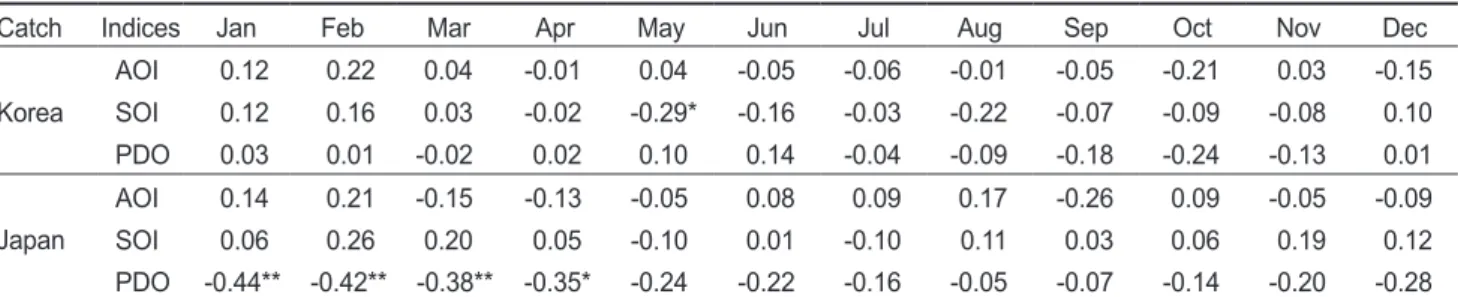
AOI는 PDO와유의한음의상관관계를보이며반대의패턴을 보였다(SOI, r=-0.57; AOI, r=-0.35). 실제로이들기후지수는 우리나라와일본의어획량과유의한상관관계를보여주는데, 우리나라의경우 5월 SOI가어획량과음의상관관계를보이고, 일본의경우 1월부터 4월의 PDO지수와강한음의상관성을나 타냈다(Table 1). Tian et al. (2008)에서는 PDO와 SOI가과거 동해의해양환경에큰영향이없었다고보고하였지만, Sakurai et al. (2002)는 SOI와살오징어자원량과의연관성을제시하 는등, 그메커니즘은현재까지도불명확하다(Kidokoro et al., 2010). 본연구결과에서 PDO와 SOI가살오징어어획량과계 절적으로강한음의상관관계를보이는것과, 일본어획량의급
격한감소가나타난 2015년의바로전년도에 PDO의패턴이음
에서양으로크게전환된것으로보아기후체제변환과최근의 살오징어자원량의급감이밀접한관계가있다고판단된다. 이 에따라향후, 위의 3개의기후지수이외의북서태평양에영향 을주는다양한지수를대상으로최신의자료를수집하여, 기후 변화와살오징어자원량과의상관메카니즘이명확히설명될 수있는분석이필요하다.
추계발생군의산란장으로알려진남해와주요어장이형성되 는동해의 10월연평균장기수온변동추이는수심 10 m와 50 m에서뚜렷한증가없이평이한수준을보였다(Fig. 2). 남해에
서는대체로 1970년대중반부터 1990년대초반까지온난했던
수온이 2000년대초반까지한랭한수온을보였고, 그이후부터
현재까지온난한상태를유지하고있다(Fig. 2a, 2b). 즉, 살오징 어산란장은비교적따뜻한해황이유지되고있음을보여준다. 살오징어의성육장이동해의경우 1990년대이후 10 m 수층은
온난화경향을보이고있지만, 50 m 수층의수온은최근의증가
Fig. 2. Variation of October seawater temperature in main fishing and spawning area of common squid Todarodes pacificus catches in Korean waters during 1965-2017. (a) 10 m in the South Sea, (b) 50 m in the South Sea, (c) 10 m in the East Sea, (d) 50 m in the East Sea.
Lag Number Lag Number
(a) (b)
CCF CCF
0 100,000 200,000 300,000 400,000 500,000 600,000
1969 1973 1977 1981 1985 1989 1993 1997 2001 2005 2009 2013 2017
Catch (MT)
(b)
0 10,000 20,000 30,000 40,000 50,000 60,000 70,000
Jan Feb Mar Apr May Jun Jul Aug Sep Oct Nov Dec
Catch (MT)
70yrs 80yrs 90yrs 00yrs 10yrs
0 5 10 15 20 25 30 35
Jan Feb Mar Apr May Jun Jul Aug Sep Oct Nov Dec
Catch (%)
70yrs 80yrs 90yrs 00yrs 10yrs (c)
15 17 19 21 23
1965 1975 1985 1995 2005 2015
Seawater temperature (℃)
9 11 13 15 17 19
1965 1975 1986 1996 2006 2016
Seawater temperature (℃)
15 17 19 21 23
1965 1975 1985 1995 2006 2016
Seawater temperature (℃)
(a)
(b)
(c)
(d) 19
21 23 25
1965 1975 1985 1995 2005 2015
Seawater temperature (℃)
South Sea East Sea
10 m
50 m
10 m
50 m
Table 1. Monthly correlation between climate indices and common squid Todarodes pacificus catches of Korea and Japan during 1970-2017
Catch Indices Jan Feb Mar Apr May Jun Jul Aug Sep Oct Nov Dec
Korea
AOI 0.12 0.22 0.04 -0.01 0.04 -0.05 -0.06 -0.01 -0.05 -0.21 0.03 -0.15
SOI 0.12 0.16 0.03 -0.02 -0.29* -0.16 -0.03 -0.22 -0.07 -0.09 -0.08 0.10
PDO 0.03 0.01 -0.02 0.02 0.10 0.14 -0.04 -0.09 -0.18 -0.24 -0.13 0.01
Japan
AOI 0.14 0.21 -0.15 -0.13 -0.05 0.08 0.09 0.17 -0.26 0.09 -0.05 -0.09
SOI 0.06 0.26 0.20 0.05 -0.10 0.01 -0.10 0.11 0.03 0.06 0.19 0.12
PDO -0.44** -0.42** -0.38** -0.35* -0.24 -0.22 -0.16 -0.05 -0.07 -0.14 -0.20 -0.28 AOI, arctic oscillation index; SOI, southern oscillation index; PDO, Pacific decadal oscillation index; *, P<0.05; **, P<0.01.
342 송혜진
를제외하면오히려낮아지고있다(Fig 2c, 2d).
특정깊이의수온과어획량의교차분석을수행한결과, 우리
나라어획량은동해 50 m 수온과 0-3년의시간차를두고음의
유의한 상관관계를 나타냈고(-0.49≤r≤-0.33), 일본의 어획량
은남해의 50 m 수온과시간차를두지않고음의유의한상관
관계를보였다(r=-0.43) (Fig. 3). 이러한결과는 Sakurai et al.
(2000)에서제시한것과같은 “온난수온-높은어획” 관계와는 다른것이다. 대체로 1990년대중반이래, 어획량은감소되었지
만표층 10-50 m 에서의수온은큰변화가없거나오히려증가
하는경향이나타났다. 이러한통계적인결과는, 살오징어자원 흉풍이단지수온에만의존하는것이아니라, 서식해역에서의 다른생태학적인요소인먹이, 포식자, 이상기후, 일차생산력
등에의하여좌우됨을의미한다. 또한 2000년대초중반의이전
연구들에서는우리나라해역은지구온난화의영향을밀접하게 받으며꾸준히수온이증가한다고보고되어왔지만(Kim et al., 2001), 동해와남해에서 2000년대후반이후수온의상승은미 비하고표층과중층의수온변화패턴이상이해지면서살오징어 자원량에부정적인영향을주었을것으로예상된다. 이러한수 온체제변환으로인하여우리나라는동해의어장형성에, 일본 의경우남해를포함하는산란장환경변화에기인하여최근의 살오징의어획량급감을초래했을가능성을시사한다. 하지만, 본연구에서사용한해양환경자료는살오징어서식지의일부 분에서만수집되었기때문에보다명확한증거를제시할필요 가있다. 이를위해서, 살오징어가전생활사에걸쳐회유함에 따라경험하는수온이외의물리생물학적인주요변수들의영 향을종합적으로고려하여, 살오징어자원관리및예측가능한
모델을위한후속연구를진행하고자한다.
사 사
이논문은기상청 KMIPA 2015-6050의지원으로수행되었
으며, 연구수행에도움을주신김수암교수님을비롯하여, 이 화현박사님, 방민경님, 김무진님께감사의마음을전합니다.
References
Bower JR and Sakurai Y. 1996. Laboratory observations on Todarodes pacificus (Cephalopoda: Ommastrephidae) egg masses. Amer Mal Bull 13, 65-71.
Bower JR. 1997. A biological study of egg masses and paralar- vae of the squid Todarodes pacificus. Ph.D. Dissertation, Hokkaido University, Hakodate, Japan.
Boyle PR. 1987. Cephalopod life cycles: Volume II: Compara- tive Reviews. Academic Press, London, UK, 5-31.
Kidokoro H, Goto T, Nagasawa T, Nishida H, Akamine T and Sakurai Y. 2010. Impact of a climate regime shift on the mi- gration of Japanese common squid (Todarodes pacificus) in the Sea of Japan. ICES J Mar Sci 67, 1314-1322. https://doi.
org/10.1093/icesjms/fsq043.
Kim K, Kim KR, Min DH, Volkov Y, Yoon JH and Takematsu M. 2001. Warming and structural changes in the East (Japan) Sea: a clue to future changes in global oceans?. Geo Res Let 28, 3293-3296. https://doi.org/10.1029/2001GL013078.
Lee J, Ryu J and Kee H. 2017. A Study on the Status of Chinese Fishing in the East Sea off North Korea and Directions for Fig. 3 Cross correlation between October seawater temperature and common squid Todarodes pacificus catches during 1970-2017. Bars indicate the coefficient, and dotted lines mean upper and lower confidence limits. (a) 50 m of East Sea and catch of Korea (b) 50 m of South Sea and catch of Japan. CCF, cross correlation function.
Lag Number Lag Number
(a) (b)
CCF CCF
0 100,000 200,000 300,000 400,000 500,000 600,000 700,000 800,000
1969 1973 1977 1981 1985 1989 1993 1997 2001 2005 2009 2013 2017
Catch (MT)
Korea Japan (a)
(b)
0 10,000 20,000 30,000 40,000 50,000 60,000 70,000
Jan Feb Mar Apr May Jun Jul Aug Sep Oct Nov Dec
Catch (MT)
70yrs 80yrs 90yrs 00yrs 10yrs
0 5 10 15 20 25 30 35
Jan Feb Mar Apr May Jun Jul Aug Sep Oct Nov Dec
Catch (%)
70yrs 80yrs 90yrs 00yrs 10yrs (c)
15 17 19 21 23
1965 1975 1985 1995 2005 2015
Seawater temperature (℃)
9 11 13 15 17 19
1965 1975 1986 1996 2006 2016
Seawater temperature (℃)
15 17 19 21 23
1965 1975 1985 1995 2006 2016
Seawater temperature (℃)
(a)
(b)
(c)
(d) 19
21 23 25
1965 1975 1985 1995 2005 2015
Seawater temperature (℃)
South Sea East Sea
10 m
50 m
10 m
50 m
Countermeasues. J Fish Bus Adm 48, 61-74. http://dx.doi.
org/10.12939/FBA.2017.48.3.061.
Lipinski MR, Durholtz MD and Underhill LG. 1998. Field vali- dation of age readings from the statoliths of chokka squid (Loligo vulgaris reynaudii d'Orbigny, 1845) and an assess- ment of associated errors. ICES J Mar Sci 55, 240-257.
https://doi.org/10.1006/jmsc.1997.0274.
Lluch-Belda D, Lluch-Cota DB, Hernández-Vázquez and Sali- nas-Zavala CA. 1992. Sardine population expansion in east- ern boundary systems of the Pacific Ocean as related to sea surface temperature. S Afr J mar Sci 12, 147-155. https://doi.
org/10.2989/02577619209504698.
Nakamura Y and Sakurai Y. 1993. Age determination from daily growth increments in statoliths of some groups of Japanese common squid, Todarodes pacificus. In: Recent Advances in Cephalopod Fisheries Biology, T Okutani, RK O’Dor and T Kubodera, eds. Tokai University Press, Tokyo, Japan, 339- Okutani T 1983. Todarodes pacificus. In: Cephalopod life cy-344.
cles: volume I: Species Accounts. Boyle PR, ed. Academic press, London, UK, 201-214.
Puneeta P, Vijai D, Yoo HK, Matsui H and Sakurai Y. 2015.
Observations on the spawning behavior, egg masses and paralarval development of the ommastrephid squid Toda
rodes pacificus in a laboratory mesocosm. J Exp Bio 218, 3825-3835. http://doi:10.1242/jeb.127670.
Rodionov SN. 2004. A sequential algorithm for testing cli- mate regime shifts. Geo Res Let 31. L09204. https://doi.
org/10.1029/2004GL019448.
Sakurai Y, Bower JR, Nakamura Y and Yamamoto S and Watanabe K. 1996. Effects of temperature on development and survival of Todarodes pacificus embryos and paralar- vae. Amer Mal Bull 13, 89-95.
Sakurai Y, Kiyofuji H, Saitoh S, Goto T and Hiyama Y. 2000.
Changes in inferred spawning areas of Todarodes pacificus (Cephalopoda: Ommastrephidae) due to changing environ- mental conditions. ICES J Mar Sci 57, 24-30. https://doi.
org/10.1006/jmsc.2000.0667.
Sakurai Y, Kiyofuji H, Saitoh SI, Yamamoto J, Goto T, Mori K and Kinoshita T. 2002. Stock fluctuations of the Japanese common squid, Todarodes pacificus, related to recent cli- mate changes. Fish sci 68, 226-229. https://doi.org/10.2331/
fishsci.68.sup1_226.
Song H. 2012. Studies on growth and reproduction of the Japa- nese common squid, Todarodes pacificus (Cephalopoda:
Ommastrephidae). Ph.D. Dissertation, Hokkaido Univer- sity, Hakodate, Japan.
Tian Y, Kidokoro H, Watanabe T and Iguchi N. 2008. The late 1980s regime shift in the ecosystem of Tsushima warm cur- rent in the Japan/East Sea: evidence from historical data and possible mechanisms. Prog Oceanogr 77, 127-145. https://
doi.org/10.1016/j.pocean.2008.03.007.