염산-에탄올에 의해 유발된 흰쥐 위염에 대한 마치현의 억제 작용
김재현*1)
동신대학교 한의과대학 방제학교실
The Inhibitory Effects of Portulaca oleracea L. on HCl-ethanol Induced Gastritis in Rats
Chae-hyun Kim*
Dept. of Prescriptionology, College of Oriental Medicine, Dongshin University
ABSTRACT
Objectives : The objective of this study was to examine the effects of P. oleracea into the HCl-ethanol induced gastritis in rats, and to isolate and determine the chemical compounds from P. oleracea.
Methods : The rats were orally administered with crude extract or fractions or isolated compounds of P.
oleracea 30 mins before the induction of gastric lesion by oral administration of HCl-ethanol. The gastric lesional area was measured using pixel counting software. Then the chemical compounds from P. oleracea was isolated and determined by LC-MS and NMR.
Results : The inhibition effect of oral administration of crude extract of P. oleracea at a dose of 500 mg/kg in HCl-ethanol induced gastritis was similar to cimetidine. Then, aqueous fraction at a dose of 240 mg/kg exhibited the effects similar to cimetidine. Then, the aqueous fraction was further separated by MPLC and yielded four sub fractions. Among those sub fractions, agent II at a dose of 40 mg/kg possessed the strongest effect in the HCl-ethanol induced gastritis. The water fraction yielded-Uridine, Adenosine, Guanosine, which were characterized by Mass, 1H-NMR, 13C-NMR.
Conclusions : This study suggest that a P. oleracea and its compounds showed potent efficacy on the development of HCl-ethanol induced gastritis. Thus, P. olaracea can be a potential natural resource for the management of gastritis although the mechanism of action involved in the treatment remains to be explored.
Key words: Portulaca oleracea, gastritis, HPLC
* Corresponding author : Chae-hyun Kim, Department of Prescriptionology, College of Oriental Medicine, Dongshin University, 252 Daeho-dong Naju-si Jeollanam-do, Republic of Korea
․Tel. 061-330-3502 ․E-mail : [email protected]
․Acceptance : 2009. 2. 6 ․Adjustment : 2009. 3. 12 ․Adoption : 2009. 3. 20
Introduction
The use of herbal products in the purpose of prevention or treatment of several chronic diseases has been practiced traditionally in various ethnic societies worldwide1). However, the restraining effect and involved mechanisms to the gastritis of herbal products have not been cleared yet. P.
oleracea (Portulacaceae) which has been ranked the eight most common plants in the world2) is listed in the World Health Organization as one of the most used medicinal plants and it has been given the term ‘Global Panacea’3).
Portulacae Herba is sour in flavor, cold in nature, nonpoisonous and attributive to large intestine and liver meridians. Medicinal properties of P. oleracea include away heat, relieving toxin, cooling the blood, treating dysentery, stopping bleeding, relieving swelling and treating stranguria. It is used for dysentery, eczema, erysipelas, snake-bite poisoning, and hemorrhoids with blood4-7).
The reported pharmacological effects of this plant include antibacterial8,9), anti-inflammatory and analgesic effects10), skeletal muscle-relaxant11), potassium channel opening effect12), relaxant effect on smooth muscle13), wound-healing activities14) and it is important in preventing heart attacks and strengthening the immune system15) and reducing the occurrence of cancer16).
Acute gastritis is an acute mucosal inflammatory process, usually of a transient nature. The inflammation may accompanied by hemorrage into the mucosa and, in more severe circumstances, by sloughing of the superfical mucosal epithelium (erosion). The pathogenesis is poorly understood, in part because normal mechanisms for gastric mucosal protection are not totally clear. Acute gastritis is frequently associated with heavy use of nonsteroidal anti-inflammatory drugs(NSAIDs), excessive alcohol consumption, heavy smoking, treatment with cancer chemotherapeutic drugs, uremia, systemic infections, severe stress, ischemia and shock, suicide attempts with acids and alkali, mechanical trauma, reflux of bilious material after distal gastrectomy17,18).
Ethnopharmacological studies have reported that a variety of botanical products possess anti-ulcer activity. A few published studies showed the P.
oleracea has protective effects on the gastric mucosal lesion19,20). This study was designed to examine the effects of P. oleracea into the HCl- induced gastritis in rats, and determine the chemical compounds from P. oleracea responsible for those effects.
Materials and method
1. Preparation of Portulaca oleracea
Portulaca oleracea was purchased from Omni- herb (Dae-gu, ROK) and identified by Department of prescription, College of Oriental Medicine Dongshin University. A voucher specimen was deposited at the herbarium of College of Oriental Medicine Dongshin University.
2. Experimental animal
Male Spraque Dawley rats weighing approximately 250~280 grams were housed under standard laboratory conditions. The animals were maintained in a temperature-controlled room (25℃) and kept on 12:12 light dark cycle (lights on at 08:00 and off at 20:00). Food and water were provided ad libitum.
Food was restricted but free access to water was allowed for 24 h before the experiment to ensure an empty stomach. And, all animals were kept in raised mesh-bottom cages to prevent coprophagy.
The experiments were carried out from 10:00 to 12:00. There were 5 rats in each group.
3. Extraction and fractionation
The dried P. oleracea (5 kg) were extracted three times with 90% ethanol (5 L) by maceration at room temperature for 24 h. The extracts were filtered and dried at 40℃ under vacuum. The yield (w/w) of the ethanolic extract was 8.8% (440 g).
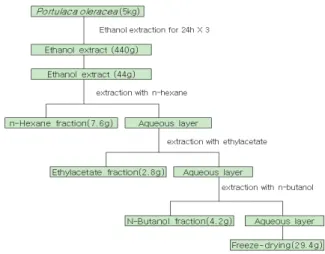
Fig. 1. Scheme for the extraction of P. oleracea and partition of the extract using different solvents
Fig. 2. HPLC chromatogram of water fraction
Waters 1525 LC systems were used for the HPLC analysis The EtOH extract (44 g) was suspended in H2O, and partitioned with n-hexane, EtOAc and n-BuOH, successively to give fractions of n-hexane (7.6 g), EtOAc (2.8 g) and n-BuOH (4.2 g) and water (29.4 g), respectively (Fig. 1). Thereafter, the water fraction was analyzed. Waters 1525 LC systems were used for the HPLC analysis. The water fraction was separated into five peaks. And then the water fraction was refractionated by MPLC for compounds determination. Five peaks were shown by four agents. 1st and 2nd peak labelled as 1st, 3rd peak as 2nd, 5th peak as 3rd and 4th peak as 4th.
4. HCl-ethanol induced gastric mucosal membrane lesion
1) Administration of the crude extract of P. oleracea
The method is based on the modification of Mizui and Doteuchi21). The rats were randomly allocated into 5 groups of 5 animals each. Prior to the experiment, animals were fasted for 24 hours but water was provided ad libitum. Animals in group 1 were treated with normal saline at 4 mL/kg and served as untreated control, while animals in group 2 were treated with cimetidine (20 mg/kg) and served as treated control. Groups 3, 4, and 5 were treated with 100, 300 and 500 mg/kg of P. oleracea extract, respectively. All treatments were done via a stainless steel intubation needle.
Thirty minutes later, 1ml of 60% ethanol in 150 mM HCl was administered orally. Each animal was anesthetized with overdose of urethane 1 h after the administration of necrotizing agents and the stomach was excised and gently rinsed under running tap water. After opening along the greater curvature and spreading out on a board, the area (mm2) of mucosal erosive lesions was mesaured using a pixel-counter which is a program made by Computer Engineering, Department in Chon-nam national university.
2) Administration of the fractions of extract
The method was same as above. The rats were orally administered with different fractions (240 mg/kg) of n-hexane, EtOAc and n-BuOH and water respectively.
3) Administration of the compounds separated from water fraction.
The method was same as above. Five peaks were shown by four agents. 1st and 2nd peak labelled as 1st, 3rd peak as 2nd, 5th peak as 3rd and 4th peak as 4th. The rats were orally administered with those agents (40 mg/kg) respectively.
5. Isolation and Structure Determination
P. oleracea extract was fractionated with organic solvents, and the water fraction showed the most
strong protective effect in the gastric mucosal injury. the water fraction was analyzed. Waters 1525 LC systems were used for the HPLC analysis.
The separation was performed on a Develosil ODS UG-5 column (4.6 x 150 mm, 5 μm; Nomura chemical, Japan). A mobile phase consists of 95%
water (containing 1% acetic acid) and 5%
acetonitrile (containing 1% acetic acid). The flow rate was kept at 1 ml/min. The sample injection volume was 10 μl. Absorbance was measured at 260 nm. The water fraction was separated into five peaks (Fig. 2). And then the water fraction was refractionated by MPLC for compounds determination.
The water fraction were characterized by Mass, 1H-NMR, 13C-NMR.
6. Data expression and statistical analysis
Data are expressed as means±SEM (standard error of means). Statistical differences between means were determined by the Student's t-test.
Differences between multiple groups were tested using analysis of variance (ANOVA) for repeated measures. P value below than 0.05 was considered as significant data.
Result and discussion
1. Effect of P. oleracea on HCl-ethanol induced gastritis
HCl-induced gastric damage was observed as elongated black-red lines(1-10 mm long by 0.5-1.5 mm wide) parellel to the long axis of the stomach in rats. The results are shown in Fig. 3, 4 and 5.
In the crude extract of P. oleracea, the extract exhibited significant antiulcer activity in rats at doses of 300, and 500 mg/kg, similar to the reference drug cimetidine. The lesion was 51.32 mm2 in control group and 2.66 mm2 in P. oleracea pretreatment (500 mg/kg) group. P. oleracea treated groups were decreased the development of HCl- ethanol induced gastritis significantly and dose-
Gastric lesion (mm2) Control 51.32±1.96 100 mg/kg 40.87±4.56 300 mg/kg 16.97±3.84 500 mg/kg 2.66±0.12 Cimetidine 1.77±0.15
Fig. 3. Effect of P. oleracea on HCl-ethanol induced gastric lesion
The rats were orally administered with various concentrations of crude extract of P. oleracea. ap <0.05, bp < 0.01 vs.
control value.
Gastric lesion (mm2) Control 51.32±1.96
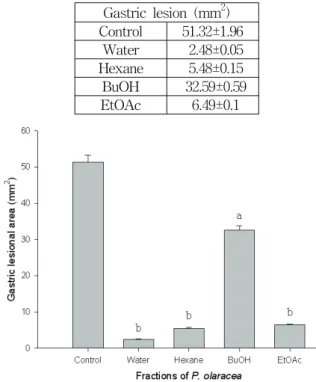
Water 2.48±0.05 Hexane 5.48±0.15 BuOH 32.59±0.59
EtOAc 6.49±0.1
Fig. 4. Effect of P. oleracea fractions on HCl-ethanol induced gastric lesion
dependently. These data suggested that P. oleracea and cimetidine have similar pharmacological activities.
In administration of the fractions of extract, The
C Fr-II (DMSO)
Uridine* (DMSO)
Fr-III (D2O)
Adenosine* (0.1M HCl)
Fr-IV (DMSO)
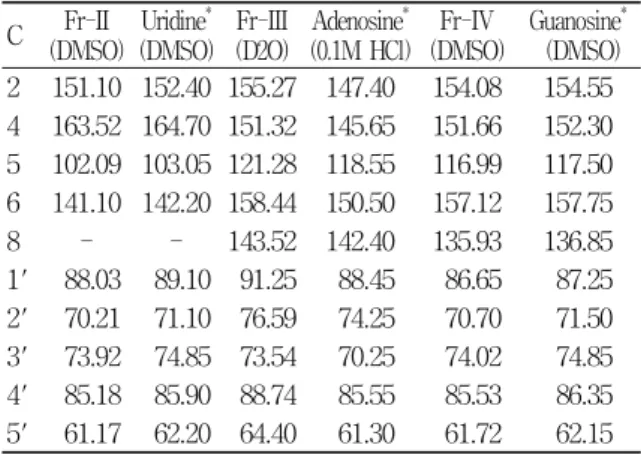
Guanosine* (DMSO) 2 151.10 152.40 155.27 147.40 154.08 154.55 4 163.52 164.70 151.32 145.65 151.66 152.30 5 102.09 103.05 121.28 118.55 116.99 117.50 6 141.10 142.20 158.44 150.50 157.12 157.75
8 - - 143.52 142.40 135.93 136.85
1' 88.03 89.10 91.25 88.45 86.65 87.25 2' 70.21 71.10 76.59 74.25 70.70 71.50 3' 73.92 74.85 73.54 70.25 74.02 74.85 4' 85.18 85.90 88.74 85.55 85.53 86.35 5' 61.17 62.20 64.40 61.30 61.72 62.15 Gastric lesion (mm2)
control 51.32±1.96 1st agent 25.95±1.3 2nd agent 4.75±0.16 3rd agent 30.19±1 4th agent 16.96±0.37
Fig. 5. Effect of different agents isolated from P.
oleracea on HCl-ethanol induced gastric lesion
lesion was 32.59 mm2 in butanol fraction and 2.48 mm2 in water fraction. The water fraction showed the strongest suppression of the gastric damage as shown in Fig. 4. In administration of the agents separated from water fraction, the lesion was 30.19 mm2 in the 3rd agent and 4.75 mm2 in the 2nd agent. Among the agents separated from water fractions, 2nd agent possessed the strongest suppression of the gastric damage as shown in the Fig. 5.
2. Isolation and Structure Determination using LC-MS and NMR
Water fraction was further separated by MPLC and yielded four sub-fraction, Fr-I-Fr-IV. HPLC chromatograms of each sub-fraction were shown in Fig. 2. Fr-I contained several peaks and pure cpmpound was not isolated from this fraction.
Compound isolated from Fr-II was analyzed using LC-MS and NMR. In the ESI-MS spectrum, the peak at m/z 243 was determined as the quasi- molecular ion [M-H]- and the molecular weight of the compound was 244. In the 13C NMR spectrum, five ribosyl carbons and four pyrimidin ring carbons were detected. HMQC and HMBC spectra also proved the presence of ribose and uracil. From
Table 1. 13C NMR (100 MHz) Data of Isolated Compounds from P. oleracea Water Fraction and Standard Compounds
* : 13C NMR data were found in reference (Breitaimer E and Voelter W [1990] In Carbon-13 NMR spectroscopy [3rd ed.] VCH. New York).
N H O
O N
O
OH O H
H H
H H
H O
Fig. 6. Uridine
the above results the structure of isolated compound from Fr-II was determined as uridine.
The ESI-MS spectrum of compound isolated from Fr-III showed the peak at m/z 268 corresponding to [M+H]+ in the positive mode and m/z 266 corresponding to [M-H]- in the negative mode. Thus, the molecular weight of the compound was determined to be 267. In the 13C NMRspectrum, five ribosyl carbons and four purine ring carbons were detected. From the above results the structure of isolated compound from Fr-III was determined as adenosine.
The ESI-MS spectrum of compound isolated from Fr-IV showed the peak at m/z 284 corresponding to [M+H]+ in the positve mode and m/z 282 corresponding to [M-H]- in the negative mode. Thus, the molecular weight of the compound was determined to be 283. In the 13C NMR
spectrum, five ribosyl carbons and four purine ring carbons were detected. From the above results the structure of isolated compound from Fr-IV was determined as guanosine.
The water fraction yielded- Uridine, Adenosine, Guanosine which are nucleosides which possessed anti-oxidant and anti-ulcerogenic activities although the effects were not restricted to only these components.
Conclusions
1. The oral administration of P. oleracea inhibited the HCl-ethanol induced gastritis by dose-dependantly.
2. The aqueous fraction exhibited the effects similar to cimetidine. Among those sub fractions, agent II possessed the strongest effect in the HCl- induced gastritis.
3. The water fraction yielded- Uridine, Adenosine, Guanosine.
4. P. oleracea could be an option in the treatment of gastritis.
This study suggest that a P. oleracea and its compounds showed potent efficacy on the development of HCl-induced gastritis. Thus, P. olaracea can be a potential natural resource for the management of gastritis although the mechanism of action involved in the treatment remains to be explored.
References
1. Li X, Wang H. Chinese herbal medicine in the treatment of chronic kidney disease. Adv Chronic Kidney Dis. 2005 ; 12 : 276-81.
2. Isin Y, Ismail T, Askim HS, Tijien D. Salinity tolerance of purslane (Portulaca oleracea L.) is achieved by enhanced antioxidative system, lower level of lipid peroxidation and proline accumulation. Environmental and Experimental Botany. 2007 ; 61 : 49-57.
3. Lim YY, Quah. Antioxidant properties of different
cultivars of Portulaca oleracea. Food chemistry.
2007 ; 3 : 734-40.
4. Sin MK. Clinical Traditional Herbalogy. Seoul : Younglimsa. 2002 : 417-8.
5. Zheng HZ, Hong DZ, She J. Modern study of Traditional Chinese Medicine. Beijing Xue Yuan Press. 1997 : 753-61.
6. Teng JL, Cui H. Chinese Materia Medica.
Beijing : People's Medical Publishing House.
2007 : 65.
7. Ahn DK. Illustrated Book of Korean Medicinal Plant. Kyo-hak publishing Co. 2003 : 66.
8. Zhang XJ, Ji YB, Qu ZY, Xia JC, Wang L.
Experimental studies on antibiotic functions of Portulaca oleracea L. in vitro. Chinese J Microecol.
2002 ; 14 : 277-80.
9. Sakai N, Inada K, Okamoto M, Shizuri Y, Fukuyama Y. Portuloside A, a monoterpene glucoside from Portulaca oleracea. Phytochemistry.
1996 ; 42 : 1625-8.
10. Chan K, Islam MW, Kamil M, Radhakrishnan R, Zakaria MNM, Habibullah M, Attas A. The analgesic and anti-inflammatory effects of Portulaca oleracea L. subsp. sativa (Haw.) Celak.
J Ethnopharmacol. 2000 ; 73 : 445-51.
11. Parry O, Marks JA, Okwuasaba F. The skeletal muscle relaxant action of Portulaca oleracea:
role of potassium ions. J Ethnopharmacol. 1993 ; 40 : 187-94.
12. Habtemariam S, Harvey AL, Waterman PG.
The muscle relaxant properties of Portulaca oleracea are associated with high concentrations of potassium ions. Journal of Ethnopharmacology.
1993 ; 40 : 195-200.
13. Parry O, Okwuasaba FK, Ejike C. Skeletal muscle relaxant action of an aqueous extract of Portulaca oleracea in the rat. Journal of Ethnopharmacology. 1987 ; 19 : 247-53.
14. Rashed AN, Afifi FU, Disi AM. Simple evaluation of the wound healing activity of a crude extract of Portulaca oleracea L. (growing in Jordan) in Mus musculus JVI-1. J Ethnopharmacol.
2003 ; 88 : 131-6.
15. Singleton VL, Rossi JA. Colorimetry of total
phenolics with phosphomolybdic–phosphotungstic acid reagents. American Journal of Enology and Viticulture. 1965 ; 16 : 144–58.
16. Ernst P. Review article: the role of inflammation in the pathogenesis of gastric cancer. Aliment Pharmacol. 1999 : 13-8.
17. Vinay Kumar, Abul K Abbas, Nelson Fausto, Richard N. Mitchell : Robbins basic pathlogy.
8th edition. Elsevier. 2007 : 593.
18. Emanuel Rubin, John L. Farber : Pathology.
second edition. Lippincott. 1995 : 632.
19. Karimi G, Hosseinzadeh H, Ettehad N. Evaluation of the gastric antiulcerogenic effects of Portulaca
oleracea L. extracts in Mice. Phytother Res.
2004 ; 18 : 484-7.
20. Islam MW, Liu XM, Radhakrishnan R, Al-Gifri AN, Abdullah. E, Chen HB, Al-Naji MA. Effect of Araak (Salvadora persica Linn.); Purslane (Portulaca oleracea) and Their Combination on Gastric Ulcers and Secretions in Rats. Kingdom of Bahrain : The Arab Conference on Medicinal Plants, Manama. 2002 : 291-95.
21. Mizui T, Sato H, Hirose F, Doteeuchi M. Effect of antiperoxida-tive drugs on gastric damage induced by ethanol in rat. Life Sci. 1987 ; 41 : 755-63.