1. INTRODUCTION
1.1 Necessity of Research
We have entered in an aging society with the re cent declining birth rate and increasing population of the elderly. According to the National Statistical Office, by 2018 14.3% of the entire population will be geriatric, and by 2026 the aged will make up 20.
8% of the entire population, turning our society int o a super-aging society (NSO, 2015). As a result, welfare facilities for the aged are increasing each year [1]. Welfare for the disabled is also an issue.
According to the Department of Health and Welfare (2015), the number of disabled people in facilities increased from 47,629 in 2005 to 80,846 in 2014 [2]. However, it is widespread knowledge that the
working conditions of social workers are poor and there are serious issues with the turnover rate [3].
To solve this turnover issue, increased job satisfac tion becomes an important factor. Job satisfaction increased as social workers have a positive percept ion on the work culture of the organisation and sub -factors including supervision, autonomy, incentiv es and job delegation. The higher the positive perc eption of organisational culture, higher the age, and if the worker was a female, higher job satisfaction was observed, but the biggest factor that affects jo b satisfaction was found to be the culture of the or ganisation [4]. Social workers working in welfare institutes for the disabled are faced with difficultie s in low job satisfaction caused by work-related st ress. Work-related stress had an increasing effect on exhaustion, and job satisfaction was found to ha
Effect of disabled facility worker’s social support on their job satisfaction
Joo-Yeon Lee*, Sung-je Cho**
Abstract The purpose of this study is to investigate the difference in social support and job satisfaction of disabled facility workers according to their general characteristics and job characteristics, and to understand the effect of social support on job satisfaction. A questionnaire was conducted against 143 disabled facility workers in D metropolitan city, from 5 January to 29 February 2016. The results of the study are as follows: first, no significant difference was found in the social support of disabled facility workers according to their general characteristics, and only the factor of job area showed significant difference in social support according to job characteristics. Secondly, there was no significant difference in job satisfaction of disabled facility workers according to their general characteristics or job characteristics. Thirdly, support of the superior, as a sub-factor of social support recognised by the disabled facility worker, was found to have a significant positive effect on job satisfaction. This study seeks to become foundational data for the development of plans to improve the job satisfaction of disabled facility workers.
Key Words : Job characteristics, Job satisfaction, Social support, Workers in disability facilities
* Department of Education at Dongbang Graduate University
** Department of Education at Dongbang Graduate University , Seoul, Korea
Received September 23, 2018 Revised October 01, 2018 Accepted October 15, 2018
ve partial mediating effect on both parties[5]. The re is now research on job satisfaction of workers in disabled facilities [3-6]. In the area of job satis faction, workers in disabled facilities were found to have greater perception of distributive justice in co mparison to workers in aged care facilities[6]. The refore, this research seeks to find the differences in social support and job satisfaction of disability fa cility workers according to their general and job ch aracteristics.
It has been reported that the higher level of wor k-related stress a disabled care worker feels, the lower the job satisfaction, causing the centre work er to become emotionally exhausted. Depersonalisa tion of disabled people who use the centre is deepe ned, reducing the level of personal sense of achiev ement and fulfilment [5]. Also, upon analysing the effect of social support on job satisfaction with the social worker’s socio-demographic characteristics as a controlled variable, it was found that social su pport has the biggest influence on job satisfaction.
This proves that the higher the social support of a social worker, the higher their job satisfaction [3].
Therefore, it is evident that the disability facility worker’s role has significant effect on client care.
This study recognises the importance of social sup port and job satisfaction of workers, and seeks to find factors that influence this.
As demonstrated above in existing studies, ther e is minimal research on the effect of social suppor t and job satisfaction according to the general and job characteristics of disabled facility workers. In particular, there is minimal research on the differe nce and influence relationship of social support and job satisfaction according to the general and job ch aracteristics of disabled facility workers. Therefor e, this study seeks to investigate the difference an d influence relationship of social support and job sa tisfaction according to the general and job chara
cteristics of disabled facility workers.
1.2 Purpose of Research
Detailed research questions are as followed:
Research question 1. How is the difference in so cial support of disabled facility workers according to their general characteristics and job characterist ics?
Research question 2. How is the difference in jo b satisfaction of disabled facility workers according to their general characteristics and job characterist ics?
Research question 3. How is the effect of social support of disabled facility workers on their job sat isfaction?
2. RESEARCH METHODOLOGY
2.1 Research Subjects
For the purpose of this study, a questionnaire w as conducted against disabled facility workers in D aejeon metropolitan city from 5 January to 29 Febr uary 2016, and excluding 7 unreturned or incomple te copies, a total of 143 copies were used for final analysis.
2.2 Research Method
There were thorough explanations of the intent of the survey and instructions to complete the surv ey before the self-administered survey. There we re also individual interviews.
2.3 Research Tool
The research tool consisted of 12 questions abo ut socio-demographic characteristics, 8 questions about social support and 31 questions about job sat isfaction. Detailed classification and evaluation of e ach factors are as followed.
2.3.1 Socio-demographic Characteristics Research tool used was developed by Communit y Health Survey [7] with amendments made befor e administering. Data for socio-demographic chara cteristics came from survey questions about the pa rticipant, including gender, age, marital status, reli gion, education, years worked, hours worked per d ay, employment status, position, operating body, jo b specialisation and wage.
2.3.2 Scale of Social Support
Questions developed by Sung [8] was modified and used as a research tool. Social support consist ed of 4 questions on support of superiors and 4 qu estions on support of colleagues, each question wo rth 5 points according to the Likert scale.
2.3.3 Scale of Job Satisfaction
Survey questions from Song’s study [9] were u sed to measure job satisfaction. Each question was worth 5 points according to the Likert scale from
‘Strongly agree’ to ‘strongly disagree’. The higher the score, the higher the worker’s job satisfaction.
2.3.4 Method of Data Processing and Analysis
The collected data was analysed using the SPSS WIN 18.0 program. Various tests were undertaken for research question analysis, including frequency analysis, t-test, one-way ANOVA, correlation ana lysis, and multiple regression analysis.
2.3.5 Reliability
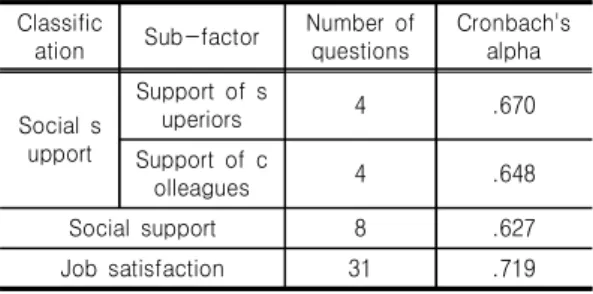
According to the reliability test of each variable, the sub-factors of social support ‘support of super ior’ was .670, ‘support of colleague’ was .648, the total reliability was .627, and the reliability of job
satisfaction was found to be .719. The reliability of each measuring tool exceeded Cronbach’s α value o f .60, which is the minimum level of reliability. Reli ability of this research was measured using the Cro nbach's alpha factor, and detailed results are shown in Table 1.
Table 1. Reliability Test of Disability Facility Workers’
Social Support and Job Satisfaction Classific
ation Sub-factor Number of questions
Cronbach's alpha
Social s upport
Support of s
uperiors 4 .670
Support of c
olleagues 4 .648
Social support 8 .627
Job satisfaction 31 .719
3. RESULTS
3.1 General Characteristics of Disability Facility Workers
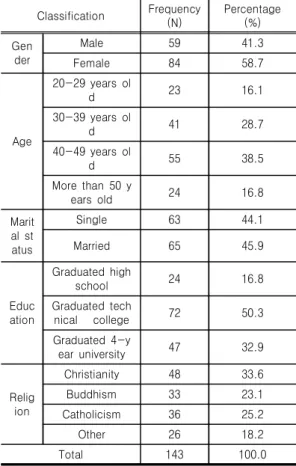
In gender, ‘male’ was 41.3% and ‘female’ was 5 8.7%, and in age, ‘40-49 years old’ was highest wi th 38.5%, then ‘30-39 years old’ 28.7%, ‘over 50 years old’ 16.8%, and ‘20-29 years old’ with 16.
1%. In marital status, ‘married’ was 55.9% and ‘un married’ was 44.1%, and in the highest level of edu cation achieved, ‘technical college graduate’ was th e highest with 50.3%, then ‘university graduate’ 4 7.0% and ‘high school graduate’ with 16.8%. In reli gion, ‘Christianity’ was the highest with 33.6%, the n ‘Catholic’ 25.2%, ‘Buddhism’ 23.1% and ‘others’
with 18.2%. The general characteristics of disabilit y facility workers are outlined in Table 2.
Table 2. General Characteristics of Disability Facility Workers
Classification Frequency (N)
Percentage (%) Gen
der
Male 59 41.3
Female 84 58.7
Age
20-29 years ol
d 23 16.1
30-39 years ol
d 41 28.7
40-49 years ol
d 55 38.5
More than 50 y
ears old 24 16.8
Marit al st atus
Single 63 44.1
Married 65 45.9
Educ ation
Graduated high
school 24 16.8
Graduated tech
nical college 72 50.3 Graduated 4-y
ear university 47 32.9
Relig ion
Christianity 48 33.6
Buddhism 33 23.1
Catholicism 36 25.2
Other 26 18.2
Total 143 100.0
3.2 Job Characteristics
Upon analysing job characteristics, the following results were found: in body of operation, most wer e ‘social welfare corporation’ with 79.7% and ‘scho ol corporation/religious corporation’ was 29.0%. In job position, ‘general administration’ was 62.9%, ‘di rector, head of department, team leader, head of se ction’ was 30.8%. In employment type, ‘permanent’
was 65.7% and ‘temporary’ was 34.3%. In the num ber of years employed, ‘3 years-less than 5 years’
was the highest with 52.4%, then ‘5 years-less th an 10 years’ was 34.3% and ‘less than 3 years’ wit h 13.3%, and in job area, ‘social worker’ was the highest with 59.4%, then ‘nurse (physical therapis
t)’ with 18.9% and ‘others’ accounted for 21.7%. I n monthly income, ‘1.5-less than 2 million won’ w as the highest with 56.6%, then ‘more than 2 millio n won’ with 25.9% and ‘1-less than 1.5 million wo n’ with 17.5%. In the average daily working hours,
‘8 hours’ was the highest with 53.1%, then ‘more than 9 hours’ with 46.9%. The detailed results of the job characteristics analysis are shown in Table 3.
Table 3. Job Characteristics
Classification Frequen cy(N)
Percenta ge(%) Opera
ting body
Social welfare cor
poration 114 79.7
Educational found
ation 29 20.3
Local government
Positi on
Secretary-general 44 30.8
Head of departme nt, team leader, s ection chief(Admin istrative position)
90 62.9
Other 9 6.3
Empl oyme nt sta tus
Permanent 94 65.7
Not permanent 49 34.3
Years worke
d
Less than 3 years 19 13.3
3~5 years 75 52.4
5~10 years 49 34.3
Job s pecial isatio n
Social workers 85 59.4
Nurse
(physical therapist) 27 18.9
Other 31 21.7
Mont hly w age
Less than 1,000,0
00-1,500,000 won 25 17.5
1,500,001-2,000,0
00 won 81 56.6
More than 2,000,0
00 won 37 25.9
Hours of wo rk per
day
8 hours 76 53.1
More than 9 hours 67 46.9
Total 143 100.0
3.3 Correlation between major variables Upon examining the correlation between social s
upport and job satisfaction, the ‘support of superio r’ and ‘support of colleague’ in social support was found to have a significantly high level of positive correlation (r=.402, p<.01). The ‘support of super ior’ in social support, as recognised by the disable facility worker, and job satisfaction was also found to have a significantly high level of positive correla tion (r=.457, p<.01). On the other hand, the ‘supp ort of colleague’ in social support, as recognised by the disable facility worker, and job satisfaction was also found to have a low level of positive correlatio n (r=.325, p<.01). The detailed results of the corr elation between social support and job satisfaction are shown in <Table 4>.
Table 4. Correlation between major variables Classification
Social suppor
Job sati sfaction Support of s
uperiors
Support of coll eagues Soc
ial sup port
Support of
superiors 1
Support of
colleagues .402** 1
Job satisfactio
n .457** .325** 1
* p<.05, ** p<.01, *** p<.001
3.4 Difference in social support according to general characteristics and job characteristics
The detailed results of the difference in social support according to general characteristics are sh own in Table 5.
Table 5. Difference in Social Support according to Job Characteristics
Classification N Avera ge
Standar d devia tion
t/F p Schef fe
Educati on
Other 24 3.24 .39
1.218 .299 - Graduated h
igh school 72 3.29 .38 Graduated t
echnical c ollege
47 3.17 .39
Religion
Graduated 4 -year univer
sity
48 3.27 .36
.541 .655 - Christianity 33 3.20 .34
Buddhism 36 3.29 .40 Catholicism 26 3.19 .48
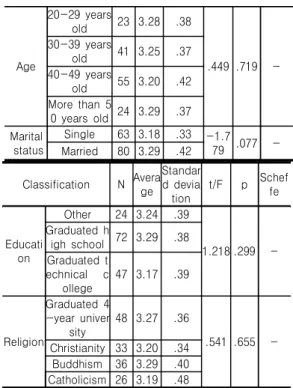
Upon examining the difference in social support according to the general characteristics of disabled facility workers, there was no significant differenc e in social support according to gender, age, marita l status, highest level of education achieved and rel igion. This demonstrates that the mean of disabled facility workers is at an even level, regardless of gender, age, marital status, highest level of educati on achieved and religion.
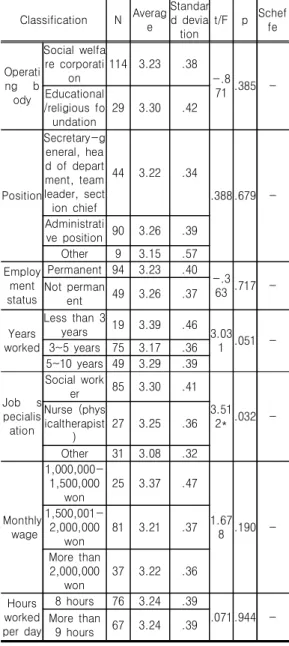
Whilst there was no difference in mean found in disabled facility worker’s job characteristics of job position, body of operation, type of employment, n umber of years workers, monthly income and numb er of working hours, the only significant difference in social support according to job characteristics w as found in the factor of job area (t=3.512, p<.0 5). The detailed results of the difference in social support according to job characteristics are shown in Table 6.
Classification N Avera ge
Standar d devia tion
t/F p Schef fe Gender Male 59 3.27 .35
.661 .510 - Female 84 3.22 .41
Age
20-29 years
old 23 3.28 .38
.449 .719 - 30-39 years
old 41 3.25 .37 40-49 years
old 55 3.20 .42 More than 5
0 years old 24 3.29 .37 Marital
status
Single 63 3.18 .33 -1.7
79 .077 - Married 80 3.29 .42
Table 6. Difference in Social Support according to Job Characteristics
Classification N Averag e
Standar d devia tion
t/F p Schef fe
Operati ng b ody
Social welfa re corporati
on
114 3.23 .38 -.8
71 .385 - Educational
/religious fo undation
29 3.30 .42
Position
Secretary-g eneral, hea d of depart ment, team leader, sect
ion chief
44 3.22 .34
.388 .679 - Administrati
ve position 90 3.26 .39
Other 9 3.15 .57
Employ ment status
Permanent 94 3.23 .40 -.3
63 .717 - Not perman
ent 49 3.26 .37
Years worked
Less than 3
years 19 3.39 .46 3.03
1 .051 - 3~5 years 75 3.17 .36
5~10 years 49 3.29 .39
Job s pecialis ation
Social work
er 85 3.30 .41
3.51 2* .032 - Nurse (phys
icaltherapist )
27 3.25 .36 Other 31 3.08 .32
Monthly wage
1,000,000- 1,500,000
won
25 3.37 .47
1.67 8 .190 - 1,500,001-
2,000,000 won
81 3.21 .37 More than
2,000,000 won
37 3.22 .36
Hours worked per day
8 hours 76 3.24 .39
.071 .944 - More than
9 hours 67 3.24 .39
* p<.05
Upon examining the difference in job satisfactio n according to the general characteristics of disabl ed facility workers, the difference in job satisfactio n according to gender, age, marital status, highest level of education achieved and religion were not st
atistically significant. This demonstrates that the mean of disabled facility workers is at an even leve l, regardless of gender, age, marital status, highest level of education achieved and religion. The detail ed results of the difference in job satisfaction acco rding to general characteristics are shown in <Tabl e 7>.
Table 7. Difference in Job Satisfaction according to General Characteristics
Classification N Averag e
Standa rd devi ation
t/F p Schef fe Gende
r
Male 59 3.17 .22 -1.52 6 .129 - Female 84 3.22 .24
Age
20-29 year
s old 23 3.21 .21
.414 .743 - 30-39 year
s old 41 3.18 .27 40-49 year
s old 55 3.20 .21 More than
50 years ol d
24 3.24 .24 Marital
status
Single 63 3.24 .25
1.906 .059 - Married 80 3.17 .21
Educat ion
Other 24 3.20 .18
1.097 .337 - Graduated
high school 72 3.23 .23 Graduated t
echnical college
47 3.16 .25
Religio n
Graduated 4-year univ
ersity
48 3.17 .22
.349 .790 - Christianity 33 3.22 .24
Buddhism 36 3.21 .25 Catholicism 26 3.20 .21
* p<.05
Upon examining the difference in job satisfactio n according to the job characteristics of disabled fa cility workers, there was no significant difference, as no difference in mean was found in the differenc e in job satisfaction according to the job characteri stics of operating body, job position, type of emplo yment, number of years worked, job area, monthly income and number of working hours. The detailed
results of the difference in job satisfaction accordi ng to job characteristics are shown in <Table 8>.
Table 8. Difference in Job Satisfaction according to Job Characteristics
Classification N Averag e
Standa rd devi ation
t/F p Schef fe
Operati ng bo dy
Social welfar e corporatio
n
114 3.20 .24
.286.775 - Educational/r
eligious foun dation
29 3.19 .20
Positio n
Secretary-ge neral, head of departme nt, team lea der, section
chief
44 3.22 .21
.227.797 - Administrativ
e position 90 3.20 .24
Other 9 3.16 .29
Employ ment st atus
Permanent 94 3.19 .24 -.4
19.676 - Not permane
nt 49 3.21 .21
Years worked
Less than 3
years 19 3.24 .18
.342.711 - 3~5 years 75 3.19 .26
5~10 years 49 3.20 .20 Job sp
ecialisa tion
Social worker 85 3.20 .25
.758.471 - Nurse (physi
cal therapist )
27 3.24 .19 Other 31 3.17 .20
Monthly wage
1,000,000-1,
500,000 won 25 3.26 .21 1.34
1 .265 - 1,500,001-2,
000,000 won 81 3.18 .24 More than 2,
000,000 won 37 3.21 .23 Hours
worked per day
8 hours 76 3.18 .23 -.8
99.370 - More than 9
hours 67 3.22 .23
* p<.05
3.5 Effect of Social Support on Job Satisfaction
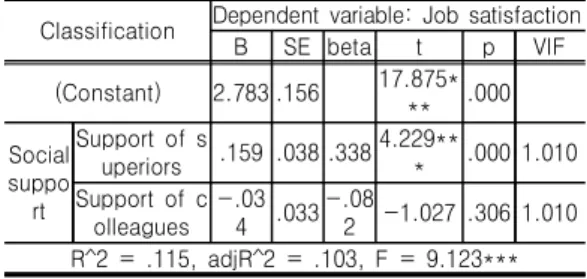
A multiple regression analysis was conducted to find the effect on social support on job satisfaction, and a regression model is evident (R^2=0.115) w ith a data variability of 11.5%. To diagnose the mul ticollinearity between variables, VIF (variable infla tion factor) and tolerance were examined. Generall
y, when VIF is over 10 or when the limit is less the 0.1, there is a multicollinearity problem. In this analysis, the VIF of variables were all under 10 wit h a limit greater than 0.1, showing that multicolline arity is not a problem. As a result of the variance analysis on the model, it is evident that the estimat ed model is significant (F=9.123, p<.001), and onl y the support of the superior (beta=.338, p<.001) has significant effect on job satisfaction. This impli es that the higher the support of superior of disabl ed facility worker, the higher their job satisfaction.
The detailed results of the effect of social support on job satisfaction are shown in Table 9.
Table 9. Effect of Social Support on Job Satisfaction Classification Dependent variable: Job satisfaction
B SE beta t p VIF
(Constant) 2.783 .156 17.875*
** .000 Social
suppo rt
Support of s
uperiors .159 .038 .3384.229**
* .000 1.010 Support of c
olleagues -.03
4 .033-.08
2 -1.027 .306 1.010 R^2 = .115, adjR^2 = .103, F = 9.123***
*** p<.001
4. DISCUSSION & CONCLUSIONS
This study investigated the difference in social support and job satisfaction according to the gener al and job characteristics of disabled facility worke rs, and analysed the effect of social support on job satisfaction. A discussion based on the results foun d is as follows:
First, upon analysing the difference in social sup port according to the general characteristics and jo b characteristics of disabled facility workers, there was no significant difference in social support acco rding to general characteristics. However, a signifi cant difference was found in social support accordi ng to the job characteristic of job area. This result implies that the level of social support recognized
by social workers demonstrates greater job satisfa ction in comparison to disabled facility workers, su ch as nurses or physical therapist. This finding is supported by the study of Jung-Hye Lee [11] that reports no significant difference in the social suppo rt of special education teachers according to their gender and marital status, but found significant diff erence in social support according to the job enviro nment.
Second, an even level of mean was found in the general characteristics of disabled facility workers, regardless of gender, age, marital status, highest le vel of education achieved and religion, and there w as no significant difference in job satisfaction accor ding to the job characteristics of job position, body of operation, type of employment, number of years worked, job area, monthly income and number of w orking hours. An even level of mean was also foun d among the job characteristic factors. This result is supported by the study of Haeng-Bok Yoon [1 2] that reports no significant difference in job satis faction according to the general characteristics and job factors of workers at welfare facilities for the elderly.
Third, upon examining the effect of social suppo rt, as recognised by disabled facility workers, on th eir job satisfaction, only the ‘support of superior’, a sub-factor of social support, was found to have a positive effect on job satisfaction. This implies th at the higher the support of the superior, the highe r the job satisfaction of disabled facility worker. T his result was in line with the results of this study, but was not similar to the result of [13] study, tha t reports the support of colleague to also affect job satisfaction.
The results of this study demonstrate that the e ffect of social support on the job satisfaction of wo rkers are difference according to the worker’s level of awareness, and also according to their working
environment.
In order to develop plans to improve the treatme nt of disabled facility workers in the future, there is a need for further research of practical intervent ion on the factors that affect job satisfaction.
REFERENCES
[1] http://www.kostat.go.kr/, 2015.
[2] http://www.mv.go.kr/, 2015.
[3] I. B. Son, D. K. Kim, S. T. Kim, “The Effect of Job Stress of Center for Independent Living (CIL) Employees on Burnout and the Mediating Effect of Job Satisfaction”, Journal of Vocationa l Rehabilitation, Vol.23, No.2, pp.107-12, 201 3.
[4] Y. M. Kim, “Study on the Influence of Organiz ational Climates for Social Worker's Job Satisfa ction in Social Welfare Centers”, Journal of the korea Contents Association, Vol.9, No.10, pp.32 8-338, 2009.
[5] W. Lee, D. K. Kim, “A study on emotional lab or affecting a burnout level of personal assista nts - Focused on the mediating effects of job stress and job satisfaction”, Social Science Res earch Review, Vol.27, No.2, pp115-140, 2011.
[6] D. S. Lee, “The Effects on the Work Attitude to the Perception of Justice in Employee of th e Social Welfare Facilities: Focussed on the A ged and the Disabled Social Welfare Facilities”, The Korean Journal of Local Government Studi es Vol.12, No.2, pp133-152, 2008.
[7] American Diabetes Association, Community He alth Survey, 2011.
[8] M. S. Seong, “The Effects of Social Support i n The Organization on Psychological well-bein g : Resilience of Health Professionals as a Me diator”, The Graduate School of Education Han yang University 2014.
[9] Y. P. Song, “A Study on Job Satisfaction with the Working Conditions of Social Welfare Cente r Employees-Focused on the Area of Dangjin, Chungcheongnamdo-”, The Graduate School of Sungkyul University, 2011.
[10] I. S. Cha, Kim, H. M, “A Study on the Influe ntial Factors and Policy Implications for Emplo yees Turnover Intention in Social Welfare Cent ers”, The Graduate School of Education Hanyan g University, 2014.
[11] J. H. Lee, “Differences in Special Education Teachers' Perceptions of Social Support by Bac
kground Variables”, Major in Elementary Educat ional Administration Graduate School of Educati on Chuncheon National University 2017.
[12] H. B. Yoon, “A Study on the Variants That B ring About Different Job Satisfactions to Those Engaged in the Community Welfare Centers for the Elderly -Based on the Welfare Facilities in Gyeonggi Province”, Department of Public Admi nistration Social Welfare Graduate School, Kook min University, 2013.
[13] N. Y. Kim, “The Effect of Job Stress and So cial Support of the Elderly Care Facility Emplo yees on Job Satisfaction”, Department of Social Welfare Kukje Theological University, 2016.
Author Biography
Joo-yeon Lee [Full Member]
• February 2010 : Dongguk University, Graduate School of Buddhism Studies, Department of Thanatology and Rituals (Master of Arts)
• March 2016 ~ Present:
Dongbang Culture
University, Department of Culture, Arts and Contents (Doctorate Candidate)
<Research Interests> Information, Education, Welfare
Sung-je CHO [Full Member]
• February 1977: Hongik University, PhD in Computer Engineering
• March 2007 ~ Present:
Professor at Dongbang University Department of Education
<Research Interests> Information, Education