1. Introduction
L2 speech production is known to be affected by several factors such as learners’ L1 sound system, initial age of L2 learning, L2 experience (i.e., amount and length of L2 exposure), and quality of L2 input. In particular, as for L2 experience, Baker et al., (2002) reported that Korean adults with 9 years of residence in English speaking countries (length of residence: LOR) were able to perceive and produce English vowels /ɑ/ and /ʌ/ target appropriately,
suggesting that LOR is an important factor in accounting for native-like vowel productions. Flege et al., (2002) found that native Italian speakers were able to attain native-like pronunciation only when they were exposed to English early in life and dominated in English. Fullana & MacKay (2002) examined Catalan EFL learners’ production of English words. The learners varied in terms of initial age of English learning and total hours of instruction received. Native English speakers’ judgments for foreign accent of the learners’ production revealed that more experienced learners
* The first author of this study was supported by the College of Education, Korea University Grant in 2017.
** Korea University, [email protected], corresponding author Received 14 May 2017; Revised 26 June 2017; Accepted 27 June 2017
ISSN 2005-8063 2017. 6. 30.
Vol.9 No.2 pp. 69-76
말소리와 음성과학
http://dx.doi.org/10.13064/KSSS.2017.9.2.069
The impact of language-learning environments on Korean learners’
English vowel production
*Lee, Shinsook · Nam, Hosung **· Kang, Jaekoo · Shin, Dong-Jin · Kim, Young Shin
Abstract
The current study investigated whether Korean learners’ English-learning environments, especially target English accent (General American English (GAE) vs. Southern British English (SBE)) and English-language experience affected their production of English vowels. Thirty six EFL learners, 27 ESL-US learners, and 33 ESL-UK learners produced 8 English vowels with a bVt frame (beat, bit, bet, bat, bought, bot, boat, boot). The learners’ productions were acoustically analyzed in terms of F1 and F2 frequencies. The overall results revealed that the learners’ target accent had an effect on their production of some English vowels. The EFL and ESL-US learners’ (especially, female learners’) production of bought, bot, boat, and boot, which show characteristic differences between the GAE and SBE accents, was closer to that of the native American English (AE) speakers than the native British English (BE) speakers. In contrast, the ESL-UK learners’
production of bought and bot demonstrated the opposite pattern. Thus, the impact of target accent was not demonstrated across the board. The effect of the learners’ different English-language experience was also rather limited. This was because the EFL learners’ production was not much different from the ESL-US learners’ production, in spite of the ESL-US learners’ residence in the US for more than 9 years. Furthermore, the Korean learners, irrespective of their different English-language experience, tended to produce bit and bat with lower F1 than the native AE and BE speakers, thus resulting in bit and bat to be produced similarly to beat and bet, respectively. This demonstrates the learners’ persistent L1 effects on their English vowel production despite the learners’ residence in the English speaking countries or their high English proficiency.
Keywords: English-learning environments, accent, ESL vs. EFL, English vowel production, acoustic analyses, variation
were perceived significantly less-accented than less experienced learners, indicating the impact of L2 experience on L2 production.
Further, Flege et al., (1999) reported that some native Italian speakers living in Ottawa for about 20 years were able to attain native-like pronunciation, although they were exposed to English rather late in life, which indicates the importance of the quality of L2 input in L2 acquisition.
By contrast, L2 learners in the classroom instructional settings often fail to obtain native-like pronunciation as they are more likely to be exposed to foreign-accented speech of their instructors/ peers or to less authentic L2 input. Bongaerts et al. (1995) and Bongaerts et al. (1997) investigated an attainment of native-like pronunciation by Dutch learners of English using diverse speech samples:
spontaneous speech, reading a text, and a list of words and sentences. One group of the learners were classified as highly successful learners of English, even though they had received formal instruction in English at around at the age of 12. Bongaerts et al. (1995, 1997) reported that native English speakers judged the productions of some Dutch learners in the highly successful group to be native-like. Bongaerts et al. (1995, 1997) attributed the results to several factors such as the learners’ high motivation and the amount of L2 input. More specifically, the learners who passed as natives were highly motivated, exposed to a large amount of both native and non-native input after the age of 18, and received formal training in perception and production. Based on the results, Bongaerts et al. (1995, 1997) maintained that it is not impossible for late L2 learners to attain native-like pronunciation when the aforementioned factors for L2 acquisition are present. Birdsong (2007), who examined the productions of Anglophone late learners of French, also found that native-like accent was attainable by late L2 learners when they were highly motivated and received phonetic training. Importantly, the Bongaerts et al. (1995, 1997) and Birdsong (2007) studies revealed that some L2 learners were able to attain native-like pronunciation although their (initial) L2 learning occurred in instructional settings.
Besides L2 experience, learners’ target language accent was known to be related to L2 vowel acquisition. Escudero & Boersma (2004) investigated whether L1 Spanish-L2 English learners’ target accents affected their perception of English vowels. The Spanish learners were exposed either to Scottish English or to Southern British English and they performed a vowel categorization test for English /i/ (e.g., sheep) and /ɪ/ (e.g., ship). Escudero & Boersma (2004) reported that native Scottish English speakers’ production of the two vowels demonstrated more F1 than temporal differences and their categorization of the vowels reflected this property. By contrast, native Southern British English speakers showed more durational than spectral (i.e., F1) differences in production and the speakers attested this property in the vowel categorization test.
According to Escudero & Boersma (2004), the Spanish learners’
experience with their target accent influenced their categorization of English vowels /i/ and /ɪ/; the Scottish English-oriented Spanish learners tended to rely on spectral cues while the Southern British English-oriented learners had a tendency to depend on temporal cues. However, the Spanish learners’, especially the Southern British English-oriented learners’ perceptual behavior was still deviant from that of the native English speakers.
Furthermore, General American English (GAE) differs from Southern British English (SBE) with regard to some vowels like /æ-a/, /ɑ-ɒ/, /oʊ-əʊ/, and /ɝ-ɜ/, although the two accents have many
common vowels (/i, ɪ, eɪ, ɛ, ə, ʌ, ɔ, ʊ, u/). For example, GAE uses /æ/ while SBE employs /a/ in words such as bat and bad. GAE also uses /ɑ/ in words like bot and hot but SBE uses its rounded counterpart /ɒ/ for the same words. GAE has /oʊ/ in words like boat and low whereas SBE has /əʊ/ in the same words. GAE also employs the r-coloring vowel /ɝ/ in words such as Burt and bird but SBE uses the r-less vowel /ɜ/ for these words with a lengthening of a preceding vowel (Celce-Murcia et al., 2010; Ladefoged, 2006;
Lee & Shin, 2015). In addition, many speakers in GAE (especially the Third Dialect region) tend to merge /ɑ/ and /ɔ/ into /ɑ/ (e.g., cot, caught) (Clopper & Pisoni, 2004; Labov, 1998, 2005).
Recently, Lee & Shin (2015) examined Korean EFL learners’
identification and mapping of GAE and SBE vowels. The Korean learners’ target accent was GAE and their experience with the SBE accent was very limited. Lee & Shin (2015) reported that the Korean learners overall identified GAE vowels better than SBE vowels and that the learners had great difficulty in identifying typical SBE vowels such as /a/, /ɒ/, /əʊ/, and /ɜ/. Based on their findings, Lee & Shin (2015) maintained that the Korean learners’
experience with their target language accent affected their vowel identification.
Previous studies on English accents mostly examined whether native American or British English speakers’ regional accents influenced their perception and/or production of the vowels in their regional accents (i.e., either AE or BE) (Clopper et al., 2005; Evans
& Iverson, 2004, 2007; Labov, 1998). However, only a few studies have investigated the impact of L2 learners’ target language accent on their L2 vowel acquisition (Escudero & Boersma, 2004; Lee &
Shin, 2015), especially on their L2 vowel production, although accent differences could pose a great challenge to L2 learners (Strange et al., 1998). Besides, learners’ L2 experience influences their L2 vowel acquisition as documented in the previous studies reviewed earlier, but not many studies have explored the effect of L2 learners’ different L2 experience on their L2 vowel production.
The current study investigated the effect of L2 learners’
language-learning environments, in particular target language accent and different L2 experience on their L2 vowel production.
Specifically, the study explored 1) whether native Korean speakers’
target English accent (i.e., GAE vs. SBE) influences their production of English vowels; 2) whether the Korean speakers’
different English-language experience (i.e., EFL vs. ESL) affects their production of English vowels. The productions of English vowels recorded by the Korean speakers were acoustically analyzed and compared to those of native American and British English speakers. It was tested whether the vowels produced by the ESL-UK learners, who were intensively exposed to SBE, were more similar to the vowels produced by the native BE speakers than to those produced by the native AE speakers. Further, the vowels produced by the ESL-US learners, who acquired English in naturalistic settings in the US, would be acoustically more similar to those produced by the native American English speakers relative to the vowels produced by the EFL learners, who learned English in a classroom environment in Korea.
2. Method 2.1. Participants
Thirty-six Korean EFL learners (EFL learners), 27 Korean ESL
learners in the US (ESL-US learners), and 33 Korean ESL learners in the UK (ESL-UK learners) participated in a vowel production experiment. The EFL learners majored/double majored in English language education at a private university in Seoul, Korea (mean age = 22.5). All of the EFL learners reported that they were familiar with GAE pronunciation and that they had a very limited exposure to British English only through media. The EFL learners should be regarded as (upper)intermediate to advanced learners of English given that their mean IBT-TOEFL score was 104 (range: 85-115).
The ESL-US learners were recruited from Urbana-Champaign, Illinois, and Denver, Colorado in the US. The participants from Urbana-Champaign were all undergraduate or graduate students.
The participants from Denver were mostly undergraduate or graduate students except some who were working in the Denver area (mean age = 29.5). The ESL-US learners were all familiar with GAE pronunciation due to their prior exposure to GAE in Korea and also to living in the US for more than one year at the time the experiment was run. The ESL-US learners self-reported that they were mostly (upper)intermediate or advanced level learners of English regarding their speaking and listening abilities. The ESL-UK learners were undergraduate/graduate students or working in (near) London (mean age = 25.9). The ESL-UK learners had resided in England, especially in (near) London for more than one year when they participated in the experiment. Most of the participants had been exposed to British English, especially SBE after the age of 20 but some of them had resided in England before 20. Most of the ESL-UK learners had a prior exposure to GAE in Korea but they were mainly exposed to British English, in particular SBE since their arrival in England (or British English speaking countries). The ESL-UK learners also self-reported that they were (upper)intermediate or advanced learners of English with respect to speaking and listening. In addition, each 4 native speakers of GAE and SBE completed the vowel production experiment (2 male and 2 female speakers for each accent). Two of the GAE speakers were from California while the other two were from Ohio and Illinois. All the SBE speakers were from London.
The participants’ demographic information is shown in <Table 1>.
Group (Number)
Chrono- logical Age (years)
Initial L2 age (years)
AOA (years)
LOR (years)
English
Proficiency Familiar
EFL (36)
22.5 (1.9)
8.1
(1.6) --- ---
(Upper) Inter- mediate/
advanced GAE
(all)
ESL-US (27)
29.5 (6.6)
9.3 (2.8)
18.8 (8.0)
9.3 (6.5)
(Upper) Inter- mediate/
advanced GAE
(all)
ESL-UK (33)
25.9 (3.8)
10 (2.6)
20.2 (5.9)
4.2 (3.0)
(Upper) Inter- mediate/
advanced
SBE (all except 4) Table 1. Background information of the participants (Numbers given in
parentheses denote standard deviation.)
Note: AOA stands for age of arrival.
2.2. Stimuli
The current study investigated 8 English vowels with a bVt frame:
beat, bit, bet, bat, bot, bought, boat, boot. The study included the
vowels /æ-a/ (bat), /ɑ-ɒ/, (bot) and /oʊ-əʊ/ (boat) since these vowels show accent differences between GAE and SBE, as discussed earlier. The merging of /ɑ/ and /ɔ/ also needs to be examined as it is a salient feature of GAE while the fronting of /u/
is more frequently observed in British English (Wells, 1982;
Williams & Kerswill, 1999). Further, previous studies have documented that Korean ESL and EFL learners had difficulty with the distinction between English /i/ and /ɪ/ and also between /ɛ/ and /æ/, showing bidirectional errors for the vowel pairs (Ingram &
Park, 1997; Flege et al., 1997; Hwang & Lee, 2012). Accordingly, the present study investigated the 8 English vowels.
2.3. Procedure
Each target word was presented in a carrier sentence ‘Say _______, again’ and displayed on the computer monitor. The participants were asked to look at the stimuli before the test for familiarization.
They produced the stimuli three times in a sound-proof booth or in a sound-attenuated room. Audio files for the production test were recorded with a Sony ECM-MS907 microphone (for the EFL learners and the ESL-US learners) or a RODE-NT1A microphone (for the ESL-UK learners) using Speech Filing System (SFS) and digitized at 44,1 kHz (16 bit). The EFL learners completed the production task in Seoul. The ESL-US learners performed the task in Urbana-Champaign and Denver while the ESL-UK learners in London. After the recording, all the recordings were automatically segmented and manually realigned. Then, the target words were extracted from the recordings by using Praat. First and second formant frequencies (F1 and F2) of the 8 vowels recorded by the participant groups were measured for analysis.
3. Results
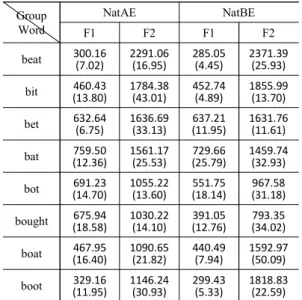
Mean F1 and F2 values of the 8 vowels are provided in <Tables 2 and 3> for male and female native speakers, respectively. Male and female Korean speakers’ mean F1 and F2 values of the same vowels are presented in <Tables 4 and 5>, respectively. The 8 vowels produced by native speakers and by each learner group are also plotted in the F1-F2 space in <Figures 1 through 4>. <Figures 1 and 2> show that both male and female native speakers of AE produced boot and boat more backward relative to native speakers of BE while they demonstrated the opposite pattern for bought.
Female native speakers of AE also tended to produce front vowels in the more front position compared to their BE counterparts.
As for the Korean speakers, the male speakers’ vowel space demonstrated F1-wise height differences between the three groups, as shown in <Figure 3>. The ESL-UK learners showed wider vowel space in F1 dimension whereas the EFL and ESL-US learners had narrower F1 dimension relative to the ESL-UK learners. This result seems to suggest that the ESL-UK learners tried to accommodate vowels from the two accents in the vowel space given that many of the ESL-UK learners had a prior experience with the GAE accent (Flege, 1995). Compared to the male speakers, the female speakers showed wider vowel space in both F1 and F2, as can be seen in
<Figure 4>. More specifically, group differences were reflected in both F1 and F2 dimensions. The entire vowel shape was high and fronted in the order of the ESL-UK learners to the ESL-US learners and then to the EFL learners. The results of the overall vowel plotting indicated that the participants’ different English-language
experience was reflected in their production of the target vowels to some extent and this trend was more salient for the female speakers.
However, the results seem to suggest that the Korean learners may not have acquired an entire vowel system of GAE or SBE in spite of their exposure to their target accent.
Figure 1. Visualization of F1 and F2 of the vowels produced by male native speakers
Figure 2. Visualization of F1 and F2 of the vowels produced by female native speakers
Figure 3. Visualization of F1 and F2 of the vowels produced by male Korean speakers by group
Figure 4. Visualization of F1 and F2 of the vowels produced by female Korean speakers by group
Group Word
NatAE NatBE
F1 F2 F1 F2
beat 300.16
(7.02) 2291.06
(16.95) 285.05
(4.45) 2371.39 (25.93) bit 460.43
(13.80) 1784.38
(43.01) 452.74
(4.89) 1855.99 (13.70) bet 632.64
(6.75) 1636.69
(33.13) 637.21
(11.95) 1631.76 (11.61) bat 759.50
(12.36) 1561.17
(25.53) 729.66
(25.79) 1459.74 (32.93)
bot 691.23
(14.70) 1055.22
(13.60) 551.75
(18.14) 967.58 (31.18) bought 675.94
(18.58) 1030.22
(14.10) 391.05
(12.76) 793.35 (34.02) boat 467.95
(16.40) 1090.65
(21.82) 440.49
(7.94) 1592.97 (50.09) boot 329.16
(11.95)
1146.24 (30.93)
299.43 (5.33)
1818.83 (22.59) Table 2. Mean F1 and F2 for male native speakers
(Standard deviations are given in parentheses.)
Group Word
NatAE NatBE
F1 F2 F1 F2
beat 361.40
(17.95) 2966.24
(60.87) 363.04
(31.09) 2563.15 (311.08) bit 562.49
(18.22) 2282.26
(92.36) 525.89
(17.76) 2117.72 (205.02) bet 789.14
(8.72) 2064.54
(61.28) 768.33
(47.14) 1668.31 (180.46) bat 1092.85
(19.92) 1889.70
(41.42) 993.25
(19.59) 1603.03 (15.41)
bot 859.55
(19.15) 1300.70
(13.15) 641.05
(23.02) 1008.04 (36.75) bought 774.20
(14.26) 1222.56
(21.38) 469.40
(13.25) 811.71 (51.08) boat 513.92
(9.45) 1397.61
(72.17) 488.10
(10.20) 1755.78 (121.98) boot 409.25
(9.33) 1624.15
(110.49) 351.09
(13.69) 1974.66 (71.53) Table 3. Mean F1 and F2 for female native speakers
(Standard deviations are given in parentheses.)
Group Word
EFL ESL-US ESL-UK
F1 F2 F1 F2 F1 F2
beat 314.30 (42.61)
2209.00 (191.41)
340.38 (70.98)
2125.75 (242.15)
313.18 (47.26)
2421.00 (321.44) bit 350.50
(28.48)
2117.60 (171.41)
350.50 (31.93)
2080.00 (126.30)
415.27 (53.52)
2083.36 (371.99) bet 609.30
(61.24)
1654.70 (172.89)
621.88 (60.23)
1759.62 (119.29)
714.73 (131.87)
1742.18 (189.09) bat 649.50
(74.14)
1644.40 (161.76)
674.88 (63.08)
1518.25 (166.42)
762.91 (100.92)
1462.09 (334.54) bot 692.90
(78.23)
1141.20 (102.33)
569.88 (113.27)
1064.75 (159.14)
485.00 (89.69)
892.27 (149.66) bought 590.80
(105.94) 974.50 (96.34)
618.50 (132.90)
1008.25 (90.50)
457.91 (92.01)
1037.73 (451.79) boat 422.90
(41.88) 906.70 (101.36)
445.38 (104.78)
982.00 (247.38)
440.64 (48.91)
1157.18 (432.87) boot 416.90
(159.44) 1156.70 (162.94)
431.00 (124.12)
1395.50 (272.87)
387.09 (126.01)
1524.91 (395.42) Table 4. Mean F1 and F2 for male Korean speakers by group
(Standard deviations are given in parentheses.)
Group Word
EFL ESL-US ESL-UK
F1 F2 F1 F2 F1 F2
beat 462.30 (74.20)
2567.04 (359.50)
407.94 (38.93)
2531.41 (107.93)
377.62 (16.56)
2537.19 (165.62) bit 467.19
(54.93)
2471.70 (262.57)
459.59 (65.96)
2269.82 (273.64)
438.81 (75.16)
2373.67 (236.55) bet 814.11
(133.02) 1675.70 (340.04)
745.53 (82.90)
1813.65 (293.39)
745.71 (113.79)
1884.10 (225.82) bat 846.44
(94.48)
1701.19 (348.17)
824.24 (109.88)
1557.29 (265.43)
811.33 (109.83)
1700.86 (302.28) bot 847.00
(136.54) 1254.85 (130.11)
753.12 (175.45)
1208.29 (138.19)
521.86 (116.47)
1054.67 (206.16) bought 659.93
(125.92) 1123.63 (105.22)
728.12 (140.64)
1151.12 (108.16)
491.95 (110.10)
935.24 (137.14) boat 490.85
(72.76) 989.04 (127.31)
509.71 (75.20)
1071.59 (117.53)
469.62 (73.92)
1049.52 (293.42) boot 449.30
(44.25)
1363.63 (172.17)
417.00 (39.32)
1367.12 (238.34)
404.86 (42.07)
1425.90 (333.36) Table 5. Mean F1 and F2 for female Korean speakers by group
(Standard deviations are given in parentheses.)
The current paper was mainly concerned with the effect of the participants’ language-learning environments, especially target accent and English-language experience on their production of the target vowels, rather than with the variability in vowels which is ascribable to the participants’ gender differences and intrinsic vowel characteristics. Accordingly, mean F1 and F2 values were z-score normalized by both gender and vowel, following DiCanio et al., (2015) normalization technique.
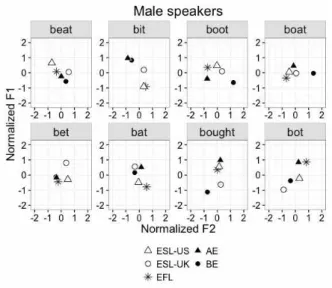
Normalized mean F1 and F2 values are plotted by the participant group with two reference points (native AE (GAE) speakers and native BE (SBE) speakers). <Figure 5> shows the plotting of the 8 English vowels produced by the male speakers and <Figure 6> by the female speakers.
Figure 5. Normalized F1 and F2 of the vowels produced by male Korean speaker groups with reference to native AE and BE speakers
Figure 6. Normalized F1 and F2 of the vowels produced by female Korean speaker groups with reference to native AE and BE speakers
As can be seen in <Figure 5>, the male speakers of native AE and BE and the male EFL and ESL-UK learners produced beat rather closely. The native speakers produced bit with higher F1 and a little backward relative to all the learner groups, indicating that the learners’ production of bit deviated from the native speakers’
reference points. The native speakers’ and the EFL and ESL-US learners’ production of bet was closer whereas the ESL-UK learners’ production of bet was lower than the native speakers’
reference points. As for bat, the native AE and BE speakers and the ESL-UK learners produced it closely, but the EFL and ESL-US learners produced the word with lower F1 than the native speakers’
reference points. As shown in <Figure 5>, all the male learner groups tended to produce bet and bat somewhat similarly. The native BE speakers produced boot in a relatively front position, thus deviating from the other speaker groups. The same holds for boat.
The native AE speakers and the EFL and ESL-US learners produced bought closely while the native BE speakers produced it with lower F1 and a little backward than the native AE speakers.
The ESL-UK learners’ production of bought was closer to the native BE speakers’ reference point. The native AE speakers and the EFL learners produced bot with higher F1 relative to the other speaker groups. The ESL-UK learners’ production of bot was further backward than the native AE speakers’ reference point. As demonstrated in <Figure 5>, the merging (or near-merging) of the vowels /ɔ/ and /ɑ/ was witnessed for the native AE speakers and the EFL learners.
As can be seen in <Figure 6>, the female EFL learners produced beat with higher F1 than the female native speakers’ reference points. However, all the learner groups produced bit with lower F1 than the native speakers’ reference points, which indicates that the learner groups tended to produce beat and bit somewhat similarly.
The learners’ production of bet was not much deviant from the native speakers’ production. However, the native AE and BE speakers produced bat with higher F1 than the other learner groups.
As shown in <Figure 6>, the Korean female speakers had a tendency to produce /ɛ/ and /æ/ rather closely regardless of their different English-language experience, similar to the Korean male speakers. As for boot, the native BE speakers produced it in a relatively high and front position than the native AE speakers, who in turn produced the word in a rather front position than the learner groups. A similar pattern was observed for boat. The native AE speakers and the EFL and ESL-US learners produced bought and bot with higher F1 and a little forward relative to the native BE speakers and the ESL-UK learners. As can be seen in <Figure 6>, the native AE speakers tended to produce bought and bot very closely, indicating the merging of the vowels /ɔ/ and /ɑ/ and the EFL and ESL-US learners exhibited a somewhat similar pattern.
Based on the normalized vowel space, Euclidean distances from the native speakers’ reference points were calculated separately for the male and female speakers by the participant group and each vowel, as given in <Figures 7 and 8>. This was because several vowels such as /æ-a/ (bat), /ɑ-ɒ/, (bot) and /oʊ-əʊ/ (boat) demonstrate accent differences between GAE and SBE, as discussed earlier. The data were analyzed using linear mixed effects models in which the response variable was Euclidean distances.
Distance (native AE speakers vs. native BE speakers), Vowel (beat, bit, bet, bat, boot, boat, bought, bot), and Group (EFL, ESL-US, ESL-UK) were treated as the predictors.
The results of the male speakers indicated that there was a significant interaction between the three predictors (F[14]=2.7672, p<.001). Post-hoc tests revealed that vowel distances were significant, especially in low and back vowels (bought, bot, boot, boat). The EFL learners were closer to the native AE speakers in bot and boat than to the native BE speakers. The ESL-US learners showed a significant difference only in bought as they were closer to the native AE speakers than to the native BE speakers. The ESL-UK learners were closer to the native BE speakers than to the native AE speakers in bot. However, their production of boot and boat was closer to that of the native AE speakers.
The results of the female speakers indicated that there was a significant interaction between the three predictors (F[14]=14.591, p<.001). Post-hoc tests revealed that the female speakers showed more significant differences than the male speakers with respect to low and back vowels (bat, bought, bot, boot, boat). Specifically, the EFL learners were closer to the native AE speakers than to the native BE speakers in bought, bot, boot, and boat, but the learners were closer to the native BE speakers in bat. The ESL-US learners
were closer to the native AE speakers in bought, boot, and boat, whereas they were closer to the native BE speakers in bat. The ESL-UK learners’ production of beat, bat, bought, and bot was closer to the native BE speakers’ reference points. However, the ESL-UK learners’ production of boot and boat was closer to that of the native AE speakers.
Figure 7. Male Korean speakers’ Euclidean distances from native AE and BE speakers
Figure 8. Female Korean speakers’ Euclidean distances from native AE and BE speakers
4. Discussion
The present study explored whether Korean speakers’
language-learning environments, especially target English accent and English-language experience had an impact on their production of English vowels. For this purpose, a total of 96 participants with different English-language experience, 36 EFL learners, 27 ESL-US learners, and 33 ESL-UK learners, produced 8 English vowels with
a bVt frame. The overall results indicated that the participants’
target accent influenced their production of English vowels to some extent. The EFL learners, especially the female speakers were closer to the native AE speakers than to the native BE speakers for the words such as bought, bot, boot, and boat, which show characteristic differences between the GAE and SBE accents.
Similarly, the female speakers of the ESL-US group were closer to the native AE speakers relative to the native BE speakers for bought, boot, and boat. The ESL-UK learners showed that their production of bot and bought was closer to that of the native BE speakers while their production of boot and boat was closer to the native AE speakers’ production. This trend was more salient for the female speakers than the male speakers. The salient effect of target English accent among the female speakers across the participant groups seems to suggest the female speakers’ better accommodation to the target accent relative to the male speakers given that gender can influence which L2 language variety L2 learners select (Hansen Edwards, 2008). Further, the ESL-UK learners’ intensive experience with their target accent (i.e., SBE) was not witnessed across all the typical SBE vowels. The ESL-UK learners’ variation in vowel production may partly be due to their prior experience with GAE pronunciation when they had been in Korea. In addition, the learners’ production of bought and bot, which deviates from the native AE speakers’ production, may partly be due to the merging of /ɔ/ and /ɑ/ in the GAE accent, even though this deserves further research. In sum, the results revealed that the participants’ target English accent was reflected in their production of some English vowels which show more characteristic differences between the GAE and SBE accents relative to other vowels.
However, the influence of the Korean speakers’ different English-language experience on their production of English vowels was rather limited, given that the EFL learners’ production of the English vowels was not much different from that of the ESL-US learners. That is, the ESL-US learners’ LOR in the US did not seem to have much impact on their production of English vowels, unlike the findings of previous studies (Baker et al., 2002; Bohn & Flege, 1992). This may partly be because the ESL-US learners had mainly been exposed to the GAE accent when they had studied English in Korea. Also, the result may partly be due to the EFL learners’ high English proficiency (mean IBT-TOEFL score =104), along with their daily exposure to the GAE accent.
Moreover, the Korean learners, regardless of their different English-language experience, tended to produce bit with much lower F1 compared to the native AE and BE speakers. This resulted in the learners’ production of bit not to be much different from their production of beat. Similarly, the Korean learners had a tendency to produce bat with lower F1 than the native AE and BE speakers, which resulted in not much meaningful distinction between bet and bat. The results seem to indicate that the Korean learners’ L1 influenced their production of the English vowels like /i/, /ɪ/, /ɛ/, and /æ/. Korean does not distinguish between /i/ and /ɪ/, and thus Korean learners of English tend to substitute /i/ for /ɪ/ as English /i/
is more similar to the Korean /i/ than English /ɪ/ is (Flege et al., 1997; Yang, 1996). Likewise, the distinction between Korean /ɛ/
and /æ/ has almost been lost, causing production/perception difficulty to Korean learners of English (Ingram & Park, 1997). The participants in the present study also seem to be influenced by the near-merging of Korean /ɛ/ and /æ/. The results, thus, seem to suggest that the Korean learners’ L1 influences their production of
English vowels at least to some extent, in spite of their LOR or high English proficiency (Munro, 1993; Flege et al., 1999).
Additionally, the native AE speakers produced bought and bot very similarly, showing the merging of /ɔ/ and /ɑ/. A similar tendency was observed for the EFL and ESL-US learners. The native BE speakers’ production of /u/ in boot was much fronted relative to that of other speaker groups, which supports the findings of previous studies (Wells, 1982; Williams & Kerswill, 1999).
To conclude, the study showed that L2 learners’ target English accent and English-learning experience affected the learners’
production of English vowels to some extent. Given that English functions as a lingua franca in many parts of the world and that L2 learners are more likely to have difficulty when hearing a new accent for the first time, the findings of the current study suggest that L2 learners should be exposed to diverse English accents including British English (Buck, 2001; Jenkins, 2007). The study, however, has some limitations in that it did not much address the variation in vowel production between the male and female speakers within each learner group or individual learners’ vowel variation. Accordingly, follow-up studies should address these issues in great detail.
References
Baker, W., Trofimovich, P., Mack, M., & Flege, J. E. (2002). The effect of perceived phonetic similarity on nonnative sound learning by children and adults. Proceedings of the 26th Annual Boston University Conference on Language Development.
Somerville, MA.
Birdsong, D. (2007). Nativelike pronunciation among late learners of French as a second language. In O.-S. Bohn & M. Munro (Eds.), Language Experience in Second Language Speech Learning: In Honor of James E. Flege (pp. 99-116). John Benjamins:
Amsterdam.
Bohn, O. -S. & Flege, J. E. (1992). The production of new and similar vowels by adult German learners of English. Studies in Second Language Acquisition, 14, 131-158.
Bongaerts, T., Planken, B., & Schils, E. (1995). Can late learners attain a native accent in a foreign language? A test of the critical period hypothesis. In D. Singleton & Z. Lengyel (Eds.), The Age Factor in Second Language Acquisition (pp. 30-50). Clevedon:
Multilingual Matters.
Bongaerts, T., Van Summeren, C., Planken, B., & Schils, E. (1997).
Age and ultimate attainment in the pronunciation of a foreign language. Studies in Second Language Acquisition, 19, 447-465.
Buck, G. (2001). Assessing Listening. New York: Cambridge University Press.
Celce-Murcia, M., Brinton, D., & Goodwin, J. (2010). Teaching Pronunciation: A Course Book and Reference Guide. Cambridge:
Cambridge University Press.
Clopper, C. G., & Pisoni, D. B. (2004). Some acoustic cues for perceptual categorization of American English regional dialects.
Journal of Phonetics, 32, 111-140.
Clopper, C. G., Pisoni, D. B., & de Jong, K. (2005). Acoustic characteristics of the vowel systems of six regional varieties of American English. The Journal of the Acoustical Society of America, 118, 1661-1676.
DiCanio, C., Nam, H., Amith, J. D., García, R. C., & Whalen, D. H.
(2015). Vowel variability in elicited versus spontaneous speech:
Evidence from Mixtec. Journal of Phonetics, 48, 45-59.
Escudero, P., & Boersma, P. (2004). Bridging the gap between L2 speech perception research and phonological theory. Studies in Second Language Acquisition, 26, 551-585.
Evans, B. G., & Iverson, P. (2004). Vowel normalization for accent:
An investigation of best exemplar locations in northern and southern British English sentences. The Journal of the Acoustical Society of America, 115, 352-361.
Evans, B. G., & Iverson, P. (2007). Plasticity in vowel perception and production: A study of accent in young adults. The Journal of the Acoustical Society of America, 121, 3814-3826.
Flege, J. E. (1995). Second language speech learning: Theory, findings and problems. In W. Strange (Ed.), Speech Perception and Linguistic Experience: Issues in Cross-Language Research (pp. 233-272). Timonium, MD: York Press.
Flege, J. E., Bohn, O. -S., & Jang, S. (1997). Effects of experience on non-native speakers’ production and perception of English vowels. Journal of Phonetics, 25, 437-470.
Flege, J. E., MacKay, I., & Meador, D. (1999). Native Italian speakers’ production and perception of English vowels. The Journal of the Acoustical Society of America, 106, 2973-2987.
Flege, J. E., Mackay, I., & Piske, T. (2002). Assessing bilingual dominance. Applied Psycholinguistics, 23, 567-598.
Fullana, R. N., & MacKay, I. (2002). A study of foreign accent in Spanish and Catalan speakers’ production of English words:
Preliminary evidence. In J. Díaz García (Ed.), Actus del II Congreso de Fonëtica Experimental (pp. 198-203). Sevilla:
Universidad de Sevilla.
Hansen Edwards, J. (2008). Social factors and variation in production in L2 phonology. In J. Hansen Edwards & M. Zampini (Eds.), Phonology and Second Language Acquisition (pp. 251-279).
Amsterdam: John Benjamins Publishing Company.
Hwang, I., & Lee, S. (2012). Perception of English vowel categories by Korean university students. Korean Journal of Linguistics, 37(4), 1095-1117.
Ingram, J., & Park, S. (1997). Cross-language vowel perception and production by Japanese and Korean learners of English. Journal of Phonetics, 25, 343-370.
Jenkins, J. (2007). English as a Lingua Franca: Attitude and Identity.
Oxford: Oxford University Press.
Labov, W. (1998). The three dialects of English. In M. D. Linn (Ed.), Handbook of Dialects and Language Variation (pp. 39-81). San Diego: Academic Press.
Labov, W. (2005). The Atlas of North American English: Phonetics, Phonology and Sound Change. Amsterdam: Mouton de Gruyter.
Ladefoged, P. (2006). A Course in Phonetics (5th edition). Boston:
Thomson Wadsworth.
Lee, S., & Shin, D. (2015). Estimating Korean EFL listeners’
perception of English vowels with reference to cross-language labelling. Studies in Phonetics, Phonology and Morphology, 21(2), 297-321.
Munro, M. (1993). Productions of English vowels by native speakers of Arabic: Acoustic measurements and accentedness ratings.
Language and Speech, 36 (1), 39-66.
Strange, W., Akahane-Yamada, R., Kudo, R., Trent, S. A., Nishi, K.,
& Jenkins, J. J. (1998). Perceptual assimilation of American English vowels by Japanese listeners. Journal of Phonetics, 26, 311-344.
Wells, J. C. (1982). Accents of English 2. Cambridge: Cambridge
University Press.
Williams, A., & Kerswill, P. (1999). Dialect leveling: Change and continuity in Milton Keynes, Reading and Hull. In P. Foulkes & G.
J. Docherty (Eds.), Urban Voices: Accent Studies in the British Isles (pp. 141-162). London: Arnold.
Yang, B. (1996). A comparative study of American English and Korean vowels produced by male and female speakers. Journal of Phonetics, 24, 245-261.
● Shinsook Lee first author
Department of English Language Education Korea University
145, Anam-ro, Seongbuk-Gu Seoul, Korea, 02841 Email: [email protected] Tel: +82-2-3290-2353
Research interests: Speech perception and production, Phonology, L2 acquisition
Present: Professor of English Language Education
● Hosung Nam corresponding author
Department of English Language and Literature Korea University
145, Anam-ro, Seongbuk-Gu Seoul, Korea, 02841 Email: [email protected]
Research interests: Speech production and perception, Language modeling and engineering
Present: Associate Professor of English Language and Literature
● Jaekoo Kang
Department of Speech-Language-Hearing Sciences The CUNY Graduate Center, CUNY
365 Fifth Avenue
New York, NY 10016, USA Email: [email protected]
Research interests: Speech production and perception, Language modeling and engineering
Present: Graduate student at CUNY
● Dong-Jin Shin
Center for Spoken Language Research(CSLR) Hankuk University of Foreign Studies 107, Imun-ro, Dongdaemun-Gu Seoul, Korea, 02450
Email: [email protected] Research interests: Phonetics
Present: Researcher and Lecturer at Hankuk University of Foreign Studies
● Young Shin Kim University College London Chandler House
2 Wakefield Street London, UK, WCIN 1PF Email: [email protected]
Research interests: Phonetics, Phonetic training
Present: Honorary Lecturer at University College London