Research in Plant Disease pISSN 1598-2262, eISSN 2233-9191 www.online-rpd.org
The Korean Society of Plant Pathology
This is an open access article distributed under the terms of the Creative Commons Attribution Non-Commercial License (http://creativecommons.org/licenses/
by-nc/4.0/), which permits unrestricted non-commercial use, distribution, and reproduction in any medium, provided the original work is properly cited.
Research Article Open Access https://doi.org/10.5423/RPD.2020.26.3.159
효율적인 배추 무름병 저항성 검정법 개발
Development of an Efficient Bioassay Method for Testing Resistance to Bacterial Soft Rot of Chinese Cabbage
이수민1,2 ∙ 최용호1 ∙ 김헌1,3 ∙ 김흥태2 ∙ 최경자1,3*
1한국화학연구원 친환경신물질연구센터, 2충북대학교 식물의학과,
3과학기술연합대학원대학교 의약화학 및 약리생물학과
Soo Min Lee1,2, Yong Ho Choi1, Hun Kim1,3, Heung Tae Kim2, and Gyung Ja Choi1,3*
1Center for Eco-friendly New Materials, Korea Research Institute of Chemical Technology, Daejeon 34114, Korea
2Department of Plant Medicine, Chungbuk National University, Cheongju 28644, Korea
3Department of Medicinal Chemistry and Pharmacology, University of Science and Technology, Daejeon 34113, Korea
Pectobacterium carotovorum subsp. carotovorum (Pcc) causes bacterial soft rot on a wide range of crops world- wide, especially in countries with warm and humid climates. This study was conducted to establish an ef- ficient screening method for resistant cultivars of Chinese cabbage to bacterial soft rot. Resistance degrees of 65 commercial Chinese cabbage cultivars to the Pcc KACC 10225 isolate were investigated. For further study, three Chinse cabbage cultivars (Taebong, Hadaejangkun, CR Alchan) showing different level of resistance to the bacterium were selected. The development of bacterial soft rot on the cultivars was tested according to several conditions such as growth stage of Chinse cabbage seedling, inoculum concentration, and incubation temperature after inoculation. On the basis of the results, we suggest that an efficient screening method for resistant Chinses cabbage to Pcc is to inoculate twenty one-day-old seedlings with a bacterial suspension of Pcc at a concentration of 1×10⁷ cfu/ml, and to incubate the plants in a dew chamber at 25oC for 24 hr and then to cultivate in a growth room at 25oC and 80% relative humidity with 12-hr light per day.
Keywords: Bacterial soft rot, Breeding, Chinese cabbage, Disease resistance, Screening
서 론
배추의 무름병은 그람양성세균인 Pectobacterium carotovo- rum subsp. carotovorum (Pcc)에 의해 발생한다(Korean Soci- ety of Plant Pathology, 2009). Pcc는 기주 식물 잔재물에서 월
동하고 환경이 좋아지면 곤충, 다른 병, 농기구, 저온 피해 등으 로 생긴 상처를 통해 기주 내로 침입하여 무름병을 일으킨다 (Rimmer, 2007). Pcc에 의한 무름병 발병 기작을 살펴보면, 발병 에 적합한 습도와 온도 그리고 혐기상태 등으로 병원균의 농도 가 107 cfu/g으로 증가하게 되고, quorum sensing autoinducer 인 N-(3-oxohexanoyl)-L-homoserine lactone이 충분히 축적되 면 cellulase, protease, pectate lyase, polygalacturonase와 같 은 병원성 관련 효소를 생산하게 된다(Collmer와 Keen, 1986;
Eriksson 등, 1998; Jones 등, 1993; Kotoujansky, 1987; Péom-
*Corresponding author Tel: +82-42-860-7434 Fax: +82-42-861-4913 E-mail: [email protected]
Received August 14, 2020 Revised September 4, 2020 Accepted September 4, 2020
belon 등, 1979; Pirhonen 등, 1993). 이러한 효소는 기주의 세포 벽을 분해하여 세포막에 손상을 줌으로써 세포 내 전해질이 누 출되어 썩는 악취와 함께 식물 조직의 무름 증상을 유발한다 (Collmer와 Keen, 1986; Kotoujansky, 1987).
Pcc는 기주 범위가 매우 넓은 세균이고, 토양에서 오랫동안 생존이 가능하며, 작물의 모든 생육 기간에 발생하는데 한번 잎에 감염되면 빠른 속도로 다른 조직으로 전이되고, 저장 중에 도 발생하기 때문에 Pcc에 의한 무름병은 경제적 손실이 큰 식 물병 중 하나이다(Aleck과 Harrison, 1978; De Boer와 Kelman, 1978; Fritz와 Honma, 1987; Ren 등, 2001). Streptomycin과 oxolinic acid 등의 항생제 및 탄산칼슘제 등을 이용하는 화학 적 방제가 널리 사용되고 있다. 최근에는 Pseudomonas나 Ba- cillus와 같은 길항미생물을 이용하거나(Colyer와 Mount, 1984;
Geels와 Schippers, 1983; Raju 등, 2006; Zhao 등, 2013), Pcc를 특이적으로 감염하여 용균시키는 박테리오파지를 생물학적 방제 방법으로 이용하려는 시도가 있다(Jee 등, 2012; Rimmer, 2007). 하지만 우리나라의 기후가 점점 아열대 기후로 변하면 서 배추의 무름병 발생도 크게 증가하고 있어, 이들 방법을 통 한 실질적인 방제효과를 얻기는 매우 어려운 현실이다.
일반적으로 저항성 품종을 재배하여 식물병, 특히 토양병, 세 균병 및 바이러스병을 방제하는 것은 친환경적이면서도 가장 효과적인 방제 방법으로 인식되고 있다(Lee et al., 2018a; Tay- lor et al., 2002). 무름병에 대한 저항성 품종 개발을 개발하기 위해서는 저항성 유전자원을 확보하고 이를 이용하여 저항성 품종 육종을 진행하게 되는데, 이 때 대량 시료에 대하여 효과 적으로 병 저항성을 검정하는 것이 매우 중요하다. 무름병 저항 성 유전자원 선발을 위한 연구들이 보고되었다(Ren 등, 2001;
Williams, 1981). 그리고 Lee 등(2018b)은 무의 무름병에 대한 저항성 품종 개발을 위한 효과적인 저항성 검정 방법에 대하여 보고하였다. 하지만 무름병에 대한 저항성 배추 품종 육성을 위 한 효과적인 저항성 검정법에 관한 연구는 거의 없는 실정이다.
본 연구에서는 효율적인 배추 무름병 저항성 검정법을 확립 하기 위해, 시판 품종 65개의 배추 품종들의 저항성 정도를 조 사하고, 이 결과로부터 저항성 정도가 다른 배추 품종 3개를 선 발하여 접종하는 배추 유묘의 생육 시기, 접종원 농도, 접종 후 배추의 재배 온도에 따른 무름병 발생을 조사하였다.
재료 및 방법
식물체 준비. 시판 중인 배추 품종 65개(Syngenta Korea [Seoul, Korea]로부터 ‘가을황’, ‘신농봄’, ‘CR일사천리’, ‘아름찬’,
‘올품’, ‘황금알’, ‘CR농심’, ‘CR안심’, ‘CR진심’ 및 ‘CR황금’을, Mon-
santo Korea [Seoul, Korea]로부터 ‘강력여름’, ‘노랑관동’, ‘노랑 김장’, ‘노랑김치’, ‘부활’, ‘불암3호’, ‘불암여름배추’, ‘불암플러스’,
‘삼보엇갈이’, ‘썬그린’, ‘진청’, ‘참이슬엇갈이’, ‘챔피온’ 및 ‘CR청록’
을, Nongwoobio [Suwon, Korea]로부터 ‘금방울’, ‘대통’, ‘뚝심 엇갈이’, ‘맞춤’, ‘산울림’, ‘쌈이랑’, ‘우리’, ‘월동천하’, ‘추월’, ‘CR맛’,
‘CR여름맛’, ‘CR입춘’, ‘CR하계’ 및 ‘월동대장’을, Farmhannong [Seoul, Korea]으로부터 ‘CR알찬’과 ‘CR맛짱’을, Koregon [An- seong, Korea]에서 ‘CR요시마사’, ‘CR키요시’, ‘CR황록’ 및 ‘금촌 얼갈이’를, Hyundai Seed [Icheon, Korea]로부터 ‘씨알제왕’, ‘CR 고냉지노랑’ 및 ‘CR황태자’를, Jeil Seed [Jeungpyeong, Korea]
로부터 ‘CR명가’와 ‘항암쌈배추’를, Sakata Korea [Seoul, Korea]
로부터 ‘노랑맛하장’, ‘파워춘광’, ‘춘광’, ‘옥황씨알’, ‘상장군’, ‘영 광’, ‘태봉’, ‘천하장군’, ‘하대장군’, ‘CR명품’, ‘CR장군’을, Nong- hyup Seed [Anseong, Korea]로부터 ‘CR강산’을, Woori Seed [Sejong, Korea]로부터 ‘청옥’과 ‘청야’를, Takii Korea [Seoul, Korea]에서 ‘CR하루요시’를, 그리고 Changxing Seed [Wuhan, China]로부터 ‘Jinjinsanhaodabaicai’를, 중국 Degao Seed [Dezhou, China]로부터 ‘DegaoCR1016’와 ‘DegaoCR117’을, 일 본 Norin [Tokyo, Japan]으로부터 ‘Akimeki’)를 구입하여 실험 에 사용하였다.
발병 조건에 따른 배추 품종들의 무름병 발생 실험은, 65개 시판 배추 품종의 Pcc에 대한 저항성 정도를 조사한 결과로부 터 무름병에 대하여 저항성 정도가 서로 다른 3개 품종, ‘태봉 (Sakata Korea)’, ‘하대장군(Sakata Korea)’, ‘CR알찬(Farmhan- nong)’을 선발하여 실험에 사용하였다.
배추의 생육 정도에 따른 무름병 발생 실험을 제외한 모든 실 험에서는 5×8 육묘용 연결포트(70 ml/pot, Bumnong, Jeon- gup, Korea)에 원예용상토 5호(Punong, Gyeongju, Korea)를 넣고 종자를 1립씩 파종하고 온실(25±5oC)에서 18일 동안 재 배한 유묘를 사용하였다. 그리고 접종하는 배추의 생육시기에 따른 무름병 발생 정도를 조사하기 위해서는 앞에서와 동일한 방법으로 파종하고 온실(25±5oC)에서 14일, 21일, 28일, 35일 동안 재배한 각각 2엽, 4엽, 6엽, 8엽이 완전 전개된 유묘를 실험 에 사용하였다(Fig. 1).
접종원 준비. 배추 무름병균은 농촌진흥청 농업유전자원 센터(KACC, Rural Development Administration, Jeonju, Ko- rea)로부터 P. carotovorum subsp. carotovorum KACC 10225 균 주를 분양 받아 실험에 사용하였다. Petri dish (직경 8.5 cm)에 준비한 nutrient agar (Becton, Dickinson and Co., Sparks, MD, USA) 배지에 KACC 10225 균주를 도말하여 접종하고 30oC에서 1일 동안 배양한 후에 nutrient broth (NB; Becton, Dickinson
and Co.) 배지를 5 ml씩 넣고 잘 섞어주었다. 이 세균현탁액을 2 ml 취하여 새로운 NB 배지 200 ml에 접종하고 30oC에서 200 rpm으로 36시간 동안 진탕배양하였다. 이 세균 배양액을 4oC 에서 8,000 rpm으로 10분간 원심분리한(Beckman Coulter Inc., Brea, CA, USA) 후에 상층액은 버리고 남은 침전물(세균) 에 멸균수를 넣고 흔들어 세균현탁액을 만들었다. 이를 멸균수 로 희석하고 UV spectrophotometer (Beckman Coulter Inc.)로 OD600값을 측정하여 세균 농도를 OD600=0.2(1×10⁸ cfu/ml)로 조정하였고, 이 세균현탁액을 멸균수로 희석하여 1×10⁶ cfu/
ml 농도의 세균현탁액을 준비하였다.
병원균 농도에 따른 배추 무름병 발생실험을 위해서는, 1×
108 cfu/ml로 조정한 세균 현탁액을 10배씩 희석하여 1×10⁷, 1
×106, 1×10⁵ cfu/ml 농도의 세균 현탁액을 준비하였다.
병원균 접종 및 병조사. 준비한 Pcc KACC 10225 균주의 세 균현탁액과 멸균한 glycerol (Duksan Pure Chemicals, Ansan, Korea)을 4:1 비율로 혼합하고 고르게 섞이도록 잘 흔들어준 후 에, 식물체 기부에 5 ml씩 관주하여 접종하였다. 접종한 식물체 의 재배 온도에 따른 무름병 발생 실험을 제외한 모든 실험은 병원균을 접종한 식물체를 25oC 습실상에서 24시간 동안 배양 하였으며, 습실처리한 배추 유묘는 항온항습실(25oC, 상대습도 80%)로 이동하여 하루에 12시간씩 광(55 µmol/m2·sec)을 조사 하면서 재배하였다.
온도에 따른 무름병 발생 실험은 접종한 식물체를 20oC, 25oC, 30oC 습실상에서 암상태로 24시간 배양한 후에 각각 20oC, 25oC, 30oC 생육실로 이동하여 하루에 12시간씩 광을 조 사하면서 재배하였다.
배추 유묘에 발생한 무름병의 발생 정도를 Table 1과 같은 기 준으로 발병도로 조사하였으며, 이를 다시 백분율로 환산하여 발병도(%)로 나타내었다. 그리고 조사한 각 품종의 발병도(%) 를 아래와 같은 식에 따라 병진전곡선하면적(area under the disease progress curve, AUDPC)를 계산하였다(Jeger와 Vil- janen-Rollinson, 2001; Madden 등, 2007). 그리고 65품종의 무 름병 발생 실험의 경우에는 각 품종의 상대적 AUDPC (relative AUDPC, rAUDPC)를 계산하였는데, 감수성이 가장 높은 ‘CR알 찬’의 AUDPC에 대한 각 품종의 AUDPC의 백분율(%)로 하였다.
AUDPC = ; n=number
of assessments, ti=number of days after inoculation on as- sessment date i, DSi=disease severity on assessment date i.
그리고 평균 발병도가 20% 이하이면 저항성으로, 21−45%는 중도저항성으로, 46% 이상은 감수성으로 판정하였다.
통계 분석. 모든 실험은 2회 독립적인 반복을 수행하였고, 반복당 개체는 10개로 하였다. SAS version 9.1 (SAS Institute Inc., Cary, NC, USA) 프로그램을 이용하여 ANOVA 분석을 하 고 처리, 평균간 비교를 위하여 Duncan’s multiple range test (P=0.05)를 실시하였다.
결과 및 고찰
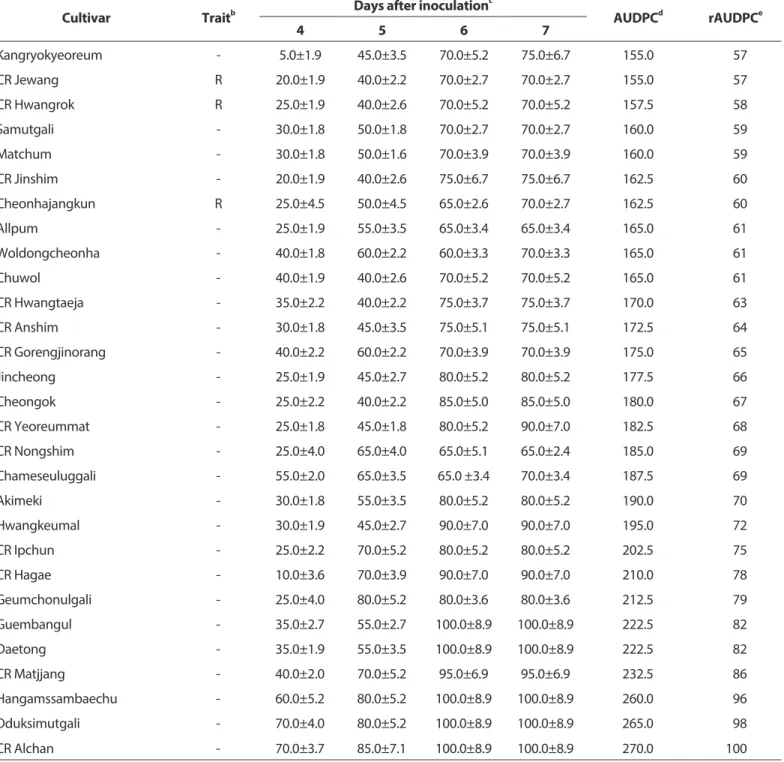
무름병에 대한 시판 배추 품종의 저항성. 배추의 무름병에 대한 효율적인 저항성 검정 방법을 확립하기 위한 실험에는 저 항성 정도가 서로 다른 품종이 필요하다. 이를 위해 시판 무 품 종 65개의 무름병 발생을 실험한 결과, 실험한 모든 품종은 접 종 후 재배 기간이 길어짐에 따라 무름병 발생이 증가하였으며, 품종에 따라 15부터 100의 rAUDPC를 나타내어 실험한 품종들 은 무름병에 대하여 다양한 정도의 저항성을 나타냄을 알 수 있었다(Table 2). Chung 등(2003)은 mineral oil을 이용한 무름 병균 관주접종법은 기존의 접종법에서 사용한 상처 내기와 접 종 후 습실처리 없이도 자연발병과 유사하게 세균 무름병을 유 도한다고 하였다. 그리고 Lee 등(2018b)은 무의 무름병 저항성 을 검정할 때 mineral oil 대신에 glycerol을 사용하였는데, 이 방법은 mineral oil이 물에 녹지 않고 세균현탁액과 층이 분리 되어 병원균을 일정한 양으로 접종하는데 어려움을 유발하는 점을 개선하고 수분증발은 억제하여 무름병이 고르게 발생하 였다고 보고하였다. 본 실험에서도 배추의 무름병 접종을 위해 포자현탁액에 glycerol을 첨가하였을 때 배추 유묘에 무름병 이 고르게 발생하여 무름병 발생에 효과적이라고 생각되었다 (Table 2).
실험한 65개 품종 중 종자회사에서 무름병 저항성 품종으로 판매하고 있는 품종은 ‘태봉’, ‘CR 요시사마’, ‘하대장군’, ‘CR키요 시’, ‘CR하루요시’, ‘CR제왕’, ‘CR청록’, ‘천하장군’ 등 8개 품종이 었는데, 이들 중 ‘태봉’은 가장 낮은 14.8의 rAUDPC을 나타내 실 험한 품종 중 가장 저항성이 높은 품종이었다(Table 2). 그리고
‘하대장군’은 42.6의 rAUDPC를 보여 중도저항성 품종으로 생각 Table 1. Disease index of Chinese cabbage bacterial soft rot ac- cording to symptom
Disease index Symptom
0 Healthy plant
1 Chlorosis or rot 1−25%
2 Chlorosis or rot 25−50%
3 Chlorosis or rot 50−75%
4 Chlorosis or rot 75−100%, plant was dead
Table 2. Resistance degree of 65 commercial Chinese cabbage cultivars to Pectobacterium carotovorum subsp. carotovorum KACC 10225a
Cultivar Traitb Days after inoculationc
AUDPCd rAUDPCe
4 5 6 7
Taebong R 0.0±0.0f 5.0±0.0 25.0±2.2 25.0±2.2 40.0 15
Sangjangkun - 5.0±1.3 15.0±1.3 30.0±1.8 30.0±1.8 62.5 23
Norangkimchi - 5.0±0.4 10.0±0.9 35.0±1.9 35.0±1.9 65.0 24
Powerchunkwang - 0.0±1.3 15.0±1.3 35.0±1.8 35.0±1.8 67.5 25
CR Jangkun - 5.0±1.3 35.0±1.3 35.0±1.9 40.0±1.9 77.5 29
Gaeulhwang - 15.0±0.4 30.0±0.4 35.0±1.9 35.0±1.9 82.5 31
Bulam3ho - 5.0±0.4 15.0±1.3 45.0±1.9 45.0±1.9 85.0 32
Buhwal - 15.0±0.0 40.0±0.9 40.0±2.7 40.0±2.7 95.0 35
Sinnongbom - 10.0±0.0 20.0±1.9 55.0±2.2 55.0±1.8 102.5 38
CR Kangsan - 10.0±1.9 35.0±1.9 40.0±2.2 45.0±1.8 102.5 38
CR Yosimasa R 5.0±1.8 20.0±1.8 55.0±3.5 55.0±3.5 105.0 39
Norangmathajang - 15.0±0.9 15.0±1.3 55.0±2.7 55.0±2.7 105.0 39
Yeongkwang - 0.0±1.7 30.0±1.8 50.0±2.0 50.0±2.0 105.0 39
Woori - 30.0±2.6 35.0±2.6 40.0±1.8 40.0±1.9 107.5 40
Gimguem3hodae-
baekche - 15.0±1.3 25.0±2.2 50.0±3.5 50.0±3.5 107.5 40
Sanullim - 25.0±1.8 45.0±2.2 45.0±1.8 45.0±1.8 115.0 43
Hadaejangkun R 20.0±1.8 35.0±1.9 45.0±3.5 50.0±4.5 115.0 43
Norangkimjang - 25.0±1.9 35.0±1.9 50.0±1.9 50.0±1.9 122.5 45
Ssamirang - 30.0±1.8 45.0±1.8 45.0±1.8 55.0±3.5 122.5 45
CR Kiyosi R 15.0±2.2 25.0±2.2 60.0±3.3 60.0±3.3 122.5 45
CR Myeongka - 25.0±1.9 35.0±1.9 50.0±2.0 50.0±2.0 122.5 45
CR 1016 - 20.0±1.3 25.0±1.4 60.0±3.6 60.0±3.6 125.0 46
CR Ilsacholli - 25.0±2.2 50.0±2.2 50.0±4.5 55.0±4.5 127.5 47
Aremchan - 25.0±2.2 40.0±2.2 50.0±2.0 50.0±2.0 127.5 47
Bulamplus - 25.0±1.3 30.0±1.4 60.0±3.3 60.0±3.3 130.0 48
CR117 - 5.0±1.7 45.0±1.8 55.0±2.7 55.0±2.7 130.0 48
CR Mat - 40.0±1.8 40.0±2.2 50.0±4.5 50.0±4.5 135.0 50
CR Cheongrok - 15.0±1.1 20.0±1.1 75.0±3.7 75.0±3.7 140.0 52
Okhwangssial - 25.0±1.8 35.0±2.2 65.0±2.6 65.0±2.6 140.0 52
Norangkwandong - 0.0±1.9 45.0±2.7 65.0±2.6 65.0±2.6 142.5 53
CR Myeongpum - 20.0±1.8 35.0±1.8 70.0±3.8 70.0±3.8 142.5 53
Champion - 30.0±1.8 30.0±1.8 65.0±2.6 70.0±3.9 145.0 54
Cheongya - 25.0±2.2 25.0±2.2 70.0±2.7 75.0±3.7 145.0 54
CR Haruyosi R 15.0±0.9 20.0±1.3 80.0±5.2 80.0±5.2 145.0 54
CR Hwangkuem - 30.0±1.9 35.0±1.9 65.0±4.0 65.0±4.0 147.5 55
Sungreen - 35.0±1.9 40.0±1.9 65.0±4.0 65.0±4.0 152.5 57
Continued
Table 2. Continued
Cultivar Traitb Days after inoculationc
AUDPCd rAUDPCe
4 5 6 7
Kangryokyeoreum - 5.0±1.9 45.0±3.5 70.0±5.2 75.0±6.7 155.0 57
CR Jewang R 20.0±1.9 40.0±2.2 70.0±2.7 70.0±2.7 155.0 57
CR Hwangrok R 25.0±1.9 40.0±2.6 70.0±5.2 70.0±5.2 157.5 58
Samutgali - 30.0±1.8 50.0±1.8 70.0±2.7 70.0±2.7 160.0 59
Matchum - 30.0±1.8 50.0±1.6 70.0±3.9 70.0±3.9 160.0 59
CR Jinshim - 20.0±1.9 40.0±2.6 75.0±6.7 75.0±6.7 162.5 60
Cheonhajangkun R 25.0±4.5 50.0±4.5 65.0±2.6 70.0±2.7 162.5 60
Allpum - 25.0±1.9 55.0±3.5 65.0±3.4 65.0±3.4 165.0 61
Woldongcheonha - 40.0±1.8 60.0±2.2 60.0±3.3 70.0±3.3 165.0 61
Chuwol - 40.0±1.9 40.0±2.6 70.0±5.2 70.0±5.2 165.0 61
CR Hwangtaeja - 35.0±2.2 40.0±2.2 75.0±3.7 75.0±3.7 170.0 63
CR Anshim - 30.0±1.8 45.0±3.5 75.0±5.1 75.0±5.1 172.5 64
CR Gorengjinorang - 40.0±2.2 60.0±2.2 70.0±3.9 70.0±3.9 175.0 65
Jincheong - 25.0±1.9 45.0±2.7 80.0±5.2 80.0±5.2 177.5 66
Cheongok - 25.0±2.2 40.0±2.2 85.0±5.0 85.0±5.0 180.0 67
CR Yeoreummat - 25.0±1.8 45.0±1.8 80.0±5.2 90.0±7.0 182.5 68
CR Nongshim - 25.0±4.0 65.0±4.0 65.0±5.1 65.0±2.4 185.0 69
Chameseuluggali - 55.0±2.0 65.0±3.5 65.0 ±3.4 70.0±3.4 187.5 69
Akimeki - 30.0±1.8 55.0±3.5 80.0±5.2 80.0±5.2 190.0 70
Hwangkeumal - 30.0±1.9 45.0±2.7 90.0±7.0 90.0±7.0 195.0 72
CR Ipchun - 25.0±2.2 70.0±5.2 80.0±5.2 80.0±5.2 202.5 75
CR Hagae - 10.0±3.6 70.0±3.9 90.0±7.0 90.0±7.0 210.0 78
Geumchonulgali - 25.0±4.0 80.0±5.2 80.0±3.6 80.0±3.6 212.5 79
Guembangul - 35.0±2.7 55.0±2.7 100.0±8.9 100.0±8.9 222.5 82
Daetong - 35.0±1.9 55.0±3.5 100.0±8.9 100.0±8.9 222.5 82
CR Matjjang - 40.0±2.0 70.0±5.2 95.0±6.9 95.0±6.9 232.5 86
Hangamssambaechu - 60.0±5.2 80.0±5.2 100.0±8.9 100.0±8.9 260.0 96
Dduksimutgali - 70.0±4.0 80.0±5.2 100.0±8.9 100.0±8.9 265.0 98
CR Alchan - 70.0±3.7 85.0±7.1 100.0±8.9 100.0±8.9 270.0 100
aTwenty four-day-old seedlings were inoculated with P. carotovorum subsp. carotovorum KACC 10225 by drenching the proximal of plants with bacterial suspension at a concentration of 1×10⁶ cfu/ml. The inoculated plants were incubated in a dew chamber at 25°C for 24 hr and then transferred to a growth room at 25°C and 80% relative humidity with 12 hr light a day. Four, five, six, and seven days after inoculation, disease severity of plants was investigated on a scale of 0−4.
bResistance to bacterial soft rot: -, unknown; R, resistant.
cDisease severity (%)={∑(disease index × the number of diseased plants)/(the highest disease index × the number of plants rated)}×100.
dAUDPC (area under the disease progress curve)= ; n=number of assessments, ti=number of days after inoculation on assessment date i, DSi=disease severity on assessment date i.
eRelative AUDPC (rAUDPC, %) of each cultivar to AUDPC of the most susceptible cultivar.
fMean disease severity±standard deviation of two runs with 10 replicates each.
되었다. 실험한 품종 중 ‘CR알찬’은 rAUDPC 100.0으로 나타나 무름병에 대하여 높은 감수성 반응을 보였다.
이들 결과로부터 rAUDPC를 이용한 배추 품종들의 무름병 저항성 기준은 rAUDPC가 0−20% 이면 저항성, 21−45%는 중도 저항성 그리고 46% 이상의 rAUDPC를 나타내는 품종은 감수 성으로 결정하는 것이 적절할 것으로 생각되었다. 이를 기준으 로, 실험한 65개 품종의 저항성을 분석하면 실험한 품종 중 저 항성 품종은 1개, 중도저항성 품종은 20개 그리고 나머지 44개 품종은 감수성이었다.
Lee 등(2018b)은 무름병 저항성을 정도를 판정하기 위해서 는 어떤 한 시기에 병조사를 하여 저항성 여부를 조사하는 것 보다 여러 시기에 병조사를 하고 AUDPC를 계산하고 이를 다시 감수성 품종의 AUDPC에 대한 rAUDPC를 계산하여 저항성을 결정하는 것이 보다 정확할 것이다. 하지만 저항성 품종 육종을 위한 대량 시료의 무름병 저항성 검정을 위해서 실험한 모든 시 료에 대하여 여러 번 무름병 발생조사를 하여 AUDPC을 구하 고 rAUDPC를 계산하여 저항성을 조사하는 것은 소요되는 노
동력, 비용 및 시간을 고려할 때 효율적이지 않다고 하였다. 따 라서 위의 rAUDPC 값과 접종 4일, 5일, 6일, 7일 후에 병조사한 발병도(%) 결과를 비교하여 병조사 시기를 결정하는 것이 필요 하다. 시판 품종 65개의 rAUDPC값에 따른 저항성 결과와 접종 4일, 5일, 6일, 7일 후의 발병도(%) 결과에 기반한 각각의 저항 성 결과를 비교한 결과, 접종 4일 후에는 무름병이 거의 발생하 지 않아 실험에 사용한 품종 중 4개 품종만 감수성 반응을 나 타냈으며, 접종 5일 후에는 저항성이 10개, 중도저항성이 35개, 감수성이 20개로 실험한 품종 중 30개(46%)가 rAUDPC와 같은 저항성 반응을 보였다(Table 2). 하지만 접종 6일 후에는 ‘태봉’
이 25%의 rAUDPC를 보여 저항성 품종은 없었으나, 중도저항 성이 13개, 감수성이 52개로 품종들의 발병도(%) 기준으로 한 저항성 판정과 rAUDPC를 기준으로 한 저항성 결과를 비교하 면 57개(86%)가 일치하였다. 그리고 접종 7일 후에는 저항성이 0개, 중도저항성이 11개, 감수성이 54개로 실험한 품종 중 55개 (83%)가 같은 반응을 나타냈다. 따라서 대량의 배추 식물들에 대하여 무름병 저항성을 검정하기 위해서는 접종 6−7일 후에 Table 3. Development of bacterial soft rot on seedlings of four Chinese cabbage cultivars according to plant growth stagea
Plant growth stageb Cultivar Day after inoculation
AUDPCc
7 8 9 10
14-Day-old Taebong 32.5d 32.5 32.5 32.5 097.5 be
Hadaejangkun 32.5 37.5 37.5 42.5 112.5 ab
CR Alchan 30.0 40.0 42.5 45.0 120.0 a0
21-Day-old Taebong 22.5 25.0 32.5 37.5 087.5 c0
Hadaejangkun 37.5 40.0 55.0 55.0 141.3 b0
CR Alchan 50.0 55.0 57.5 57.5 166.3 a0
28-Day-old Taebong 7.5 12.5 20.0 25.0 048.8 b0
Hadaejangkun 15.0 27.5 32.5 35.0 085.0 ab
CR Alchan 17.5 17.5 42.5 47.5 092.5 a0
35-Day-old Taebong 12.5 15.0 17.5 22.5 050.0 b0
Hadaejangkun 10.0 12.5 12.5 22.5 041.3 c0
CR Alchan 25.0 25.0 27.5 30.0 080.0 a0
aSeven-, 14-, 21-, 24-, and 34-day-old seedlings were inoculated with Pectobacterium carotovorum subsp. carotovorum KACC 10225 by drench- ing the proximal of plants with bacterial suspension at a concentration of 8×10⁵ cfu/ml. The inoculated plants were incubated in a dew chamber at 25oC for 24 hr and then transferred to a growth room at 25°C and 80% relative humidity with 12 hr light a day. Three, four, and five days after inoculation, disease severity of plants was investigated on a scale of 0−4 and then converted to a percentage value.
bFourteen-day-old, fully expanded two-leaf stage; 21-day-old, fully expended four-leaf stage; 28-day-old, fully expended six-leaf stage;
35-day-old, fully expended eight-leaf stage.
cAUDPC (area under the disease progress curve) ; n=number of assessments, ti=number of days after inoculation on assessment date i, DSi=disease severity on assessment date i
d Each value represents the mean disease severity (%) of two runs with 10 replicates each.
eValues in the labeled with the same letter within each growth stage are not significantly different based on Duncan’s multiple range test at P=0.05.
병조사하는 것이 효과적이라고 생각되었다.
그리고 이들 결과로부터 배추의 무름병 저항성 검정법 확립 을 위한 실험을 수행할 품종으로 저항성 정도에 차이가 있는 다음과 같은 3개 품종을 선발하였다. rAUDPC 값이 20 미만인
‘태봉’을 저항성 품종으로, rAUDPC가 45 이하인 ‘하대장군’을 중도저항성으로 그리고 가장 높은 감수성을 보인 ‘CR알찬’은 감수성 품종으로 선정하였다.
배추의 생육 시기에 따른 무름병 발생. 선발한 4개 품종을 파종하고 14, 21, 28, 35일 동안 재배한 각각 2엽, 4엽, 6엽, 8엽이 완전하게 전개된 배추 유묘에 Pcc를 접종하고 무름병 발생을 조사한 결과, 실험한 4가지 생육 시기 중 파종 후 21일된 유묘(4 엽 완전 전개)는 저항성 품종인 ‘태봉’과 중도저항성인 ‘하대장 군’과 감수성 품종인 ‘CR알찬’의 AUDPC 값이 각각 87.5, 141.3, 166.3이었으며, 3개 품종들은 서로 통계적으로 유의성 있는 차 이를 보였다(Table 3). 그리고 저항성 품종과 감수성 품종 간의 AUDPC 값의 차이도 61.3으로 실험한 생육 시기별 감수성과 저 항성 품종 간의 AUDPC 차이가 가장 큰 차이를 보였다(Table 3).
그러나 파종 후 14일 후, 28일 후, 35일 후 배추 유묘들에서 는 저항성 품종과 감수성 품종 간의 AUDPC 값의 차이가 각각 22.5, 43.7, 30으로 나타나 그룹간의 발병 정도의 차이가 크지도
않았으며, 저항성, 중도저항성, 감수성 품종의 AUDPC에 통계적 으로 유의성 있는 차이가 없었다(Table 3).
Doullah 등(2006)은 Alternaria brassicicola에 의한 검은무늬 병에 대한 무의 감수성 품종은 무의 생장 단계에 따라 서로 다 른 병 발생 정도를 보이는데, 오래된 잎이 어린 잎에 비해 더 높 은 감수성을 나타낸다고 보고하였다. 이와 달리 본 실험의 경우 에는 감수성 품종인 ‘CR알찬’의 경우에는 21일(4엽 완전 전개) 에서 가장 높은 AUDPC를 나타냈고 그 다음은 14일(2엽 완전 전개) 그리고 6엽 및 8엽이 완전 전개된 파종 28일과 35일 유묘 는 오히려 무름병 발생이 감소하였다(Table 3).
저항성 품종을 육성하기 위해서는 신속하게 병리검정하는 것이 중요하고 또한 저항성 품종의 저항성과 감수성 품종의 감 수성이 가장 잘 나타나는 배추의 생육 시기에 접종해야 하는 데, 배추 종자를 파종하고 온실(25±5oC)에서 약 21일 재배하여 본엽 4엽이 완전 전개된 배추 유묘를 사용하여 Pcc에 대한 저항 성을 검정하는 것이 효과적이라고 생각되었다.
접종원 농도에 따른 무름병 발생. 선발한 3개 품종의 배추 유묘에 병원균 Pcc KACC 10225 균주를 1×10⁵, 1×10⁶, 1×10⁷ cfu/ml의 농도로 접종하고 무름병 발생을 조사한 결과, 실험한 품종들의 평균 AUDPC는 각각 56.7, 63.8, 65.0 이었으며, 감수 Table 4. Development of bacterial soft rot on seedlings of four Chinese cabbage cultivars according to inoculum concentration of Pecto- bacterium carotovorum subsp. carotovoruma
Inoculum concentration
(cfu/ml) Cultivar Day after inoculation
AUDPCb
7 8 9 10
1×10⁵ Taebong 5.0c 7.5 7.5 17.5 26.3 cd
Hadaejangkun 10.0 15.0 30.0 30.0 65.0 b
CR Alchan 22.5 22.5 30.0 30.0 78.8 a
1×10⁶ Taebong 5.0 10.0 15.0 15.0 35.0 c
Hadaejangkun 20.0 20.0 25.0 25.0 67.5 b
CR Alchan 25.0 27.5 32.5 32.5 88.8 a
1×10⁷ Taebong 10.0 10.0 10.0 12.5 31.3 c
Hadaejangkun 15.0 17.5 20.0 22.5 56.3 b
CR Alchan 30.0 32.5 40.0 40.0 107.5 a
aTwenty eight-day-old seedlings were inoculated with P. carotovorum subsp. carotovorum KACC 10225 by drenching the proximal of plants with bacterial suspension at concentrations of 1×105,1×106,and 1×10⁷ cfu/ml. The inoculated plants were incubated in a dew chamber at 25oC for 24 hr and then transferred to a growth room at 25oC and 80% relative humidity with 12 hr light a day. Three, four, and five days after inoculation, disease severity of plants was investigated on a scale of 0−4 and then converted to a percentage value.
bAUDPC (area under the disease progress curve)= ; n=number of assessments, ti=number of days after inoculation on assessment date i, DSi=disease severity on assessment date i.
cEach value represent the mean disease severity (%) of two runs with ten replicates each.
dValues in the labeled with the same letter within each inoculum concentration are not significantly different based on Duncan’s multiple range test at P=0.05.
성인 ‘CR알찬’의 AUDPC는 각각 78.8, 88.8, 107.5이었다(Table 4). 즉, 접종 농도가 증가할수록 감수성 품종들의 무름병 발생 은 증가함을 알 수 있었다. 하지만 저항성 품종인 ‘태봉’은 접 종 농도가 1×10⁵, 1×10⁶, 1×10⁷ cfu/ml로 10배씩 증가하여도 AUDPC가 각각 26.3, 35.0, 31.3으로 김수성 품종과 비교할 때 크게 증가하지 않았다(Table 4).
실험한 3가지 접종 농도(1×10⁵, 1×10⁶, 1×10⁷ cfu/ml)로 접종 하였을 때 품종 간의 무름병 발생(AUDPC)은 모두 통계적으로 유의성 있는 차이를 나타냈다(Table 4). 따라서 3가지 접종 농 도 모두 배추의 무름병 저항성 검정에 이용할 수 있다고 판단되 었으며, 이들 중 1×10⁷ cfu/ml로 접종하였을 때에는 저항성인
‘태봉’과 감수성인 ‘CR알찬’의 AUDPC의 차이가 76.2로 가장 컸 다(Table 4). 이를 이어 1×10⁶ cfu/ml이 53.8 그리고 1×10⁴ cfu/
ml이 52.5 차이를 보였다. 이상의 결과로부터 배추의 무름병 저 항성을 검정하기 위해서는 1×10⁷ cfu/ml로 조정하여 세균현탁 액을 식물체당 5 ml씩 접종하는 것이 효율적이라고 생각되었다.
질적 저항성으로 알려진 멜론의 덩굴쪼김병(Fusarium oxy- sporum f. sp. melonis) 저항성은 단인자우성 유전자인 ‘Fom- 1’, ‘Fom-2’에 의해 저항성이 발현되는데(Risser 등, 1976), 이들 저항성은 병원균의 접종 농도가 증가하여도 저항성에는 변화 가 거의 없었다(Lee 등, 2015). 그러나 고추의 역병(Phytoph- thora capsici) 저항성 그리고 고추의 풋마름병(Ralstonia sola- nacearum) 저항성 등 많은 식물병의 저항성들은 양적 저항성 인 경우가 많은데(Lefebvre와 Palloix, 1996; Lefebvre 등, 2002;
Thabuis 등, 2003, 2004), 이들의 경우에는 접종 농도가 증가하 게 되면 저항성이 감소한다고 알려져 있다(Barksdale 등, 1984;
Hwang 등, 2017; Kim 등, 1989). 따라서 배추의 무름병 저항성 도 고추의 역병 및 풋마름병 저항성과 유사한 경향을 나타낸다 고 생각되었다.
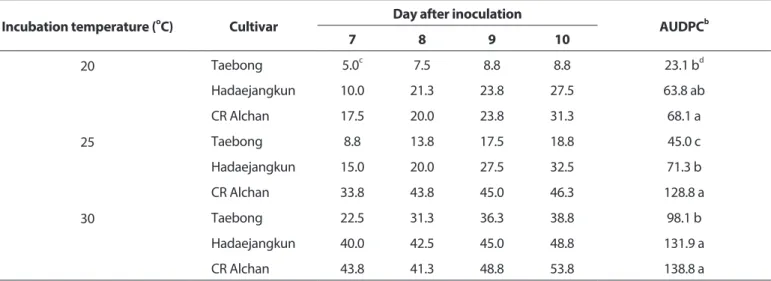
접종 후 재배 온도에 따른 배추 무름병 발생. 선발한 품종의 배추 유묘에 Pcc를 접종하고 20oC, 25oC, 30oC에서 습실처리하고 재배하여 무름병 발생을 조사한 결과, 재배온도가 20oC, 25oC, 30oC일 때 3개 품종의 평균 AUDPC 값은 각각 51.7, 81.7, 122.9이 었으며 감수성인 ‘CR알찬’의 AUDPC는 각각 68.1, 128.8, 138.8로 재배 온도가 올라갈수록 무름병 발생은 증가하였다(Table 5).
Raju 등(2008)도 20−35oC에서 무에 무름병이 발생하며, 상대습도 가 100%이고 온도가 35oC인 경우에 무름병이 가장 심하게 발생 했다고 하였다. 감자의 경우에도 접종 후 재배 온도는 무름병 발 생에 결정적인 역할을 한다고 알려져 있다(Fox 등, 1971). 본 연구 에서도 이들 결과와 마찬가지로 접종 후 재배온도가 증가함에 따 라 배추에 무름병 발생도 증가하였다(Table 5).
효과적인 병 저항성 검정을 위해서는 저항성, 감수성 품종 들의 병 발생에 차이가 크고 이들이 통계적으로 유의성 있는 차이를 보이는 것이 중요하다. 실험한 세 가지 재배온도 20oC, 25oC, 30oC에서 저항성 품종으로 선발한 ‘태봉’과 감수성 품종 으로 선발한 ‘CR알찬’의 무름병 발생 AUDPC 차이는 각각 45.0, 83.8, 40.7로 25oC에서 가장 큰 차이를 나타냈다. 그리고 저항 성 ‘태봉’, 중도저항성 ‘하대장군’, 감수성 ‘CR알찬’의 AUDPC 값 도 25oC에서 재배하였을 때에는 모두 통계적으로 유의성 있는 차이를 나타냈다(Table 5). 하지만 20oC와 30oC에서 재배하였 을 때에는 3개 품종이 모두 통계적으로 유의성 있는 차이를 나 타내지는 않았다. 따라서 배추 무름병 저항성 검정을 위해서는 Pcc를 접종하고 25oC에서 24시간 습실처리한 후에 하루에 12시 간씩 광을 조사하면서 25oC 항온항습실에서 재배하는 것이 효 과적이라고 생각되었다.
배추의 무름병의 저항성에 대한 연구는 현재까지 없지만 만 약에 질적 저항성(qualitative resistance)이라면, 멜론의 덩굴쪼 김병에 대한 저항성과 배추의 뿌리혹병(Plasmodiophora bras- sicae)에 대한 저항성처럼 저항성 품종에서 접종 농도, 유묘의 생육 시기, 접종 후 재배 온도 등 발병 조건에 따라 병 발생이 거 의 차이가 없으며 병원균은 race가 분화되어 있을 것이다(Kim 등, 2016; Lee 등, 2015). 그러나 이와 달리 양적 저항성이라면 고 추의 역병(P. capsici) 저항성과 같이 race 분화는 없고 단지 균주 의 병원력에 반비례하여 저항성을 나타내며, 저항성 품종이라 도 발병 조건에 따라 저항성 정도에 차이를 보일 것이다(Jo 등, 2014, 2016). 본 연구에서 저항성 품종으로 선발된 ‘태봉’과 ‘노 랑추석’은 접종원 농도, 배추 유묘의 생육 시기, 접종 후 재배온 도에 따라 저항성 정도에 차이를 나타냈다. 따라서 ‘태봉’과
‘노랑추석’의 무름병균 Pcc에 대한 저항성은 양적 저항성인 것으로 생각되었다. 이는 포장에서 무름병이 심하게 발생하 면 이들 저항성 품종도 감수성 반응을 나타낼 수 있다는 것 을 의미한다.
이상의 결과로부터 배추 무름병의 저항성 검정을 위한 효과 적인 방법으로 종자를 파종하고 온실(25±5oC)에서 21일 동안 재배하여 4엽이 완전히 전개된 배추 유묘의 기부에 Pcc 세균현 탁액(1×10⁷ cfu/ml)을 5 ml씩 관주접종하고, 25oC 습실상에서 24시간 동안 습실처리한 후에 식물체를 25oC의 항온항습실(상 대습도 80%)로 이동하여 하루 12시간씩 광을 조사하면서 재배 하고, 접종 7일 후에 배추 무름병의 발병도(%)를 조사하는 것 을 제안하고자 한다. 하지만 배추의 무름병에 대한 저항성이 발 병 조건 즉 disease pressure에 따라 저항성 정도가 달라지는 양적 저항성으로 생각되므로, KACC 10225가 아닌 다른 Pcc 균 주를 사용하여 실험할 때는 균주 병원력(virulence)에 따라 접
종 농도를 조정할 필요가 있을 것으로 생각된다.
요 약
Pactobacterium carotovorum subsp. carotovorum (Pcc)에 의 한 무름병은 전세계적으로 문제가 되고 있고 특히 온난 다습한 지역에서 문제가 심각하다. 본 연구는 Pcc에 의해 발생하는 배 추 무름병에 대한 효율적인 저항성 검정법을 확립하기 위하여 실험하였다. 시판 배추 품종 65개의 Pcc KACC 10225에 대한 저 항성 정도를 조사하고, 추후 실험을 위해 저항성에 차이를 보 이는 3개 품종을 선발하였다. 이들 3개 품종의 접종하는 배추 의 생육 시기, 접종원 농도, 접종 후 재배 온도 등의 발병 조건에
따른 무름병 발생을 조사하였다. 이들 실험의 결과로부터 배추 의 무름병에 대한 저항성을 검정하기 위해서는, 배추 종자를 파 종하고 온실(25±5oC)에서 21일 동안 재배한 유묘에 Pcc 균주의 세균현탁액(1×10⁷ cfu/ml)을 식물체 기부에 5 ml씩 관주하여 접종하고, 접종한 식물은 25oC 습실상에 24시간 동안 배양한 후에 25oC, 상대습도 80%의 생육상으로 이동하여 재배하는 것 을 제안하고자 한다.
Conflicts of Interest
No potential conflict of interest relevant to this article was re- ported.
Table 5. Development of bacterial soft rot on seedlings of four Chinese cabbage cultivars according to incubation temperature after in- oculationa
Incubation temperature (oC) Cultivar Day after inoculation
AUDPCb
7 8 9 10
20 Taebong 5.0c 7.5 8.8 8.8 23.1 bd
Hadaejangkun 10.0 21.3 23.8 27.5 63.8 ab
CR Alchan 17.5 20.0 23.8 31.3 68.1 a
25 Taebong 8.8 13.8 17.5 18.8 45.0 c
Hadaejangkun 15.0 20.0 27.5 32.5 71.3 b
CR Alchan 33.8 43.8 45.0 46.3 128.8 a
30 Taebong 22.5 31.3 36.3 38.8 98.1 b
Hadaejangkun 40.0 42.5 45.0 48.8 131.9 a
CR Alchan 43.8 41.3 48.8 53.8 138.8 a
aTwenty eight-day-old seedlings were inoculated with Pectobacterium carotovorum subsp. carotovorum KACC 10225 by drenching the proximal of plants with bacterial suspension of at a concentration of 8×10⁵ cfu/ml. The inoculated plants were incubated in a dew cham- ber at 20°C, 25°C, and 30°C for 24 hr and then transferred to each growth room at 20°C, 25°C, and 30°C with 12 hr light a day. Three, four, and five days after inoculation, disease severity of plants was investigated on a scale of 0−4 and then converted to a percentage.
bAUDPC (area under the disease progress curve)= ; n=number of assessments, ti=number of days after inoculation on assessment date i, DSi=disease severity on assessment date i.
cEach value represent the mean disease severity of two runs with ten replicates each.
dValues in the labeled with the same letter within each incubation temperature are not significantly different based on Duncan’s multiple range test at P=0.05.
Fig. 1. Growth stage of Chinese cabbage plants used in this study. Fourteen-day-old (A), 21-day-old (B), 28-day-old (C), and 35-day-old (D) seedlings.
Acknowledgments
This research was supported by Golden Seed Project Vegeta- ble Seed Center (213006-05-4-SB910), Ministry of Agriculture, Food and Rural Affairs (MAFRA), Ministry of Oceans and Fisher- ies (MOF), Rural Development Administration (RDA) and Korea Forest Service (KFS).
References
Aleck, J. R. and Harrison, M. D. 1978. The influence of inoculum den- sity and environment on the development of potato blackleg.
Am. Potato J. 55: 479-494.
Barksdale, T. H., Papavizas, G. C. and Johnston, S. A. 1984. Resistance to foliar blight and crown rot of pepper caused by Phytophthora capsici. Plant Dis. 68: 506-509.
Chung, E.-K., Zhang, X.-Z., Choi, B.-R., Lee, E.-J., Yeoung, Y.-R. and Kim, B.-S. 2003. Screening of disease resistance of Chinese cab- bage cultivars and lines to bacterial soft rot. Res. Plant Dis. 9: 39- 41. (In Korean)
Collmer, A. and Keen, N. T. 1986. The role of pectic enzymes in plant pathogenesis. Ann. Rev. Phytopathol. 24: 383-409.
Colyer, P. D. and Mount, M. S. 1984. Bacterization of potatoes with Pseudomonas putida and its influence on postharvest soft rot diseases. Plant Dis. 68: 703-706.
De Boer, S. H. and Kelman, A. 1978. Influence of oxygen concentra- tion and storage factors on susceptibility of potato tubers to bacterial soft rot (Erwinia carotovora). Potato Res. 21: 65-79.
Doullah, M. A. U., Meah, M. B. and Okazaki, K. 2006. Development of an effective screening method for partial resistance to Alternar- ia brassicicola (dark leaf spot) in Brassica rapa. Eur. J. Plant Pathol.
116: 33-43.
Eriksson, A. R. B., Andersson, R. A., Pirhonen, M. and Palva, E. T. 1998.
Two-component regulators involved in the global control of virulence in Erwinia carotovora subsp. carotovora. Mol. Plant- Microbe Interact. 11: 743-752.
Fox, R. T. V., Manners, J. G. and Myers, A. 1971. Ultrastructure of en- try and spread of Erwinia carotovora var. atroseptica into potato tubers. Potato Res. 14: 61-73.
Fritz, V. A. and Honma, S. 1987. The effect of raised beds, population densities, and planting date on the incidence of bacterial in Chinese cabbage. J. Am. Soc. Hortic. Sci. 112: 41-44.
Geels, F. P. and Schippers, B. 1983. Selection of antagonistic fluores- cent Pseudomonas spp. and their root colonization and persis- tence following treatment of seed potatoes. J. Phytopathol. 108:
193-206.
Hwang, S. M., Jang K. S., Choi, Y. H., Kim, H. and Choi, G. J. 2017.
Development of an efficient bioassay method to evaluate re- sistance of chili pepper cultivars to Ralstonia solanacearum. Res.
Plant Dis. 23: 334-347. (In Korean)
Jee, S., Malhotra, S., Roh, E., Jung, K., Lee, D., Choi, J. et al. 2012.
Isolation of bacteriophages which can infect Pectobacterium carotovorum subsp. carotovorum. Res. Plant Dis. 18: 225-230. (In Korean)
Jeger, M. J. and Viljanen-Rollinson, S. L. H. 2001. The use of the area under the disease-progress curve (AUDPC) to assess quantita- tive disease resistance in crop cultivars. Theor. Appl. Genet. 102:
32-40.
Jo, E. J., Jang, K. S., Choi, Y. H., Ahn, K. G. and Choi, G. J. 2016. Resis- tance of cabbage plants to isolates of Plasmodiophora brassicae.
Korean J. Hortic. Sci. Technol. 34: 442-452. (In Korean)
Jo, S.-J. Shim, S.-A., Jang, K. S., Choi, Y. H., Kim, J.-C. and Choi, G. J.
2014. Resistance of chili pepper cultivars to isolates of Phytoph- thora capsici. Korean J. Hortic. Sci. Technol. 32: 66-76. (In Korean) Jones, S., Yu, B., Bainton, N. J., Birdsall, M., Bycroft, B. W., Chhabra, S.
R. et al. 1993. The lux autoinducer regulates the production of exoenzyme virulence determinants in Erwinia carotovora and Pseudomonas aeruginosa. EMBO J. 12: 2477-2482.
Kotoujansky, A. 1987. Molecular genetics of pathogenesis by soft- rot Erwinias. Annu. Rev. Phytopathol. 25: 405-430.
Kim, H., Jo, E. J., Choi, Y. H., Jang, K. S. and Choi, G. J. 2016. Pathot- ype classification of Plasmodiophora brassicae isolates using clubroot-resistant cultivar of Chinese cabbage. Plant Pathol. J.
32: 423-430.
Kim, Y. J., Hwang, B. K. and Park, K. W. 1989. Expression of age- related resistance in pepper plants infected with Phytophthora capsici. Plant Dis. 73: 745-747.
Korean Society of Plant Pathology. 2009. Vegetables. In: List of Plant Disease in Korea. 5th ed., eds. by W.-G. Kim and H. M. Koo, pp.
99-103. Korean Society of Plant Pathology, Suwon, Korea. (In Korean)
Lee, J. H., Lee, J. and Oh, D.-G. 2018a. Resistance of pepper cultivars to Ralstonia solanacearum isolates from major cultivated areas of chili peppers in Korea. Hortic. Sci. Technol. 36: 569-576. (In Ko- rean)
Lee, S. M., Choi, Y. H., Jang, K. S., Kim H., Lee, S.-W. and Choi, G. J.
2018b. Development of an efficient bioassay method for test- ing resistance to bacterial soft rot of radish. Res. Plant Dis. 24:
193-201. (In Korean)
Lee, W. J., Lee, J. H., Jang, K. S., Choi, Y. H., Kim, H. T. and Choi, G. J.
2015. Development of efficient screening methods for melon plants resistant to Fusarium oxysporum f. sp. melonis. Korean J.
Hortic. Sci. Technol. 33: 70-82. (In Korean)
Lefebvre, V. and Palloix, A. 1996. Both epistatic and additive effects of QTLs are involved in polygenic induced resistance to disease:
a case study, the interaction pepper-Phytophthora capsici Leo- nian. Theor. Appl. Genet. 93: 503-511.
Lefebvre, V., Pflieger, S., Thabuis, A., Caranta, C., Blattes, A., Chauvet, J.-C. et al. 2002. Towards the saturation the pepper linkage map by alignment of three intraspecific maps including known- function genes. Genome 45: 839-845.
Madden, L. V., Hughes, G. and van den Bosch, F. 2007. The Study of Plant Disease Epidemics. APS Press, St. Paul, MN, USA. 421 pp.
Péombelon, M. C. M., Gullings-Handley, J. and Kelman, A. 1979.
Population dynamics of Erwinia carotovora and pectolytic Clos- tridium spp. in relation to decay of potatoes. Phytopathology 69:
167-173.
Pirhonen, M., Flego, D., Heikinheimo, R. and Palva, E. T. 1993. A small diffusible signal molecules is responsible for the global control of virulence and exoenzyme production in the plant pathogen Erwinia carotovora. EMBO J. 12: 2467-2476.
Raju, M. R. B., Pal, V. and Jalali, I. 2006. Antagonistic rhizospheric bacteria for management of bacterial soft rot of radish seed crop. Ann. Plant Prot. Sci. 14: 393-395.
Raju, M. R. B., Pal, V. and Jalali, I. 2008. Inoculation method of Pec- tobacterium carotovorum subsp. carotovorum and factors in- fluencing development of bacterial soft rot in radish. J. Mycol.
Plant Pathol. 38: 311-315.
Ren, J., Petzoldt, R. and Dickson, M. H. 2001. Screening and iden- tification of resistance to bacterial soft rot in Brassica rapa. Eu- phytica 118: 271-280.
Rimmer, S. R. 2007. Bacterial soft rot. In: Compendium of Brassica Disease, eds. by S. R. Rimmer, V. I. Shattuck and L. Buchwaldt, pp. 59-60. APS Press, St. Paul, MN, USA.
Risser, G., Banihashemi, Z. and Davis, D. W. 1976. A proposed no- menclature of Fusarium oxysporum f. sp. melonis races and resis- tance genes in Cucumis melo. Phytopathology 66: 1105-1106.
Taylor, J. D., Conway, J., Roberts, S. J., Astley, D. and Vincente, J. G.
2002. Sources and origin of resistance to Xanthomonas campes- tris pv. campestris in Brassica genomes. Phytopathology 92: 105- 111.
Thabuis, A., Lefebvre, V., Bernard, G., Daubèze, A. M., Phaly, T., Po- chard, E. et al. 2004. Phenotypic and molecular evaluation of a recurrent selection program for a polygenic resistance to Phy- tophthora capsici in pepper. Theor. Appl. Genet. 109: 342-351.
Thabuis, A., Palloix, A., Pflieger, S., Daubèze, A.-M., Caranta, C. and Lefebvre, V. 2003. Comparative mapping of Phytophthora resis- tance loci in pepper germplasm: evidence for conserved resis- tance loci across Solanaceae and for a large genetic diversity.
Theor. Appl. Genet. 106: 1473-1485.
Williams, P. H. 1981. Workshop on Screening Crucifers for Multiple Disease Resistance. University of Wisconsin, Medison, WI, USA.
105 pp.
Zhao, Y., Li, P., Huang, K., Wang, Y., Hu, H. and Sun, Y. 2013. Control of postharvest soft rot caused by Erwinia carotovora of vegetables by a strain of Bacillus amyloliquefaciens and its potential mode of action. World J. Microbiol. Biotechnol. 29: 411-420.