Research Article Open Access http://dx.doi.org/10.5423/RPD.2014.20.4.245
Research in Plant Disease
©The Korean Society of Plant Pathology pISSN 1598-2262, eISSN 2233-9191
This is an open access article distributed under the terms of the Creative Commons Attribution License (http://creativecommons.org/licenses/by/2.0), which permits unrestricted use, distribution, and reproduction in any medium, provided the original work is properly cited.
오이 덩굴쪼김병에 대한 효율적인 저항성 검정 방법
Efficient Screening Method for Resistance of Cucumber Cultivars to Fusarium oxysporum f. sp. cucumerinum
이지현1 · 김진철2 · 장경수1 · 최용호1 · 최경자1*
1한국화학연구원 바이오화학연구센터, 2전남대학교 응용생물공학부
Ji Hyun Lee1, Jin-Cheol Kim2, Kyoung Soo Jang1, Yong Ho Choi1 and Gyung Ja Choi1*
1Research Center for Biobased Chemistry, Korea Research Institute of Chemical Technology, Daejeon 305-600, Korea
2Division of Applied Bioscience and Biotechnology, Institute of Environmentally-Friendly Agriculture, Chonnam National University, Gwangju 500-757, Korea
The study was performed to establish an efficient screening method for resistant cucumber to Fusarium oxy- sporum f. sp. cucumerinum. The isolate KR5 was identified as F. oxysporum f. sp. cucumerinum based on mo- lecular analyses of ITS and TEF genes and host-specificity test on cucurbits including melon, oriental melon, cucumber, and watermelon. Then four cucumber and two rootstock cultivars showing different resistance degrees to the Fusarium wilt pathogen KR5 were selected. And development of Fusarium wilt of the six cul- tivars according to several conditions, including incubation temperature after inoculation, inoculum concen- tration, root wounding, and growth stages of seedlings, was investigated. Disease severity of Fusarium wilt on the resistant cultivars was changed with incubation temperatures after inoculation. The resistant cultivars showed the higher resistance when inoculated plants were kept at 25 or 30oC than at 20oC. Among four differ- ent growth stages of the seedlings, seven-day-old seedling represented the most difference of resistance and susceptibility to Fusarium wilt. From above results, we suggest that an efficient screening method for resistant cucumber to F. oxysporum f. sp. cucumerinum is to dip the non-cut roots of seven-day-old seedlings in spore suspension of 1.0 × 10⁶-1.0 × 10⁷ conidia/ml and to transplant the seedling into a non-infected soil, and then to incubate the inoculated plants in a growth room at 25oC for 3 weeks to develop Fusarium wilt.
Keywords : Breeding, Disease resistance, Fusarium wilt, Resistant screening
서 론
Fusarium oxysporum은 전세계적으로 존재하는 토양 전염성 병원균으로 100종 이상의 경제적으로 중요한 작물에 도관의 시들음과 피층 괴사를 일으킨다(Both, 1971). 이 병원균은 뿌리 를 통해 침입한 후 지제부나 도관을 폐쇄하여 식물체를 시들게
하는데, 박과 작물의 경우 병에 걸린 도관 부위가 파열되어 줄 기가 세로로 쪼개지는 병징 즉, 덩굴쪼김 현상을 보인다(Lee와 Lee, 1994).
병원성인 F. oxysporum은 80개 이상의 기주 분화형(formae speciales, f. sp.)으로 나뉘어지는데(Armstrong과 Armstrong, 1981; Snyder와 Hansen, 1940), 박과 작물 중에서 오이를 침입 하는 균주는 f. sp. cucumerinum, 수박은 f. sp. niveum, 멜론은 f. sp. melonis, 박은 f. sp. lagenaria, 수세미는 f. sp. luffae 등이 있다(Armstrong과 Armstrong, 1981; Kawai 등, 1958; Leach와
*Corresponding author Tel : +82-42-860-7434 Fax: +82-42-861-4913 E-mail: [email protected]
Received September 3, 2014 Revised September 23, 2014 Accepted October 31, 2014
Currence, 1938; Matuo와 Yamamoto, 1957; Owen, 1956). 그 러나 플로리다의 수박에서 분리한 F. oxysporum f. sp. niveum 의 경우 머스크 멜론에 대한 병원성이 보고되었고(Owen, 1955;
1956), F. oxysporum f. sp. cucumerinum 균주는 수박과 멜론에 서도 병원성이 확인된 바 있다(Owen, 1955). 이처럼 박과 작 물 안에서의 교차 병원성이 많이 보고되고 있다(Bouhot, 1981;
Davis, 1966; Gerlagh와 Blok, 1988; Martyn과 McLaughlin, 1983b; McMillan, 1986; Owen, 1955; 1956).
F. oxysporum f. sp. cucumerinum 균주에 의해 발생하는 오이 덩굴쪼김병은 작물의 생장에 심각한 영향을 미쳐 오이의 품질 저하 및 생산량 감소 등의 피해를 주는 중요한 병임에도 효과적 인 방제 방법이나 고도의 저항성을 가지는 품종 개발에 대한 연 구는 부족한 실정이다(Ahn 등, 1998; Chen 등, 2010; Vakalou- nakis, 1993). 특히, 화학 농약을 이용한 방제는 저항성 균주 출현 등의 문제가 있고(Freeman 등, 2002; Sherf와 MacNab, 1985), 현재 주로 이용되고 있는 저항성 대목을 이용한 접목 재 배의 경우에는 오이 고유의 맛이 떨어지고 곡과 발생이 많아 상 품 가치를 낮추며 접목시 많은 노동력이 요구되는 문제점 등을 가진다(Yang과 Kim, 1994). 따라서 오이 덩굴쪼김병을 방제하 기 위한 저항성 품종의 재배는 친환경적일 뿐만 아니라 경제적 측면에서도 최선의 대안이다(Sherf와 MacNab, 1985).
F. oxysporum f. sp. cucumerinum은 유전자형의 저항성 반응 에 따라 세 개의 race(1, 2, 3)로 구분되어지며(Armstrong 등, 1978), 오이의 Fusarium 저항성은 단일 우성 유전자 또는 단인 자, 다인자 열성 유전자의 영향을 받는다고 알려져 있다(Kanno 등, 1991; Toshimitsh와 Noguchi, 1975). 오이 저항성은 ‘Ano 2’와 ‘Aofushinari’ 품종에서 발견된 다원유전자계(Kanno 등, 1991; Vakalounakis, 1996)나 ‘WIS-248’ 같은 품종이 보이는 F.
oxysporum f. sp. cucumerinum race 2에 대한 단일 우성 저항 성 유전자인 ‘Foc’ 등이 보고되어 있다(Netzer 등, 1977). 이후,
‘SMR-18’과 ‘WI-2757’ 품종에서 F. oxysporum f. sp. cucumerinum race 1과 2에 저항성인 단일 우성 유전자 ‘Fcu-1’가 보고된 바 있 다(Vakalounakis, 1993; 1995; Vakalounakis와 Smardas, 1995).
하지만 오이 덩굴쪼김병에 관한 전반적인 연구는 매우 부족 한 현실이며, 오이 덩굴쪼김병 저항성 품종에 대한 높은 요구에 도 불구하고 국내에선 저항성 품종이 아직 판매되지 못하고 있 다. 따라서 저항성 유전자의 규명, 저항성 유전 양식 및 저항성 품종 육성을 위한 분자 표지 개발 등에 대한 연구가 시급하며 이들 연구를 위해서는 효율적이고 신뢰할 수 있는 병 저항성 검 정 방법의 확립이 우선적으로 필요하다.
본 연구에서는 효율적인 오이 덩굴쪼김병 저항성 검정 방법 을 확립하고자 오이로부터 분리된 F. oxysporum f. sp. cucumerinum KR5 균주를 동정하고, 이 균주를 덩굴쪼김병에 대한 저항성 정 도가 다른 오이 4개 품종과 대목 2개 품종에 접종하여 재배 온 도, 접종원 농도, 뿌리 상처 유무 및 생육 정도에 따른 시들음병 발생 정도를 조사하였다.
재료 및 방법
병원균 동정. 강릉에서 채집한 전형적인 덩굴쪼김병 병 징을 보이는 오이 식물체로부터 분리된 병원균(KR5)을 강릉 원주대학교로부터 분양받아 실험에 사용하였다. 염기서열 분 석을 통하여 분리된 병원균의 동정을 수행하고자 PDA 배지 에 접종하고 25oC에서 7일 동안 배양한 균사체를 InstaGene matrix(Bio-Rad, USA)를 사용하여 산물을 얻어 ITS(internal transcribed spacer) 영역과 TEF(translation elongation factor 1α) 영역의 polymerase chain reaction(PCR) 증폭을 수행하 였다. ITS 영역은 universal primer ITS1(5’-TCC GTA GGT GAA CCT GCG G-3’)/ITS4(5’-TCC TCC GCT TAT TGA TAT GC-3’)를 이 용하였고(White 등, 1990), TEF 영역은 EF1T(5’-ATG GGT AAG GAG GAC AAG AC-3’)/EF2T(5’-GGA AGT ACC AGT GAT CAT GTT-3’)를 이용하여(O’Donell 등, 1998) 동정하였다. PCR 반응 액은 InstaGene matrix 산물 1 µl, 10 mM의 dNTP 1 µl, 10 pmol 의 primer 각각 1 µl, 10 × Buffer 3 µl, 2.5 unit/µl의 EF-Taq DNA polymerase(Solgent, Korea)를 0.2 µl 넣고 멸균수로 반응액의 부피를 최종 30 µl가 되게 하였다. ITS 영역 유전자 증폭은 95oC 에서 5분간 initial denaturation을 실시한 후에 denaturation 95oC/45초, annealing 55oC/1분, extension 70oC/1분으로 35 cycle을 수행하고 final extension 70oC에서 10분간 실시하였 고, TEF 영역 유전자 증폭을 위해 95oC에서 2분간 initial dena- turation 후에 denaturation 95oC/30초, annealing 54oC/30초, extension 72oC/1분으로 35 cycle을 수행하고 final extension 72oC에서 10분간 수행하였다. 그리고 PCR 산물은 Big Dye® terminator v3.1 cycle sequencing kits(Applied Biosystems, USA)로 반응 후 각각의 primer로 DNA Engine Tetrad 2 peltier thermal cycler(Bio-Rad, USA)을 이용하여 PCR을 수행하고 ABI Prism 3730xl Analyzer 96 capillary type(Applied Biosystems, USA)로 염기서열 분석결과를 얻었다. 그리고 이 염기서열을 BLAST search에 의해 GenBank에 등록된 ITS 영역과 TEF 영역의 염기서열과 비교하였고, 동정하고자 하는 균주와 GenBank로 부터 얻은 염기서열은 CLUSTAL X(Thompson 등, 1997)와 PHY- DIT program version 3.0(Chun, 1995)을 이용하여 분석하였다.
Neighbor-joining tree는 PHYLIP 3.57c package(Felsenstein, 1985)의 Kimura’s 2-parameter distance model(Kimura, 1980) 를 이용하여 작성하였다.
식물 재배. 대부분의 실험에서는 실험에 필요한 품종의 종 자를 8 × 16 연결포트(15 ml/pot, 범농사)에 원예용상토 5호(부 농사)를 넣고 포트 당 1립씩 파종하여 온실에서 7일간 재배한 유묘를 실험에 사용하였다.
실험에 사용한 균주 KR5의 기주 특이성을 조사하기 위해서는 오이 ‘아시아청장’(아시아종묘)과 ‘백미백다다기’(동부팜한농), 멜론 ‘베타리치’(동부팜한농)와 ‘아시아황금’(아시아종묘), 수박
‘서태자’(아시아종묘)와 ‘꼬꼬마’(아시아종묘), 그리고 참외 ‘금 제’(아시아종묘)와 ‘조은대’(신젠타종묘)의 8개 품종을 사용하 였다. 그리고 오이 덩굴쪼김병의 저항성 검정법을 확립하기 위 해서는 오이 4개 품종, ‘러스보이’(아시아종묘), ‘미니큐’(아시아 종묘), ‘글로리삼척’(아시아종묘), ‘중복삼척’(신젠타)과 오이용 대목 2개 품종 ‘서포트’(쿠루메원종육성회), ‘눈부셔’(한국다끼 이)를 선발하여 실험을 수행하였다.
그리고 유묘의 생육 정도에 따른 덩굴쪼김병 발생 실험에 서는 위와 동일한 방법으로 6개 품종의 종자를 파종하고 온실 (25 ± 5oC)에서 7, 10, 13, 16일 동안 재배한 유묘를 사용하여 실 험을 수행하였다.
접종원 준비. KR5 균주를 potato dextrose broth(PDB;
Becton, Dickinson and Co.) 배지에 접종하고 25oC에서 7일간 배 양한 균총으로부터 균사조각을 떼어내어 V8-juice broth[V8 broth; V8 Juice(Campbell Soup Co.) 200 ml, CaCO3 3 g (Samchun Chem. Co., Ltd.), distilled water 1 l] 배지에 접종하고 7일 동안 150 rpm으로 25oC 암상태로 진탕배양 하였다. KR5 균주 배양 액을 수확하여 4겹의 거즈로 걸러 균사를 제거하고 원심분리하 여(4300 g, 10분, 4oC, Beckman Coulter Inc.) 배양여액을 제거하 였다. 포자 침전물에 멸균수를 넣고 잘 현탁한 후에 hematocy- tometer를 이용하여 광학현미경하에서 포자(소형분생포자)의 농도를 측정하였다.
접종원 농도에 따른 덩굴쪼김병 발생 실험을 제외한 모든 실 험에서는 1.0 × 10⁷ conidia/ml이 되도록 멸균수로 희석하여 접 종원으로 사용하였다. 접종원 농도 실험을 위해서는 1.1 × 10⁶, 3.3 × 10⁶, 1.0 × 10⁷, 3.0 × 10⁷, 9.0 × 10⁷ conidia/ml 농도의 포자 현탁액을 준비하였다.
덩굴쪼김병균 접종. 온실에서 재배한 유묘의 뿌리를 물로 세척하여 흙을 제거한 후에 KR5 균주의 포자현탁액에 30분 동 안 침지하여 접종하였다. 접종한 유묘를 5 × 8 연결포트(80 ml/
pot, 범농사)에 원예용상토 5호(범농사)를 넣고 이식하였다. 그 외 상처 접종의 경우에는 위의 방법으로 준비한 유묘의 뿌리를 2-2.5 cm 정도 남기고 잘라 동일한 방법으로 접종하였다.
발병 및 병조사. 접종한 유묘는 25oC 습실상에서 24시간 동 안 배양한 후에 25oC 항온실로 옮기고 하루에 12시간 동안 광을 조사하면서 3주 동안 재배하고 덩굴쪼김병 발생을 조사하였다.
재배 온도에 따른 덩굴쪼김병 발생 실험은 접종한 유묘를 20, 25 및 30oC 습실상에서 24시간 동안 배양한 후에 각 온도의 항 온실로 이동하고 하루 12시간씩 광을 처리하여 재배하고 접종 3주 후에 병조사를 하였다.
병조사는 식물체의 뿌리를 뽑아 도관을 잘라 갈변 유무를 확 인하고 유묘의 생육 억제 정도에 따라 발병 정도를 조사하였다.
발병도(disease index)는 0 = 건전, 1 = 도관이 갈변되고 유묘의
생육이 약간 억제된 것, 2 = 도관이 갈변되고 유묘의 생육이 현 저히 억제된 것, 3 = 도관이 갈변되고 유묘의 생육이 심하게 억 제된 것, 4 = 고사 등의 5단계로 하였다(Fig. 1).
평균 발병도가 1.0 이하인 경우에는 저항성, 1.0 초과 2.0 이하 는 중도저항성, 2.0 초과는 감수성으로 판정하였고, 모든 실험 은 10반복으로 2회 실시하였다. 통계 분석은 SAS(SAS Institute, Inc., 1989, Cary, NC) 프로그램을 이용하여 ANOVA 분석을 하였 으며, 처리 평균간 비교를 위하여 Duncan’s multiple range test (P = 0.05)를 실시하였다.
결과 및 고찰
균주 동정. KR5 균주의 분자생물학적 동정은 일반적으로 균류의 동정에 사용하는 ITS 영역과 Fusarium 속의 동정을 위 해 많이 사용되고 있는 TEF 영역의 염기서열 분석을 통해 수행 하였는데, KR5 균주는 ITS 영역의 염기서열(White 등, 1990) 분 석에서 F. oxysporum(DQ459007) 균주와 100%의 염기서열 상 동성을 보였으며 GenBank에 등록된 Fusarirum 균주의 ITS 염 기서열과 상동성을 비교하여 작성된 phylogenic tree에서도 F. oxysporum과 동일한 그룹을 형성하였다(결과 미제시). 그 리고 TEF 영역의 염기서열 분석(O’ Donell 등, 1998)에서도 F.
oxysporum(AF160312) 균주와 99.2%의 높은 유사도를 보였으 며, TEF 염기서열의 상동성 비교를 통한 타 Fusarium 균주들과 의 유연관계 분석을 수행한 phylogenic tree결과에서도 KR5 균 주는 F. oxysporum과 동일한 그룹을 형성하였다(Fig. 2). 이상의 결과로부터 KR5 균주는 F. oxysporum으로 동정되었다.
분리한 KR5 균주의 기주 특이성을 조사하기 위하여 오이, 멜 론, 수박 및 참외 총 4개 박과 작물의 2개 품종씩을 선발하여 병 원성 검정을 수행한 결과, 본 균주는 멜론과 참외에도 병원성을 보이나 오이에 특히 높은 병원성을 나타내며, 수박에는 비교적 낮은 발병도를 보였다(Table 1). F. oxysporum은 형태로 구별이 불가능하지만 서로 다른 기주를 침입하여 적어도 80개의 다른 기주 분화형(formae speciales)으로 나뉘며 높은 기주 특이성 을 나타낸다(Armstrong과 Armstrong, 1981; Snyder와 Hansen, 1940). 하지만 높은 기주 특이성에도 불구하고 박과 작물에서 Fig. 1. Disease index of Fusarium wilt on cucumber seedlings.
분리된 F. oxysporum 균주들은 교차 병원성이 많이 보고되고 있 다(Bouhot, 1981; Davis, 1966; Gerlagh과 Blok, 1988; Martyn과 McLaughlin, 1983b; McMillan, 1986; Owen, 1955; 1956). 따라 서 본 실험에서 사용된 KR5 균주는 오이에서 분리되었고 오이 에 강한 병원성을 나타내서 F. oxysporum f. sp. cucumerinum으 로 동정하였다. 그리고 이 균주가 멜론, 참외, 수박 등에 병원성 을 나타낸 것은 Owen(1955)에 의해 보고된 것처럼 교차 병원성 일 것으로 생각되었다.
재배 온도에 따른 오이 덩굴쪼김병 발생. 오이 덩굴쪼김병 에 대한 효율적인 저항성 검정법 확립을 위한 실험에 사용할 품 종을 선발하고자 시판 중인 오이 45개 품종과 오이용 대목 23개 품종의 F. oxysporum f. sp. cucumerinum KR5 균주에 대한 저항 성 정도를 조사한 결과, 오이 45개 품종 중 7개 품종이 중도저항 성 이상의 저항성을 보였고 나머지 오이 38개 품종은 감수성을 나타내었다. 그리고 오이용 대목 23개 품종은 모두 매우 낮은 발병도 즉 높은 저항성을 나타냈다(결과 미제시). 이 결과를 바 Fig. 2. Phylogenetic tree based on sequences of translation elongation factor 1α genes of Fusarium oxysporum isolates and related species. The values above each branch indicate the percentage levels of bootstrap support (>50%) for the branch point based on 1000 resamplings. The bar represents 0.01 substitutions per nucleotide position. ( ) is GenBank accession number.
Table 1. Pathogenicity of Fusarium oxysporum f. sp. cucumerinum KR5 to cucumber, melon, watermelon and oriental melona
Crop Cultivar Scientific name Disease
indexb Cucumber Asiacheongjang Cucumis sativus 4.0 ± 0.0
Beakmibaekdadagi Cucumis sativus 2.8 ± 1.1
Melon Betarich Cucumia melo 2.0 ± 0.0
Asiahwanggeum Cucumia melo 2.6 ± 0.9 Watermelon Seotaja Citrullus lanatus 1.4 ± 1.1 Kokoma Citrullus lanatus 1.0 ± 0.0 Oriental melon Geumje C. melo var. makuwa 2.0 ± 0.0 Joeundae C. melo var. makuwa 3.0 ± 1.0
aSeven-day-old seedlings of each cultivar were inoculated with F.
oxysporum f. sp. cucumerinum KR5 by dipping the roots in spore suspen- sion of 1.0 × 10⁷ conidia/ml for 30 min. The inoculated plants were incubated in a dew chamber at 25oC for 24 hr and then transferred to a growth room at 25oC with 12-hour light a day. After 3 weeks, disease severity of the plants was investigated.
bEach value represents the mean disease severity ± standard deviation of two runs with ten replicates each.
탕으로 실험한 오이 품종 중 가장 높은 저항성을 보인 2개 품종
‘러스보이’와 ‘미니큐’ 그리고 감수성 오이 2개 품종 ‘글로리삼 척’과 ‘중복삼척’을 선발하였다. 또 고도의 저항성을 보인 오이 용 대목 2개 품종 ‘서포트’와 ‘눈부셔’도 선발하여 총 6개 품종을 실험에 사용하였다.
선발한 6개 품종을 사용하여 재배 온도에 따른 오이 덩굴쪼 김병 발생의 차이를 확인하기 위해 20oC, 25oC 및 30oC의 생육 상에서 병 발생을 조사한 결과, 고도의 저항성을 보이는 대목 품종과 감수성 오이 품종은 재배 온도에 상관없이 동일 반응을 나타내었다. 하지만 저항성 오이 품종 ‘러스보이’와 ‘미니큐’의 경우, 25oC와 30oC에서는 0.8 미만의 안정적인 저항성을 나타내 었으나, 20oC에서는 2.2의 평균 발병도를 보이며 저항성이 무너 졌다(Fig. 3). 오이의 덩굴쪼김병 저항성 검정은 25oC와 30oC에 서 모두 가능하지만, 30oC에서는 이식한 식물체가 쉽게 정착하 지 못하고 고사하는 경우가 종종 발생하는 어려움이 있다. 따라 서 F. oxysporum f. sp. cucumerinum 균주를 접종한 실험에 많은 연구자들이 접종 후 재배 온도를 24oC 또는 26oC 내외에 수행하 고 있는 것처럼(Vakalounakis, 1993; 1995; 1996; Vakalounakis 와 Smardas, 1995), 오이 덩굴쪼김병 저항성 정도를 조사하기 위해서는 접종 후 25oC에서 재배하는 것이 적당하리라 생각 된다.
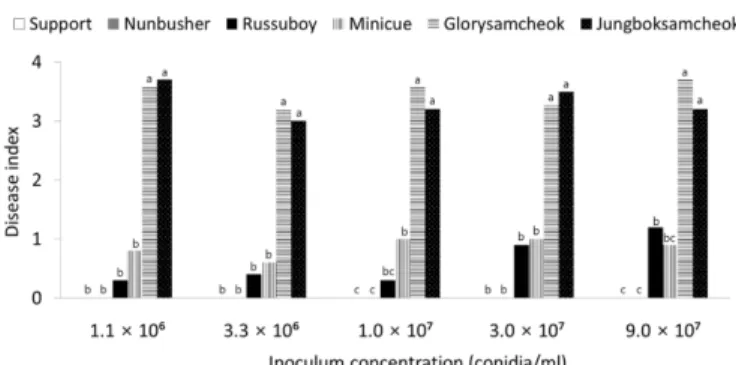
접종원 농도에 따른 오이 덩굴쪼김병 발생. 오이와 대목 품종의 뿌리를 다섯 농도의 F. oxysporum f. sp. cucumerinum KR5 포자 현탁액에 침지하여 접종하였을 때, 접종원 농도에 관
계없이 대목 품종 ‘서포트’와 ‘눈부셔’는 0.0 이하의 높은 저항성 을 나타냈다. 그리고 오이 감수성 품종 ‘중복삼척’과 ‘글로리삼 척’은 3.0 이상의 감수성을 보였다. 하지만 저항성 품종 ‘러스보 이’, ‘미니큐’는 포자 현탁액의 포자 농도가 증가함에 따라 오이 덩굴쪼김병의 발병도가 증가하였는데 ‘미니큐’의 경우에는 접 종원의 농도가 높아져도 저항성으로 판정되는 범위 이내에 포 함되지만 ‘러스보이’의 경우에는 9.0 × 10⁷ conidia/ml의 농도에 서는 중도저항성을 보였다(Fig. 4).
Martyn과 McLaughlin(1983a)은 F. oxysporum f. sp. niveum 균 주를 이용한 접종 농도에 따른 수박 품종의 저항성을 확인한 결 과에서 가장 높은 접종 농도인 1 × 10⁶ conidia/ml에서 ‘Dixielee’
와 ‘Smokylee’ 같은 저항성 품종들이 여전히 특성을 잘 나타낼 수 있음을 확인하였고, 박과 작물에 발생하는 덩굴쪼김병에 관 한 연구에 1 × 10⁶ conidia/ml의 접종원을 사용한 경우 또한 다 수 있다(Freeman과 Rodriguez, 1993; Freeman 등, 2002; Zhou 등, 2010). 오이 덩굴쪼김병에 관한 연구 중 비교적 높은 농도 의 포자현탁액(8 × 10⁷ conidia/ml)을 사용한 경우도 있었으나 (Vakalounakis, 1993; 1995; Vakalounakis와 Smardas, 1995), 본 실험에서 접종원 농도에 따른 덩굴쪼김병 발생의 결과에 따라 1.1 × 10⁶ conidia/ml에서 1.0 × 10⁷ conidia/ml 농도의 포자현탁 액을 사용하는 것이 오이 덩굴쪼김병의 안정적인 저항성 검정 에 바람직할 것으로 판단되었다.
뿌리 상처에 따른 오이 덩굴쪼김병 발생. 뿌리 상처에 따 른 덩굴쪼김병의 발생에서 상처의 유무에 상관없이 감수성 오 이 품종인 ‘중복삼척’과 ‘글로리삼척’은 높은 감수성을, 높은 저 항성을 보이는 대목 품종 ‘서포트’와 ‘눈부셔’는 고도의 저항성 Fig. 3. Development of Fusarium wilt on four cucumber and two rootstock
cultivars incubated at three temperatures. Seven-day-old seedlings of each cultivar were inoculated with Fusarium oxysporum f. sp. cucumerinum KR5 by dipping the roots in spore suspension of 1.0 × 10⁷ conidia/ml for 30 min. The inoculated plants were incubated in a dew chamber at 20, 25, and 30oC for 24 hr and then transferred to a growth room at 20, 25, and 30oC with 12-hour light a day, respectively. After 3 weeks, disease severity of the plants was investigated. Each value represents the mean of two runs with ten replicates each. Values in the labeled with the same letter within each incubation temperature of seedlings are not significantly different in Duncan’s multiple range test at P = 0.05.
Fig. 4. Fusarium wilt occurrence of four cucumber and two rootstock cultivars according to inoculum concentration. Seven-day-old seedlings of each cultivar were inoculated with Fusarium oxysporum f. sp. cucumerinum KR5 by dipping the roots in spore suspensions of 1.1 × 10⁶, 3.3 × 10⁶, 1.0 × 10⁷, 3.0 × 10⁷, and 9.0 × 10⁷ conidia/ml for 30 min. The inoculated plants were incubated in a dew chamber at 25oC for 24 hr and then transferred to a growth room at 25oC with 12-hour light a day. After 3 weeks, disease severity of the plants was investigated. Each value represents the mean of two runs with ten replicates each. Values in the labeled with the same letter within each inoculum concentration of seedlings are not significantly different in Duncan’s multiple range test at P = 0.05.
을 유지하였다. 그리고 저항성 오이 품종 ‘러스보이’와 ‘미니큐’
는 가위로 뿌리를 자르는 상처를 가하여 접종하였을 때에는 가 위로 자르지 않은 것에 비하여 평균 발병도가 0.4 정도 증가하 며 저항성이 다소 낮아졌다. 하지만 가위 상처의 유무에 따른 통계적인 유의성 있는 차이는 없었다(Fig. 5).
F. oxysporum f. sp. cucumerinum를 식물체에 접종할 때 여 러 연구자들은 뿌리를 잘라서 수행하고 있으나(Ahn 등, 1998;
Vakalounakis, 1993; 1995), 오이 덩굴쪼김병을 접종할 때 유묘 의 흙을 제거하고 세척하는 과정에서 발생하는 상처만으로도 덩굴쪼김병균 감염이 충분히 일어나므로 대량 검정에서는 불 필요하게 가위로 뿌리를 자르는 것과 같은 과정을 추가하지 않 는 것이 더 효율적이라고 생각되었다.
유묘의 생육 시기에 따른 오이 덩굴쪼김병 발생. 생육 시 기에 따른 오이 덩굴쪼김병 발생에서 대목 품종과 감수성 오이 품종에서는 유묘의 생육 정도에 따라 큰 차이없이 저항성 특성 을 잘 나타내었다. 하지만 저항성 오이 품종 ‘러스보이’와 ‘미니 큐’의 경우에는 7일 유묘에서는 0.6 이하의 평균 발병도를 보이 며 덩굴쪼김병에 대한 저항성을 확인할 수 있었으나 10일 이상 성장한 유묘에서는 1.1 이상의 발병도를 나타내며 오이품종의 저항성 발현이 효과적이지 못함이 확인되었다(Fig. 6).
박과 작물 중 멜론 품종에 대한 F. oxysporum f. sp. melonis의 접종법에 관한 연구 중 Latin과 Snell(1986)은 본엽 1엽이 펼쳐 진 11일된 식물체에서 떡잎 단계의 6일 식물체보다 더 적은 멜
론 덩굴쪼김병 발생을 보고하였다. 하지만 본 실험에서는 파종 후 10, 13, 16일된 오이 유묘에 비해 파종 후 7일 유묘에서 덩굴 쪼김병 발생이 적으며 저항성 특성도 잘 나타내는 것으로 확인 됨에 따라 7일 재배된 유묘를 사용하는 것이 오이 덩굴쪼김병 저항성 검정에 바람직할 것으로 생각된다.
이상의 결과로부터 F. oxysporum f. sp. cucumerinum에 의한 오이 덩굴쪼김병의 저항성 검정을 위한 방법으로 파종 후 온실 에서 7일간 재배한 오이 유묘의 뿌리를 씻어 뿌리의 흙을 제거 하고 1.0 × 10⁶–1.0 × 10⁷ conidia/ml 농도의 F. oxysporum f. sp.
cucumerinum 포자현탁액에 침지한 후 건전한 상토에 이식하 여 접종한 오이를 25oC 생육상에서 하루 12시간씩 광을 처리하 면서 3주 동안 재배한 후에 병조사 하는 것이 효율적이라고 생 각된다. 본 연구에서 확립한 오이 덩굴쪼김병 저항성 검정방법 은 저항성 품종 육성을 위한 분자마커 개발, 저항성 유전자 탐 색 및 규명 등에 대한 연구에 유용하게 활용될 수 있을 것이다.
요 약
본 실험은 Fusarium oxysporum f. sp. cucumerinum에 의해 발 생하는 오이 덩굴쪼김병의 효율적인 저항성 검정 방법을 확립 하기 위하여 수행되었다. ITS와 TEF 유전자 염기서열 분석과 멜 론, 참외, 오이 및 수박을 포함한 박과 작물에 대한 기주 특이 성 분석을 통해 KR5 균주를 F. oxysporum f. sp. cucumerinum으 로 동정하였다. 그리고 덩굴쪼김병균 KR5에 저항성 정도가 다 른 오이 네 품종과 오이용 대목 두 품종을 선발하여 유묘의 생 Fig. 5. Development of Fusarium wilt on four cucumber and two
rootstock cultivars when cut and non-cut roots were dipped in a spore suspension of Fusarium oxysporum f. sp. cucumerinum. Seven- day-old seedlings of each cultivar were inoculated with F. oxysporum f. sp. cucumerinum KR5 by dipping the cut and non-cut roots in spore suspension of 1.0 × 10⁷ conidia/ml for 30 min. The inoculated plants were incubated in a dew chamber at 25oC for 24 hr and then trans- ferred to a growth room at 25oC with 12-hour light a day. After 3 weeks, disease severity of the plants was investigated. Each value represents the mean of two runs with ten replicates each. Values in the labeled with the same letter within each inoculation method of seedlings are not significantly different in Duncan’s multiple range test at P = 0.05.
Fig. 6. Fusarium wilt occurrence on four cucumber and two rootstock cultivars inoculated at four growth stages of seedlings. Seven-, ten-, thirteen- and sixteen-day-old seedlings of each cultivar were inocu- lated with Fusarium oxysporum f. sp. cucumerinum KR5 by dipping the roots in spore suspension of 1.0 × 10⁷ conidia/ml for 30 min. The inoculated plants were incubated in a dew chamber at 25oC for 24 hr and then transferred to a growth room at 25oC with 12-hour light a day. Three weeks after inoculation, disease severity of the plants was investigated. Each value represents the mean of two runs with ten replicates each. Values in the labeled with the same letter within each growth stage of seedlings are not significantly different in Duncan’s multiple range test at P = 0.05.
육 시기, 뿌리 상처, 접종원 농도 및 접종 후 재배 온도에 따라 이 들 여섯 품종의 덩굴쪼김병 발생을 조사하였다. 저항성 품종의 덩굴쪼김병 발병도는 접종 후 재배 온도에 따라 차이를 나타냈 으며, 저항성 품종들은 접종 후에 20oC보다 25oC나 30oC에서 재 배하였을 때 높은 저항성을 보였다. 그리고 유묘의 생육 시기 중 파종 후 7일된 유묘에 덩굴쪼김병균을 접종하였을 때 가장 큰 저항성과 감수성 차이를 나타내었다. 이상의 결과로부터 오 이 덩굴쪼김병에 대한 저항성을 효과적으로 검정하는 방법으 로 파종하고 7일 동안 재배한 유묘의 뿌리로부터 흙을 제거하 고, 이들을 1.0 × 10⁶–1.0 × 10⁷ conidia/ml 농도의 F. oxysporum f. sp. cucumerinum 포자현탁액에 침지하여 접종한 후에 건전한 원예용 상토에 이식하고 25oC 생육상에서 3주간 재배하는 방법 을 제안한다.
Acknowledgment
This research was supported by Golden Seed Project Veg- etable Seed Center, Ministry of Agriculture, Food and Rural Affairs (MAFRA), Ministry of Oceans and Fisheries (MOF), Rural Development Administration (RDA) and Korea Forest Service (KFS).
References
Ahn, I. P., Chung, H. S. and Lee, Y. H. 1998. Vegetative compatibility groups and pathogenicity among isolates of Fusarium oxysporum f.
sp. cucumerinum. Plant Dis. 82: 244-246.
Armstrong, G. M. and Armstrong, J. K. 1981. Formae speciales and races of Fusarium oxysporum causing wilt disease. In: Fusarium:
Disease, Biology, and Taxonomy, ed. by P. E. Nelson, T. A. Toussoun and R. J. Cook, pp. 391–399. Pennsylvania State University Press, University Park.
Armstrong, G. M., Armstrong, J. K. and Netzer, D. 1978. Pathogenic races of the cucumber-wilt Fusarium. Plant Dis. 62: 824-828.
Both, C. 1971. The genus Fusarium. Commonwealth Mycological Institute, Kew, Surrey, England.
Bouhot, D. 1981. Some aspects of the pathogenic potential in formae speciales and races of Fusarium oxysporum on Cucurbitaceae.
In: Fusarium: Disease, Biology, and Taxonomy. ed. by P. E. Nelson, T. A. Toussoun and R. J. Cook, pp. 318-326. Pennsylvania State University Press, University Park.
Chen, F., Wang, M., Zheng, Y., Luo, J. M., Yang, X. R. and Wang, X. L.
2010. Quantitative changes of plant defense enzymes and phy- tohormone in biocontrol of cucumber Fusarium wilt by Bacillus subtilis B579. World J. Microbiol. Biotechnol. 26: 675-684.
Chun, J. 1995. Computer-assisted classification and identification of Actinomycetes. Ph. D. thesis, University of Newcastle, Newcastle upon Tyne, UK.
Davis, D. 1966. Cross-infection in Fusarium wilt diseases. Phytopa-
thology 56: 825-828.
Felsenstein, J. 1985. Confidence limits on phylogenies: An approach using the bootstrap. Evolution 39: 783-791.
Freeman, S. and Rodriquez, R. J. 1993. A rapid inoculation tech- nique for assessing pathogenicity of Fusarium oxysporum f. sp.
niveum and F. o. melonis on cucurbits. Plant Dis. 77: 1198-1201.
Freeman, S., Zveibil, A., Vintal, H. and Maymon, M. 2002. Isolation of nonpathogenic mutants of Fusarium oxysporum f. sp. melonis for biological control of Fusarium wilt in cucurbits. Phytopathol- ogy 92: 164-168.
Gerlagh, M. and Blok, W. J. 1988. Fusarium oxysporum f. sp. cucur- bitacearum n. f. embracing all formae speciales of F. oxysporum attacking cucurbitaceous crops. Neth. J. Plant Pathol. 94: 17-31.
Kanno, T., Han, X. and Tabei, Y. 1991. Genetic analysis of resistance in cucumber to Fusarium oxysporum f. sp. cucumerinum. Bull. Natl.
Res. Inst. Veg. Ornament. Plants Tea 4: 27–30.
Kawai, I., Suzuki, H. and Kawai, K. 1958. On the pathogenicity of the wilt Fusarium of the cucurbitaceous plants and their forms. Shizuoka Agric. Exp. Stn. Bull. 3: 49–68.
Kimura, M. 1980. A simple method for estimating evolutionary rate of base substitution through comparative studies of nucleotide sequence. J. Mol. Evol. 16: 111–120.
Latin, R. X. and Snell, S. J. 1986. Comparison of methods for inocu- lation of muskmelon with Fusarium oxysporum f. sp. melonis.
Plant Dis. 70: 297–300.
Leach, J. G. and Currence, T. M. 1938. Fusarium wilt of muskmelon in Minnesota. Minn. Agric. Exp. Stn. Tech. Bull. 129: 32.
Lee, S. G. and Lee, W. H. 1994. Control of Fusarium wilt of water- melon with the root-stock grafting of Sicyos angulatus L. Korean J. Plant Pathol. 10: 240–244.
Martyn, R. D. and McLaughlin, R. J. 1983a. Effects of inoculum concentration on the apparent resistance of watermelons to Fusarium oxysporum f. sp. niveum. Plant Dis. 67: 493–495.
Martyn, R. D. and McLaughlin, R. J. 1983b. Susceptibility of summer squash to the watermelon wilt pathogen (Fusarium oxysporum f.
sp. niveum). Plant Dis. 67: 263–266.
Matuo, T. and Yamamoto, I. 1957. On Fusarium oxysporum f. sp. lage- nariae n. f. causing wilt of Lagenaria vulgaris var. hispida. Trans.
Mycol. Soc. Jpn. 2: 61–63.
McMillan, R. T. 1986. Cross pathogenicity studies with isolates of Fusarium oxysporum from either cucumber or watermelon pathogenic to both crop species. Ann. Appl. Biol. 109: 101–105.
Netzer, D., Niego, S. and Galun, E. 1977. A dominant gene confer- ring resistance to Fusarium wilt in cucumber. Phytopathology 67: 525–527.
O’ Donnell, K., Cigelnik, E. and Casper, H. H. 1998. Molecular phylo- genetic, morphological, and mycotoxin data support reidentifi- cation of the Quorn mycoprotein fungus as Fusarium venenatum.
Fungal Genet. Biol. 23: 57-67.
Owen, J. H. 1955. Fusarium wilt of cucumber. Phytopathology 45:
435–439.
Owen, J. H. 1956. Cucumber wilt, caused by Fusarium oxysporum f.
sp. cucumerinum. Phytopathology 46: 153–157.
Sherf, A. F. and MacNab, A. A. 1985. Vegetable disease and their control. John Wiley and Sons, New York. 728 pp.
Snyder, W. C. and Hansen, H. N. 1940. The species concept in Fu- sarium. Am. J. Bot. 27: 64–67.
Thompson, J. D., Gibson, T. J., Plewniak, F., Jeanmougin, F. and Higgins, D.
G. 1997. The Clustal X windows interface: flexible strategies for multiple sequence alignment aided by quality analysis tools.
Nucleic Acids Res. 24: 4876–4882.
Toshimitsh, Y. and Noguchi, T. 1975. Inheritance of resistance to Fusarium wilt in cucumber. Proc. Mtg. Jpn. Hort. Society 150–151.
Vakalounakis, D. J. 1993. Inheritance and genetic linkage of fusarium wilt (Fusarium oxysporum f. sp. cucumerinum race 1) and scab (Cladosporium cucumerinum) resistance genes in cucumber (Cucumis sativus). Ann. Appl. Biol. 123: 359–365.
Vakalounakis, D. J. 1995. Inheritance and linkage of resistance in cucumber line SMR-18 to races 1 and 2 of Fusarium oxysporum f.
sp. cucumerinum. Plant Pathol. 44: 169–172.
Vakalounakis, D. J. 1996. Allelism of the Fcu-1 and Foc genes confer- ring resistance to Fusarium wilt in cucumber. Eur. J. Plant Pathol.
102: 855–858.
Vakalounakis, D. J. and Smardas, K. 1995. Genetics of resistance to Fusarium oxysporum f. sp. cucumerinum races 1 and 2 in cucum- ber line Wisconsin-2757. Ann. Appl. Biol. 127: 457–461.
White, T. J., Bruns, T., Lee, S. and Taylor, J. 1990. Amplification and direct sequencing of fungal ribosomal RNA genes for phyloge- netics, In: PCR protocols: A guide to methods and applications, ed. by M. A. Innis, D. H. Gelfand, J. J. Sninsky and T. J. White, pp. 315–322. Academic Press, San Diego.
Yang, S. S. and Kim, C. H. 1994. Studies on cross protection of Fusar- ium wilt of cucumber Ⅲ. Selection of nonpathogenic isolates and their protective effects in the greenhouse. Korean J. Plant Pathol. 10: 29–33. (In Korean)
Zhou, X. G., Everts, K. L. and Bruton, B. D. 2010. Race 3, a new and highly virulent race of Fusarium oxysporum f. sp. niveum causing Fusarium wilt in watermelon. Plant Dis. 94: 92–98.