Alternaria brassicicola에 의한 무 검은무늬병에 대한 효율적인 저항성 검정법 개발
이지현ㆍ장경수ㆍ최용호ㆍ김헌ㆍ최경자*
한국화학연구원 친환경신물질연구센터
*Corresponding author: [email protected]
This study was conducted to establish an efficient screening method for radish ( Raphanus sativus ) cultivars that are resistant to black spot, which is caused by Alternaria brassicicola . Seven A. brassicicola isolates were selected and investigated for their ability to produce spores and pathogenicity. Of these isolates, A. brassicicola KACC 40036 and 43923 produced abundant spores in V-8 juice agar medium and showed pathogenicity and strong virulence on radish seedlings. We examined the resistance of 61 commercial cultivars of radish to A.
brassicicola KACC40036, and found that there are no highly resistant radish cultivars; however, some cultivars, such as ‘Geumbong’ and ‘Searom’, showed weak resistance to A. brassicicola . For further study, we selected four radish cultivars that showed different disease responses to A. brassicicola KACC40036. According to the growth stage of the radish seedlings, inoculum concentration, and incubation temperature of radish, development of black spot on four cultivars has been investigated. The results showed that younger seedlings were more sensitive to A. brassicicola than older seedlings, and the disease severity depended on the concentration of the spore suspension. The disease severity of plants incubated in humidity chamber at 25°C was greater than that of plants grown at 20°C or 30°C. Taken together, we suggest the following method for screening for radish plants that are resistant to A. brassicicola : 1) inoculate 16-day- old radish seedlings with an A. brassicicola spore suspension (2.0 × 10
5spores·mL
-1) using the spray method, 2) incubate the inoculated plants in a humidity chamber at 25°C for 24 h and then transfer the plants to a growth chamber at 25°C with 80% relative humidity under a 12 h light/
dark cycle, and 3) assess the disease severity of the plants two days after inoculation.
breeding, disease resistance, inoculation, Raphanus sativus
본 연구는 농림축산식품부 해양수산부 농촌진흥청 산림청 Golden Seed 프로젝트 채소종자사업단 (213002-04-4-SBc10, 213002-04-4-SBZ10)의 지원에 의해 수행되었음.
HORTICULTURAL SCIENCE and TECHNOLOGY 35(2):210-219, 2017
URL: http://www.kjhst.org pISSN : 1226-8763 eISSN : 2465-8588
This is an Open-Access article distributed under the terms of the Creative Commons Attribution NonCommercial License which permits unrestricted non-commercial use, distribution, and reproduction in any medium, provided the original work is properly cited.
Copyrightⓒ2017 Korean Society for Horticultural Science.
OPEN ACCESS
Received:
Revised:
Accepted:
June 10. 2016 September 26. 2016 October 6. 2016
Abstract
Additional key words:
Development of an Effective Method for Testing Resistance to Black Spot of Radish Caused by Alternaria brassicicola
Ji Hyun Lee, Kyoung Soo Jang, Yong Ho Choi, Hun Kim, and Gyung Ja Choi*
Center for Eco-friendly New Materials, Korea Research Institute of Chemical Technology, Daejeon 34114,
Korea
서 언
Alternaria 에 의한 식물병은 전세계적으로 다양한 기주에서 발생하고 있으며, Alternaria 병에 의한 경제적인 손실은 어떤 식 물병원균에 의한 것보다 높은 비율을 차지하고 있다( Agrios , 2005 ). 또한, 각종 작물의 잎, 줄기뿐만 아니라 농산물을 감염하거 나 종자를 오염시켜 피해를 주고 있으므로 농업환경 내에서 발생 분포가 매우 넓다고 하겠다( Lee and Yu , 1995 ). 세계적으로 배추과 작물( Brassicaceae )에 병을 일으키는 Alternaria 로는 A. brassicae, A. brassicicola, A. japonica 그리고 A. alternata가 보 고되었다( Nowicki et al ., 2012 ). 이 중 무( Raphanus sativus L .)에 발생하는 검은무늬병은 A. brassicicola, A. brassicae 그리고 A. japonica (= A. raphani)에 의해 발생한다( Yu et al ., 1991 ; KSPP , 2009 ).
무에 Alternaria 검은무늬병균이 감염되면 초기 잎에 진한 갈색-검정색의 점무늬를 나타내다가 점차 둥근형 또는 타원형으 로 병반이 확대되면서 연한 갈색–회갈색의 윤문을 형성하고 병반 가장자리에 검은색의 둥근 테두리가 형성되거나 주위에 황 색–녹황색의 무리가 생기기도 한다. 결국 심하게 병든 잎은 여러 개의 병반이 합쳐지며 병반 주위가 회갈색–회황색으로 변 하고 잎이 말라 죽게 된다( Yu et al ., 1991 ).
배추과 작물의 검은무늬병은 기주 범위와 포자의 비산 범위가 넓어 방제가 어려운 균이다( King , 1994 ). 이 병을 방제하는 가 장 일반적인 방법으로 합성 살균제가 사용되고 있지만( Mora and Earle , 2001 ; Iacomi - Vasilescu et al ., 2004 ), 인체와 동물 그 리고 환경에 대한 독성 화학 농약 사용에 대한 우려가 증가하고 있다( Muto et al ., 2005 ). 그러므로 이 병을 방제하기 위한 가장 친환경적이고 경제적인 방법은 저항성 품종의 재배일 것이다( Iacomi - Vasilescu et al ., 2004 ).
King ( 1994 )에 의해 A. brassicicola에 저항성인 Brassica napus와 B. oleracea의 유전자형이 보고되었다. 그리고 배추과 작물 인 Camelina sativa와 Capsella bursapastoris가 Alternaria 병원균에 대하여 높은 저항성을 나타내는 것으로 알려졌다( Conn et al ., 1988 ; King , 1994 ). 그러나 Tewari and Mithen ( 1999 )는 거의 모든 상업적인 Brassica 들은 A. brassicicola와 A. brassicae에 감수성이고, B. rapa와 B. juncea는 A. brassicae균주에 대해 B. napus와 B. carinata보다 더 감수성이라고 보고하였다. 이와 같 이 검은무늬병에 대한 저항성이 보고된 배추과 작물이 있음에도 불구하고 상업적으로 저항성을 나타내는 품종이 판매되지 못 하고 있는 실정이다( Iacomi - Vasilescu et al ., 2004 ; Muto et al ., 2005 ).
따라서 검은무늬병에 대한 저항성 품종을 개발하기 위해서는 신규 저항성 유전자원 발굴, 저항성 유전자의 규명, 저항성 유 전 양식 및 저항성 품종 육성을 위한 분자 표지 개발 등에 대한 연구가 시급하다( Bae et al ., 2015 ; Kim et al ., 2016 ). 이들 연구 를 위해서는 효율적이고 신뢰할 수 있는 무 검은무늬병 저항성 검정 방법의 확립이 필요하다. B. napus, B. juncea 또는 B. rapa에 서는 식물 생장단계, 습도 기간, 접종 농도, 접종 방법, 재배 온도 등의 주요 요인과 A. brassicicola와 A. brassicae에 의한 검은 무늬병 발생에 관한 연구가 수행되었다( Mridha and Wheeler , 1993 ; King , 1994 ; Hong and Fitt , 1995 ; Hong et al ., 1996 ; Doullah et al ., 2006 ). 하지만, 우리나라의 5 대 채소 중 하나인 무에 큰 피해를 주고 있는 무 검은무늬병에 대해서는 거의 연구 가 이루어지지 못하였다.
본 연구에서는 효율적인 무 검은무늬병 저항성 검정법을 확립하고자, 광 조사기간에 따른 A. brassicicola 균주들의 포자 형 성량과 병원성을 조사하여 저항성 검정에 사용할 균주를 선발하고, 이 검은무늬병균에 대한 시판 중인 무 61 개 품종의 저항성 정도를 조사하고, 저항성 정도가 다른 4 개의 무 품종을 선발하여 생육 정도, 접종원 농도 및 재배 온도 등의 발병 조건에 따른 이 들 품종의 A. brassicicola에 의한 검은무늬병 발생을 조사하였다.
재료 및 방법
광처리 시간에 따른 A. brassicicola 7균주의 포자 형성량 조사
농촌진흥청 농업유전자원센터( KACC )로부터 무 검은무늬병균 A. brassicicola 7 균주( KACC 40034 , 40036 , 40857 , 43923 ,
44415 , 44877 , 44878 )를 분양받아 실험에 사용하였다.
A. brassicicola 7 개 균주들의 광처리 기간에 따른 포자 형성량을 조사하고자 각각의 균주를 potato dextrose agar ( PDA ; Becton , Dickinson and Co .) 배지에 접종하고 25°C 에서 7 일간 전배양하여 형성된 균총으로부터 균사조각을 떼어내 직경 8 . 5cm Petri dish 의 V - 8 juice agar [ V8 agar ; V - 8 Juice ( V8 Campbell Soup Co .) 200mL , CaCO ₃ 3g ( Samchun Chem . Co ., Ltd .), Agar ( Junsei Chemical Co ., Ltd .) 18g , distilled water 800mL ] 배지 중앙에 1 조각씩 올려놓고 알루미늄 호일로 싸서 암 상태가 되도록 한 후에 25°C 에서 7 일 동안 배양 하였다. 배양한 검은무늬병균 plate 의 뚜껑을 열고 25°C 항온항습실(상대습도 80% )에서 하루에 12 시간씩 광( 55µmol · m
-2· s
-1)을 처리하면서 1 일 또는 2 일간 배양한 후에 배지에 멸균수 20mL 를 넣고 멸균 한 붓으로 긁어 포자를 수확하였다. 그리고 4 겹의 거즈로 걸러서 균사체를 제거하고 광학현미경 하에서 hemocytometer 를 이 용하여 mL 당 포자의 수를 조사하고 이를 각 배지 plate 에 형성된 포자의 수로 환산하였다. 실험은 처리 당 3 개의 plate 를 사용 하였으며, 각 실험은 2 회 반복하여 실시하였다.
식물 재배
시판중인 무 품종 61 개(‘금봉’, ‘백춘’, ‘가을김장’, ‘새롬’, ‘전무후무’, ‘하우스청옥’, ‘백동’, ‘명산’, ‘장생’, ‘보석알타리’, ‘태창’, ‘청 풍명월’, ‘한농알타리’, ‘강성’, ‘알파인’, ‘극동’, ‘빛고은열무’, ‘명가가을 1 호’, ‘제일슈퍼시래기’, ‘아우리월동’, ‘슈퍼길조’, ‘우정알 타리’, ‘평강김장’, ‘백옥’, ‘초롱’, ‘ YR 챔피온열무’, ‘비바리월동’, ‘태광’, ‘백자’, ‘산나리열무’, ‘백세 1 호’, ‘청운플러스’, ‘참조아열무’,
‘슈퍼모델’, ‘제일건강시래기 1 호’, ‘송백’, ‘제일보라’, ‘미농조생’, ‘선봉알타리’, ‘초비’, ‘길조’, ‘시래기’, ‘만사형통’, ‘동하’, ‘박자’, ‘ 대박’, ‘청일품’, ‘아시아가을저장’, ‘관동여름’, ‘토광’, ‘여름춘향이열무’, ‘대들보’, ‘청두’, ‘청수궁중’, ‘태청’, ‘청운’, ‘대동’, ‘탐스런’,
‘강추’, ‘장형봄’, ‘대평여름’)의 종자를 시중에서 구입하여 실험에 사용하였다.
A. brassicicola 7 개 균주들의 무에 대한 병원성 실험은 ‘한농알타리’(동부팜한농)와 ‘미농조생’(아시아종묘)을 그리고 발병 조건에 따른 무 품종 등의 검은무늬병 발생 실험은 ‘금봉’(권농종묘), ‘새롬’(신젠타), ‘토광’(동부팜한농), ‘대평여름’(신젠타) 네 품종을 사용하였다.
무의 생육 정도에 따른 검은무늬병 발생 실험을 제외한 모든 실험에서는 무 종자를 5 × 8 육묘용 연결 포트( 70mL / pot , 범농 사)에 원예용상토 5 호(부농사)를 넣고 포트 당 2 립씩 파종하고 온실( 25 ± 5°C )에서 재배하였다. 종자가 발아한 후 생장이 고 른 개체로 포트 당 1 주씩 남기고 솎아 주었다. 파종 후 13 - 16 일 동안 재배한 유묘를 실험에 사용하였다. 그리고 무의 생장 정도 에 따른 검은무늬병 발생 실험은 앞에서와 동일한 방법으로 파종하고 온실( 25 ± 5°C )에서 10 , 13 , 16 , 19 일 동안 재배한 유묘 를 실험에 사용하였다.
접종원 준비
A. brassicicola 7 개 균주들의 무에 대한 병원성 실험을 위해서는 ‘A. brassicicola 7 균주의 광처리 시간에 따른 포자 형성량 조사’ 실험에서 수확한 포자를 사용하여 포자 농도가 5 . 0 × 10
5spores · mL
-1인 포자현탁액을 준비하였다. 그리고 A. brassicicola KACC 40036 을 다양한 포자 농도로 접종하여 병원성을 조사하는 실험을 위해서는 포자현탁액의 포자 농도가 각각 3 . 7 × 10
3, 1 . 1 × 10
4, 3 . 3 × 10
4, 1 . 0 × 10
5, 3 . 0 × 10
5spores · mL
-1이 되도록 조정하였다.
A. brassicicola 균주들의 병원성 실험을 제외한 나머지 실험은 A. brassicicola KACC 40036 균주를 PDA 배지에 접종하고
25°C 에서 7 일간 배양한 균총으로부터 균사조각을 떼어내어 직경 8 . 5cm Petri dish 의 V - 8 juice agar 배지에 3 조각씩 올려놓
고 25°C 에서 7 일 동안 배양하였다. 그리고 이 Petri dish 의 뚜껑을 열고 25°C 항온항습실(상대습도 80% )에서 하루에 12 시간
씩 광( 55µmol · m
-2· s
-1)을 조사하면서 1 일간 배양한 후에 ‘광처리 시간에 따른 A. brassicicola 7 균주의 포자 형성량 조사’ 실험
과 동일한 방법으로 포자를 수확하고 포자 농도를 측정하였다.
A. brassicicola 균주들의 병원성 실험과 접종원 농도에 따른 4 개 품종들의 저항성 정도 실험을 제외한 모든 실험은 포자현탁 액의 포자 농도를 2 . 0 × 10
5spores · mL
-1로 조정하여 사용하였고, 접종원 농도에 따른 검은무늬병 발생 실험을 위해서는 포자 현탁액의 포자 농도가 각각 2 . 5 × 10
4, 5 . 0 × 10
4, 1 . 0 × 10
5, 2 . 0 × 10
5spores · mL
-1가 되도록 준비하였다.
접종 및 병조사
A. brassicicola 7 개 균주의 병원성과 재배 온도에 따른 무 검은무늬병 발생 실험을 제외한 모든 실험은 A. brassicicola KACC 40036 의 포자현탁액을 무 유묘가 충분히 젖도록 분무 접종한 후에 25°C 습실상에서 암상태로 24 시간 동안 배양하였다. 습실 처리한 유묘는 항온항습실( 25°C , 상대습도 80% )로 이동하여 하루에 12 시간씩 광( 55 µmol · m
-2· s
-1)을 처리하며 재배하여 병 발생을 유도하였고, 접종 2 일 후에 잎에 발생한 검은무늬병의 병반면적율( % )을 달관조사 하였다.
A. brassicicola 7 개 균주의 병원성 실험은 앞에서 같이 동일한 방법으로 접종하고 25°C 습실상에서 48 시간 배양한 후에 항 온항습실( 25°C , 상대습도 80% )에서 1 일 동안 재배한 후에 병조사 하였다. 그리고 재배온도에 따른 무 검은무늬병 발생 실험은 A. brassicicola KACC 40036 을 앞에서와 같은 방법으로 접종하고 각각 20 , 25 , 30°C 습실상에 넣고 48 시간 동안 배양한 후에 검은무늬병 발생 정도를 조사하였다.
시판 중인 무 61 개 품종의 A. brassicicola에 대한 저항성 정도 실험은 10 반복씩 2 회 수행하였으며, 나머지 모든 무 검은무늬 병 발생 실험은 5 반복으로 2 회 수행하였다. 그리고 SAS ( SAS 9 . 1 , SAS Institute Inc ., USA ) 프로그램을 이용하여 ANOVA 분 석을 하였으며, 처리 평균간 비교를 위하여 Duncan ’ s multiple range test (p = 0 . 05 )를 실시하였다.
결과 및 고찰
A. brassicicola 7균주의 광처리 시간에 따른 포자 생산량 및 병원성
광( 55 µmol · m
-2· s
-1)을 조사한 기간에 따른 A. brassicicola 7 개 균주( KACC 40034 , 40036 , 40857 , 43923 , 44415 , 44877 , 44878 )의 포자 형성량을 실험한 결과, 7 균주 모두 암상태에서 7 일 동안 배양하였을 때에는 hemocytometer 로 포자 형성량을 조사하기 어려울 정도로 적은 양의 포자가 형성되었으나(결과 미제시), 광을 처리하였을 때에는 실험한 균주 모두 포자 형성량 이 크게 증가하여 6 . 0 × 10
6개부터 1 . 4 × 10
8개의 많은 포자가 형성되었다( Table 1 ). 하지만 광을 하루에 12 시간씩 1 일 또는 2 일 처리에 의한 포자 형성량은 통계적으로 유의성 있는 차이를 보이지 않았다. 따라서 A. brassicicola 의 포자 형성을 위한 광 ( 55µmol · m
-2· s
-1) 조사는 1 일이면 충분하다고 생각되었다.
실험한 균주 중 KACC 40036 와 KACC 43923 은 가장 많은 포자를 형성하였는데 1 일 광처리후에 각각 plate 당 1 . 1 × 10
8, 1 . 4 × 10
8개의 포자를 형성하였다( Table 1 ). 그리고 KACC 44878 은 포자 형성이 가장 적었으며 1 일 광처리에 의해 plate 당 6 . 0 × 10
6개를 생산할 뿐이었다.
A. brassicicola 7 개 균주들의 무에 대한 병원성 검정을 검정하고자 2 개 무 품종(한농알타리, 미농조생)에 병원균을 분무 접 종하고 검은무늬병 발생을 실험한 결과, 실험한 균주 모두는 무 유묘에 분무접종하고 3 일 후에 유묘 전체가 고사하였다 ( Table
1 , Fig . 1 ). 따라서 7 균주의 병원성 실험에서 접종한 유묘가 모두 고사한 것은 다른 실험들이 24 시간 습실처리한 것과 달리 48 시
간 동안 습실처리하여 검은무늬병이 심하게 발생한 것으로 생각되었다. 그리고 KACC 40036 균주의 포자현탁액을 5 가지 농 도로 하여 두 품종의 무 유묘에 접종하고 24 시간 습실처리하고 2 일 후에 발병 정도를 조사한 결과, 두 품종 모두 접종한 포자 농 도 의존적으로 검은무늬병이 발생하였다 ( Fig . 2 ) . 비병원성 균주는 습실처리 시간을 길게 하여도 병이 발생하지 않으므로, 실험 한 A. brassicicola 균주는 모두 무에 대하여 강한 병원성이 있다는 것을 알 수 있었다.
많은 연구자들은 A. brassicicola의 포자 형성을 위해 암상태에서( Otani et al ., 1998 ; Iacomi - Vasilescu et al ., 2004 ; Doullah
KACC NO. Photoperiod for spore production
zCultivar
y1 day 2 days Hannongaltari Minongjosaeng
KACC 40034 80
xcd
w88 bcd 100 ± 0.0
v100 ± 0.0
KACC 40036 110 abc 82 cd 100 ± 0.0 100 ± 0.0
KACC 40857 92 bcd 91 bcd 100 ± 0.0 100 ± 0.0
KACC 43923 140 a 120 ab 100 ± 0.0 100 ± 0.0
KACC 44415 93 bcd 60 d 100 ± 0.0 100 ± 0.0
KACC 44877 67 d 71 d 100 ± 0.0 100 ± 0.0
KACC 44878 6 e 7 e 100 ± 0.0 100 ± 0.0
z
Each isolate inoculated on a V-8 juice agar plate was incubated in darkness at 25°C for 7 days, and then the plates were cultured under a fluorescent lamp (55 µmol·m
-2
·s
-1, 12 h/day) in a growth chamber (25°C, RH 80%).
y
Seedlings at the three-leaf stage were inoculated by spraying a spore suspension of the fungus at a concentration of 5.0 × 10
5spores·mL
-1. The infected plants were incubated in a humidity chamber at 25°C for 48 hr and then transferred to a growth chamber at 25°C and 80% RH with a 12-h light/dark cycle. The percent diseased leaf area was scored 3 days after inoculation.
x
Each value represents the mean number (× 10⁶) of spores per plate of two runs with three replicates each.
w
Values labeled with the same letter are not significantly different based on Duncan’s multiple range test at p = 0.05.
v
Each value represents the mean disease severity ± standard deviation of two runs with five replicates each.
Table 1. Spore production of Alternaria brassicicola isolates by light treatment and pathogenicity of the fungus on two radish cultivars
Fig. 1. Disease development on seedlings of radish cultivars ‘Hannongaltari’ (left) and ‘Minongjosaeng’ (right) caused by
Alternaria brassicicola KACC 40036. (A) Two-week-old radish plants prior to inoculation; (B) Photograph of plants taken 3 days after inoculation.
Fig. 2. Effects of spore concentration on the occurrence of black spot on seedlings of radish cultivars ‘Hannongaltari’ and
‘Minongjosaeng’. Thirteen-day-old seedlings were inoculated with various concentration of spore suspension by the spray
method: (A) 3.0 × 10
5; (B) 1.0 × 10
5; (C) 3.3 × 10
4; (D) 1.1 × 10
4; (E) 3.7 × 10
3spores·mL
-1of Alternaria brassicicola KACC
40036; (F) control. The inoculated plants were incubated in a humidity chamber at 25°C for 24 h and then transferred to a
growth chamber at 25°C and 80% RH with a 12-h light/dark cycle. Photograph were taken two days after inoculation.
et al ., 2006 ) 혹은 연속적인 광처리에서( Pedras et al ., 2009 ) 혹은 하루에 12 시간 광처리( Babadoost and Gabrielson , 1979 ; Muto et al ., 2005 ; Köhl et al ., 2010 )를 하는 등 다양한 방법으로 A. brassicicola를 배양하였다. 하지만 대량시료의 무 검은무늬병 저 항성 검정을 위해서는 효율적으로 A. brassicicola의 포자를 생산하는 것이 중요하다. 이를 위해서는 기존의 포자 형성 방법들 을 비교하여 가장 효율적으로 A. brassicicola의 포자를 대량생산할 수 있는 방법을 선발하는 것이 필요하다. 기존 연구자들의 포자 형성 방법을 실험을 통해 비교한 결과, A. brassicicola를 암상태에서만 배양하였을 때에는 거의 포자가 형성되지 않았고, 대량의 포자를 생산하기 위해 병원균을 접종한 많은 plate 를 펼쳐서 연속적으로 광상태에서 배양하는 것은 공간적으로 많은 제 약이 따랐다. 이와 달리 plate 를 쌓아서 공간을 적게 사용하면서 암상태에서 7 일 동안 배양한 후에 이들을 펼쳐서 하루에 12 시 간씩 1 일 혹은 2 일 광을 처리하였을 때에는 용이하게 많은 양의 포자가 형성되었다.
따라서 무 검은무늬병 저항성 검정을 위한 A. brassicicola의 포자 형성을 효과적으로 유도하는 방법으로 V - 8 juice agar 배 지에 접종하고 7 일 동안 배양한 후에 하루에 12 시간씩 1 일 동안 광( 55 µmol · m
-2· s
-1)을 처리를 하는 방법을 확립하였다. 한편, A. brassicicola의 race 분화는 아직 보고된 바 없으므로 실험한 균주 중 A. brassicicola KACC 40036 가 포자의 형태가 균일하 고 다른 균주보다 많은 포자를 형성하였으므로, 이 균주를 무 검은무늬병 저항성 검정법을 확립을 위해 선발하였다. 그리고 향 후 보다 정확한 무 검은무늬병 저항성 검정을 위해 다양한 저항성 유전자원을 확보한 후에 A. brassicicola의 race 분화에 관한 연구를 수행할 예정이다.
시판 무 61품종의 저항성
시판 중인 61 개 무 품종의 A. brassicicola KACC 40036 에 대한 저항성 정도를 조사하기 위하여 실험한 결과, 실험한 품종 중 높은 저항성을 나타내는 품종은 없었다. 하지만 ‘대평여름’ 등이 95% 이상의 병반면적율을 보이는 반면에 ‘금봉’, ‘백춘’, ‘새 롬’ 등은 54 - 66% 의 병반면적율을 보여 이들이 A. brassicicola에 대해 약간의 저항성을 나타낸다고 생각되었다 ( Table 2 ).
이들 품종 중 종자회사에서 검은무늬병에 대한 저항성으로 공시한 품종은 없었고 우리의 저항성 검정 결과에서도 강한 저항 성 품종은 없었으므로, 무 검은무늬병 저항성 검정 체계확립을 위한 발병조건에 따른 무 검은무늬병 발생 실험을 위해 실험한 품종 중 높은 감수성을 보인 ‘토광’과 ‘대평여름’ 그리고 약한 저항성을 보인 ‘금봉’과 ‘새롬’을 선발하였다.
무 유묘의 생장 정도에 따른 검은무늬병 발생
무 4 품종의 파종 시기를 다르게 하여 10 , 13 , 16 , 19 일 동안 재배한 유묘에 병원균 접종하고 무 유묘의 생육 시기에 따른 검은 무늬병의 발생을 조사한 결과, 16 일 재배한 유묘의 경우에는 ‘금봉’, ‘새롬’, ‘토광’, ‘대평여름’ 각각 82 , 82 , 95 , 98% 의 평균 병반 면적율을 보였다( Fig . 3 ). 하지만 10 일 또는 13 일 재배한 유묘는 실험한 품종 모두에서 91% 이상의 높은 병반면적율을 보였으 며, 19 일 재배한 유묘는 감수성 품종인 ‘토광’과 ‘대평여름’이 각각 86% 와 75% 의 다소 낮은 병반면적율을 나타냈다( Fig . 3 ).
Doullah et al .( 2006 )은 A. brassicicola에 대한 저항성 B. rapa 품종은 30 일 재배한 유묘의 잎에서는 강한 저항성을 나타내었 지만 40 일 재배한 식물의 잎에서는 경계선 상의 저항성을 나타냈으며, 감수성 품종도 생장 단계에 따라 서로 다른 병 발생 정도 를 보이며 나이든 잎이 어린 잎에 비해 더 감수성을 나타낸다고 보고하였다. 하지만 본 실험에서는 10 , 13 , 16 , 19 일 동안 재배 한 무 유묘의 검은무늬병 발생을 실험한 결과, 무 4 품종의 평균 발병도는 각각 99 , 96 , 89 , 74% 로 무가 성장할수록 검은무늬병 발생은 감소하였다( Fig . 3 ). 이는 실험에 사용한 무 식물의 생장 정도가 서로 다르기 때문인 것으로 생각되었다. 본 실험은 저항 성 품종 육성을 위한 대량검정법 개발을 목표로 실험하였기 때문에 유묘를 사용하였고, Doullah et al .( 2006 )은 30 - 40 일 재배 한 성숙한 식물을 사용하여 실험한 결과이다.
저항성 정도가 다른 그룹으로 나누어 살펴보면 비교적 약한 저항성을 보인 ‘금봉’과 ‘새롬’ 두 품종에 대한 10 , 13 , 16 , 19 일 재
배한 유묘의 평균 병반면적율은 각각 98 , 93 , 82 , 67% 을, 그리고 감수성 품종 ‘토광’과 ‘대평여름’ 두 품종은 각각 100 , 99 , 97 ,
81% 의 병반면적율을 보였다( Fig . 3 ). 따라서 품종의 저항성 정도와 관계없이 무가 생장할수록 검은무늬병 발생이 감소하는 것
Cultivar Diseased leaf area (%) Cultivar Diseased leaf area (%)
Geumbong 54 ± 38
yCheongunplus 88 ± 17
Baekchun 61 ± 19 Chamjoayeolmu 89 ± 9.5
Gaeulgimjang 62 ± 27 Jeilgeongangsireagi1ho 89 ± 15
Saerom 66 ± 16 Supermodel 89 ± 13
Jeonmuhumu 67 ± 38 Jeilbora 90 ± 12
Housechungok 69 ± 44 Minongjosaeng 90 ± 11
Baekdong 70 ± 12 Seonbongaltari 90 ± 14
Myoungsan 70 ± 17 Songbaek 90 ± 15
Jangsaeng 71 ± 40 Chobi 91 ± 13
Boseokaltari 72 ± 11 Giljo 91 ± 6.0
Taechang 73 ± 2.8 Sireagi 91 ± 8.8
Cheongpungmyeongwol 74 ± 27 Mansahyeongtong 92 ± 12
Hannongaltari 74 ± 2.8 Bakja 93 ± 5.7
Kangseong 75 ± 29 Daebak 93 ± 5.3
Alphain 76 ± 22 Dongha 93 ± 6.4
Geukdong 77 ± 25 Yeoreumchunhyangyiyeolmu 94 ± 3.2
Myeonggagaeul1ho 78 ± 5.7 Asiagaeulgimjang 94 ± 8.8
Bitgoeunyeolmu 78 ± 26 Chungilpum 94 ± 7.8
Jailsupersireagi 79 ± 14 Gwandongyeoreum 94 ± 8.1
Auriwoldong 80 ± 27 Tokwang 94 ± 5.3
Supergiljo 81 ± 20 Chungdu 95 ± 6.7
Ujeongaltari 82 ± 13 Chungsukungjung 95 ± 6.7
Pyeonggimjang 82 ± 19 Daedeulbo 95 ± 5.3
Baekok 83 ± 18 Cheongun 96 ± 5.7
Chorong 83 ± 17 Taechung 96 ± 5.3
Bibariwoldong 84 ± 19 Tamseurun 96 ± 4.9
YR-championyeolmu 84 ± 15 Deadong 96 ± 5.7
Taegwang 85 ± 13 Kangchu 97 ± 4.2
Baekja 86 ± 11 Janghyeingbom 98 ± 3.5
Sannariyeolmu 87 ± 12 Daepyeongyeoreum 99 ± 1.4
Baekselho 88 ± 7.8
z
Thirteen-day-old seedlings of radish cultivars were inoculated with a spore suspension (2.0 × 10
5spores·mL
-1) of A. brassicicola KACC 40036 by the spray method.
The plants were incubated in a humidity chamber at 25°C for 24 h and then transferred to a growth chamber at 25°C and 80% RH with a 12-h light/dark cycle. Two days after inoculation, the percent diseased leaf area of each plant was scored.
y
Mean ± standard deviation of two runs with ten replicates each.
Table 2. Resistance degree of 61 commercial radish cultivars to Alternaria brassicicola causing black spotz
.
Fig. 3. Development of black spot on four radish cultivars at different plant growth stages. Spore suspension (2.0 × 10⁵
spores·mL
-1) of Alternaria brassicicola KACC 40036 was inoculated onto 10-, 13-, 16-, and 19-day-old seedlings of four radish cultivars were inoculated with by the spray method. The inoculated plants were incubated in a humidity chamber at 25°C for 24 h and then transferred to a growth chamber at 25°C and 80% RH with a 12-h light/dark cycle. Disease severity was measured two days after inoculation, and is represented as percentage of infected leaf area. The data were obtained from five replicates with two repetitions.
Geumbong Saerom Tokwang Daepyeongyeoreum
Cultivation period
Infected leaf area(%)
0 20 40
10 days 60
80 100
13 days 16 days 19 days
을 알 수 있었으며, 실험한 4 가지 생육 시기 중 16 일 재배한 유묘는 품종간 검은무늬병에 대한 저항성 차이가 가장 뚜렷하여 검 은무늬병 저항성 검정에 적합한 무의 생육 시기로 생각되었다.
접종원 농도에 따른 검은무늬병 발생
접종원 농도( 2 . 5 × 10
4, 5 . 0 × 10
4, 1 . 0 × 10
5, 2 . 0 × 10
5spores · mL
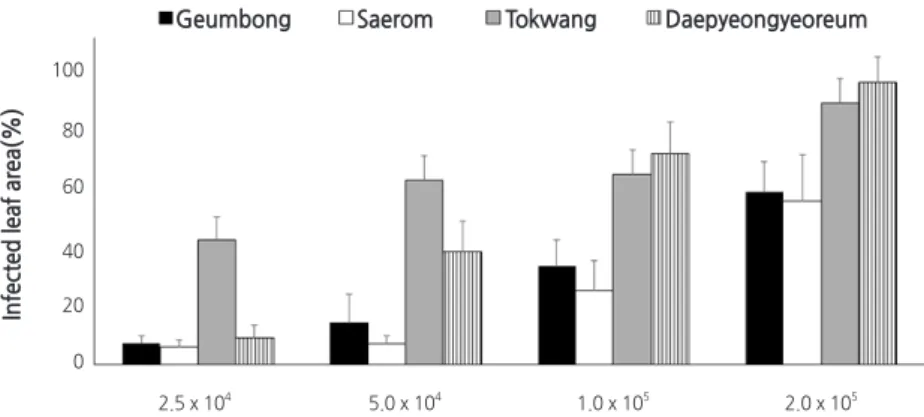
-1)에 따른 4 개 무 품종의 검은무늬병 발생을 실험한 결과, 실험한 모든 품종들은 모두 접종 농도가 증가할수록 검은무늬병 발생이 증가하였다( Fig . 4 ). 감수성 품종인 ‘토광’과 ‘대평여름’
은 1 . 0 × 10
5spores · mL
-1이하에서는 71% 이하의 다소 낮은 병반면적율을 보였으나, 2 . 0 × 10
5spores · mL
-1에서는 88% 이상 의 높은 병반면적율을 보였다 ( Fig . 4 ).
King ( 1994 )은 양배추(Brassica oleracea var . capitata)와 유채(B. napus)에 A. brassicicola 균주를 2 . 3 × 10
4, 3 . 7 × 10
4, 그리 고 5 × 10
4conidia · mL
-1농도로 접종하고 검은무늬병 발생을 조사한 결과, 처리 간의 발병도 차이를 확인할 수 없었다고 보고 하였다. 하지만 본 실험에서 무 4 품종에서 접종원 농도에 따른 검은무늬병 발생을 조사한 결과에서는 2 . 5 × 10
4, 5 . 0 × 10
4, 1 . 0
× 10
5, 2 . 0 × 10
5spores · mL
-1농도로 접종하였을 때 각각 16 , 30 , 48 , 74% 의 평균 발병도를 나타내며, 접종한 포자 농도가 높아 질수록 실험한 무 품종들의 검은무늬병의 발생은 증가하였다( Fig . 4 ). 이와 같은 경향은 모든 품종에서 확인되었는데, 이것은 무 검은무늬병에서 뿐만 아니라 대부분 균류병에서의 감수성 품종과 고추 역병 및 수박 덩굴쪼김병 등에서 고도의 질적저항성 품종이 아닌 중도저항성 품종에서는 일반적으로 발생하는 것으로( Jo et al ., 2014 ; Jo et al ., 2015 ) 본 실험에 사용한 무 품종들 중에 고도의 저항성 품종이 포함되지 않았기 때문으로 생각되었다. 본 결과로부터 A. brassicicola에 의한 무의 검은무늬병 저 항성 검정을 위해서는 2 . 0 × 10
5spores · mL
-1농도로 접종하여 실험하는 것이 효과적이라 생각되었다.
재배 온도에 따른 검은무늬병 발생
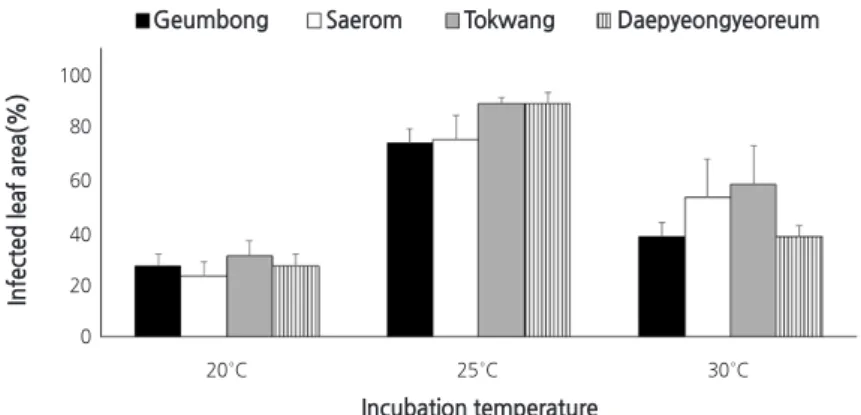
접종 후 재배온도( 20 , 25 , 30°C )에 따른 네 가지 무 품종들의 검은무늬병 발생을 실험한 결과, 25°C 의 경우에는 ‘금봉’, ‘새롬’,
‘토광’, ‘대평여름’에서 각각 74 , 75 , 89 , 89% 의 병반면적율을 보였다 ( Fig . 5 ). 즉, 감수성 품종들에서는 검은무늬병이 심하게 발 생하였고, 감수성 및 약한 저항성 품종 간의 발병 정도 차이 또한 효과적으로 나타났다. 하지만 20°C 와 30°C 에서는 감수성 품 종을 비롯한 모든 품종에서 58% 이하의 낮은 병반면적율을 보였을 뿐만 아니라, 감수성 및 약한 저항성 품종간의 차이도 거의 없었다( Fig . 5 ).
Fig. 4. Effects of inoculum concentration on the occurrence of black spot on four radish cultivars. Sixteen-day-old seedlings were
inoculated with various concentration (2.5 × 10
4, 5.0 × 10
4, 1.0 × 10
5and 2.0 × 10
5spores·mL
-1) of Alternaria brassicicola KACC 40036 spore suspension by the spray method. The inoculated plants were incubated in a humidity chamber at 25°C for 24 hr and then transferred to a growth chamber at 25°C and 80% RH with a 12-h light/dark cycle. Disease severity was measured two days after inoculation, and is represented as percentage of infected leaf area. The data were obtained from two runs with five replicates each.
Geumbong Saerom Tokwang Daepyeongyeoreum
Inoculum concentration (spores/ml)
Infected leaf area(%)
0 20 40
2.5 x 10⁴ 60
80 100
5.0 x 10⁴ 1.0 x 10⁵ 2.0 x 10⁵
그리고 유묘에 병원균을 접종하고 20 , 25 , 30°C 에서 재배하였을 때 무 4 품종의 평균 발병도는 각각 27 , 82 , 47% 를 나타내 25°C 에서 검은무늬병이 가장 효과적으로 발생하고 있음을 알 수 있었다( Fig . 5 ). A. brassicicola를 접종한 식물은 25°C 에서 검 은무늬병이 가장 빠르게 병징을 나타내지만, 병원균이 이미 감염되어 있는 종자로부터 재배된 유묘는 30°C 에서 더 빠르게 병 징을 나타낸다고 하였다( Bassey and Gabrielson , 1983 ; Kumar et al ., 2014 ). 본 연구는 건전 종자로부터 재배한 유묘에 병원균 을 접종한 경우이므로 검은무늬병 발생 최적온도가 25°C 라는 점에서 유사한 결과이다.
이상의 결과로부터 무 검은무늬병의 저항성 검정을 위한 효과적인 방법으로 종자를 파종하고 온실( 25 ± 5°C )에서 16 일 동 안 재배한 무 유묘의 잎에 A. brassicicola의 포자현탁액( 2 . 0 × 10
5spores · mL
-1)을 충분히 분무하여 접종하고, 25°C 습실상에 서 24 시간 동안 습실처리한 후에 25°C 의 항온항습실(상대습도 80% )로 이동하여 하루 12 시간씩 광을 조사하면서 재배하고, 접종 2 일 후에 잎에 발생한 검은무늬병의 병반면적율( % )을 달관조사 하는 것을 제안하고자 한다.
초 록
본 연구는 Alternaria brassicicola에 의해 발생하는 무 검은무늬병에 대한 효율적인 저항성 검정법을 확립하기 위하여 수행 되었다. A. brassicicola 7 균주의 포자 형성량과 병원성을 검정하였다. 실험한 균주 중, A. brassicicola KACC 40036 과 43923 균주는 V - 8 juice agar 배지에서 가장 많은 포자를 생산하였다. 그리고 실험한 균주 모두는 무 유묘에 대하여 강한 병원력을 나 타냈다. 시판 중인 무 61 개 품종의 A. brassicicola KACC 40036 균주에 대한 저항성 스크리닝을 수행하였다. 실험한 품종 중 높은 저항성을 보이는 품종은 없었으나 ‘금봉’과 ‘새롬’같이 약한 저항성을 나타내는 품종이 발견되었다. 이들 결과로부터 추후 실험을 위해 저항성 반응에 차이를 보이는 4 개 품종을 선발하였다. 이들 4 개 품종의 접종하는 무의 생육 시기, 접종원 농도 그 리고 접종 후의 재배 온도에 따른 검은무늬병 발생을 조사하였다. 실험한 모든 품종은 어린 유묘일수록 검은무늬병에 대한 감 수성이 증가하였으며, 더 많은 A. brassicicola 포자를 접종할수록 검은무늬병이 더 많이 발생하였다. 그리고 접종한 유묘를 25°C 의 습실상에서 배양하였을 때에는 20°C 나 30°C 에서 배양하였을 때보다 검은무늬병 발생이 증가하였다. 이들 실험의 결 과로부터 무 품종의 검은무늬병에 대한 저항성을 검정하기 위해서는 무 종자를 파종하고 온실( 25 ± 5°C )에서 16 일 동안 재배 하고, 이 유묘에 A. brassicicola 균주의 포자현탁액( 2 . 0 × 10
5spores · mL
-1)을 분무하여 접종하고, 접종한 식물은 25°C 습실상 에 24 시간 동안 배양한 후에 25°C , 상대습도 80% 의 생육상에서 재배하고, 접종 2 일 후에 병반면적율을 조사하는 것을 제안한다.
Fig. 5. Effects of incubation temperature on the development of black spot on four radish cultivars. Sixteen-day-old seedlings
were inoculated with spore suspension (2.0 × 10
5spores·mL
-1) of Alternaria brassicicola KACC 40036 by the spray method.
The inoculated plants were incubated at 20, 25, and 30°C in a controlled humidity chambers. Disease severity of the plant was measured two days after inoculation, and is represented as percentage of infected leaf area. The data were obtained from five replicates with two repetitions.
Geumbong Saerom Tokwang Daepyeongyeoreum
Incubation temperature
Infected leaf area(%)
0 20 40
20°C 60
80 100
25°C 30°C
Literature Cited
Agrios GN (2005) Plant diseases caused by fungi. In Plant Pathology, Ed 5. Academic Press Ltd., San Diego, CA, USA, pp 385-614. doi:
10.1016/b978-0-08-047378-9.50017-8
Babadoost M, Gabrielson RL (1979) Pathogens causing Alternaria diseases of brassica seed crops in western Washington. Plant Dis Reptr 63:815-820
Bae K-M, Sim S-C, Hong J-H, Choi K-J, Kim D-H, Kwon Y-S (2015) Development of genomic SSR markers and genetic diversity analysis in cultivated radish ( Raphanus sativus L.). Hortic Environ Biotechnol 56:216-224. doi:10.1007/s13580-015-0089-y
Bassey EO, Gabrielson RL (1983) The effects of humidity, seed infection level, temperature and nutrient stress on cabbage seedling disease caused by Alternaria brassicicola. Seed Sci Technol 11:403-410
Conn KL, Tewari JP, Dahiya JS (1988) Resistance to Alternaria brassicae and phytoalexin-elicitation in rapeseed and other crucifers.
Plant Sci 56:21-25. doi:10.1016/0168-9452(88)90180-X
Doullah MAU, Meah MB, Okazaki K (2006) Development of an effective screening method for partial resistance to Alternaria brassicicola (dark leaf spot) in Brassica rapa . Eur J Plant Pathol 116:33-43. doi:10.1007/s10658-006-9035-2
Hong CX, Fitt BDL (1995) Effect of inoculum concentration, leaf age and wetness period on the development of dark leaf and pod spot ( Alternaria brassicae ) on oilseed rape ( Brassica napus ). Ann Appl Biol 127:283-295. doi:10.1111/j.1744- 7348.1995.tb06673.x
Hong CX, Fitt BDL, Welham SJ (1996) Effect of wetness period and temperature on development of dark pod spot ( Alternaria brassicae ) on oilseed rape ( Brassica napus ). Plant Pathol 45:1077-1089. doi:10.1046/j.1365-3059.1996.d01-193.x
Iacomi-Vasilescu B, Avenot H, Bataill -Simoneau N, Laurent E, Gu nard M, Simoneau P (2004) In vitro fungicide sensitivity of Alternaria species pathogenic to crucifers and identification of Alternaria brassicicola field isolates highly resistant to both dicarboximides and phenylpyrroles. Crop Protect 23:481-488. doi:10.1016/j.cropro.2003.10.003
Jo EJ, Lee JH, Choi YH, Kim J-C, Choi G J (2015) Development of an efficient method of screening for watermelon plants resistant to Fusarium oxysporum f. sp. niveum . Korean J Hortic Sci Technol 33:409-419. doi:10.7235/hort.2015.14156
Jo S-J, Shim S-A, Jang KS, Choi YH, Kim J-C, Choi G J (2014) Resistance of chili pepper cultivars to isolates of Phytophthora capsici . Korean J Hortic Sci Technol 32:66-76. doi:10.7235/hort.2014.13079
Kim J, Kim D-S, Park S, Lee H-E, Ahn Y-K, Kim JH, Yang H-B, Kang B-C (2016) Development of a high-throughput SNP marker set by transcriptome sequencing to accelerate genetic background selection in Brassica rapa . Hortic Environ Biotechnol 57:280-290.
doi:10.1007/s13580-016-1036-2
King SR (1994) Screening, selection, and genetics of resistance to Alternaria diseases in Brassica oleracea . Ph.D. thesis, Cornell University, Ithaca, New York
K hl J, van Tongeren CAM, Groenenboom-de Haas BH, van Hoof RA, Driessen R, van der Heijden L. (2010) Epidemiology of dark leaf spot caused by Alternaria brassicicola and A. brassicae in organic seed production of cauliflower. Plant Pathol 59:358-367.
doi:10.1111/j.1365-3059.2009.02216.x
Korean Society of Plant Pathology (KSPP) (2009) Vegetables. In W-G Kim, HM Koo, eds, List of Plant Disease in Korea, Ed 5. KSPP, Suwon, Korea, pp 99-103
Kumar D, Maurya N, Bharati YK, Kumar A, Kumar K, Srivastava K, Chand G, Kushwaha C, Singh SK, Mishra RK, Kuma A (2014) Alternaria blight of oilseed Brassicas: A comprehensive review. Afr J Microbiol Res 8:2816-2829. doi:10.5897/AJMR2013.6434 Lee HB, Yu SH (1995) Distribution of mycotoxin-producing isolates in the genus Alternaria . Korean J Plant Pathol 11:151-157 (In Korean) Mora A, Earle ED (2001) Combination of Trichoderma harzianum endochitinase and a membrane-affecting fungicide on control of
Alternaria leaf spot in transgenic broccoli plants. Appl Microbiol Biotechnol 55:306-310. doi:10.1007/s002530000496
Mridha MAU, Wheeler BEJ (1993) In vitro effects of temperature and wet periods on infection of oilseed rape by Alternaria brassicae . Plant Pathol 42:671-675. doi:10.1111/j.1365-3059.1993.tb01551.x
Muto M, Takahashi H, Ishihara K, Yuasa H, Huang JW (2005) Control of black leaf spot ( Alternaria brassicicola ) of crucifers by extracts of black nightshade ( Solanum nigrum ). Plant Pathol Bull 14:25-34
Nowicki M, Nowakowska M, Niezgoda A, Kozik EU (2012) Alternaria black spot of crucifers: symptoms, importance of disease and perspectives of resistance breeding. Vegetable Crops Res Bull 76:5-19. doi:10.2478/v10032-012-0001-6
Otani H, Kohnobe A, Kodama M, Kohmoto K (1998) Production of a host-specific toxin by germinating spores of Alternaria brassicicola . Physiol Mol Plant Pathol 52:285-295. doi:10.1006/pmpp.1998.0147
Pedras MSC, Chumala PB, Jin W, Islam MS, Hauck DW (2009) The phytopathogenic fungus Alternaria brassicicola : Phytotoxin production and phytoalexin elicitation. Phytochemistry 70:394-402. doi:10.1016/j.phytochem.2009.01.005
Tewari JP, Mithen RF (1999) Disease. In C G mez-Campo, ed, Biology of Brassica Coenospecies. Elsevier, Amsterdam, Netherlands, pp 375-411. doi:10.1016/S0168-7972(99)80013-9
Yu HY, Yun HK, Park CH, Lee HB (1991) Three species of Alternaria associated with Alternaria leaf spot of radish in Korea. Korean J Plant Pathol 7:188-191 (In Korean)
추가 주요어 :