Res. Plant Dis. 19(2) : 95−101 (2013) © The Korean Society of Plant Pathology http://dx.doi.org/10.5423/RPD.2013.19.2.095
양배추 검은썩음병에 대한 효율적인 저항성 검정법
이지현1·김진철1·장경수1·최용호1·안경구2·최경자1*
1한국화학연구원 바이오화학연구센터, 2조은종묘
Development of Efficient Screening Method for Resistance of Cabbage Cultivars to Black Rot Disease Caused by Xanthomonas campestris pv. campestris
Ji Hyun Lee1, Jin-Cheol Kim1, Kyoung Soo Jang1, Yong Ho Choi1, Kyoung Gu Ahn2 and Gyung Ja Choi1*
1Research Center for Biobased Chemistry, Korea Research Institute of Chemical Technology, Daejeon 305-600, Korea
2Joeun Seeds, Goesan 367-833, Korea
(Received on March 25, 2013; Revised on May 28, 2013; Accepted on June 8, 2013)
Black rot caused by Xanthomonas campestris pv. campestris (Xcc) is one of the most serious diseases of crucifers world-wide. To establish the efficient screening method for resistant cabbage to Xcc, different inoculation methods, inoculation positions, growth stages of seedlings, and incubation temperatures after inoculation were investigated with the seven cabbage cultivars showing different resistance degrees to the pathogen. Clipping with mouse-tooth forceps was better inoculation method than piercing with 18 pins or cutting with scissors to distinguish the level of resistance and susceptibility. In inoculation using mouth-tooth forceps, clipping the edges of the leaves near veins is more effective than injuring the veins of the leaves directly. In addition, the inoculated plants kept at 22oC showed more clear resistant and susceptible responses than those kept at 26 or 30oC. On the basis of the results, we suggest that an efficient screening method for resistance of cabbage cultivars to black rot is to clip the edges of the leaves near veins of the four-week-old seedlings with mouth-tooth forceps dipped in a suspension of Xcc at a concentration of 7× 10⁷ cfu/ml and incubate the inoculated plants in a growth room at 22oC with 12-hr light a day.
Keywords : Black rot, Breeding, Crucifer crop, Disease resistance, Resistant screening
서 론
Xanthomonas campestris pv. campestris에 의하여 발생하 는 검은썩음병은 세계적으로 배추과 작물에 큰 피해를 일 으키며(Kamoun 등, 1992; Williams, 1980), 도관세포가 검 어지고 잎 가장자리에 V모양으로 황화되는 괴사 병반을 특징적으로 나타낸다(Smith, 1911; Stewart와 Harding, 1903; Sutton과 Williams, 1970). 병이 진전됨에 따라 엽 맥의 도관을 덮고 있는 유조직 세포 또한 검어지고 식물 은 점점 시들며 생육이 억제되어 마침내 이름처럼 썩어
버린다(Slusarenko 등, 2000). 이 병은 상대습도 80−100%, 25−35oC에서 잘 발생하며, 지리적으로 널리 분포하여 피 해를 주고 있다(Griesbach 등, 2003). Brassica 속 작물이 나 배추과 잡초 등에도 침입 가능하고, 특히 B. oleracea 작물의 생산량 감소와 품질 저하를 초래하여 큰 손실을 일으킨다(Taylor 등, 2002; Williams, 1980).
B. oleracea는 Capitata 그룹인 양배추, Italica 그룹인 브 로콜리 그리고 Botrytis 그룹인 컬리플라워 등의 농업 채 소분야에서 매우 경제적으로 중요한 여러 작물을 포함하 고 있다(Cartea 등, 2008; Jo 등, 2012). 양배추는 Brassica 속의 대표적인 작물로 지중해 연안 일대와 아시아가 원 산지이고, 재배 역사가 가장 오래된 작물 중 하나이다(Oh 등, 2011). 국내에서는 평창, 제주도, 남양주, 괴산, 홍성, 달성 등지가 주산지이다. 국내 생산량의 30%가 제주도에
*Corresponding author
Phone) +82-42-860-7434, Fax) +82-42-861-4913 Email) [email protected]
Research Article Open Access
서 생산되고, 그 다음으로 강원도에서 23%가 생산되고 있다(Eum 등, 2012; Lee, 2007).
양배추에 발생하는 주요 병해인 검은썩음병의 방제를 위해 윤작, 건전한 종자나 유묘의 사용 그리고 잠재적인 전염원이 될 수 있는 병든 식물 잔재와 배추과 잡초를 제 거하는 방법 등이 일반적으로 수행된다(Kocks 등, 1998;
Schaad와 Dianese, 1981; Williams, 1980). 저항성 품종의 사용은 아주 중요한 방제 방법 중 하나로(Williams, 1980), 낮은 비용으로 방제의 안정성을 가질 수 있어 큰 잠재성 을 가진 방법이다(Taylor 등, 2002; Vicente 등, 2001). X.
campestris pv. campestris(Xcc) 저항성에 대한 연구로는 양배추 품종 ‘Early Fuji’와 ‘Hugenot’가 고도저항성을 나 타낸다고 처음 보고된(Bain, 1952; Bain, 1955) 이후에 많 은 연구자들은 B. carinata, B. juncea, B. napus, B. nigra, B. rapa 뿐만 아니라 B. oleracea에도 많은 저항성 유전 자형을 추가적으로 선발하여 도입하였다(Dickson과 Hunter, 1987; Guo 등, 1991; Hunter 등, 1987; Marthe 등, 2002;
Monakhos와 Djalilov, 2000; Quazi, 1988; Sharma 등, 1972; Westman 등, 1999; Williams 등, 1972). 하지만 지 속적으로 저항성에 대한 연구가 수행되고 있었음에도 검 은썩음병에 대한 저항성 양배추 품종의 육종이 쉽지 않 아 성공한 사례가 적은 실정이다(Ignatov 등, 1998; Jensen 등, 2005; Taylor 등, 2002; Vicente 등, 2001). 앞으로 Xcc 에 대한 양배추의 저항성 연구와 새로운 저항성 육종 소 재의 발굴이 수행되기 위해서는 효율적이고 신뢰할 수 있 는 병 저항성 검정법의 확립이 필수적으로 요구된다.
따라서 본 연구에서는 효율적인 양배추 검은썩음병 저 항성 검정법을 확립하기 위하여 접종 방법, 접종 위치, 생 육 정도, 재배 온도 등의 다양한 발병 조건에 따른 양배 추 검은썩음병의 발생 정도를 조사하였다.
재료 및 방법
양배추 재배. 양배추 검은썩음병 저항성 검정법을 확 립하기 위해 시판 중인 양배추 3개 품종 ‘루비아’(한국다 끼이), ‘오조라’(사카타코리아) 그리고 ‘그린핫’(아시아종 묘)과 조은종묘로부터 분양 받은 양배추 4개 품종 ‘Saint’,
‘Joeun-ACE’, ‘Wonderball’ 및 ‘XCCR 500’을 실험에 사 용하였다. 각 품종들의 양배추 검은썩음병에 대한 저항성 특성은 Table 1과 같다.
양배추 7개 품종의 종자를 5 × 8 육묘용 연결포트(70 ml/
pot, 범농사)에 원예용상토 5호(부농사)를 넣고 파종한 후, 생육 정도에 따른 실험을 제외한 모든 실험은 온실(25 ± 5oC) 에서 약 4주 동안 재배한 4엽기 양배추를 실험에 사용하
였다. 양배추의 생육 시기에 따른 검은썩음병 발생 실험 에서는 파종한 종자를 온실에서 3, 4 및 5주 동안 재배 한 양배추 유묘를 사용하였다.
접종원 준비 및 병원균 접종. 양배추 검은썩음병을 일 으키는 X. campestris pv. campestris KACC 10377을 농촌 진흥청 농업유전자원센터(KACC)로부터 분양 받았으며, 균주의 장기 보관을 위하여 20% glycerol 용액에 현탁하 여 −70oC deep freezer에 저장하였다. Trypticase soy agar (TSA; Becton, Dickinson and Co.) 배지에 균주를 접종하 여 30oC에서 3일간 배양한 후에 이를 TSA 배지에 다시 접종하고 30oC에서 2일 동안 배양한 균을 실험에 사용하 였다. 균주가 배양된 배지에 멸균수를 붓고 spreader로 수 확하여 세균 현탁액을 만들었다. DU®800 UV/Visible Spectrophotometer(Beckman Coulter Inc., Fullerton)를 사 용하여 흡광도(OD, optical density)를 측정하고 현탁액의 농도를 OD600= 0.125(6.86× 10⁷ cfu/ml)가 되도록 멸균수 를 이용하여 조정하였다.
접종 방법에 따른 양배추 검은썩음병 발생을 조사하기 위해 핀셋, 핀 및 가위를 이용한 4가지 방법으로 양배추 유묘의 본엽 1엽과 2엽에 병원균을 접종하였다. 핀셋(mouth- tooth forceps) 접종은 Xcc 현탁액을 핀셋에 묻힌 후에 수 공과 엽맥에 직접적인 상처가 나지 않게 엽맥(secondary vein) 옆의 엽육 가장자리에 잎 당 2회씩 길이 1 cm의 상 처가 나도록 핀셋으로 집어 주었고, 핀 접종은 핀 18개를 묶어 Xcc 현탁액에 담근 후에 잎의 가로 직경이 가장 넓 은 부위의 각 양쪽에 핀으로 찔러 접종하였다. 가위 접종 은 두 가지 방법으로 수행하였는데, Xcc 현탁액을 묻힌 가위로 엽의 직경이 가장 넓은 부위 양 옆에 엽맥을 피 하여 길이가 1 cm 되도록 잘라 접종하는 방법과 잎 선단 부분이 2 cm 남도록 잎 끝을 잘라내어 접종하는 방법을 이용하였다.
핀셋으로 엽맥에 직접적인 상처를 내며 접종하는 방법 Table 1. Trait of seven cabbage cultivars used in this study against Xanthomonas campestris pv. campestris
Cultivar Company Traita
Rubia Takii Korea S
Ohjora Sakata Korea S
Greenhot Asia Seed R
Saint Monsanto Korea S
Joeun-ACE Joeun Seed MR
Wonderball Monsanto Korea MR
XCCR 500 Joeun Seed R
aS, susceptible; MR, moderately resistant; R, resistant.
과 엽맥에 직접적인 상처가 나지 않게 엽맥 근처에 접종 하는 방법을 잎 당 4회씩 수행하여 접종 위치에 따른 검 은썩음병 발생을 조사하였다. 그리고 접종 방법에 따른 검은썩음병 발생 실험을 제외한 모든 실험은 핀셋으로 수 공과 엽맥을 피해 잎 당 4회씩 상처 접종을 하였으며, 처 리 당 양배추 유묘 10개씩 사용하였고 모든 실험은 2회 실시하였다.
발병 및 병조사. 접종 후 재배 온도에 따른 양배추 7 품종의 검은썩음병 발생 실험은 접종한 양배추를 22, 26 및 30oC 습실상에서 24시간 동안 배양한 후에 동일한 온 도의 항온항습실에서 하루에 12시간씩 광을 처리하면서 재배하였다. 그 외 모든 실험은 22oC 습실상에서 24시간 배양 후 22oC 항온항습실로 옮겨 13−20일 동안 재배한 후에 양배추 검은썩음병의 발생을 조사하였다. 발병 정도 는 Vicente 등(2001)의 기준을 참고하여 0 = 병징이 없음, 1 =약한 괴사 및 접종 부위 주변의 퇴록, 2 = 면적 1 cm2 이하의 전형적인 V 모양의 병반과 검은 엽맥, 4 = 면적 1 cm2 초과의 전형적인 V 모양의 병반과 검은 엽맥 등의 4단계로 처리한 1엽과 2엽 중 병 저항성 및 감수성이 뚜 렷한 잎의 발병도를 조사하였다. 그리고 가위로 엽의 끝 을 잘라 접종한 경우는 주맥을 기준으로 병반 길이를 조사 하여 0 = 건전, 1 = 0.2 cm 이하, 2 = 0.3−1.0 cm, 4 = 1.1 cm 이상 등 4단계로 하였다. 평균 발병도가 1.0 이하인 경우 에는 저항성, 1.1−1.5는 중도저항성, 1.6 이상은 감수성으 로 판정하였으며, 처리 당 양배추 유묘 10개씩 사용하였
고 모든 실험은 2회 실시하였다. 통계 분석은 SAS(SAS Institute, Inc., 1989, Cary, NC) 프로그램을 이용하여 ANOVA 분석을 하였으며, 처리 평균간 비교를 위하여 Duncan’s multiple range test(P = 0.05)를 실시하였다.
결과 및 고찰
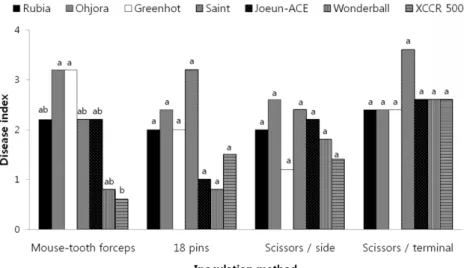
접종 방법에 따른 검은썩음병의 발생. 접종 방법에 따 른 양배추 검은썩음병의 발생을 조사하기 위해 핀셋, 18 핀, 가위로 엽의 양쪽을 접종하는 방법 그리고 엽 말단을 접종하는 4가지 방법으로 접종하였다. 가위로 접종하는 두 방법 중 주맥이 접종되도록 엽 말단을 자르는 방법은 특히 저항성과 감수성의 차이를 보기 어려울 정도로 모 든 품종에서 2.4 이상의 높은 발병도를 보였고 양 옆을 자르는 방법 또한 모든 품종에서 높은 발병도를 나타내 어 품종간의 유의성 있는 차이가 없었다. 그리고 18핀 접 종의 경우 평균 발병도에서는 차이를 보이는 듯 하였으 나 품종간의 병 발병도에서 통계적으로 유의차가 없었 다. 하지만 핀셋 접종의 경우는 감수성 품종으로 보이는
‘오조라’의 경우 3.2, 저항성 품종 ‘XCCR 500’은 0.8의 발병도를 보이며 품종간의 저항성 차이를 나타내며 통계 적으로 유의차도 확인되었다(Fig. 1).
가위로 접종하는 두 방법은 접종 과정에서 편리성이 있 으나 병 발생이 지나치게 많고 품종 간의 차이를 나타내 지 못하여 검정 방법으로 적절하지 않다고 생각되었다.
Fig. 1. Development of black rot on seven cabbage cultivars inoculated by four different inoculation methods. Four-week-old seedlings of cabbage cultivars were inoculated with Xanthomonas campestris pv. campestris KACC 10377 using mouth-tooth forceps, 18 pins, and scissors. The inoculated plants were incubated in humidity chamber at 22oC for 24 hours and then transferred to a growth room at 22oC with 12-hour light a day. After 3 weeks, disease severity of the seedlings was investigated on a scale of 0–4. Each value represents the mean of two runs with ten replicates each. Values in the labeled with the same letter are not significantly different in Duncan’s multiple range test at P = 0.05.
하지만 Xcc의 병원성 기작 연구 등에서 여러 균주들의 병원성을 검정하는 경우에는 효율적으로 이용될 수 있을 것이다. Tonguç 등(2003)에 의해 2개의 바늘로 접종하고 35일 후 병조사를 하는 방법으로 저항성에 관한 연구에 사용된 바 있는 핀 접종은 접종 부위와 접종량을 증가시 키기 위해 18개의 핀으로 빠른 병 발생이 가능하도록 본 실험에서 설계하여 수행하였으나 검은썩음병 발생이 다 소 적고 품종간에 유의차를 보이지 않아 저항성 검정에 는 적합하지 않은 것으로 보인다. 핀셋으로 접종하는 방 법은 검은썩음병 접종에 많이 사용되고 있는 방법으로 (Ignatov 등, 1998; Staub와 Williams, 1972; Taylor 등, 2002; Vicente 등, 2001), 본 연구에서도 다른 접종 방법 과 비교하여 검은썩음병 발생도 용이하며 선발된 품종간 의 유의적 차이도 잘 나타내고 있으므로 가장 효과적인 접종 방법으로 판단되었다.
Staub와 Williams(1972)에 의해 검은썩음병에 대한 저 항성과 감수성 양배추의 엽맥과 수공 접종에 의한 병 발 생을 비교하면서 접종 위치의 중요성이 제기된 바 있다.
따라서 핀셋을 사용하여 엽맥에 직접적으로 접종하는 방 법과 엽맥 주변 엽육에 접종하여 검은썩음병 발생을 비 교한 결과, 엽맥에 접종한 경우에는 품종의 저항성이 품 종의 특성과 큰 차이를 보였으며, 엽맥 근처에 접종하였 을 때에는 저항성, 중도저항성 그리고 감수성 품종들의 특성이 효과적으로 나타났다(Fig. 2). 이는 레이스 특이적 저항성이 엽육에서 더 잘 발현되기 때문으로 생각된다
(Ignatov 등, 1998). 그러므로 양배추 검은썩음병의 가장 효과적인 접종 방법으로 선발된 핀셋 접종은 엽맥에 직 접적인 상처를 가하며 접종하는 것보다 엽맥을 피해서 근 처 엽육에 접종하는 방법이 검은썩음병 저항성 검정에 효 과적인 것으로 생각되었다.
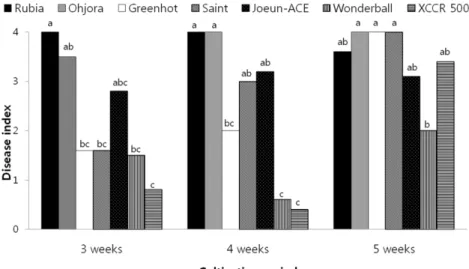
생육 정도에 따른 검은썩음병의 발생. Xcc 접종에 적 합한 양배추의 생육 시기를 결정하기 위하여 양배추 7개 품종의 파종 시기를 다르게 하여 3, 4, 5주 동안 재배한 유묘에 Xcc를 접종하여 생육시기에 따른 검은썩음병 발 생을 조사하였다. 3주, 4주 및 5주 동안 재배한 양배추 7개 품종의 평균 발병도는 각각 2.3, 2.5, 3.4로 양배추가 생장할수록 Xcc에 대한 감수성이 증가한다는 것을 알 수 있었다(Fig. 3). 그리고 파종 후 5주간 재배한 양배추 품 종들은 양배추의 특성에 관계없이 높은 발병도를 보였 다. 그러나 3주 동안 재배한 양배추의 경우에는 저항성 품종 ‘XCCR 500’, 감수성인 ‘루비아’ 품종이 각각 발병 도 0.8과 4.0로 저항성 특성과 유사한 양상을 보였다. 한 편 4주 재배한 후에 Xcc를 접종하였을 때에는 3주 재배 한 양배추 보다 감수성 품종과 저항성 품종의 발병도 차 이가 더 크게 나타남에 따라 품종의 특성을 가장 잘 나 타낼 수 있는 양배추의 생육 시기는 파종 후 4주 동안 재 배한 유묘로 생각되었다.
Jensen 등(2005)에 의한 B. oleracea에 발생하는 검은썩 음병의 저항성 검정 실험 중 정식 후 생육 기간에 차이 를 두고 접종을 수행하여 수치상 차이가 확인된 바 있으
Fig. 2. Black rot occurrence on seven cabbage cultivars inoculated at vein and near vein of leaf. Four-week-old seedlings of cabbage cultivars were inoculated with Xanthomonas campestris pv. campestris (Xcc) KACC 10377 by clipping the edges of the leaves veins or near veins in 1 cm from leaf border with mouse-tooth forceps dipped in a suspension of Xcc. The inoculated plants were incubated in humidity chamber at 22oC for 24 hours and then transferred to a growth room at 22oC with 12-hour light a day. After 3 weeks, disease severity of the seedlings was investigated on a scale of 0–4. Each value represents the mean of two runs with ten replicates each. Values in the labeled with the same letter are not significantly different in Duncan’s multiple range test at P = 0.05.
나 야외에서 수행되었던 관계로 접종 시기뿐만 아니라 접 종 초기의 강우량 차이도 있어 적절한 접종 시기에 대한 평가는 이루어지지 못하였다. 하지만 재배 기간이 충분하 지 못할 경우 병의 진전이 원만하지 않고 길어지면 하위
엽이 노화되고 낙엽이지는 증상이 발생하여 정확한 저항 성 검정이 어려우므로 적절한 양배추 생육 시기에 접종 하는 것이 필요하다.
재배 온도에 따른 검은썩음병의 발생. Staub와 Williams Fig. 3. Development of black rot of seven cabbage cultivars inoculated at different growth stages. Five-, four-, and three-week-old seedlings of each cabbage cultivar were inoculated with Xanthomonas campestris pv. campestris (Xcc) KACC 10377 by clipping the edges of the leaves near veins in 1 cm from leaf border with mouse-tooth forceps dipped in a suspension of Xcc. The inoculated plants were incubated in humidity chamber at 22oC for 24 hours and then transferred to a growth room at 22oC with 12-hour light a day. After 2–3 weeks, disease severity of the seedlings was investigated on a scale of 0–4. Each value represents the mean of two runs with ten replicates each. Values in the labeled with the same letter are not significantly different in Duncan’s multiple range test at P = 0.05.
Fig. 4. Development of black rot on seven cabbage cultivars according to incubating temperature after inoculation. Four-week-old seedlings of cabbage cultivars were inoculated with Xanthomonas campestris pv. campestris (Xcc) KACC 10377 by clipping the edges of the leaves near veins in 1 cm from leaf border with mouse-tooth forceps dipped in a suspension of Xcc. The inoculated seedlings were incubated in humidity chamber at 22oC, 26oC, and 30oC for 24 hours and then transferred to a growth room at 22oC, 26oC, and 30oC, respectively, with 12-hour light a day. After 3 weeks, disease severity of the plants was investigated on a scale of 0–4. Each value represents the mean of two runs with ten replicates each. Values in the labeled with the same letter are not significantly different in Duncan’s multiple range test at P = 0.05.
(1972)는 양배추 유묘에 핀셋(mouth-tooth forceps)으로 Xcc 를 접종한 후에 16, 20, 24 및 28oC에서 재배하여 저항성 및 감수성 양배추 품종들의 검은썩음병 발생을 실험한 결 과, 28oC에서는 저항성 품종과 감수성 품종은 거의 차이 가 없이 많은 검은썩음병 발생을 보였으나, 20−24oC에서 는 양배추 품종의 저항성 잘 나타났다고 보고하였다. 본 실험에서도 세균 생육에 적온인 30oC에서는 병 저항성이 거의 나타나지 않았으나, 실험한 세 온도(22, 26, 30oC) 중 양배추의 생육에 가장 좋은 온도인 22oC에서는 ‘루비 아’, ‘오조라’, ‘그린핫’, ‘Saint’, ‘Joeun-ACE’, ‘Wonderball’,
‘XCCR 500’는 각각 2.8, 4.0, 2.3, 3.0, 0.9, 0.6, 0.6의 평 균 발병도를 나타내며 품종간의 뚜렷한 저항성 차이를 보 였다(Fig. 4).
이상의 결과로부터 검은썩음병(X. campestris pv. campestris) 에 대한 양배추의 저항성을 검정하기 위해서는 파종 후 25± 5oC의 온실에서 4주 동안 재배한 4엽기 양배추 유묘 의 본엽 1엽과 2엽의 엽맥에 직접적인 상처를 피하며 엽 맥 옆의 엽육에 핀셋(mouth-tooth forceps)으로 접종하고 접종 후 22oC 습실상에서 1일 동안 습실처리한 후에 22oC 생육상에서 하루에 12시간 동안 광을 처리하면서 재배한 후에 병조사하는 것이 효율적이라고 생각된다. 본 연구에 서 확립한 양배추 검은썩음병 저항성 품종 검정법은 앞 으로 새로운 저항성 유전자원을 발굴하거나 분자마커 개 발 및 저항성 유전자 규명 등의 연구를 수행할 때 유용 하게 활용될 수 있을 것이다.
요 약
Xanthomonas campestris pv. campestris(Xcc)에 의한 검 은썩음병은 세계적으로 배추과 작물에 발생하여 큰 피해 를 주고 있는 주요 식물병이다. Xcc에 대한 양배추의 효 율적인 저항성 검정법을 확립하기 위해, Xcc에 대한 저 항성 정도가 서로 다른 ‘루비아’, ‘오조라’, ‘그린핫’, ‘Saint’,
‘Joeun-ACE’, ‘Wonderball’ 및 ‘XCCR 500’ 등 7개 양배 추 품종을 대상으로 접종 방법, 접종 위치, 재배 기간 그 리고 재배 온도에 따른 검은썩음병 발생을 조사하였다.
양배추 품종들의 저항성은 18핀이나 가위를 사용하여 접 종하는 것보다 핀셋(mouth-tooth forceps)을 사용하여 접 종하였을 때 가장 큰 차이를 보이며, 직접적으로 엽맥에 접종하는 것보다 엽맥 주변에 접종이 더 효과적이었다.
그리고 접종한 유묘를 30oC 보다 22oC에서 재배하였을 때에 감수성과 저항성 반응이 더 분명하게 나타났다. 이 상의 결과로부터 양배추 검은썩음병에 대한 효과적인 저 항성 검정법으로 4주 재배한 유묘의 엽맥 주변을 핀셋
(mouth-tooth forceps)으로 상처 접종한 후 22oC 생육상에 서 재배하는 방법을 제안하고자 한다.
Acknowledgment
This study was supported by a grant (Project No.
609002-5) from the Screening Center for Disease Resistant Vegetable Crops of Technology Development Program for Agriculture and Forestry, Ministry for Food, Agriculture, Forestry and Fisheries, Republic of Korea.
References
Bain, D. C. 1952. Reaction of Brassica seedlings to black rot.
Phytopathology 42: 497−500.
Bain, D. C. 1955. Resistance of cabbage to black rot.
Phytopathology 45: 35−37.
Cartea, M. E., Velasco, P., Obregon, S., Padilla, G. and Haro, A.
D. 2008. Seasonal variation in glucosinolate content in Brassica oleracea crops grown in northwestern Spain.
Phytochemistry 69: 403−410.
Dickson, M. H. and Hunter, J. E. 1987. Inheritance of resistance in cabbage seedlings to black rot. Hort. Sci. 22: 108−109.
Eum, H. L., Lee, Y. H., Hong, S. J., Shin, I. S. and Yeoung, Y. R.
2012. Quality change during harvest time and storage of various cabbages grown on high land by different transplanting times. J. Bio-Environ. Control 21: 95−101.
Griesbach, E., Loptien, H. and Miersch, U. 2003. Resistance to Xanthomonas campestris pv. campestris (Pammel) Dowson in cabbage Brassica oleracea L. J. Plant Dis. Prot. 110: 461− 475.
Guo, H., Dickson, M. H. and Hunter, J. E. 1991. Brassica napus sources of resistance to black rot of crucifers and inheritance of resistance. Hort. Sci. 26: 1545−1547.
Hunter, J. E., Dickson, M. H. and Ludwig, J. 1987. Source of resistance to black rot of cabbage expressed in seedlings and adult plants. Plant Dis. 71: 263−266.
Ignatov, A., Kuginuki, Y. and Hida, K. 1998. Race-specific reaction of resistance to black rot in Brassica oleracea. Eur. J.
Plant Pathol. 104: 821−827.
Jensen, B. D., Massomo, S. M. S., Swai, I. S., Hockenhull, J. and Andersen, S. B. 2005. Field evaluation for resistance to the black rot pathogen Xanthomonas campestris pv. campestris in cabbage (Brassica oleracea). Eur. J. Plant Pathol. 113: 297−
308.
Jo, S. J., Shim, S. A., Jang, K. S., Choi, Y. H., Kim, J. C. and Choi, G. J. 2012. Development of efficient screening method for resistant cabbage and broccoli to Plasmodiophora brassicae.
Res. Plant Dis. 18: 86−92. (In Korean)
Kamoun, S., Kadmar, H. V., Tola, E. and Kado, C. I. 1992.
Incompatible interaction between crucifers and Xanthomonas campestris involve a vascular hypersensitive response: Role of the hrpX locus. Mol. Plant-Microbe Interact. 5: 22−33.
Kocks, C. G., Ruissen, M. A., Zadoks, J. C. and Duijkers, M. G.
1998. Survival and extension of Xanthomonas campestris pv.
campestris in soil. Eur. J. Plant Pathol. 104: 911–923.
Lee, S. O. 2007. Agricultural products story (21) Cabbage.
Agrochemical News Magazine 28: 48. (In Korean) Marthe, F., Scholze, P., Griesbach, E. and Ryschka, U. 2002. New
resistances to black rot (Xanthomonas campestris pv.
campestris), clubroot (Plasmodiophora brassicae), blackleg and leaf spots (Phoma lingam) from genus Brassica to enhance resistance in cabbage (Brassica oleracea). 13.
Crucifer Genetics Workshop, Davis, USA. 88 pp.
Monakhos, G. F. and Djalilov, F. S. 2000. Genetic sources and methods for estimation of brassicas resistance to black rot. J.
Russ. Phytopathol. Soc. 1: 83−88.
Oh, I. N., Choi, S. H., Park, S. Y., Lim, Y. P. and An, G. H. 2011.
Effect of season, tissue position and color on content of amino acids in cabbage (Brassica oleracea). CNU J. Agr. Sci. 38: 79− 86. (In Korean)
Quazi, M. H. 1988. Interspecific hybrids between Brassica napus and Brassica oleracea L. developed by embryo culture. Theor.
Appl. Genet. 75: 309−318.
Schaad, N. W. and Dianese, J. C. 1981. Cruciferous weeds as sources of inoculum of Xanthomonas campestris in black rot of crucifers. Phytopathology 71: 1215−1220.
Sharma, B. R., Swarup, V. and Chatterjee, S. S. 1972. Inheritance of resistance to black rot in cauliflower. Can. J. Genet. Cytol.
14: 363−370.
Slusarenko, A. J., Fraser, R. S. S. and van Loon, L. C. 2000.
Mechanisms of resistance to plant diseases. In: Black Rot of Crucifers, ed. by A. M. Alvarez, pp. 21−52. Kluwer Academic
Publishers, Netherlands.
Smith, E. F. 1911. Bacteria in Relation to Plant Diseases; History, General Considerations, Vascular Diseases. Vol. II. Carnegie Inst., Washington D. C. 262 pp.
Staub, T. and Williams, P. H. 1972. Factors influencing black rot lesion development in resistant and susceptible cabbage.
Phytopathology 62: 722−728.
Stewart, F. C. and Harding, H. A. 1903. Combating the black rot of cabbage by the removal of affected leaves. N. Y. Agric. Exp.
St. Bull. 232: 43−65.
Sutton, M. D. and Williams, P. H. 1970. Relation of xylem plugging to black rot lesion development in cabbage. Can. J.
Bot. 48: 391−401.
Taylor, J. D., Conway, J., Roberts, S. J., Astley, D. and Vicente, J.
G. 2002. Sources and origin of resistance to Xanthomonas campestris pv. campestris in Brassica genomes. Phytopathology 92: 105−111.
Tonguç, M., Earle, E. D. and Griffiths, P. D. 2003. Segregation distortion of Brassica carinata derived black rot resistance in Brassica oleracea. Euphytica 134: 269−276.
Vicente, J. G., Conway, J., Roberts, S. J. and Taylor, J. D. 2001.
Identification and origin of Xanthomonas campestris pv.
campestris races and related pathovars. Phytopathology 91:
492−499.
Westman, A., Kresovich, S. and Dickson, M. H. 1999. Regional variation in Brassica nigra and other weedy crucifers for disease reaction to Alternaria brassicicola and Xanthomonas campestris pv. campestris. Euphytica 106: 253−259.
Williams, P. H., Staub, T. and Sutton, J. C. 1972. Inheritance of resistance in cabbage to black rot. Phytopathology 62: 247− 252.
Williams, P. H. 1980. Black rot: A continuing threat to world crucifers. Plant Dis. 64: 736−742.