Biological Control of Soft Rot on Chinese Cabbage Using Beneficial Bacterial Agents in Greenhouse and Field
Anupama Shrestha, Eun Chang Kim, Chuen Keun Lim, Saeyoull Cho, Jang Hyun Hur
1and Duck Hwan Park*
Laboratory of Bacterial Genetics and Biotechnology, Division of Bio-Resources Technology, College of Agriculture and life Sciences, Kangwon National University, Chuncheon 200-701, Korea,
1Division of Biological Environment, College of Agricultural and Life Sciences, Kangwon National University, Chuncheon 200-701, Korea
(Received September 19, 2009; accepted September 26, 2009)
Three beneficial bacterial agents, Lactobacillus strain KLF01, Lactococcus strain KLC02 and Paenibacillus strain KPB3 were showed clear zone against plated Pectobacterium carotovorum subsp. carotovorum (Pcc) soft rot pathogen. In greenhouse test, bio-control efficacy was more significantly effective in the treatments by KLC02 and KPB3 as 64%, 50%, 56% and 66%, 57%, 58% according to date of evaluation, respectively. In case of KLF01 control effect was relatively lower than treatments of KLC02 and KPB3 but its efficacy was still significantly observed when compared to control (only water treatment). Furthermore, KLF01, KLC02 and KPB3 showed 55%, 60% and 62% bio-control efficacy, respectively in field test from early March to late July of 2009. Thus, we suggest that these strains can be useful as bio-control agents against soft rot caused by Pcc.
Key words beneficial bacterial agents, biological control, Chinese cabbage, soft rot Abstract
*연락저자 : Tel. +82-33-256-8253, Fax. +82-33-256-8254 E-mail: [email protected]
Introduction
Bacterial soft rot caused by Pectobacterium carotovorum subsp. carotovorum (Pcc) occurs worldwide in several eco- nomically important plant species (P´erombelon and Kelman, 1980) and is one of the most hazardous pathogen which damages Chinese cabbage production in Korea (Kikumoto, 2000). Pcc produces several extracellular enzymes (pectatelyases, pectinases, cellulases and proteases) which are able to degrade plant cell walls, resulting into tissue maceration or rotting is mainly attributed to its virulence (Kotoujansky, 1987). It is also a major problem in potato post harvest storage (Cladera-olivera et al., 2006). Moreover, Pcc severely cause soft rot in Pinellia ternata (Hu et al., 2008). Chinese cabbage (Brassica campestris var. pekinensis) is a major crop in Korea based on both cultivation acreage and con-
sumption amount (Jee et al., 1999). It is extensively used for a preparation of a favorite Korean dish “Kimchi”.
Recently, outbreaks of soft rot have been observed widely in fields of Korea. It is mainly reported to be controlled by the chemicals and antibiotics. Since the conventional use of chemical pesticides or soil fumigants like a methyl bromide is deleterious to environment and human health, the biological control of plant pathogens is important (Hayward, 1991; Bernal et al., 2002). In previous reports, avirulent mutant of Erwinia (Takahara et al., 1993; Kyeremeh et al., 2000), microbial pesticide (Takahara, 1994), fluorescent antagonistic bacterium (Togashi et al., 2000) has been reported to be used as bio-control agents against soft rot.
Moreover, transgenic cultivar of Chinese cabbage (Vanjildorj et al., 2009) resistance to soft rot has been developed.
However, use of different genus strains such as Lactobacillus, Lactococcus, and Paenibacillus to control soft rot seems to be a new try. The genus of Lactobacillus and Lactococcus 325
ORIGINAL ARTICLE/CONTROL
are widely used as probiotics organisms (Naidu et al., 1999) and preservative against food spoilage organisms (Ray and Daeschel, 1992). However, its study against plant pathogenic bacteria is limited. Antimicrobial effect of these genuses has been reported against different pathogens like Xanthomonas campestris, Erwinia carotovora and Pseudomonas syringae (Visser et al., 1986), Fusarium (Laitila et al., 2002) and Ralstonia solanacearum (Shrestha et al., 2009).
In this study, thus, we have aim to evaluate the anti- bacterial activity of three bacterial genus treatment against soft rot disease.
Materials and Methods
Bio-control agents and pathogen preparations Strains KLF01 (Shrestha et al., 2009), KLC02 and KPB3 (Suk et al., 2006) were used as beneficial bacterial agents.
These isolates and the pathogen were routinely grown in Lactobacilli MRS agar (de Man et al., 1960) and MGY (Mannitol Glutamate Yeast extract Agar) respectively. For long term storage, all the strains and pathogen were freeze dried in 10% skim milk as described by Perry et al.
(1995).
The inoculum of Pcc was prepared in liquid cultures adjusted to 1 × 10
8CFU ml
-1as previously described by Romero et al. (2004). For greenhouse experiments, the strain suspensions were obtained from laboratory liquid cultures and adjusted to 1 × 10
8CFU ml
-1. First bacterial inoculums were prepared in MRS 5 ml broth and incubated at 37°C for 24 hrs. Then, it was sub-cultured to 100 ml MRS broth and incubated at 30°C for 24 hrs. For field experiments, 5 ml of grown culture was sub-cultured to 1 L MRS or M5 broth for KLF01, KLC02 and KPB3, respectively and incubated for 24 hrs. For integrated samples, the strain cultures were mixed in 1:1 (v : v) ratio as described by Anjum et al. (2007). The inoculum was adjusted to neutral pH 7.0 before treatment.
In vitro antagonism test
Strains KLF01, KLC02 and KPB3 were subjected to in vitro antibacterial assay against Pcc. Agar well diffusion method as described by Benkerroum and Sandine (1988)
with some modifications was carried out. Briefly, MRS agar plates were overlaid with 7 ml Soft MGY agar (con- taining 0.75% agar) inoculated with 100 µl of the overnight growth culture of the Pcc (1 × 10
8CFU ml
-1) and incubated for 3 hrs at 28°C. After incubation for 3 hrs, wells were punched out of the agar and then 10 µl of streptomycin (200 ppm), water (control), cell suspension, cell free suspension and pellet of the test organisms were poured into each well separately and incubated for 48 hrs at 30°C to observe clear zone.
The antibacterial activity was assayed by observing inhibitory zones in the background of tested strains after 18-24 hrs of incubation. Each assay was performed in triplicate. Degree of antagonism shown was determined by measuring the average diameter of clear zone of inhibition;
- , no inhibition (< 1 mm); +, weak inhibition (< 5 mm);
++, strong inhibition (> 5 mm).
Pots experiments in greenhouse
Experiments were carried out in greenhouse to evaluate the suppressive effect of tested strains and its integrated treatments on soft rot. The seedling of Chinese cabbage was grown under greenhouse conditions. Plants were grown in 10 cm pots containing medium, watered daily before reaching four-leaf stage (approximately 6 weeks from sowing seed). The experiment was carried out in a completely randomized blocked design with 7 treatments (a) Control, (b) Streptomycin (200 ppm), (c) KLF01, (d) KLC02, (e) KPB3, (f) KLF01+KPB3 and (g) KLC02+KPB3. Experiments were replicated for 3 times with 12 plants per replication.
Three or four leaves plants were drenched with 5 ml of all the samples into each pot. The control plants received 5 ml tap-water. One week after drench treatment, 10 ml of Pcc suspensions (1 × 10
8CFU ml
-1) was applied to all treated and control plant along with mineral oil in 4:1 (v : v) ratio as described by Lee and Cha (2001). The tested plants were maintained in the greenhouse with a normal conditions at 28-32°C. Disease assessment was performed every 4
th, 8
thand 12
thdays after pathogen inoculation.
Disease severity was assessed as described by Champosieau
et al. (2006) with a few modifications. Briefly, disease
symptoms were recorded on every 4
th, 8
thand 12
thdays
inoculation using a symptom severity scale ranging from 0 to 5, where 0 = no symptoms, 1 = one or two pencil- line streaks, 2 = more than two pencil-line streaks, 3 = leaf chlorosis or bleaching, 4 = leaf necrosis, and 5 = death of the plant. Inoculated plants were rated individually based on the score of the leaf showing the most severe symptom. Disease severity was expressed as DS =100 [(1
× N1 + 2 × N2 + 3 × N3 + 4 × N4 + 5 × N5) / 5NT], where Ni = number of plants with score i and NT = total number of plants.
Field tests and data analyses
Experiments were conducted on experimental farm of the Kangwon National University during the season of 2009. Seeds were sown in plastic boxes (50 × 40 × 10 cm) containing the soil in mid of February and transplanted into a plastic pot (8 cm diameter) containing the same soil, one plant per pot in early of March. The plants were raised in a polyethylene vinyl house at 16-28°C until field transplanting. The seedlings were transplanted into field in late May following standard cultivation method conducted routinely in Korea. The field plot consisted of 30 rows and each row is 25 cm long, 70 cm wide and 30 cm between rows. Prior to transplanting, soil surface of the row was mulched with 0.03 mm thick black polyethylene film. Seedlings were then transplanted in hand line in each row 30 cm apart each other. Pathogen was artificially post inoculated by drench after strains were applied.
Development of soft rot on Chinese cabbage was examined at 3 to 10 days over the field plot from July to end of season. Number of plants having at least one infected leaf was counted from 30 to 50 samples randomly chosen around the plot. Sampling was repeated three times in different place in the field plots. The number of infected plants was converted into the percentage or proportion of infected plants in the total number of sample plants.
For the field test, biological control efficacy was calculated according to Guo et al. (2004) as BCE = Dc – DT / Dc.
100%, where Dc is disease control and DT is disease of the treatment group. Additionally, statistical analyses were performed with SPSS (version 17).
Results
Antagonistic effect
The antibacterial substances produced from strains KLF01, KLC02 and KPB3, showed antagonism against Pcc. St- reptomycin (200 ppm) was used as positive control and water as negative control to compare the antagonistic results (Fig. 1). The suspension and pellet of all strains and were able to show inhibitory zones against pathogen. The degrees of antagonism were shown strong (+++), which is consistent with clear zone. Whereas, the supernatants of strains unable to show antagonism against pathogen. The degrees of an- tagonism shown by each strain were highly significant than shown by integrated treatments against Pcc.
Bio-control effect under greenhouse conditions Plants inoculated with Pcc suspension adjusted to 1 × 10
8CFU ml
-1resulted in severe disease severity of 100%
as observed for untreated plants every 4
th, 8
thand 12
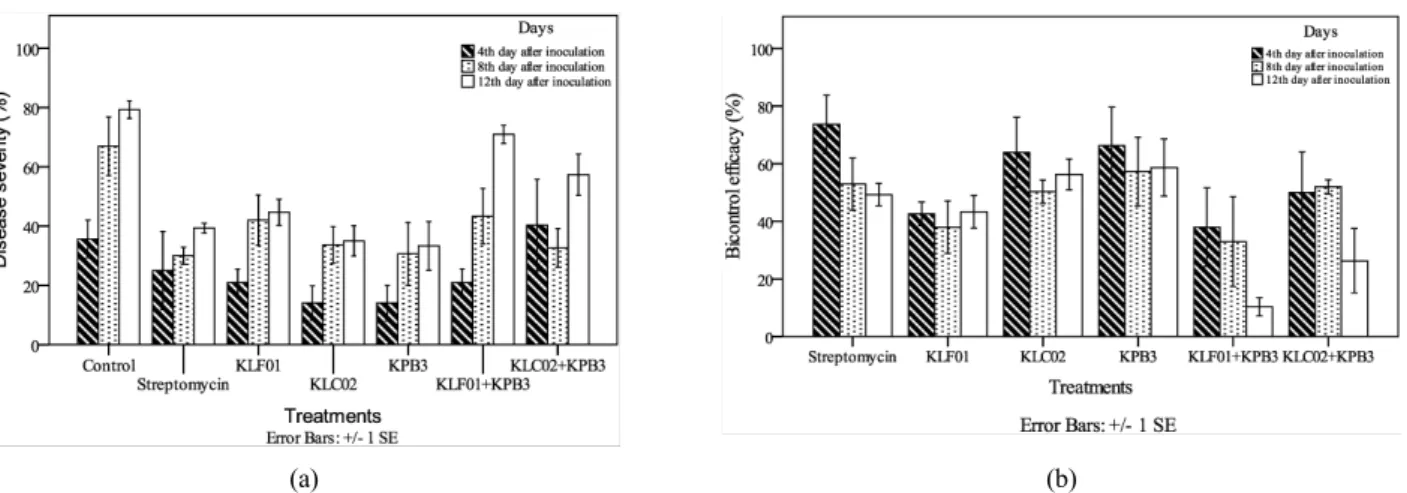
thdays after inoculation. Bio-control efficacy was more sig- nificantly effective in the treatments by KLC02 and KPB3 as 64%, 50%, 56% and 66%, 57%, 58% according to date of evaluation (Fig. 2b). In case of KLF01, control effect was relatively lower than treatments of KLC02 and KPB3, but its efficacy was still significantly observed when compared to control (only water treatment). Disease severity observed on 4
th, 8
thand 12
thday after pathogen inoculation showed efficacy of strains with respect to control (water) (Fig. 2a). In general, all the biological treatments delayed the progress of soft rot disease compared with the un- treated ones. The highest bio-control efficacy was shown by the strain KPB3 (Fig. 2b). Integrated use of the strains could not show the satisfactory suppression of the soft rot disease when performed under greenhouse conditions con- ducted in early June and July 2009. Therefore, we chose to delete the integrated treatments of strains in subsequent analysis.
Field assessment
Initially, the mild symptom of soft rot was seen in
Chinese cabbages on early June. At the end of July the
Streptomycin Water Suspension Supernatant Pellet
KLF01
KLC02
KPB3
+++ - +++ - +++
KLF01+KPB3 KLC02+KPB3
+ ++
Fig. 1. Antibacterial activity of KLF01, KLC02, and KPB3 against Pcc by agar well diffusion mehtod. - , no inhibition (< 1 mm);
+ , weak inhibition (< 5 mm); ++ , strong inhibition (> 5 mm).
(a) (b)
Fig. 2. Disease severity (a) and bio-control efficacy (b) of soft rot on Chinese cabbage by application of KLF01, KLC02 and KPB3 after inoculation of Pcc under greenhouse. Mean obtained in three independent experiments are shown. Standard deviation is shown in bars. Treatment includes control (water), streptomycin, KLF01, KLC02, KPB3, integrated treatments KLF01+KPB3, and KLC02+
KPB3.
(a) (b)
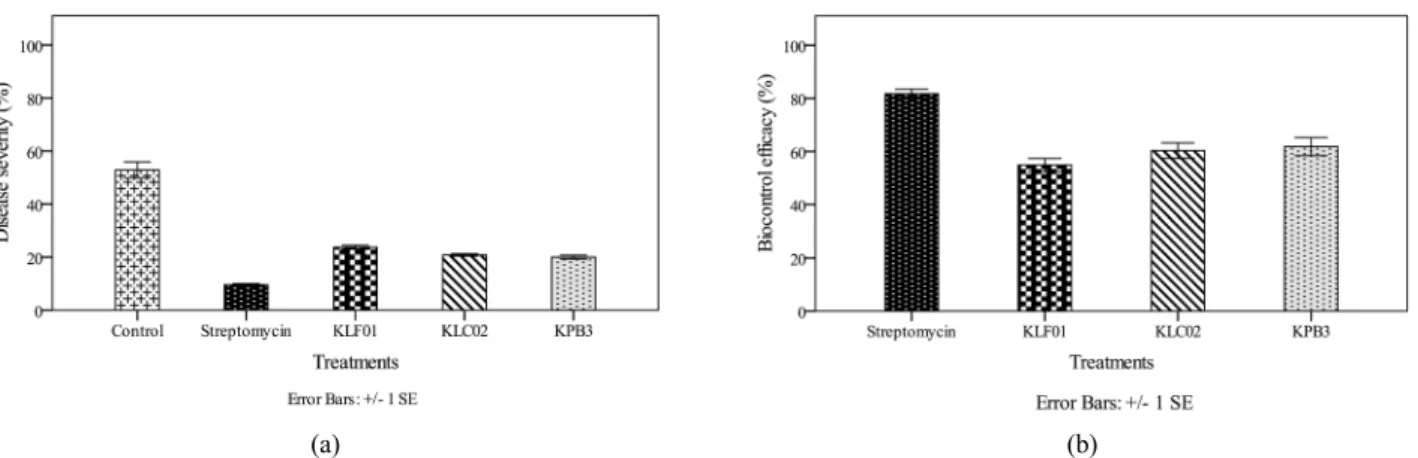
Fig. 3. Disease severity (a) and Bio-control efficacy (b) of soft rot on Chinese cabbage by application of KLF01, KLC02 and KPB3 after inoculation of Pcc under field. Mean obtained in three independent experiments are shown. Standard deviation is shown in bars. Treatment includes control (water), streptomycin, KLF01, KLC02 and KPB3.
disease severity was the highest. The leaves of Chinese cabbage were totally decayed and collapsed causing the severe production loss. The experiments carried out in the field showed that the drench treatments of strains sig- nificantly suppressed soft rot. The disease severity for KLF01, KLC02 and KPB3 was found to be 23%, 20%
and 20%, respectively (Fig. 3a). Bio-control efficacy of KLF01, KLC02 and KPB3 showed 55%, 60% and 62%, respectively in field test from early March to late July of 2009 (Fig. 3b). Strain KPB3 showed the highest bio- control efficacy among all the other treatments (Fig. 3b).
Discussion
Soft rot is a destructive disease of many horticultural crops (Vanneste et al., 1994) and its pathogen, Pectobacterium carotovorum subsp. carotovorum is one of the most destructive plant pathogenic bacterium (Kyeremeh et al., 2000). Outbreak of soft rot on Chinese cabbage is reported to be highly correlated with the growing stage of the host plant. Additionally, high population density of pathogen in rhizosphere and its ability of rapid multiplication create difficulty in its control (Togashi, 1985). Pesticides have been extensively used to control soft rot which are not safe for environment. Strains KLF01, KLC02 and KPB3 have been reported to show antagonistic effect against R.
solanacearum (Suk et al., 2006; Shrestha et al., 2009).
However, use of strains in genus such as Lactobacillus,
Lactococcus, and Paenibacillus as a biological treatment against soft rot caused by Pcc is novel. Earlier, various anti- bacterial substances like acetic acid, lactic acid (Ariyapitipun et al., 1999), hydrogen peroxide (Chang et al., 1997) and bacteriocins (Klaenhammer, 1982) had been reported to be produced by Lactobacillus and Lactococcus, Moreover, antibacterial substances like bacteriocins had been reported to show antibacterial activity against only gram positive food spoilage bacteria (Ko and Ahn 2000) and human pathogens Salmonella typhimurium, E. coli and Staphylococcus aureus (Lin et al., 2006). These strains were also reported to show antagonistic effect (Visser et al., 1986) and anti- fungal activity (Laitila et al., 2002) against some phyto- pathogens. KLF01 and KPB3 showed higher degree of antagonism than KLC02 in in-vitro condition. The clear zone shown by strain KPB3 was more consistent (Fig. 1).
In previous studies mutant of Pcc species has been reported to show degree of inhibition against Pcc. The use of mic- roorganisms for biological purposes has become an effective alternative to control plant pathogenic bacteria. Under green- house conditions, plant inoculated with the antagonistic strains reduced disease severity. Analysis of the data from three replicates of each experiment with Chinese cabbage indicated that diseased plants were significantly reduced in compared to the control after post-inoculation of tested strains. However, the integrated treatment was unable to show significant effect against the pathogen.
While performing in vitro test both KLF01 and KLC02
showed higher degree of zone of inhibition against Pcc, however, its effect observed was higher incase of KLC02 than KLF01 in in planta test (Fig. 2). The plants treated with water showed the soft rot symptoms and collapsed.
Disease severity curve showed that the control treatments has the highest degree of disease progress shown in every 4
th, 8
thand 12
thday in comparison with other strains as shown in Fig. 2. Strain KPB3 showed the lowest degree of disease severity percentage among all the treatments in this study. As disease progress curve obtained for the integrated treatment was not so satisfactory, thus field test was carried out with only each strain. Results ob- served in field tests found to be quite convincing. Disease severity observed in the test treated with strain KPB3 was the lowest in compared with all the other treatments. How- ever, the control treatment showed the disease severity to the optimum. Strain KPB3 has the highest suppressive effect than the other treatments (Fig. 3).
The bio-control efficacy of tested strains was confirmed herein to control Pcc in both greenhouse and field test.
These results, therefore, suggest that Lactobacillus, Lactococcus, and Paenibacillus spp. can be further developed as a stable biological control agent to manage soft rot, which greatly affect the Chinese cabbage production not only in Korea but also worldwide.
Acknowledgement
This study was supported by a grant from Rural Development Administration fund (20090101-036-043-001-01-00), Republic of Korea.
Literature Cited
Anjum, M. A., M. R. Sajjad, N. Akhtar, M. A. Qureshi, A.
Iqbal, A. R. Jami and M. Hasan (2007) Response of cotton to plant growth promoting rhizobacteria (PGPR) inoculation under different levels of nitrogen. J. Agric. Res. 45(2):137
~ 138.
Ariyapitipun, T., A. Mustapha and A. D. Clarke (1999) Microbial shelf life determination of vacuum packaged fresh beef treated with polylacetic acid, and nisin solutions. J. Food.
Prot. 62:913~920.
Benkerroum, N. and W. E. Sandine (1988) Inhibitory action of nisin against Listeria monocytogenes. J. Dairy. Sci. 71:3237
~ 3245.
Bernal, G., A. Illanes and L. Ciampi (2002) Isolation and partial purification of a metabolite from a mutant strain of Bacillus sp. with antibiotic activity against plant pathogenic agents.
Elect. J. Biotechnol. 5:12~20.
Available from: [http://www.ejb.org/content/vol5/issue1/full/4].
Champosieau, P., J. H. Daugrois, J. C. Girard, M. Royer and P. Rott (2006) Variation in albicidin biosynthesis genes and in pathogenicity of Xanthomonas albilineans, the sugarcane leaf scald pathogen. Phytopathology 96:33~45.
Chang, I. S., B. H. Kim and P. K. Shin (1997) Use of sulfite and hydrogen peroxide to control bacterial contamination in ethanol production. Appl. Environ. Microbiol. 63:1~6.
Cladera-olivera, F., G. R. Caron, A. S. Motta, A. A. Souto and A. Brandelli (2006) Bacteriocin-like substance inhibits potato soft rot caused by Erwinia carotovora. Canadian J. Mic- robiol. 52(6):533~539.
De Man, J. D., M. Rogosa and M. E. Sharpe (1960) A medium for the cultivation of Lactobacilli. J. Appl. Bacteriol. 23:
130~135.
Guo, Y. H., H. L. Ge, L. Y. Gong, L. X. Zhang and P. H. Sun (2004) Biocontrol of tomato wilt by plant growth-promoting rhizobacteria. Biol. Control 29:66~72.
Hayward, A. C. (1991) Biology and epidemiology of bacterial wilt caused by Pseudomonas solanacearum. Annu. Rev. Phy- topathol. 29:65~87.
Hu, X. F., F. X. Ying, Y. B. He, Y. Y. Gao, H. M. Chen and J. S. Chen (2008) Characterization of Pectobacterium carotovorum subsp. carotovorum causing soft-rot disease on Pinellia ternata in China. Eur. J. Plant Pathol. 120:305~310.
Jee, H. J., W. G. Kim and W. D. Cho (1999) Phytophthora root rot of Chinese cabbage and spinach caused by P. drechsleri in Korea. Plant Pathol. J. 15:28~33.
Kikumoto, T. (2000) Ecology and biocontrol of soft rot of Chinese cabbage. J. Gen. Plant Pathol. 66:275~277.
Klaenhammer, T. R. (1982) Bacteriocins of lactic acid bacteria.
Biochimie. 70:337~349.
Ko, H. S. and C. Ahn (2000) Bacteriocin production by Lactococcus lactis KCA2386 isolated from white kimchi. The Korean J.
Food Sci. and Technol. 9:263~269.
Kotoujansky, A. (1987) Molecular genetics of pathogenesis by soft rot Erwinia. Annu. Rev. Phytopathol. 25:405~430.
Kyeremeh, G. A., T. Kikumoto, D. Chuang, Y. Gunji, Y. Takahara and Y. Ehara (2000) Biological control of soft rot of Chinese cabbage using single and mixed treatments of bacteriocin- producing avirulent mutants of Erwinia carotovora subsp.
carotovora. J. Gen. Plant Pathol. 66:264~268.
Laitila, A. H., L. Alakomi, L. Raaska, T. Mattila-Sandholm and
A. Haikara (2002) Antifungal activities of two Lactobacillus
plantarum strains against Fusarium moulds in vitro and in
유용세균(Beneficial Bacterial Agents)을 이용한 배추 무름병의 생물적 방제