Research Article Open Access http://dx.doi.org/10.5423/RPD.2015.21.3.201
Research in Plant Disease
©The Korean Society of Plant Pathology pISSN 1598-2262, eISSN 2233-9191
This is an open access article distributed under the terms of the Creative Commons Attribution License (http://creativecommons.org/licenses/by/2.0), which permits unrestricted use, distribution, and reproduction in any medium, provided the original work is properly cited.
덩굴쪼김병 저항성 멜론을 위한 효율적이고 간편한 대량 검정법 개발
Development of an Efficient Simple Mass-Screening Method for Resistant Melon to Fusarium oxysporum f. sp. melonis이원정1,2 · 장경수1 · 최용호1 · 김흥태2 · 김진철3 · 최경자1*
1한국화학연구원 친환경신물질연구센터, 2충북대학교 식물의학과, 3전남대학교 응용생명공학부
Won Jeong Lee1,2, Kyoung Soo Jang1, Yong Ho Choi1, Heung Tae Kim2, Jin-Cheol Kim3 and Gyung Ja Choi1*
1Center for Eco-friendly New Materials, Korea Research Institute of Chemical Technology, Daejeon 305-600, Korea
2Department of Plant Medicine, Chungbuk National University, Cheongju 361-763, Korea
3Division of Applied Bioscience and Biotechnology, Institute of Environmentally-Friendly Agriculture, Chonnam National University, Gwangju 500-757, Korea
This study was conducted to establish a simple mass-screening method for resistant melon to Fusarium wilt caused by Fusarium oxysporum f. sp. melonis (FOM). Root-dipping inoculation method has been used to in- vestigate resistance of melon plants to Fusarium wilt. However, the inoculation method requires a lot of labor and time because of complicate procedure. To develop a simple screening method on melon Fusarium wilt, occurrence of Fusarium wilt on susceptible and resistant cultivars of melon according to inoculation method including root-dipping, soil-drenching, tip, and scalpel methods was investigated. Scalpel and tip methods showed more clear resistant and susceptible responses in the melon cultivars than root-dipping inoculation method, but tip method represented slightly variable disease severity. In contrast, in the case of soil-drench- ing inoculation method, disease severity of the susceptible cultivars was very low. Thus we selected scalpel method as inoculation method of a simple screening method for melon Fusarium wilt. By using the scalpel inoculation method, resistance degrees of the cultivars according to incubation temperature after inoculation (25 and 30oC) and inoculum concentration (1×10⁶ and1×107 conidia/ml) were measured. The resistance or susceptibility of the cultivars was hardly affected by all the tested conditions. To look into the effectiveness of scalpel inoculation methods, resistance of 22 commercial melon cultivars to FOM was compare with root-dip- ping inoculation method. When the melon cultivars were inoculated by scalpel method, resistance responses of all the tested cultivars were clearly distinguished as by root-dipping method. Taken together, we suggest that an efficient simple mass-screening method for resistant melon plant to Fusarium wilt is to sow the seeds of melon in a pot (70 ml of soil) and to grow the seedlings in a greenhouse (25±5oC) for 7 days, to cut the root of seedlings with a scalpel and then pour a 10 ml-aliquot of the spore suspension of 1×10⁶ conidia/ml on soil.
The infected plants were cultivated in a growth room at 25 to 30oC for about 3 weeks with 12-hr light a day.
Keywords : Breeding, Disease resistance, Fusarium wilt, Inoculation method, Resistant screening
*Corresponding author Tel : +82-42-860-7434 Fax: +82-42-861-4913 E-mail: [email protected]
Received July 8, 2015 Revised July 22, 2015 Accepted August 3, 2015
서 론
멜론(Cucumis melo L.)은 주로 시설에서 재배되고 있으며, 2000년대 들어서면서 국내 재배 면적이 급격히 증가되어 현 재는 약 900 ha에 이르고 생산량은 약 26,000 MT이다(Seo 등, 2006). 멜론 과일은 육질이 부드럽고 즙이 많으며 특이한 맛과 향기가 있어 시설에서 재배되는 과일 중 최고로 꼽히고 있다 (Kwon 등, 1999). 우리나라에서 멜론(C. melo) 및 참외(C. melo var. makuwa)에 발생하는 병으로는 덩굴쪼김병, 덩굴마름병, 열매썩음병, 탄저병, 잿빛곰팡이병, 흰가루병, 역병, 노균병, 잘 록병, 모자이크병 등 21종이 보고되어 있다(KSPP, 2009). 멜론 의 재배 작형이 촉성 또는 반촉성으로 바뀌면서 비닐하우스나 유리온실에서 연작하여 재배하고 같은 작부체계를 반복함으로 써 병해충 발생이 증가하고 있다(Park 등, 1996).
멜론 덩굴쪼김병(Fusarium wilt)은 Fusarium oxysporum f. sp.
melonis(FOM)에 의해 발생하는데, 전 세계적으로 멜론 재배에 서 심각한 수량 손실을 일으키므로 이 병의 방제는 매우 중요 하다(Beckman, 1987; Katan 등, 1994). 멜론 덩굴쪼김병균은 뿌 리를 통해 유관속으로 침입하여 시들음 증상을 일으키면서 식 물을 고사시킨다(Gordon과 Okamoto, 1990; Sherf와 Macnab, 1986). 최근 농산물의 안전성에 대한 사회적 관심이 증가하면 서 합성농약을 사용하지 않고 재배하는 친환경 방제 방법이 요 구되고 있다(Yeo 등, 2013). 여러 환경친화적인 방제 방법 중 저 항성 품종을 이용하거나 저항성 대목을 접목하여 재배하는 것 이 멜론의 덩굴쪼김병 방제에 매우 효과적인 것으로 알려져 있 다(Lee, 1994; Traka-Mavrona 등, 2000).
멜론의 덩굴쪼김병 저항성 유전자는 단인자 우성 유전을 하 는 Fom-1과 Fom-2가 알려져 있으며, 이들 저항성 유전자가 포 함된 모든 품종에서 덩굴쪼김병을 일으키지 못하는 race 0, 저 항성 품종 중 Fom-1 저항성 품종에만 덩굴쪼김병을 일으키는 race 1, 그리고 Fom-2 품종만을 침입할 수 있는 race 2 그리고 Fom-1과 Fom-2 모두가 포함된 품종에도 덩굴쪼김병을 일으키 는 race 1, 2가 보고되어 있다(Risser 등, 1976). 현재 race 0, 1, 2에 대한 저항성 품종이 개발되어 있으나, race 1, 2에 대한 저항성 품종은 아직 개발된 적이 없다. 따라서 race 1, 2에도 저항성을 나타내는 새로운 저항성 유전자원 발굴이 요구되고 있다(Herman 과 Perl-Treves, 2007).
멜론 덩굴쪼김병에 대한 내병성 품종 개발 및 새로운 저항성 유전자원 탐색을 위해서는 대량의 멜론시료에 대하여 효율적 으로 저항성을 검정하는 방법이 필요하다. 멜론 덩굴쪼김병균 의 병원성 확인, race 판별 그리고 이 병원균에 대한 멜론의 저 항성 조사 등 다양한 연구에서 멜론 덩굴쪼김병균의 접종 방법 으로 포자현탁액에 뿌리를 침지하는 방법(root-dipping meth- od)이 오래 전부터 널리 사용되어왔다(Cohen 등, 1989; Lee 등, 2015; Matsumoto 등, 2011; Namiki 등, 1998; Wellman, 1939).
하지만 뿌리 침지 접종 방법은 접종 과정에서 시간과 노동력
이 많이 소요되고 병원균 포자현탁액에 침지하고 새로운 토양 에 이식하였을 때 활착에 어려움이 있다는 단점이 있다(Latin과 Snell, 1986). 따라서 대량의 멜론 식물에 대해 덩굴쪼김병 저항 성을 효율적으로 조사하기 위해서는 뿌리 침지(root-dipping) 방법보다 간편하고 효율적인 접종법을 이용한 검정법의 개발 이 필요하다.
본 연구는 멜론 덩굴쪼김병에 대한 간편하고 효율적인 대 량 검정법을 개발하기 위하여 실험하였다. 저항성 정도가 다 른 6개 품종 멜론에 멜론 덩굴쪼김병균 포자를 뿌리 침지(root- dipping), 토양 관주(soil-drenching), scalpel 및 tip 방법으로 접 종하고 멜론 품종들의 덩굴쪼김병의 발생 및 저항성 정도를 비 교하여 접종 방법으로 scalpel 접종 방법을 선택하였다. 그리고 scalpel 접종 방법에서 접종원 농도(1×106,1×107 conidia/ml)와 접종 후 재배 온도(25, 30oC)에 따른 6개 멜론 품종들의 저항성 차이를 조사하였다. 이들 결과로부터 확립한 scalpel 접종 방법 을 이용한 간편 검정법의 효용성을 확인하기 위하여, 시판 멜론 품종 22개에 멜론 덩굴쪼김병균 뿌리 침지 방법과 scalpel 방법 으로 접종하여 두 방법에 따른 멜론 품종들의 저항성 차이를 조 사하였다.
재료 및 방법
식물 재배. 접종 방법, 접종 농도 및 접종 후 재배 온도에 따 른 멜론 품종들의 덩굴쪼김병에 대한 저항성 차이 실험을 위해 서는 저항성 품종으로 ‘레드퀸’(농협종묘), ‘썸머쿨’(코레곤종 묘), ‘슈퍼세지’(아시아종묘)를, 그리고 감수성 품종으로 ‘아시 아황금’(아시아종묘), ‘얼룩파파야’(아시아종묘), ‘장춘FR파파이 야’(장춘종묘) 등 6개 멜론 품종을 시중에서 구입하여 실험에 사 용하였다.
시판 멜론 품종들의 덩굴쪼김병에 대한 저항성은 시중에서 멜론 22개 품종 ‘아시아황금’(아시아종묘), ‘아세아조춘만추’(아 시아종묘), ‘아시아파파야’(아시아종묘), ‘아시아성하’(아시아종 묘), ‘베타리치’(동부팜한농), ‘얼스엘리제’(신젠타종묘), ‘얼스엘 리트’(신젠타종묘), ‘얼스골드킹’(코레곤종묘), ‘얼스해피’(코레 곤종묘), ‘얼스킹’(코레곤종묘), ‘얼스마운트하계’(아시아종묘),
‘얼스파티’(신젠타종묘), ‘얼스탑원’(아시아종묘), ‘얼스VIP’(농협 종묘), ‘얼룩파파야’(아시아종묘), ‘장춘FR파파이야’(장춘종묘),
‘JJ하계’(아시아종묘), ‘JJ원탑’(아시아종묘), ‘레드퀸’(농협종묘),
‘세지오케이’(동부팜한농), ‘썸머쿨’(코레곤종묘) 및 ‘슈퍼세지’
(아시아종묘)를 구입하여 실험에 사용하였다.
뿌리 침지 접종 방법을 위해서는 8×16 육묘용 연결 포트(포 트 당 토양 21 ml, 범농사)에 원예용상토 5호(부농사)를 넣고 종 자를 1립씩 파종하여 온실(25±5oC)에서 7일 동안 재배한 유묘 를 실험에 사용하였다. 그리고 scalpel, tip 및 토양 관주 접종 방 법을 위해서는 5×8 연결 포트(포트 당 토양 70 ml, 범농사)에 원예용상토 5호(부농사)를 넣고 종자를 1립씩 파종하여 온실
(25±5oC)에서 7일 동안 재배하여 실험에 사용하였다.
접종원 준비. Potato dextrose agar(PDA; Becton, Dickinson and Co.) 배지 중앙에 F. oxysporum f. sp. melonis GR 균주의 균 사 조각을 접종하고 25oC에서 7일 동안 배양한 균총으로부터 균사 조각을 떼어 V8-juice broth 배지에 접종하였다(Lee 등, 2015). 그리고 이를 25oC 암상태에서 7일 동안 150 rpm으로 진 탕배양 하였다. GR 균주 배양액은 4겹의 거즈로 걸러 균사를 제 거하고 원심분리 한(4,300 g, 10분, 4oC, Beckman Coulter Inc.) 후에 배양여액을 버리고 포자(침전물)를 수확하였다. 여기에 멸 균수를 넣고 잘 현탁하고 hematocytometer를 이용하여 광학 현미경 하에서 포자(소형분생포자)의 농도를 측정하였으며, 포 자 농도가 1×10⁶ conidia/ml와 1×10⁷ conidia/ml이 되도록 멸 균수로 희석하여 접종원을 준비하였다. 한편, 뿌리 침지와 scal- pel 접종 방법에 따른 22개 멜론 품종의 덩굴쪼김병 저항성 실 험을 위해서는 포자 농도를 1×10⁶ conidia/ml로 조정하여 실 험에 사용하였다.
덩굴쪼김병균 접종. 뿌리 침지 접종 방법은 온실에서 재 배한 멜론 유묘의 뿌리를 물로 세척하여 흙을 제거한 후에 F.
oxysporum f. sp. melonis GR 균주의 포자현탁액에 30분 동안 침지하여 접종하였다. 그리고 원예용상토 5호(부농사)를 넣은 5×8 연결 포트(포트 당 토양 70 ml, 범농사)로 접종한 멜론 유 묘를 이식하였다.
Scalpel 접종 방법은 5×8 연결 포트에서 재배한 멜론 유묘에 scalpel을 이용하여 지제부에서 1 cm 떨어진 곳에서 45o 각도 로 3 cm 깊이로 뿌리를 향하여 찔러서 상처를 주고, 여기에 멜 론 덩굴쪼김병균 포자현탁액을 10 ml씩 관주하여 접종하였다 (Park 등, 2013).
Tip 접종 방법은 5×8 연결 포트에서 재배한 멜론 유묘에 10 ml tip을 이용하여 scalpel 접종 방법과 마찬가지로 방법으 로 뿌리를 향하여 찔러서 상처를 주고 포자현탁액을 10 ml씩 관 주 하였다.
토양 관주 접종 방법은 멜론 유묘가 있는 5×8 연결 포트 토 양에 멜론 덩굴쪼김병균 포자현탁액을 10 ml씩 관주하여 접종 하였다.
발병 및 병조사. 접종한 멜론 유묘는 25oC 습실상에서 1일 동안 배양한 후에 25oC 항온실로 옮기고 하루에 12시간씩 광을 조사하면서 약 3주 동안 재배한 후에 덩굴쪼김병 발생을 조사 하였다.
접종한 후의 재배 온도에 따른 멜론의 덩굴쪼김병 발생 실험 은 접종한 멜론 유묘를 25oC와 30oC 습실상에서 1일 동안 배양 한 후에 각각 25oC와 30oC 항온실로 이동하고 하루에 12시간씩 광을 조사하면서 약 3주 동안 재배한 후에 병 발생을 조사하 였다.
병조사는 각 식물체의 덩굴쪼김병 발생 정도(disease sever- ity)를 조사하였으며, 발병 정도는 다음과 같은 발병도(disease index)로 조사하였다. 0=건전, 1=도관이 갈변되고 생육이 약간 억제된 것, 2=도관이 갈변되고 생육이 억제된 것, 3=도관이 갈 변되고 생육이 심하게 억제되고 황화된 것, 4=고사 등의 5단계 로 하였다(Fig. 1). 그리고 평균 발병도가 1.0 이하인 경우에는 저항성, 1.1–2.5는 중도저항성, 2.6 이상은 감수성으로 판정하 였다. 모든 실험은 10반복으로 2회 실시하였다.
결과 및 고찰
네 가지 접종 방법에 따른 멜론 품종의 덩굴쪼김병 발생.
뿌리 침지, scalpel, tip 및 토양 관주 등 네 가지 접종 방법에 따 른 저항성 및 감수성 멜론 품종들의 덩굴쪼김병 발생을 두 가 지 접종원 농도(1×10⁶, 1×10⁷ conidia/ml)로 실험한 결과, 실험 한 모든 감수성 멜론 품종들은 뿌리 침지 방법으로 접종하였을 때에는 실험한 두 농도 모두에서 4.0의 높은 발병도를 보였다 (Table 1). 그리고 scalpel 및 tip 방법으로 접종하였을 때에도 뿌 리 침지 접종법 보다는 다소 낮지만 발병도 3.3 이상의 높은 감 수성 반응을 나타냈다. 하지만 토양 관주 접종법에서는 저항성 품종들은 저항성을 잘 나타내었으나, 감수성 품종인 ‘아시아황 금’은 2.8-3.6의 발병도를 그리고 ‘얼룩파파야’와 ‘장춘FR파파 이야’는 1.1-1.6의 낮은 발병도를 보였다. 네 가지 접종 방법 중 토양 관주 접종법이 시간과 노동력이 가장 적게 들고 이식 후 활착 문제 등이 없어 가장 선호하는 접종 방법이나 감수성 품 종에서 덩굴쪼김병 발생이 충분하지 못하여 멜론 덩굴쪼김병 저항성 검정에는 적합하지 않은 접종 방법으로 생각되었다.
저항성 품종 중 ‘레드퀸’과 ‘슈퍼세지’는 뿌리 침지, scalpel 및 tip 방법으로 접종하였을 때 농도에 상관없이 모두 1.0 이하의 낮은 발병도를 보였다(Table 1). 하지만 저항성 품종인 ‘썸머쿨’
은 scalpel 및 tip 방법으로 접종하였을 때에는 두 접종 농도 모 두에서 고도의 저항성 반응을 나타냈으나, 뿌리 침지 방법으로 Fig. 1. Disease index of Fusarium wilt in melon plants.
접종하였을 때에는 1×10⁶ conidia/ml의 농도에서는 저항성을 보이나 1×10⁷ conidia/ml의 농도로 접종하였을 때에는 1.4의 발병도 즉 중도저항성을 나타냈다.
기존의 뿌리 침지 방법을 이용한 멜론의 덩굴쪼김병에 대한 저항성 검정은 주로 1×10⁶에서 1×10⁷ conidia/ml의 농도로 접 종하여 실험하였으나(Freeman 등, 2002; Iori 등, 2001; Zhou와 Everts, 2007; Zink 등, 1983), 멜론의 덩굴쪼김병 저항성이 단인 자 우성 유전을 하는 저항성 유전자 Fom-1과 Fom-2에 의한 것 이라는 것을 고려할 때(Risser 등, 1976), scalpel 및 tip 접종 방법 은 두 접종 농도 모두 사용이 가능하나, 뿌리 침지 접종 방법에 서는 1×10⁷ conidia/ml의 농도로 접종하는 것은 바람직하지 않 다고 생각되었다.
뿌리 침지 접종법의 경우, 감수성 품종과 저항성 품종의 평균 발병도는 각각 4.0과 0.9이었다. 그리고 scalpel 접종 방법은 저 항성 품종이 발병도 3.8과 감수성 품종이 0.1이었으며, tip 접종 법은 각각 3.8과 0.2의 평균 발병도를 보였다. 따라서 scalpel 및 tip 접종 방법에 의한 멜론 덩굴쪼김병 저항성은 전통적으로 사 용해 오던 뿌리 침지 접종 방법과 유사한 발병도를 나타내며 실 험한 품종들의 저항성과 감수성을 명확히 구별할 수 있었다.
Park 등(2013)은 토마토 시들음병(Fusarium wilt) 발생 실험에 서 scalpel과 tip 방법으로 접종하였을 때, 감수성인 토마토 품종 이 scalpel 방법에서는 뿌리 침지 방법과 유사한 발병도를 보이
며 감수성을 나타냈지만 tip 방법에서는 병이 잘 발생하지 않아 중도저항성을 보였다고 보고한 바 있다. 하지만 멜론 덩굴쪼김 병의 경우에는 scalpel과 tip 방법 모두에서 각 품종의 저항성 혹 은 감수성 반응이 잘 나타났다. 하지만 tip 방법에서는 Table 1 에서와 같이 scalpel 방법에서보다 개체 간의 발병도 차이가 다 소 컸으므로 멜론 덩굴쪼김병의 대량 검정을 위한 접종 방법으 로 scalpel 방법이 더 안정적인 방법이라고 생각되었다.
Latin과 Snell(1986)은 뿌리 침지 방법을 대체할 접종 방법 으로 유묘를 재배한 포트에 포자현탁액을 5 ml씩 관주하는 pipette 방법을 제안한 적이 있지만 상대적으로 상처가 부족하 여 덩굴쪼김병 발생이 적고, 멜론 품종들의 저항성 순위가 일정 하지 않은 결과를 보였다. 하지만 본 연구에서 scalpel 접종 방 법은 표준 방법인 뿌리 침지 방법과 유사한 발병도를 나타내며 멜론 품종들의 저항성과 감수성을 명확히 구별할 수 있고 접종 방법도 간편하므로 대량 멜론시료의 덩굴쪼김병 저항성 검정 을 위한 접종 방법으로 scalpel 방법을 선택하였다(Table 1).
Scalpel 접종 방법에서 재배 온도에 따른 멜론 품종들의 덩 굴쪼김병 발생. 재배 온도에 따른 덩굴쪼김병 발생의 정도를 알아보기 위하여 scalpel 방법으로 6개 멜론 품종에 멜론 덩굴 쪼김병균 포자현탁액을 1×10⁶ 및 1×10⁷ conidia/ml의 농도로 접종하고 25oC와 30oC 항온실에서 재배하여 멜론 품종들의 덩 Table 1. Development of Fusarium wilt on six melon cultivars according to inoculation methoda
Inoculation method
Inoculum concentration
(conidia/ml)
Melon cultivar Red-
queen (R)
Summer- cool
(R)
Super- seji (R)
Asia- hwanggeum
(S)
Eoluk- papaya
(S)
Jangchoon- FRpapaiya
(S)
Root- dippingb 1×10⁶ 0.8±0.4c 0.8±0.2 0.8±0.1 4.0±0.0 4.0±0.0 4.0±0.0
1×10⁷ 0.8±0.1 1.4±0.3 1.0±0.0 4.0±0.0 4.0±0.0 4.0±0.0
Scalpeld 1×10⁶ 0.0±0.0 0.2±0.1 0.0±0.0 3.8±0.3 3.7±0.1 3.8±0.3
1×10⁷ 0.2±0.1 0.3±0.4 0.1±0.1 4.0±0.0 3.5±0.1 3.7±0.1
Tipe 1×10⁶ 0.3±0.4 0.2±0.3 0.0±0.0 3.8±0.3 3.9± 0.2 3.3±0.1
1×10⁷ 0.2±0.3 0.6±0.7 0.1±0.1 3.9±0.1 4.0±0.0 3.9±0.1
Soil-drenchingf 1×10⁶ 0.1±0.1 0.5±0.5 0.1±0.1 2.8±1.3 1.1±1.6 1.1±1.6
1×10⁷ 0.0±0.0 0.7±0.7 0.0±0.0 3.6±0.6 1.3±1.6 1.6±1.3
aSeven-day-old seedlings of melon cultivars were inoculated with Fusarium oxysporum f. sp. melonis (FOM) GR. The inoculated plants were incubated in a dew chamber at 25oC for 24 hours and then transferred to a growth room at 25oC with 12-hour light a day. After 3 weeks, disease severity of the seedling was investigated on a scale of 0–4.
bSeedlings of melon cultivars were uprooted and the roots were washed gently in water. And then the plants were inoculated with FOM GR by dipping the roots in inoculum suspensions of 1×10⁶ conidia/ml and 1×10⁷ conidia/ml for 30 minutes and were transplanted into 40-cell plastic trays.
cEach value represents the mean disease index±standard deviation of two runs with ten replicates each.
dSeedlings of melon cultivars were inoculated with FOM GR by cutting the roots with a scalpel and then pouring a 10 ml-aliquot of spore suspen- sions of 1×10⁶ conidia/ml and 1×10⁷ conidia/ml on soil.
eSeedlings of melon cultivars were inoculated with FOM GR by cutting the roots with 10 ml tip and then pouring a 10 ml-aliquot of spore suspen- sions of 1×10⁶ conidia/ml and 1×10⁷ conidia/ml on soil.
fSeedlings of melon cultivars were inoculated with FOM GR by pouring a 10 ml-aliquot of spore suspensions of 1×10⁶ conidia/ml and 1×10⁷ conidia/ml on soil without cutting of the roots.
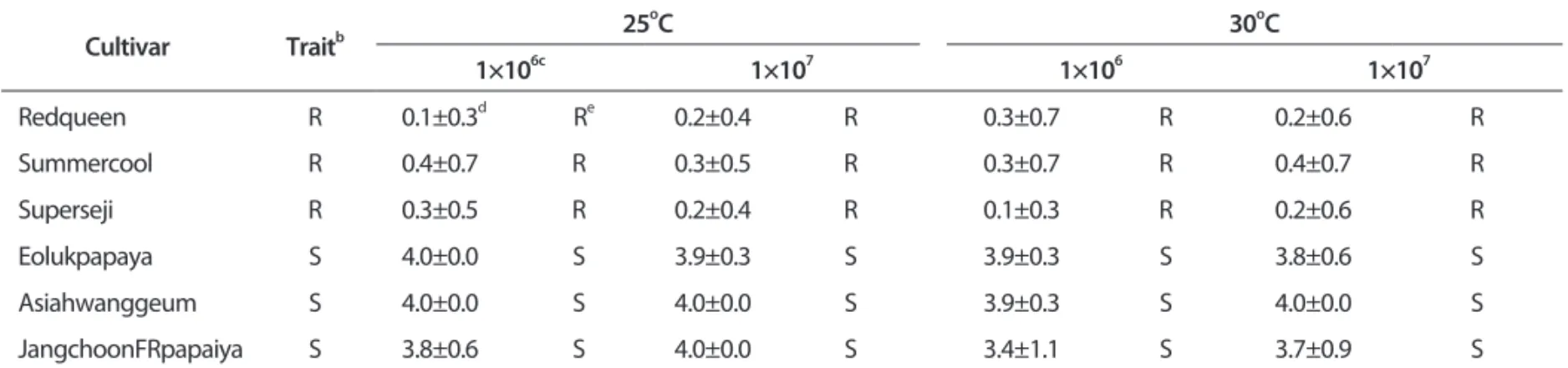
굴쪼김병 발생을 조사한 결과, 저항성 품종들은 모든 재배 온도 에서 0.4 이하의 발병도 즉 고도의 저항성을 나타냈다(Table 2).
또한 감수성 품종들도 실험한 접종 농도와 재배 온도에 상관없 이 발병도 3.4 이상의 높은 감수성을 보였다.
기존의 멜론 덩굴쪼김병에 대한 저항성 검정에서 접종한 식 물은 주로 20-30oC의 온도에서 재배하였다(Cohen 등, 1989;
Matsumoto 등, 2011; Namiki 등, 1998; Zhou와 Everts, 2007;
Zink 등, 1983). 하지만 Lee 등(2015)은 실험한 저항성 품종(‘레 드퀸’과 ‘슈퍼세지’)이 20oC에서는 저항성이 무너지면서 덩굴 쪼김병이 심하게 발생하였으나, 25oC와 30oC에서는 고도의 저 항성을 나타내므로 25–30oC에서 재배해야 한다고 하였다. 본 연구에서 scalpel 방법으로 접종하였을 때에도 두 온도 모두에 서 멜론 품종들의 감수성 및 저항성 반응이 명확히 구분되었다 (Table 2).
따라서 멜론 덩굴쪼김병 대량 검정을 위한 접종원 준비를 고 려하여 scalpel 방법으로 멜론 덩굴쪼김병균 포자현탁액을 1×
106 conidia/ml 농도로 접종하고 25–30oC에서 재배하는 것이 효율적이라고 생각되었다.
Scalpel 접종법에 의한 22개 멜론 품종의 덩굴쪼김병에 대 한 저항성. 확립한 scalpel 접종 방법을 이용한 멜론 덩굴쪼김 병 간편 검정 방법의 효용성을 확인하기 위하여, 시판 멜론 22개 품종을 뿌리 침지와 scalpel 방법으로 접종하고 덩굴쪼김 병 발생을 조사한 결과, 실험한 멜론 품종 중 종자회사에서 덩 굴쪼김병에 대한 저항성 품종으로 판매하고 있는 5개 품종(‘레 드퀸’, ‘썸머쿨’, ‘아시아성하’, ‘아세아조춘만추’, ‘장춘FR파파이 야’) 중 ‘장춘FR파파이야’와 ‘아세아조춘만추’를 제외한 나머지 3개 품종은 두 방법 모두에서 1.0 이하의 낮은 발병도를 보였다
(Table 3). 그리고 ‘장춘FR파파이야’는 모든 실험에서 3.4 이상의 높은 발병도를 보이는 고도의 감수성을 나타냈다. 실험에 사용 한 GR 균주가 race 1 즉 Fom-1 저항성 유전자를 포함하는 멜론 품종을 침해할 수 있는 병원균이므로(Lee 등, 2015), ‘장춘FR파 파이야’는 Fom-1 유전자를 도입한 품종으로 추정되었다. 한편
‘아시아조춘만추’는 뿌리 침지 방법에서 1.3의 발병도로 중도저 항성을 나타냈으나 scalpel 방법에서는 0.6의 낮은 발병도로 저 항성을 보였다.
그리고 저항성 품종으로 공시하지 않은 17개 품종 중 ‘아시아 황금’과 ‘얼룩파파야’는 접종 방법에 상관없이 모두 3.3-4.0의 발병도를 보여 높은 감수성 품종임을 알 수 있었다. 하지만 ‘슈 퍼세지’는 저항성 품종으로 공시되지 않았지만 두 방법 모두에 서 0.0–0.9의 낮은 발병도로 높은 저항성을 보였다. 하지만 나머 지 14개 품종들은 ‘아시아조춘만추’처럼 뿌리침지 방법에서는 중도저항성을 보였으나 scalpel 방법에서는 0.9 이하의 높은 저 항성을 나타냈다.
이와 같이 scalpel 방법으로 접종하면 저항성과 감수성으로 명확히 구별되어 중도저항성 품종의 특성을 보기가 어렵다. 하 지만 덩굴쪼김병에 대한 멜론의 저항성이 단인자 우성 유전자 인 Fom-1과 Fom-2에 의한 것으로 알려져 있고(Risser 등, 1976), 이들 단인자 우성 유전자에 의해서는 중도저항성 반응은 있을 수 없고 저항성 혹은 감수성 반응으로만 구분되는 것이 일반적 이라는 점을 고려한다면 뿌리 침지 방법보다 scalpel 방법으로 접종하는 것이 오히려 더 정확한 저항성 검정 방법일 수도 있 다. 따라서 scalpel 방법은 멜론 덩굴쪼김병의 병 저항성 유전자 의 특성을 잘 반영한 저항성 검정 결과를 제공하고 대량의 시료 에 대해 간편하게 저항성 유무를 손쉽게 검정할 수 있으므로 효 율적인 대량검정법으로 생각되었다.
Table 2. Development of Fusarium wilt on melon cultivars according to incubation temperaturea
Cultivar Traitb 25oC 30oC
1×10⁶c 1×10⁷ 1×10⁶ 1×10⁷
Redqueen R 0.1±0.3d Re 0.2±0.4 R 0.3±0.7 R 0.2±0.6 R
Summercool R 0.4±0.7 R 0.3±0.5 R 0.3±0.7 R 0.4±0.7 R
Superseji R 0.3±0.5 R 0.2±0.4 R 0.1±0.3 R 0.2±0.6 R
Eolukpapaya S 4.0±0.0 S 3.9±0.3 S 3.9±0.3 S 3.8±0.6 S
Asiahwanggeum S 4.0±0.0 S 4.0±0.0 S 3.9±0.3 S 4.0±0.0 S
JangchoonFRpapaiya S 3.8±0.6 S 4.0±0.0 S 3.4±1.1 S 3.7±0.9 S
aSeven-day-old seedlings of melon cultivars were inoculated with Fusarium oxysporum f. sp. melonis GR by cutting the roots with a scalpel and then pouring a 10 ml-aliquot of spore suspensions of 1×10⁶ conidia/ml and 1×10⁷ conidia/ml on soil. The inoculated plants were incubated in dew chambers at 25oC and 30oC for 24 hours and then transferred to growth rooms at 25oC and 30oC with 12-hour light a day, respectively.
After 3 weeks, disease severity of the seedling was investigated on a scale of 0–4.
bR, resistant cultivar to Fusarium wilt provided by each seed company; S, susceptible cultivar to the disease.
cSpore concentration, conidia/ml.
dEach value represents the mean disease index±standard deviation of two runs with ten replicates each.
eResistance response: R, resistance [disease index (DI)=0–1.0]; MR, moderate resistance (DI=1.1–2.5); S, susceptibility (DI=2.6–4.0).
이상의 결과로부터 멜론 덩굴쪼김병에 대한 간편 대량 저항 성 검정법으로 멜론 종자를 파종하고 온실(25±5oC)에서 7일 동안 재배한 유묘의 뿌리를 scalpel을 이용하여 상처를 준 후에 1×10⁶ conidia/ml 농도의 멜론 덩굴쪼김병균 포자현탁액을 포 트 당 10 ml씩 관주하고 25–30oC에서 약 3주일 동안 재배하는 것을 제안하고자 한다.
요 약
본 연구는 Fusarium oxysporum f. sp. melonis에 의해 발생하 는 멜론 덩굴쪼김병의 간편 대량 저항성 검정법을 확립하기 위 하여 수행하였다. 멜론의 덩굴쪼김병 저항성 검정에는 대부분 뿌리 침지(root-dipping) 접종 방법을 사용하고 있지만, 이 방법 은 접종과정이 번거로워 노동력과 시간이 많이 소요된다. 간편 저항성 검정법을 개발하기 위해 뿌리 침지, scalpel, tip 및 토양 관주 방법으로 F. oxysporum f. sp. melonis 균주를 감수성 및 저 항성 멜론 품종에 접종하여 덩굴쪼김병 발생을 조사하였다. 그 결과 멜론 품종들은 scalpel 방법과 tip 방법에서 뿌리 침지 방 법에서와 같은 분명한 저항성과 감수성 반응을 보였다. 하지만 tip 방법은 scalpel 방법보다 개체간의 발병도 차이가 약간 더 심하였으며 토양 관주 방법의 경우에는 감수성 멜론 품종들에 서 덩굴쪼김병 발생이 매우 낮았다. 따라서 멜론 덩굴쪼김병의 간편 대량 저항성 검정을 위한 효율적인 접종 방법으로 scalpel 방법을 선발하였다. 그리고 scalpel 방법으로 접종할 때 접종 농 도(1×10⁶, 1×10⁷ conidia/ml)와 접종 후 재배 온도(25, 30oC) 에 따른 멜론 품종들의 덩굴쪼김병 발생을 조사한 결과, 이들 은 scalpel 방법으로 접종된 멜론 품종의 저항성 정도에 거의 영 향을 미치지 않았다. 그리고 확립한 간편 검정법을 이용하여 시 판 멜론 22개 품종의 덩굴쪼김병 저항성을 뿌리 침지 접종 방법 과 비교하여 실험하여 이 방법의 효용성을 확인하였다. 이와 같 은 결과로부터 멜론 덩굴쪼김병에 대한 간편 대량 저항성 검정 법으로 멜론 종자를 파종하고 온실(25±5oC)에서 7일 동안 재 배한 유묘의 뿌리를 scalpel을 이용하여 상처를 준 후에 1×10⁶ conidia/ml 농도의 멜론 덩굴쪼김병균 포자현탁액을 포트 당 10 ml씩 관주하고 25–30oC에서 약 3주일 동안 재배하는 것을 제안하고자 한다.
Acknowledgement
This research was supported by Golden Seed Project Vegetable Seed Center (213002-04-3-SBc10, 213002-04-3-SBZ10), Ministry of Agriculture Food and Rural Affairs (MAFRA), Ministry of Oceans and Fisheries (MOF), Rural Development Administration (RDA) and Korea Forest Service (KFS).
References
Beckman, C. H. 1987. The nature of wilt diseases of plants. APS Press, St. Paul, MN.
Cohen, R., Katan, T., Katan, J. and Cohn, R. 1989. Occurrence of Fusarium oxysporum f. sp. melonis race 1,2 on muskmelon in Israel. Phytoparasitica 17: 319-322.
Freeman, S., Zveibil, A., Vintal, H. and Maymon, M. 2002. Isolation of nonpathogenic mutants of Fusarium oxysporum f. sp. melonis Table 3. Degrees of resistance of 22 melon cultivars to Fusarium wilt
according to inoculation methoda
Cultivar Traitb Root dipc Scalpeld
Asiaseongha R 1.0±0.0e Rf 0.6±0.2 R
Redqueen R 0.7±0.7 R 0.2±0.2 R
Summercool R 0.7±0.5 R 0.1±0.3 R
Asiajochunmanchu R 1.3±0.5 MR 0.6±0.5 R
JangchoonFRpapaiya R 4.0±0.0 S 3.4±0.9 S
Superseji 0.9±0.3 R 0.0±0.0 R
Asiapapaya 2.0±0.0 MR 0.5±0.3 R
Betarichi 2.0±0.6 MR 0.1±0.2 R
Earlselite 2.0±0.0 MR 0.3±0.4 R
Earlselysee 1.3±0.5 MR 0.1±0.3 R
Earlsgoldking 1.3±0.7 MR 0.3±0.1 R
Earlshappy 1.4±0.5 MR 0.3±0.1 R
Earlsking 1.9±0.3 MR 0.1±0.3 R
Earlsmounthagye 1.3±0.5 MR 0.1±0.3 R
Earlsparty 1.1±0.8 MR 0.1±0.0 R
Earlstopone 1.5±0.5 MR 0.9±0.2 R
EarlsVIP 1.1±0.3 MR 0.4±0.5 R
Jjhagye 1.7±0.5 MR 0.4±0.2 R
Jjonetop 2.2±0.4 MR 0.3±0.0 R
Sejiokay 2.4±0.5 MR 0.2±0.2 R
Asiahwanggeum 4.0±0.0 S 3.9±0.5 S
Eolukpapaya 4.0±0.0 S 3.3±0.6 S
aSeven-day-old seedlings of melon cultivars were inoculated with Fusarium oxysporum f. sp. melonis (FOM) GR. The inoculated plants were incubated in a dew chamber at 25oC for 24 hours and then trans- ferred to a growth room at 25oC with 12-hour light a day. After 3 weeks, disease severity of the seedling was investigated on a scale of 0–4.
bResistant cultivar to Fusarium wilt provided by each seed company.
cSeedlings of melon cultivars were uprooted and the roots were washed gently in water. And then the plants were inoculated with FOM GR by dipping the roots in inoculum suspensions of 1×10⁶ conidia/ml and 1×10⁷ conidia/ml for 30 minutes and were transplant- ed into 40-cell plastic trays.
dSeedlings were inoculated with FOM GR by cutting the roots with a scalpel and then pouring a 10 ml-aliquot of the spore suspension of 1×10⁶ conidia/ml on soil.
eEach value represents the mean disease index±standard deviation of two runs with ten replicates each.
fResistance response: R, resistance [disease index (DI)=0–1.0]; MR, moderate resistance (DI=1.1–2.5); S, susceptibility (DI=2.6–4.0).
for biological control of Fusarium wilt in cucurbits. Phytopathol- ogy 92: 164-168.
Gordon, T. R. and Okamoto, D. 1990. Colonization of crop residue by Fusarium oxysporum f. sp. melonis and other species of Fusarium. Phytopathology 80: 381–386.
Herman, R. and Perl-Treves, R. 2007. Characterization and inheri- tance of a new source of resistance to Fusarium oxysporum f. sp.
melonis race 1.2 in Cucumis melo. Plant Dis. 91: 1180–1186.
Iori, I., Ohara, T., Namiki, F. and Tsuge, T. 2001. Isolation of pathoge- nicity mutants of Fusarium oxysporum f. sp. melonis by inser- tional mutagenesis. Gen. J. Plant Pathol. 67: 191–199.
Katan, T., Katan, J., Gordon, T. R. and Pozniak, D. 1994. Physiologic races and vegetative compatibility groups of Fusarium oxyspo- rum f. sp. melonis in Israel. Phytopathology 84: 153–153.
Kwon, J. H., Kang, S. W., Son, K. A., Bae, D. W. and Park, C. S. 1999.
Gray mold rot on fruit of Cucumis melo var. reticulatus caused by Botrytis cinerea. Kor. J. Mycol. 27: 280–282. (In Korean)
Latin, R. X. and Snell, S. J. 1986. Comparison of methods for inocu- lation of muskmelon with Fusarium oxysporum f. sp. melonis.
Plant Dis. 70: 297–300.
Lee, J. M. 1994. Cultivation of grafted vegetables I. Current status, grafting methods, and benefits. HortScience 29: 235–239.
Lee. W. J., Lee, J. H., Jang, K. S., Choi, Y. H., Kim, H. T. and Choi, G. J.
2015. Development of efficient screening methods for melon plants resistant to Fusarium oxysporum f. sp. melonis. Kor. J. Hort.
Sci. Technol. 33: 70–81. (In Korean)
Matsumoto Y., Ogawara, T., Miyagi, M., Watanabe, N. and Kuboyama, T. 2011. Response of wild Cucumis species to inoculation with Fusarium oxysporum f. sp. melonis race 1,2y. Jpn. J. Soc. Hort. Sci.
80: 414–419.
Namiki, F., Shiomi, T., Nishi, K., Kayamura, T. and Tsuge, T. 1998.
Pathogenic and genetic variation in the Japanese strains of Fu- sarium oxysporum f. sp. melonis. Phytopathology 88: 804–810.
Park, M. S., Jang, K. S., Choi, Y. H., Kim, J.-C. and Choi, G. J. 2013.
Simple mass-screening methods for resistance of tomato to Fusarium oxysporum f. sp. lycopersici. Kor. J. Hort. Sci. Technol. 31:
110–116. (In Korean)
Park, S. D., Kwon, T. Y., Lim, Y. S., Jung, K. C. and Choi, B. S. 1996. Dis- ease survey in melon, watermelon, and cucumber with differ- ent successive cropping periods under vinylhouse conditions.
Kor. J. Plant Pathol. 12: 428–431. (In Korean)
Risser, G., Banihashemi, Z. and Davis, D. W. 1976. A proposed no- menclature of Fusarium oxysporum f. sp. melonis races and resis- tance genes in Cucumis melo. Phytopatholoy 66: 1105–1106.
Seo, S. T., Park, J. H., Lee, J. S., Han, K. S. and Cheong, S. R. 2006. Bac- terial fruit blotch of melon caused by Acidovorax avenae subsp.
citrulli. Plant Dis. 12: 185–188.
Sherf, A. F. and MacNab, A. A. 1986. Fusarium wilt of muskmelon.
In: Vegetable Diseases and Their Control 2nd ed., pp. 334–337.
Wiley, New York .
The Korean Society of Plant Pathology (KSPP). 2009. Vegetables. In:
List of plant disease in Korea 5th ed., eds. by W.-G. Kim and H. M.
Koo, pp. 99–103. KSPP, Suwon, Korea.
Traka-Mavrona, E., Koutsika-Sotiriou, M. and Pritsa, T. 2000.
Response of squash (Cucurbita spp.) as rootstock for melon (Cucumis melo L.). Sci. Hortic. 83: 353–362.
Yeo, K. H., Jang, Y. A., Kim, S., Um, Y. C., Lee, S. G. and Rhee, H. C. 2013.
Evaluation of environment-friendly control agents for the man- agement of powdery mildew infection during seedling stage of three Cucurbitaceae vegetables. Protected Hort. Plant Fac. 22:
413–420.
Wellman, F. L. 1939. A technique for studying host resistance and pathogenicity in tomato Fusarium wilt. Phytopathology 29:
945–956.
Zhou, X. G. and Everts, K. L. 2007. Characterization of a regional population of Fusarium oxysporum f. sp. niveum by race, cross pathogenicity, and vegetative compatibility. Phytopathology 97: 461–469.
Zink, F. W., Gubler, W. D. and Grogan, R. G. 1983. Reaction of musk- melon germ plasm to inoculation with Fusarium oxysporum f.
sp. melonis race 2. Plant Dis. 67: 1251–1255.