서 론
어류의 정자를 동결보존하는 기술은 어미의 산란·방정 시 기가 일치하지 않거나(Rideout et al., 2003), 정액을 확보하 기 어렵거나 정액양이 적을 때 발생하는 문제를 해결할 수 있 다(Suquet et al., 1994; Clearwater and Crim, 1995; Ohta and Izawa, 1996). 또한 정액을 확보하기 위한 친어관리나 산란주 기 조절 등에 소요되는 비용을 절약할 수 있고 수송이 간편 하며, 유전적 자원을 보존할 수 있다는 장점이 있다(Suquet et al., 2000).
어류 정자의 성공적인 동결보존을 위해서는 먼저 적합한 희 석액 및 동해방지제(Cryoprotectant)를 선택하여 동결에 의한 피해를 최소화해야 한다. 희석액은 동결보존 과정에서 희석 후에도 정자가 운동하지 않도록 하여 운동에 필요한 에너지의 소비를 효과적으로 억제시켜야 한다(Ohta and Izawa, 1996).
동해방지제는 세포막을 통과할 수 있는 능력에 따라 침투성과 비침투성으로 분류될 수 있으며, 침투성 동해방지제로는 주
로 dimethyl sulfoxide(DMSO), ethylene glycol(EG), glycerol, methanol 및 propylene glycol(PG) 등이 해산어류 정자의 동 결보존에 사용되고 있다(Suquet et al., 2000). 동결보존에 사용 되는 동해방지제는 친수성이어야 하고 원형질막에 대한 투과 성이 높아야 하며, 독성은 낮아야 한다(Leung and Jamieson, 1991). 이러한 동해방지제는 동결보존하려는 대상종에 따라 각기 다른 동결효과를 나타내기 때문에 동결보존하려는 종 에 알맞은 동해방지제를 선택해야 하며, 성공적인 동결보존은 동해방지제와 정자 세포막의 인지질과의 상호작용에 의한 빠 른 침투에 의해 이루어 질 수 있다고 보고된 바 있다(Ogier de Baulny et al., 1996).
대구(Gadus macrocephalus)는 대구목(Gadiformes) 대구과 (Gadidae)에 속하는 어류로 우리나라 서해 북부와 동해, 북쪽 으로는 오호츠크해, 베링해, 북동 태평양쪽으로는 알라스카만 을 따라 남쪽으로 북미 캘리포니아 연안까지 광범위한 해역에 분포하는 냉수성어종이다(Westrheim, 1996). 우리나라 대구 어업생산량은 7,511톤, 수입량은 21,522톤(2018년 기준)으로 (KOSIS, 2019), 국내에서 다양한 형태로 소비되고 있으며 상 업적으로 중요한 어종이다(Lee et al., 2005; Kim et al., 2007).
그러나 대구의 생물학적 연구는 성숙, 산란, 부화 및 자어 성
—195 — http://www.fishkorea.or.kr
* Corresponding author: Byung Hwa Min Tel: 82-51-720-2435, Fax: 82-51-720-2439, E-mail: [email protected]
ISSn: 1225-8598(Print), 2288-3371(online). DoI: https://doi.org/10.35399/ISK.31.4.2
accepted: november 20, 2019
대구 (Gadus macrocephalus)의 정자 동결보존
도용현·조재권·이희정·민병화1,*
국립수산과학원 남동해수산연구소, 1국립수산과학원 양식관리과
Sperm Cryopreservation of Pacific Cod Gadus macrocephalus by Yong Hyun Do, Jae Kwon Cho, Hee Jung Lee and Byung Hwa Min1,* (South east Sea fisheries research Institute, nIfS, tongyoung 53085, republic of Korea;
1aquaculture research Division, nIfS, Busan 46083, republic of Korea)
ABSTRACT An experiment was performed to obtain cryopreservation techniques of Pacific cod Gadus macrocephalus sperm. Milt were cryopreservation using five cryoprotectant demethyl sulfoxide (DMSO), ethylene glycol(EG), glycerol, methanol and propylene glycol(PG) with marine fish ringer’s solution(MFRS) as diluent. Milt were cryopreserved each experimental methods like cryoprotectants (10% and 20%), equilibration time(3, 5 and 10 min) and freezing protocols(liquid nitrogen vapor above 3, 8 and 12cm). Post-thaw sperm survival rate revealed the highest in 10% PG with optimum methods of equilibration time(3 min) and freezing protocol(liquid nitrogen vapor above 8cm) about 21.3±1.8%.
Hatching rate of fertilization eggs using fresh and cryopreserved sperm were no significantly different.
Key words: Pacific cod, sperm, cryopreservation, cryoprotectant
장 등에 한정되어 있으며(Cha et al., 2007; Lee et al., 2007), 자원량 및 개체이동 등 자원관리를 위한 연구들만이 수행되어 져 왔다(Hwang et al., 2012; Lee et al., 2015).
따라서 본 연구에서는 대구 정자의 동결보존 기술을 개발 하기 위해 적정 희석액 및 동해방지제의 종류와 농도, 그리고 동결방법을 탐색하고, 이에 따른 동결보존 효과를 조사하고자 한다.
재료 및 방법
대구의 정액 채취를 위하여 2015년 1~2월에 창원시 연근 해에서 어획된 대구 수컷(평균전장 66.5±0.5cm, 평균체중 3,112.8±92.7g) 12마리를 구입하여 국립수산과학원 내 실험 실로 옮겼다. 정액 채취 시 복부를 부드럽게 압박하여 채정하 였으며, 배설물 등 이물질이 포함되지 않도록 하였다.
1. 희석액
대구 정자의 동결보존을 위해 희석액으로 marine fish Ringer’s solution(MFRS)을 제조하여 사용하였으며 그 조성 은 다음과 같다; 0.6g/L KCl, 13.5g/L NaCl, 0.35g/L CaCl2, 0.02g/L MgCl2, 0.03g/L NaHCO3; pH7.7, Osmolality 444 mmol/kg.
2. 동해방지제 및 냉동방법
동해방지제는 DMSO, EG, glycerol, methanol 및 PG를 사용 하였으며, 각 동해방지제에서 10% 및 20%의 농도를 실험구로 설정하였다. 희석비율은 3 : 1(희석액+동해방지제 : 정액)으로 하였으며, 각 동해방지제 농도별로 혼합 후에 평형시간은 각 각 3, 5 및 10분으로 설정하였다. 혼합액을 0.5mL 용량의 정액 동결보존용 스트로(straw)에 넣고 봉입 후, 액체질소 표면으로
부터 각각 3, 8 및 12cm 위에서 1차 동결한 후, -196℃ 액체 질소에 보관하였다. 각 동해방지제 종류, 농도, 평형시간, 1차 동결 방법에 따라 총 90개 실험구를 설정하였으며, 각 실험구 별 냉동방법에 따라 스트로는 5개씩 동결하였다(Fig. 1). 동결 보존한 정액이 담긴 스트로를 36℃ 증류수에 넣어 빠르게 해 동시킨 후 정자의 활성을 조사하였다.
3. 정자 운동성 평가
정자의 운동성을 평가하기 위하여 보존 정액을 인공해수 (0.7g/L KCl, 27.0g/L NaCl, 1.2g/L CaCl2, 4.6g/L MgCl2, 0.5 g/L NaHCO3, 1 L DW; pH 7.42, Osmolality 940mmol/kg)에서 100배 희석하여 정자운동성 관찰용 slide glass(Teflon Printed Glass Slide; 21 wells; diameter of each well, 4mm; Funakoshi Co., Japan) 위에 4μL씩 분주하여 cover slide 없이 광학현미 경(Axioskop 2 plus: Carl Zeiss, Jena, Germany)으로 운동성 을 관찰하였다. 정자의 운동성은 Table 1의 운동지수에 따라 점수를 부여하고, 각각의 운동점수와 운동정자의 비율에 따 라 Strüssmann et al.(1994)의 방법을 변형하여 정자활성지수 (sperm activity index, SAI)로 나타내었다.
4. 동결정자의 수정능력
동결보존이 정자의 수정 능력에 영향을 미치는지 조사하기 위해 경상남도 진해시 연근해에서 어획된 대구 암컷으로부터 복부압박법으로 미수정란을 얻었다. 수컷으로부터 채정한 신
Fig. 1. Various freezing methods of sperm cryopreservation of Pacific Cod Gadus macrocephalus in this experiment(90 experimental groups).
DMSO: demethyl sulfoxide, EG: ethylene glycol, PG: propylene glycol, LN: liquid nitrogen.
Table 1. Numerical index for the evaluation of sperm activity index (SAI)
Index Score Motility Characteristics I 3 Sperm display forward movement rapidly II 2 Sperm display forward movement slowly III 1 Sperm display forward movement moderately
IV 0 Immobile sperm
선한 정액와 생존율이 가장 높았던 실험방법으로 동결보존되 어 있던 정액을 해동하여 각각 건식법으로 인공수정시켰으며, 여과해수로 세란 후에 1L 비이커에 수정란을 수용 후 부화율 을 조사하였다. 수온은 8℃로 유지하였으며, 하루에 30%씩 8℃ 여과해수로 환수하였다.
모든 실험은 3반복으로 실시하였으며, 실험결과의 자료값은 평균±표준오차로 나타내었다. 유의차는 SPSS 통계프로그램 (ver. 18.0)을 사용하여 Independent samples t-test와 one-way ANOVA 및 Duncan’s multiple range test로 유의성을 검정하였 다(P<0.05).
결 과
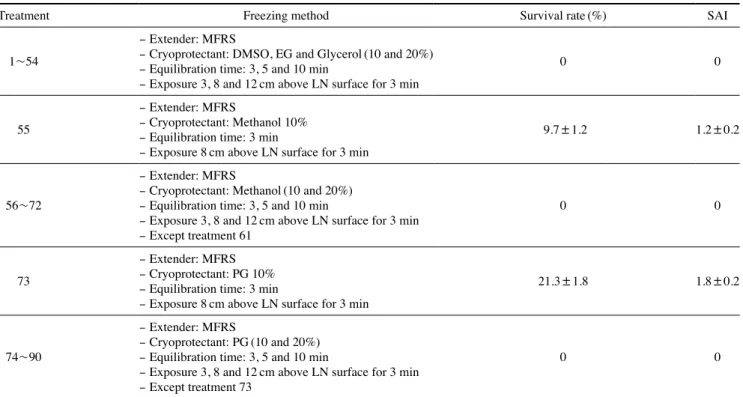
동해방지제 종류(DMSO, EG, glycerol, methanol, PG) 및 농 도별(10%, 20%)로 90가지 조합에 따라 대구 정자를 동결하 였을 때, 생존율 및 운동성을 조사한 결과를 Table 2에 나타내 었다. 동해방지제로 DMSO, EG, glycerol을 사용하였을 때, 정 자의 생존율은 0%로 나타났다. Methanol의 경우 10%에서 3 분간 침지시킨 후 액체질소 표면 8cm 위에서 1차 동결한 결 과, 정자 생존율은 9.7±1.2%, 정자활성지수 1.2±0.2를 나타 내었다. 하지만 Methanol을 동해방지제로 사용하여 평형시 간 및 동결방법을 다르게 한 실험구에서는 생존율이 0%로 나
타났다. PG 10%를 동해방지제로 적용하여 3분간 침지시킨 후 액체질소 표면 8cm 위에서 1차 동결한 결과, 정자 생존율 21.3±1.8%, 정자활성지수 1.8±0.2로 다른 실험구와 비교하 여 가장 높은 생존율 및 활성을 나타내었다. 하지만 동해방지 제로 PG를 사용하고 평형시간 및 동결방법을 다르게 한 실험 구에서는 생존율이 0%로 나타났다. 해동 후 정자가 생존율을 보인 동결방법(평형시간 3분, 액체질소 표면 8cm 위 1차 동 결)에서 각 동해방지제별 정자 생존율 및 정자활성지수는 Fig.
2에 나타내었다.
신선한 정자와 동결보존되어 있던 정자의 수정률은 각각 6.55±1.57%, 4.17±0.30%로 나타나 유의한 차이는 아니지만 신선한 정자의 수정률이 높게 나타났다. 8℃에서 부화까지 소 요된 시간은 약 12일이었다.
고 찰
동해방지제는 정자의 동결보존 시 가장 중요한 요소로 세 포 내 삼투질농도를 조절하고 빙결정 형성을 완화하는 역할을 한다(Jamieson and Leung, 1991). 동해방지제의 이러한 역할 이 중요한 이유는 정자가 동결과 해동과정 중 많은 손상을 입 을 수 있기 때문에 이를 방지하기 위해서이다(Lim et al., 2007).
동해방지제는 중성으로 친수성이어야 하며, 정자의 세포막
Table 2. Effects of various freezing methods on survival rate(%) and sperm activity index(SAI) of post-thawed sperm of Pacific Cod, Gadus macrocephalus
Treatment Freezing method Survival rate(%) SAI
1~54
- Extender: MFRS
- Cryoprotectant: DMSO, EG and Glycerol(10 and 20%) - Equilibration time: 3, 5 and 10 min
- Exposure 3, 8 and 12cm above LN surface for 3 min
0 0
55
- Extender: MFRS
- Cryoprotectant: Methanol 10%
- Equilibration time: 3 min
- Exposure 8cm above LN surface for 3 min
9.7±1.2 1.2±0.2
56~72
- Extender: MFRS
- Cryoprotectant: Methanol(10 and 20%) - Equilibration time: 3, 5 and 10 min
- Exposure 3, 8 and 12cm above LN surface for 3 min - Except treatment 61
0 0
73
- Extender: MFRS - Cryoprotectant: PG 10%
- Equilibration time: 3 min
- Exposure 8cm above LN surface for 3 min
21.3±1.8 1.8±0.2
74~90
- Extender: MFRS
- Cryoprotectant: PG(10 and 20%) - Equilibration time: 3, 5 and 10 min
- Exposure 3, 8 and 12cm above LN surface for 3 min - Except treatment 73
0 0
MFRS: marine fish Ringer’s solution, DMSO: demethyl sulfoxide, EG: ethylene glycol, PG: propylene glycol, LN: liquid nitrogen.
에 대한 투과성이 높아야 하며, 정자에 대한 독성도 적어야 한 다(Kuwano and Saga, 2000). 일반적으로 많이 이용되고 있는 DMSO, EG, glycerol, methanol 및 PG 등의 동해방지제들은 다 양한 어종들의 정자 동결보존에서 동일한 효과를 보이지 않으 며, 가장 높은 생존율을 나타내는 동해방지제가 다르게 나타나 고 있다(Suquet et al., 2000; Jeong et al., 2014). 이러한 이유 는 동해방지제가 어종별로 종 특이성을 나타내기 때문에, 모든 어류에 적용될 수 있는 단일한 동해방지제가 없기 때문인 것으 로 판단된다(Lim et al., 2007). 본 연구에서는 평형시간을 3분 으로 설정하고 액체질소 표면 8cm 위에서 1차 동결하였을 때, PG 10%와 methanol 10%에서는 생존율을 보였으나, 이를 제외 한 다른 동해방지제 및 농도로 동결한 결과에서는 생존율을 보 인 실험구가 없었다. 강도다리(Platichthys stellatus)(Lim et al., 2007), 감성돔(Acanthopagrus schlegeli)(Jeong et al., 2012), 문치가자미(Pleuronectes yokohamae), 찰가자미(Microstomus achne), 참가자미(Pleuronectes herzensteini)(Saitoh, 1996) 등 많은 어류 정자 동결보존에서 DMSO가 적정 동해방지제 로서 보고된 바 있지만, 본 연구결과는 DMSO를 비롯한 EG, glycerol이 동결보존 과정에 있어서 대구 정자에 동해방지제로 서의 역할보다 독성물질로서 작용한 것으로 판단된다. 본 연구 에서 PG가 해동 후에 가장 높은 정자 생존율과 운동성을 보여
대구의 적정 동해방지제로 판단할 수 있었다. 또한 같은 대구과 (Gadidae)에 속하는 Atlantic cod Gadus morhua의 정자 동결 보존에서도 PG가 가장 높은 정자 생존율을 보여 적정 동해방지 제로 보고된 바 있다(Butts et al., 2010). Lim et al.(2008)은 어 종별 적정 동해방지제는 동일한 종이라 할지라도 동해방지제와 희석액의 조합에 따라 달라질 수 있다고 하였다. 본 연구에서도 동해방지제로 PG를 사용하여 10%와 20%로 농도를 달리하였 을 때, PG 10%에서만 생존율을 나타내었다. 따라서 대구의 종 특이적인 동해방지제가 PG 10%인 것으로 판단할 수 있었다.
성공적인 정자 동결보존을 위해서는 적정 희석액이나 동해방 지제를 탐색하는 것도 중요하지만, 최적 동결방법을 구명하는 것도 중요하다(Butts et al., 2010). Atlantic cod의 경우 액체질 소를 스티로폼 박스에 넣고 액체질소 표면 위에서 1차 동결한 후에 액체질소에 보관하는 방법이 알려져 있다(Rideout et al., 2004; Marschhäuser, 2007). 또한 프로그램동결기를 이용하여 -5℃/min의 속도로 -150℃까지 1차 동결한 후 액체질소에 보관한 결과도 보고된 바 있다(Degraaf and Berlinsky, 2004).
하지만 -5℃/min보다 더 느리게 -1℃/min으로 동결하게 되 면 해동 후 정자 생존율이 낮아진다고 보고된 바 있다(Mounib et al., 1968). 본 연구에서는 액체질소 표면 3cm와 12cm 위에 서는 생존한 정자가 관찰되지 않았지만, 8cm에서 1차 동결한 결과에서 정자가 생존율을 나타내었다. -196℃인 액체질소 표 면 위에서 높이 차이는 동결의 속도를 결정하게 된다. 이러한 액 체질소 표면 위에서의 냉각은 분당 냉각속도를 설정할 수 있는 프로그램동결기를 사용하는 것보다 동결방법이 항상 정확하지 않을 수 있다(Babiak et al., 1999). 하지만 동결보존을 하는 장 소가 프로그램동결기를 이용할 수 없는 장소에서 정자 동결보 존을 해야 할 경우가 있기 때문에 액체질소 증기를 이용한 동 결방법이 규명될 필요성이 있다. 양태(Platycephalus indicus) 의 경우 액체질소 표면 2cm 위에서 동결하였을 때 정자의 운 동성 및 생존율이 가장 높게 나타난다고 보고된 바 있다(Kim et al., 2011). 본 연구에서는 액체질소 표면 8cm 위에서 1차 냉 각하였을 때 가장 높은 생존율을 보였다. 이 결과는 대구 정자 를 two-step으로 동결보존 하는 데 있어서 양태와 비교하여 완 만한 동결속도를 요구하는 것으로 판단할 수 있으며, 이러한 동 결방법의 차이는 종 특이적인 특성으로 판단된다. 이러한 종 특 이적인 동결속도의 차이는 바라문디 Late calcarifer -31℃/
min(Leung, 1987), 넙치(Paralichthys olivaceus) -8℃/min (Tabata and Mizuta, 1997), 농어(Dicentrarchus labrax) -10℃/
min(Villani and Catena, 1991), 터봇(Scophthalmus maximus) -99℃/min(Dreanno et al., 1997) 등 많은 어종에서도 보고된 바 있다.
대구 수정란은 수온 8℃에서 부화에 도달하기까지 약 12 일이 소요되었다. 이 결과는 Buslov et al.(2010)의 결과와도 일치하였다. 또한 대구 수정란의 부화가 가능한 수온 범위는 Fig. 2. Effects of cryoprotectant(10%) on survival rate(%) and
sperm activity index(SAI) of post-thawed sperm of Pacific cod Gadus macrocephalus. DMSO: demethyl sulfoxide, EG: ethylene glycol, PG: propylene glycol. Different letters indicate significantly difference(P<0.05).
2~12℃로, 12℃ 이상의 수온에서는 수정란이 발생과정 동안 폐사하고, 2℃ 이하의 수온에서는 발생이 진행되지 않는다고 알려져 있다(Buslov et al., 2010). 또한 Lee et al.(2007)에 의 하면 7℃에서 65%로 가장 높은 부화율을 보였다고 보고된 바 있어, 실험수온이 대구의 부화에 부정적인 영향을 주지는 않 은 것으로 판단된다. 하지만 본 실험에서 대구 수정란의 부화 율은 신선한 정자와 동결보존한 정자를 사용한 결과 모두 낮 게 나타났다. 이것은 수정란을 수집하는 데 있어서 어획되면 서 폐사한 대구를 사용하여 미수정란의 난질에 부정적인 영향 을 준 것으로 판단된다. 신선한 정자와 동결보존한 정자로 수 정시킨 수정란의 부화 소요시간은 차이를 보이지 않았다. 또 한 부화율도 신선한 정자와 동결보존한 정자 간에 유의한 차 이를 나타내지 않았다. 이것은 동결보존하여 액체질소에 보관 한 대구 정자가 수정란의 부화율에는 영향을 미치지 않는 것 으로 판단할 수 있다.
요 약
본 연구는 대구(Gadus macrocephalus) 정자의 동결보존 기 술을 개발하기 위해 적정 동해방지제 및 동결보존 방법을 탐 색하고, 동결보존된 정자를 해동하여 효과를 조사하고자 한다.
동결보존에 사용된 동해방지제는 demethyl sulfoxide(DMSO), ethylene glycol(EG), glycerol, methanol 및 propylene glycol (PG)였으며, marine fish ringer’s solution(MFRS)를 희석액으 로 사용하였다. 적정 동결보존 방법을 탐색하기 위하여 동해 방지제 농도별(10%, 20%), 평형시간(3분, 5분, 10분), 1차 동 결(액체 질소 표면 위 3, 8, 12cm)별로 총 90개 실험구를 설정 하였다. 해동 후 가장 높은 정자 생존율을 보인 실험구는 PG 10%, 평형시간 3분, 1차동결 8cm 방법으로 21.3±1.8%의 생 존율을 보였다. 신선한 정자와 해동한 정자를 사용하여 인공 수정시킨 수정란의 부화율에서 유의한 차이는 없었다.
사 사
이 논문은 2019년도 국립수산과학원 수산시험연구사업 (R2019015)의 지원으로 수행된 연구입니다.
REFERENCES
Babiak, I., L. Fraser, S. Dobosz, K. Goryczko, H. Kuzminski and J.
Strzezek. 1999. Computer-controlled freezing of rainbow trout Oncorhynchus mykiss spermatozoa for routine pro- grammes. Aquac. Res., 30: 707-710.
Buslov, A.V., N.P. Sergeeva and O.I. Il’in. 2010. Embryonic devel-
opment of the Pacific cod Gadus macrocephalus. Russ. J.
Mar. Biol., 36: 526-538.
Butts, I.A.E., M.K. Litvak, V. Kaspar and E.A. Trippel. 2010. Cryo- preservation of Atlantic cod Gadus morhua L. spermatozoa:
Effects of extender composition and freezing rate on sperm motility, velocity and morphology. Cryobiology, 61: 174- 181.
Cha, H.K., S.I. Lee, S.C. Yoon, Y.S. Kim, Y.Y. Chun, D.S. Chang and J.H. Yang. 2007. Maturation and spawning of the Pa- cific cod, Gadus macrocephalus TILESIUS in East sea of Korea. J. Kor. Soc. Fish. Tech., 43: 320-328.(in Korean) Clearwater, S.J. and L.W. Crim. 1995. Milt quality and quantity
produced by yellowtail flounder Pleuronectes ferrugineus following GnRH-analogue treatment by microspheres or pellet. In: Goetz, F.W. and Thomas, P.(eds.), Proceedings of the fifth international symposium, Reproductive Physiology of Fish, p. 113.
DeGraaf, J.D. and D.L. Berlinsky. 2004. Cryogenic and refrigerated storage of Atlantic cod Gadus morhua and haddock Mela- nogrammus aeglefinus spermatozoa. Aquaculture, 234: 527- Dreanno, C., M. Suquet, L. Quemener, J. Cosson, H. Le Delliou and 540.
R. Billard. 1997. Cryopreservation of turbot Scophthalmus maximus spermatozoa. Theriogenology, 48: 589-603.
Hwang, K.S., I.S. Choi and S.K. Jung. 2012. Estimating the abun- dance and fishing mortality of Pacific cod Gadus macro- cephalus during the spawning season in Jinhae bay, Korea, using a mark-recapture method. Kor. J. Fish. Aquat. Sci., 45: 499-506.(in Korean)
Jamieson, B.G.M. and L.K. Leung. 1991. Fish evolution and sys- tematics: Evidence from spermatozoa. With a survey of lophophorate, echinoderm and protochordate sperm and an account of gamete cryopreservation. Cambridge University Press, Chambridge, U.S.A., xiv 319pp.
Jeong, M.H., H.G. Lim, Y.H. Do, J.H. Kim, M.H. Son and Y.J.
Chang. 2012. Assessment of sperm activity of black porgy (Acanthopagrus schlegeli) acclimated in freshwater on cryo- preservation condition. Dev. Reprod., 16: 77-85.(in Korean) Jeong, M.H., B.H. Min, M.S. Park, J.I. Myeong, J.H. Im, H.K. Lim
and H.G. Hwang. 2014. Cryopreservation of common Ko- rean bitterling Acheilognathus signifer sperm. Kor. J. Fish.
Aquat. Sci., 47: 39-44.(in Korean)
Kim, D.H., I.K. Kong, S.J. Rha, J.W. Yun, K.H. Han and K.H. Kho.
2011. Practical procedure of sperm cryopreservation of the bar-tailed flathead Platycephalus indicus. Korean J. Ichthy- ol., 23: 75-79.
Kim, T.J., C.Y. Park, S.G. Lee and W.S. Gwak. 2007. Morpho- logical development of eggs and larvae of the Pacific cod Gadus macrocephalus. Korean J. Ichthyol., 19: 343-349.(in Korean)
KOSIS. 2019. Korean statistics information service. Retrieved from http://kosis.kr.
Kuwano, K. and N. Saga. 2000. Cryopreservation of marine al-
gae: Applications in biotechnology. In: Figerman, M. and Nagabhushanam, R.(ed.), Recent advances in marine bio- technology. Volume 4: Aquaculture. Part A: Seaweed and invertebrates, pp. 23-40.
Lee, J.H., J.N. Kim, J.B. Lee, J.H. Choi, S.Y. Moon, J.S. Park and D.N. Kim. 2015. Movement of Pacific cod Gadus macro- cephalus in the Korean southeast sea, ascertained through pop-up archival tags and conventional tags. J. Korean Soc.
Fish. Technol., 51: 624-629.(in Korean)
Lee, J.Y., C.S. Lee, W.K. Kim, S.U. Park and B.H. Min. 2007. Ef- fects of water temperature on egg development, hatching and laval growth rearing of the Pacific cod Gadus macro- cephalus. J. Aquaculture, 20: 260-264.(in Korean)
Lee, C.S., Y.H. Hur, J.Y. Lee, W.K. Kim, S.H. Hong, S.J. Hwang and S.H. Choi. 2005. Maturity and spawning of Pacific cod Gadus macrocephalus in the East Sea. J. Kor. Fish. Soc., 38: 245-250.(in Korean)
Leung, L.K.P. 1987. Cryopreservation of spermatozoa of the barra- mundi Lates calcarifer. Aquaculture, 64: 243-247.
Leung, L.K.P. and B.G.M. Jamieson. 1991. Live preservation of fish gametes.In: Jamieson, B.G.M.(ed.), Fish evolution and systematics: Evidence from spermatozoa. Cambridge Uni- versity Press, New York, pp. 245-269.
Lim, H.G., C.M. An, G.A. Noh and B.H. Min. 2007. Effects of di- luents cryoprotectants on sperm cryopreservation in starry flounder Platichthys stellatus. J. Aquaculture, 20: 173-177.
(in Korean)
Lim, H.G., C.H. Lee, B.H. Min, J.U. Lee, C.S. Lee, K.B. Seong and S.M. Lee. 2008. Effects of diluents and cryoprotectants on sperm cryopreservation of masou salmon Oncorhynchus masou masou. J. Kor. Fish. Soc., 41: 267-271.(in Korean) Marschhäuser, V. 2007. Cryopreservation of Atlantic cod Gadus
morhua L. sperm. Master Thesis, Department of Fisheries and Natural Sciences, Bodo University College, Norway, pp. 1-61.
Mounib, M.S., P.C. Hwang and D.R. Idler. 1968. Cryogenic preser- vation of Atlantic cod Gadus morhua sperm. J. Fish. Res.
Board. Can., 25: 2623-2632.
Ogier de Baulny, B., Y. Le Vern, D. Kerboeuf, M. Heydorff and G.
Maisse. 1996. Flow cytometric analysis of plasma mem- brane demages of rainbow trout and turbot frozen sperm.
In: Proceedings of the commission C2, Refrigeration and Production, International Symposium Froid et Aquacul- ture’s, pp. 65-72.
Ohta, H. and T. Izawa. 1996. Diluent for cool storage of the Japa- nese eel Anguilla japonica spermatozoa. Aquaculture, 142:
107-118.
Rideout, R.M., M.K. Litvak and E.A. Trippel. 2003. The develop- ment of a sperm cryopreservation protocol for winter floun- der Pseudopleuronectes americanus(Walbaum): evaluation of cryoprotectants and diluents. Aquac. Res., 34: 653-659.
Rideout, R.M., E.A. Trippel and M.K. Litvak. 2004. The develop- ment of haddock and Atlantic cod sperm cryopreservation technique and the effect of sperm age on cryopreservation success. J. Fish. Biol., 65: 299-311.
Saitoh, S. 1996. Cryopreservation of flatfish sperm. Sci. Rep. Hok- kaido Fish Exp. Stn., 48: 9-17.(in Japanese)
Strüssmann, C.A., P. Renard, H. Ling and F. Takashima. 1994.
Motility of pejerrey Odontesthes bonariensis spermatozoa.
Fisheries Sci., 60: 9-13.
Suquet, M., R. Billard, J. Cosson, G. Dorange, L. Chauvaud, C.
Mugnier and C. Fauvel. 1994. Sperm features in turbot (Scophthalmus maximus): a comparison with other freshwa- ter and marine fish species. Aquat. Living Resour., 7: 283- 294.
Suquet, M., C. Dreanno, C. Fauvel, J. Cosson and R. Billard. 2000.
Cryopreservation of sperm in marine fish. Aquac. Res., 31:
231-243.
Tabata, K. and A. Mizuta. 1997. Cryopreservation of sex reversed gynogenetic females sperm in hirame. Fisheries Sci., 63:
482-483.
Villani, P. and C. Catena. 1991. Gametes cryopreservation of male sea bass Dicentrarchus labrax L.: solutions and methodolo- gies. Rivista Italiano Acquacoltura, 26: 217-226.
Westrheim, S.J. 1996. On the Pacific cod Gadus macrocephalus in British Columbia waters, and a comparison with Pacific cod elsewhere, and Atlantic cod G. morhua. Canadian Tech.
Rep. Fish. Aquat. Sci., 2092: 390pp.