• 검색 결과가 없습니다.

Nevoid Basal Cell Carcinoma Syndrome: A Case Report and Review of Korean Cases

N/A
N/A
Protected

Academic year: 2021

Share "Nevoid Basal Cell Carcinoma Syndrome: A Case Report and Review of Korean Cases"

Copied!
6
0
0

로드 중.... (전체 텍스트 보기)

전체 글

(1)

ISSN 2288-8101(Print) ISSN 2288-8586(Online)

Case Report

RECEIVED September 6, 2014, REVISED September 17, 2014, ACCEPTED October 16, 2014 Correspondence to Seung-O Ko

Department of Oral and Maxillofacial Surgery, School of Dentistry, Chonbuk National University 567 Baekje-daero, Deokjin-gu, Jeonju 561-756, Korea

Tel: 82-63-250-2113, Fax: 82-63-250-2089, E-mail: [email protected]

Copyright © 2014 by The Korean Association of Maxillofacial Plastic and Reconstructive Surgeons. All rights reserved.

CC

This is an open access article distributed under the terms of the Creative Commons Attribution Non-Commercial License (http://creativecommons.org/licenses/

by-nc/3.0) which permits unrestricted non-commercial use, distribution, and reproduction in any medium, provided the original work is properly cited.

Nevoid Basal Cell Carcinoma Syndrome: A Case Report and Review of Korean Cases

Eun-Joo Jung 1 , Hyokeun Shin 1,2 , Jin-A Baek 1,2 , Dae-Ho Leem 1,2 , Seung-O Ko 1,2

1

Department of Oral and Maxillofacial Surgery, School of Dentistry, Chonbuk National University,

2
Research Institute of Clinical Medicine, Chonbuk National University

Abstract

Nevoid basal cell carcinoma syndrome (NBCCS) is a rare autosomal genetic disease caused by a PTCH mutation. The disease is characterized by multiple basal cell carcinomas of the skin, multiple keratocystic odontogenic tumors (KCOTs) in the jaw, palmar and/or plantar pits, bifid ribs, ectopic calcification of the falx cerebri, and skeletal abnormalities. Early diagnosis is difficult in many cases because there may be a number of systemic symptoms. The purpose of this study is to report the case of a 12-year-old girl who was hospitalized with multiple KCOTs that occurred in the upper and lower jaws. Through characteristic clinical symptoms and radiologic findings, she was finally diagnosed as having NBCCS. This study also aims to organize the symptoms often observed in Korea using previously published case reports to provide useful information for the early diagnosis of NBCCS.

Key words: Basal cell nevus syndrome, Nevoid basal cell carcinoma syndrome, Nevoid basal cell carcinoma syndrome, Odontogenic cyst

Introduction

In 1960, Gorlin and Goltz[1] defined nevoid basal cell carcinoma syndrome (NBCCS), or Gorlin-Goltz syndrome, as a disease characterized by multiple basal cell carcinomas (BCCs), multiple keratocystic odontogenic tumors (KCOTs) in the jaw, and skeletal anomalies. NBCCS is an autosomal genetic disease showing high penetrance and variable expressivity. It is currently accepted that NBCCS is caused by a mutation of the tumor suppressor gene PTCH, but there are claims that it may be caused by new mutations because about 60% occur without a family history[2,3].

This multisystem disease is often difficult to diagnose early

because it may show numerous systemic clinical symptoms

that can occur inconsistently[4]. However, early diagnosis

is important because it can predict possible disease and

provide patients with the opportunity to receive conservative

treatment and prevent exacerbations through frequent

examination. In Korea, 48 cases of NBCCS were reported

from 1981 to 2013 by the Journal of Korean Association

of Maxillofacial Plastic and Reconstructive Surgeons , the

Journal of Korean Association of Oral and Maxillofacial

Surgeons , the Korean Journal of Oral and Maxillofacial

Radiology , the Korean Journal of Otorhinolaryngology , the

(2)

Table 1. Journals reporting nevoid basal cell carcinoma syndrome cases in Korea

Departments Reported cases (n)

Oral and maxillofacial surgery Dermatology

Otorhinolaryngology Pathology

Oral and maxillofacial radiology Pediatric Neurosurgery

35 9 2 1 1 1

Fig. 1. Preoperative panoramic view.

Fig. 2. Chest x-ray view showing bifid ribs in the posterior aspect of both 3rd rib.

Fig. 3. Facial computed tomography view showing calcification of falx cerebri.

Korean Journal of Dermatology , and the Annals of Dermatology , among others (Table 1)[4-18]. We experienced a NBCCS case in a 12-year-old female patient admitted with multiple recurring KCOTs. In this study, we examine the symptoms expressed in Korean NBCCS patients by analyzing the above 49 Korean cases.

Case Report

A 12-year-old female patient had a unicystic KCOT sur- gery of the mandibular anterior region at Chonbuk National University Dental Hospital, two years prior. She then visited the hospital for regular exams. There were no clinical find- ings such as extraoral swelling, redness, or heat generation.

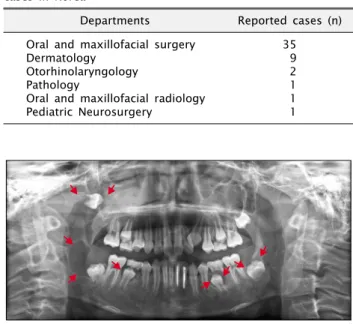
Teeth #17, 27, 37, and 47 were unerupted and primary molars #75, 85 remained in the oral examination. A pan- oramic view showed that the previous surgical site had healed well, but that five different sizes of radiolucent le- sions with clear boundaries were observed around #17, 35, 37, 45, and 47 impacted teeth (Fig. 1). The lesion surrounding the crown, while displacing #17 upward and laterally in the cone beam computed tomography (CT) and the CT of the facial bone, filled the right maxillary sinus.

In addition, radiolucent lesions surrounding the crowns of #35, 37, 45, and 47 resulted in cortical thinning and expansion. The initial impression of these lesions were

dentigerous cysts or KCOTs. Under general anesthesia, ex- traction of #17, 75, and 85 and surgical enucleation were carried out, and Carnoy solution was applied to prevent recurrence. Upon biopsy, they were all diagnosed as KCOTs.

NBCCS was suspected, so the patient’s clinical findings, family history, medical history, and radiographic examina- tions were reviewed. Six to seven cutaneous nevi on the face and many pits on the palms and plantar were observed. There was no family history of NBCCS or KCOTs.

Bifid ribs in the left and right were discovered through

(3)

Fig. 4. Postoperative 13 months panoramic view.

Table 2. Relative frequencies of associated complications compared with other countries Evans

et al.[22]

Shanley et al.[26]

Kimonis et al.[19]

Lo Muzio et al.[27]

Pruvost-Balland et al.[28]

Ahn et al.[5]

Shimada

et al.[25] This study Year

Nationality Diagnostic criteria No. of cases Mean age (yr) BCC (%) KCOT (%)

Palmar or plantar pits (%) Rib anomaly (%) Calcification of the falx

cerebri (%)

1993 UK

- 84

- 47 66 71 - -

1994 Australia

- 118

35 76 75 80 45 92

1997 USA

- 105 34.5

80 74 87 42 65

1999 Italy Evans

37 31.4

30 92 35 32 70

2006 France Shanley

22 44.9

100 62 45 - 66

2004 Korea Evans 33 21.2

15 91 67 36 21

2013 Japan Kimonis

25 23.8

28 100

76 44 28

2014 Korea Kimonis

21.6 22 86 63 39 37

BCC, basal cell carcinomas; KCOT, keratocystic odontogenic tumor.

chest x-rays (Fig. 2), and calcification of the falx cerebri was found through a CT of the facial bones and an x-ray of the skull (Fig. 3). Four symptoms including multiple KCOTs, palmar and/or plantar pits, bifid ribs, and ectopic calcification of the falx cerebri fit the major diagnostic cri- teria of NBCCS organized by Kimonis et al .[19] in 1997.

NBCCS was diagnosed based on these findings.

While observing progress after surgery, small radiolucent lesions surrounding impacted tooth #27 were observed, and surgical enucleation was conducted under local anesthesia. Upon biopsy, this lesion was diagnosed as KCOT as well. Regular check-ups were carried out for the patient through collaborative treatment with dermatology and neurosurgery. We observed the patient for 13 months, and teeth #35, 45, and 47 erupted to the occlusal surface (Fig. 4). We recommended that the patient and her family undergo genetic testing, but they refused to do so.

Discussion

Reports of NBCCS prevalence vary from 1/57,000 to 1/256,000, but 1/60,000 is generally accepted[20,21]. The

prevalence in Korea is estimated to be very low[5]. NBCCS occurs at a similar rate in men and women and varies by race. Clinical symptoms of NBCCS usually appear before the age of 30 and early diagnosis is difficult in many cases because the symptoms may appear systemically and vari- ously widely.

Evans et al .[22] and Kimonis et al .[19] organized the criteria for NBCCS. Evans et al .[22] presented two or more BCCs, KCOTs in the jaw, three or more palmar and/or plantar pits, bi-lamellar calcification of the falx cerebri, and family history as major criteria. Kimonis et al .[19] also in- cluded rib anomalies of bifid in the major criteria. They said that other symptoms were classified as minor criteria and that if two major or one major and two minor criteria are observed, one can diagnose NBCCS.

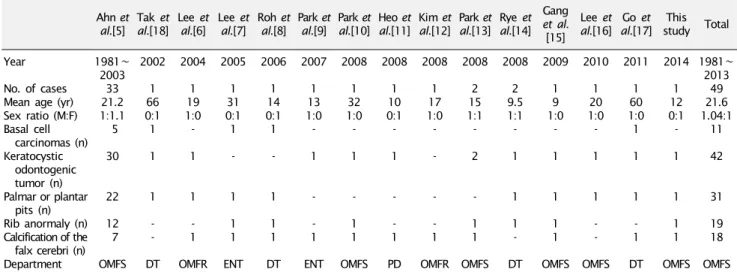
In Korea, the first case of NBCCS was reported in 1981[23]. In 2004, Ahn et al .[5] analyzed 33 NBCCS cases reported in Korea from 1981 to 2002. This study also ana- lyzed NBCCS cases published in Korea through Korea’s journals of oral and maxillofacial surgery, oral and max- illofacial radiology, otorhinolaryngology, pathology, and dermatology from 1981 to 2013 (Table 1). Forty-nine cases were reported excluding duplicate cases and cases not suit- able for Kimonis diagnostic criteria, and including our one case (Table 2∼4). NBCCS patients in Korea occur almost equally in men and women (25:24) who first presented between the ages of 6 and 68. The mean age was 21.6, and 17 people were included in a total of six households (34.7%).

BCCs of the skin are the most common symptom of

NBCCS and occur about 80% in European ethnicities and

about 38.0% in African Americans[19,24]. However, they

(4)

Table 4. Nevoid basal cell carcinoma syndrome cases reported between the years 1981 to 2013 in Korea Ahn et

al.[5] Tak et al.[18] Lee et

al.[6] Lee et al.[7] Roh et

al.[8] Park et al.[9] Park et

al.[10] Heo et al.[11] Kim et

al.[12] Park et al.[13] Rye et

al.[14]

Gang et al.

[15]

Lee et al.[16] Go et

al.[17] This study Total

Year No. of cases Mean age (yr) Sex ratio (M:F) Basal cell

carcinomas (n) Keratocystic

odontogenic tumor (n) Palmar or plantar

pits (n) Rib anormaly (n) Calcification of the

falx cerebri (n) Department

1981∼

2003 33 21.2 1:1.1 5 30

22 12 7 OMFS

2002 1 66 0:1 1 1

1 - - DT

2004 1 19 1:0

- 1

1 - 1 OMFR

2005 1 31 0:1

1 -

1 1 1 ENT

2006 1 14 0:1 1

-

1 1 1 DT

2007 1 13 1:0

- 1

- - 1 ENT

2008 1 32 1:0

- 1

- 1 1 OMFS

2008 1 10 0:1 - 1

- - 1 PD

2008 1 17 1:0

- -

- - 1 OMFR

2008 2 15 1:1

- 2

- 1 1 OMFS

2008 2 9.5 1:1 - 1

1 1 - DT

2009 1 9 1:0

- 1

1 1 1 OMFS

2010 1 20 1:0

- 1

1 - - OMFS

2011 1 60 1:0 1 1

1 - 1 DT

2014 1 12 0:1

- 1

1 1 1 OMFS

1981∼

2013 49 21.6 1.04:1

11 42

31 19 18 OMFS M, male; F, female; OMFS, oral and maxillofacial surgery; DT, dermatology; OMFR, oral and maxillofacial radiology; ENT, otolaryngology;

PD, pediatric dentistry.

Table 3. Frequency of findings in 49 Korean patients with nevoid basal cell carcinoma syndrome

Reporting frequency Value

≥50%

Keratocystic odontogenic tumor Palmar and plantar pits Hypertelorism

30%∼50%

Frontal, parietal, and temporal bossing Rib anomaly

Calcification of the falx cerebri Family history

Multiple nevi 10%∼30%

Basal cell carcinomas Scoliosis

Mental retardation Mandibular prognathism Visual disturbance and blindness

<10%

Scoliosis

Cleft lip and/or palate Congenital hydrocephalus Ovarian cyst, tumor Dental agenesis Medulloblastoma

Hypogonadism, megaloureter

42 (85.71) 31 (63.27) 25 (51.02) 19 (38.78) 19 (38.78) 18 (36.73) 17 (34.69) 16 (32.65) 11 (22.45) 8 (16.33) 8 (16.33) 5 (10.20) 5 (10.20) 8 (16.33) 4 (8.16) 4 (8.16) 4 (8.16) 2 (4.08) 2 (4.08) 2 (4.08) Values are presented as number (%).

occurred in 11 cases (22.5%) out of 49 in Korea, and a lower rate was also reported in Japan, at 28.0% (Table 2)[25]. Ahn et al .[5] suggested that such a difference may be attributed to genetic and geographic differences.

According to the results of this study, 35 out of 49 NBCCS cases were reported in oral and maxillofacial surgery, nine cases in dermatology, and five cases in other areas. NBCCS accompanied by BCCs accounted for 11 cases and eight

of these cases were reported in dermatology (Table 1).

The most NBCCS cases were published in oral and max- illofacial surgery and the main symptoms in Korea were KCOTs. Therefore, clinical findings of BCCs may have been missed. Because low BCC incidence was also reported in Italy, the low frequency of BCCs in Korea and Japan is difficult to consider an Asian feature, as epidemiological investigations in other Asian countries are needed for fur- ther study. Nevi on the skin begin to turn into intrusive and aggressive moles after puberty, so periodic examina- tion and careful observation are required. In addition, in- dividuals should not be exposed to ionizing radiation or ultraviolet light, both of which are risk factors for BCCs.

Palmar and/or plantar pits have been reported at a high rate (64%∼87%) in many countries[5,19,22,25,26] and ob- served at a rate of 63.3% (31 cases) in Korea, consistent with other studies except for Italy (35%) and France (45%) (Table 2)[27,28]. The pits are usually 1∼3 mm in depth and 2∼3 mm in diameter, and they usually develop in the second decade. Their number can increase up to 500 or more with age[29]. A pit itself is not malignant, but continuous observation is required because a pit may result in BCCs occurring in the hands and feet.

Multiple KCOTs of jaws appear at the highest rate (66%∼

100%) in NBCCS patients. Multiple KCOTs can provide

a chance for diagnosis in many cases because they occur

earlier than other symptoms of NBCCS and are often ac-

companied by symptoms such as swelling and pain. In

(5)

Korea, KCOTs were present in 42 cases out of 49 NBCCS cases (85.7%). Surgical enucleation, enucleation after mar- supialization, or bone resection was conducted for treat- ment, and Carnoy solution was used to prevent recurrence.

Choi et al .[30] reported that when treating KCOT patients, Carnoy solution was applied for 3∼5 minutes after surgical enucleation and most patients obtained good results with- out recurrence. KCOT that occurs with NBCCS occurs at an early age compared to general KCOT and shows a 60%

higher recurrence rate. In addition, it may occur both in the upper and lower jaws and usually appears in multi- ples[31,32]. Therefore, when faced with a case of multiple or recurrent KCOTs in the jaw, oral and maxillofacial sur- geons should conduct further investigations to exclude NBCCS[33]. Long-term surveillance for KCOTs is required because of the high recurrence rate.

While reporting the high rate (65%∼92%) in Australia, the USA, and Italy, ectopic calcification of the falx cerebri is uncommon, seen 18 cases (36.7%) in Korea. Rib anoma- lies, including bifid ribs, were observed in 19 cases (38.8%), similar proportion to other countries (Table 3)[19,26,27].

Additional symptoms may include abnormalities of the dental and skeletal system such as cleft lip/palate, mandible prognathism, scoliosis and frontal bossing, and abnormal- ities of the ocular system including visual problems and hypertelorism, nervous system abnormalities such as mild mental retardation, medulloblastoma and congenital hydro- cephalus, and abnormalities of the genitourinary system including cysts or tumor of the ovaries[19].

The low frequency of BCCs and ectopic calcification of the falx cerebri were two major differences of this study compared with studies in other countries. Hypertelorism (25 cases, 51.0%) and frontal bossing (19 cases, 38.8%) occurred frequently in Korea. These symptoms can be use- ful for diagnosing patients with early-stage NBCCS in Korea.

In addition, since 34.7% of cases have a family history, genetic tests may be useful for patients and their families for more accurate diagnoses and disease prevention.

References

1. Gorlin RJ, Goltz RW. Multiple nevoid basal-cell epithelioma, jaw cysts and bifid rib. A syndrome. N Engl J Med 1960;

262:908-12.

2. Gorlin RJ. Nevoid basal cell carcinoma (Gorlin) syndrome:

unanswered issues. J Lab Clin Med 1999;134:551-2.

3. Tanioka M, Takahashi K, Kawabata T, et al . Germline muta- tions of the PTCH gene in Japanese patients with nevoid basal cell carcinoma syndrome. Arch Dermatol Res 2005;

296:303-8.

4. Son YJ, Jo HG, Kim YO, Woo YJ. A case of basal cell nevus syndrome. J Korean Child Neurol Soc 2010;18:147-52.

5. Ahn SG, Lim YS, Kim DK, Kim SG, Lee SH, Yoon JH.

Nevoid basal cell carcinoma syndrome: a retrospective anal- ysis of 33 affected Korean individuals. Int J Oral Maxillofac Surg 2004;33:458-62.

6. Lee BD, Kim JH, Choi DH, Koh KS, Lee SR. Recurrent odontogenic keratocysts in basal cell nevus syndrome:

Report of a case. Korean J Oral Maxillofac Radiol 2004;34:

203-7.

7. Lee BK, Lee JS, Chang DS, Park KY. Nevoid basal cell car- cinoma syndrome: a case report and literature review.

Korean J Otolaryngol-Head Neck Surg 2005;48:819-22.

8. Roh BH, Park SJ, Lee SY, Lee JS, Whang KU. A case of ne- void basal cell carcinoma syndrome with meningioma and sclerosing stromal tumor of the ovary. Korean J Dermatol 2006;44:1030-3.

9. Park SH, Kim HY, Kim JH, Hong SD. A case of basal cell nevus syndrome with odontogenic keratocyst. Korean J Otolaryngol-Head Neck Surg 2007;50:552-5.

10. Park CM, Kim HK, Kim SG, Lee KJ. Treatment of basal cell nevus syndrome with enucleation following marsupialization:

A case report. J Korean Assoc Oral Maxillofac Surg 2008;34:

485-9.

11. Heo SK, Choi NK, Kim SM, Yang KH. Nevoid basal cell car- cinoma syndrome: a report of case. J Korean Acad Pediatr Dent 2008;35:725-30.

12. Kim JD, Seo YS, Kim JS. Basal cell nevus syndrome: 2 case reports. Korean J Oral Maxillofac Radiol 2008;38:109-15.

13. Park JH, Yoon KH, Park KS, Cheong JK, Shin JM, Choi MK.

Case report of multiple odontogenic keratocysts with basal cell nevus syndrome. J Korean Assoc Maxillofac Plast Reconstr Surg 2008;30:172-7.

14. Ryu DJ, Kwon YS, Roh MR, Lee MG. Two cases of nevoid basal cell carcinoma syndrome in one family. Ann Dermatol 2008;20:221-5.

15. Gang TI, Park YJ, Nam JH, et al . Case report of treatment of multiple odontogenic keratocysts with basal cell nevus syn- drome using preoperative marsupialization and orthodontic extrusion. J Korean Assoc Maxillofac Plast Reconstr Surg 2009;

31:429-34.

16. Lee EY, Kim KW. Long term follow-up of multiple odonto- genic keratocysts associated with basal cell nevus syndrome:

a case report. J Korean Assoc Maxillofac Plast Reconstr Surg 2010;32:81-5.

17. Go JW, Kim SH, Yi SY, Cho HK. Basal cell nevus syndrome showing several histologic types of basal cell carcinoma.

Ann Dermatol 2011;23 Suppl 1:S36-40.

18. Tak WJ, Shin BJ, Kim MN, Ro BI. A case of nevoid basal cell carcinoma syndrome with multiple, symmetrically dis- tributed basal cell carcinomas. Korean J Dermatol 2002;

40:682-5.

19. Kimonis VE, Goldstein AM, Pastakia B, et al . Clinical mani-

(6)

festations in 105 persons with nevoid basal cell carcinoma syndrome. Am J Med Genet 1997;69:299-308.

20. Kiran NK, Tilak Raj TN, Mukunda KS, Rajashekar Reddy V.

Nevoid basal cell carcinoma syndrome (Gorlin-Goltz syn- drome). Contemp Clin Dent 2012;3:514-8.

21. Manfredi M, Vescovi P, Bonanini M, Porter S. Nevoid basal cell carcinoma syndrome: a review of the literature. Int J Oral Maxillofac Surg 2004;33:117-24.

22. Evans DG, Ladusans EJ, Rimmer S, Burnell LD, Thakker N, Farndon PA. Complications of the naevoid basal cell carci- noma syndrome: results of a population based study. J Med Genet 1993;30:460-4.

23. Lee SC, Lai YL. Endothelin-1 in citric acid aerosol in- halation-induced airway constriction of guinea pigs. Chin J Physiol 2002;45:25-31.

24. Goldstein AM, Pastakia B, DiGiovanna JJ, et al . Clinical find- ings in two African-American families with the nevoid basal cell carcinoma syndrome (NBCC). Am J Med Genet 1994;50:

272-81.

25. Shimada Y, Morita K, Kabasawa Y, Taguchi T, Omura K.

Clinical manifestations and treatment for keratocystic odonto- genic tumors associated with nevoid basal cell carcinoma syn- drome: a study in 25 Japanese patients. J Oral Pathol Med 2013;42:275-80.

26. Shanley S, Ratcliffe J, Hockey A, et al . Nevoid basal cell

carcinoma syndrome: review of 118 affected individuals. Am J Med Genet 1994;50:282-90.

27. Lo Muzio L, Nocini PF, Savoia A, et al . Nevoid basal cell carcinoma syndrome. Clinical findings in 37 Italian affected individuals. Clin Genet 1999;55:34-40.

28. Pruvost-Balland C, Gorry P, Boutet N, et al . Clinical and ge- netic study in 22 patients with basal cell nevus syndrome.

Ann Dermatol Venereol 2006;133:117-23.

29. Gutierrez MM, Mora RG. Nevoid basal cell carcinoma syndrome. J Am Acad Dermatol 1986;15:1023-30.

30. Choi ST, Kim TK, Leem DH, Baek JA, Shin HK, Ko SO.

Carnoy’s solution application for patient preliminarily diag- nosed with keratocystic odotogenic tumor: case report. J Korean Assoc Maxillofac Plast Reconstr Surg 2012;34:498-504.

31. Donatsky O, Hjørting-Hansen E. Recurrence of the odonto- genic keratocyst in 13 patients with the nevoid basal cell carcinoma syndrome. A 6-year follow-up. Int J Oral Surg 1980;9:173-9.

32. Lo Muzio L, Nocini P, Bucci P, Pannone G, Consolo U, Procaccini M. Early diagnosis of nevoid basal cell carcinoma syndrome. J Am Dent Assoc 1999;130:669-74.

33. Bitar GJ, Herman CK, Dahman MI, Hoard MA. Basal cell

nevus syndrome: guidelines for early detection. Am Fam

Physician 2002;65:2501-4.

수치

Fig. 2. Chest x-ray view showing bifid ribs in the posterior aspect of both 3rd rib.
Table 2. Relative frequencies of associated complications compared with other countries Evans  et al.[22]  Shanley  et al.[26]  Kimonis  et al.[19]  Lo Muzio et al.[27]  Pruvost-Balland et al.[28]  Ahn  et al.[5]  Shimada
Table 3. Frequency of findings in 49 Korean patients with nevoid  basal cell carcinoma syndrome

참조

관련 문서

Basal Cell Carcinoma Presenting as a Perianal Ulcer and Treated with Radiotherapy.. Hyun Soo Lee, Sue

Background: Basal cell carcinoma (BCC) is the most com- mon form of skin cancer and possesses various clinical features including translucency, ulceration, pigmentation,

We report a 12-year-old female xeroderma pigmentosum patient with recurrent basal cell carcinoma successfully treated by skin grafting.. DNA 손

Molecular Classification of Basal Cell Carcinoma of Skin by Gene Expression

Keratocystic odontogenic tumor(KCOT) is defined as intraosseous tumor of odontogenic origin with a characteristic lining of parakeratinized stratified squamous

1 In addition to basal cell carcinoma from a young age, distinguishing features are keratocystic odontogenic tumors, dyskeratotic palmar and plantar pitting, skeletal and

Dong-Uk Seo et al: Treatment of nevoid basal cell carcinoma syndrome: a case report. J Korean Assoc Oral Maxillofac Surg 2016.. Fig. Chest PA shows right 4th

Basal cell carcinoma mas- querading as breast cnacer in a male.. Basal cell carcinoma of the