Study Note
환경오염 지표종인 집비둘기의 생체조직 내 중금속 분포 특성
이장호·이종천·박종혁·이유진·심규영·장희연·김명진 국립환경과학원 자연환경연구과
The Characteristics of Heavy Metal Distributions
in the Tissues of Feral Pigeon (Columba livia) as a Bio-monitoring Indicator
Jangho Lee·Jongchun Lee·Jong-Hyouk Park·Eugene Lee·
Kyuyoung Shim·Heeyeon Jang·Myungjin Kim
Natural Environment Research Division, National Institute of Environmental Research
요 약 : 본 연구에서는 환경오염 모니터링 지표종인 집비둘기(Columba livia)의 생체조직 내 중금속 축적 특성을 파악하기 위해 국가환경시료은행 자체 모니터링 지점(한강공원, 함평공원)에서 채집된 집비둘기 시료를 분석하고, 집비둘기를 포함한 국내외 조류 총 17종의 연구 자료를 검토하여 생체조직 내 중금속 분 포특성을 고찰하였다. 유해 중금속인 카드뮴은 한강공원과 함평공원 모두에서 신장에 가장 높은 축적농도 비율을 보였고, 국내외 집비둘기 사례와 기타 사례 총 34개 중 31개에서도 조류종과 상관없이 거의 대부 분 신장이 가장 높은 축적농도 비율을 나타냈다. 유해 중금속인 납은 한강공원과 함평공원 모두에서 뼈가 가장 높은 축적농도 비율을 나타냈으며, 기존 연구사례 총 30개 중 17개에서 뼈에 가장 높은 축적농도 비 율을 보였고, 다음으로 신장(10개 사례), 간(3개 사례) 순으로 나타났다. 따라서 납의 주요 축적 조직은 뼈 라고 볼 수 있다. 아연은 한강공원에서 간에 가장 높은 축적농도 비율을 보였고, 함평공원에서는 뼈에 가 장 높은 비율을 보였다. 기존 연구사례 총 16개 중 13개에서는 뼈에 가장 높은 축적농도 비율을 보였고, 다
First author: Jangho Lee, Natural Environment Research Division, National Institute of Environmental Research, 42 Hwangyeong-ro, Seo- gu, Incheon, Korea, Tel: +82-32-560-7590, E-mail: [email protected]
Corresponding Author: Jangho Lee, Natural Environment Research Division, National Institute of Environmental Research, 42 Hwangyeong- ro, Seo-gu, Incheon, Korea, E-mail: [email protected]
Co-author: Jongchun Lee, Natural Environment Research Division, National Institute of Environmental Research, 42 Hwangyeong-ro, Seo- gu, Incheon, Korea, E-mail: [email protected]
Jong-Hyouk Park, Natural Environment Research Division, National Institute of Environmental Research, 42 Hwangyeong-ro, Seo- gu, Incheon, Korea, E-mail: [email protected]
Eugene Lee, Natural Environment Research Division, National Institute of Environmental Research, 42 Hwangyeong-ro, Seo-gu, Incheon, Korea, E-mail: [email protected]
Kyuyoung Shim, Natural Environment Research Division, National Institute of Environmental Research, 42 Hwangyeong-ro, Seo- gu, Incheon, Korea, E-mail: [email protected]
Heeyeon Jang, Natural Environment Research Division, National Institute of Environmental Research, 42 Hwangyeong-ro, Seo-gu, Incheon, Korea, E-mail: [email protected]
Myungjin Kim, Natural Environment Research Division, National Institute of Environmental Research, 42 Hwangyeong-ro, Seo- gu, Incheon, Korea, E-mail: [email protected]
Received: 7 November, 2016. Revised: 16 December, 2016. Accepted: 19 December, 2016
I. 서 론
환경 중 오염물질이 인간에 끼치는 영향은 함께 공 존하는 생물에 대한 영향과도 밀접한 관계가 있다.
본 연구의 대상종인 집비둘기도 도심 등 사람들이 생 활하는 공간에 주로 서식하면서 호흡과 음식물 찌꺼 기, 곡류, 흙 등의 섭취를 통해 오염물질을 받아들이 는 대표적인 지표종으로 알려져 있으며(Johnston &
Janiga 1995), 특히, 납이나 카드뮴 같은 유해 중금 속의 모니터링에 많이 활용되어 왔다(Brait &
Antoniosi Filho 2011; Nam et al. 2003). 국가환경 시료은행도 오염물질 생물축적 특성 파악을 위해 집 비둘기를 모니터링 종으로 선정하여 연구를 수행해 오고 있는데, 본 연구에서는 생물축적 모니터링 연구 의 기초적 분석으로서 자체 모니터링 지점(한강공원, 함평공원)에서 채집된 집비둘기의 생체조직에 주요 중금속이 어떤 농도분포로 축적되는 지를 파악하고
자 하였다. 이를 통해 중금속별 주요 모니터링 대상 생체조직은 무엇인지 검토하였고, 중금속별 생화학 적 역할과 축적 기작을 고찰하였다.
II. 연구방법
연구지역은 도시지역인 서울 광나루지구 한강공원 과 농촌지역인 함평군 함평공원을 대상으로 하였다.
2013년에 채집한 집비둘기를 대상으로 성조 각각 6마 리(암컷 3마리, 수컷 3마리)씩 총 12마리를 해부하여 생체조직(뼈, 신장, 간, 허파)별로 중금속을 분석하였 고, 본 연구에서는 납(Pb), 카드뮴(Cd), 아연(Zn), 철(Fe), 알루미늄(Al)을 중심으로 생체조직 내 분포특성을 검 토하였다. 전처리는 히팅블록(HSR200, HUMAS, 한국)을 사용하였고, 농도분석은 ICP-MS(Agilent 7500A, Agilent Technologies사, Japan)를 사용하 였다. 그리고 집비둘기 생체조직 간 중금속 축적의 음으로 간이 차지하였다. 본 연구에서는 이상의 결과 등을 중금속의 생화학적 축적특성(뼈 생성과정에서 납-칼슘의 경쟁관계, 중금속 흡착 단백질(메탈로치오네인)의 역할 등)과 관련하여 검토하였다. 이러한 검 토결과는 향후 집비둘기의 오염물질 축적 모니터링 연구의 기초자료로 활용될 수 있을 것으로 기대된다.
주요어 : 모니터링, 카드뮴, 납, 메탈로치오네인
Abstract : In this study, heavy metal distributions in the tissues of feral pigeon (Columba livia) were characterized using samples collected from bio-monitoring sites (Hangang Park and Hampyeong Park) of the NESB (National Environmental Specimen Bank), Korea, in order to evaluate the feasibility of feral pigeons as an indicator for the environmental monitoring. Cadmium (Cd) was analyzed to be accumulated in kidneys at higher concentration than in the other tissues. Such trend can also be found in the reviews on the Cd accumulations of the 34 cases including 17 avian species which showed that 31 cases had the highest Cd concentrations in the kidney among tissues.
However, lead (Pb) was found to be richest in the bones in this study. 17 cases out of 30 reviewed cases had the highest Pb concentration in bones, whereas other 10 cases showed the highest concentration in kidneys, and 3 cases in livers. Therefore, kidneys together with bones can be a main target organ to test cadmium exposure to different habitat environments depending on physiological traits of birds. Zinc (Zn) was found to be the highest concentration in the pigeon livers of Hangang Park, but not in the bones. In contrast, the 13 cases of 16 reviewed cases had the highest Zn concentration in bones, and the 3 cases in livers. In addition, the heavy metal distribution patterns in relations to the metal accumulation mechanisms (a competition between Pb and Ca, a function of methallothionein protein, and etc.) were discussed.
Keywords : Monitoring, Cadmium, Lead, Methallothionein
일반적 분포특성을 파악하기 위해 국내외 집비둘기 분석 사례와 집비둘기 외 기타조류의 사례도 함께 검 토하였다(Appendix 2~5). 생체조직간 중금속 축적 정도를 비교하기 위해 뼈, 신장, 간, 허파 중 3개 이 상을 포함하는 연구사례를 선정하였다. 국내 집비둘 기 연구사례는 2개 논문(납과 카드뮴: 각 7개 사례, 아연: 1개 사례, 철: 1개 사례)을 포함하였고, 국외 집 비둘기 사례는 3개 논문(납: 3개 사례, 카드뮴: 7개 사례), 기타조류는 6개 논문(납과 카드뮴: 각 20개 사 례, 아연: 15개 사례, 철: 1개 사례)을 포함하였다. 기 존 연구사례 중 wet weight으로 농도를 표시한 경 우, 신장, 간, 허파는 wet weight 값을 3배하여 dry weight으로 변환하였고(Kim et al. 2006), 뼈의 경 우, 수분함량이 거의 없는 것으로 간주하여 wet weight으로 측정된 값을 그대로 표시하였다. 자료 분석은 각 생체조직별 중금속 농도를 비율로 환산한 농도기준 백분율값(%)을 계산하여 실시하였다.
III. 결과 및 고찰
2013년 서울 광나루지구 한강공원과 전남 함평군 함평공원에서 포획한 집비둘기의 생체조직별 중금속 농도분포를 살펴보면(Figure 1, Appendix 1), 납(Pb) 의 경우, 한강공원과 함평공원 전체 평균농도의 78.6%
를 뼈(bone)가 차지하였고, 다음으로 신장(kidney) 13.2%, 간(liver) 5.1%, 허파 3.2%를 보였다. 지역별로 보면, 한강공원도 납 평균농도의 82.3%는 뼈, 10.5%
는 신장, 4.8%는 간, 2.4%는 허파가 차지하였다. 함 평공원도 납 평균농도의 67.9%가 뼈, 20.8%는 신장, 5.9%는 간, 5.3%는 허파가 차지하였다. 국내에서 연 구된 집비둘기 체내 축적농도 사례를 보면(Appendix 2), 경우에 따라서 납이 뼈보다는 신장이나 간에서 더 높은 농도를 보인 사례도 있었다(Figure 2(a)의 C5-p, C6-p, C7-p). 국내 집비둘기 사례 7개 중 4개 (C1-p ~ C4-p)는 35.5~54.6% 범위로 뼈가 가장 높은 비율을 차지하였고, 사례 C5-p와 C7-p는 신 장(각각 32.9%, 41.0%)에서 가장 높았고, C6-p는 간(34.4%)에서 가장 높았다. 국외에서 연구된 집비 둘기 체내 축적농도 사례를 보면(Appendix 2), 납의
경우, 3개 사례 모두 뼈(54.7~58.3%)가 가장 높은 비율을 보였고, 다음으로 신장(30.1~42.2%), 간(3.1
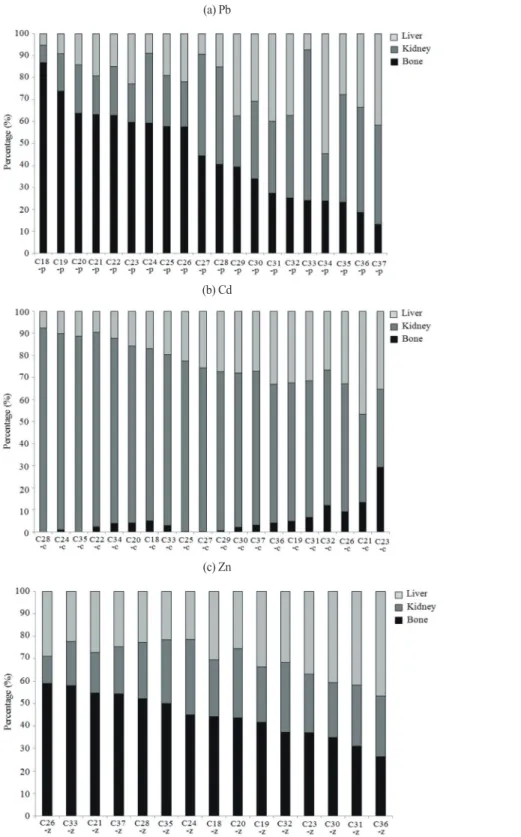
~11.5%) 순으로 나타났다(Figure 3(a)). 다음으로 국내외 연구 중 집비둘기 외 조류 16종의 20개 사례 를 살펴 본 결과, 납은 총 20개 사례 중 10개(Figure 4(a)의 C18-p ~ C26-p, C29-p)에서 뼈가 가장 높 은 비율(39.3~86.6%)을 보였고, 신장은 8개(C27- p, C28-p, C30-p, C32-p, C33-p, C35-p~C37- p)에 서 35.5~68.7% 범 위 를 보 였 고 , 간 은 2개 (C31-p, C34-p)의 사례에서 35.3%와 54.6%로 가 장 높은 비율을 보였다(Appendix 3). 이상의 결과로 볼 때, 납의 주요 축적 조직은 뼈라고 볼 수 있으며, 서식환경 등에 따라 신장에서의 축적이 높게 나타날 수도 있다고 판단된다. 납은 일반적으로 뼈에 주로 축적되는 것으로 알려져 있다(Scheuhammer 1987).
뼈의 주요 구성성분은 칼슘(Ca)인데, 뼈에 공급되어 야 할 칼슘 대신 납이 유입되기 때문이다. 중금속의 특성 중 하나는 체내에 유입되면 흡착력이 강한 산화 형태를 띠는 것이다(Duruibe et al. 2007). 납은 산 화된 형태(Pb2+)로 칼슘흡수 효소에 칼슘대신 흡착되 어 뼈에 축척된다(Rabinowitz 1991). 또한 신장은 배 설기관으로서 다양한 중금속이 축적되는 특성이 있 다. 특히, 금속 독성을 완화시키기 위한 금속 흡착 단 백질(예: 메탈로치오네인)은 신장에서 납과 같은 중 금속과 강한 흡착형태로 축적되는 것으로 알려져 있 다(Gonick 2011; Wang et al. 2009). 간의 경우는 체내에 유입된 물질이 일차적으로 거치는 해독기관 으로서 간을 거쳐서 이후에 기타 생체조직(뼈, 신장 등)으로 이동하게 되는데, 신장과 마찬가지로 금속 흡착 단백질인 메탈로치오네인이 합성되어 중금속을 흡착하나, 신장보다는 생물학적 반감기가 짧은 것으 로 알려져 있다(Kim et al. 2006). 중금속 노출 특성 은 장기간에 걸친 만성 노출과 단기간의 급성 노출로 나눌 수 있는데, 납의 경우, 간보다 뼈의 축적농도가 크면 만성적 노출로 인한 영향으로 보지만, 반대로 간에서 더 높은 축적농도를 보이면 단기간의 급성 노 출에 의한 것으로 판단한다(Kim et al. 2009). 본 연 구에서 한강공원과 함평공원의 납 축적농도 비율은 뼈에 각각 82.3%와 67.9%였고, 간에 각각 4.8%,
5.9%를 보여 장기간의 만성적 노출에 의한 축적특성 을 보인다고 볼 수 있다.
다음으로 카드뮴(Cd)을 살펴보면, 본 연구에서 직 접 채집·분석한 집비둘기의 경우는 신장(전체:
84.1%, 한강공원: 85.1%, 함평공원: 82.2%)에서 가 장 높은 비율을 보였고, 다음으로 간(전체: 14.8%, 한강공원:14.1%, 함평공원: 16.2%), 허파(전체:
1.1%, 한강공원: 0.8%, 함평공원: 1.6%) 순으로 나타 났다. 뼈에서는 한강공원, 함평공원 두 곳 모두 카드 뮴이 검출한계 미만으로 나타나 축적농도가 표시되 지 않았다(Figure 1, Appendix 1). 국내 집비둘기 연 구사례의 경우는 하나의 사례를(Figure 2(b)의 C6- c: 간 28.1%, Appendix 2)를 제외하고 6개 사례 모 두에서 신장이 49.4~85.5% 범위로 가장 높은 비율 을 보였다. 국외 집비둘기 체내 축적농도 사례에서는 7개 사례 모두 신장(61.5~93.0%), 간(6.1~35.9%), 허파(0.4~2.6%) 순으로 나타났다(Figure 3(b), Appendix 2). 다음으로 국내외 연구 중 집비둘기 외 조류의 카드뮴 축적 사례 20개 중 C21-c와 C23-c 를 제외한 나머지 18개 사례 모두가 신장(58.2~
92.4%)에서 가장 높은 비율을 나타냈고, C21-c 사 례는 간이 46.5%로 가장 높았고, C23-c는 사례는 신장과 간이 35.3%로 같은 비율을 보였다(Figure 4(b), Appendix 4). 이상의 결과로 볼 때, 카드뮴의 주요 축적 조직은 신장인 것으로 판단할 수 있다. 카 드뮴은 금속 흡착 단백질인 메탈로치오네인과 결합 하여 축적되는데, 메탈로치오네인은 간과 신장에서 주로 생성되지만, 생물학적 반감기는 신장이 더 길기 때문에 신장의 축적비율이 높게 나타나는 것으로 판 단된다(Kim et al. 2006; Lee 1996). 카드뮴 노출 특 성 판단에서 간보다 신장의 축적농도가 크면 만성적 노출로 인한 영향으로 보지만, 반대로 간이 신장보다 더 높은 축적농도를 보이면 단기간의 급성 노출에 의 한 것으로 판단한다(Kim et al. 2009). 본 연구의 한 강공원과 함평공원의 카드뮴 축적농도 비율은 신장 에 각각 85.1%와 82.2%였고, 간에 각각 14.1%, 16.2%를 보여 장기간의 만성적 노출에 의한 축적특 성을 보인다고 볼 수 있다.
아연(Zn)의 경우는 한강공원과 함평공원 전체 평
균 농도에서는 뼈가 35.6%로 가장 높은 비율을 보였 고, 다음으로 간 31.2%, 신장 27.4%, 허파 5.8% 순 으로 나타났다. 한강공원에서는 간이 36.9%, 다음으 로 뼈 32.3%, 신장 25.7%, 허파 5.1%로 나타났다.
함평공원에서는 뼈가 40.1%, 신장 29.6%, 간 23.7%, 허파 6.6% 순으로 나타났다(Figure 1, Appendix 1).
국내 집비둘기 연구 사례에서는 뼈(37.1%), 신장 (27.8%), 간(24.2%), 허파(10.9%) 순으로 나타났다 (Appendix 2). 다음으로 국내외 연구 중 집비둘기 외 조류의 아연 축적 사례 15개 중 12개가 뼈(37.0~
59.0%)에서 가장 높은 비율을 보였고, 나머지 3개 사 례는 간(40.6~46.6%)이 가장 높은 비율을 차지하였 다(Figure 4(c), Appendix 5). 이상의 결과로 볼 때, 아연의 주요 축적 조직은 뼈라고 판단되며, 다음으로 간이나 신장인 것으로 판단할 수 있다. 아연은 체내 신진대사의 필수 무기원소로서 각종 효소의 필수 구 성요소이며, 뼈 형성에 필수 요소로 작용하는 것으로 알려져 있다(Honda et al. 1986; Prasad 1993;
Sunder et al. 2008). 또한 간과 신장에서 주로 생성 되는 메탈로치오네인(중금속 흡착 단백질)의 주요 구 성요소인데, 특히 간은 아연의 신진대사를 담당하는 주요 기관으로 알려져 있다(Grüngreiff et al. 2016;
Mills 1989).
철(Fe)은 한강공원과 함평공원 연구에서 간(전체:
51.0%, 한강공원: 54.8%, 함평공원: 45.2%), 허파 (전체: 30.4%, 한강공원: 27.6%, 함평공원: 34.7%), 신장(전체: 10.6%, 한강공원: 10.5%, 함평공원:
10.7%), 뼈(전체: 8.0%, 한강공원: 7.1%, 함평공원:
9.4%) 순으로 나타났다(Figure 1, Appendix 1). 국내 집비둘기 연구 사례에서는 간(40.4%), 허파(33.8%), 신장(22.2%), 뼈(3.5%) 순으로 나타났다(Appendix 2). 그리고 집비둘기 외 조류 연구 중 Honda et al.
(1986)이 연구한 중대백로 사례에서 간(62.4%), 신 장(33.1%), 뼈(4.5%) 순으로 나타났다(Appendix 5).
이러한 결과는 철의 생화학적 역할과 관련이 있는데, 철은 혈액의 적혈구 내 헤모글로빈의 주요 구성원소 이다. 헤모글로빈은 허파에서 산소와 결합하여 체내 로 산소를 공급하는 기능을 담당하는데, 적혈구가 수 명을 다하여 파괴되면, 철은 재활용을 위해 간에 저
장되는 것으로 알려져 있다(Lee 1996; Nam et al.
2002b).
알루미늄(Al)은 한강공원과 함평공원 모두에서 허 파가 95% 이상의 높은 비율을 차지하였다(Figure 1, Appendix 1). 하지만 기존 비교 연구사례가 적어 추 가 농도분포 자료를 제시하지는 못했다. 다만 알루미 늄의 생화학적 기작에 대해서 살펴보면, 알루미늄은 구강을 통해 소화기로 유입되는 경우, 장에 의한 흡 수는 매우 적고, 그나마도 거의 대부분 배설되어 체 내 축적은 거의 이루어지지 않는 것으로 알려져 있다 (Barabasz et al. 2002; Scheuhammer 1987). 조류 에 있어서 먹이를 통해 유입된 알루미늄에 대한 노출 과 배출특성은 신장이나 간보다는 뼈의 축적 정도가 더 잘 반영하는 것으로 알려져 있다. 뼈에서 10 μg/g dry 이상 수준으로 축적되는 경우, 알루미늄의 갑작 스러운 노출 증가 또는 배출 기능 감소를 의미하는 것으로 알려져 있다(Scheuhammer 1987). 본 연구 에서 한강공원과 함평공원은 뼈에서의 평균농도가 각각 1.608 μg/g dry와 1.264 μg/g dry로 나타나 알 루미늄과 관련한 노출 또는 배출 기능 측면에서의 문 제는 없는 것으로 판단된다(Appendix 1). 알루미늄 은 산소, 규소 다음으로 지각에 풍부하게 존재하는 원소로서 토양에 풍부하며, 인간 활동 정도에 따라 대기에도 상당량 존재한다(Barabasz et al. 2002).
Watanabe et al.(1990)은 집비둘기(Columba livia) 허파의 알루미늄 축적을 실험했는데, 90~160 μg/g dry를 농도를 나타냈다고 보고한 바 있다. 본 연구의 한강공원과 함평공원의 집비둘기 허파에서는 각각 86 μg/g dry와 96 μg/g dry 나타내 다른 생체조직 에 비해 허파의 축적농도가 상당히 높은 것으로 나타 났다. 이러한 허파 내 알루미늄의 고축적은 구강을 통한 소화기 유입경로보다는 호흡에 의한 대기오염 물질 흡입 경로에 의한 축적으로 판단되나 향후에 추 가적인 연구와 검토가 필요하다.
V. 결 론
본 연구에서는 환경오염 모니터링 지표종인 집비 둘기의 생체조직 내 중금속 축적특성을 국내외의 여
러 조류 종 사례와 함께 검토하였다. 유해 중금속인 카드뮴은 집비둘기를 포함한 조류에서 대부분 신장 에 가장 높은 축적농도 비율을 보였다. 다만 간에서
Figure 1. The heavy metal concentration ratios of feral pigeon tissues in Hangang Park and Hampyeong Park
※Total value : the ratio of mean concentration ((Hangang Park + Hampyeong Park) / 2).
(c) Hampyeong Park (b) Hangang Park
(a) Total
가장 높은 비율을 보인 몇몇 연구사례의 경우, 단기 간의 카드뮴 급성 노출에 영향을 받았을 가능성이 크
다고 판단된다. 유해 중금속인 납은 뼈가 가장 높은 축적농도 비율을 보인 조직으로 나타났으며, 다음으 Figure 2. The lead (Pb) and Cadmium (Cd) concentration
ratios of feral pigeon’s tissues in reviewed papers of Korea (Nam et al. 2002a; Yoon 2000)
※Each acronym is explained in Appendix 2.
(b) Cd (a) Pb
Figure 3. The lead (Pb) and Cadmium (Cd) concentration ratios of feral pigeon’s tissues in reviewed international papers (Cui et al. 2013; Elabidi et al. 2010; Johnson et al. 1982)
※Each acronym is explained in Appendix 2.
(b) Cd (a) Pb
Appendix 1. The heavy metal concentrations (mean ± standard error) of feral pigeon (Columba livia) in Hangang Park and Hampyeong Park 2013
Heavy metals Survey site n Bone(µg/g dry) Kidney(µg/g dry) Liver(µg/g dry) Lung(µg/g dry)
Pb Hangang 6 16.621 ± 5.769 2.116 ± 0.393 0.968 ± 0.158 0.488 ± 0.104
Hampyeong 6 4.858 ± 1.232 1.490 ± 0.182 0.425 ± 0.057 0.376 ± 0.039
Cd Hangang 6 ND 8.773 ± 4.230 1.450 ± 0.238 0.083 ± 0.008
Hampyeong 6 ND 4.463 ± 1.406 0.881 ± 0.211 0.086 ± 0.007
Zn Hangang 6 193 ± 8 154 ± 17 220 ± 23 31 ± 1
Hampyeong 6 178 ± 15 132 ± 6 105 ± 12 29 ± 2
Fe Hangang 6 523 ± 22 773 ± 96 4,033 ± 736 2,030 ± 86
Hampyeong 6 461 ± 15 525 ± 42 2,218 ± 285 1,699 ± 66
Al Hangang 6 1.608 ± 0.233 1.120 ± 0.096 1.031 ± 0.120 86 ± 44
Hampyeong 6 1.264 ± 0.204 1.086 ± 0.174 1.090 ± 0.202 96 ± 33
ND: non-detectable.
Figure 4. The lead (Pb), Cadmium (Cd), and Zinc (Zn) concentration ratios of other birds’ tissues in reviewed papers (Deng et al. 2007; Honda et al. 1986; Hulse et al. 1980; Kim et al. 2006; Kim et al. 2009; Llacuna et al. 1995)
※Each acronym is explained in Apeendix 3~5.
(c) Zn (b) Cd (a) Pb
Appendix 2. The mean concentrations (μg/g dry) of heavy metals of pigeons in the reviewed papers Heavy
metals Case
No. English name Scientific
name Location Age n Bone Kidney Liver Lung Reference
Pb
C1-p Feral pigeon Columba livia Seoul, Korea Adult 12 29.5 12.39W 6.99W 5.13W Nam et al. 2002a C2-p Feral pigeon Columba livia Ulsan, Korea Adult 10 24.6 9.87W 5.52W 5.40W Nam et al. 2002a C3-p Feral pigeon Columba livia Busan, Korea Adult 9 23.8 12.09W 8.16W 5.82W Nam et al. 2002a C4-p Feral pigeon Columba livia Ansan, Korea Adult 10 10.5 8.94W 5.40W 4.74W Nam et al. 2002a C5-p Feral pigeon Columba livia Kwangju, Korea Adult 7 19.76 22.56W 11.16W 15.09W Yoon 2000 C6-p Feral pigeon Columba livia Duckjeok, Korea Adult 8 1.80 4.35W 4.71W 2.82W Nam et al. 2002a C7-p Feral pigeon Columba livia Yochon, Korea Adult 11 2.13 7.56W 4.08W 4.65W Nam et al. 2002a
Cd
C1-c Feral pigeon Columba livia Seoul, Korea Adult 12 0.23 3.15W 0.72W 0.66W Nam et al. 2002a C2-c Feral pigeon Columba livia Ulsan, Korea Adult 10 0.31 3.81W 0.93W 0.78W Nam et al. 2002a C3-c Feral pigeon Columba livia Busan, Korea Adult 9 0.29 1.98W 0.75W 0.57W Nam et al. 2002a C4-c Feral pigeon Columba livia Ansan, Korea Adult 10 0.27 1.29W 0.42W 0.63W Nam et al. 2002a C5-c Feral pigeon Columba livia Kwangju, Korea Adult 7 0.03 1.77W 0.18W 0.09W Yoon 2000 C6-c Feral pigeon Columba livia Duckjeok, Korea Adult 8 0.18 0.18W 0.33W 0.27W Nam et al. 2002a C7-c Feral pigeon Columba livia Yochon, Korea Adult 11 0.33 2.04W 0.63W 0.60W Nam et al. 2002a Zn - Feral pigeon Columba livia Kwangju, Korea Adult 7 81 61W 53W 24W Yoon 2000 Fe - Feral pigeon Columba livia Kwangju, Korea Adult 7 49 305W 555W 464W Yoon 2000 Pb
C8-p Feral pigeon Columba livia Agricultural land,UK - 8 12 6.3 2.3 - Johnson et al. 1982 C9-p Feral pigeon Columba livia Dorchester, UK - 8 33 17 6.5 - Johnson et al. 1982 C10-p Feral pigeon Columba livia Liverpool, UK - 12 245 189 13.7 - Johnson et al. 1982
Cd
C11-c Feral pigeon Columba livia Centre of town,Morocco Adult 9 - 9.21W 0.60W 0.090W Elabidi et al. 2010 C12-c Homing pigeons - Beijing, China 9-10+years 24 - 11.137 0.947 0.116 Cui et al. 2013 C13-c Homing pigeons - Beijing, China 1-2 years 10 - 2.142 0.299 0.056 Cui et al. 2013 C14-c Homing pigeons - Beijing, China 5-6 years 15 - 2.676 0.383 0.059 Cui et al. 2013 C15-c Feral pigeon Columba livia Kamra, Morocco Adult 10 - 1.74W 0.57W 0.009W Elabidi et al. 2010 C16-c Feral pigeon Columba livia Oulja, Morocco Adult 6 - 0.78W 0.39W 0.024W Elabidi et al. 2010 C17-c Feral pigeon Columba livia Allal Behraoui,Morocco Adult 6 - 0.36W 0.21W 0.015W Elabidi et al. 2010 w: Wet weight values multiplied by 3 were used as dry weight values in kidney, liver, and lung.
Appendix 3. The mean concentrations (μg/g dry) of lead (Pb) of birds in the reviewed papers
Case No. English name Scientific name Location n Bone Kidney Liver Reference
C18-p Greenfinch Carduelis sinica Beijing, China 20 7.46¶ 0.68 0.45 Deng et al. 2007 C19-p Great tit Parus major Beijing, China 25 5.24¶ 1.21 0.64 Deng et al. 2007 C20-p Blackbird Turdus merula Cercs, Spain 8 15.64 5.40 3.48 Llacuna et al. 1995 C21-p Ancient murrelet Synthliboramphus antipuus Hongdo Island, Jeollanam-do, Korea 8 13.3 3.70 4.04 Kim et al. 2009 C22-p Cattle egret Bubulcus ibis Texas, USA 9 7.93 2.82W 1.89W Hulse et al. 1980 C23-p Rufous turtle dove Streptopelia orientalis Gyeonggi-do, Korea 3 1.51 0.44 0.58 Kim et al. 2009 C24-p Blackbird Turdus merula St.Jaume de Frontanya,
Spain 4 8.70 4.68 1.30 Llacuna et al. 1995 C25-p Arctic loon Gavia arctica Busan, Korea 12 1.49 0.60 0.49 Kim et al. 2006
C26-p Passerines - Gyeonggi-do, Gangwon-do 6 1.84 0.66 0.70 Kim et al. 2009
Appendix 3. Continued
Case No. English name Scientific name Location n Bone Kidney Liver Reference
C27-p Red-throated loon Gavia stellata Busan, Korea 4 0.91 0.95 0.19 Kim et al. 2006 C28-p Rock bunting Emberiza cia Cercs, Spain 8 3.67 4.04 1.37 Llacuna et al. 1995 C29-p Pacific loon Gavia pacifica Busan, Korea 9 1.28 0.76 1.22 Kim et al. 2006 C30-p Eastern great white egret Egretta alba modesta Cheonan, Korea 5 0.23 0.24W 0.21W Honda et al. 1986
C31-p Waterfowls - Gangwon-do 3 1.45 1.74 2.12 Kim et al. 2009
C32-p Raptors - Gyeonggi-do, Gangwon-do 7 1.05 1.57 1.55 Kim et al. 2009
C33-p Great tit Parus major Cercs, Spain 6 2.49 7.12 0.76 Llacuna et al. 1995
C34-p Laughing gull Larus atricilla Texas, USA 25 6.93 6.30W 15.93W Hulse et al. 1980 C35-p Rock bunting Emberiza cia St.Jaume de Frontanya,
Spain 4 2.47 5.22 2.95 Llacuna et al. 1995
C36-p Herons and egrets - Gyeonggi-do,
Chungcheongnam-do 10 2.07 5.30 3.72 Kim et al. 2009 C37-p Great tit Parus major St.Jaume de Frontanya,
Spain 5 1.00 3.40 3.14 Llacuna et al. 1995
¶: The lead concentration of the bone was the average value of femur bone and sternum bone.
w: Wet weight values multiplied by 3 were used as dry weight values in kidney and liver.
Appendix 4. The mean concentrations (μg/g dry) of cadmium (Cd) of birds in the reviewed papers
Case No. English name Scientific name Location n Bone Kidney Liver Reference
C18-c Greenfinch Carduelis sinica Beijing, China 20 0.17¶ 2.59 0.56 Deng et al. 2007 C19-c Great tit Parus major Beijing, China 25 0.10¶ 1.32 0.68 Deng et al. 2007
C20-c Blackbird Turdus merula Cercs, Spain 8 0.56 10.9 2.13 Llacuna et al. 1995
C21-c Ancient murrelet Synthliboramphus antipuus Hongdo Island, Jeollanam-do, Korea 8 4.38 13.2 15.3 Kim et al. 2009 C22-c Cattle egret Bubulcus ibis Texas, USA 9 0.088 3.225W 0.345W Hulse et al. 1980 C23-c Rufous turtle dove Streptopelia orientalis Gyeonggi-do, Korea 3 0.05 0.06 0.06 Kim et al. 2009 C24-c Blackbird Turdus merula St.Jaume de Frontanya,
Spain 4 0.26 26.22 2.95 Llacuna et al. 1995 C25-c Arctic loon Gavia arctica Busan, Korea 12 0.02 11.8 3.45 Kim et al. 2006
C26-c Passerines - Gyeonggi-do, Gangwon-do 6 0.05 0.32 0.18 Kim et al. 2009
C27-c Red-throated loon Gavia stellata Busan, Korea 4 0.03 18.3 6.34 Kim et al. 2006
C28-c Rock bunting Emberiza cia Cercs, Spain 8 ND 3.78 0.31 Llacuna et al. 1995
C29-c Pacific loon Gavia pacifica Busan, Korea 9 0.1 13.9 5.3 Kim et al. 2006
C30-c Eastern great white egret Egretta alba modesta Cheonan, Korea 5 15.0 510W 204W Honda et al. 1986
C31-c Waterfowls - Gangwon-do 3 0.08 0.75 0.38 Kim et al. 2009
C32-c Raptors - Gyeonggi-do, Gangwon-do 7 0.09 0.46 0.20 Kim et al. 2009
C33-c Great tit Parus major Cercs, Spain 6 0.08 2.12 0.54 Llacuna et al. 1995
C34-c Laughing gull Larus atricilla Texas, USA 25 0.207 4.527W 0.660W Hulse et al. 1980 C35-c Rock bunting Emberiza cia St.Jaume de Frontanya,
Spain 4 ND 3.29 0.42 Llacuna et al. 1995
C36-c Herons and egrets - Gyeonggi-do,
Chungcheongnam-do 10 0.08 1.22 0.64 Kim et al. 2009 C37-c Great tit Parus major St.Jaume de Frontanya,
Spain 5 0.09 1.97 0.77 Llacuna et al. 1995
¶: The cadmium concentration of the bone was the average value of femur bone and sternum bone.
w: Wet weight values multiplied by 3 were used as dry weight values in kidney and liver. ND: non-detectable.
로 신장에서 높은 축적 비율을 보였다. 따라서 본 연 구지역인 한강공원과 함평공원의 집비둘기 생체조직 내 카드뮴과 납의 분포는 조류 일반의 특성을 잘 반 영한다고 볼 수 있으며, 카드뮴에 대해선 신장과 간, 납에 대해선 뼈와 신장 또는 간의 축적정도를 모니터 링하는 것이 중요하다고 볼 수 있다. 이러한 축적특 성은 메탈로치오네인(중금속 흡착 단백질) 합성 등 체내 신진대사의 주요 요소로서의 기능과 관련이 있 는 것으로 생각되나 향후에 조류 생체조직 내 중금속 의 생화학적 축적 메커니즘 연구와 검토가 추가되어 중금속 축적을 증감시키는 요인과 메커니즘에 대한 이해를 확대시켜나가는 작업이 필요하다.
사 사
본 연구는 국립환경과학원에서 2013년 ‘환경오염 지표종인 집비둘기 시료의 부위별 중금속 농축특성 연구’(NIER-RP2013-340)의 일환으로 수행되었습 니다.
References
Barabasz W, Albi´nska D, Ja´skowska M, Lipiec J.
2002. Ecotoxicology of aluminium. Pol J Environ Stud. 11(3): 199-203.
Brait CHH, Antoniosi Filho NR. 2011. Use of feathers of feral pigeons as a technique for metal quantification and environmental monitoring. Environ Monit Assess. 179:
457-467.
Cui J, Wu B, Halbrook RS, Zang S. 2013. Age- dependent accumulation of heavy metals in liver, kidney and lung tissutes of homing pigeons in Beijing, China.
Ecotoxicology. 22: 1490-1497.
Deng H, Zhang Z, Chang C, Wang Y. 2007.
Trace metal concentration in great tit (Parus major) and greenfinch (Carduelis sinica) at the western mountains of Beijing, China.
Appendix 5. The mean concentrations (μg/g dry) of zinc (Zn) and iron (Fe) of birds in the reviewed papers Heavy
metals Case
No. English name Scientific name Location n Bone Kidney Liver Reference
Zn
C18-c Greenfinch Carduelis sinica Beijing, China 20 154¶ 88 106 Deng et al. 2007 C19-c Great tit Parus major Beijing, China 25 146¶ 86 117 Deng et al. 2007
C20-c Blackbird Turdus merula Cercs, Spain 8 150 106 87 Llacuna et al. 1995
C21-c Ancient murrelet Synthliboramphus
antipuus Hongdo Island,
Jeollanam-do, Korea 8 176 58 87 Kim et al. 2009 C23-c Rufous turtle dove Streptopelia orientalis Gyeonggi-do, Korea 3 21 15 21 Kim et al. 2009 C24-c Blackbird Turdus merula St.Jaume de Frontanya, Spain 4 153 113 72 Llacuna et al. 1995
C26-c Passerines - Gyeonggi-do, Gangwon-do 6 13 3 7 Kim et al. 2009
C28-c Rock bunting Emberiza cia Cercs, Spain 8 210 100 91 Llacuna et al. 1995 C30-c Eastern great white egret Egretta alba modesta Cheonan, Korea 5 87 61W 101W Honda et al. 1986
C31-c Waterfowls - Gangwon-do 3 12 10 16 Kim et al. 2009
C32-c Raptors - Gyeonggi-do, Gangwon-do 7 26 22 22 Kim et al. 2009
C33-c Great tit Parus major Cercs, Spain 6 256 86 99 Llacuna et al. 1995
C35-c Rock bunting Emberiza cia St.Jaume de Frontanya, Spain 4 166 94 72 Llacuna et al. 1995
C36-c Herons and egrets - Gyeonggi-do,
Chungcheongnam-do 10 71 73 126 Kim et al. 2009 C37-c Great tit Parus major St.Jaume de Frontanya, Spain 5 249 96 113 Llacuna et al. 1995 Fe - Eastern great white egret Egretta alba modesta Cheonan, Korea 5 50 366W 690W Honda et al. 1986
¶: The zinc concentration of the bone was the average value of femur bone and sternum bone.
w: Wet weight values multiplied by 3 were used as dry weight values in kidney and liver.
Environ Pollut. 148: 620-626.
Duruibe JO, Ogwuegbu MOC, Egwurugwu JN.
2007. Heavy metal pollution and human biotoxic effects. Int J Phys Sci. 2(5): 112- 118.
Elabidi A, Fekhaoui M, Ghouli A, Piervittori R, Yahyaoui A. 2010. Use of pigeons as bioindicators of air pollution from heavy metals at Rabat-Sale (Morocco). Avocetta.
34: 29-34.
Gonick HC. 2011. Lead-binding proteins: a review. J Toxicol. 2011(2011), Article ID 686050.
Gr˝ungreiff K, Reinhold D, Wedemeyer H. 2016.
The role of zinc in liver cirrhosis. Ann Hepatol. 15(1): 7-16.
Honda K, Min BY, Tatsukawa R. 1986.
Distribution of heavy metals and their age- related changes in the eastern great white egret, Egretta alba modesta, in Korea. Arch Environ Contam Toxicol. 15: 185-197.
Hulse M, Mahoney JS, Schroder GD, Hacker CS, Pier SM. 1980. Environmentally acquired lead, cadmium, and manganese in the cattle egret, Bubulcus ibis, and the laughing gull, Larus atricilla. Arch Environ Contam Toxicol. 9: 65-78.
Johnston RF, Janiga M. 1995. Feral Pigeons.
Oxford University Press, Inc.
Johnson MS, Pluck H, Hutton M, Moore G.
1982. Accumulation and renal effects of lead in urban populations of feral pigeons, Columba livia. Arch Environ Contam Toxicol. 11(6): 761-767.
Kim SJ, Lee JN, Lee DP. 2006. Cadmium and lead levels of loons wintering in Korea. J Ecol Field Biol. 29(6): 539-543. [Korean Literature]
Kim JS, Shin JR, Koo TH. 2009. Heavy metal
distribution in some wild birds from Korea. Arch Environ Contam Toxicol. 56:
317-324.
Lee DP. 1996. Relationship of heavy metal level in birds. Bull Kor Inst Orni. 5(1): 59-67.
[Korean Literature]
Llacuna S, Gorriz A, Sanpera C, Nadal J. 1995.
Metal accumulation in three species of passerine birds (Emberiza cia, Parus major and Turdus merula) subjected to air pollution from a coal-fired power plant.
Arch Environ Contam Toxicol. 28: 298-303.
Mills CF. 1989. Zinc in human biology. Springer- Verlag Berlin Heidelberg.
Nam DH, Lee DP, Koo TH. 2002a. Comparison of lead and cadmium levels in tissues of feral pigeons (Columba livia) from rural, central urban, and industrial complex areas. Korean J Ecol. 25(5): 329-334.
[Korean Literature]
Nam DH, Lee DP, Koo TH. 2002b. Correlation between heavy metal levels in tissues of feral pigeons (Columba livia). Korean J Ecol. 25(5): 335-339. [Korean Literature]
Nam DH, Lee DP, Koo TH. 2003. Comparison of lead and cadmium accumulations in feral pigeons (Columba livia) with different developmental stages from urban and industrial complex areas. Korean J Environ Biol. 21(2): 142-148. [Korean Literature]
Prasad AS. 1993. Biochemistry of zinc. Springer Science+Business Media, New York.
Rabinowitz MB. 1991. Toxicokinetics of bone lead. Environ Health Perspect. 91: 33-37.
Scheuhammer AM. 1987. The chronic toxicity of aluminium, cadmium, mercury, and lead in birds: a review. Environmental Pollut. 46:
263-295.
Sunder GS, Panda AK, Gopinath NCS, Rama
Rao SV. 2008. Effects of higher levels of zinc supplementation on performance, mineral availability, and immune competence in broiler chickens. J Appl Poult Res. 17: 79-86.
Wang L, Chen D, Wang H, Liu Z. 2009. Effects of lead and/or cadmium on the expression of metallothionein in the kidney of rats. Biol Trace Elem Res.
129(1): 190-199.
Watanabe T, Nakatsuka H, Kasahara M, Ikeda M.
1990. Silica and aluminum in the lungs of
feral pigeons and experimental rats exposed to studded tire-gernrated road dust. Environ Int. 16: 23-29.
Yoon HY. 2000. A study on the breeding ecology and heavy metal contents in Columba livia in relation to the growth stage. Kyung Hee University, Graduate School. Master’s Thesis. [Korean Literature]