• 검색 결과가 없습니다.

IEG 환경지질연구정보센터

N/A
N/A
Protected

Academic year: 2021

Share "IEG 환경지질연구정보센터"

Copied!
8
0
0

로드 중.... (전체 텍스트 보기)

전체 글

(1)

Vol. 9, No. 3, p. 227 − 234, September 2005

Variation in dip-angle of the Indian plate subducting beneath the Burma plate and its tectonic implications

ABSTRACT: The paper presents an analysis of the dip-angle of the Benioff zone trajectory, infers the state of stress of the descend- ing Indian plate and the overriding Burma plate, and proposes three-stage episodic development of the descending Indian lithos- phere and the Burma plate along the strike of the Indoburman arc. The first stage accounts for the late Oligocene–early Miocene east–west stretching of back-arc region, which divided the central lowland of Burma into western and eastern troughs along the vol- canic line. The dip-angle of Benioff zone trajectory in sector II (ca.

24.0° to 25.5°N), the late Oligocene–early Miocene westward tran- scurrent displacement of blocks, and the east–west splitting of late Cretaceous–early Eocene ophiolites are evidences of this stretch- ing. The effect of stretching probably lasted through till when post-middle Miocene causing north–northeastward motion of the hanging Indian lithosphere together with the Burma plate through the asthenosphere. This may have been the cause of the westward offset between the main Irrawaddy River and the Chindwin River in the second stage. North–south varying degree of decoupling between the descending Indian plate and overriding plate may account for the interplay between the Indoburman arc and the northward moving Indian plate. The stress state and north–south shallow level seismicity observed in the present study may be evi- dences for a slow subduction of the Indian plate in the recent or third stage of development.

Key words: back-arc, depth-dip-angle of subducting slab, slow subduction 1. INTRODUCTION

It is thought that the early Cenozoic east–northeast motion of the Indian plate started to change its direction around the early Oligocene (Mitchell, 1981; Morgan, 1983; Patriat and Achache, 1984). The motion finally slowed down or even ceased in the late Oligocene–early Miocene (Sclater and Fisher, 1974; Patriat and Achache, 1984; Schluter et al., 2002). A renewed convergence, which in action during the early–middle Miocene caused the Burma micro-plate to become partly coupled with the north moving Indian plate along the subparallel zones of underthrusting and transcur- rent faulting (Fitch, 1972). The convergence resulted in the increase in the obliquity between the Indian and Eurasian plates (McCaffrey et al., 2000; Schluter et al., 2002). The seafloor spreading and transform faulting in the Andaman Sea was accommodated to the north by slip along the Saga- ing fault in Burma (Le Dain et al., 1984). The tectonics of Burma and its surrounding regions are thought to be related

to the change in plate motion pattern from oblique conver- gence and subduction to strike-slip displacements and con- jugate shear on north–south trending faults (Fitch, 1972; Le Dain et al., 1984). These tectonic events might had led to the northward movement of the descending Indian lithos- phere through the asthenosphere and the 460 km opening of the Andaman Sea since mid-Miocene time (Curray et al., 1979;

Le Dain et al., 1984). The northward movement of the Indian plate caused more than 400 km offset along the Irrawaddy River from its former connection; now called the Chindwin River (Maung, 1987).

The decoupling between the northern Indoburman Range from the underlying Indian plate (Maung, 1987; Chen and Molnar, 1990), evolution of troughs on the eastern and west- ern sides of the Burma central belt (Rodolfo, 1969), sliding of the Burma platelet (Win Swe, 1972; Le Dain et al., 1984) and velocity inhomogeneity between the Burma platelet and northward moving Indian plate (Maung, 1987) do not comply with the configuration of the Benioff zones pro- posed by Saikia et al. (1987), Mukhopadhyay and Dasgupta (1988), Ni et al. (1989) and Dasgupta et al. (2003). In par- ticular, the dip of the Benioff zone, as proposed by these workers, seems to be a oversimplification in view of their consideration of average slab dip (ca. 45 ° ) consistent over the entire subducting slab length. Thus, this region addresses a long awaited high-resolution investigation on the deformation of downgoing Indian lithosphere and its effect on the geo- dynamic evolution of the overriding Burmese plate along this plate margin. Two modes for rate of subduction have been proposed in this plate margin. One accounts for active subduction (Verma et al., 1976; Verma and Krishna Kumar, 1987; Mukhopadhyay and Dasgupta, 1988; Satyabala, 1998; Dasgupta et al., 2003), and the another for cessation or slow subduction (Le Dain et al., 1984; Ni et al., 1989;

Chen and Molnar, 1990; Rao and Kumar, 1999) of the Indian plate. However, both fail to provide concrete rea- soning towards this long-standing problem. In this study, I propose three-stage episodic development of the Burma.

The first stage accounts for the evolution of the eastern and western troughs separated by volcanic line on the Burma central belt during the late Oligocene–early Miocene time.

The westward offset of the main Irrawaddy River and for- mation of the Chidwin River occurred in the second stage.

Finally in the last stage the slow subduction of the Indian

P. K. Khan* Department of Applied Geophysics, Indian School of Mines, Dhanbad-826004, India

*Corresponding author: [email protected]

(2)

plate together with the downward deflection or underthrust- ing of the north-western part of Burma plate below the north-east Himalaya occurred.

2. TECTONIC AND GEOLOGICAL BACKGROUND

The early Cenozoic convergence and concurrent subduc- tion of the Indian plate along the Indoburman arc (Mitchell, 1981; Morgan, 1983; Patriat and Achache, 1984) was doc- umented by during the investigations of late Cretaceous–

early Eocene ophiolites and volcanicity (Chhibber, 1934;

Brunnschweiler, 1966; Hatchinson, 1975; Acharya et al., 1990; Bhattacharjee, 1991). The northern part of the central belt (combinedly the Eastern trough, western trough and the volcanic line in between; Fig. 1) contain information on the episodic volcanic activity which began around the late Cre- taceous–early Eocene and continued until recently with intermittent activities during the Oligocene, Miocene and Pleistocene along its southern side (Chhiber, 1934; Rodolfo, 1969; Curray et al., 1979; Gill, 1981; Saikia et al., 1987). The eastern side of the Indoburman Range experienced severe folding and westward thrusting (antithetic character), verti- cal faultings and block movement (Chhibber, 1934; Desika- char, 1974; Mitchell and McKerrow, 1975; Dutta and Saikia, 1976; Saikia et al., 1987). These activities can be seen in the

large-scale displacement of ophiolites (Brunnschweiler, 1966;

Acharyya et al., 1990; Bhattacharjee, 1991) during the late Oligocene–early Miocene. The early Tertiary east–west conver- gence and folding was more intense in the Naga Hills than in its south, and is thought to be related with the subduction of the Indian plate (Curray et al., 1979; Mitchell, 1981; Bender, 1983). The major phase of folding occurred during the late Oligocene–early Miocene (Brunnschweiler, 1966; Mitchell and McKerrow, 1975). Folding and westward reverse-fault- ing which molded the Burma were triggered by the westerly component of transcurrent movement of blocks (Rodolfo, 1969). This period was characterised by the intermittent ver- tical movements of crustal blocks along the western trough of the central lowland of Burma, which continued through- out the Tertiary. On the other hand, the eastern trough expe- rienced a similar event during the early Miocene (Desikachar, 1974; Mitchell and McKerrow, 1975). The rootless ophiolite bodies near the eastern part of the Indoburman arc (Fig. 1), which are wider in the northern Nagaland sector and nar- rows towards south in Manipur, are characteristic features of this region (Acharya et al., 1990; Bhattacharjee, 1991).

Another ophiolite belt along the igneous line of the central belt of Burma was identified by Chhibber (1934). The geo- logical details of this belt remain unclear (Bender, 1983).

The oblique to tangential indentation of the Indian plate

Fig. 1. Map on left showing regional tectonic framework of the western part of southeast Asia after Tapponnier et al. (1982). Left bottom

open arrow indicates Indian plate motion vector and right top open arrow for major block motion with respect to Siberia since Miocene

time. The geological set-up of the Burma showing on right after Curray et al. (1979), Le Dain et al. (1984) and Maung (1987).

(3)

against the Eurasian plate may have caused the subduction zone to rotate in clockwise direction (Curray et al., 1982) and caused the overriding Indoburman Range in the west- ern Burma on India to move towards the west. Such tan- gential convergence of the Indian plate may have initiated the right-lateral movements along both the Indoburman Range and Kabaw fault (Fitch, 1972; Curray et al., 1979).

The sliding of the Burma platelet since mid-Miocene may have caused the leading edge of the Eurasian plate to shear off along the Sagaing fault (Win Swe, 1972; Mitchell and McKerrow, 1975; Curray et al., 1979; Le Dain et al., 1984).

3. SEISMICITY

A total of 943 earthquake data (m

b

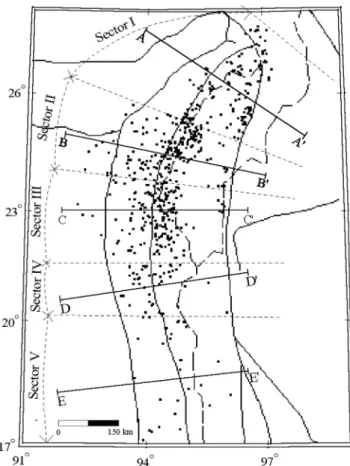
3.5), recorded at more than 15 stations, which lie between latitudes 17 ° and 28 ° N were considered for the present study. Of these data, 766 which lie on the downgoing Indian plate were used for the reconstruction of Benioff zone trajectory. The remaining 177 earthquakes lie on the overriding Burma plate. The datasets were taken from ISC (International Seismological Centre) Bulletin spanning the period between 1964 and 1999. Based on geotectonic trend, geologic information and seismic activity, the study area was divided into five sectors from

Fig. 2. Map showing the sectorwise distribution of earthquake epi- centres and AA'–EE' represent five depth section profiles in five respective sectors in the studied area.

Fig. 3. Diagrams showing sector-specific distribution of earth-

quake’s hypocentre on vertical depth sections. Thin lines represent

the Benioff zone trajectory. Note variation in Benioff zone trajec-

tories between different sectors and the hypocentres in sector II to

V of the Burma plate lie away from the descending Indian plate

with very close distribution in sector I.

(4)

the northern to southern Burma along the plate boundary (I to V; Fig. 2).

Figure 3 shows the Benioff zone trajectories over differ- ent depth ranges of the descending Indian lithosphere for the five sectors. The sectors span 33 187 km (91 hypocentres;

sector I), 1 − 205 km (261 hypocentres; sector II), 7 − 160 km (160 hypocentres; sector III), 28 152 km (106 hypocentres;

sector IV) and 8 98 km (43 hypocentres; sector V). Sector II shows the maximum concentration of seismic activity which decreases southwards from sector III to sector IV and drops abruptly in sector V. From sectors I to V, there are 82, 43, 36, 7 and 9 earthquakes on the Burma plate with max- imum events in sector I. The deepest hypocentre on the Burma plate is 74 km in sector I. According to figure 3, the hypocentres of the earthquakes that occur in sectors II to V of Burma plate are located away from the descending Indian plate. For sector I, they lie very close to the descend- ing plate.

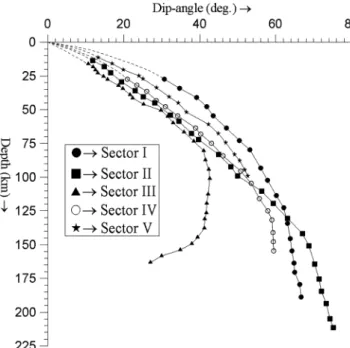
Assuming that all the earthquakes occur within the down- going slab, a smooth curve can be drawn (Khan, 2003) that best matches the distribution of hypocentres (Fig. 3). A comparison of the depth versus dip-angle plot of Benioff zone trajectories reveals a large spatial variations (Fig. 4).

These variation can be attributed to i) successive increase in the depth of flexing of plate (ca. 40 km depth variation) from sectors II to III; ii) near coincident trajectories at shal- low depths, which deviate from around 74 km to 101 km depths in their dip angle; iii) decrease in dip-angle at depths greater than 137 km in sector III, iv) abrupt dip-angle vari- ation from sectors II to III which shows 26 ° at 101 km

depth, and 42 ° at 163 km depth. These variations in dip- angle of the slab are consistent with the abrupt change in Bouguer gravity anomalies ( − 150 to 175 mgal) towards the eastern part of the northern Indoburman Range (Evans and Crompton, 1946; Verma et al., 1976). It also demonstrates that the Indian plate has flexed down considerably during its active subduction period beneath the Indoburman Range.

The coincidence of closely spaced structure contours in sec- tor II for the top surface of descending Indian lithosphere (Dasgupta et al., 2003) or the closeness of contours of Wadati-Benioff zone towards north (Ni et al., 1989) appear to be consistent with the present observation of abrupt dip- angle change (between sectors II and III). Successive lower dip-angle value can be seen at shallow depth from sectors I to II with minimum in sector III. The dip-angle increases towards south and becomes maximum in sector V. Though such dip-angle variation is not so large except between sec- tors I and II, the observed variation can be explained in terms of interplay between the Indoburman arc and north- ward drag imposed on the Indian lithosphere. The supposed radius of curvature of the Indoburman arc (cf. Maung, 1987), however, do not comply with the presently interpreted plate flexing in sector II. The nonconformity between plate shape and subduction margin geometry might have caused the intra- plate extension and have resulted in the tearing of the sub- duction slab between sectors II and III in this plate margin.

4. STATE OF STRESS

Figure 5 shows the predominant state of stress (Khan, 2000, 2003) within the descending Indian plate and the overriding Burma plate. The plunge and azimuth values of maximum (P) and minimum (T) compressive stress axes of the earthquakes occurring between May 1976 and Decem- ber 2000 were obtained from Harvard CMT solutions, and between March 1954 and April 1976 from the reports of Rastogi et al. (1973), Ben Menahem et al. (1974), Tandon and Srivastava (1975), Chaudhury and Srivastava (1976), Verma et al. (1976), Chandra (1978), Verma et al. (1980), Verma and Reddy (1988), Chen and Molnar (1990), Holt et al. (1991) and Mukhopadhyay (1992). Though, these solu- tions are from different sources, the present study concen- trates on a population of data (P and T axes), the closeness or clustering of which allowed prediction for ambient stress field with greater certainty. The predominant direction of stress could be used as good indicator for recognition of regional stress field (Zoback and Zoback, 1980; Sbar, 1982).

Based on the depth-wise dip-angle variation for the descending Indian lithosphere, I examined the state of stress at two depth ranges ( ≤ 89 km and >89 km). This shows a cluster of E −

W trending horizontal P axes all through the Benioff zone in sectors I, III and IV, which may account for the eastward convergence of the Indian plate. On the other hand, NNW −

SSE, N S and NNE SSW trending horizontal P axes in

Fig. 4. Downdip dip-angle variation of the Benioff zone trajectory

for different sectors. Note sharp variation in subduction angle

between sectors II and III.

(5)

sectors II, III, and IV appear to be consistent with the north- ward convergence of the Indian plate. These observations are consistent with the shape of curvature of the Indobur-

man Range, which in turn is controlled by the geometry of the interface between the dipping part of the Indian plate and the leading edge of the overriding Burma plate (Ni et al., 1989). Moreover, the sub-vertical to vertical T axes at depth greater than 89 km in sectors from I to IV, parallel with the descending Indian plate, may have been caused by the downward pulling of the descending Indian lithosphere by slab pull force. At shallow level, WNW ESE and E W trending horizontal T axis sectors from II to IV might be related with the magnitude of decoupling between the descending Indian plate with the overriding mass also was noticed in seismic activity (Fig. 3) and depth-dip-angle rela- tion (Fig. 4). Isacks and Molnar (1971) and Apperson and Frohlich (1987) surmised orientation of either P or T axis towards down-dip direction of the descending lithosphere in any active subduction zone depending on predominance of compression or tension. In contrast, this consistent cluster- ing in either P or T along down-dip direction is not observed in all the sectors discussed here of the Wadatti-Benioff zone. The Burma plate documents WSW ENE trending horizontal P axis. Generally, the tectonic stress in the over- riding plate at a subduction boundary is presumably com- pressional because two plates are converging at the boundary.

Thus, the nature of stress is consistent in the overriding plate, while this is partly conforming with the subduction of the Indian plate. Thus there may be a lagging of the Burma plate motion behind the northward dragging Indian plate (Maung, 1987). Further, the coupling between the subduct- ing and the overriding plates can be varied with time as the slab configuration and the plate motion change, which is indirectly related with the tectonic stress on both these plates (Uyeda and Kanamori, 1979; Froidevaux et al., 1988). Thus, the entire region is partially dominated by eastward con- vergence of the Indian plate, which is occasionally over- come by its northward dragging. The downdip oriented T axis to the north of 26 ° latitude and the evidence of thrust faulting (Le Dain et al., 1984; Ni et al., 1989; Holt et al., 1991;

Khan, 2000; Dasgupta et al., 2003) may be related with the downward deflection (Mukhopadhyay and Dasgupta, 1988) or underthrusting (Maung, 1987; Ni et al., 1989) of northern part of the Burma plate beneath the north-east Himalaya.

The NNW − SSE trending horizontal T axis between latitude 25 ° N and 24 ° N of the Burma plate either possibly related with the decoupling effect or intra-continental deformation.

5. DISCUSSION

Considering an average rate of subduction valid for the Indian plate over the entire late Tertiary time the present study thrives towards understanding of high-resolution depth-dip angle trajectories for the Benioff zones over Burma sub- duction margin. Contray to earlier assumptions, the present work clealy reveals that benioff zone trajectories over this region not only varied spatially but on any particular sector

Fig. 5. Diagrams showing the lower hemisphere projections of P and T axes. Indian plate: open circles and squares for shallow depth events ( ≤ 89 km), solid ones for deep depth events (>89 km).

Burma plate: circles, squares and triangles for events north of 26°,

between 25° and 26° and south of 25° latitudes.

(6)

dip variation can be recorded also in temporal frame. This in-depth observation definitely allowed the author to under- stand the temporal evolution of subduction mechanism and the causative forcings in a better and comprehensive way.

Episodic volcanic activity (ranging from late Cretaceous to Holocene time) on the overriding plate with chronolog- ical shfting in loci in northward direction (Chhiber, 1934;

Rodolfo, 1969; Curray et al., 1979; Gill, 1981; Saikia et al., 1987) and east–west stretching in the back-arc region com- ply well with the sequential development of the western and eastern troughs of the central lowland of Burma during late Oligocene–early Miocene time (cf. Bertrand and Rangin, 2003). The plate flexing at shallow depth and abrupt dip- angle change at ca. 100 km depth in sector II record history of this east–west stretching in the central lowland of Burma.

The Oligocene–Miocene east–west splitting of ophiolite trend, intense folding and westward reverse-thrusting through east–west block displacement and transcurrent movement (Brunnschweiler, 1966; Rodolfo, 1969; Desikachar, 1974;

Mitchell and McKerrow, 1975; Acharya et al., 1991) in the central Burma region also corroborate the present observa- tion. Beck (1991) and McCaffrey (1992) suggested that the deformation by oblique subduction may take place on the overriding as well as within the downgoing plate, and this may be acted upon by downgoing slab pull force. The clockwise rotation of the subduction zone north of sector III has changed the obliquity between the Indian and Burma plates, which further caused the Indoburman Range to over- ride the Indian plate towards the west. Thus the slab pull force along with the stress impressed by the Indoburman Range may have deformed the descending Indian plate as well as the Burma plate with the initiation of formation of eastern and western troughs of Burma through the intermit- tent volcanic activities. Such features (Indoburman Range) at the subduction zones when attained a critical thickness and rigidity, became capable of transmitting the applied stresses without failure, increase the stress level over the base of the accretionary prism and caused deformation in that area (Karig et al., 1980). The effect of late Oligocene–

early Miocene east–west stretching and transcurrent move- ment of the back-arc region appears to have continued into the mid-Miocene which further initiated the westward off- setting of the then main Irrawaddy River. The post-middle Miocene shearing of leading edge of the Burma plate along the Sagaing fault and the clockwise rotation of the region around the Eastern Himalayan Syntaxis (Holt et al., 1991) possibly limits its eastward shifting. Tentative time corre- lation for the initial two phases can be attempted from plate convergence rate, subducted slab length and depth of abrupt dip angle change in Benioff zone trajectory. Considering Indian plate subduction rate as ca. 2.0 cm/yr (Peltzer and Saucier, 1996), the time duration reflected by the subducted slab length down to 200+ km is approximately the last 10 Ma or so, which corresponds to the second stage of west-

ward offsetting of the main Irrawaddy River since the mid- Miocene. For the first stage, conceived in the present model, the evidences are derived from steeper part of the Benioff zone trajectory at higher depth (165+ km) in sector II. The Benioff zone trajectory of sector II between 115 km and 165 km depths possibly accounts for the westward folding and thrusting along with vertical subsidence, supposed in the early history of development of the Burma.

The two school of thoughts proposed for the Indian plate subduction rate along this plate margin (Molnar et al., 1973;

Verma et al., 1976; Le Dain et al., 1984; Verma and Krishna Kumar, 1987; Mukhopadhyay and Dasgupta, 1988; Ni et al., 1989; Chen and Molnar, 1990; Satyabala, 1998; Rao and Kumar, 1999; Dasgupta et al., 2003) partially comply with the shallow level seismicity. However, they are unable to explain the shallow as well as deeper level stress state observed in the present study. Strikewise diversity in pre- dominant trend of P axes and T axes and north–south depth-dip-angle relation at shallow depths, and downdip T axis at higher depth gives evidences for the convergence and varying strength of decoupling between the Indian and Burma plates. This coupling inhomogeneity along this mar- gin can be interpreted as the low concentration of shallow level seismicity in some sectors and vice versa, and might have been affected by the interplay between the radius of curvature of the Indoburman Range and northward moving Indian and Burma plates. N S to E W strain rates variation suggested by Rao and Kumar (1997) for the Indoburman arc region possibly related with this strike-wise decoupling strength variation. The nonconsistent P axes all through the Benioff zone in the five sectors, downdip T axes at higher depths of the descending Indian plate and the downward deflection or underthrusting of the north-western part of the Burma plate below the Eastern Himalayan Syntaxis may be evidences for the recent slow down of subduction of the Indian plate.

ACKNOWLEDGEMENTS: The author is grateful to the Depart- ment of Science and Technology (DST), Govt. of India, New Delhi for assisting the financial support and the Director, Indian School of Mines (ISM) and Head, Department of Applied Geophysics, ISM, Dhanbad for providing the infrastructural facilities and inspiration. Thanks are also due to Dr. Partha Pratim Chakraborty, Department of Applied Geology, ISM for critically going through an early version of the manuscript and suggesting many improvements.

REFERENCES

Acharya, S.K., Ray, K.K. and Sengupta, S., 1990, Tectonics of the ophiolite belt from Naga Hills and Andaman Islands, India. Pro- ceeding of the Indian Academy Science, Earth and Planetary Sci- ences, 99, 187 199.

Apperson, K.D. and Frohlich, C., 1987, The relationship between

Wadati-Benioff Zone geometry and P, T and B axes of interme-

diate and deep focus earthquakes. Journal of Geophysical Research,

92, 13821 13831.

(7)

Beck, M.E., Jr., 1991, Coastwise transport reconsidered: Lateral dis- placements in oblique subduction zones, and tectonic conse- quences. Physics of the Earth and Planetary Interiors, 68, 1 − 8.

Ben Menahem, A., Aboodi, E. and Schild, R., 1974, The source of great Assam earthquake an interplate wedge motion. Physics of the Earth and Planetary Interiors, 9, 265 − 289.

Bender, F., 1983, Geology of Burma, Gebruder Brontraeger, Berlin, 293 p.

Bertrand, G. and Claude, R., 2003, Tectonics of the western margin of the Shan plateau (central Myanmar): implication for the India- Indochina oblique convergence since the Oligocene, 21, 1139 1157.

Bhattacharjee, C.C., 1991, The ophiolites of northeast India - a sub- duction zone ophiolite complex of the Indo-Burman orogenic belt. Tectonophysics, 191, 213 222.

Brunnschweiler, R.O., 1966, On the geology of the Indo-Burma ranges.

Geological Society of Australia Journal, 13, 127 − 194.

Chandra, U., 1978, Seismicity, earthquake mechanisms and tectonics along the Himalaya mountain range and vicinity. Physics of the Earth and Planetary Interiors, 16, 109 − 131.

Chaudhury, H.M. and Srivastava, H.N., 1976, Seismicity and focal mechanisms of some recent earthquakes in NE India. Annal Geo- physics, 29, 41 − 56.

Chen, W.P. and Molnar, P., 1990, Source parameters of earthquakes and intraplate deformation beneath the Shillong plateau and the northern ranges. Journal of Geophysical Research, 95, 12527 − 12552.

Chhibber, H.L., 1934, Geology of Burma. Macmillan and Company, London, 538 p.

Curray, J.R., Moore, D.G., Lawyer, L.A., Emmel, F.J., Raitt, R.W., Hennry, M. and Kieckhefer, R., 1979, Tectonics of the Andaman sea and Burma. American Assocation of Petroleum Geologists Memoir, 29, 189 198.

Curray, J.R., Emmel, L.A., Moore, D.G. and Raitt, R.W., 1982, Struc- ture, tectonics, and geological history of the northeastern Indian ocean. In: Nairn, A.E.M. and Stehli, F.G. (eds.), The ocean basins and Margins, The Indian Ocean, New York, 6, 399 450.

Dasgupta, S., Mukhopadhyay, M., Bhattacharya, A. and Jana, T.K., 2003, The geometry of the Burma-Andaman subducting lithos- phere. Journal of Seismology, 7, 155 − 174.

Desikachar, S.V., 1974, A review of the tectonic and geological his- tory of eastern India in terms of plate tectonics theory. Geological Society of India, 15, 137 − 149.

Dutta, T.K. and Saikia, M.M., 1976, The eastern limit of the Hima- layan orogenic belt-The Indo-Burman orogen and its geody- namic development. Journal of Himalayan Geology, 6, 303 − 313.

Evans, P. and Crompton, W., 1946, Geological factors in gravity interpretations illustrated by evidence from India and Burma.

Geological Society of London Journal, 102, 211 − 249.

Fitch, T.J., 1972, Plate convergence, transcurrent faults and internal deformation adjacent to southeast Asia and western Pacific. Jour- nal of Geophysical Research, 77, 4432 4460.

Froidevaux, C., Uyeda, S. and Uyeshima, M., 1988, Island arc tec- tonics. Tectonophysics, 148, 1 9.

Gill, J., 1981, Orogenic Andesites and plate tectonics. Springer, Ber- lin-Heidelberg, 387 p.

Hatchinson, C.S., 1975, Ophiolites in Southeast Asia. Geological Society of America Bulletin, 86, 797 − 806.

Holt, W.E., Ni, J.F., Wallace, T.C. and Haines, A.J., 1991, The active tectonics of the eastern Himalayan syntaxis and surroundings regions. Journal of Geophysical Research, 96, 14595 − 14632.

Isacks, B. and Molnar, P., 1971, Mantle earthquakes mechanisms and the sinking of the Lithosphere. Nature, 223, 1121 − 1124.

Karig, D.E., Lawrence, M.B., Moore, G.F. and Curray, J.R., 1980, Structural framework of the fore-arc basins, NW Sumatra. Geo- logical Society of London Journal, 137, 77 − 91.

Khan, P.K., 2000, Evolving trends of seismicity in India and its neighbourhood. Ph. D. thesis, Indian School of Mines, Dhanbad, India, 159 p.

Khan, P.K, 2003, Stress state, seismicity and subduction geometry of the descending lithosphere below the Hindukush and Pamir.

Gondwana Reseasrch, 6, 867 877.

Le Dain, A.Y., Tapponnier, P. and Molnar, P., 1984, Active faulting and tectonics of Burma and surrounding regions. Journal of Geo- physical Research, 89, 453 472.

Maung, H., 1987, Transcurrent movements in the Burma-Andaman Sea region. Geology, 15, 911 912.

McCaffrey, R., 1992, Oblique plate convergence, slip vectors, and forearc deformation. Journal of Geophysical Research, 97, 8905 − 8915.

McCaffrey, R., Zwick, P.C., Bock, Y., Prawirodirdjo, L., Genrich, J.F., Stevens, C.W., Puntodewo, S.O. and Subarya, C., 2000, Strain par- titioning during oblique plate convergence in northern Sumatra:

Geodetic and seismologic constraints and numerical modeling.

Journal of Geophysical Research, 105, 28363 − 28376.

Mitchell, A.H.G. and McKerrow, W.S., 1975, Analogous evolution of the Burma orogen and the Scottish Caledonides. Geological Society of America Bulletin, 86, 305 − 315.

Mitchell, A.H.G, 1981, Phanerozoic plate boundaries in mainland SE Asia, the Himalayas and Tibet. Geological Society of London Journal, 138, 109 − 122.

Molnar, P., Fitch, T.J. and Wu, F.T., 1973, Fault plane solutions of shallow earthquakes and contemporary tectonics in Asia. Earth and Planetary Science Letter, 19, 101 112.

Morgan, W.J., 1983, Hotspot tracks and the early rifting of the Atlan- tic. Tectonophysics, 94, 123 139.

Mukhopadhyay, M. and Dasgupta, S., 1988, Deep structure and tec- tonics of the Burmese arc: constraints from earthquake and grav- ity data. Tectonophysics, 149, 299 322.

Mukhopadhyay, M., 1992, On earthquake focal mechanism studies for the Burmese arc. Current Science, 62, 72 85.

Ni, J.F., Guzman-Speziale, M., Bevis, M., Holt, W.E. Wallace, T.C.

and Seager, W.R., 1989, Accretionary tectonics of Burma and the three-dimensional geometry of the Burma subduction zone. Geol- ogy, 17, 68 − 71.

Patriat, P. and Achache, J., 1984, India-Eurasia collision chronology has implications for crustal shortening and driving mechanism of plates. Nature, 311, 615 − 621.

Peltzer, G. and Saucier, F., 1996, Present-day kinematics of Asia derived from geologic fault rates. Journal of Geophysical Research, 101, 27943 − 27956.

Rao, N.P. and Kumar, M.R., 1997, Uplift and tectonics of the Shillong plateau, northeast India. Journal of Physics and Earth, 45, 167 176.

Rao, N.P. and Kumar, M.R., 1999, Evidences for cessation of Indian plate subduction in the Burmese arc region. Geophysical Research Letter, 26, 3149 3152.

Rastogi, B.K., Singh, J. and Verma, R.K., 1973, Earthquake mech- anisms and tectonics in the Assam-Burma region. Tectonophys- ics, 18, 355 − 366.

Rodolfo, K.S., 1969, Bathymetry and marine geology of the Anda-

man basin, and tectonic implications for southeast Asia. Geolog-

ical Society of America Bulletin, 80, 1203 − 1230.

(8)

Satyabala, S.P., 1998, Subduction in the Indo-Burma region: Is it still active. Geophysical Research Letter, 25, 3189 − 3192.

Saikia, M.M., Kotoky, P. and Duarah, R., 1987, A zone of plate con- vergence with associated seismic activity-the Indo-Burman arc.

Tectonophysics, 134, 145 − 152.

Sbar, M.L., 1982, Delineation and interpretation of seismotectonic domain in western North America. Journal of Geophysical Research, 87, 3919 − 3928.

Schluter, H.U., Gaedicke, C., Roeser, H.A., Schreckenberger, B., Meyer, H., Reichert, C., Djajadihardja, Y. and Prexl, A., 2002, Tectonic features of the southern Sumatra-western Java forearc of Indonesia. Tectonics, 21, 1 15.

Sclater, J.G. and Fisher, R.L., 1974, Evolution of the east central Indian Ocean with emphasis on the tectonic seting of the Ninetyeast Ridge. Geological Society of America Bulletin, 85, 683 702.

Tandon, A.N. and Srivastava, H.N., 1975, Focal mechanisms of some recent Himalayan earthquakes and regional plate tectonics.

Bulletin of the Seismological Society of America, 65, 963 − 969.

Tapponnier, P., Peltzer, G., Le Dain, A.Y, Armijo, R., and Cobbold, P., 1982, Propagating extrusion tectonics in Asia: new insights from simple experiments with plasticine. Geology, 10, 611 − 616.

Uyeda, S. and Kanamori, H., 1979, Back-arc opening and mode of

subduction. Journal of Geophysical Research, 84, 1049 − 1061.

Verma, R.K., Mukhopadhyay, M. and Ahluwalla, M.S., 1976, Earth- quake mechanisms and tectonic features of northern Burma. Tec- tonophysics, 32, 387 − 399.

Verma, R.K., Mukhopadhyay, M. and Nag, A.K., 1980, Seismicity and tectonics in S China and Burma. Tectonophysics, 64, 85 − 96.

Verma, R.K. and Krishna Kumar, G.V.R., 1987, Seismicity and the nature of plate movement along the Himalayan arc, Northeast India and Arakan-Yoma: a review. Tectonophysics, 134, 153 − 175.

Verma, R.K. and Reddy, Y.S.K., 1988, Seismicity, focal mechanisms and their correlation with the geological/tectonic history of the Tibetan plateau. Tectonophysics, 156, 107 131.

Win Swe, 1972, Strike-slip faulting in central belt of Burma, in Regional Conference on the Geology of Southeast Asia. In:

Haile, N.S. (ed.), Geological Society of Malaysia, Kuala Lumpur, 59 p.

Zoback, M.L. and Zoback, M., 1980, State of stress in the conter- minous United States. Journal of Geophysical Research, 85, 6113 − 6156.

Manuscript received November 13, 2003

Manuscript accepted April 6, 2005

수치

Fig. 1.  Map on left showing regional tectonic framework of the western part of southeast Asia after Tapponnier et al
Fig. 3.  Diagrams showing sector-specific distribution of earth- earth-quake’s hypocentre on vertical depth sections
Figure 3 shows the Benioff zone trajectories over differ- differ-ent depth ranges of the descending Indian lithosphere for the five sectors
Fig. 5.  Diagrams showing the lower hemisphere projections of P and T axes. Indian plate: open circles and squares for shallow depth events ( ≤ 89 km), solid ones for deep depth events (>89 km).

참조

관련 문서

After choosing the type of bike, the next step is the right bike size. the right size for you from

 The Dutch physicist Pieter Zeeman showed the spectral lines emitted by atoms in a magnetic field split into multiple energy levels...  With no magnetic field to align them,

Nonlinear Optics Lab...

Modern Physics for Scientists and Engineers International Edition,

If both these adjustments are considered, the resulting approach is called a bootstrap-BC a -method (bias- corrected-accelerated). A description of this approach

③ A student who attended Korean course at KNU Korean Language Program and holds TOPIK Level 3 or a student who completed Korean course Level 4 at the KNU Korean Language

· 50% exemption from tuition fee Ⅱ for the student with a TOPIK score of level 3 or higher or completion of level 4 or higher class of the Korean language program at the

웹 표준을 지원하는 플랫폼에서 큰 수정없이 실행 가능함 패키징을 통해 다양한 기기를 위한 앱을 작성할 수 있음 네이티브 앱과