Introduction
Small grain millets represent eight small grain species of millet which are cultivated as food crops in different countries of the world. These include finger millet [Eleusine coracana (L.) Gaertn.], foxtail millet [Setaria italica (L.) Beauv.], proso millet (Panicum miliaceum L.), little millet (Panicum sumatrense Roth. ex Roem. & Schult.), barnyard millet [Echinochloa crusgalli (L.) Beauv. & Echinochloa colona (L.)], kodo millet (Paspalum scrobiculatum L.), teff [Eragrostis tef (Zucc.)] and fonio millet (Digitaria exilis Stapf. &
Digitaria iburua Stapf.) (Goron et al., 2015). The foxtail millet and proso millet are cultivated as a miner crop in Korea due to their ability to grow in barren soil and tolerate drought stress. However, little millet (Panicum sumatrense) is cultivated in semi-arid area in India, SriLanka, Pakistan, Myanmar, and other South East Asian countries (Hiremath et al., 1990). The maturing time of little millet is ~90 days
(deWet et al., 1983) and it is tolerant against biotic and abiotic stresses such as pest, drought and salt (Bhaskaran and Panneerselvam, 2013; Ajithkumar and Panneerselvam, 2014).
The nutritional value of little millet is comparable to other cereals and rich in phytochemicals including phenolic acids, flavonoids, tannins, and phytates (Pradeep and Guha, 2011).
For this reason, little millet is one of the putative crops to introduce and cultivate on reclaimed land and prepare the global climate exchange in Korea.
The collection and conservation of plant genetic resources is important for proper utilization and improvement of existing crop resources along with the introduction of new crops. However, diversity of conserved plant genetic resources is also emphasized to provide an opportunity for plant breeders to develop new and improved cultivars with desirable characteristics. The assessment of genetic diversity within and between plant populations is routinely performed using morphological and DNA marker analysis (Govindaraj et al., 2015). In plant genetics, SSR markers were widely used for genetic diversity studies, molecular mapping, molecular
Development of EST-SSRs and Assessment of Genetic Diversity in Little Millet (Panicum sumatrense) Germplasm
Asjad Ali, Yu-Mi Choi, Do-Yoon Hyun, Sukyeung Lee, Jin-Hee Kim, Sejong Oh and Myung Chul Lee*
National Agrobiodiversity Center, National Institute of Agricultural Sciences, RDA, Jeonju 54874, Korea
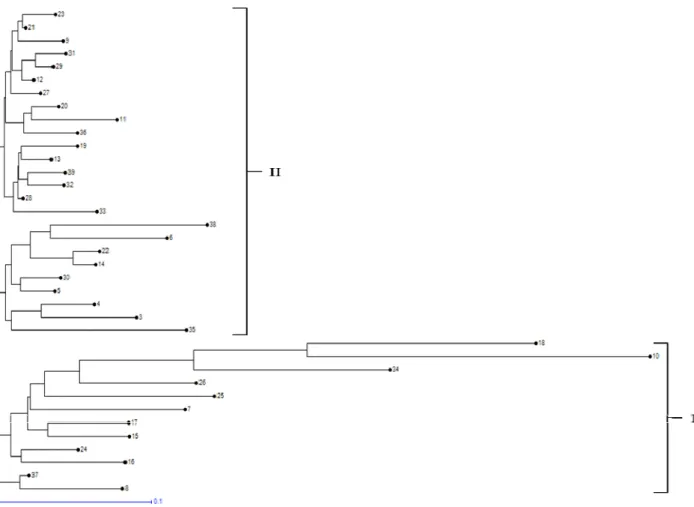
Abstract - Little millet (Panicum sumatrense) is well known for its salt and drought stress tolerance and high nutritional value, but very limited knowledge of genetic variation and genomic information is available. In this study, a total of 779 primer pairs were designed from the 22,961 EST sequences of switchgrass (Pancium virgatum), of which 48 EST-SSR markers were developed based on the trials of transferability of these primers in little millet. The EST-SSR amplicons showed reproducible single band polymorphism and produced a total of 160 alleles with an average of 3.3 alleles per locus in 37 accessions of little millet. The average values of expected and observed heterozygosities were 0.266 and 0.123, respectively. The polymorphic information content (PIC) values were observed in range of 0.026 to 0.549 with an average of 0.240. The genetic relatedness among the little millet accessions was evaluated by neighbor-joining dendrogram, which grouped all accessions into two distinct groups. The validation thus demonstrated the utility of the switchgrass EST-SSR markers in assessing genomic relationships in little millet. The findings from this study could be useful for designing strategies for the identification of diverse germplasm for conservation and future molecular breeding programs for little millet.
Key words - EST-SSRs, Genetic diversity, Little millet
*Corresponding author. E-mail : [email protected] Tel. +82-63-238-4900
ⓒ 2017 by The Plant Resources Society of Korea
Original Research Article
fingerprinting and conservation strategies due to their high variability, abundance, multiallelic nature, reproducibility, polymorphism, transferability as well as their codominant inheritance, chromosome-specific location and wide genomic distribution (Jia et al., 2009; Gupta et al., 2012; Im et al., 2014). Recently, the expressed sequence tags (ESTs)-SSRs were suggested more efficient than genomic SSR markers, because the EST-SSRs are physically associated to coding regions and can enhance the evaluation of plant populations by enabling the variation assay in expressed genes with known function (Nicot et al., 2004; Seo et al., 2013). Therefore, identification of EST-SSRs is important to study different species of the same genus. Furthermore, the transferability of EST-SSRs between species may support the idea of exploring genes with similar function and contribute to comparative genomics and diversity analysis.
The genomic information and molecular marker related studies in little millet are very limited; however, little millet belongs to the same genus as that of switchgrass (Panicum virgatum) that has well defined molecular information (Wang et al., 2011; Casler, 2012). It is now possible to easily obtain thousands of switchgrass ESTs that could be the main source of identification for in silico EST-SSRs.
The objective of this study was, to develop highly poly- morphic EST-SSR markers based on cross-species transferability of derived SSRs from switchgrass EST databases and characterize newly developed EST-SSRs to better understand the genetic diversity of collected germplasm of little millet.
Materials and Methods
Plant material and DNA extraction
Thirty seven accessions of little millet, obtained from ICRISAT, India were used in this study (Table 1). All the
accessions were maintained at the National Agrobiodiversity Center (NAS, RDA, Republic of Korea). The seeds were germinated and grown in the greenhouse. The leaves were harvested at two-leaf stage after 15 days of planting and genomic DNA was extracted according to Qiagen DNeasy Plant Mini kit protocol (QIAGEN, Germany). The concent- rations of DNA were estimated using NanoDrop ND-1000 (NanoDrop Technologies Inc., USA) and final adjustment was made at 100 ng/µL. DNA samples were stored at a temperature of -20℃ for further use.
Database mining for EST-SSRs and primer design Publicly available database of the National Center for Biotechnology Information (NCBI) was used to deduce the sequences of switchgrass as on March 17, 2016. A total of 22,961 EST sequences were retrieved from NCBI to search simple sequence repeats. Those ESTs were assembled into unigenes using SeqMan DNA Star lasergene version 7.1 (DNASTAR Inc, Madison, WI) and the parameters for clustering were set at a minimum of 98% identity in 30-bp overlap. The unigenes were used for identification of the microsatellite primer pairs via simple sequence repeat identification tool (SSRIT) (http://www.gramene.org/gramene/
searches/ssrtool) and SSR locator V.1 software (da Maia et al., 2008). The criteria for selection of markers were repeat units of di-, tri-, tetra-, penta-, and higher nucleotides and expected product sizes in the range of 100 to 400 bp.
PCR amplifications
EST-SSRs were amplified in a 20 ㎕ total volume containing 50 ng of genomic DNA, 2 ㎕ of each EST-SSR primer (10 pmol), 4 ㎕ of 5x Green GoTaq reaction Buffer (Promega Co, USA), 1 U of Taq DNA polymerase (Promega Co., USA), 1.6 ㎕ of dNTP (2.5 mM), and 11 ㎕ nuclease-
Table 1. List of little millet accessions used in this study
Origin country Accession Number
India IT153625 IT261890 IT261894 IT261898 IT261902 IT261906 IT261910 IT284250 IT284254
IT153626 IT261891 IT261895 IT261899 IT261903 IT261907 IT261911 IT284251 IT284255
IT153627 IT261892 IT261896 IT261900 IT261904 IT261908 IT261912 IT284252 IT297286
IT153628 IT261893 IT261897 IT261901 IT261905 IT261909 IT261913 IT284253 IT297288
IT153629
free water. DNA amplifications were performed in PTC-100 thermal controller (MJ Research Watertown, MA, USA). The PCR profile was: initial denaturation of 3 min at 94 ℃, followed by 35 cycles of 45s at 50-55℃ and 45s at 72℃, and a final extension of 10 min at 72℃. All the amplifications were separated by capillary electrophoresis using Fragment Analyzer
TM12-capillary Automated CE System using DNF- 900 double stranded DNA Reagent Kit (Advanced analytical Technologies, USA).
Data Analysis
Blastn was used for the annotation of EST-SSRs with default parameters at NCBI database. Analysis for different parameters of variability such as number of alleles (N
A), expected heterozygosity (H
E), observed heterozygosity (H
o), and polymorphism information content (PIC) was performed by employing PowerMarker V3.25 (Liu and Muse, 2005).
The neighbor joining method was used to construct a dendrogram with the help of DARwin 6.0. (Perrier and Jacquemoud-Collet, 2006). A Principal Coordinate Analysis (PCoA) was used to investigate the genetic relationships between garlic in each country based on EST-SSR data (Peakall and Smouse, 2006).
Results
Frequency distribution of EST-SSR markers
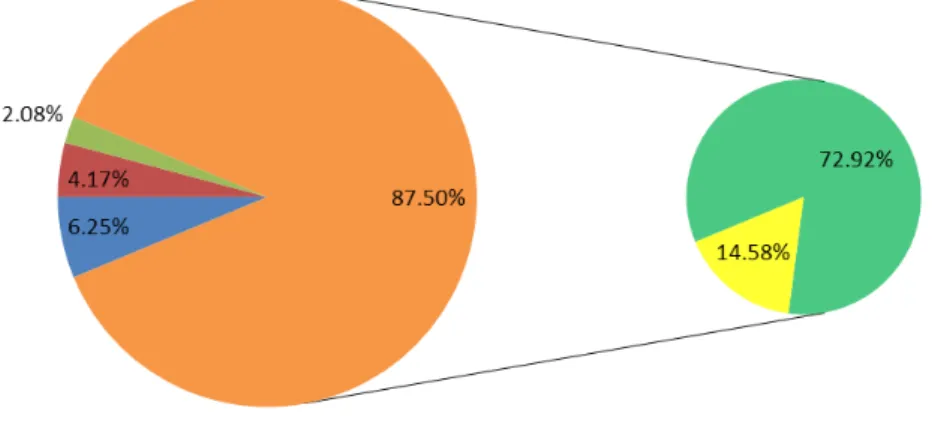
A total of 22, 961 non-redundant ESTs of switchgrass were used to find the EST-SSR domain. The mining of SSRs from the pool of EST sequences demonstrated the presence of 779 microsatellite repeats with a minimum SSR length set to 20 bp and an amplicon length ranging from 100 to 280 nucleotides. Thus 3.39% ESTs contained at least one SSR. A variation of repeat motifs in terms of di-, tri-, tetra-, penta- or higher nucleotides (hexa- and above) was observed among those 779 EST-SSRs. The vast majority of EST-SSRs were di-nucleotide repeats 289 (37%). The second most dominant type of EST-SSRs was tri-nucleotides 242 (31%), which are comparatively more enriched in protein coding regions, followed by penta- and tetra-nucleotides with frequencies of 60 (8%) and 40 (5%), respectively. The remaining proportion of 19% was covered by hexa- and higher nucleotides (Fig. 1).
Genetic diversity analysis of EST-SSR markers
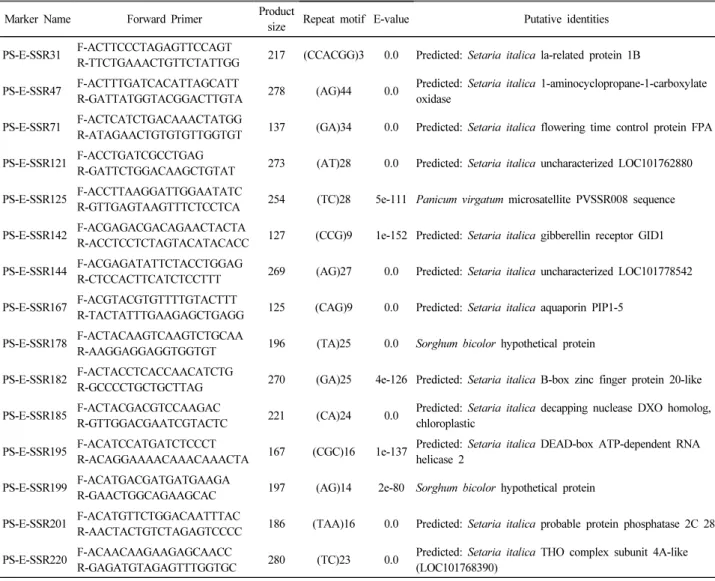
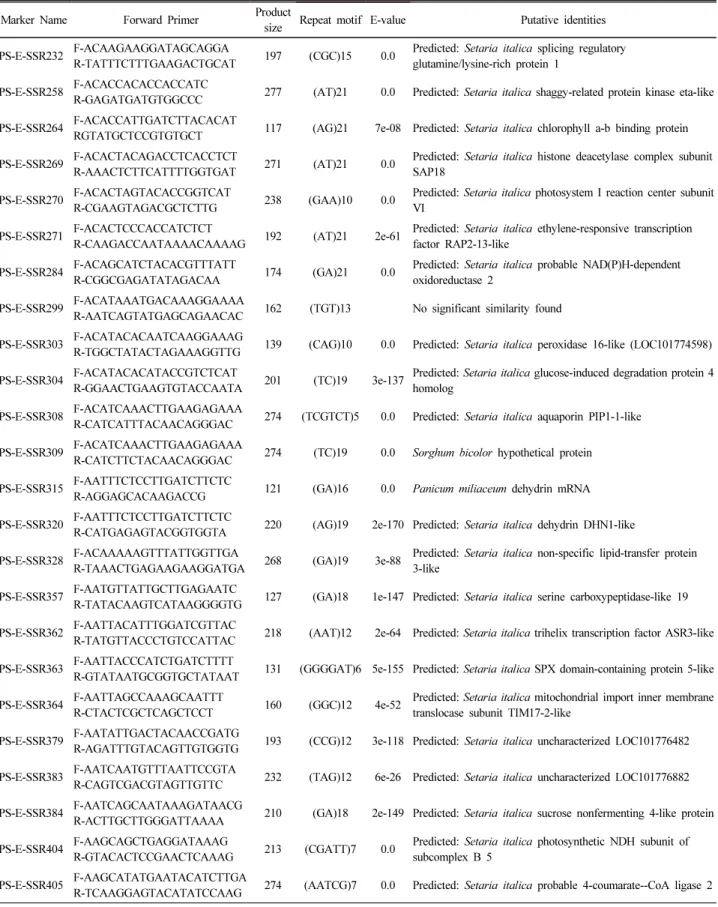
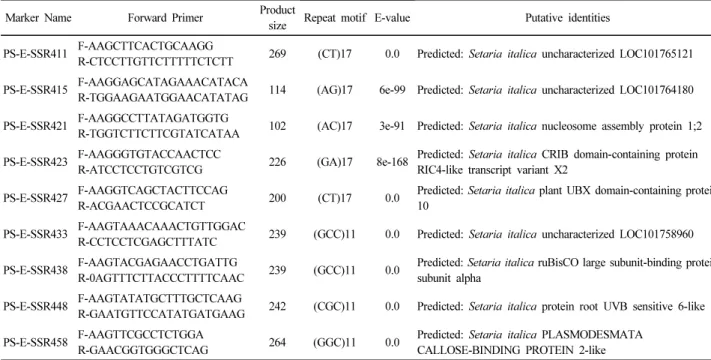
Forty eight (6.2%) of 779 EST-SSRs were shown highly polymorphic among 37 accessions of little millet, for instance, Fig. 2 shows the amplification of PS-E-SSR299. The primer sequence information, product sizes, and repeat motifs for the 48 EST-SSR markers developed in this study have been mentioned in Table 2, while the summary of genetic diversity analysis of 48 EST-SSR markers by PowerMarker has been shown in Table 3. A total of 160 alleles were identified and the number of alleles per locus ranged from 2 to 7 for polymorphic markers. A mean of 3.3 alleles per marker was observed across the 48 EST-SSR markers. Generally, higher genetic variability is uncovered by higher values of H
Eand H
o. As listed in Table 3, the average value for the H
Ewas 0.266 ranging from 0.027 (PS-E-SSR121) to 0.615 (PS-E- SSR362). However, the value for H
oranged from 0.000 to 1.
The PIC values ranged from 0.026 to 0.549 with an average
of 0.240 across all the EST-SSRs. Out of 48 EST-SSRs,
60.4% markers (PS-E-SSR47, PS-E-SSR71, PS-E-SSR167,
PS-E-SSR178, PS-E-SSR182, PS-E-SSR185, PS-E-SSR195,
PS-E-SSR201, PS-E-SSR220, PS-E-SSR258, PS-E-SSR264,
PS-E-SSR271, PS-E-SSR284, PS-E-SSR303, PS-E-SSR304,
PS-E-SSR308, PS-E-SSR320, PS-E-SSR328, PS-E-SSR357,
PS-E-SSR362, PS-E-SSR363, PS-E-SSR379, PS-E-SSR383,
PS-E-SSR384, PS-E-SSR404, PS-E-SSR411, PS-E-SSR415,
PS-E-SSR433, PS-E-SSR448) were highly polymorphic with
PIC values in a range of 0.174 to 0.549, whereas 39.6% of the
markers (PS-E-SSR31, PS-E-SSR121, PS-E-SSR125, PS-E-
Fig. 1. Frequency distribution of EST-derived SSR markers.
M M
Fig. 2. Amplicons of 37 little millet accessions using PS-E-SSR299 primer. M: size markers of 500bp and 35bp, Lanes 1-37: The name of accessions as listed in Table 1.
Table 2. Description of EST-SSR markers developed in this study
Marker Name Forward Primer Product
size Repeat motif E-value Putative identities PS-E-SSR31 F-ACTTCCCTAGAGTTCCAGT
R-TTCTGAAACTGTTCTATTGG 217 (CCACGG)3 0.0 Predicted: Setaria italica la-related protein 1B PS-E-SSR47 F-ACTTTGATCACATTAGCATT
R-GATTATGGTACGGACTTGTA 278 (AG)44 0.0 Predicted: Setaria italica 1-aminocyclopropane-1-carboxylate oxidase
PS-E-SSR71 F-ACTCATCTGACAAACTATGG
R-ATAGAACTGTGTGTTGGTGT 137 (GA)34 0.0 Predicted: Setaria italica flowering time control protein FPA PS-E-SSR121 F-ACCTGATCGCCTGAG
R-GATTCTGGACAAGCTGTAT 273 (AT)28 0.0 Predicted: Setaria italica uncharacterized LOC101762880 PS-E-SSR125 F-ACCTTAAGGATTGGAATATC
R-GTTGAGTAAGTTTCTCCTCA 254 (TC)28 5e-111 Panicum virgatum microsatellite PVSSR008 sequence PS-E-SSR142 F-ACGAGACGACAGAACTACTA
R-ACCTCCTCTAGTACATACACC 127 (CCG)9 1e-152 Predicted: Setaria italica gibberellin receptor GID1 PS-E-SSR144 F-ACGAGATATTCTACCTGGAG
R-CTCCACTTCATCTCCTTT 269 (AG)27 0.0 Predicted: Setaria italica uncharacterized LOC101778542 PS-E-SSR167 F-ACGTACGTGTTTTGTACTTT
R-TACTATTTGAAGAGCTGAGG 125 (CAG)9 0.0 Predicted: Setaria italica aquaporin PIP1-5 PS-E-SSR178 F-ACTACAAGTCAAGTCTGCAA
R-AAGGAGGAGGTGGTGT 196 (TA)25 0.0 Sorghum bicolor hypothetical protein PS-E-SSR182 F-ACTACCTCACCAACATCTG
R-GCCCCTGCTGCTTAG 270 (GA)25 4e-126 Predicted: Setaria italica B-box zinc finger protein 20-like PS-E-SSR185 F-ACTACGACGTCCAAGAC
R-GTTGGACGAATCGTACTC 221 (CA)24 0.0 Predicted: Setaria italica decapping nuclease DXO homolog, chloroplastic
PS-E-SSR195 F-ACATCCATGATCTCCCT
R-ACAGGAAAACAAACAAACTA 167 (CGC)16 1e-137 Predicted: Setaria italica DEAD-box ATP-dependent RNA helicase 2
PS-E-SSR199 F-ACATGACGATGATGAAGA
R-GAACTGGCAGAAGCAC 197 (AG)14 2e-80 Sorghum bicolor hypothetical protein PS-E-SSR201 F-ACATGTTCTGGACAATTTAC
R-AACTACTGTCTAGAGTCCCC 186 (TAA)16 0.0 Predicted: Setaria italica probable protein phosphatase 2C 28 PS-E-SSR220 F-ACAACAAGAAGAGCAACC
R-GAGATGTAGAGTTTGGTGC 280 (TC)23 0.0 Predicted: Setaria italica THO complex subunit 4A-like
(LOC101768390)
Table 2. Description of EST-SSR markers developed in this study (Continued)
Marker Name Forward Primer Product
size Repeat motif E-value Putative identities PS-E-SSR232 F-ACAAGAAGGATAGCAGGA
R-TATTTCTTTGAAGACTGCAT 197 (CGC)15 0.0 Predicted: Setaria italica splicing regulatory glutamine/lysine-rich protein 1
PS-E-SSR258 F-ACACCACACCACCATC
R-GAGATGATGTGGCCC 277 (AT)21 0.0 Predicted: Setaria italica shaggy-related protein kinase eta-like PS-E-SSR264 F-ACACCATTGATCTTACACAT
RGTATGCTCCGTGTGCT 117 (AG)21 7e-08 Predicted: Setaria italica chlorophyll a-b binding protein PS-E-SSR269 F-ACACTACAGACCTCACCTCT
R-AAACTCTTCATTTTGGTGAT 271 (AT)21 0.0 Predicted: Setaria italica histone deacetylase complex subunit SAP18
PS-E-SSR270 F-ACACTAGTACACCGGTCAT
R-CGAAGTAGACGCTCTTG 238 (GAA)10 0.0 Predicted: Setaria italica photosystem I reaction center subunit VI
PS-E-SSR271 F-ACACTCCCACCATCTCT
R-CAAGACCAATAAAACAAAAG 192 (AT)21 2e-61 Predicted: Setaria italica ethylene-responsive transcription factor RAP2-13-like
PS-E-SSR284 F-ACAGCATCTACACGTTTATT
R-CGGCGAGATATAGACAA 174 (GA)21 0.0 Predicted: Setaria italica probable NAD(P)H-dependent oxidoreductase 2
PS-E-SSR299 F-ACATAAATGACAAAGGAAAA
R-AATCAGTATGAGCAGAACAC 162 (TGT)13 No significant similarity found PS-E-SSR303 F-ACATACACAATCAAGGAAAG
R-TGGCTATACTAGAAAGGTTG 139 (CAG)10 0.0 Predicted: Setaria italica peroxidase 16-like (LOC101774598) PS-E-SSR304 F-ACATACACATACCGTCTCAT
R-GGAACTGAAGTGTACCAATA 201 (TC)19 3e-137 Predicted: Setaria italica glucose-induced degradation protein 4 homolog
PS-E-SSR308 F-ACATCAAACTTGAAGAGAAA
R-CATCATTTACAACAGGGAC 274 (TCGTCT)5 0.0 Predicted: Setaria italica aquaporin PIP1-1-like PS-E-SSR309 F-ACATCAAACTTGAAGAGAAA
R-CATCTTCTACAACAGGGAC 274 (TC)19 0.0 Sorghum bicolor hypothetical protein PS-E-SSR315 F-AATTTCTCCTTGATCTTCTC
R-AGGAGCACAAGACCG 121 (GA)16 0.0 Panicum miliaceum dehydrin mRNA PS-E-SSR320 F-AATTTCTCCTTGATCTTCTC
R-CATGAGAGTACGGTGGTA 220 (AG)19 2e-170 Predicted: Setaria italica dehydrin DHN1-like PS-E-SSR328 F-ACAAAAAGTTTATTGGTTGA
R-TAAACTGAGAAGAAGGATGA 268 (GA)19 3e-88 Predicted: Setaria italica non-specific lipid-transfer protein 3-like
PS-E-SSR357 F-AATGTTATTGCTTGAGAATC
R-TATACAAGTCATAAGGGGTG 127 (GA)18 1e-147 Predicted: Setaria italica serine carboxypeptidase-like 19 PS-E-SSR362 F-AATTACATTTGGATCGTTAC
R-TATGTTACCCTGTCCATTAC 218 (AAT)12 2e-64 Predicted: Setaria italica trihelix transcription factor ASR3-like PS-E-SSR363 F-AATTACCCATCTGATCTTTT
R-GTATAATGCGGTGCTATAAT 131 (GGGGAT)6 5e-155 Predicted: Setaria italica SPX domain-containing protein 5-like PS-E-SSR364 F-AATTAGCCAAAGCAATTT
R-CTACTCGCTCAGCTCCT 160 (GGC)12 4e-52 Predicted: Setaria italica mitochondrial import inner membrane translocase subunit TIM17-2-like
PS-E-SSR379 F-AATATTGACTACAACCGATG
R-AGATTTGTACAGTTGTGGTG 193 (CCG)12 3e-118 Predicted: Setaria italica uncharacterized LOC101776482 PS-E-SSR383 F-AATCAATGTTTAATTCCGTA
R-CAGTCGACGTAGTTGTTC 232 (TAG)12 6e-26 Predicted: Setaria italica uncharacterized LOC101776882 PS-E-SSR384 F-AATCAGCAATAAAGATAACG
R-ACTTGCTTGGGATTAAAA 210 (GA)18 2e-149 Predicted: Setaria italica sucrose nonfermenting 4-like protein PS-E-SSR404 F-AAGCAGCTGAGGATAAAG
R-GTACACTCCGAACTCAAAG 213 (CGATT)7 0.0 Predicted: Setaria italica photosynthetic NDH subunit of subcomplex B 5
PS-E-SSR405 F-AAGCATATGAATACATCTTGA
R-TCAAGGAGTACATATCCAAG 274 (AATCG)7 0.0 Predicted: Setaria italica probable 4-coumarate--CoA ligase 2
Table 2. Description of EST-SSR markers developed in this study (Continued)
Marker Name Forward Primer Product
size Repeat motif E-value Putative identities PS-E-SSR411 F-AAGCTTCACTGCAAGG
R-CTCCTTGTTCTTTTTCTCTT 269 (CT)17 0.0 Predicted: Setaria italica uncharacterized LOC101765121 PS-E-SSR415 F-AAGGAGCATAGAAACATACA
R-TGGAAGAATGGAACATATAG 114 (AG)17 6e-99 Predicted: Setaria italica uncharacterized LOC101764180 PS-E-SSR421 F-AAGGCCTTATAGATGGTG
R-TGGTCTTCTTCGTATCATAA 102 (AC)17 3e-91 Predicted: Setaria italica nucleosome assembly protein 1;2 PS-E-SSR423 F-AAGGGTGTACCAACTCC
R-ATCCTCCTGTCGTCG 226 (GA)17 8e-168 Predicted: Setaria italica CRIB domain-containing protein RIC4-like transcript variant X2
PS-E-SSR427 F-AAGGTCAGCTACTTCCAG
R-ACGAACTCCGCATCT 200 (CT)17 0.0 Predicted: Setaria italica plant UBX domain-containing protein 10
PS-E-SSR433 F-AAGTAAACAAACTGTTGGAC
R-CCTCCTCGAGCTTTATC 239 (GCC)11 0.0 Predicted: Setaria italica uncharacterized LOC101758960 PS-E-SSR438 F-AAGTACGAGAACCTGATTG
R-0AGTTTCTTACCCTTTTCAAC 239 (GCC)11 0.0 Predicted: Setaria italica ruBisCO large subunit-binding protein subunit alpha
PS-E-SSR448 F-AAGTATATGCTTTGCTCAAG
R-GAATGTTCCATATGATGAAG 242 (CGC)11 0.0 Predicted: Setaria italica protein root UVB sensitive 6-like PS-E-SSR458 F-AAGTTCGCCTCTGGA
R-GAACGGTGGGCTCAG 264 (GGC)11 0.0 Predicted: Setaria italica PLASMODESMATA CALLOSE-BINDING PROTEIN 2-like
Table 3. Genetic parameters of 48 EST-SSR markers among 37 accessions of little millet
Marker Name N
AzH
EyH
oxPIC
wMarker Name N
AH
EH
oPIC
PS-E-SSR31 2 0.053 0.000 0.051 PS-E-SSR304 4 0.200 0.000 0.193
PS-E-SSR47 6 0.539 0.784 0.444 PS-E-SSR308 5 0.576 0.838 0.494
PS-E-SSR71 5 0.291 0.000 0.280 PS-E-SSR309 2 0.149 0.000 0.138
PS-E-SSR121 2 0.027 0.027 0.026 PS-E-SSR315 3 0.152 0.000 0.146
PS-E-SSR125 2 0.102 0.000 0.097 PS-E-SSR320 5 0.612 0.108 0.538
PS-E-SSR142 2 0.053 0.000 0.051 PS-E-SSR328 7 0.559 0.514 0.517
PS-E-SSR144 2 0.102 0.000 0.097 PS-E-SSR357 2 0.193 0.000 0.174
PS-E-SSR167 7 0.577 0.027 0.549 PS-E-SSR362 5 0.615 1.000 0.539
PS-E-SSR178 4 0.586 1.000 0.498 PS-E-SSR363 2 0.289 0.081 0.248
PS-E-SSR182 5 0.405 0.000 0.379 PS-E-SSR364 2 0.078 0.0811 0.075
PS-E-SSR185 2 0.193 0.000 0.174 PS-E-SSR379 4 0.586 1.000 0.498
PS-E-SSR195 4 0.244 0.000 0.232 PS-E-SSR383 3 0.283 0.000 0.263
PS-E-SSR199 2 0.149 0.000 0.138 PS-E-SSR384 3 0.324 0.000 0.302
PS-E-SSR201 3 0.239 0.0541 0.221 PS-E-SSR404 3 0.197 0.000 0.186
PS-E-SSR220 2 0.234 0.000 0.206 PS-E-SSR405 3 0.103 0.027 0.100
PS-E-SSR232 2 0.149 0.000 0.138 PS-E-SSR411 5 0.551 1.000 0.450
PS-E-SSR258 3 0.279 0.000 0.252 PS-E-SSR415 4 0.329 0.000 0.310
PS-E-SSR264 6 0.291 0.027 0.281 PS-E-SSR421 3 0.104 0.000 0.101
PS-E-SSR269 2 0.102 0.000 0.097 PS-E-SSR423 2 0.102 0.000 0.097
PS-E-SSR270 2 0.102 0.000 0.097 PS-E-SSR427 3 0.128 0.027 0.122
PS-E-SSR271 4 0.439 0.108 0.409 PS-E-SSR433 3 0.197 0.000 0.186
PS-E-SSR284 4 0.244 0.000 0.232 PS-E-SSR438 2 0.149 0.000 0.138
PS-E-SSR299 2 0.053 0.000 0.051 PS-E-SSR448 5 0.574 0.946 0.483
PS-E-SSR303 3 0.199 0.000 0.189 PS-E-SSR458 2 0.053 0.000 0.051
Mean 3.3 0.266 0.123 0.240
z