The Role of Innate and Adaptive Immune Cells in the Immunopathogenesis of
Chronic Obstructive Pulmonary Disease
Fariz Nurwidya, M.D., Ph.D., Triya Damayanti, M.D., Ph.D. and Faisal Yunus, M.D., Ph.D.
Department of Respiratory Medicine, Persahabatan General Hospital, University of Indonesia Faculty of Medicine, Jakarta, Indonesia
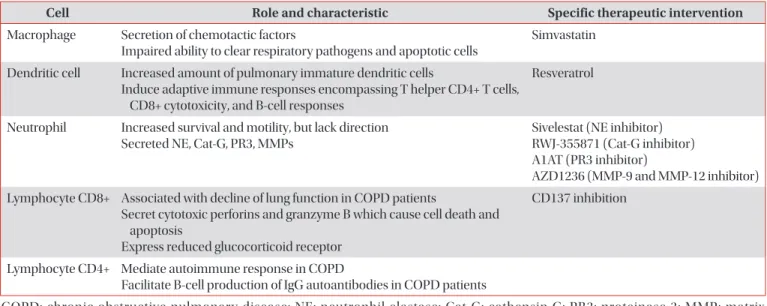
Chronic obstructive pulmonary disease (COPD) is a chronic and progressive inflammatory disease of the airways and lungs that results in limitations of continuous airflow and is caused by exposure to noxious gasses and particles. A major cause of morbidity and mortality in adults, COPD is a complex disease pathologically mediated by many inflammatory pathways. Macrophages, neutrophils, dendritic cells, and CD8+ T-lymphocytes are the key inflammatory cells involved in COPD. Recently, the non-coding small RNA, micro-RNA, have also been intensively investigated and evidence suggest that it plays a role in the pathogenesis of COPD. Here, we discuss the accumulated evidence that has since revealed the role of each inflammatory cell and their involvement in the immunopathogenesis of COPD. Mechanisms of steroid resistance in COPD will also be briefly discussed.
Keywords: Pulmonary Disease, Chronic Obstructive; Macrophages; Neutrophils; Dendritic Cells; Lymphocytes
For the population without COPD over the age of 40, the risk of developing COPD within the next 40 years was 12.7% for men and 8.3% for women
3. In patients with very severe COPD, 26% died after 1 year of follow-up, whereas 2.8% died among the non-COPD subjects
3.
COPD, a common and preventable disease, is characterized by persistent airflow limitation that is usually progressive and associated with an enhanced chronic inflammatory response in the airways and the lung to noxious particles or gasses
4. The Global Initiative for Chronic Obstructive Lung Disease (GOLD) defines airflow obstruction as spirometry where the ratio of forced expiratory volume in the first second to forced vital capacity after bronchodilation is less than 0.70
5.
Cigarette Smoke Exposure as a Model to Study COPD
Cigarette smoking (CS) is an established risk factor for COPD
6,7, and study suggests that CS exposure could have a suppressive effect on host innate immunity including structural and functional changes in the respiratory ciliary epithelium, and immune cells such as alveolar macrophages (AMs), neutrophils, and lymphocytes
8. Moreover, CS could
Introduction
In 2020, chronic obstructive pulmonary disease (COPD) will be the third leading cause of death worldwide (from sixth in 1990) and fifth leading cause of years lost through early mortality or handicap (disability-adjusted life years) from pre- viously 12th in 1990
1. However, recent studies suggest COPD is already the third most common cause of death, worldwide
2.
Address for correspondence: Fariz Nurwidya, M.D., Ph.D.
Department of Respiratory Medicine, Persahabatan General Hospital, University of Indonesia Faculty of Medicine, Jalan Persahabatan Raya No.1, Rawamangun, Jakarta 13220, Indonesia
Phone: 62-21-489-3536, Fax: 62-21-489-0744 E-mail: [email protected]
Received: Aug. 6, 2015 Revised: Sep. 1, 2015 Accepted: Oct. 12, 2015
cc It is identical to the Creative Commons Attribution Non-Commercial License (http://creativecommons.org/licenses/by-nc/4.0/).